Medusa Tattoo Meaning: Why the Monster Might Be the Mirror
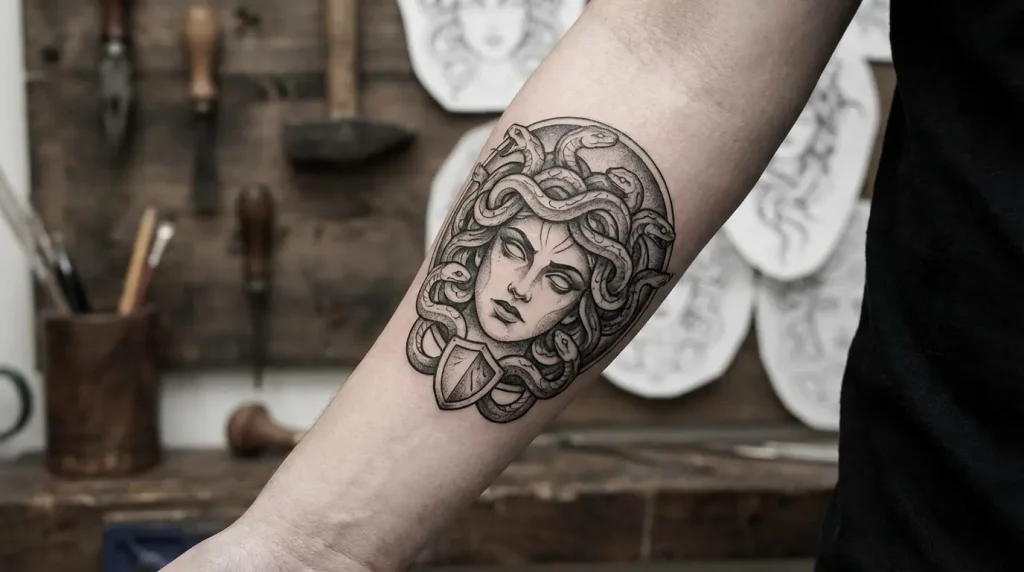
The Overlooked Truth About Medusa’s Story
I’ve probably seen two hundred Medusa tattoos in the last year alone. Instagram, obviously, but also in coffee shops, at the gym, three different ones at my cousin’s wedding. And for the longest time, I thought they were just the latest mythology trend, like when everyone was getting Icarus or whatever. Then a client sat down and started crying while explaining why she wanted the serpents positioned exactly so, and I realized I’d been seeing these tattoos completely wrong.
Medusa wasn’t born a monster. She was made into one.
Before the snakes, before the stone-turning gaze, before Perseus showed up with his shield and sword, Medusa was a priestess. Beautiful, devoted to Athena, living a life of service in the goddess’s temple.

Then Poseidon assaulted her in that sacred space.
Athena’s response wasn’t protection or justice. She transformed Medusa into a creature so terrifying that anyone who looked directly at her would turn to stone. The victim became the warning. The survivor became the monster. And for centuries, that’s where the story ended in popular culture: with a dangerous creature who needed to be slain by a hero.
Most people know Medusa as the snake-haired Gorgon who turned men to stone, but Ovid’s version reveals she was assaulted by Poseidon in Athena’s temple, and Athena’s “punishment” transformed her into the monster we recognize. This reframing is essential. We’re not looking at a villain origin story. We’re examining what happens when survival requires becoming something feared.
The TikTok hashtag #medusatattoo has accumulated nearly a billion views. That’s not random. That’s collective recognition of something that traditional mythology glossed over for thousands of years.
Medusa didn’t choose monstrosity. She was forced into it. And once you understand that, you can’t look at these tattoos the same way.
What Traditional Interpretations Get Wrong
Walk into most tattoo parlors and ask about Medusa symbolism. You’ll hear about danger, protection through fear, feminine rage, mystery. All technically accurate, but they’re reading the last chapter without acknowledging how we got there.
Traditional interpretations treat Medusa as inherently monstrous. She’s the villain in Perseus’s hero story, the obstacle to overcome, the head mounted on Athena’s shield as a trophy. Even when tattoo culture embraced her as a feminine power symbol, it often skipped over the why behind that power.
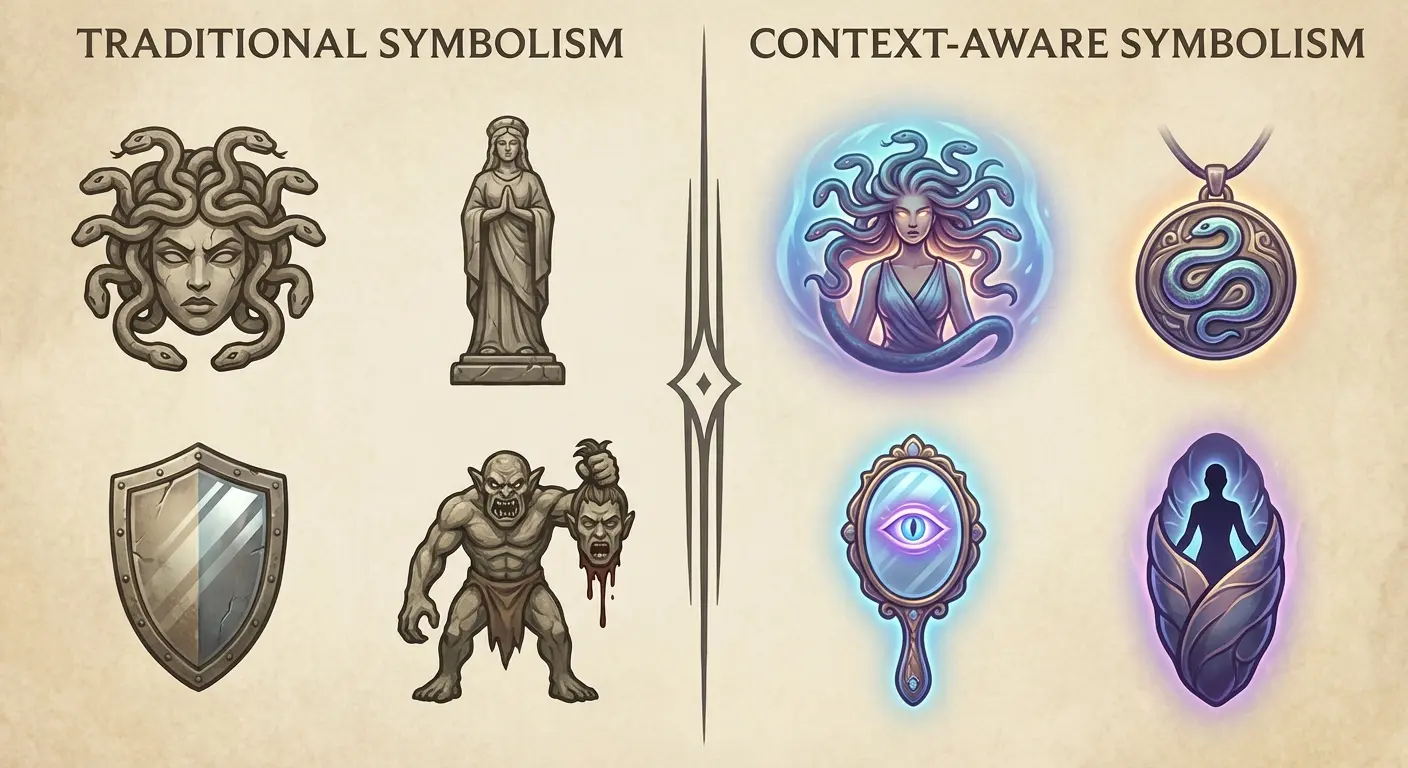
The “dangerous woman” angle sells flash sheets and gets likes on social media. It’s not wrong, exactly. But when you strip away the assault, the forced transformation, the complete loss of agency followed by the development of a defense mechanism so extreme it literally petrifies threats, you’re left with a Halloween costume version of a deeply complex figure.
Medusa didn’t choose to be dangerous. She was made dangerous because being vulnerable had already destroyed her once. That’s survival that looks like monstrosity because that’s the only form survival was allowed to take.
Traditional tattoo culture has positioned Medusa as a symbol of danger or feminine rage without context. Male-dominated tattoo history shaped these interpretations and they persist despite being fundamentally incomplete.
|
Traditional Reading |
Context-Aware Reading |
|---|---|
|
Medusa as inherent monster |
Medusa as trauma survivor |
|
Danger for danger’s sake |
Protection born from violation |
|
Feminine rage as aesthetic |
Rage as justified response to injustice |
|
Perseus as hero |
Perseus as someone who killed a victim |
|
Snakes as decoration |
Snakes as visible mark of what was done to her |
|
Stone gaze as villainy |
Stone gaze as boundary enforcement |
The meaning changes completely when you understand that her monstrosity wasn’t a choice.
Medusa as a Symbol of Transformation Through Trauma
You can’t return to the temple after what happened in the temple.
That’s the part of Medusa’s story that hits differently when you’ve lived through something that fractured your sense of self. The snakes aren’t decoration. They’re what rape looks like when it rewrites your DNA. And that gaze, the one that turns people to stone? That’s what happens when your nervous system decides that being vulnerable almost killed you once and it’s never letting that happen again.
According to statistics in the National Library of Medicine, 26 percent of girls and five percent of boys experience some form of sexual assault. The numbers are worse than most people realize. That’s not abstract. That’s your friends, your family, the person sitting next to you.
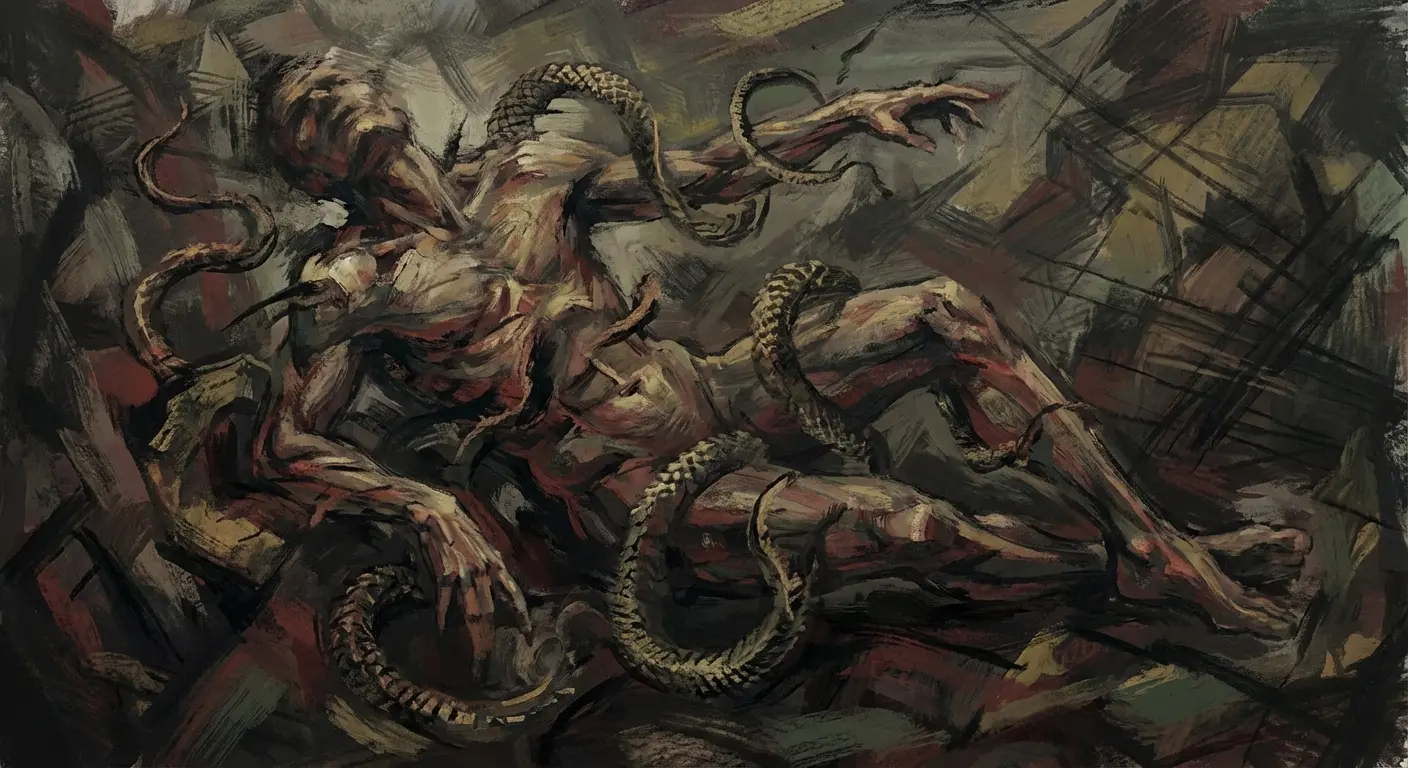
Trauma doesn’t just hurt you and then politely exit. It rewires how you move through the world. Medusa’s transformation captures that reality without the sanitized “healing journey” narrative that dominates most trauma discourse.
She didn’t heal back into her former self. She became something else entirely, something that couldn’t be hurt the same way twice.
I had a client once who came in for a Medusa piece about six months after her assault case was dismissed. She’d been this really open, warm person before, the kind who’d hug you when she met you. After, she developed what her therapist called “hypervigilance” but what she just called “walls.” The gaze that could shut down a room. The ability to freeze someone mid-sentence when they got too close, asked too much, touched without asking.
She didn’t choose these defenses consciously. Her body made the choice for her.
The Medusa tattoo she got wasn’t about the person she used to be. It was about honoring who she had to become to stay safe, and refusing to apologize for the transformation.
When considering how to visually represent transformation through trauma, exploring different traditional tattoo styles can help you find the approach that best captures the weight of Medusa’s narrative.
The Gaze That Protects: Reclaiming Power in Ink
Medusa’s power lives in her eyes, and that’s not accidental.
Eyes are how we’re seen. How we’re assessed, judged, desired, targeted. Poseidon saw her and decided her beauty gave him rights to her body. Athena saw her and decided the assault made her impure. Perseus saw her reflection and decided she was a monster worth killing for glory.
Everyone kept looking at Medusa and deciding what she meant to them.
Her transformation flipped that dynamic. Now when someone looks at her, they’re the ones who suffer consequences. The gaze that once made her vulnerable became the thing that makes her untouchable.
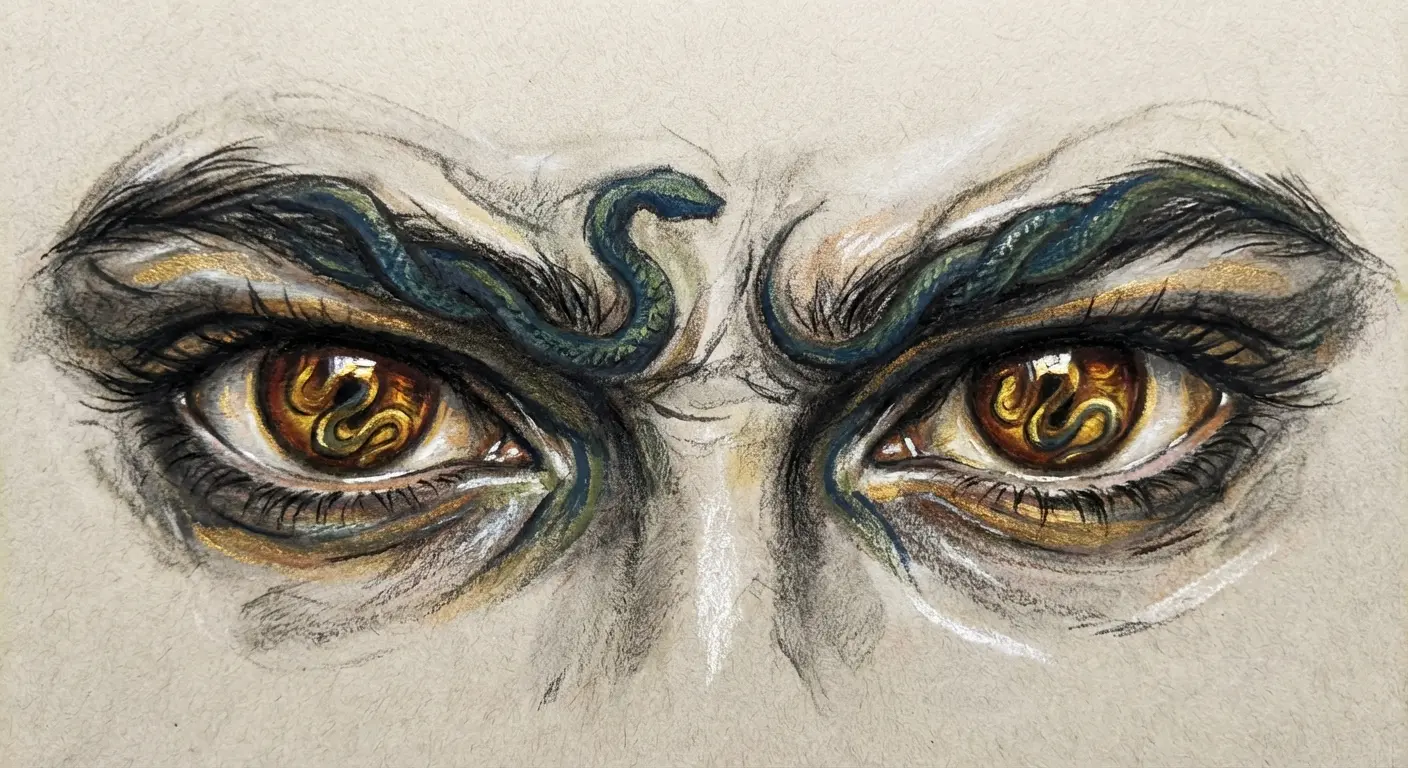
I know a woman who works in tech, one of maybe three women on a team of thirty guys. She has a Medusa forearm tattoo that she got after one too many meetings where men talked over her or dismissed her contributions. She positions her arms on the table so Medusa’s gaze is visible. She’s not saying anything explicitly threatening. But the symbolism does work that words can’t. It communicates that she sees exactly what’s happening, that she’s not someone who can be diminished without consequence.
When you put Medusa on your skin, you’re often making a statement about visibility. About who gets to see you, how they get to interpret what they see, and what happens when they cross lines you’ve drawn.
Why Survivors Choose Medusa (And What That Says About Modern Tattoo Culture)
Scroll through #medusatattoo on any platform and you’ll find thousands of captions that start the same way: “She was assaulted and blamed for it.”
That’s new. Not the tattoos themselves (Medusa has been a popular subject for decades), but the explicit connection to sexual violence and survival. People aren’t getting these tattoos and leaving the meaning ambiguous. They’re stating it directly, often in the caption, sometimes in the design itself.
Since 2022, TikTok videos referencing “meeting Medusa” have emerged as coded language for sexual violence. By 2024, the trend accelerated dramatically as survivors began showing off their Medusa tattoos publicly, creating a visible community of people reclaiming this ancient symbol.

The cultural significance of Medusa tattoos has even reached mainstream reality television, with Love Island UK contestant Toni sporting a large Medusa tattoo on her back, sparking widespread discussion among viewers about the symbolism and meaning behind the inking. Fans took to social media noting how the tattoo “is breaking my heart,” recognizing its deeper significance beyond aesthetics.
Traditional tattoo symbolism relied on established meanings passed down through generations of artists and collectors. You didn’t need to explain why you got a dagger through a rose or what your anchor meant.
Medusa is different now. She’s being actively reclaimed and redefined by the people wearing her, and they’re doing it publicly.
Survivors choose her because she doesn’t offer false comfort. There’s no “everything happens for a reason” embedded in her story. No promise that speaking your truth will bring justice. No guarantee that time heals all wounds. Just the reality that sometimes trauma transforms you into something unrecognizable, and you have to find power in that new form because the old one isn’t coming back.
That honesty resonates in ways that more sanitized symbols can’t match.
Design Elements That Shift the Narrative
Your Medusa doesn’t have to look like everyone else’s. In fact, she probably shouldn’t.
Serpent positioning alone changes everything. Are they coiled protectively around her head like a crown? That’s power claimed and worn deliberately. Are they wild and chaotic, striking outward? That’s ongoing rage, unprocessed and active. Are they settled, almost peaceful? That suggests integration, a transformation that’s been lived with long enough to become familiar.
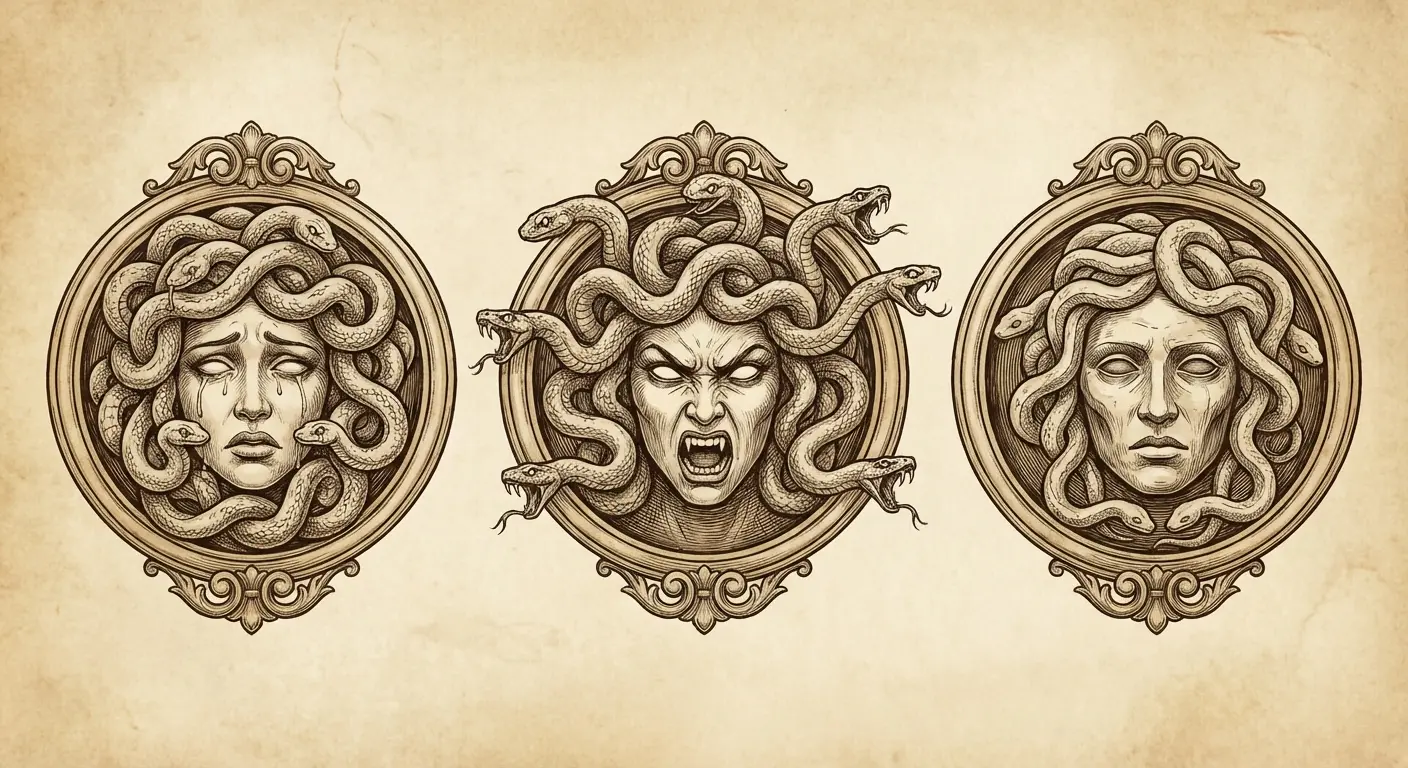
Facial expression might be the most critical choice you’ll make. A screaming Medusa tells a different story than a crying one. A serene face with that deadly gaze suggests someone who’s made peace with what they had to become. A face twisted in rage says the anger is still fresh, still fuel. A face marked by tears acknowledges the grief that comes with surviving something that required you to become unrecognizable.
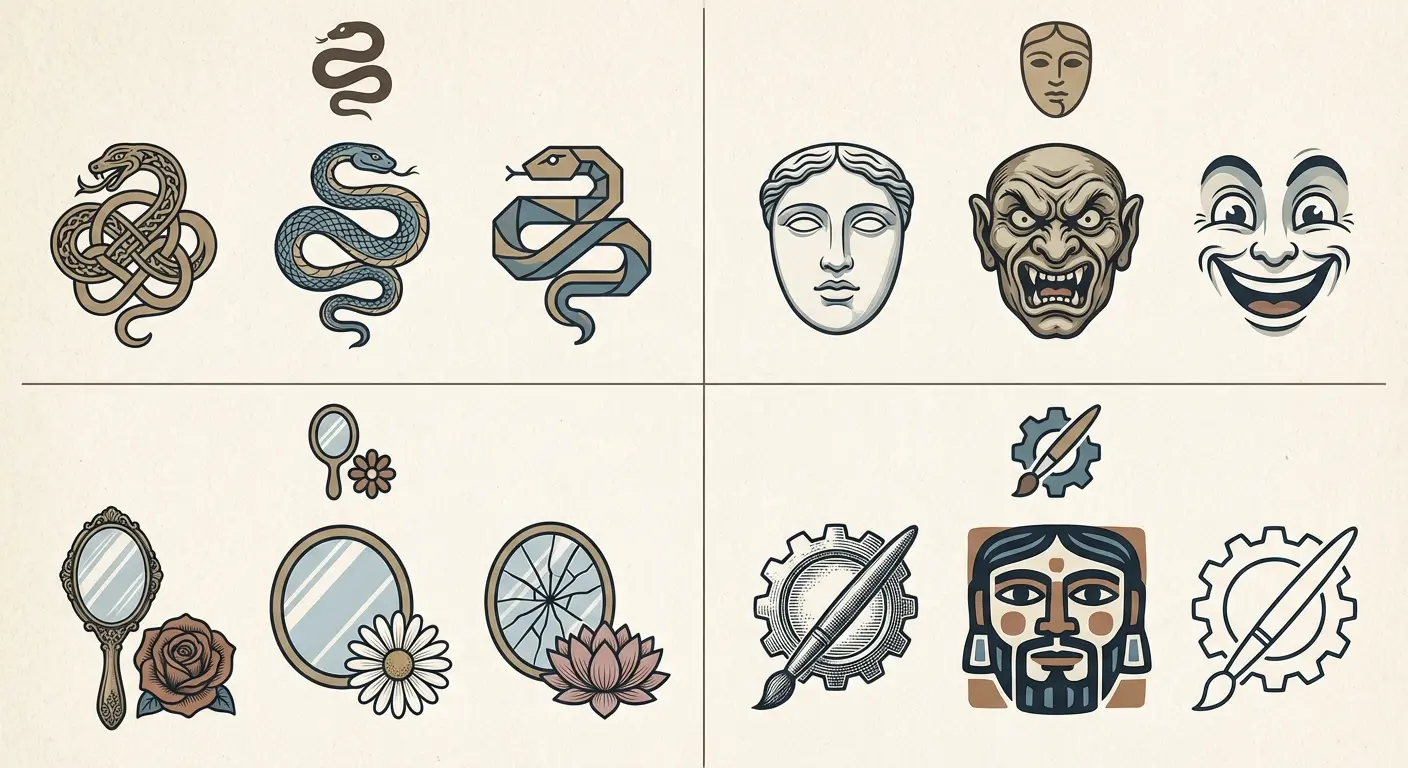
What you add to the core image matters too. Mirrors reference Perseus and the way she was killed by forcing her to see herself, which can symbolize self-awareness or the pain of recognizing what you’ve become. Flowers (especially around the serpents) can represent growth from trauma or the person she was before. Blood is direct, unflinching acknowledgment of violence.
Style choices carry weight beyond aesthetics. Hyper-realistic Medusa forces viewers to confront her as a person, not a symbol. Illustrative styles can lean into the mythological aspects while maintaining emotional resonance. Abstract or geometric approaches might emphasize the transformation itself over the figure.
You’re not just picking what looks cool. You’re deciding which part of the narrative you’re claiming.
From Victim to Victor: The Cultural Evolution of Medusa Imagery
Ancient Greek pottery showed Medusa as grotesque, barely human. Renaissance painters gave her beauty but made it dangerous, seductive, something that justified her punishment. Victorian art emphasized her as a cautionary tale about female sexuality.
Each era looked at Medusa and saw their own fears reflected back.
We’re doing the same thing now, but with a crucial difference: the people getting the tattoos are often the ones who identify with her, not the ones who fear her.
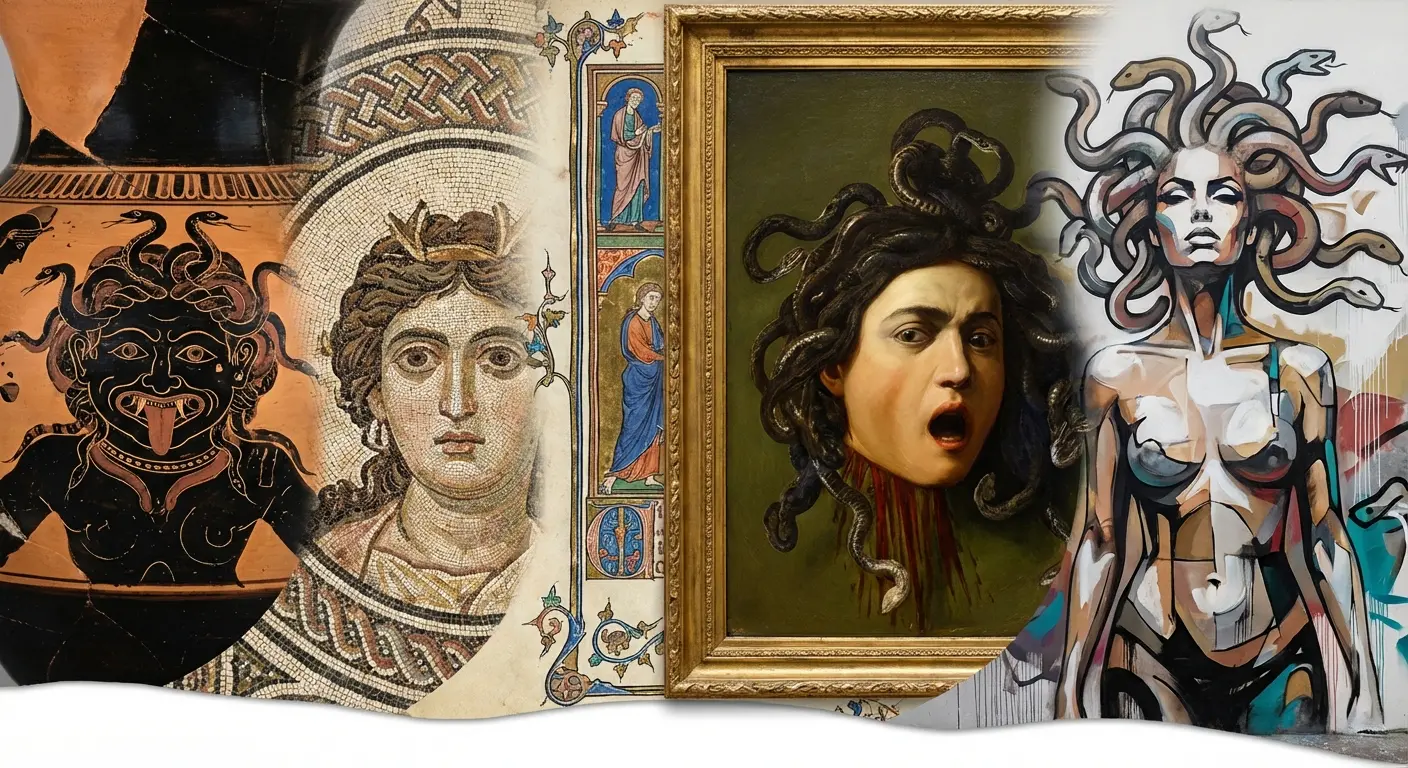
For thousands of years, Medusa’s story was told by people who saw her as the threat. Perseus was the hero. Athena was justified. Poseidon’s assault was mentioned in passing if at all.
Contemporary interpretation, especially within tattoo culture and feminist discourse, has flipped the script. Medusa isn’t the monster in someone else’s hero story. She’s the protagonist in a survival story, and Perseus is the guy who killed a traumatized woman for glory and got celebrated for it.
In 2016, Elizabeth Johnston wrote in her essay “The Original ‘Nasty Woman’” that “In Western culture, strong women have historically been imagined as threats requiring male conquest and control, and Medusa herself has long been the go-to figure for those seeking to demonize female authority.”
When someone gets a Medusa tattoo today with full awareness of this history, they’re not just wearing mythology. They’re actively rejecting centuries of narrative framing that positioned female power as something monstrous that needed to be controlled or destroyed.
How to Translate Your Personal Story Into Medusa Ink
You’re not getting a generic Medusa. You’re translating something specific about your experience into visual form, using her story as the framework.
Start by asking yourself which part of her narrative hits hardest. Is it the violation itself and the lack of justice? Is it the forced transformation? Is it the development of defenses so extreme they make intimacy impossible? Is it the eventual death at the hands of someone who saw her as nothing more than a monster to be slain?
Each of those focal points suggests different design priorities.
Therapist Anita Astley, speaking with Parade Magazine about the symbolism behind Medusa tattoos for survivors, explains: “I believe the Medusa tattoo is the perfect visual depiction of a survivor’s journey from pain to resilience, strength, empowerment and self-preservation, a protective symbol, as she has the ability to destroy those who are a threat to her being.”
You’ll need to find an artist who can handle both technical execution and emotional weight. Someone who draws beautiful snakes isn’t enough if they don’t understand why those serpents matter. Have the conversation about meaning before you talk about placement or size. Share the aspects of the story that resonate with you. See if they engage with that narrative or just nod and start sketching.

Personal elements can bridge the gap between mythology and your specific experience. Maybe there’s a flower that means something to you woven among the serpents. Maybe the background includes imagery from your own life. Maybe the expression on her face mirrors something you see in your own eyes on hard days.
The goal isn’t to make Medusa unrecognizable. It’s to make her specifically, unmistakably yours while honoring the core of why her story matters.
If you’re struggling to articulate what you want, I’ve found that tools like Tattoo Generator IQ can be helpful for exploring different visual interpretations before you commit. Sometimes you need to see several versions to know which one captures what you’re trying to say.
Final Thoughts
Medusa’s story isn’t about being a monster. It’s about what happens when survival requires becoming something feared, when protection means making yourself untouchable, when the only way forward is through a transformation you never asked for.
I don’t know if this happens to you, but when I see someone with a Medusa tattoo now, I always want to ask what their version means. Not in an invasive way. Just curious about which part of the story they’re carrying.
She doesn’t promise healing or justice. She doesn’t offer platitudes about strength or resilience. She just shows what it looks like when trauma rewrites you at a fundamental level and you have to find power in that new form because the old one isn’t available anymore.
When you choose Medusa, you’re claiming a narrative that’s been misunderstood for thousands of years. You’re saying that the serpents aren’t the problem, the assault was. That the deadly gaze isn’t cruelty, it’s a boundary enforced absolutely because softer boundaries failed. That transformation doesn’t mean you’re broken, it means you adapted to survive something that was supposed to destroy you.
Your Medusa tattoo participates in an ongoing cultural conversation about victimhood, survival, and power. It challenges the traditional hero narrative that celebrated Perseus for killing a traumatized woman. It refuses to separate her monstrosity from the violence that created it.
The serpents are a crown, not a curse. The gaze that petrifies is protection, not punishment. And the woman beneath it all never stopped being a person, even when everyone else decided she was just a monster who needed slaying.
That’s the Medusa worth wearing. That’s the story worth telling in ink.
