23 Tattoo Ideas for Men With Meaning That Actually Reflect Who You Are
Table of Contents
-
Tattoos That Honor Your Personal Philosophy
-
The Stoic Compass
-
Ouroboros and Cyclical Growth
-
Memento Mori Skull
-
Tree of Life Reimagined
-
Unalome Path
-
The Phoenix Rising
-
Icarus Falling
-
Sisyphus and the Boulder
-
-
Tattoos Rooted in Lineage and Legacy
-
Family Crest Modernized
-
Ancestral Coordinates
-
Heirloom Object Replica
-
Father’s Handwriting
-
Cultural Symbol Reclaimed
-
Birth Flower Constellation
-
Generational Trade Tools
-
Immigration Route Map
-
-
Tattoos That Mark Personal Transformation
-
Kintsugi Crack Lines
-
Before and After Imagery
-
Chrysalis to Butterfly (But Make It Masculine)
-
The Broken Chain
-
Mountain Summit You’ve Conquered
-
Addiction Recovery Date in Roman Numerals
-
Scar Cover-Up With Intentional Design
-
TL;DR
Most tattoo lists tell you what symbols mean. We’re talking about designs that document your actual life. Your specific failures, your family’s journey, the exact moment you changed. The meaning lives in the details only you know.
Why Most “Meaningful Tattoo” Lists Miss the Point
The lists are everywhere. Lion equals courage. Anchor equals stability. Compass equals direction.
Sure, fine. Also completely useless.
Because a lion doesn’t mean courage if you’ve never had to be brave. It means you liked the way it looked in the flash book. The symbol isn’t the meaning. Your story is.
In the UK, one in three young adults aged between 20 and 40 have some kind of tattoo, and that number’s climbing. Which means the bar for “meaningful” just got higher. Everyone’s got ink now. The question is whether yours actually says something.
Look, the tattoos that age well aren’t the ones that looked cool in the moment. They’re the ones that continue to reflect something true about who you are, even as you change. Generic symbolism starts to feel hollow after a few years. A tattoo tied to a specific experience or person stays relevant.
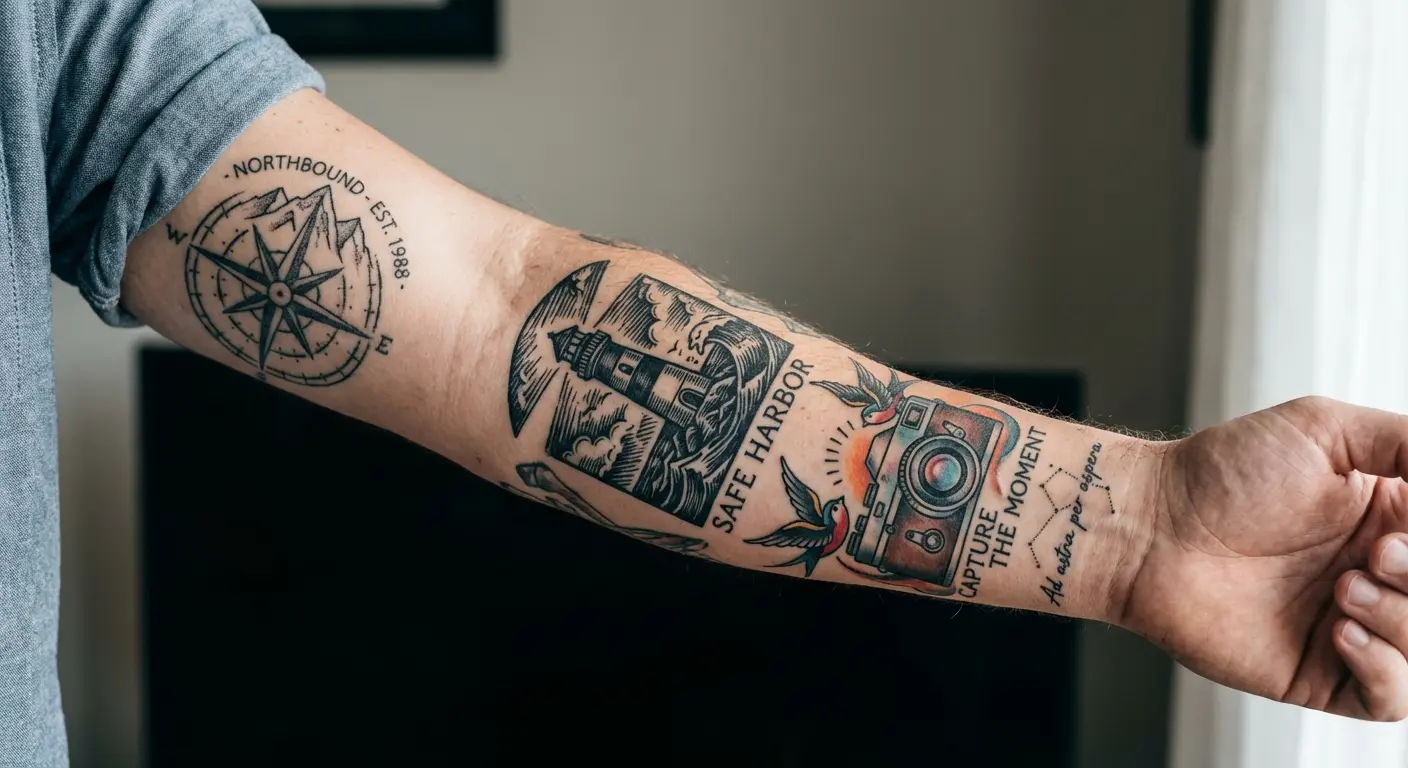
I’ve organized these 23 ideas into three categories: your philosophical evolution, your family lineage, and your personal transformations. Each one serves a different purpose in telling your story through ink. These go beyond surface aesthetics to create permanent markers of what actually matters.
Full transparency: some of you will read this and think it’s pretentious bullshit. Maybe you’re right. Maybe the drunk tattoo you got at 22 means more than any of these planned pieces ever could. But if you’re the type who needs your ink to mean something specific, who’ll regret the generic flash design, who wants to look at your arm in 20 years and remember exactly why you did it? Keep reading.
Tattoos That Honor Your Personal Philosophy
1. The Stoic Compass
Traditional compass tattoos point toward “true north.” Fine. But what if your north isn’t a direction?
Map the four Stoic virtues (wisdom, courage, justice, temperance) to the cardinal points instead. Whichever virtue anchors your decision-making points up.
From a distance, it looks like a regular compass. Up close, it’s your philosophical operating system.
Most people will never look that close, which is the point. This combines navigational imagery with philosophical principles you’ve actually used to rebuild your life after setbacks, not just concepts you find interesting. The visual simplicity works for forearm, chest, or shoulder placement. The meaning stays private unless you choose to explain it.
2. Ouroboros and Cyclical Growth
Ever notice how you keep learning the same shit at different ages?
The relationship issues you worked through at 25 weren’t identical to the ones at 35, but they rhymed. The ouroboros captures this perfectly. We’re adding specificity by varying the snake’s appearance around the circle. Thicker scales where you felt most defended. Smoother sections during periods of openness. Subtle color shifts marking major transitions.
You end up with a growth timeline that loops back on itself, just as real development does.
The circular nature makes it ideal for shoulder, upper arm, or around the wrist for smaller versions. You’re not stuck in a pattern. You’re acknowledging that growth isn’t linear, and sometimes circling back is part of moving forward.
3. Memento Mori Skull
Most memento mori tattoos are philosophical exercises. This one documents an actual moment when you confronted your mortality and changed because of it.
The skull remains central, but you’re incorporating details from your specific experience. A crack pattern that mirrors the windshield you went through. Flowers that grew at the cemetery where you buried someone too young. Medical imagery from the diagnosis that made you quit the job you hated.
You’re not trying to be morbid.
You’re marking the moment you stopped living on autopilot. The skull reminds you daily that your time is finite, but the specific details remind you exactly why that matters. Death reminder tattoos have been done to exhaustion, but this version focuses on a specific memento mori moment that changed your behavior.
4. Tree of Life Reimagined
Your belief system didn’t arrive fully formed. It grew, branched, and sometimes required pruning.
This tree maps that evolution. Roots labeled with early influences: a grandfather’s work ethic, a coach’s discipline, a book that cracked something open. The trunk represents your non-negotiables now. Branches extend toward concepts you’re currently integrating or questioning.
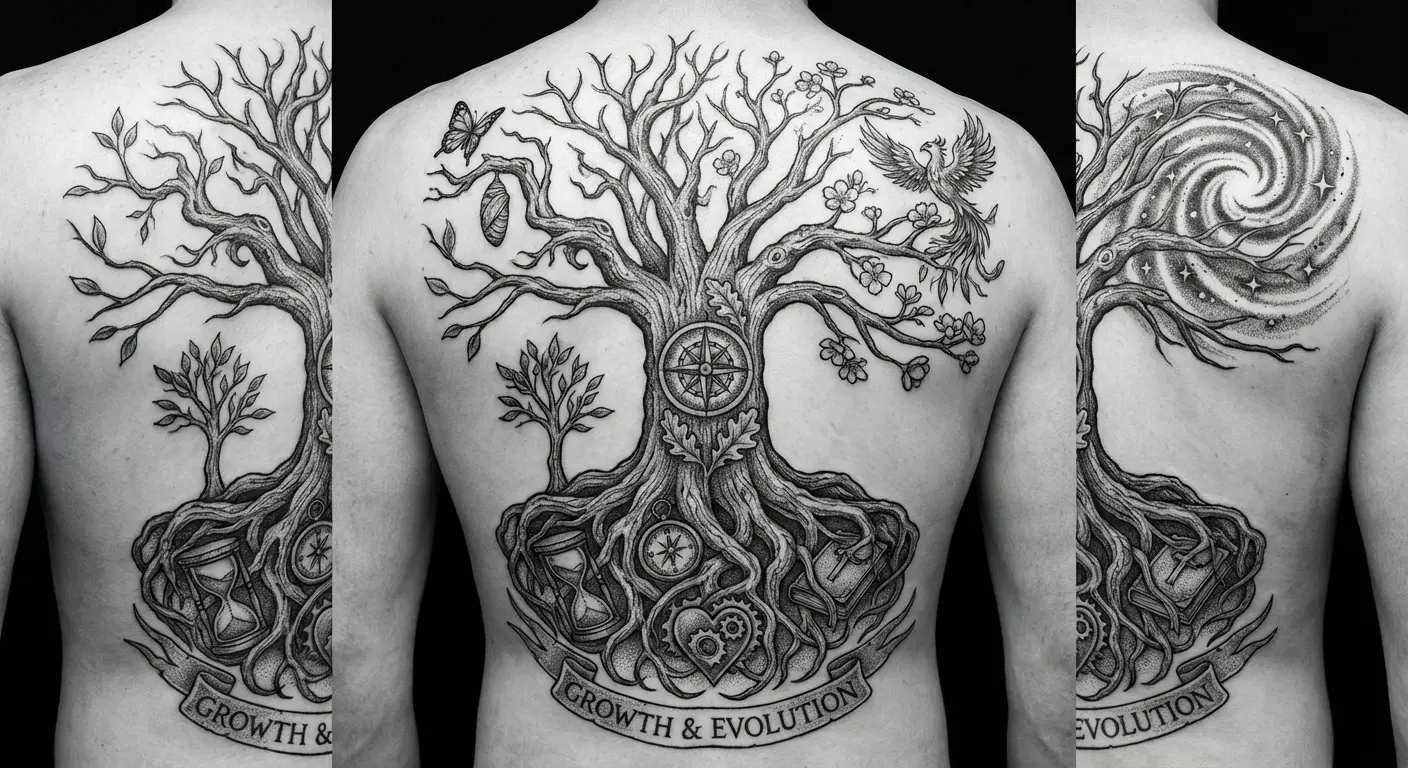
Anyone can get a tree of life. Only you can get a tree that shows exactly how your philosophy developed. Some guys add a new branch every few years when they integrate something significant. Others keep it as a snapshot of a particular period of growth.
Instead of a generic tree, this version maps your philosophical or spiritual evolution through the tree’s structure. It’s a living document of your intellectual development, which sounds pretentious until you realize you’re literally documenting how you think now versus how you thought ten years ago.
5. Unalome Path
Your path to wherever you are now wasn’t a straight line. The unalome gets that.
Customize the traditional Buddhist design by making each spiral and turn represent actual events. That loop might be the year you relapsed. This straightening section could mark when therapy finally clicked. The final dots might represent specific people who helped you get here.
What you get is a design that looks clean and spiritual to observers but functions as a detailed map of your journey for you. It’s particularly powerful for recovery stories or major life transitions where the struggle itself is part of the meaning. The design’s simplicity makes it versatile for almost any placement.
6. The Phoenix Rising
Phoenix tattoos are everywhere. This version specifies what you’re rising from by incorporating imagery from your “ashes.”
You’re not being subtle about it. If you lost everything in addiction, pill bottles in the ash. If you rebuilt after your business failed, documents or tools from that venture burning away. If you survived something that should have killed you, imagery from that specific trauma.
|
Phoenix Element |
What It Represents |
Customization Examples |
|---|---|---|
|
Flames/Fire |
The destructive phase |
Wedding rings, pill bottles, business documents, injury imagery |
|
Ashes |
What you’re leaving behind |
Currency symbols, job titles, old identity markers |
|
Rising Phoenix |
Your rebirth |
New life symbols, recovery imagery, rebuilt identity |
|
Wing Details |
Strength gained through struggle |
Scars incorporated into feathers, dates of transformation |
|
Color Palette |
Emotional tone of transformation |
Dark to light gradient, specific meaningful colors |
The phoenix itself stays traditional and recognizable. The foundation tells your specific story. You’re not celebrating rebirth in general. You’re documenting the exact thing you survived and transformed from.
7. Icarus Falling
Not every meaningful tattoo celebrates victory. Some honor the failures that made you wiser.
Your Icarus carries details from your specific crash. The melting wings might incorporate symbols of what you sacrificed or destroyed. The sun you flew toward could contain imagery of the false goal you chased. The ocean below might represent the reality you ignored.
Look, if you’ve never fucked up spectacularly, this isn’t your tattoo.
But if you’ve made a mistake that humbled you and taught you something you couldn’t have learned any other way? You’re not glorifying the failure. You’re also not pretending it didn’t fundamentally change your trajectory. Most tattoos celebrate triumph. This one honors a spectacular failure that taught you something essential.
Celebrating your failures sounds noble until you’re explaining your “failure tattoo” to someone who just met you. It’s going to feel pretentious sometimes. Get it anyway if it’s true.
8. Sisyphus and the Boulder
Some of your most meaningful work will never be finished. You’ll push the same boulder up the same hill for decades.
Your version shows what’s in the boulder. Raising good humans. Staying sober. Building something that matters. Caring for family. The work repeats daily without ever being complete, and that’s not a bug but a feature.
This makes sense when you’ve stopped waiting for the struggle to end and started finding meaning in the consistency of showing up. You’re not celebrating the boulder getting lighter or the hill getting easier. You’re honoring the decision to keep pushing anyway.
The boulder contains imagery of your repetitive struggle: raising kids, building a business, maintaining sobriety, caring for aging parents. The hill never ends. That’s the point.
Tattoos Rooted in Lineage and Legacy
9. Family Crest Modernized
Your family crest (if you have one) probably includes imagery that made sense centuries ago but feels disconnected now.
Keep elements that still resonate while updating the rest. Maybe the lion stays because courage remains a family value, but you’re replacing the crown with something that better represents how you define success now. Or you’re creating entirely new heraldry based on values you’re consciously instilling in your kids.
The result bridges past and present. You’re honoring where you came from while taking ownership of where you’re taking your family’s story.
The risk with updating family heraldry is that you’re essentially saying your values are better than your ancestors’. Maybe they are. Maybe you’re just judging them by modern standards they never had access to. I don’t know. You’ll have to sit with that tension.
This works particularly well if you’re the first generation doing something differently or if you’re consciously breaking certain family patterns while preserving others.
10. Ancestral Coordinates
Your family’s story is partially written in the places you’ve been.
The coordinates mark locations that matter: where your grandfather fled from, where your parents built their life, where you’re planting roots. You can include dates alongside coordinates or keep it purely geographical. Arrange them chronologically or by significance.
Here’s what makes this work: coordinates look clean and geometric but carry enormous personal weight. Nobody knows what they mean unless you tell them, but you’ll always know you’re carrying your family’s geographical history on your body.
I know a guy who has his grandfather’s immigration coordinates, his father’s birth city, and his daughter’s birthplace running down his ribs. From a distance it looks like random numbers. Up close it’s three generations of his family’s journey.
This design uses latitude and longitude coordinates of places that matter to your family’s history. It creates a geographical map of your lineage without requiring a literal map image.
11. Heirloom Object Replica
Some objects carry your family’s history more than others.
Render a specific heirloom in detailed, realistic ink. Not a generic pocket watch, but your grandfather’s exact one, complete with the dent he put in it and the inscription inside. Not just any wedding band, but the one your dad wore for forty years with its specific wear patterns.
The specificity matters because you’re not celebrating heirlooms in general. You’re permanently carrying this particular object that connected generations of your family.
It works whether you still have the item or whether it’s been lost. This tattoo replicates a specific object passed down through your family, rendered in detail accurate enough that you could recognize it from the design alone.
12. Father’s Handwriting
Your father’s handwriting is as unique as his fingerprint. Carrying his written words means something different than carrying a quote he might have said.
Use text from something he wrote. A birthday card. A letter. Advice scrawled on a napkin. His signature from an important document. The handwriting itself, with its specific slant and imperfections, carries his presence.
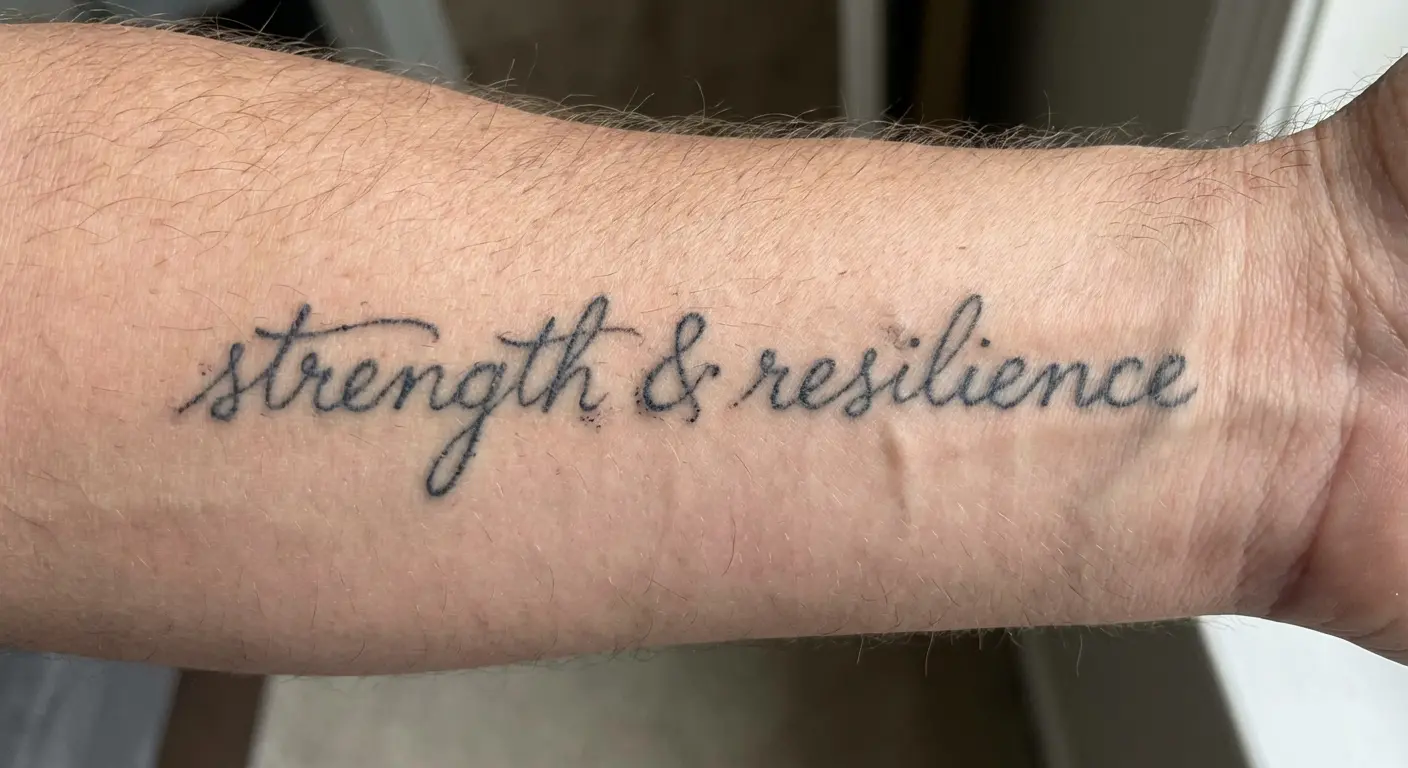
If your dad was an asshole, this tattoo gets complicated. Maybe that’s the point. Maybe carrying his words anyway is about forgiveness or acceptance or just acknowledging that he existed and shaped you, for better or worse.
You’re not making a statement about perfect fatherhood. You’re preserving something he created with his own hand, and that act of preservation means whatever you need it to mean. The imperfect, human quality of real handwriting carries more emotional weight than any font could.
13. Cultural Symbol Reclaimed
Assimilation costs families their cultural vocabulary. Sometimes reclaiming a symbol is about rebuilding what was lost.
Don’t grab generic cultural imagery. Research what your specific ancestors would have used, what it meant in their context, and how to render it respectfully. This might mean consulting with cultural advisors, studying historical records, or connecting with distant relatives who maintained traditions your immediate family lost.
The tattoo functions as reconnection. You’re not pretending you grew up immersed in these traditions if you didn’t. You’re acknowledging the break and choosing to rebuild the bridge.
The cultural reclamation piece gets complicated fast, and I’m not qualified to tell you where the line is between honoring and appropriating . That’s between you and your community. But if you’re reclaiming something that was taken from your family through forced assimilation, that’s different than borrowing aesthetics from a culture you have no connection to.
14. Birth Flower Constellation
Name tattoos feel limiting and portrait tattoos are risky. Birth flowers arranged as constellations give you another option.
Each person gets their birth month flower rendered in botanical detail. Arrange them in a pattern that reflects your family structure. Maybe your parents form a binary star system with you and your siblings orbiting. Maybe your wife and kids create a constellation you navigate by.
The arrangement matters as much as the flowers themselves. You’re not just listing family members. You’re showing how they relate to each other and to you.
Leave space to add flowers as kids are born or as the family grows. Each family member is represented by their birth month flower, arranged in a constellation pattern that maps your family structure.
15. Generational Trade Tools
Some families pass down trades, not just genetics. The tools tell that story.
Show how the tools evolved across generations while the work stayed consistent. Your great-grandfather’s hand saw, your grandfather’s electric saw, your father’s precision equipment, your modern tools. The progression shows both continuity and adaptation.
This resonates if you see yourself as continuing family work, even if you’re doing it differently. You’re not stuck in the past, but you’re also not pretending you invented this path.
The tools acknowledge everyone who worked before you while leaving room for how you’ll evolve it further. If multiple generations of your family worked the same trade or craft, this tattoo shows the evolution of tools across those generations.
16. Immigration Route Map
Your family didn’t just appear where you are now. Someone traveled, fled, or migrated to make your life possible.
The design traces that route. Use a simplified map showing the path from the old country to the new one, or a more abstract line that connects significant stops along the way. Dates mark when they left, where they paused, when they arrived.
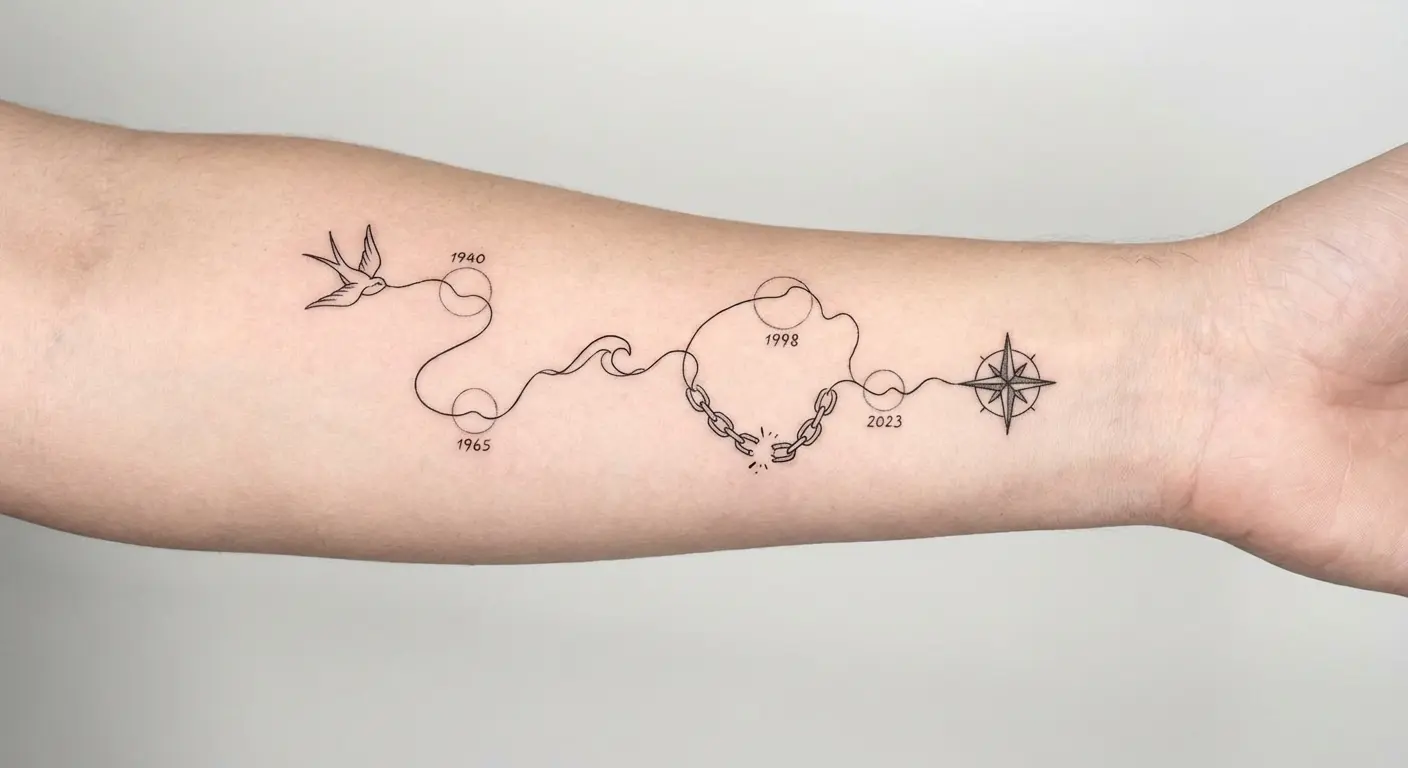
You’re documenting displacement, courage, or necessity depending on your family’s story. Some immigration was chosen. Some was forced. The tattoo acknowledges the reality of that journey and the fact that you exist because someone made it.
Don’t romanticize the difficulty. This design traces your family’s immigration or migration journey using a simplified map or route line, honoring that journey without pretending it wasn’t hard as hell.
Tattoos That Mark Personal Transformation
17. Kintsugi Crack Lines
You’ve been broken. Pretending otherwise doesn’t serve you.
Kintsugi acknowledges that the breaks happened and that repairing them made you more interesting, not less. Add gold-effect crack lines over the parts of you that shattered and healed. The placement corresponds to what broke: over your heart, across your head, along your spine.
The cracks don’t diminish you.
They prove you survived something that could have ended you and chose to rebuild. The gold suggests that the rebuilt version carries value the original didn’t have. You’re not the same person who broke, and that’s the point.
This Japanese art of repairing broken pottery with gold translates to your body by adding gold-effect crack lines over areas where you’ve been broken and rebuilt. The breaks become part of your beauty, not something to hide.
I’m not sure how kintsugi translates across different skin tones or how the gold effect holds up over time. You’d need to consult an artist who specializes in this specific technique and can show you healed examples on skin similar to yours.
18. Before and After Imagery
Transformation isn’t about erasing who you were. It’s about integrating both versions into something whole.
One side shows imagery from before: darker tones, symbols of whatever was destroying you, visual chaos. The other side shows after: clearer imagery, symbols of what you built in recovery, more intentional composition. The line between them marks when the shift happened.
Don’t hide the before or pretend it didn’t happen. Show that you lived through it and became someone different on the other side. Both halves matter because the transformation only makes sense with both parts visible.
This design shows a clear split between who you were before a transformation and who you became after. It acknowledges that both sides are part of your complete story, even if one side is uglier than the other.
19. Chrysalis to Butterfly (But Make It Masculine)
Metamorphosis works as a transformation metaphor, but you don’t have to use delicate butterflies to express it.
Use a moth emerging from its cocoon, rendered in black and gray with aggressive shading. Or focus on the chrysalis stage itself, showing the in-between state where you were neither what you were nor what you’d become. Darker color palettes and bolder lines make the concept feel less decorative.
The chrysalis-to-butterfly thing sounds corny as hell until you’ve actually metamorphosed into someone unrecognizable. Then it makes perfect sense.
This fits if you’ve experienced identity-level change. You’re not the person you were five years ago in any meaningful sense. The metamorphosis imagery captures that you didn’t just improve or grow. You became something categorically different.
20. The Broken Chain
Some family inheritances need to end with you.
The chain shows continuity until it reaches the broken link, which represents your conscious decision to stop passing something down. Include dates on the intact links showing how many generations it continued, with your date on the break point.
The broken link can be rendered violently (shattered, exploded) or cleanly, deliberately opened, depending on how the break felt. Either way, you’re marking that you did the work to ensure your kids don’t inherit what you did.
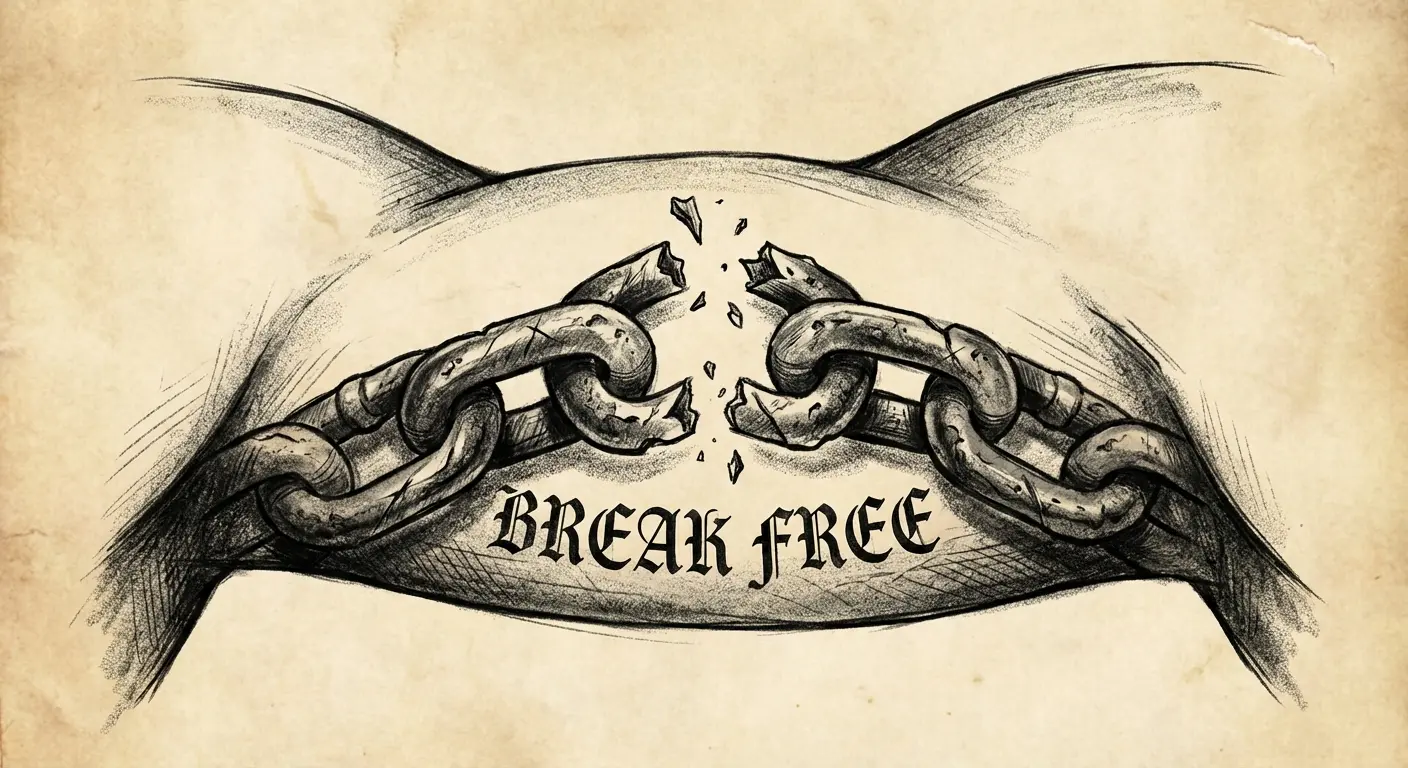
That choice cost you something, and the tattoo honors that cost. Skip this one unless you’ve actually done the work to break a generational pattern of abuse, addiction, poverty, or toxic masculinity that ran through your family for generations. This isn’t aspirational. It’s documentation.
21. Mountain Summit You’ve Conquered
Generic mountain tattoos are everywhere. This one shows the specific summit you stood on.
Athletes and adventurers have long used tattoos to commemorate physical achievements. According to running tattoo trends documented by runners, marking specific distances, race dates, and GPS coordinates of meaningful locations has become increasingly popular as a way to honor accomplishments that required genuine dedication and sacrifice.
Render the actual peak you climbed with enough accuracy that you’d recognize the ridgeline and features. Include the date you summited, elevation, or coordinates. The tattoo documents a specific achievement, not a general concept.
The mountain might be literal or metaphorical. Either you physically climbed it, or it represents a goal that felt equally impossible: finishing your degree, building your business, completing treatment. What matters is that you did it, and the tattoo proves to you that you’re capable of doing hard things when you commit.
22. Addiction Recovery Date in Roman Numerals
Your recovery date or sobriety start date matters more than most dates in your life. Making it permanent increases its weight.
Roman numerals give the date formality and make it slightly less obvious to casual observers. You know exactly what it means, but you don’t have to explain it unless you choose to. Placement matters based on whether you want it as a public accountability tool or a private reminder.
The tattoo serves dual purposes. It celebrates every day you add to your count, and it reminds you what you’re protecting when you’re tempted to throw it away.
Some guys in recovery say the tattoo creates pressure, like they’re advertising their sobriety to everyone who sees it. Others say that pressure keeps them honest. You’ll know which type you are.
Add tally marks or additional elements to mark major milestones: one year, five years, ten years. Your sobriety date rendered in Roman numerals creates a permanent accountability marker that functions as both celebration and commitment.
23. Scar Cover-Up With Intentional Design
Scars tell stories you didn’t choose. Cover-up tattoos add your own narrative.
Don’t completely hide the scar. Incorporate it into a design that acknowledges what it represents while adding meaning you control. The scar’s shape might become part of the imagery, or the texture might show through in ways that add depth to the design.
Scar cover-ups work differently depending on what you’re covering:
Surgical scars: Clean lines that you can incorporate into geometric patterns or natural imagery. The scar becomes part of the design structure.
Self-harm scars: Kintsugi approach works here. Gold lines that acknowledge the scars happened while adding beauty to them. Or growth imagery like vines that cover without hiding.
Injury scars: Battle imagery if that’s how it felt, or phoenix rising if you rebuilt yourself after.
Burn scars: These are harder. You need an artist who’s worked with textured skin before. Most haven’t.*
*Seriously, ask to see their portfolio of scar work, not just their regular tattoos. Burn scars and keloid scars require specialized experience.
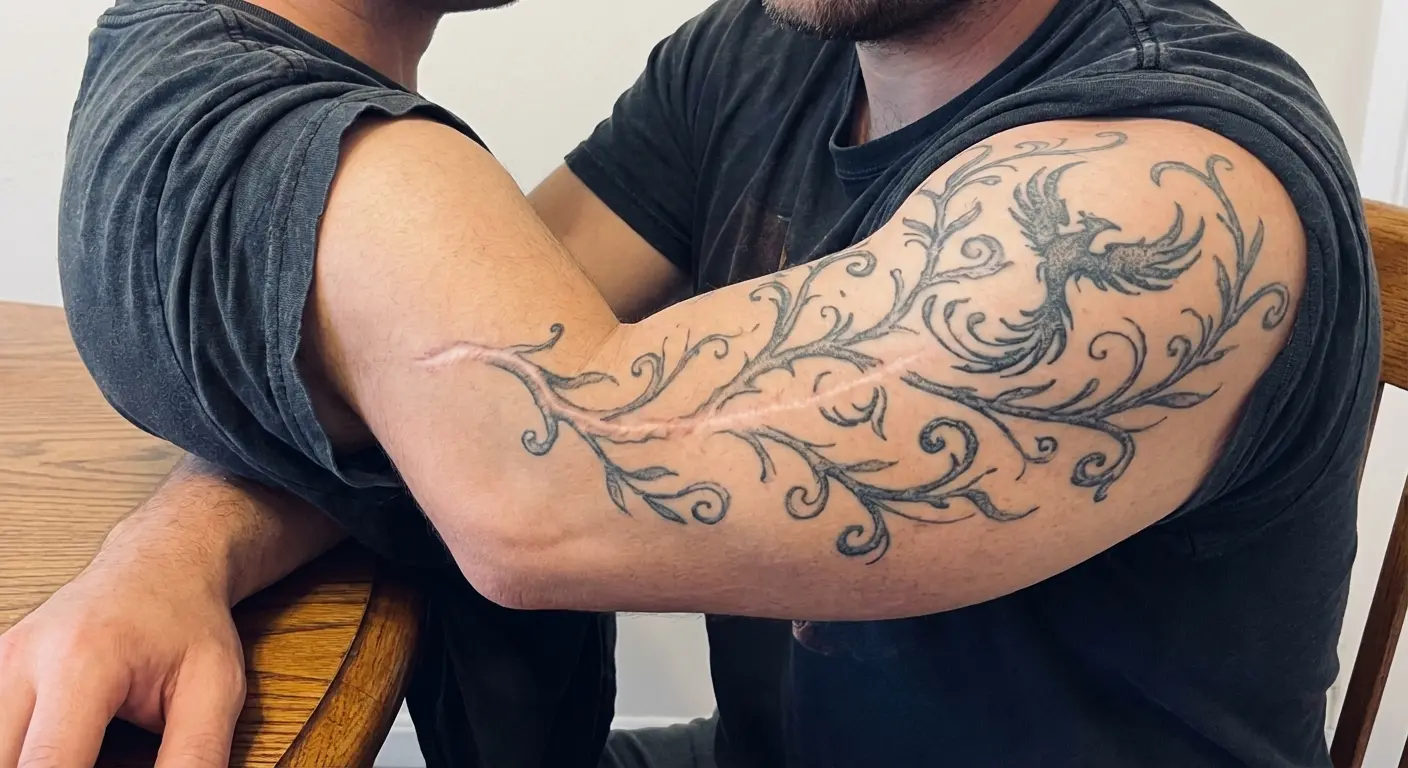
This matters because you’re reclaiming your body. The scar happened to you, but the tattoo is something you chose. You’re not erasing evidence of what you survived. You’re adding your own interpretation of it, taking ownership of the narrative rather than letting the scar tell the only story.
This approach transforms trauma into testament, covering a scar from surgery, injury, self-harm, or violence with a design that acknowledges what the scar represents rather than hiding it completely.
Turning Ideas Into Ink You’ll Want
Here’s where most guys get stuck: you know what you want it to mean, but you have no idea what it should look like.
You can’t just google “father’s handwriting tattoo” and find your design because your design doesn’t exist yet. It’s specific to your dad’s handwriting, your placement choice, your style preference.
Before you commit to permanent ink, remember that according to tattoo placement research, you should consider all potential scenarios in which your tattoo will be seen and start with something discreet in an unobtrusive area if it’s your first time.
Tattoo Generator IQ helps with this part. Describe your concept, see it in different styles, refine it before you sit with an artist. You’re not replacing your tattoo artist (they’ll still do the final work and make it perfect for your body). You’re giving them a much clearer starting point than “I want something meaningful about my family.”
Full disclosure: this works better for these personal concepts than for generic designs because generic designs already exist in every flash book. Your specific story? That needs custom work.
The tool works particularly well for these personal, meaningful pieces because generic flash designs won’t cut it. You need something built around your specific story, and being able to generate and refine custom designs means you walk into the shop knowing exactly what you want rather than trying to describe abstract concepts and hoping the artist interprets them correctly.
Final Thoughts
The tattoos that still matter when you’re 50 aren’t the ones that looked cool at 25.
They’re the ones that document something true. Your father’s handwriting. The date you got sober. The mountain you actually climbed. The chain you broke so your kids wouldn’t inherit it.
You don’t need all 23 of these ideas. You probably shouldn’t get all 23 of these ideas. Pick the one that documents something true about your life and ignore the rest.
Nobody needs to understand your tattoos except you. The meaning can be entirely private if that serves you better. You don’t owe explanations to strangers who ask what something represents. The tattoo exists for you, not for their curiosity.
Start with what’s true. The design follows once you’re clear on what you’re documenting or honoring. Your body tells your story whether you mark it intentionally or not. These 23 ideas give you frameworks for telling that story on your own terms.
The best tattoos aren’t the ones that follow trends. They’re the ones that document truth, honor lineage, and mark transformation in ways that remain meaningful decades after the needle stops.
