20 Black Cat Tattoos That Actually Age Well (Unlike That One You Saw on Pinterest)
Table of Contents
Midnight Minimalism
1. Single Line Silhouette
2. Geometric Shadow Cat
3. Dot Work Feline Profile
4. Negative Space Arch
5. Micro Crescent Moon Companion
Occult & Mystical
6. Third Eye Black Cat
7. Crystal Ball Guardian
8. Tarot Card Frame
9. Lunar Phase Sequence
10. Witch’s Familiar with Herbs
Vintage Americana Reimagined
11. Traditional Lucky 13 Cat
12. Sailor Jerry Influenced Panther-Cat Hybrid
13. Old School Banner Wrap
14. Flash Sheet Tribute
15. Woodblock Print Style
Contemporary Surrealism
16. Melting Shadow Form
17. Galaxy Interior Cat
18. Botanical Overgrowth Integration
19. Abstract Brush Stroke Interpretation
20. Double Exposure Portrait Merge
TL;DR
-
Black cat tattoos work when you skip the Halloween bullshit and explore what the symbol actually means to you
-
Minimalist doesn’t mean easy (your artist might be seriously underestimating the difficulty)
-
Occult symbolism paired with black cats works if you actually know what the symbols mean, not just because they look witchy
-
Vintage Americana gives black cats a rebellious edge that modern interpretations usually miss
-
Surrealist approaches can transform the black cat from literal animal into something more personal
-
Placement matters more with black cats because their silhouette depends entirely on contrast
-
Most people miss how these tattoos can represent taking back the “bad luck” narrative instead of just celebrating darkness
-
Solid black work ages weird on different skin tones (we’ll get into it)
Why Black Cat Tattoos Work When You Stop Caring About Superstitions
Every October, the same black cat tattoo guides flood the internet. They’re all about “spooky vibes” and “mysterious energy” and other vague nonsense that doesn’t help you choose a design that’ll still look good in five years.
What I’m covering here goes deeper. I’m looking at black cat tattoos through the lens of taking back symbols that society labeled as “bad luck” and turning them into personal power statements. Your black cat tattoo shouldn’t just look good when Spirit Halloween opens. It needs to carry meaning that works year-round, through every phase of your life.
The technical execution makes or breaks these designs. I’ve organized these twenty options by the emotional and visual impact they create, not arbitrary style categories. You’ll find everything from whisper-quiet minimalism to complex surrealist compositions, but more importantly, you’ll understand why certain approaches succeed as long-term body art while others become regrettable within five years.
Here’s what most guides won’t tell you until you’re sitting in the chair: how black ink ages on different skin tones, why placement affects readability over time, and which design elements hold up versus those that blur into grey blobs. I’m addressing all of it because the goal isn’t just to show you pretty pictures. I want you to walk away understanding the difference between a black cat tattoo that ages gracefully and one that becomes a source of frustration.
The surge in black cat tattoo popularity reflects how we view these creatures now versus a century ago. The #blackcattattoo hashtag has blown up to over 30,000 posts, showing that what was once a niche design has become mainstream. This mirrors how tattoos themselves have shifted from countercultural statements to legitimate art forms, with black cat imagery leading the charge in designs that balance aesthetic appeal with actual meaning.
Midnight Minimalism
Minimalist black cat tattoos are the hardest category to execute well. Everyone thinks minimalist means easy because it’s simple. Wrong. These designs strip away everything except the bare bones, which means every line carries way more weight than you’d think.
A single wobbly curve ruins the entire piece. There’s no shading to hide behind, no color to distract the eye, and no decorative elements to compensate for shaky execution. When you’re considering minimalist approaches, check out how fine line tattoo techniques translate to black cat designs, because the precision required is basically the same challenge we’re discussing here.
I’ve identified five approaches to minimalist black cat tattoos that stay interesting without adding complexity just for the sake of it. Each design solves a specific problem: how to suggest movement with static lines, how to create depth without shading, how to make a small black cat tattoo readable from across the room. These aren’t just “simple” designs. They’re smart solutions to challenging artistic problems that happen to look effortless when done right.
Okay, fine, here’s a table because this stuff is easier to compare side-by-side:
|
Design Element |
Healing Time Impact |
Longevity Rating |
Best For |
|---|---|---|---|
|
Single continuous line |
1-2 weeks |
Excellent (lines stay crisp 15+ years) |
Forearms, behind ear, ribs |
|
Geometric angles |
2-3 weeks |
Excellent (sharp edges maintain definition) |
Upper arm, calf, shoulder blade |
|
Dot work density |
3-4 weeks (more trauma) |
Outstanding (individual dots don’t blur) |
Anywhere with minimal stretching |
|
Negative space |
1-2 weeks |
Good (depends on skin tone contrast) |
Flat surfaces: back, thigh, chest |
|
Micro scale (under 1 inch) |
1 week |
Fair (may need touch-ups after 5-7 years) |
Wrist, ankle, behind ear |
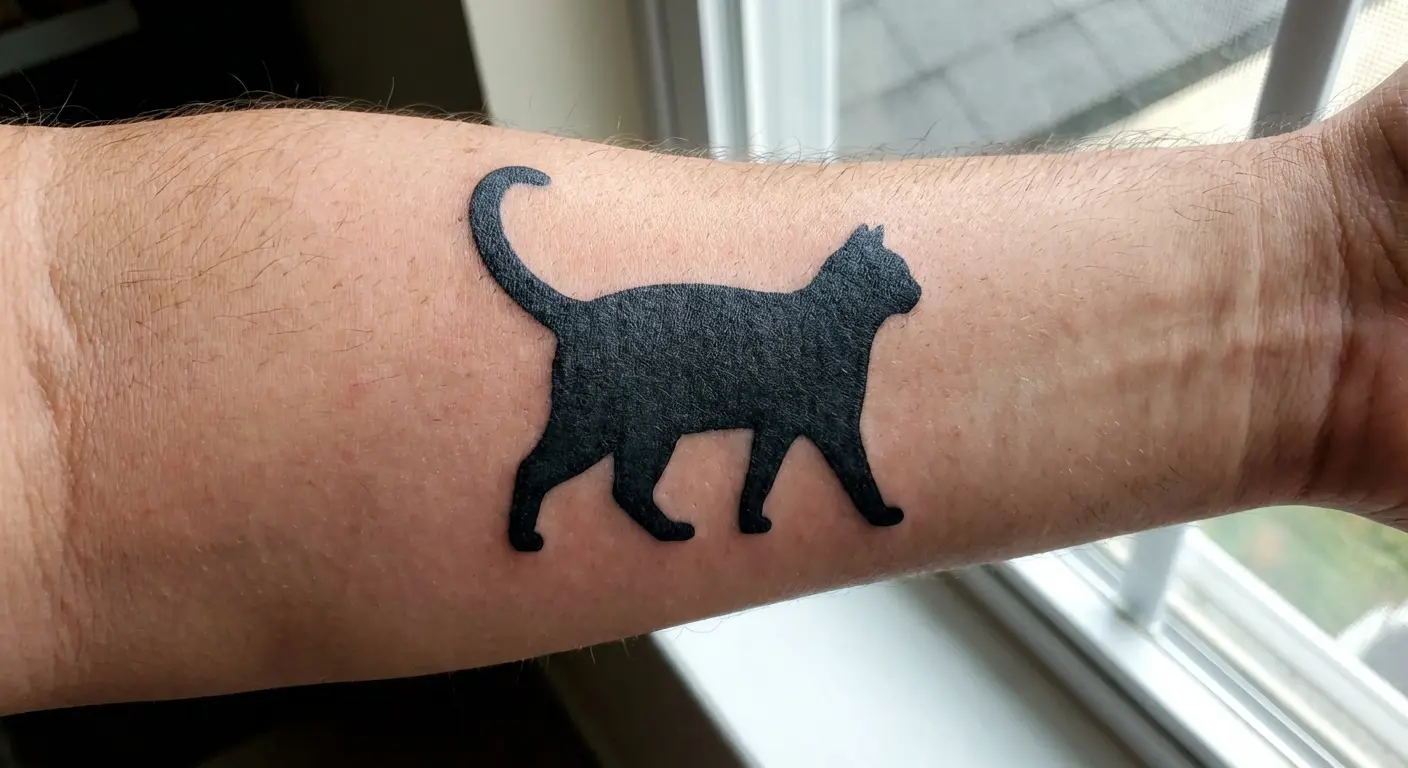
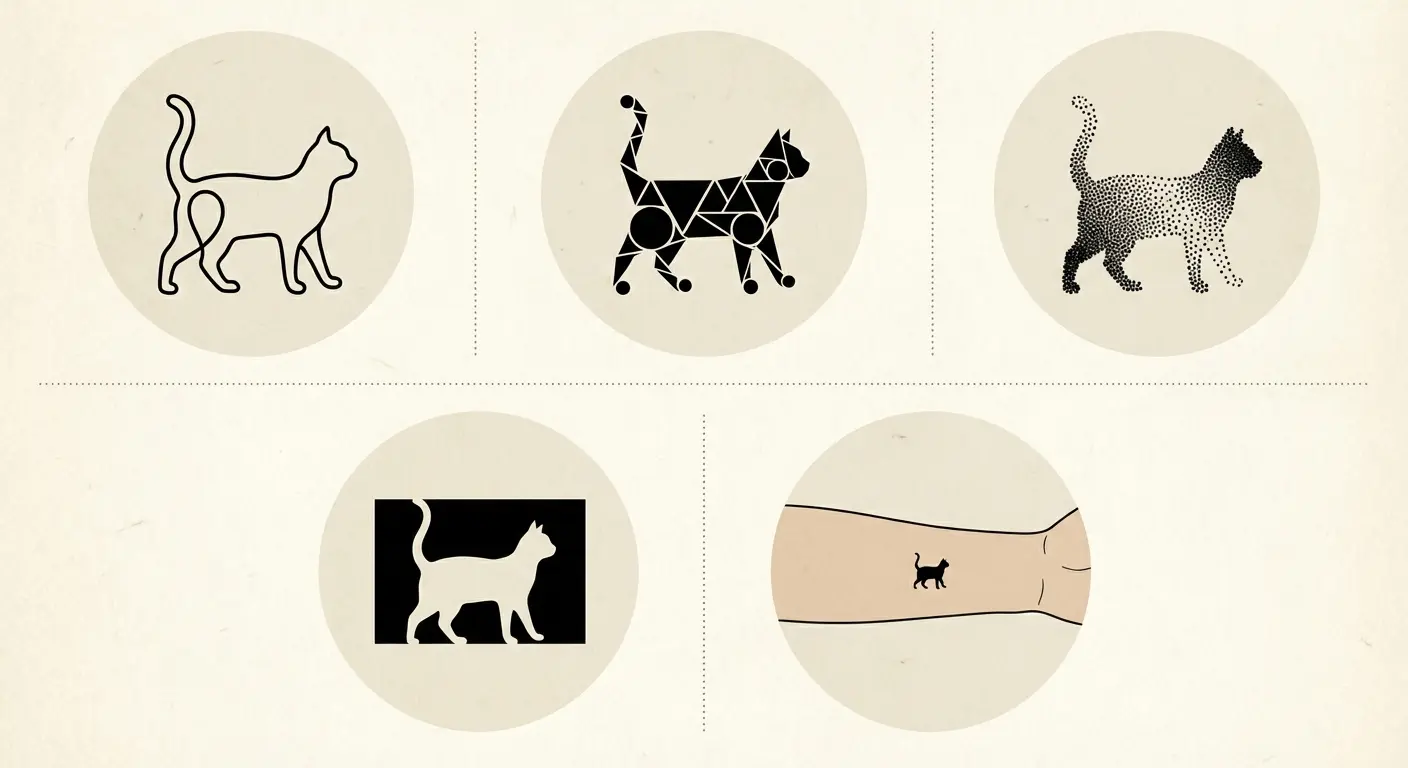
1. Single Line Silhouette
The single line black cat sits on your skin as one continuous mark that the artist can’t lift their machine from until it’s done. This creates a meditative quality in both the tattooing process and the finished image.
The cat appears to materialize from one unbroken gesture, which carries symbolic weight about wholeness and continuity. Technically, this demands an artist with serious line confidence because there’s zero room for correction. You’re asking them to draw a perfect cat in one breath, basically.
The design works best on forearms, ribs, or behind the ear where your body’s natural curves enhance the flowing quality. Most people underestimate how much this hurts compared to regular linework because the machine stays in constant contact with skin. The payoff? You get a black cat tattoo that looks deceptively simple but reveals its technical mastery to anyone who understands the craft.
Fair warning: behind the ear hurts like hell. Just so you know going in.
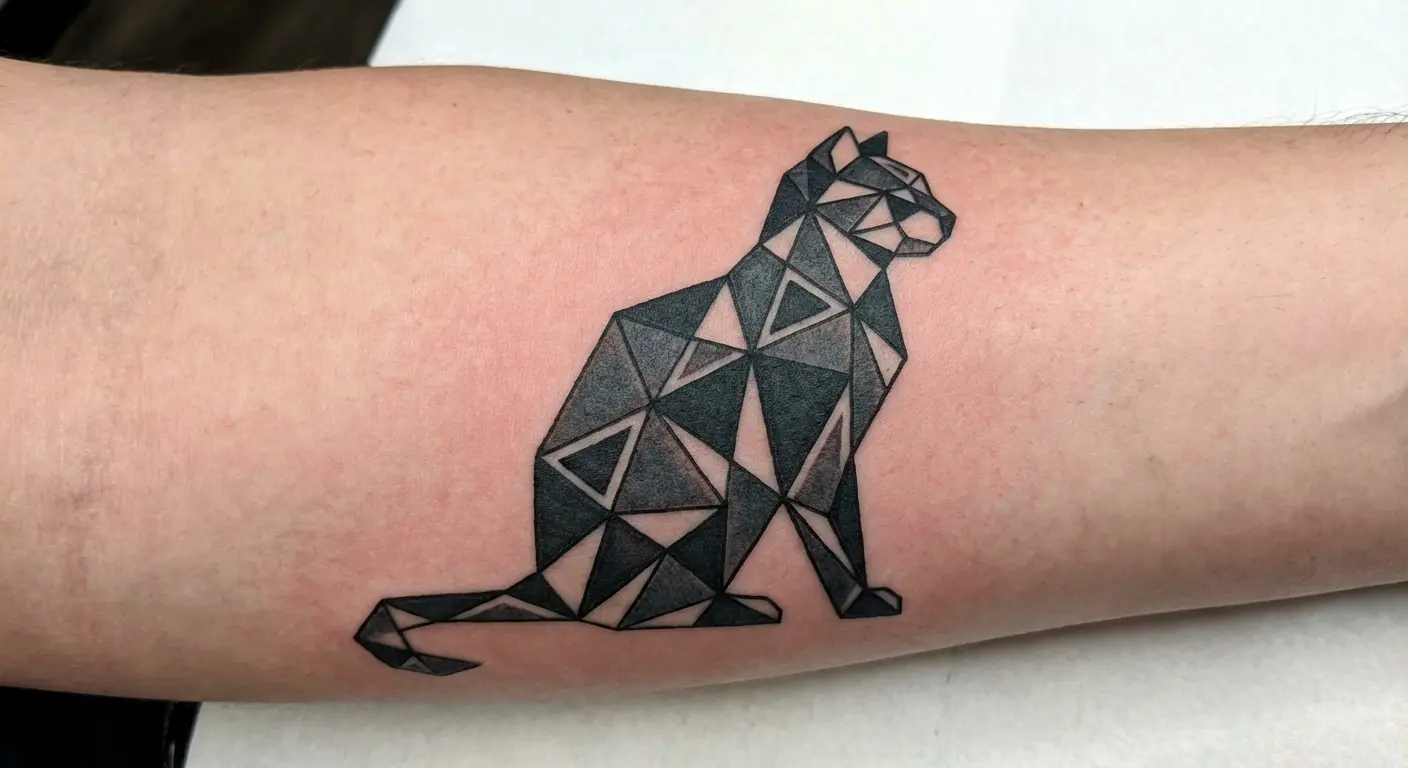
2. Geometric Shadow Cat
Geometric black cat tattoos replace organic curves with angular precision, transforming the feline into something almost architectural. The cat becomes a collection of triangles, polygons, and straight edges that somehow still reads as unmistakably cat-like.
This approach works great for people who want a black cat tattoo but feel disconnected from witchy or mystical associations. The geometric treatment gives it a contemporary, almost scientific quality that fits better with tech, mathematics, or design-focused aesthetics.
Placement on the upper arm or calf allows for larger compositions where the geometric complexity can breathe. You need an artist experienced in geometric work because the angles need mathematical consistency. If the proportions drift even slightly, the entire cat looks off-balance in a way that organic designs forgive more easily. This style shows how modern design principles can transform traditional imagery into something fresh.
3. Dot Work Feline Profile
Dot work transforms the black cat into thousands of individual points that create form through density variation rather than solid lines. From a distance, you see a cat. Up close, you discover a constellation of deliberate marks that build texture and dimension through pure patience.
This technique ages like fine wine. Those individual points don’t blur together the way fine lines do, which means your black cat tattoo looks nearly identical at year twenty as it did on day one. I’m biased toward dot work because I’ve seen too many fine-line tattoos turn into blurry messes after a decade.
The process takes longer than equivalent solid work (sometimes double or triple the session time), which affects both cost and your endurance. But you’re future-proofing your black cat tattoo in a way few other techniques achieve. The profile view works best because it maximizes recognizable silhouette while allowing for gradual density shifts that create three-dimensional form.
4. Negative Space Arch
Negative space black cat tattoos define the feline by what’s NOT there, rather than what is. Your skin tone becomes the cat while black ink creates the surrounding environment (a moon, a doorway, a window frame).
This reversal creates visual tension that makes people look twice. The design challenges expectations about how tattoos typically work, which gives it staying power that more conventional approaches lack.
You need significant contrast between your skin tone and the black ink for this to succeed, which means it works differently across different complexions. On lighter skin, the cat appears as a light silhouette against darkness. On darker skin, you might need to adjust the concept or add subtle linework to maintain definition. The arch element (doorway, window, moon curve) provides structure that prevents the negative space from feeling accidental or incomplete. This approach plays with perception in ways that keep viewers engaged long after the initial viewing.
5. Micro Crescent Moon Companion
Micro black cat tattoos paired with a crescent moon create a complete composition in less than an inch of skin. This addresses one of the biggest concerns people have about minimalist work: will it look unfinished or like an afterthought?
The moon provides context and balance, transforming what could read as a random cat shape into an intentional celestial scene. Placement behind the ear, on the inner wrist, or on the ankle keeps it personal rather than public-facing.
The micro scale demands an artist who specializes in tiny work because standard needle configurations don’t translate down effectively. You’re looking for someone who regularly does fine-line micro tattoos and can show you healed photos (not fresh) of similar scale work. If your artist says they can do a one-inch micro tattoo with perfect detail, they’re either a wizard or they’re lying. Probably lying.
The moon also serves a practical function: it gives the eye somewhere to rest, which makes the overall composition feel complete rather than like a fragment of something larger. This black cat tattoo proves that size doesn’t determine impact.
Yes, I know the crescent moon plus black cat combo is basic. Fight me. It works.
Occult & Mystical
Black cats carry centuries of occult associations that most modern tattoos only scratch the surface of. I’m moving beyond generic witchy aesthetics into specific magical traditions and symbolic systems where black cats serve functional roles, rather than decorative ones.
These designs work for people who want their black cat tattoo to carry protective or intentional energy, not just look cool. I’m examining how to integrate genuine occult symbolism (third eyes, tarot, lunar phases, herbal correspondences) with black cat imagery in ways that feel real rather than appropriative or surface-level.
The symbolism behind black cat tattoos spans vastly different cultural interpretations that make them particularly powerful for personal reclaiming. As Certified Tattoo notes, in ancient Egypt, black cats were revered and associated with the goddess Bastet as bringers of good fortune, while in medieval Europe they were linked with witchcraft and misfortune. This historical split is precisely what gives black cats their power in modern occult tattoo work. You’re not just choosing an animal; you’re claiming a symbol that has meant radically different things across time and geography.
Each design in this category solves the problem of how to make mystical tattoos that age well conceptually (not just physically) as your understanding of these traditions deepens over time. Your relationship with these symbols will evolve. The black cat tattoo should have enough depth to grow with you.
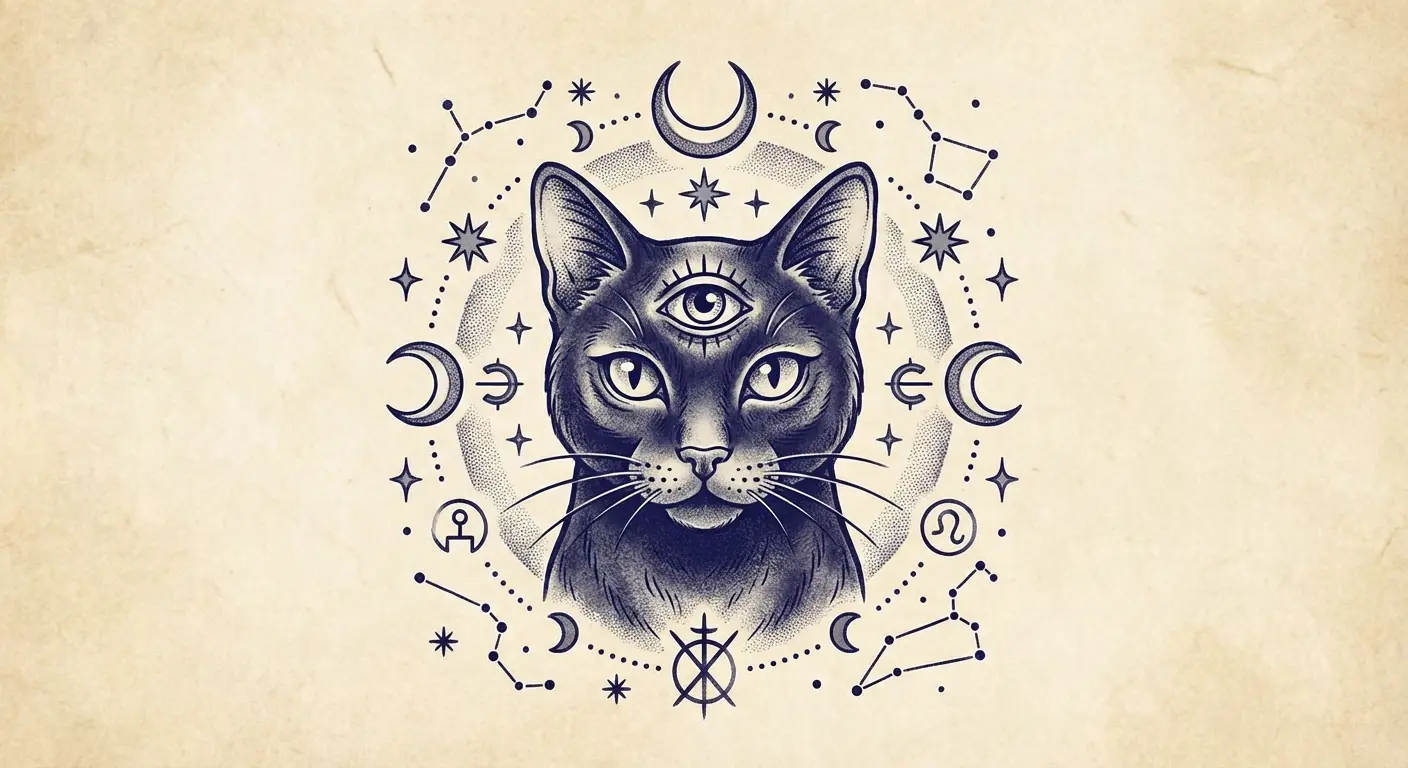
6. Third Eye Black Cat
The third eye positioned on a black cat’s forehead transforms it from familiar animal into seer. This design speaks to intuition, psychic protection, and the ability to perceive what others miss.
In mystical traditions, cats already possess heightened sensory awareness. Adding the third eye makes that implicit knowledge explicit. The protective symbolism inherent in third eye imagery connects to broader tattoo meaning traditions where animals become vessels for spiritual concepts beyond their physical form.
The eye itself needs careful rendering because it becomes the focal point that draws attention first. Many artists default to a simple almond shape, but incorporating iris detail, subtle shading around the lid, or even a small pupil reflection adds dimension that keeps the design interesting long-term. Placement on the forearm or shoulder allows you to position the cat in profile or three-quarter view, which gives the third eye proper prominence. You’re creating a guardian figure that watches over you, which carries psychological weight beyond pure aesthetics.
7. Crystal Ball Guardian
A black cat curled around or peering into a crystal ball builds a complete fortune-telling tableau on your skin. This design works because it tells a micro-story: the cat as both guardian of mystical knowledge and curious seeker of hidden truths.
The crystal ball provides an opportunity for technical showmanship through highlights and reflections that demonstrate your artist’s skill with light sources. You can leave the ball empty for minimalist impact or include subtle imagery inside (moons, stars, eyes, abstract swirls) that adds personal meaning.
The curled position of the cat creates a natural circular composition that works beautifully on shoulders, thighs, or the upper back. This black cat tattoo also scales well, working as a small 3-inch piece or expanding into a larger 6-8 inch composition without losing coherence. The mystical pairing of feline intuition with divination tools speaks to those who trust their instincts and seek deeper understanding.
8. Tarot Card Frame
Framing a black cat within a tarot card border (complete with title banner and number) elevates it into archetypal territory. You’re building your own personal Major Arcana card that represents your relationship with mystery, independence, or transformation.
The frame provides structure that makes the black cat tattoo feel intentionally composed, rather than floating randomly on your body. You can incorporate traditional tarot symbolism (pentacles, wands, celestial bodies) into the border or keep it clean with just the architectural frame and a title that holds personal meaning.
“The Familiar,” “The Shadow,” “The Observer,” or even just “XIII” (the traditional number for transformation) all work depending on what clicks for you. This black cat tattoo demands precise linework because the frame’s symmetry will reveal any wobbles or inconsistencies. The rectangular format works well on forearms, calves, or the center back where straight edges complement body geometry.
9. Lunar Phase Sequence
A black cat silhouette repeated across the lunar cycle builds a design about transformation and cyclical nature rather than static identity. Each moon phase shows the same cat in slightly different positions or poses, suggesting movement through time and emotional states.
This hits different for anyone who identifies with the waxing and waning of energy, creativity, or emotional availability, rather than maintaining constant presentation. The design works horizontally across the collarbone, around the bicep as an armband, or vertically down the spine. You’re building a flipbook animation that the eye travels across, which gives it a sense of movement that single-image tattoos lack.
The technical challenge lies in maintaining consistent cat proportions across all phases while varying the pose enough to justify the repetition. You want evolution, not redundancy.
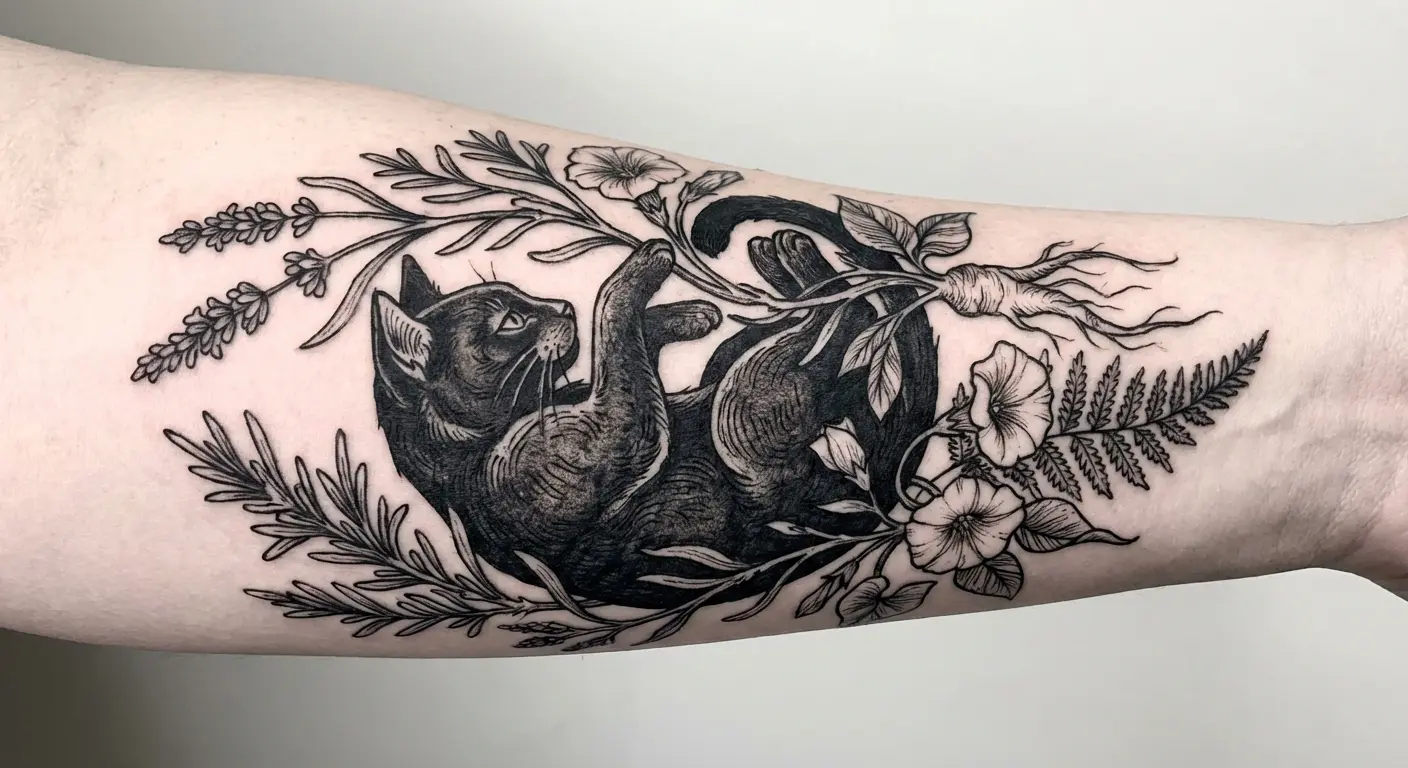
10. Witch’s Familiar with Herbs
A black cat surrounded by or intertwined with specific herbs (mugwort, rosemary, lavender, belladonna) roots the design in actual magical practice rather than generic witchy vibes.
Each herb carries specific correspondences (protection, clarity, peace, transformation), allowing you to build a custom formula that represents your intentions or values. Belladonna, for example, is historically linked to witchcraft because it was supposedly used in flying ointments. Including it in your familiar tattoo isn’t just aesthetic, it’s referencing actual medieval grimoire traditions. Meanwhile, rosemary is basically the opposite: it’s protective, cleansing, the herb your Italian grandmother would use. The combination builds tension.
The botanical elements also add visual texture that prevents the solid black cat from feeling too heavy or monolithic.
You’ll want to research which herbs genuinely click with your practice or personality rather than just choosing what looks pretty, because this black cat tattoo invites questions and you’ll be explaining the symbolism repeatedly . The herbs can frame the cat, grow from beneath it, or even appear to sprout from the cat itself (suggesting the familiar as a living conduit for plant magic). This works beautifully as a larger thigh or ribcage piece where the botanical detail has room to shine.
Vintage Americana Reimagined
Traditional American tattooing (what most people call “old school” or “Sailor Jerry style”) has a complicated relationship with black cats. These designs appeared in flash sheets for decades but often got overshadowed by more obviously masculine imagery like panthers, eagles, or pin-ups.
I’m reclaiming that vintage aesthetic and applying it specifically to black cats in ways that honor the bold lines and limited color palette of traditional work while pushing the imagery in fresh directions. The bold aesthetic of vintage black cat tattoos draws directly from old school tattoo traditions that defined American tattooing for generations, making these designs both historically grounded and visually striking.
These designs work for anyone drawn to tattoo history and the rebellious cultural associations that came with getting tattooed in the mid-20th century. I’m exploring how to make vintage-inspired black cat tattoos that feel real, rather than like costume pieces or nostalgic throwbacks.
Traditional Americana gets gatekept hard by purists who’ll tell you that’s “not real traditional.” Ignore them. If it’s got thick lines and limited color, it’s traditional enough.
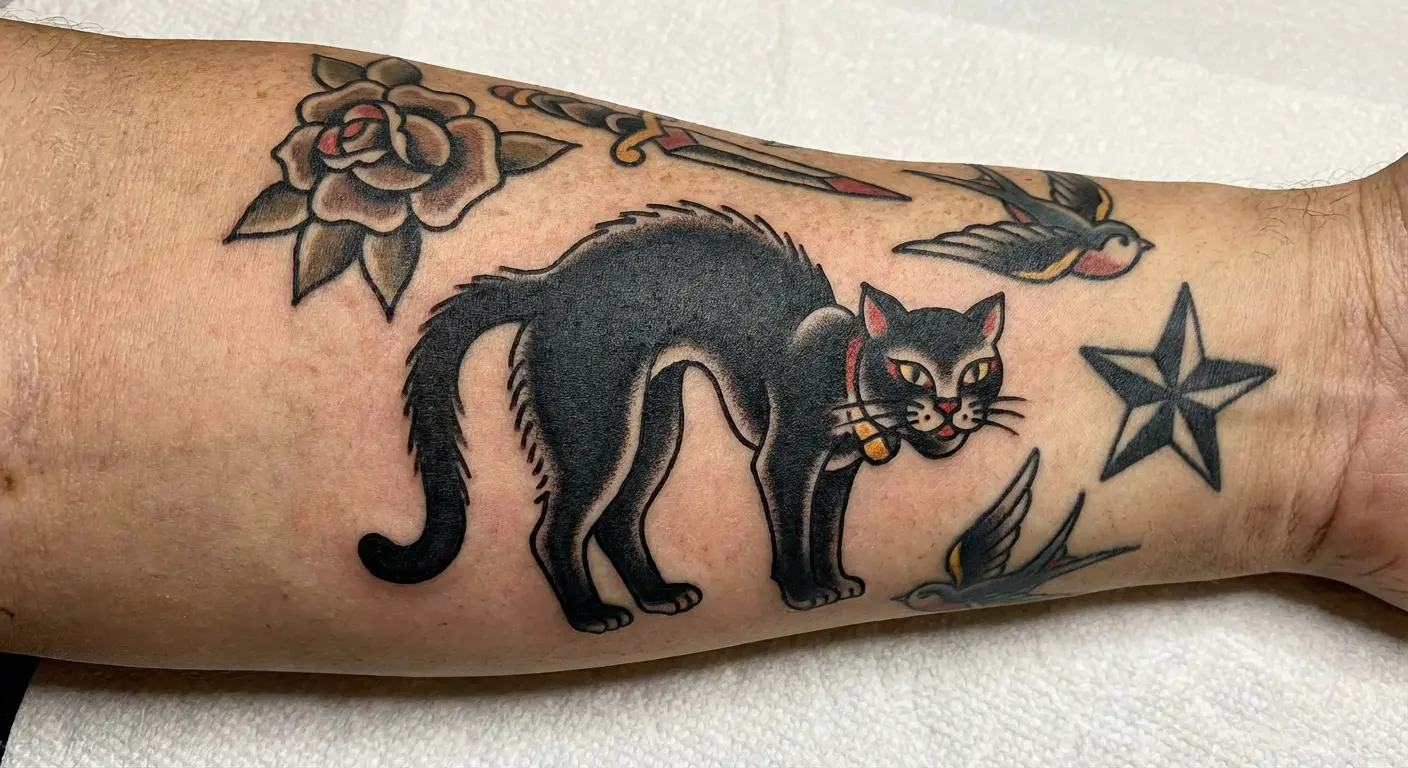
11. Traditional Lucky 13 Cat
Pairing a black cat with the number 13 doubles down on superstition in a way that transforms bad luck into defiant personal branding. Traditional tattoo style demands thick outlines, limited shading, and bold color choices (though in this case, we’re working primarily with black and maybe red or yellow accents).
The 13 can appear on the cat’s body like a racing number, integrate into the background, or exist as a separate element that the cat interacts with (sitting on it, reaching toward it, wearing it as a collar tag). This black cat tattoo speaks to anyone who’s ever been called unlucky, difficult, or cursed and decided to own that label rather than fight it.
Traditional style makes sure it ages well because those thick lines maintain definition even as skin changes over decades. Placement on the upper arm, calf, or forearm keeps it visible, which matters for a design that’s fundamentally about displaying your relationship with superstition publicly.
12. Sailor Jerry Influenced Panther-Cat Hybrid
Sailor Jerry’s panther designs are iconic in traditional tattooing, but replacing the panther’s aggressive snarl with a black cat’s more mysterious expression creates something entirely different. You keep the bold posture, the powerful musculature, and the dynamic composition but shift the emotional register from aggression to confidence.
The cat doesn’t need to bare its teeth to command respect. This hybrid approach works for people drawn to traditional tattoo aesthetics but who don’t connect with the overtly masculine or military associations that often accompany them.
The panther’s prowling stance translates beautifully to cat proportions, and the traditional shading techniques (using parallel lines rather than smooth gradients) give the black fur incredible texture and depth. This black cat tattoo demands significant space (think outer thigh, back, or chest) because the powerful posture needs room to read clearly.
13. Old School Banner Wrap
A black cat with a banner wrapped around its body (or held in its mouth) provides space for text that personalizes the design beyond pure imagery. The banner is a traditional tattoo staple that adds narrative context: names, dates, phrases, or single words that anchor the visual to specific meaning.
“Nine Lives,” “Bad Luck,” “Familiar,” or even just a name all work depending on what you’re commemorating or claiming. The banner’s curves guide the eye through the composition, and the ribbon-like quality adds dimension to what could otherwise read as flat.
Traditional style banners have specific proportions and shadow placement that differ from realistic ribbon rendering, so you want an artist versed in that vocabulary rather than someone trying to make it look photographically accurate. The cat can be sitting, standing, or in profile depending on how the banner wraps around it, giving you flexibility in overall composition.
14. Flash Sheet Tribute
Designing your black cat tattoo to look like it came directly from a vintage flash sheet (complete with intentional color separation marks, registration dots, or even a small number in the corner) creates a meta-commentary about tattoo culture itself.
You’re not just getting a black cat. You’re getting a black cat that acknowledges and celebrates the history of how tattoo designs were shared, sold, and standardized across shops. This works brilliantly for tattoo collectors who view their body as a curated gallery of the art form itself rather than just personal symbolism.
The flash sheet aesthetic demands specific technical choices: thick outlines, limited color palette, slightly exaggerated proportions that prioritize readability over realism. Some artists specialize in this exact style, while others might struggle to capture the specific quality that makes flash look like flash rather than just simplified illustration.
15. Woodblock Print Style
Woodblock print technique (think Japanese ukiyo-e or early American printmaking) translates beautifully to black cat tattoos because both mediums rely on bold contrast and limited tonal range.
The carved quality of woodblock prints builds texture through parallel lines and negative space that mimics the limitations of the original medium. Your black cat tattoo looks like it was printed rather than drawn, which gives it a handcrafted, almost archival quality.
The slight imperfections inherent to woodblock aesthetics (where the wood grain affects the final print) can be incorporated intentionally to add character without looking like mistakes. This style works great for people who appreciate folk art, printmaking history, or the intersection of craft and fine art. The bold blacks and strategic use of skin tone as white space create high contrast that remains readable as the tattoo ages, making this both aesthetically interesting and practically sound for long-term wear.
Contemporary Surrealism
Surrealist black cat tattoos abandon literal representation entirely and use the feline form as a starting point for emotional or conceptual exploration. These designs work for people who want their black cat tattoo to function as personal symbolism rather than recognizable imagery that others can easily categorize.
The black cat becomes a vessel for expressing internal states, abstract ideas, or the dissolution of boundaries between self and environment. This category requires the most trust between you and your artist because the designs resist easy description and demand interpretation.
You’re not asking for a cat that looks like a cat. You’re asking for a feeling, a concept, or a psychological state rendered through feline-inspired forms. These black cat tattoos age interestingly because their meaning often deepens as you change, whereas literal designs can feel static or disconnected from who you become.
Surrealist tattoos attract the worst kind of pseudo-intellectual bullshit sometimes. Don’t be the person explaining how your melting cat represents “the fluidity of postmodern identity” at parties. Just say it looks cool and move on.
|
Surrealist Approach |
Emotional Resonance |
Technical Difficulty |
Typical Session Time |
Color vs. Black/Grey |
|---|---|---|---|---|
|
Melting/dissolving forms |
Transformation, impermanence, identity flux |
High (requires smooth gradients) |
4-6 hours |
Black/grey recommended |
|
Galaxy/cosmic interior |
Expansiveness, wonder, infinite self |
Very High (color blending critical) |
5-8 hours |
Color essential for impact |
|
Botanical integration |
Growth, decay, natural cycles, grief |
Medium-High (botanical detail) |
4-7 hours |
Works beautifully either way |
|
Abstract brush strokes |
Energy, spontaneity, essence over form |
High (must look intentional) |
3-5 hours |
Black/grey captures gesture best |
|
Double exposure merge |
Duality, connection, layered identity |
Very High (two images must coexist) |
6-10 hours |
Black/grey for clarity |
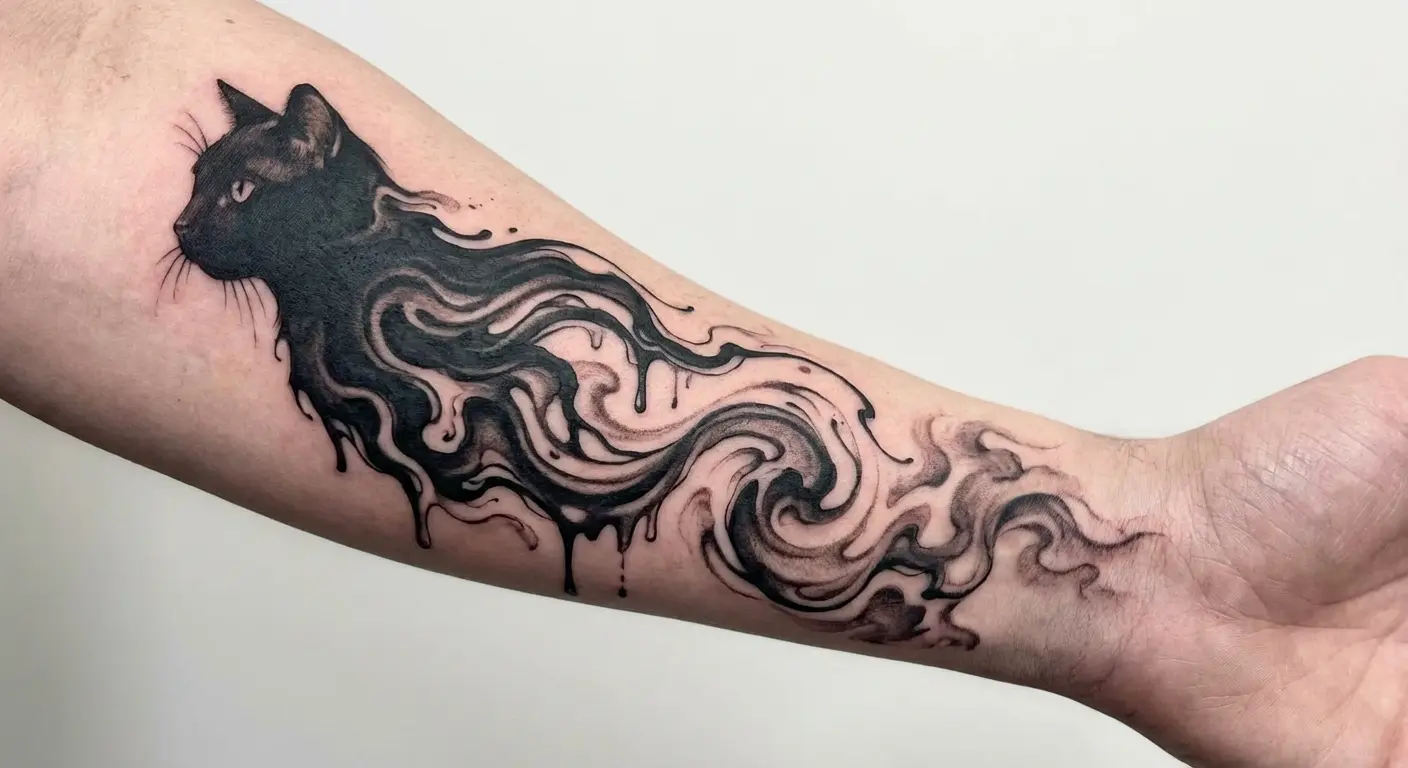
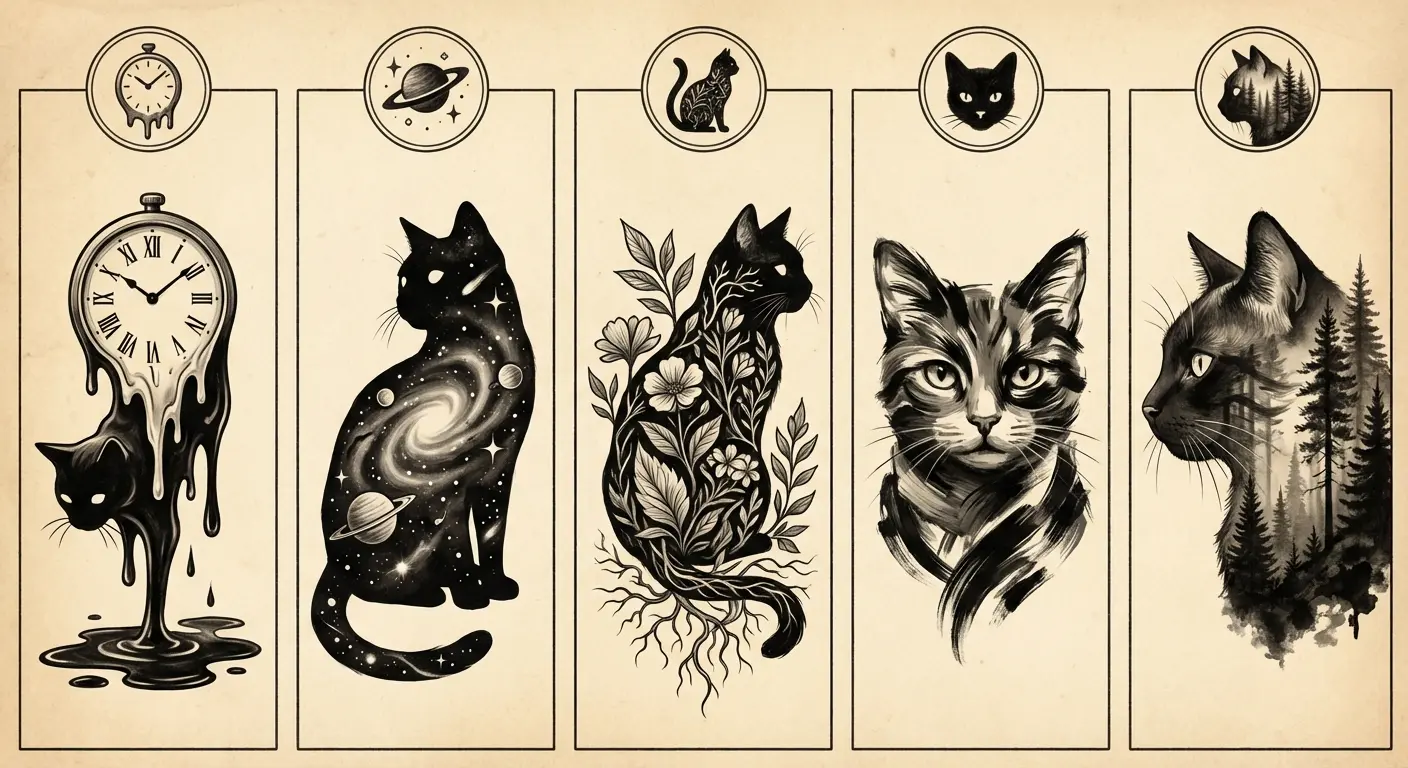
16. Melting Shadow Form
A black cat rendered as if it’s melting or dissolving into pure shadow builds imagery about impermanence and the fluid nature of identity. The top portion maintains recognizable feline features (ears, eyes, whiskers) while the lower body liquefies into abstract drips, puddles, or smoke-like wisps.
This black cat tattoo design hits different for anyone who’s experienced significant transformation and wants to acknowledge that you’re never really solid or fixed. The melting effect requires an artist skilled in organic flow and gradient work because the transition from form to formlessness needs to feel inevitable, rather than arbitrary.
Where does the cat end and the shadow begin? Who cares, that’s what makes it work.
Placement on the ribs, thigh, or forearm allows gravity to enhance the melting direction naturally. You can incorporate subtle environmental elements (the cat melting into water, shadow, or even flowers) to add context without over-explaining the concept.
Is it pretentious? Maybe. Does it work anyway? Absolutely.
17. Galaxy Interior Cat
The galaxy cat (where the feline’s silhouette contains stars, nebulae, and cosmic imagery) has become popular enough to risk cliché, but done thoughtfully it still carries genuine impact. The key is treating the cosmic interior as actual space rather than decorative filler.
Use astronomical references from specific constellations, nebulae you’ve observed, or celestial events that hold personal significance, rather than generic starfield patterns. The contrast between the solid black outline and the colorful cosmic interior grabs attention immediately, but the design’s longevity depends on whether those colors maintain vibrancy as they age.
Purples and blues tend to hold better than reds and yellows in cosmic tattoos. My friend got the galaxy interior cat with bright yellows and pinks. Five years later, the yellows are completely gone and the pinks are muddy orange. Stick with blues and purples for cosmic stuff unless you want to commit to color refreshes.
The silhouette itself needs strong, simple lines because busy outlines compete with the detailed interior rather than containing it. This black cat tattoo works as a medium to large piece (4-7 inches) where the cosmic detail has room to breathe without becoming muddy.
The galaxy interior cat is overdone to the point of parody. I’m including it because done RIGHT it works, but 90% of them look like someone vomited a Lisa Frank folder onto your skin.
18. Botanical Overgrowth Integration
A black cat partially consumed by or merged with botanical growth (flowers, vines, leaves) builds imagery about the relationship between animal and plant, domesticity and wildness, or the inevitable return of all living things to the earth.
The plants don’t just decorate the cat. They grow through it, around it, or from it in ways that suggest genuine integration rather than simple proximity.
This black cat tattoo design works for people processing grief, transformation, or the complex feelings around impermanence and renewal. The botanical elements add color opportunities if you want them (though all-black versions with just line variation create stunning results too). You’ll want to choose plants with specific meaning rather than generic flowers: roses for love and pain, forget-me-nots for memory, nightshade for danger, ivy for persistence.
The overgrowth can be subtle (a few strategic vines) or overwhelming (cat barely visible through foliage) depending on how aggressively you want to explore the concept.
19. Abstract Brush Stroke Interpretation
Treating the black cat as a series of bold brush strokes rather than a cohesive animal creates a design that exists between representation and pure abstraction. You see a cat, but you’re also seeing the gesture of creating a cat, the movement of the artist’s hand, the energy of the mark-making itself.
This approach comes from East Asian brush painting traditions where the goal isn’t photographic accuracy but capturing the spirit or energy of the subject. The design demands an artist comfortable with freehand work and confident brush-like linework because the strokes need to feel spontaneous even though they’re carefully planned.
Each mark carries weight and intention. There’s no room for tentative or scratchy lines. This black cat tattoo works beautifully for people who value process over product, who find meaning in the act of creation rather than just the finished result. Placement on the forearm, shoulder blade, or calf allows for vertical or horizontal compositions that follow the body’s natural flow.
20. Double Exposure Portrait Merge
Double exposure tattoos overlay two images (in this case, a black cat and a human portrait) to create psychological complexity and narrative depth. The cat might merge with your own face, a loved one’s features, or an anonymous figure that represents an aspect of yourself.
This technique speaks to identity fluidity, the parts of ourselves we recognize in animals, or the way we carry others within us. The technical execution requires precise planning because both images need to remain readable while occupying the same space.
You’re not just stacking one on top of the other. You’re finding the moments where features align (cat eyes becoming human eyes, whiskers extending from a human cheek, ears emerging from hair) to create seamless integration.
This black cat tattoo works best as a larger piece (5-8 inches minimum) because the detail required for two recognizable images needs space. Black and grey realism artists typically handle this style best because it demands sophisticated understanding of value, contrast, and how details read at different scales.
Making Your Black Cat Tattoo Last (The Part Most Guides Skip)
You’ve found a design you love, but most people don’t consider how black cat tattoos specifically age compared to other subjects. Solid black work behaves differently than color, linework, or grey wash as your skin changes over decades.
I’m addressing the practical questions that emerge after the initial excitement fades: how to choose placement that maximizes longevity, why some black ink spreads while other holds crisp, what to ask your artist about their black ink preferences, and how your skin tone affects the final result.
Understanding proper healing protocols is critical for any design, but especially for solid black work, so review comprehensive tattoo aftercare guidelines before committing to your black cat tattoo to ensure optimal healing and color retention.
I’m also tackling the design revision process that most people dread. You’ve got an idea, but translating that into something your artist can execute requires communication skills that nobody teaches you. If you’ve been staring at Pinterest boards feeling overwhelmed about how to move from inspiration to actual appointment, this section gives you the framework.
The tattoo industry itself is evolving to meet changing consumer values around health and ethics. In September 2023, Black Cats Tattoo opened in Orono, Maine (WABI), offering completely vegan and organic tattoos along with cruelty-free aftercare products. The shop avoids plastics and animal by-products in everything from ink to transfer paper, which traditionally uses lanolin derived from sheep. This represents a growing movement toward conscious tattooing that considers not just the final aesthetic but the entire process and its ethical implications, something worth investigating if you share those values.
Thirteen years ago, I saw someone’s black cat tattoo blur into a grey blob on their forearm. The artist had used cheap ink and placed it where the sun hits constantly. That tattoo cost $400 and lasted maybe three years before it needed a cover-up.
I’m telling you this because Pinterest won’t. Neither will Instagram. You’ll see thousands of gorgeous black cat tattoos that are either fresh (so you can’t see how they age) or heavily filtered (so you can’t see the blurring).
Here’s the reality about healing times: single lines heal in a week or two and stay crisp for 15+ years if done right. Dot work? That’ll hurt more and take 3-4 weeks to heal, but those individual dots won’t blur together even decades later. Micro tattoos under an inch might need touch-ups after 5-7 years because the detail just doesn’t hold at that scale. Negative space designs heal fast but depend entirely on your skin tone maintaining contrast with the black ink.
Price discussions matter because everyone’s thinking about it anyway. Dot work takes 2-3x longer than equivalent solid work, which means you’re paying 2-3x more. A simple line cat might run $150- 300. That same design in dot work? Easily $400-800 depending on your city and artist. Worth it if you care about longevity, but know what you’re signing up for.
If your artist says “sure, I can do that” to every single design in this guide, run. Nobody’s equally good at traditional Americana AND surrealist watercolor AND geometric precision work. Find someone who specializes in the style you want, not someone who claims they can do everything.
Look, I need to mention something useful here: trying to explain your tattoo idea to an artist is awkward as hell. You’ve got Pinterest screenshots and you’re like “I want THIS but also kind of like THIS but not exactly…” and the artist is nodding but you can tell they’re not seeing what’s in your head.
That’s where Tattoo Generator IQ actually helps. You can mess around with different versions, add geometric elements, try different placements, see if the occult stuff feels too heavy, before you walk into a shop. The AI generates high-res images you can actually show your artist, which beats trying to describe “minimalist but with cosmic vibes” for the tenth time.
Full disclosure: the AI isn’t going to replace your artist. It’s going to save you both from that awkward “can you read my mind?” conversation. Generate some options, pick what’s closest, then let your artist make it actually good. Is it perfect? No. Does it beat showing up with three contradictory Pinterest screenshots? Absolutely.
Don’t Get This Tattoo If…
Real talk. Don’t get a black cat tattoo if:
-
You’re doing it because it’s October and you’re feeling spooky. Wait six months. If you still want it in March, then book the appointment.
-
You can’t commit to sunscreen. Black ink plus sun damage equals grey blob. I’ve seen it happen too many times.
-
You want something “meaningful” but can’t articulate why beyond “I like cats.” That’s fine for getting a cat, not fine for permanent body art.
-
You’re hoping it’ll make you seem mysterious. It won’t. You’ll just have a cat tattoo.
-
You’re not willing to pay for an artist who specializes in solid black work. This isn’t the tattoo to let someone practice on.
-
You think minimalist means cheap. Minimalist means harder, which often means more expensive.
-
You’re getting it to one-up your ex who also has a black cat tattoo. Just get a houseplant instead. Cheaper, less permanent, equally good at making you feel like you’ve made a decision.
Artist Red Flags to Watch For
You need to know what to avoid. Here are the red flags:
If they show you only fresh photos and no healed work, that’s a problem. Healed photos show you how their black ink actually holds up after a year or two. Fresh photos can hide a lot of issues.
If they don’t ask about your skin type, sun exposure habits, or lifestyle, they’re not thinking long-term. A good artist wants to know if you’re a lifeguard or work outdoors because that affects ink longevity.
If they push you toward a design that’s more complex than what you asked for, they might be more interested in their portfolio than your satisfaction. Sometimes simpler is better.
If they can’t explain why they prefer certain black inks over others, they might not have enough experience with solid black work. Artists who specialize in this stuff have opinions about ink brands and will tell you why.
If they seem annoyed when you ask questions about aging, placement, or touch-ups, find someone else. Your questions are legitimate and deserve real answers.
What About Touch-Ups?
Let’s talk about the reality of touch-ups because most guides skip this entirely.
Solid black work typically needs fewer touch-ups than color or grey wash, but placement matters. Black cat tattoos on hands, feet, or anywhere that gets constant friction will fade faster. You’re looking at touch-ups every 3-5 years for high-friction areas.
For most body placements (arms, legs, back, chest), a well-executed black cat tattoo can go 10-15 years before needing any touch-up work. Some never need it at all if you’re religious about sunscreen.
Micro tattoos are the exception. Anything under 2 inches will likely need touch-ups within 5-7 years because the fine detail doesn’t hold as well over time. I got a micro black cat behind my ear in 2015. By 2018, you couldn’t tell it was a cat anymore. Just a black blob. Learn from my mistake.
Most artists offer free or discounted touch-ups within the first year if the fading is due to technique rather than your aftercare. After that, you’re typically paying a reduced hourly rate for touch-up work.
How Black Ink Ages on Different Skin Tones
This is the conversation most guides avoid, but it matters.
On lighter skin tones, black ink maintains high contrast and stays readable longer. The main aging concern is sun exposure causing the black to fade to grey or develop a slightly blue tint over decades.
On medium skin tones, black ink still provides good contrast but you need to be more strategic about placement. Areas where the skin naturally has more melanin (knuckles, knees, elbows) might not hold black ink as crisply over time.
On darker skin tones, black ink can be trickier. It still works beautifully, but the artist needs to understand how to pack the ink properly and you might need to go slightly larger with your design to maintain readability. Negative space designs become more challenging because the contrast between skin and ink is less dramatic.
The best approach regardless of skin tone: find an artist who regularly tattoos people with your complexion and can show you healed examples of their black work on similar skin. Don’t be someone’s first attempt at figuring this out.
Placement Matters More Than You Think
Where you put your black cat tattoo affects how it ages, how it reads visually, and how much it hurts.
Forearms: Great for visibility and relatively low pain. The skin ages well here and black ink holds crisp for decades. The main risk is sun exposure if you’re not diligent about sunscreen.
Ribs: High pain but the skin doesn’t stretch much over time, which means your black cat tattoo maintains its shape. The curved surface can enhance flowing designs like the melting shadow or single line styles.
Behind the ear: Trendy placement but high pain and limited space. Only works for micro designs, which as I mentioned, need touch-ups more frequently.
Thighs: Excellent for larger pieces. The skin is relatively stable and provides a good canvas for complex designs like the botanical overgrowth or double exposure work.
Upper arm/shoulder: Classic placement for a reason. Low to medium pain, ages well, easy to show or hide depending on clothing. Works for almost any black cat tattoo style.
Hands and fingers: I’m going to be honest: don’t do it unless you’re already heavily tattooed and understand the maintenance. Hand tattoos fade fast and need frequent touch-ups. They also limit job opportunities in some fields.
Ankles and feet: Painful and prone to fading because of friction from shoes and socks. If you’re set on this placement, go slightly larger than you think you need and plan for touch-ups.
Final Thoughts
The best black cat tattoo is the one that still means something to you when nobody else can see it. If you’re getting it for Instagram or to seem witchy or because your ex had one and you want to one-up them, just get a houseplant instead. Cheaper, less permanent, equally good at making you feel like you’ve made a decision.
But if you’ve read this far and you’re still thinking about which design fits, you’re probably ready. Just don’t cheap out on the artist. A $200 black cat tattoo that blurs in three years costs way more than an $800 one that lasts twenty.
Here’s the thing about black cat tattoos: they only work if you stop caring about what they’re “supposed” to mean. Bad luck? Good luck? Who cares. The question is whether the design still matters to you when it’s February and you’re wearing a winter coat and nobody can see it anyway.
Pick something that’ll age well technically. Pick something that means something specific to you, not just “mystery” or “magic” in the abstract. And for the love of god, find an artist who’s actually done solid black work before, because this isn’t the tattoo to let someone practice on.
Black cats have been called unlucky for centuries. Getting one tattooed on your body is basically saying you don’t buy into that narrative. You’re taking a symbol that society decided was negative and making it yours. That’s more powerful than any superstition.
Just make sure it still looks like a cat in ten years.
