21 Egyptian Tattoos That Actually Connect You to Ancient Symbolism (Not Just Look Cool)
Table of Contents
The Protectors: Eye of Horus • Bastet • Anubis • Wadjet • Scarab • Sphinx
The Divine Powers: Isis • Ra • Osiris • Hathor • Thoth
The Eternal Marks: Ankh • Djed • Was Scepter • Shen Ring • Lotus • Cartouche
The Underworld: Weighing Scene • Duat Serpent • Book of the Dead • Ba Bird
TL;DR
Egyptian tattoos aren’t just aesthetically cool. Each symbol had a specific job in ancient Egypt: protection, healing, transformation, judgment. Match the symbol to your actual life experience, not just the vibe. Placement mattered to the Egyptians and it should matter to you. And if you can’t explain why you chose your symbol in 30 seconds, you’re not ready to get it tattooed.
The Sacred Guardians
Most ancient Egyptian tattoos? They were about protection. Not decoration. Not style points. Protection from specific, named threats: spiritual, physical, medical.
These weren’t pretty pictures. They were tools designed to shield the wearer from real dangers. The protective category includes deities, sacred animals, and objects that ancient Egyptians believed could actively intervene on your behalf.
There’s this mummy from Deir el Medina (workers’ village, not royal) covered in more than 30 tattoos showing important Egyptian symbols including the Eye of Horus, nefer signs, and baboons. For decades, scholars assumed tattooed women were sex workers (because of course they did). Turns out they were probably priestesses. The tattoos weren’t decoration. They were credentials. These findings completely changed what we thought we knew about who got tattooed and why in ancient Egypt.
1. Eye of Horus
The Eye of Horus is everywhere: festivals, new age shops, Pinterest boards. But what gets missed is this: it wasn’t about general protection. Each part of the eye represented a mathematical fraction used in ancient Egyptian medicine and measurement.
The eyebrow equaled 1/8. The pupil, 1/4. The side marking, 1/2.
Healers prescribed medicines using these fractions, making this symbol a literal prescription for wholeness. When you get this tattooed, you’re carrying a 3,000-year-old mathematical formula for healing.
The eye works best on the upper arm or back of the neck: somewhere it can “watch” where you’re going. Sounds woo-woo, but placement actually mattered to the Egyptians if you care about original intent.
Here’s something most people don’t consider: right eye versus left eye. The right eye (representing concrete factual information, controlled by the left brain) versus the left eye (representing intuition and the arts, controlled by the right brain). The distinction matters.
|
Eye of Horus Component |
Fraction Value |
Associated Sense |
Healing Application |
|---|---|---|---|
|
Eyebrow |
1/8 |
Thought |
Mental clarity treatments |
|
Pupil |
1/4 |
Sight |
Vision-related remedies |
|
Side marking (white of eye) |
1/2 |
Hearing |
Ear ailments |
|
Curved tail |
1/16 |
Taste |
Digestive medicines |
|
Teardrop |
1/32 |
Smell |
Respiratory treatments |
|
Inner corner |
1/64 |
Touch |
Topical applications |
Fair warning: the Eye of Horus is approaching infinity symbol territory: so common it’s lost some impact. If that bothers you, dig deeper into Egyptian symbolism. Get something that shows you actually studied this.

2. Bastet the Cat Goddess
Bastet started as a lioness deity of warfare before transitioning to domestic cat protector of the home. Most people don’t know about that transformation. She went from fierce to gentle, which makes her ideal if you’ve gone through your own evolution and want to honor both versions of yourself, similar to how black cat tattoo symbolism evolved from superstition to protection.
Cats protected grain stores from mice and snakes. That made Bastet a goddess of practical, everyday protection rather than dramatic battlefield heroics. She’s perfect if you want protection imagery that doesn’t scream aggression.
Women in ancient Egypt wore Bastet amulets during childbirth. Families kept Bastet statues near doorways. A Bastet tattoo works beautifully on the forearm where she can “guard” your daily actions, or on the ribcage as a more private protector. Include the sistrum (a musical instrument) in her hand: music was believed to ward off evil spirits.

3. Anubis the Jackal-Headed Guide
Anubis wasn’t the god of death.
He was the god of the dying process and mummification. A transition specialist. Jackals naturally hung around cemeteries in ancient Egypt, so Egyptians figured they must know something about the boundary between life and death.
Anubis guided souls through the scariest part: the journey through the underworld, and protected bodies during their most vulnerable state. Get him if you’re in major life transition: career changes, recovery journeys, gender transitions, grief processing.
The symbolism hits different when you’re actually in the middle of a transformation. Placement on the chest or back allows for a full figure design showing Anubis in his guiding posture, one hand extended. Some people add the scales of judgment (more on that later) to show Anubis in his role as witness to the soul’s weighing.
Here’s the thing though: Anubis reads as “death god” to most people who aren’t into Egyptian mythology. Be ready to explain. A lot.
4. Wadjet the Cobra Protector
Wadjet appeared on every pharaoh’s crown as the uraeus, a rearing cobra. But her protective power extended to common people too. She was the protector of Lower Egypt and represented the fierce maternal instinct that strikes before thinking when her children are threatened.
The cobra doesn’t give warnings or second chances. Neither did Wadjet. Ancient Egyptian women connected with this energy. A Wadjet tattoo signals that you’ve got boundaries and you’ll enforce them.
She works as a throat or chest piece, mirroring her traditional placement on the crown. You could also wrap her around your wrist or ankle, letting her “strike” outward from your body. The key detail: her hood should be flared in the attack position, not relaxed. A relaxed cobra is just a snake. Wadjet is never decorative.
5. Scarab Beetle
The scarab represents self-creation and transformation through your own effort. Ancient Egyptians watched dung beetles roll balls of dung (which contained their eggs) across the sand and saw a metaphor for the sun god rolling the sun across the sky.
The scarab. Self-creation through your own effort. No help, no mate. Just you and the work.
But here’s the deeper layer: the beetle creates the next generation through its own work, without needing a mate (or so they thought). You don’t need anyone else to become who you’re meant to be.
Scarabs work as smaller tattoos on the wrist, behind the ear, or on the finger. You can certainly go larger with wings spread across the upper back. Ancient Egyptians often depicted scarabs pushing the solar disk: you’re not just transforming yourself, you’re moving your own source of light and energy forward.

6. Sphinx
The Sphinx combines human intelligence with lion strength, creating a guardian that thinks before it acts (unlike Wadjet who strikes first). Ancient Egyptians placed sphinx statues along temple approaches and tomb entrances because the Sphinx could discern who deserved passage and who didn’t.
This isn’t brute force protection. It’s protection that requires wisdom. The riddle tradition (Greek, not Egyptian, but still relevant) adds another dimension: the Sphinx challenges you to prove your worth through knowledge.
Get a Sphinx if you protect through intelligence, strategy, and careful judgment rather than immediate reaction. The design requires space to show both the human face and lion body properly: thigh, back, or outer arm. You might position the Sphinx in the classic recumbent pose (lying down with paws extended) or in a more dynamic seated position. Some designs include the nemes headdress to emphasize the royal aspect.
The Divine Rulers
Egyptian gods weren’t distant, abstract concepts. They were participants in daily life, each governing different aspects of existence with clear job descriptions. You didn’t worship them generally; you called on certain deities for certain needs.
This section covers the major divine figures whose powers extended beyond protection into healing, wisdom, justice, and transformation. These tattoos work best when you can articulate which aspect of your life connects to that deity’s domain.

7. Isis with Outstretched Wings
Isis rebuilt her murdered husband Osiris from scattered pieces and brought him back to life long enough to conceive their son Horus. That’s not a delicate, passive goddess. That’s someone who refuses to accept that broken things must stay broken, much like how phoenix tattoos symbolize resurrection and rising from ashes.
Ancient Egyptians called on Isis for healing, magic, and motherhood. Her real power was restoration. She put things back together that everyone else said were impossible to fix.
The winged version of Isis (often shown on sarcophagi) represents her protective aspect, wrapping the deceased in her wings. For a tattoo, this translates to someone who’s either been through their own reconstruction or who helps others rebuild. The wings work beautifully across the upper back or wrapping around the ribcage. You can include the tyet (Isis knot) symbol in the design, which represents her life-giving power.
8. Ra’s Solar Disk
Ra was the sun god. More accurately, he was the sun’s daily journey from birth (dawn) to death (sunset) to rebirth (next dawn). Every single day, Ra fought the chaos serpent Apophis in the underworld and won, allowing the sun to rise again.
Every sunrise was Ra beating the chaos serpent. Again. The Egyptians knew that light winning over darkness wasn’t guaranteed: it was a daily battle that could be lost.
An Egyptian tattoo of Ra (usually shown as the solar disk with a cobra or falcon) works for people who’ve survived their own underworld journeys and come back. The design can be simple (the disk with rays) or complex (Ra in his solar barque, fighting Apophis). Placement on the shoulder or upper chest lets the sun “rise” on your body.
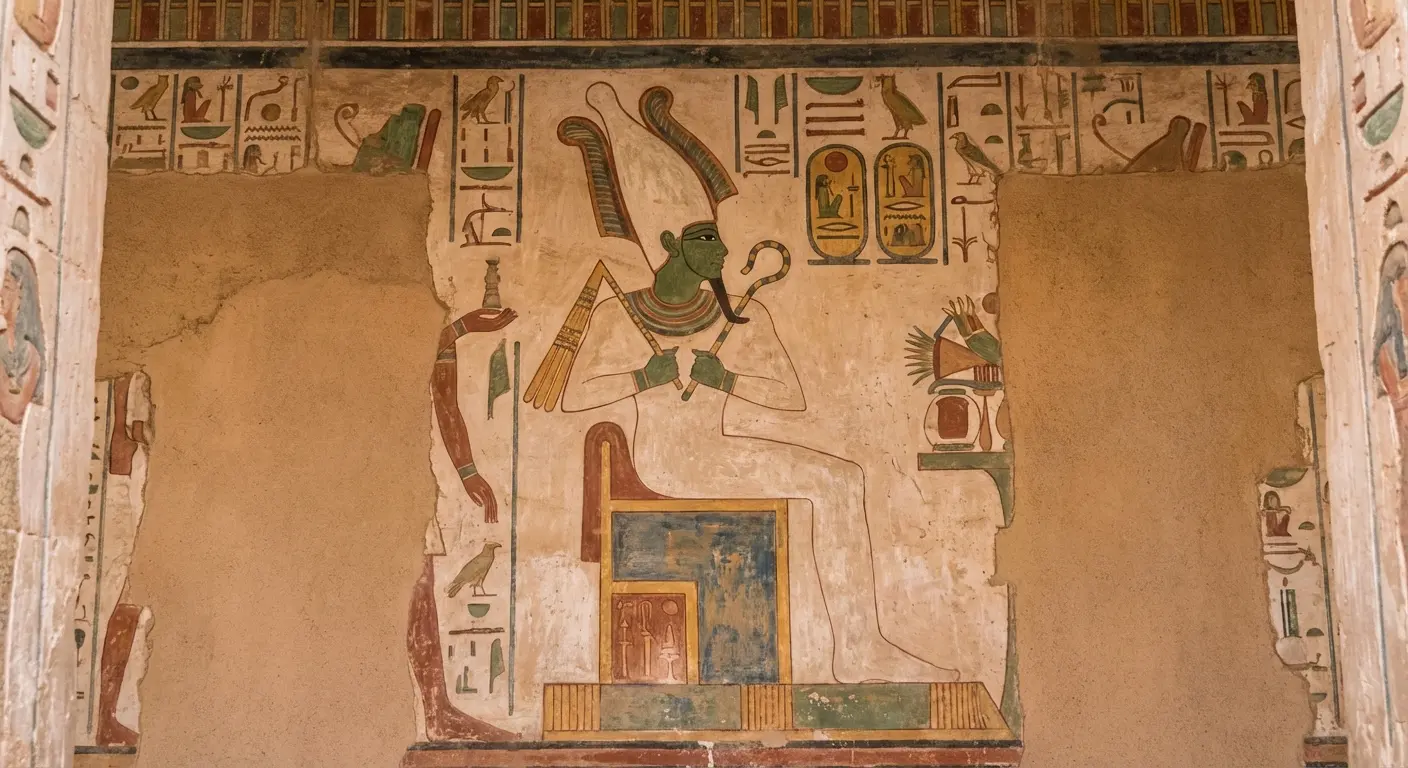
9. Osiris in Judgment
Osiris ruled the underworld not as a punisher but as a judge who’d been through death himself. He was murdered, dismembered, and resurrected, which qualified him to judge the dead because he understood what they’d experienced.
The judgment scene (psychostasia) shows Osiris seated on his throne while the deceased’s heart is weighed against the feather of Ma’at (truth). This isn’t about religious judgment in the modern sense. It’s about whether you lived according to truth and order or fell into chaos and deception.
Get Osiris if you’re in recovery, if you’ve survived trauma, or if your work involves judgment and justice. The full judgment scene requires significant space (full back or thigh). You’re looking at 15-20 hours minimum, probably 3-4 sessions, and anywhere from $2,000-$5,000 depending on your artist and city. Make sure you’re committed before you start something this big.
10. Hathor’s Horned Crown
Hathor governed joy, music, dance, fertility, and drunkenness. She was the goddess of everything that makes life worth living rather than just survivable. Ancient Egyptians celebrated multiple festivals for Hathor involving music and wine because they understood that pleasure and celebration were sacred acts, not frivolous distractions.
Her crown (cow horns holding the solar disk) combines her nurturing aspect (cows provided milk) with solar power. Hathor is perfect for anyone reclaiming joy after a difficult period or anyone whose spirituality centers on celebration rather than suffering.
Archaeological evidence from Deir el Medina shows that women with tattoos featuring bent-lotus plants and open lotus blossoms had clear connections to Hathor, as these same symbols appeared as graffiti on the stones of the Ramesside temple to Hathor at the site. Tattooed women may have embodied the goddess herself in religious practice.
The tattoo can show the crown, Hathor’s face with cow ears, or her full figure holding the sistrum. Placement on the forearm or calf allows for a vertical design that shows her full regalia.
11. Thoth the Scribe
Thoth invented writing, mathematics, science, and magic, then served as the scribe who recorded the results of the heart-weighing ceremony. He represented knowledge as power: knowledge you’ve earned through study rather than inherited or received as a gift.
Ancient Egyptian scribes were among the most respected professionals because literacy was rare and valuable. A Thoth tattoo (shown with an ibis head or sometimes as a baboon) works for writers, researchers, students, or anyone whose power comes from what they know rather than what they own.
The design often includes Thoth holding a writing palette or the was scepter. You might add hieroglyphs that spell out a concept important to you, making Thoth both the subject and the frame for your personal message. Placement on the forearm mirrors the position where a scribe would hold their writing tools.
The Eternal Symbols
Egyptian symbolic objects carried meaning independent of any deity. These symbols appeared everywhere: on amulets, in tomb paintings, carved into temple walls, and possibly as tattoos (though direct evidence of tattooing in ancient Egypt is limited to geometric patterns and deity images on female mummies).
The power of these symbols came from their shape and what that shape represented in Egyptian cosmology. They’re building blocks of meaning that you can combine or use individually.
12. Ankh Cross
The ankh means “life” or more accurately “the breath of life.” Gods are shown holding ankhs to the noses of pharaohs, giving them the breath that sustains existence. The shape possibly represents a sandal strap (the loop) or a combination of male and female symbols, but its meaning is clear: this is life itself in physical form.
Ancient Egyptians wore ankh amulets and included them in every tomb because you needed access to life in the afterlife too. An ankh tattoo works anywhere, but consider what you want it to “give life to” through its placement. On the chest near the heart? Over a scar you’ve healed from? On your wrist where you can see it during difficult moments?
The ankh is simple enough that size and placement become your primary creative choices. You can combine it with other symbols (an ankh with wings, an ankh incorporated into a cartouche) or keep it stark and minimal.
13. Djed Pillar
The djed represents stability and endurance. It possibly originated as a stylized spine or a pole with grain sheaves wrapped around it. Some scholars think it’s Osiris’s backbone. Others say it’s a pole with grain sheaves. A few argue it’s a stylized tree. Nobody knows for sure, which is kind of perfect for a symbol of stability; it’s been stable enough to survive without needing a definitive answer.
Ancient Egyptians raised a djed pillar during festivals to ensure stability for the coming year. This wasn’t passive hope. The Egyptians didn’t sit around hoping for stability; they made it happen through ritual.
Get a djed if you’ve rebuilt your life after collapse or if you provide stability for others. The vertical design suits the spine placement perfectly (putting a symbol of stability along your backbone), but it also works on the forearm or calf. The djed along your spine looks incredible but that’s bone-on-needle for hours. If you’ve never sat for a tattoo before, maybe don’t start there.
14. Was Scepter
The was scepter (a long staff with a forked bottom and an animal head on top) represented power and dominion. Gods held it. Pharaohs held it. It was the visual shorthand for “this person has authority.” The forked bottom possibly allowed the user to catch and pin snakes, making it both symbolic and practical. Get a was scepter if you’re stepping into leadership roles or reclaiming power you’d lost.
The vertical design works on the outer thigh, forearm, or along the side of the ribcage. You rarely see the was alone in Egyptian art (it usually appears with the ankh and djed), but as a standalone tattoo it makes a strong statement about personal authority.
15. Shen Ring
The shen is a circle of rope with a horizontal line at the bottom, representing eternity and protection. The circle has no beginning or end, and the rope itself was believed to have protective properties. Gods and goddesses are often shown holding shen rings or standing within them.
The cartouche (which we’ll cover next) evolved from the shen, extending it into an oval to fit longer names. A shen ring tattoo works as a frame for other elements (a name, a date, another symbol) or as a standalone symbol of eternal protection.
The circular design suits the shoulder, behind the ear, or the ankle. You might include the shen with wings (a common variation that adds the power of flight to eternal protection) or doubled (two shen rings interlocked to represent eternal partnership or union).
|
Symbol |
Primary Meaning |
Best Placement |
Combines Well With |
|---|---|---|---|
|
Ankh |
Life, breath, vitality |
Wrist, chest, over scars |
Wings, cartouche, solar disk |
|
Djed |
Stability, endurance, backbone |
Spine, forearm, calf |
Ankh, was scepter, Osiris imagery |
|
Was Scepter |
Power, authority, dominion |
Thigh, forearm, ribcage |
Ankh, djed, personal hieroglyphs |
|
Shen Ring |
Eternity, protection, completeness |
Shoulder, ankle, behind ear |
Wings, names, other symbols as fill |
|
Lotus |
Rebirth, emergence, transformation |
Forearm, neck, ankle |
Water, sun imagery, multiple stages |
|
Cartouche |
Royal protection, name preservation |
Forearm, upper arm, ribcage |
Personal hieroglyphs, protective symbols |

16. Lotus Flower
The lotus closes at night and sinks underwater, then rises and opens again at dawn. Ancient Egyptians saw this as a daily resurrection that mirrored the sun’s journey and the soul’s rebirth. The blue lotus had psychoactive properties and was used in religious ceremonies to induce altered states.
This wasn’t a pretty flower. It was a tool for transformation and a symbol of emerging from darkness (murky water) into light (blooming above the surface), which connects to broader lotus flower tattoo meanings across cultures.
Get a lotus if you’ve been through your own submersion and emergence cycle. The flower can be shown closed (potential), opening (transformation in progress), or fully bloomed (achieved enlightenment or recovery). Placement options include the forearm (showing the stem rising from wrist to elbow), back of the neck (blooming from the spine), or ankle (rising from the foot).
You can incorporate the lotus into larger Egyptian scenes or let it stand alone. Some designs show multiple lotus stages to represent ongoing cycles of death and rebirth rather than a single completed transformation.

17. Cartouche with Personal Hieroglyphs
Cartouches were elongated shen rings that enclosed royal names in hieroglyphs. The rope circle protected the name (and therefore the person’s identity and soul) for eternity. Only pharaohs and their immediate family got cartouches.
Here’s where it gets personal: you can create your own cartouche with your name, a meaningful word, or a phrase translated into hieroglyphs. Ancient Egyptians believed that speaking or writing someone’s name kept them alive in memory. Erasing a name was the worst curse you could inflict.
A cartouche tattoo with your name claims that same eternal preservation for yourself. The oval shape works on the forearm, upper arm, or ribcage. You’ll need to work with someone who understands hieroglyphic translation: not alphabet substitution, which doesn’t capture how the writing system worked.
Hieroglyphs can be read left to right, right to left, or top to bottom depending on which way the figures face, so orientation matters. Some people include their birth name, others choose a word that represents who they’ve become or who they’re becoming.
The power of names and identity markers extends into modern Egypt. Religious freedom advocates are currently urging the Egyptian government to remove religion designations from national ID cards to prevent discrimination against Christians and other minorities. Egyptians have always understood that marking someone’s identity has power and consequences. Names and symbols have always carried weight in Egypt. Three thousand years hasn’t changed that.
The Underworld Journey
Egyptian underworld imagery isn’t about death as an ending. It’s about the journey through transformation that leads to rebirth. The Duat (Egyptian underworld) was a real place in their cosmology, with geography, inhabitants, and dangers that the deceased had to navigate.
These weren’t metaphors. They were maps.
This section covers imagery from that journey, which resonates with anyone going through major life transitions, shadow work, or recovery processes. The underworld wasn’t punishment. It was the necessary dark passage between one life stage and the next.
18. Weighing of the Heart Scene
This is the moment that determined your afterlife fate. Your heart (which contained your conscience and actions) was weighed against Ma’at’s feather (representing truth, justice, and cosmic order). If your heart was heavier than the feather (burdened with lies and chaos), the demon Ammit devoured it and you ceased to exist. If it balanced or was lighter, you passed into the afterlife.
Ammit, the demon who eats unworthy hearts, is part crocodile, part lion, part hippo. Ancient Egypt’s nightmare fuel.
The scene shows Anubis operating the scales, Thoth recording the results, and Ammit waiting nearby. This image works for people in recovery (from addiction, trauma, or any pattern they’ve broken) because it represents the moment of honest self-assessment.
You can’t lie to the scales. Your heart weighs what it weighs based on how you lived.
A full scene requires significant space (full back, thigh, or ribcage). The weighing scene is cool but it’s also huge and expensive. I’ve seen more bad versions than good ones. If you can’t afford a top-tier artist, choose something else.

19. Duat Serpent
The Duat contained multiple serpents, but Apophis was the big one: the chaos serpent who tried to swallow Ra’s solar barque every night. Apophis represented everything that opposed order, light, and existence itself.
He couldn’t be killed, only defeated temporarily, which meant the battle happened every single night forever, similar to how snake tattoos represent transformation and eternal cycles.
Your depression, your addiction, your trauma doesn’t get defeated once and disappear. You fight it repeatedly, and winning means showing up for the fight again tomorrow.
A Duat serpent tattoo (often shown as a massive coiled snake, sometimes being speared by Ra or the deceased) works on the upper arm, thigh, or wrapping around the ribcage. The serpent can be the antagonist in a larger scene or the central figure showing the chaos you’re fighting.
20. Book of the Dead Passage
The Book of the Dead wasn’t a single book. It was a collection of spells, prayers, and instructions for navigating the underworld, customized for whoever could afford to have one made. Think of it as a survival guide for the afterlife.
Specific spells did specific things: Spell 125 was for the judgment scene, Spell 6 made shabtis (servant figures) work for you in the afterlife, Spell 100 let you board Ra’s solar barque.
A Book of the Dead tattoo can show a passage in hieroglyphs (you’ll need someone who can read Middle Egyptian to translate properly) or a scene from the papyrus illustrations. This works well if there’s a certain spell that resonates with your journey.
Spell 30B, for example, prevented your heart from testifying against you during judgment. That hits different if you’re working through shame or self-blame.
The full Book of the Dead passage? Unless you can read Middle Egyptian, you’re trusting your artist got it right. One wrong hieroglyph and you’re wearing gibberish forever. Maybe stick to simpler symbols.
The papyrus-style illustration (figures in profile, hieroglyphic text, earth tones) creates a distinctive aesthetic that immediately reads as Egyptian. Placement depends on the passage length: forearm for shorter spells, back or thigh for longer scenes with multiple figures.

21. Ba Bird with Human Face
The ba was one part of the Egyptian soul (they divided it into multiple components). It had a human head and bird body, representing the personality and individual characteristics that survived death.
The ba could leave the tomb and fly around during the day but had to return to the body at night, which is why tomb doors often had ba-sized openings. This represents the part of you that remains distinctly you even through transformation and death.
Your ba is your essence, your personality, the thing that makes you different from everyone else.
Get a ba bird if you’ve maintained your core self through major changes or if you’ve reclaimed your identity after losing it. The design shows a bird (usually a falcon or swallow) with a human face. You can use your own face or a more stylized Egyptian profile.
The bird is often shown hovering over a mummy or flying toward the sun. Placement on the shoulder blade lets the ba “fly” from your back, or you can place it on the chest near your heart.
Before You Commit to Your Design
You’ve got 21 options now, each with clear meanings and historical context. But here’s where most people get stuck: they know what they want symbolically but can’t visualize how it should look on their body.
You’re trying to describe a complex Egyptian scene to a tattoo artist who may or may not know this style, and the reference images you’ve found online don’t quite match what’s in your head.
Look, I spent three weeks trying to describe my Anubis vision to artists before I just built a tool to generate it myself. That’s how Tattoo Generator IQ started: from frustration. You can describe exactly what you want (Anubis facing left, scales included, New Kingdom color palette) and get variations in seconds. It’s for people who can see it in their head but can’t draw.
The tool gives you artist-ready references that show your tattoo artist exactly what you’re after, which saves both of you time and frustration. Try it out before your consultation so you walk in with a clear visual reference instead of a Pinterest board of images that don’t quite fit together.
Final Thoughts
Egyptian tattoos carry weight because they come from a culture that believed images and symbols had power. They weren’t decorative. They were functional magic.
When you choose Egyptian imagery, you’re tapping into that intentionality whether you believe in the magic or not. The symbols work because they represent complex ideas in visual form: transformation, protection, judgment, resurrection, eternal life, much like how tattoo meanings across cultures encode personal narratives into permanent art.
You don’t need to practice Kemeticism or believe in Egyptian gods for these symbols to resonate. You need to understand what they meant to the people who created them and why that meaning connects to your own journey.
Egyptian tattoos aren’t about looking cool (though they do). They’re about encoding your personal transformation into symbols that have carried meaning for over 3,000 years. You’re not just getting an Egyptian tattoo. You’re joining a tradition of marking the body with images that mean something beyond aesthetic preference.
If you’re getting Egyptian religious symbols, do the work. Read actual Egyptology, not just tattoo blogs. Know the difference between Old Kingdom, Middle Kingdom, and New Kingdom iconography. Understand that modern Egyptians have opinions about this. Some will think it’s cool. Some will think you’re treating their heritage like a costume. You can’t control their reaction, but you can at least be informed.
Choose symbols that reflect your actual journey. And make sure you can explain why: not to me, to yourself. If you can’t articulate it, you’re not ready. The details matter because that’s where the actual meaning lives, not in the general vibe of “Egyptian mysticism.”
Find an artist who’s done Egyptian work before. Hieroglyphs are unforgiving; one wrong line and you’ve spelled something completely different. Ask to see healed photos of their Egyptian pieces, not just fresh ones. The style ages differently than traditional American or Japanese work.
Fine line work like hieroglyphs needs extra careful healing. Any blowout or scarring will make the symbols illegible. Follow your artist’s aftercare religiously (pun intended). Hieroglyphs need to be big enough that they’ll still be readable in 20 years. Lines blur, skin changes. What looks crisp at 25 might look like a smudge at 50. Plan accordingly.
Last thing: if you can’t explain why you chose your Egyptian symbol to a curious stranger in 30 seconds, you’re not ready to get it tattooed. These aren’t decorative. They’re statements. Make sure you know what you’re saying.
