18 Anchor Tattoos That Challenge What You Think You Know About This Classic Symbol
TL;DR
-
Anchors don’t have to mean “stuck.” They can mean choosing where you plant yourself
-
Floating/inverted designs flip the script on traditional symbolism
-
Motion-based anchors: because even heavy things move sometimes
-
Architectural anchors = stability as something you build, not something that traps you
-
Living anchors (coral, flowers, trees) = growth from what weighs you down
-
Best anchor tattoos subvert expectations instead of following them
I’ve been looking at anchor tattoos for fifteen years, and I’m convinced most people get them for the wrong reasons.
Not wrong like “you made a mistake,” but wrong like “you picked the first design you saw instead of the one that actually means something to you.”
Traditional anchors are fine if you want fine. But if you’re reading an article called “18 Anchor Tattoos That Challenge What You Think You Know,” you probably don’t want fine. You want something that makes people stop and actually look.
Why Your Anchor Doesn’t Have to Point Down
Anchors point down. Everyone knows that. It’s literally what they do. They sink, they hold, they keep things from drifting.
Except on your skin, an anchor can do whatever the hell you want it to.
Point up. Float. Dissolve. Grow flowers. Form doorways. Break apart. The maritime guys had their reasons for getting anchored. You don’t have to share them.
The anchor has evolved far beyond its maritime origins. In ancient Egypt, it symbolized stability and certainty, while in the navy it became a symbol of safety on stormy seas, giving sailors hope of returning home safely according to InkSearch’s analysis of anchor tattoo symbolism. Today’s designs carry meanings that vary dramatically from person to person, reflecting power in constancy, strength and confidence, but also (when reimagined) freedom, transformation, and intentional choice rather than passive acceptance.
But here’s the thing nobody tells you: orientation, context, and artistic interpretation can completely transform what this symbol means on your skin. The standard downward-pointing anchor with rope? That’s just one interpretation. Your anchor can point sideways, upward, or exist in a state that defies gravity entirely.
Ask yourself: does being grounded feel like safety, or does it feel like being trapped? Does stability give you the foundation to take risks, or does it hold you back? The most compelling designs often question the very nature of what an anchor is supposed to do.
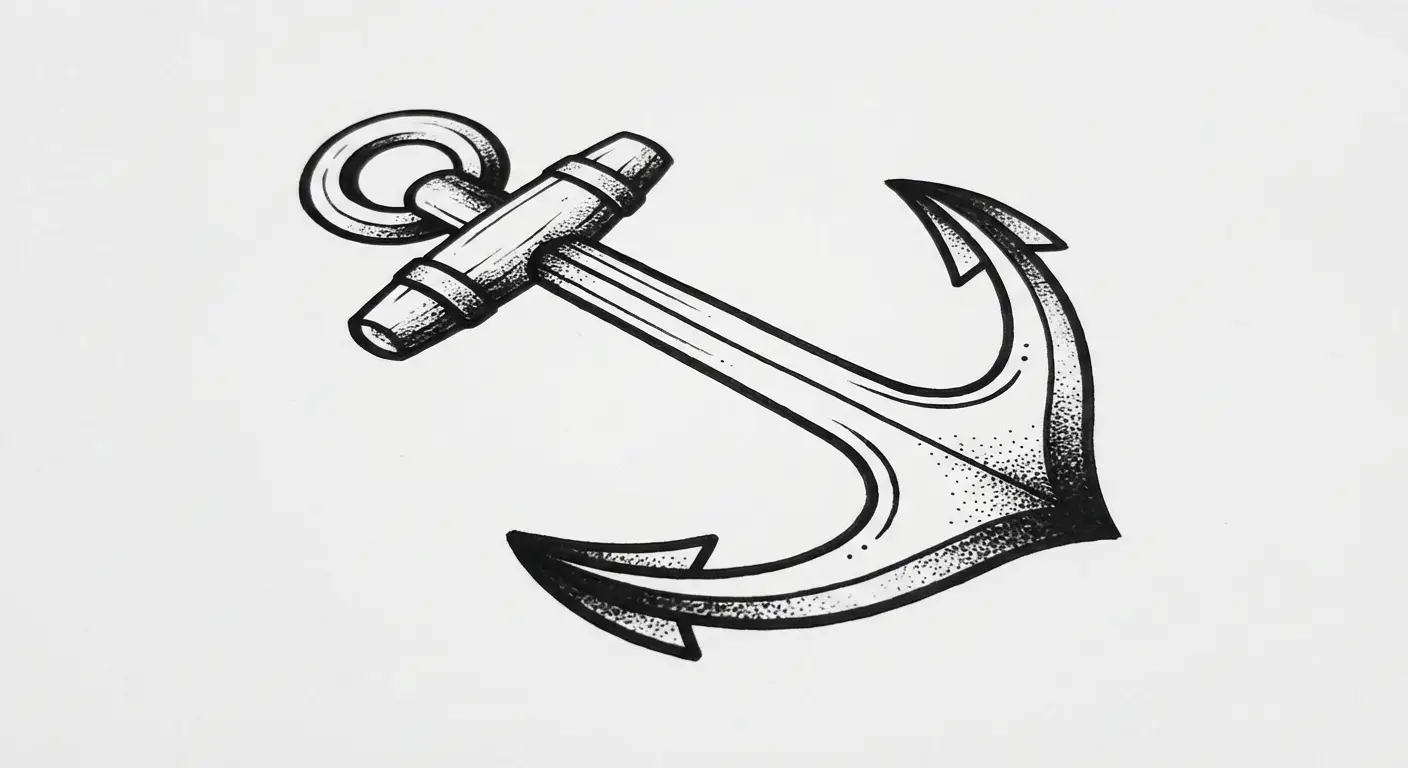
Look, traditional designs are fine if that’s your thing. But if you’ve been scrolling through anchor ideas feeling like something’s off, like none of them quite capture what you mean… yeah, this is for you. The concepts we’re about to explore treat this symbol as a versatile design element that can express whatever relationship you have with stability, change, or personal history.
Anchors That Float: Reimagining Weight as Liberation
You know that feeling when something that’s supposed to hold you down sets you free? That’s the conceptual space these designs occupy.
Floating anchors flip the script on traditional symbolism, creating that push-pull that catches your eye and makes people look twice. These designs aren’t about rejecting stability. They’re about redefining it on your own terms.
1. The Broken Chain Anchor
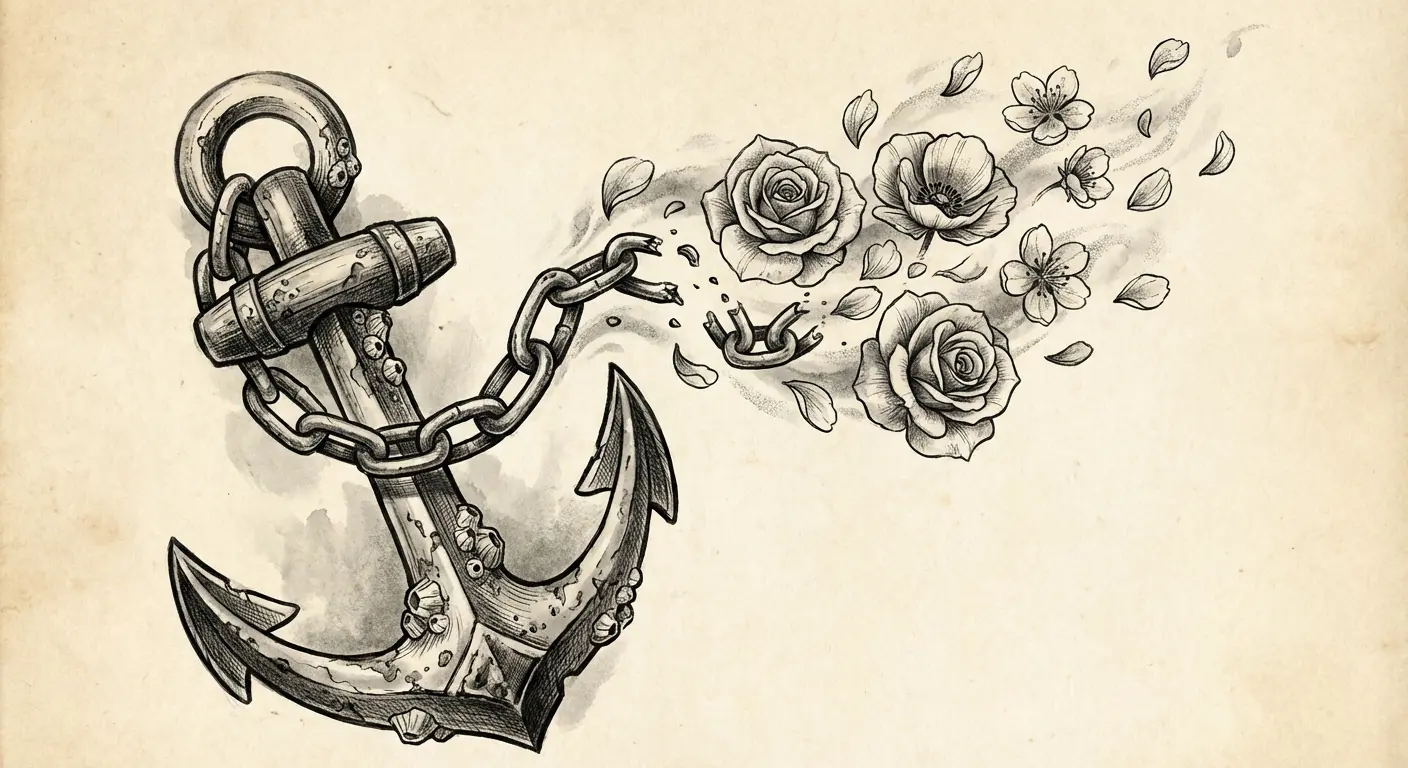
Picture an anchor with its chain snapped clean through, the links trailing off into negative space or transforming into something else entirely. This design works because it tells a specific story about breaking free from what once held you, whether that’s a relationship, addiction, toxic pattern, or limiting belief.
The broken chain resonates when you want to honor your past without being defined by it. Placement matters here. On the forearm, it becomes a daily reminder visible to you. On the shoulder blade, it’s something you carry but don’t constantly see.
The chain break can be clean and recent-looking, or weathered and old, depending on how far removed you are from whatever you’ve left behind. You can incorporate the year of your breakthrough into the chain links themselves, or leave it timeless. Some people add small details where the break occurs (a burst of light, flower petals, geometric shapes) to represent what filled the void.
Even celebrities with famous anchor tattoos change their minds about what they mean. Brooklyn Beckham literally lasered off part of his anchor tattoo (the one dedicated to his dad) and replaced it with a starfish and life preservers according to Page Six. Family relationships evolve. So do tattoos. So should their meanings.
Chain break styles and what they mean:
-
Clean snap: You made a choice and you’re done
-
Corroded break: Time did the work for you
-
Explosive fragments: Sometimes you have to blow things up to get free
-
Dissolving links: The gentlest kind of letting go
-
Transformed links: When constraints become something beautiful
2. Upside-Down Anchor with Roots
What happens when you flip an anchor and let roots grow from its flukes? You get a design that suggests stability doesn’t come from weight pulling you down, but from choosing where you plant yourself.
The upside-down anchor with roots challenges our assumptions about what keeps us grounded. The roots can be realistic and gnarled, or stylized and geometric. They can dig into earth (shown through shading and texture), or they can simply extend into open space, suggesting the grounding happens internally rather than externally.
This hits different if you’re a military kid who lived in seven states by age 15, or if you’re the friend who’s moved apartments six times in three years but somehow always makes the new place feel like yours within a week. The anchor itself can be traditional navy-style or more decorative. Some variations include small shoots or leaves emerging from the roots, indicating that what grounds you also helps you grow.
Rib cage placement emphasizes the personal, close-to-heart nature of this concept. Upper arm placement makes it more visible and shareable. The vertical orientation naturally follows your body’s lines, creating a sense of organic integration.
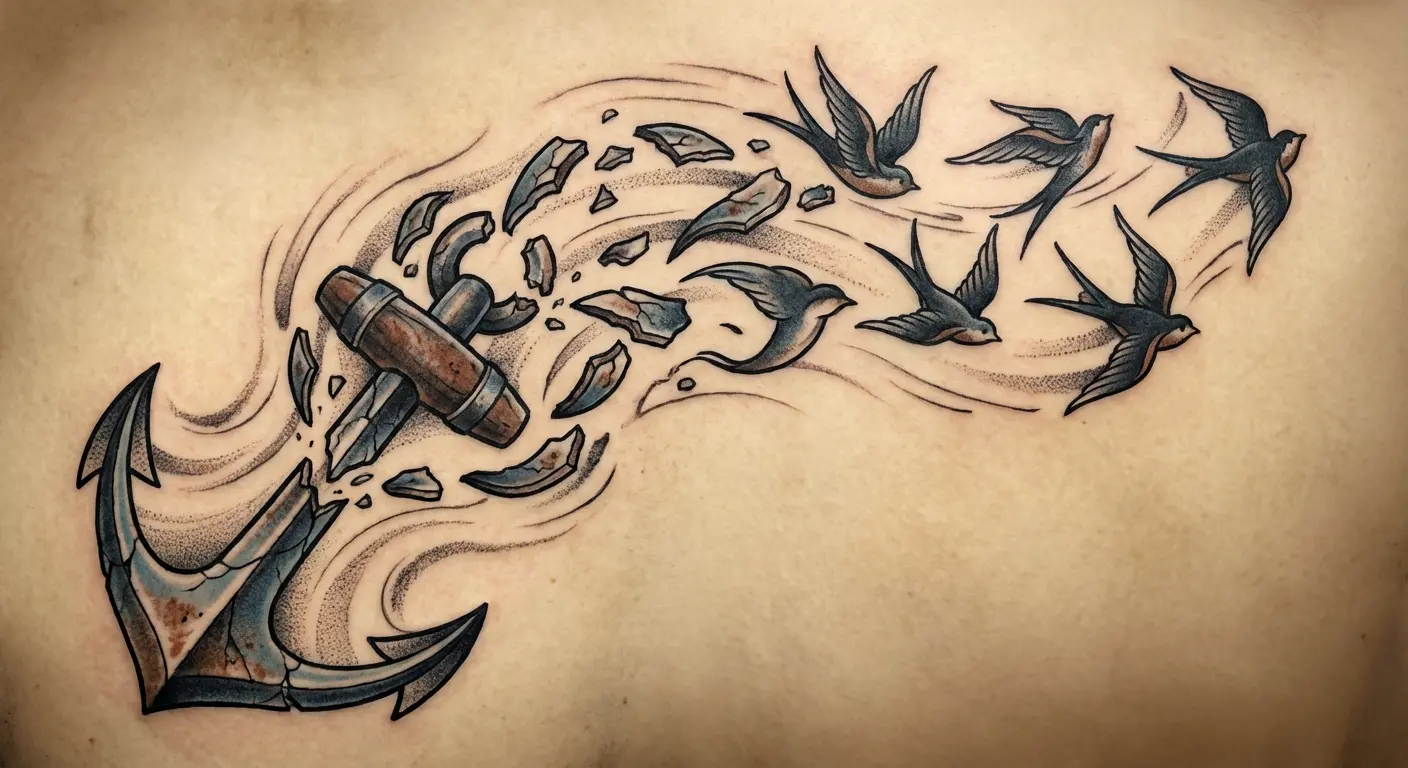
3. Anchor Dissolving into Birds
Real talk: The anchor-to-birds thing is everywhere right now. Your artist has probably done five this month. That doesn’t make it wrong for you, but it does mean you need to bring something specific to the table.
The meaningful versions show the dissolution process itself, not just a clean transition. We’re talking about designs where the metal appears to be breaking apart, fragmenting, or weathering away, with each piece becoming a bird mid-flight. The number of birds matters. Three birds can represent past, present, future. Five might symbolize family members. Seven could reference the seas. Or skip symbolic numbers entirely and let the composition dictate the count.
The bird species matters too. Swallows tie back to nautical tradition (sailors got swallow tattoos after traveling specific distances). Crows or ravens add a darker, more mystical element. Sparrows feel more delicate and hopeful.
The partial anchor that remains shows you haven’t completely abandoned what once held you. You’ve just transformed your relationship with it. Forearm, shoulder, or side body placements give you the vertical space this needs to breathe. The transition zone where metal becomes feather is where your artist’s skill really shows.
4. Compass Rose Anchor Hybrid
Some of us need both grounding and direction, and that’s exactly what a compass rose anchor hybrid provides. These designs integrate compass elements directly into the anchor structure. The anchor’s shank becomes the north-south axis, while east-west points extend from the stock.
And no, I don’t mean just smooshing a compass and anchor together. That’s been done to death and usually looks like a Pinterest fail. The versions that work make the compass and anchor inseparable, as if they were always meant to be one object.
Put the coordinates of where you met your partner on the east fluke, where you got sober on the west. Or the latitude of your hometown on one side, the longitude of where you’re headed on the other. The compass points can be simple and clean, or ornately decorated with different symbols representing what each direction means in your life. Cardinal directions might represent different people, values, or life phases.
This appeals to people who value both stability and exploration, who want roots but also adventures. Chest placement centers it over your heart. Shoulder placement suggests carrying both guidance and weight. For those drawn to maritime symbolism with deeper spiritual meaning, exploring lighthouse tattoo designs and symbolism can complement the navigational themes present in compass-anchor hybrids.
Anchors in Motion: Defying Their Own Nature
Okay, so we’ve covered anchors that float. Now let’s talk about anchors that move.
Anchors are designed to be still, to resist movement, to hold fast. But what if your tattoo captured the moment before it settles, or the energy of being pulled back up?
Motion-based designs are for anyone who respects tradition but refuses to sit still. These concepts recognize that even the heaviest objects have moments of movement, transition, and transformation.
5. Anchor with Unfurling Sails
My friend Sarah got an anchor with sails tattooed on her ribs two weeks before she quit her corporate job and moved to Thailand. The tattoo artist thought she was nuts. She said that was kind of the point.
This design captures a conceptual impossibility that somehow makes perfect sense: an anchor with sails attached and unfurling. It represents the tension between staying and going, between safety and risk.
The sails can be realistic canvas with visible texture and shadows, or more stylized and graphic. They might be fully unfurled and catching wind, or just beginning to open. The rope connecting anchor to sail becomes crucial, showing whether these opposing forces are in conflict or cooperation.
Some versions show the sails pulling the anchor upward, suggesting that the desire to move can overcome even the heaviest weight. Others show the anchor and sails in balance, neither winning, representing someone who’s learned to hold both impulses simultaneously.
You can incorporate specific sail configurations that mean something to you (a particular boat type, a family sailing tradition, a metaphor for how you move through life). Outer thigh or calf placements give you the space this needs. Upper arm works if you’re willing to let it wrap slightly.
6. Rope-Whipped Anchor Mid-Throw
There’s something powerful about capturing the exact moment an anchor is thrown overboard, rope whipping behind it, frozen in that instant before it plunges. This design is all about commitment, about the point of no return.
The rope creates dynamic movement lines that a skilled artist can use to guide the eye around your body’s contours. The anchor itself should show motion blur or trailing lines suggesting speed and weight. Water splash elements at the anticipated impact point add drama without cluttering the composition.
This works for people who’ve made big, irreversible decisions: career changes, cross-country moves, ending relationships, coming out, getting sober. The mid-throw moment represents that split second where you’ve committed but haven’t yet experienced the full consequence. Some people add a timestamp or date in small text along the rope, marking when they took their leap.
Forearm placement lets you see it daily. Rib or side body placement follows your body’s natural lines and creates interesting movement.
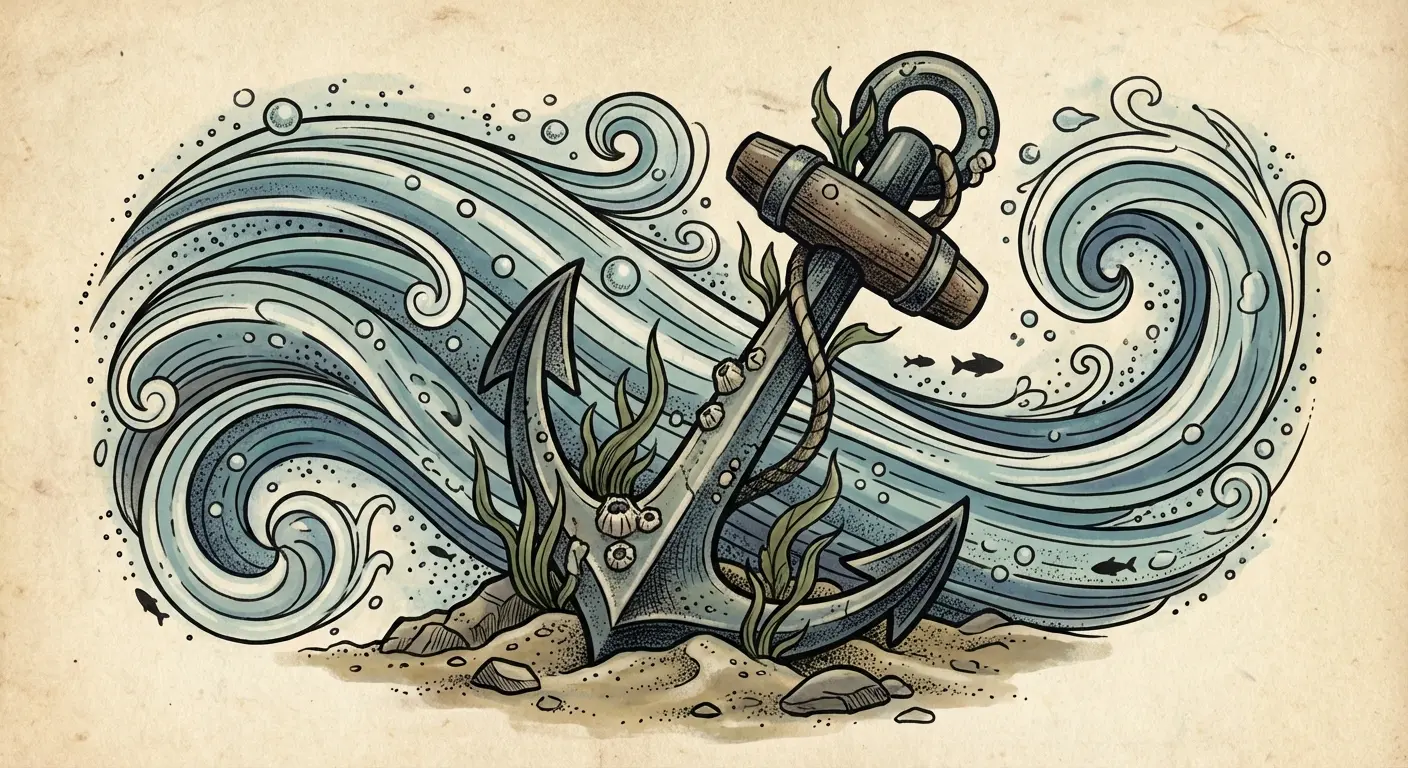
7. Anchor Caught in Current Lines
Imagine an anchor surrounded by flowing current lines, showing water or wind moving around and through it. The anchor remains solid and defined, but everything around it is in motion.
This speaks to people who stay themselves while everything changes around them. The current lines can be realistic water (with skilled shading showing depth and transparency), or more abstract and graphic. They might flow in one consistent direction, or swirl and eddy around the anchor in complex patterns.
Some versions incorporate small details being carried by the current (leaves, petals, small fish, bubbles) to emphasize the passage of time and change. The anchor’s position matters too. Is it resting on the bottom with currents flowing overhead? Is it suspended mid-water with currents from all directions? Is it partially buried with only the crown visible?
Each positioning tells a different story about your relationship with change. Back of shoulder, outer bicep, or calf placements work well. The current lines can extend and wrap slightly, creating connection between the design and your body’s movement.
8. Wave-Formed Anchor Silhouette
What if the anchor itself was made entirely of waves? Not waves around an anchor, but waves forming the anchor’s shape. This requires serious artistic skill to pull off (the negative space and flow need to be perfect), but when it works, it’s stunning.
I’m honestly not sure if the wave-formed anchor will still look good in 15 years. The concept is relatively new. But if you’re willing to be an early adopter, it’s gorgeous.
The wave-formed anchor represents finding stability within change itself, or recognizing that what grounds you isn’t solid at all. The waves can be realistic with detailed foam and spray, or more stylized and graphic. They can all flow in the same direction, or come from different angles to meet and form the anchor shape.
Some versions use different wave intensities (calm ripples forming some parts, crashing waves forming others) to represent varying life circumstances. Color choices matter here. Traditional blue water keeps it clearly nautical. Black and gray makes it more versatile and timeless. Unexpected colors (deep purples, greens, even warm tones) can add personal meaning.
This needs space to be readable, so think larger placements: thigh, back, chest, or full shoulder.
Anchors as Architectural Elements
Different vibe entirely: what if your anchor was architecture?
We don’t often think of anchors as building blocks, but that’s literally what they are. Structural elements designed to bear weight and hold things in place. These designs reimagine anchors as architectural elements, transforming nautical symbolism into something more universal.
The architectural approach opens up entirely new conceptual territory. Instead of maritime references, you’re working with ideas about construction, support, and the deliberate building of stability.
9. Anchor as Building Foundation
Picture an anchor buried in the ground with a structure built on top of it, the anchor’s crown forming the literal foundation. The structure could be a house (representing family or home), a lighthouse (representing guidance or hope), or something more abstract and geometric.
This works for people who recognize that their stability isn’t accidental. It’s engineered and intentional. The anchor portion can be realistic and weathered, showing age and reliability. The structure above can match that realistic style or contrast with it (geometric and modern against traditional anchor, for example).
Some versions show the anchor partially underground with cross-section views revealing how deep the foundation goes. Others keep the anchor visible and make it clearly load-bearing.
You can incorporate architectural details that mean something specific to you: a particular window style, a door color, a roof shape that matches a meaningful place. The ground line where anchor meets structure creates a natural division if you want to add other elements (flowers growing at the surface, roots extending down).
Outer thigh gives you the vertical space this needs. Rib placement creates interesting interaction with your body’s natural architecture.
10. Geometric Anchor Mandala
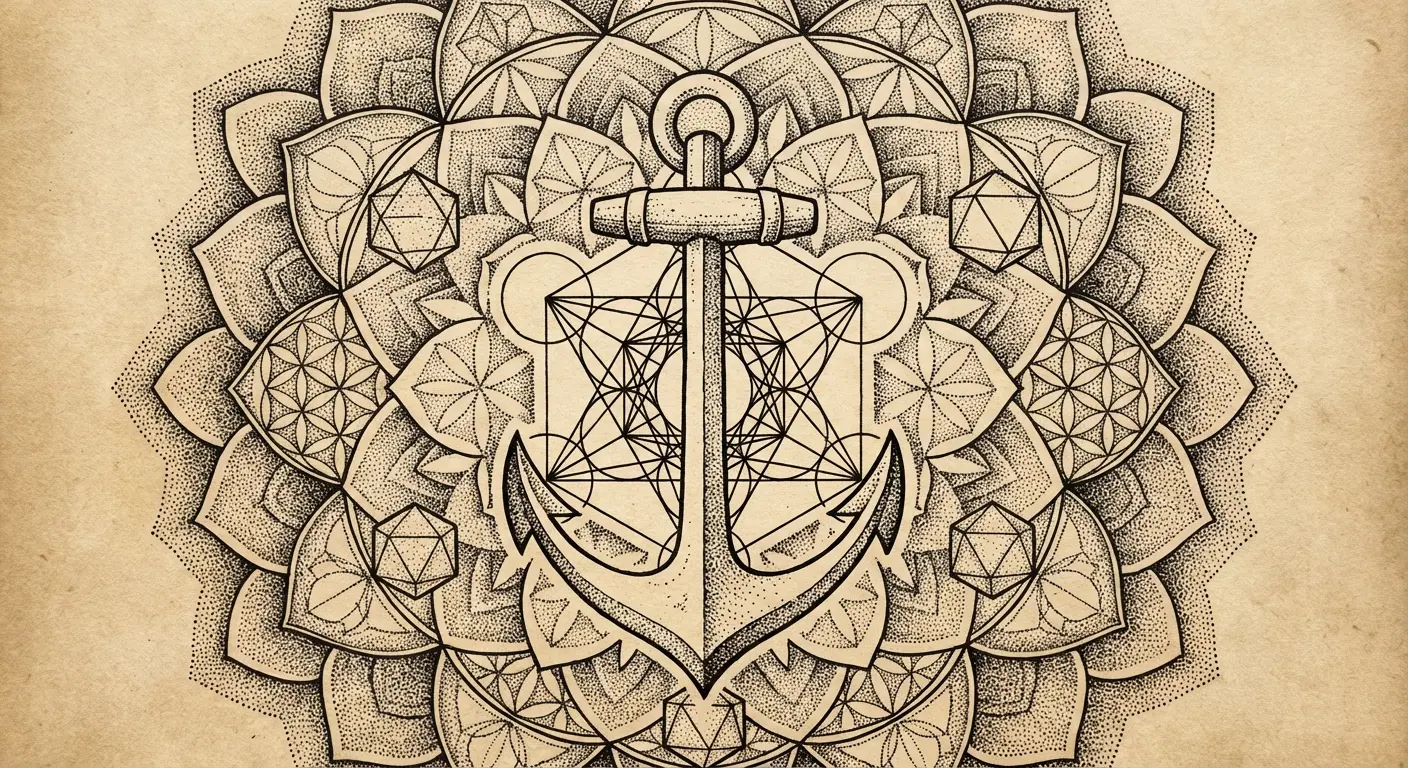
Mandala designs represent wholeness, but anchoring that concept (literally) creates something unexpected. A geometric anchor mandala uses the anchor as the central axis around which sacred geometry radiates.
Fair warning: geometric tattoos show EVERY imperfection. If your artist’s lines aren’t perfectly crisp, you’ll see it. Check their geometric work specifically, not just their general portfolio.
The anchor’s vertical line becomes the mandala’s spine, with symmetrical patterns extending outward from it. The versions that work integrate the anchor so thoroughly that you can’t tell where anchor ends and mandala begins.
The flukes might form part of the outer mandala ring. The stock could incorporate geometric divisions. The shank might feature repeating patterns that echo in the surrounding design. Dotwork, linework, or combination approaches all work depending on your style.
This appeals to people who find their center through stability, who see grounding as a spiritual practice rather than just a physical state. The symmetry creates a meditative quality that traditional designs don’t have.
Placement options are wide open: back, chest, thigh, or even forearm if you size it appropriately. The circular nature of mandalas makes them work well on body areas with natural curves.
11. Anchor Forming a Doorway
An anchor bent and shaped to form a doorway or archway creates immediate visual intrigue. What does it mean to enter through an anchor? To pass through the symbol of staying put?
This plays with contradiction in ways that make people think. The anchor’s shank can form the arch itself, with flukes creating decorative elements on either side. Or the entire anchor can be abstracted and reformed into an architectural arch shape while maintaining recognizable anchor elements.
The doorway can open onto specific imagery (an ocean view, a memory, another symbol entirely, or just negative space suggesting infinite possibility). Some versions include an actual door within the anchor archway, complete with handle and hinges. Others leave it open, emphasizing passage and transition.
This works for people moving through major life transitions, or for those who see their stability as something that enables movement rather than prevents it. You can add text above the arch (a meaningful phrase, coordinates, a name) or keep it clean.
Placement depends on size and detail level. Larger versions need back, thigh, or chest. Simpler interpretations can work on forearm or shoulder.
12. Anchor as Bridge Support
Bridges need anchors too, and this design shows an anchor functioning as a bridge support or pier, with the structure extending from it. The bridge can be realistic and detailed, or simple and symbolic.
It might stretch across your body from the anchor point, or extend into negative space, suggesting continuation beyond what’s visible. This represents being the foundation for others, or recognizing that your stability enables connection.
The bridge type matters. A suspension bridge suggests flexibility and span. An arch bridge emphasizes strength through structure. A simple beam bridge keeps it clean and minimal. You can show people crossing the bridge (silhouettes, footprints, shadows) or leave it empty.
Water below the bridge adds context and completes the scene, or you can leave the space abstract. Some versions show multiple anchors supporting one bridge, representing community or shared foundation. Others show a single anchor bearing the full weight, emphasizing individual strength.
This works really well for people in caretaking roles, or those who’ve learned that being grounded doesn’t mean being isolated. Upper arm, shoulder blade, or outer thigh placements provide the canvas this concept needs.
Living Anchors: When Metal Meets Organic
And now for my favorite category: anchors that nature takes back.
The most overlooked angle in anchor design might be the simplest: what happens when you leave an anchor underwater long enough? Nature reclaims it.
These designs explore anchors as habitats, as gardens, as frameworks for growth rather than instruments of restraint. The contrast between manufactured metal and organic life creates visual interest that goes beyond typical designs.
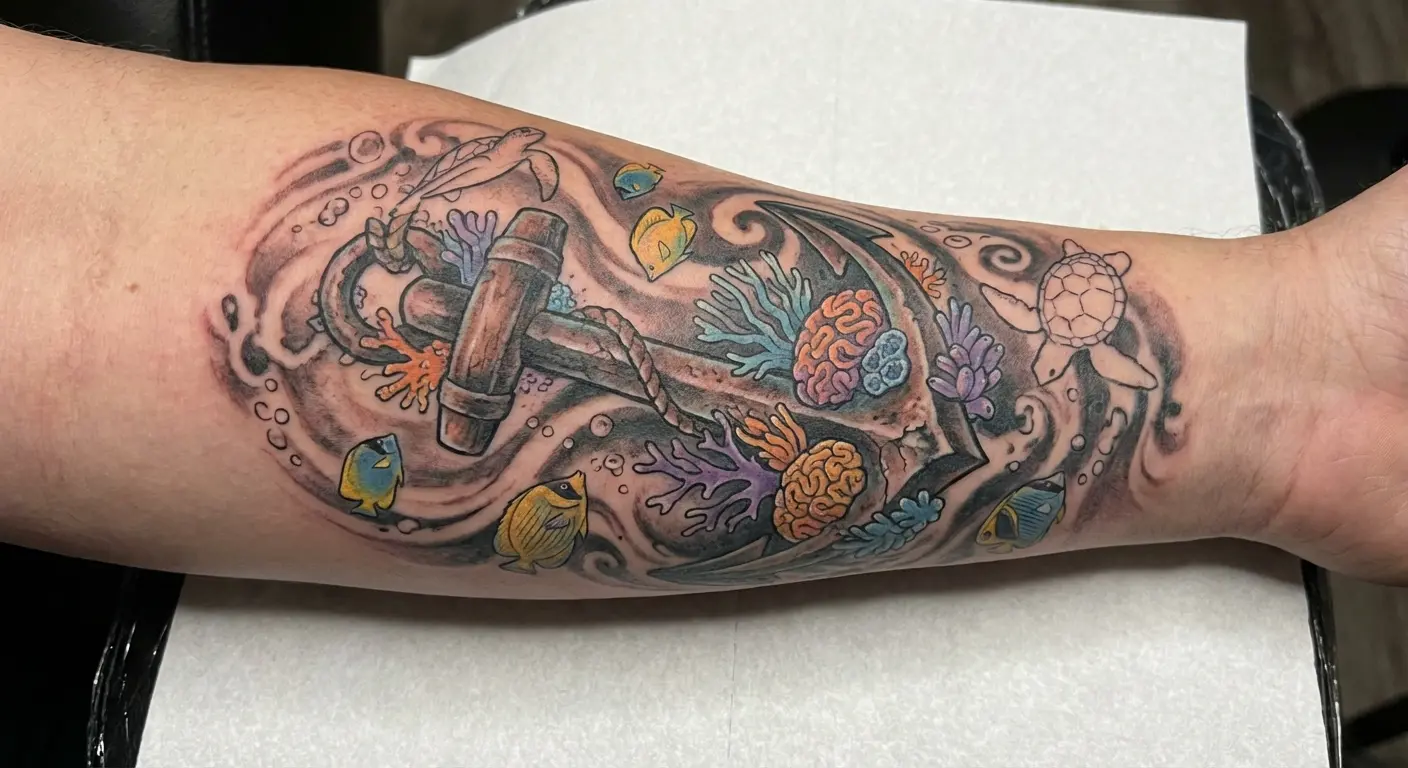
13. Coral-Encrusted Anchor Garden
A realistic anchor covered in coral growth tells a story about time, transformation, and unexpected beauty emerging from what was meant to hold things down. The coral can be scientifically accurate (brain coral, staghorn, fan coral, each with distinct textures) or more stylized and decorative.
Color or black and gray? Here’s the honest answer: color looks incredible for about 3-5 years, then you’re looking at touch-ups. Black and gray ages better but loses that underwater magic. Pick your priority.
The amount of coral coverage matters too. Partial encrustation shows the transformation in progress. Complete coverage where you can barely see the anchor underneath suggests something almost entirely reclaimed by nature.
Small fish, sea stars, or anemones can inhabit the coral garden, adding life and movement. This resonates with people who’ve learned that staying in one place doesn’t mean stagnation, that roots (or anchors) can become the foundation for entire ecosystems.
The biological accuracy level is up to you. Some people want their coral species to be identifiable and realistic. Others prefer the aesthetic of coral shapes without worrying about scientific precision.
Placement options are wide open, though areas with more surface space (thigh, back, shoulder) let you include more detail and variety in the coral species.
14. Anchor Sprouting Wildflowers
An anchor with wildflowers growing from every surface creates an immediate visual contrast: heavy metal versus delicate petals, maritime versus meadow, holding down versus reaching up.
The flower choices carry meaning. Poppies suggest remembrance or sleep. Lavender indicates calm. Sunflowers represent optimism. Wildflower mixes suggest untamed growth and resilience.
The flowers can emerge from cracks in the anchor (suggesting beauty breaking through damage), or simply grow alongside and through it (suggesting coexistence of strength and softness). Stem and leaf details matter. Realistic botanical illustration style creates one mood, while loose watercolor flowers create another entirely.
You can include roots visible within the anchor’s structure, showing how deeply the growth has taken hold. Some versions show flowers in various stages (buds, blooms, seed heads) to represent the full cycle of growth.
The evolution of anchor tattoos reflects broader shifts in tattoo culture. While anchors were initially done primarily by people associated with the sea like sailors and fishermen, over time they’ve taken on more universal messages, with some people now adding elements such as flowers, hearts or infinity signs to give their designs unique meaning according to InkSearch’s exploration of anchor symbolism. This trend toward personalization and hybrid designs explains why wildflower-anchor combinations resonate so strongly with contemporary tattoo enthusiasts seeking to merge traditional maritime imagery with organic, growth-oriented symbolism.
This speaks to people who’ve found that what once weighed them down became the foundation for something beautiful. It’s particularly meaningful for anyone who’s transformed trauma, grief, or hardship into personal growth. The anchor can be pristine with flowers as decoration, or weathered and broken with flowers as reclamation.
Placement flexibility is high. Forearm, shoulder, thigh, and rib cage all work depending on your size and detail preferences. Even smaller, the symbolism carries significant weight.
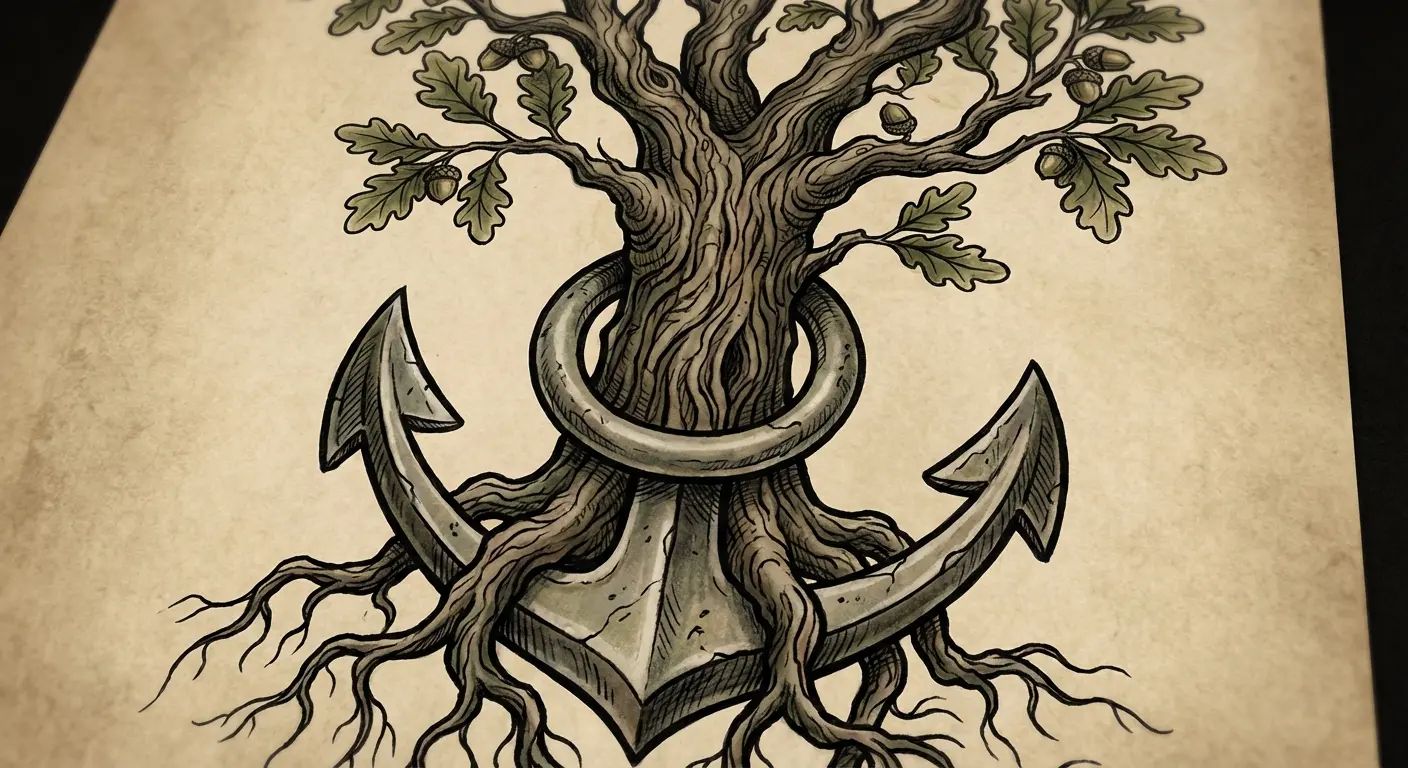
15. Tree Growing Through Anchor Frame
A tree trunk growing up through the center of an anchor, with branches extending beyond and roots reaching below, creates a powerful vertical composition. The anchor becomes a frame rather than the focus, suggesting that what once defined you now simply contains part of your story.
The tree species changes everything. Oak suggests strength and endurance. Willow indicates flexibility and emotion. Cherry blossom represents impermanence and beauty. Pine suggests resilience and longevity.
The trunk can be centered perfectly through the anchor’s shank, or growing at an angle that suggests it pushed through rather than grew neatly. Branch placement determines composition. Branches can extend symmetrically for balance, or asymmetrically for dynamic movement.
Roots below can mirror the branch structure, or take their own path. Some versions show the anchor partially broken or bent from the tree’s growth, emphasizing nature’s power to overcome metal and human intention. Others show anchor and tree in harmony, neither dominating.
Seasonal details add another layer: spring blossoms, summer leaves, autumn colors, winter bare branches, or a combination showing multiple seasons simultaneously. This works for people who’ve outgrown old definitions of themselves but still carry them as part of their structure.
Back placement gives you the vertical space this deserves. Outer thigh or full side body also work well.
16. Anchor with Mushroom Clusters
The mushroom anchor is weird. Like, genuinely weird. I love it. Your mom will hate it. That might be the point.
Mushrooms growing from an anchor create an unexpectedly beautiful design that most people overlook entirely. Mushrooms represent decomposition, transformation, and the hidden networks that connect things underground.
An anchor covered in mushroom growth suggests something being broken down and returned to the earth, or the mysterious beauty that emerges in dark, damp places. Mushroom variety matters significantly. Oyster mushrooms create shelf-like layers. Morel mushrooms add intricate texture. Amanita mushrooms (the classic red with white spots) bring fairytale energy. Bracket fungi suggest age and slow transformation.
You can go scientifically accurate or more whimsical and stylized. Some versions include mycelium networks visible around and through the anchor, showing the underground connections that feed the visible growth.
Spore dispersal patterns, gills underneath caps, and growth stages (buttons to mature fruiting bodies) add realism and interest. This appeals to people interested in natural cycles, those who appreciate that decay feeds new life, or anyone drawn to the mysterious and slightly dark aesthetic mushrooms provide.
The anchor can be partially buried in forest floor debris (leaves, moss, small stones), or floating in negative space with mushrooms as the only context. Color choices range from natural earth tones to fantastical palettes.
Upper arm, thigh, or shoulder blade placements work well. The clustered nature of mushroom growth adapts nicely to body contours. This adds unexpected depth even in smaller sizes.
Bringing Your Anchor Vision to Life
You’ve spent time considering which concept resonates with your story. You’ve moved beyond the standard designs that everyone defaults to. But translating that vision into something a tattoo artist can work with? That’s where many people get stuck.
Here’s the thing about bringing your anchor idea to a tattoo artist: “I want an anchor but like… different” doesn’t give them much to work with.
You need visuals. Not just vague Pinterest boards of kinda-similar stuff, but actual references that show what you mean. The gap between “I want an anchor that dissolves into birds with a broken chain and maybe some flowers” and an actual coherent design is wider than you think. Artists need visual references, not just verbal descriptions.
They need to see proportions, understand how elements interact, and visualize the composition on your specific body placement. Bringing a collection of vaguely similar Pinterest images doesn’t give your artist the clarity they need to execute your vision.
That’s where Tattoo Generator IQ comes in. Plug in your specific concept (floating anchor with roots, geometric mandala anchor, coral-covered anchor garden, whatever speaks to you) and get actual design variations you can show your artist in seconds.
Want to see how that tree-through-anchor looks with oak versus willow? Generate both options. Curious if your wave-formed anchor reads better in realistic or geometric style? Compare them side by side. Need to show your artist exactly what you mean by “anchor forming a doorway”? Bring them a crystal-clear reference instead of trying to explain it verbally.
The designs come out artist-ready, meaning your tattoo artist can use them as solid references rather than starting from scratch or trying to interpret your verbal description. You maintain creative control while giving your artist the visual foundation they need to do their best work.
I’m not saying it replaces your artist’s skill. I’m saying it helps you communicate what’s in your head so they can do their best work.
We’ve seen too many people compromise on their ideas because they couldn’t communicate their vision effectively. Having a concrete visual reference changes the entire consultation process.
Final Thoughts
Your anchor doesn’t have to anchor you to anything. Not to tradition, not to the past, not to some prescribed meaning that never fit you anyway.
Anchor tattoos don’t have to follow outdated symbolism or predictable designs. The eighteen concepts we’ve covered here challenge what anchors are supposed to mean and how they’re supposed to look.
They represent the full range of what stability, weight, and grounding can signify in a human life. Some of you will connect with designs that float or dissolve, finding freedom in the subversion of what anchors traditionally do.
Others will gravitate toward anchors in motion, capturing that energy of change while respecting nautical heritage. The architectural approaches will appeal to people who see their stability as something they’ve built intentionally, not something that happened to them.
The living designs speak to anyone who’s discovered that what weighs you down can become the foundation for unexpected growth. Your tattoo doesn’t need to explain itself to everyone who asks. It just needs to be true for you.
Whatever concept you choose, make sure it challenges you a little bit. The best tattoos aren’t the ones that fit neatly into existing categories. They’re the ones that make you think twice, that carry layered meanings, that reveal something new each time you look at them.
Your tattoo should do the same. The ideas that resonate most deeply are usually the ones that surprised you when you first encountered them, the designs that made you reconsider what this symbol could mean.
We’ve moved far beyond the simple maritime anchor that sailors wore as a badge of their profession. Today’s designs can represent anything from breaking free of the past to choosing where you plant your roots, from honoring what grounds you to celebrating what helps you grow.
The best anchor tattoo is the one that makes you reconsider what an anchor even is. The one that surprises you every time you look at it. The one that carries meanings you haven’t even discovered yet.
Make it weird. Make it yours. Make it mean something that only makes sense to you.
That’s when anchor tattoos actually work. If you’re considering placement and sizing for your design, reviewing proper tattoo aftercare practices will help ensure your piece heals beautifully and maintains its visual impact for years to come.
