16 Spider Lily Tattoos That Capture What Most Designs Miss
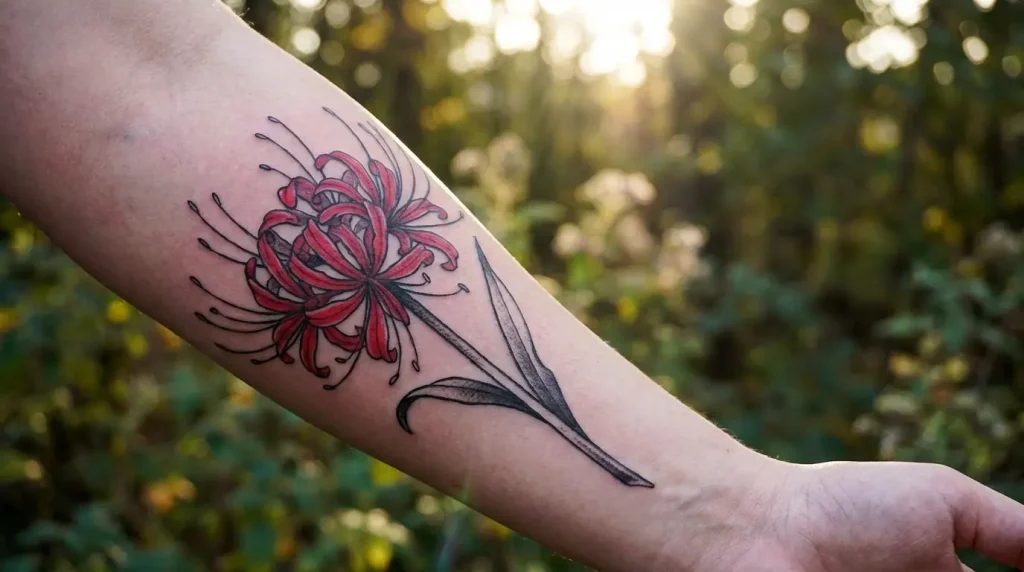
Table of Contents
-
Blooms That Don’t Shy Away from Death
-
Classic Red Spider Lily with Falling Petals
-
White Spider Lily Against Black Ink Waves
-
Dual-Toned Red and White Spider Lily Pair
-
Spider Lily Emerging from Cracked Earth
-
-
Why Placement Changes Everything
-
Spine-Aligned Single Stem Spider Lily
-
Behind-the-Ear Miniature White Spider Lily
-
Finger-Wrap Spider Lily Vine
-
Collarbone-Following Red Spider Lily Cascade
-
-
How to Not Be Culturally Ignorant (Please)
-
Spider Lily with Hanzi Script Integration
-
Buddhist Wheel and Spider Lily Composition
-
Korean Folklore-Inspired Spider Lily Path
-
Spider Lily Framing Ancestral Portrait
-
-
When Botanical Accuracy Actually Matters
-
Anatomically Correct Spider Lily Root System
-
Spider Lily in Various Growth Stages
-
Cross-Section View of Spider Lily Bulb
-
Wildfire-Scarred Spider Lily Resilience Piece
-
Quick Version
-
These flowers mean death and goodbye in Japanese culture, not just “pretty red flower”
-
Where you put it changes what it means (spine work isn’t the same as ankle work)
-
Red is everywhere; white is underrated
-
Don’t Google Translate your Chinese characters. Please.
-
Most designs are generic. These aren’t.
Blooms That Don’t Shy Away from Death
Yeah, spider lilies are gorgeous. Those curves, that red. I get it. But here’s the thing nobody tells you: the flowers and leaves never exist at the same time. The leaves die completely before the bloom ever shows up. Once you know that, you can’t unsee it.
The flower and foliage never coexist. This biological quirk has made them symbols of separation, loss, and the barrier between worlds across multiple Asian cultures.
In Japanese culture, the spider lily (Higanbana) gets planted at gravesites and shows up in death symbolism constantly, which adds serious weight to the tattoo according to floral tattoo specialists. These four designs lean into that darkness instead of pretending it’s just another pretty flower.
They’re for people who want their ink to acknowledge grief, transformation, or those weird in-between moments where one phase of life ends and another begins. These designs don’t soften the flower’s associations with death. They embrace them, creating pieces that honor the full weight of what this bloom represents. I’ve watched clients who understand this deeper meaning walk away with tattoos that hit on a completely different level than purely decorative floral work. When you’re exploring ideas, understanding the symbolism transforms the entire process from surface-level aesthetics to something that actually means something.
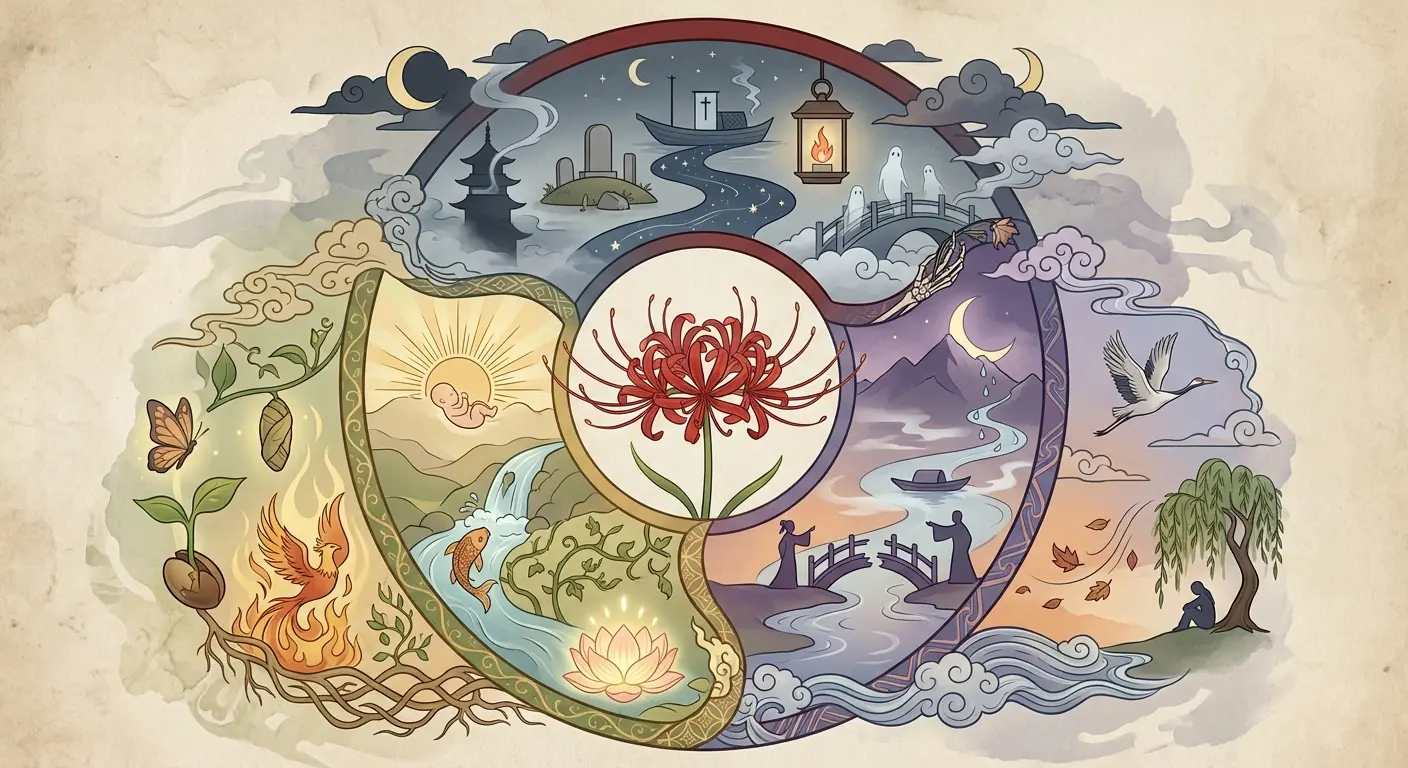
Red ones mean death and goodbye. They’re all over Japanese graves. White spider lilies flip that to rebirth and purity. And if you get both? You’re holding space for contradictions. Red works for processing loss, honoring the deceased. White works for transformation, fresh starts. Dual red and white works for major life changes, complex emotions that don’t fit into neat categories.
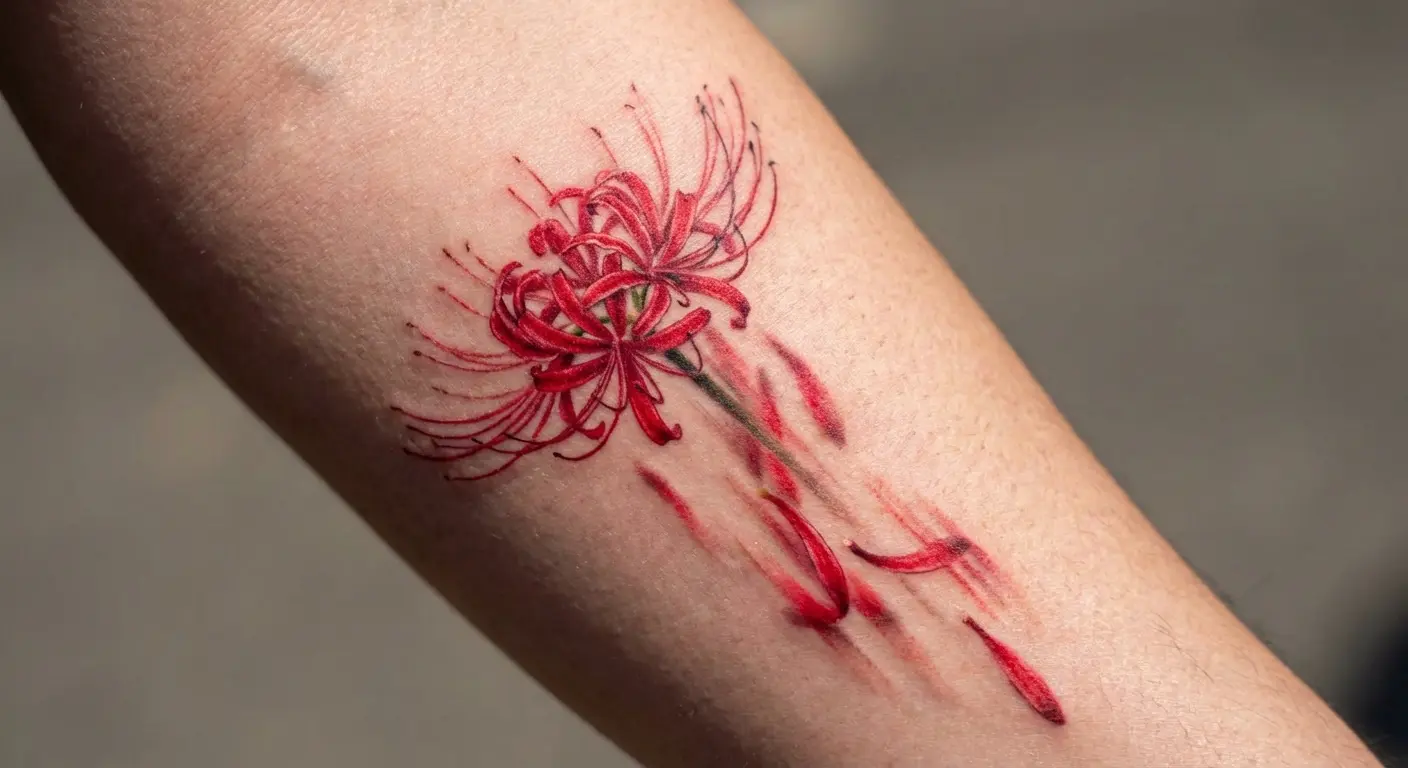
1. Classic Red Spider Lily with Falling Petals
This design captures the flower at its peak, but adds motion through descending petals. The falling elements show time passing and beauty fading. Which is exactly the point.
You can place this anywhere from forearm to thigh, but it needs vertical space to show the petal descent. The red pigment stays vibrant for years if you follow proper aftercare, though you’ll want to discuss ink saturation with your artist. Some people add a single green leaf at the base, but that contradicts the plant’s growth pattern.
Spider lily leaves don’t appear until after the flowers die. If botanical accuracy matters to you, skip the foliage.
Just like with lotus flower tattoo symbolism, understanding the deeper meaning elevates it from decorative to deeply personal. I’ve worked with clients who initially wanted just a pretty red flower, then completely redesigned their concept after learning about the separation between bloom and leaf. That knowledge transformed their piece from decoration into memorial. The classic version remains one of the most requested designs because it captures both beauty and melancholy in a single image.
2. White Spider Lily Against Black Ink Waves
White spider lilies carry different weight than their red counterparts. They’re associated with purity and rebirth rather than death and farewell. Pairing them with black wave patterns creates stark contrast while nodding to the flowers’ connection with water crossings in Japanese Buddhist tradition.
The Sanzu River (which souls cross after death) gets depicted with spider lilies on its banks. This design works particularly well as a half-sleeve or back piece where you have room to develop the wave patterns. The negative space matters as much as the inked areas.
Your artist needs solid experience with Japanese-style water elements to pull this off correctly. If you’re drawn to Japanese traditional tattoo aesthetics, combining white spider lilies with wave patterns creates an authentic cultural composition that honors the style’s heritage. Popular variations include too many attempts where the waves look more like random curved lines than actual water. The difference between good and mediocre execution becomes immediately obvious when you understand traditional Japanese wave rendering techniques. A white version set against dramatic waves offers a striking alternative to the more common red variations.
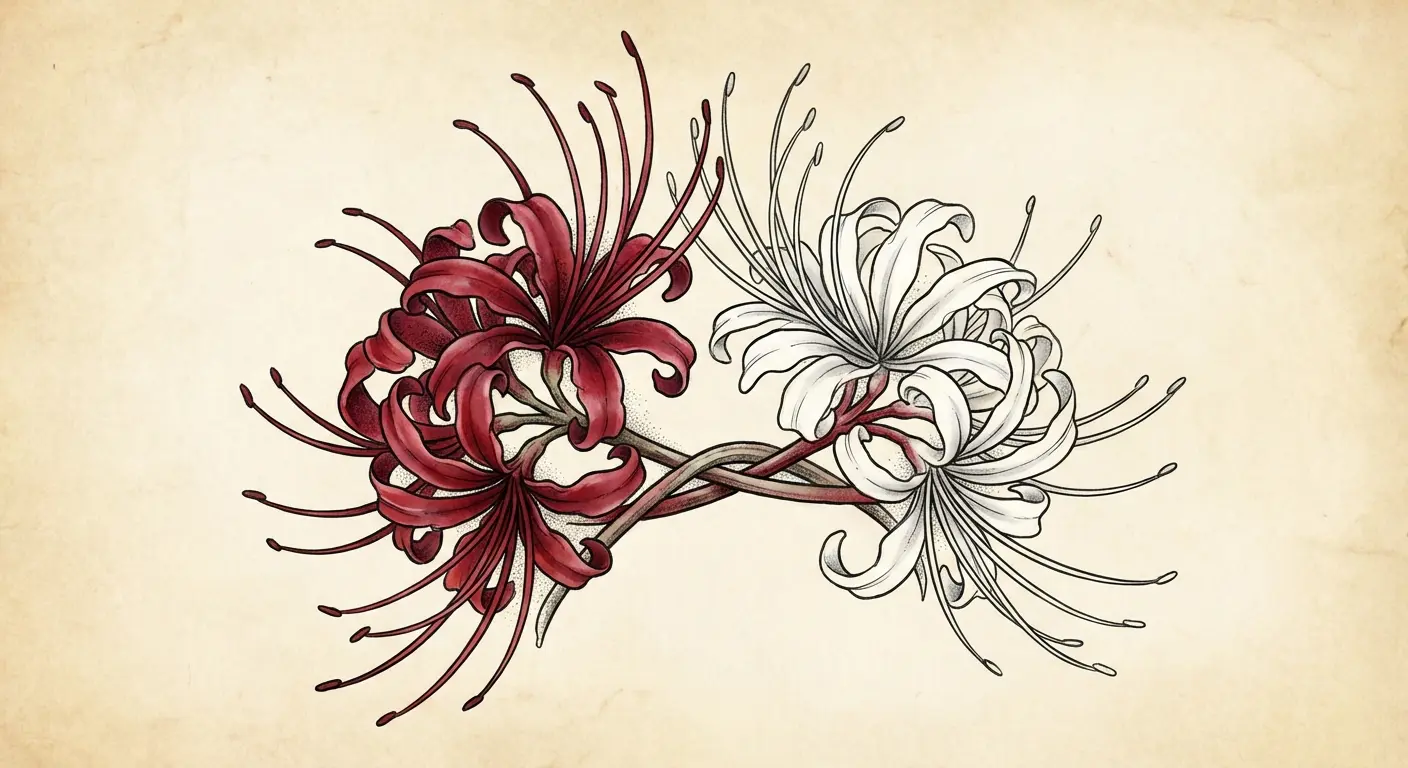
3. Dual-Toned Red and White Spider Lily Pair
Combining both colors in one design lets you hold multiple meanings simultaneously. Red for goodbye, white for new beginnings. This works for people processing major life transitions, whether that’s leaving a relationship, losing someone, or closing a significant chapter.
The flowers can intertwine or stand separate depending on how you want to represent your specific experience. Placement-wise, this needs enough space for both blooms to read clearly. Upper arm, shoulder blade, or thigh give you that room.
Color saturation matters here. You’ll want deep, true red that doesn’t lean orange and clean white that pops against your skin tone.
Dual-toned designs resonate with people who refuse to simplify their experiences into single emotions. Grief and hope can coexist. Endings and beginnings can overlap. This design acknowledges that complexity in a way that single-color pieces can’t quite capture. When considering ideas, the dual-toned approach offers unique storytelling potential that honors life’s contradictions.
4. Spider Lily Emerging from Cracked Earth
This design emphasizes the flower’s reputation for blooming in harsh conditions and disturbed soil. Spider lilies often appear suddenly in areas affected by fire or flooding. They’re survivors.
Adding cracked, dry earth around the base creates visual tension between the delicate bloom and the hostile environment. This resonates with people who’ve grown through difficult circumstances rather than despite them.
The cracks can extend outward to fill space or stay contained around the stem. You might incorporate ash, small stones, or other environmental details. Shading becomes critical here. Your artist needs to create depth in those earth cracks without making them look like random black lines.
Bring reference photos of actual cracked earth patterns to your consultation. The designs that include environmental context tend to tell more complete stories than isolated blooms floating on skin. This concept works especially well for those who want to emphasize resilience and transformation through adversity.
Why Placement Changes Everything
Where you put this thing changes what it says. These flowers already carry heavy symbolic weight, but placement adds another layer of meaning that most people overlook. Your spine represents your core self. Your fingers interact with the world constantly. Behind your ear sits close to where you process sound and memory.
Each location creates a different relationship between you and the design. These four placements aren’t just about aesthetics (though they certainly look good). They’re about positioning the symbolism in ways that reflect how you experience it.
A piece on your collarbone hits different than one on your ankle, and we’re going to explore why that matters. I’ve consulted with clients who changed their entire design approach after considering how placement would affect their daily interaction with the piece. The placement can amplify or shift its meaning in ways that transform the entire concept.
Spine placement: High pain level, low visibility, represents core identity and central transformation. Minimal fading, stable over time.
Behind ear: Moderate pain, selective visibility depending on hairstyle, represents hidden memory and whispered goodbye. May require touch-ups.
Finger: Moderate to high pain, constant visibility, represents daily reminder and impermanence. Fades quickly, frequent touch-ups needed.
Collarbone: Moderate pain, high visibility with most necklines, represents prominent statement and visible grief or growth. Moderate stability, skin stretches with movement.
5. Spine-Aligned Single Stem Spider Lily
Running a single stem along your spine creates a vertical line that emphasizes the flower’s connection to life force and core identity. The bloom can sit at the base of your neck or between your shoulder blades, with the stem extending downward.
This placement hurts more than fleshier areas (there’s no getting around that), but the pain becomes part of the meaning for many people. The discomfort mirrors the difficulty of growth and transformation.
You’ll need to consider how this works with your existing or planned back pieces. A spine piece creates a strong central axis that other designs will need to work around or incorporate.
I’ve had clients describe their spine sessions as meditative despite the pain. Something about the location and the flower’s symbolism creates a ritualistic quality to the experience. It becomes not just the finished product but the entire process of getting it. This placement transforms your piece into a deeply personal statement about your core transformation and identity.

6. Behind-the-Ear Miniature White Spider Lily
Small doesn’t mean insignificant. A tiny white version behind your ear stays mostly hidden but reveals itself with certain hairstyles or head movements. This placement works for people who want the symbolism without the constant visibility.
The behind-the-ear location has become popular, but most designs there are generic. A spider lily brings specific meaning about memory, loss, and whispered goodbyes. The small size means simplified details. Your artist will need to decide which elements to keep and which to suggest rather than render fully.
For delicate behind-the-ear designs, working with artists experienced in fine-line tattoo techniques ensures your miniature version maintains clarity and detail despite its small size. Fine-line work requires an experienced hand. Poor execution at this scale looks muddy fast, and Popular variations include too many beautiful concepts ruined by artists who didn’t have the technical skill for miniature work. This discreet placement offers intimacy and personal meaning without demanding constant visibility.
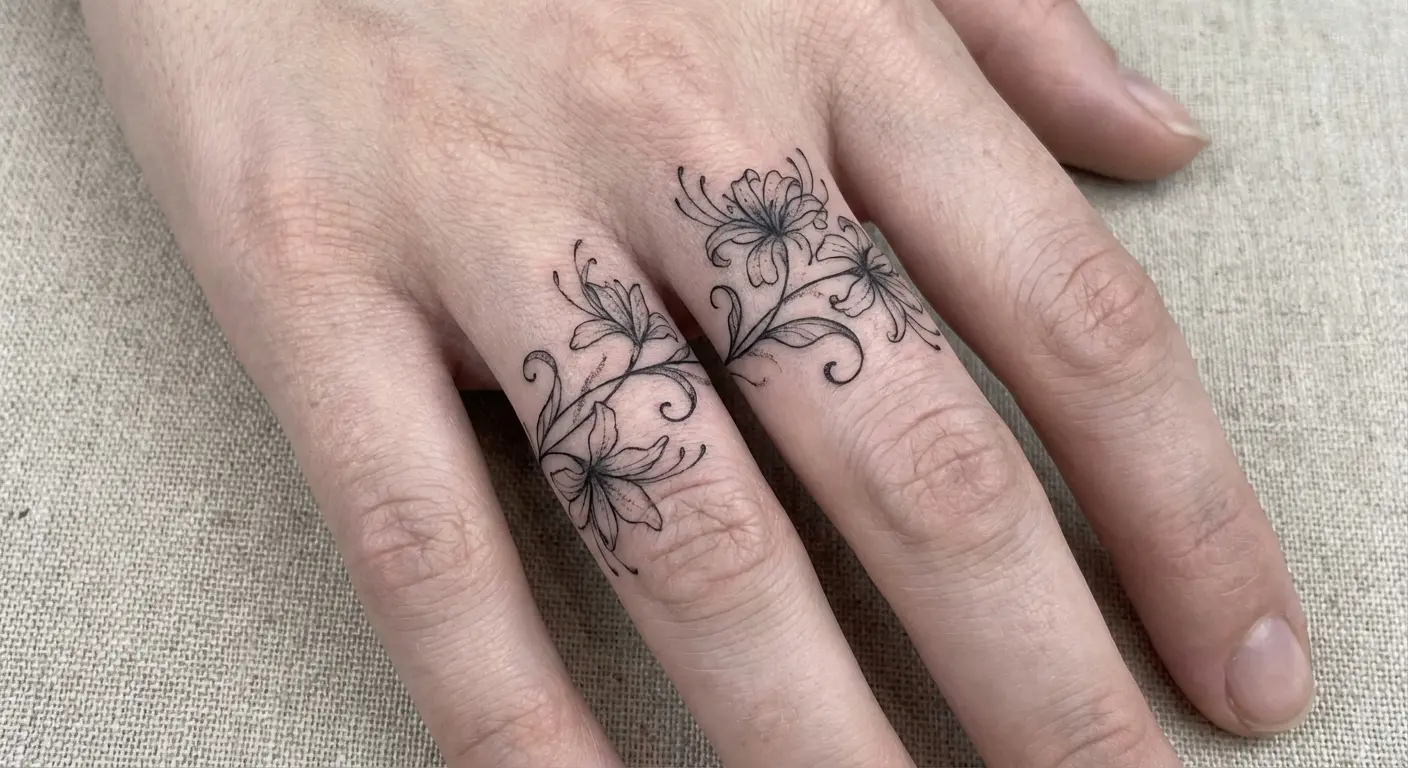
7. Finger-Wrap Spider Lily Vine
Spider lilies don’t grow as vines (they’re bulb plants), but artistic license lets you wrap a stylized version around a finger. This creates a ring-like effect with deeper symbolism than traditional band tattoos.
Your hands age faster than other body parts, and finger tattoos fade quicker. That impermanence reinforces the themes about transience and letting go. You’ll likely need touch-ups every few years.
The wrapping motion can go clockwise or counterclockwise. Some traditions assign different meanings to each direction, though interpretations vary. Discuss sizing carefully with your artist. Too thick and it looks heavy, too thin and it fades into illegibility.
Finger pieces are commitments to maintenance, not one-and-done work. The fading becomes part of the story if you’re willing to embrace it. This unconventional placement creates a constant reminder of impermanence and transformation.
8. Collarbone-Following Red Spider Lily Cascade
Your collarbone provides a natural horizontal line for flowers to follow. A cascade can flow from sternum to shoulder or vice versa. This placement draws eyes to your chest and neck, which means it makes a statement.
The flowers can decrease in size as they move outward, creating perspective, or stay consistent for a more pattern-like effect. Collarbone pieces show prominently with most necklines. You’ll want to consider your professional environment and how much visible ink you’re comfortable with.
The bone proximity means moderate pain levels. The skin stretches with certain movements, so your artist needs to account for how that affects the design.
Red cascades along the collarbone work particularly well for people who want their grief or transformation visible rather than hidden. There’s power in wearing your story where others can see it. A collarbone piece makes a bold statement about embracing both beauty and sorrow publicly.
How to Not Be Culturally Ignorant (Please)
Spider lilies carry specific cultural weight in Japanese, Chinese, and Korean traditions. Getting one when you’re not from those cultures requires thought about what you’re taking and why. These four designs show ways to honor the cultural context without cosplaying someone else’s heritage.
They incorporate cultural elements respectfully or reframe the symbolism through a personal lens that doesn’t claim ownership of traditions that aren’t yours. You’re not trying to look Japanese. You’re engaging with symbolism that resonates with your experience while acknowledging where that symbolism comes from.
There’s a difference between appreciation and appropriation, and that difference often comes down to how much homework you’ve done. I’ve turned away clients who wanted these purely for aesthetic reasons without any understanding of what they represent. That’s not gatekeeping. That’s encouraging people to engage meaningfully with cultural symbols rather than treating them as decorative elements. Approaching these designs with cultural awareness ensures your piece honors rather than exploits the flower’s rich heritage.
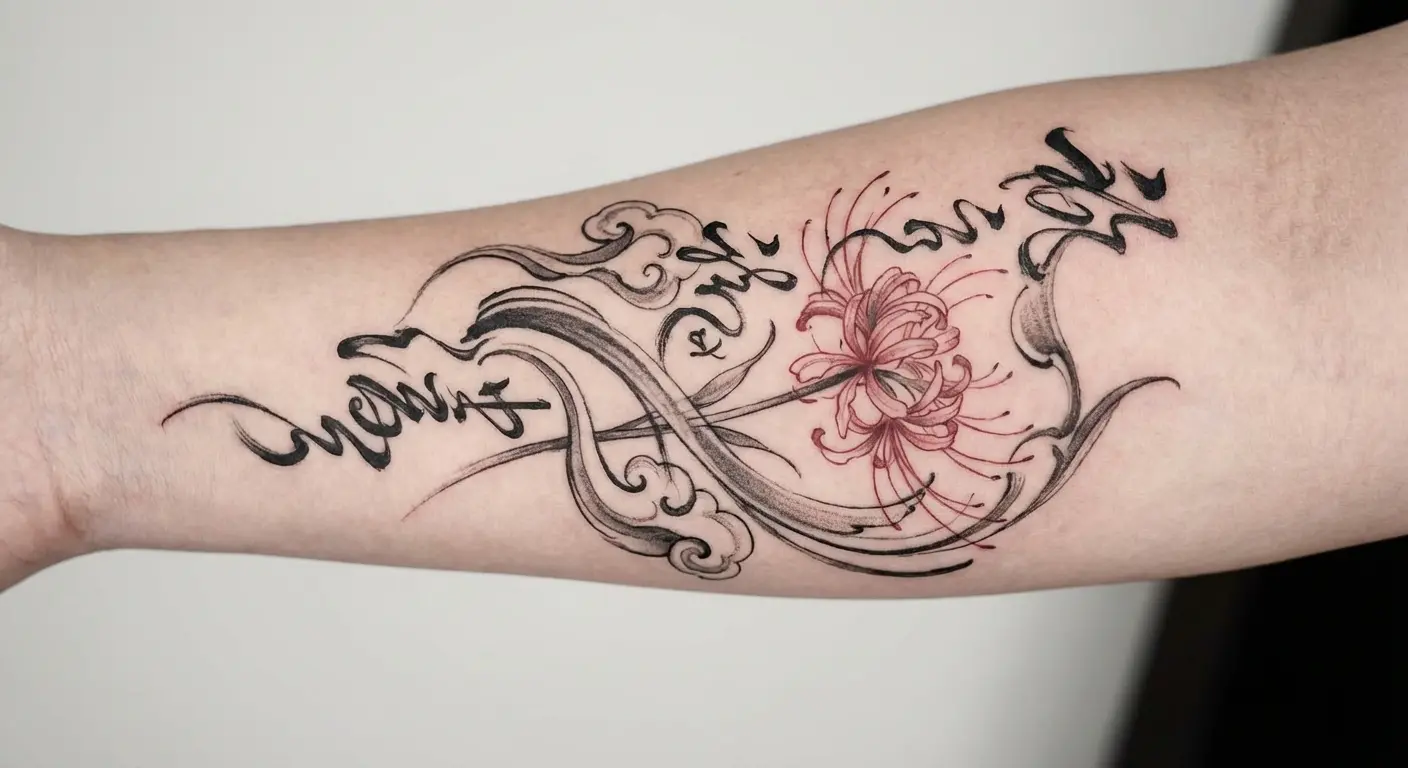
9. Spider Lily with Hanzi Script Integration
Combining spider lilies with Chinese characters requires careful consideration. You need to know exactly what the characters mean and verify their accuracy with a native speaker. Too many people have gotten nonsense or unintentionally offensive text permanently inked because they trusted online translators.
If you have personal connection to specific Chinese words (through family, study, or meaningful experience), integrating them with imagery can create layered meaning. The script can wrap around the stem, appear as background elements, or form a base from which the flower grows.
Calligraphy style matters. Different
Calligraphy style matters. Different scripts (kaishu, xingshu, caoshu) carry different aesthetic and cultural weight. Your tattoo artist needs reference material from an actual calligrapher, not a font.
I always recommend clients work with a calligrapher first to get proper character rendering, then bring that to their tattoo artist. The piece becomes a collaboration between multiple experts rather than a single artist guessing at cultural elements they don’t fully understand. This thoughtful approach ensures authenticity and respect.
10. Buddhist Wheel and Spider Lily Composition
The Dharma wheel represents Buddhist teachings about suffering, impermanence, and liberation. Spider lilies appear frequently in Buddhist contexts as flowers of the afterlife and transition. Combining them creates a design rooted in specific philosophical traditions.
This works if you practice Buddhism or have deep engagement with Buddhist thought. It doesn’t work if you just think the wheel looks cool. The composition can place flowers around the wheel’s perimeter, emerging from its center, or integrated with its spokes.
You might add other elements from Buddhist iconography like lotus flowers or bodhi leaves, though adding too much can make the design cluttered. Balance becomes key. Each element needs breathing room.
Popular variations include beautiful concepts ruined by overcrowding. When you’re working with symbols that carry this much weight, restraint often creates more impact than abundance. This approach works best when philosophical understanding guides the aesthetic choices.
11. Korean Folklore-Inspired Spider Lily Path
Korean tradition associates spider lilies with the path souls walk after death. They guide the deceased while simultaneously marking the boundary between worlds. A path of flowers can curve across your body, suggesting journey and transition.
This design works particularly well for people processing grief or major life changes. The path can be literal (showing ground or stones) or abstract (just the flowers in a line). You might incorporate Korean design elements like traditional patterns or architectural details, but only if you’ve researched their specific meanings.
Not every Korean visual element pairs appropriately with death symbolism. Some are celebratory or auspicious in ways that clash with the associations.
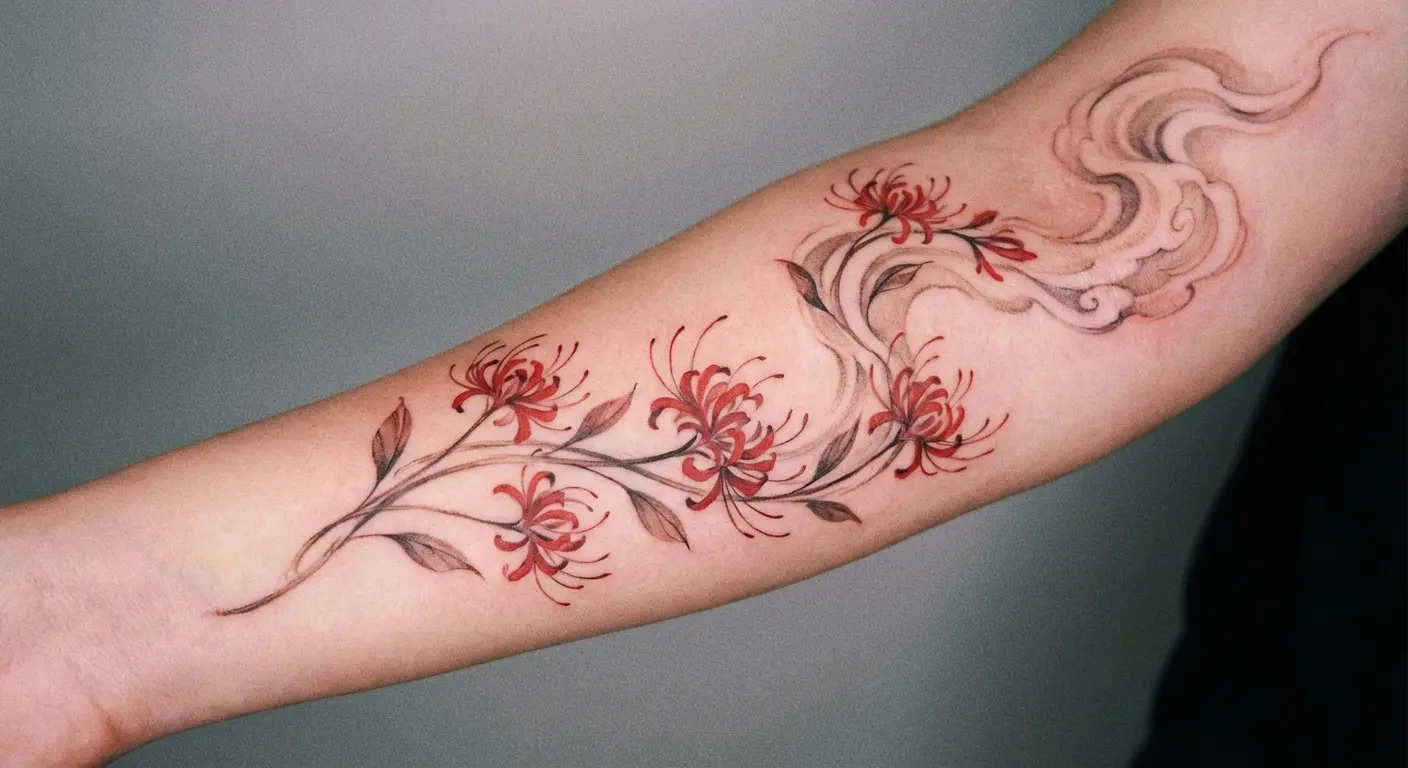
One Taiwanese woman recently shared her experience of getting a red spider lily piece to honor her stepfather who passed away when she was eighteen. According to UToday’s coverage of tattoo stories, she chose the design specifically because in Japanese culture, a spider lily represents a “last goodbye,” and the tattooing process helped her through the grieving process, something her psychologist confirmed. She placed it on her left forearm because her stepfather always held her left hand, creating a permanent connection to his memory.
Stories like this show how these designs can serve therapeutic purposes when grounded in genuine personal meaning rather than borrowed aesthetics. Her piece demonstrates how cultural symbolism can be personally adapted without appropriation.
12. Spider Lily Framing Ancestral Portrait
Using spider lilies to frame a portrait of a deceased family member creates a memorial piece grounded in the flowers’ traditional role. This personalizes the cultural symbolism by connecting it to your specific loss.
The portrait can be realistic or stylized, large or small. Flowers can form a complete border or appear at strategic points around the image. This design requires an artist skilled in portraiture. Bad portrait tattoos are immediately obvious and impossible to ignore.
You’ll need high-quality reference photos with good lighting and clear details. The flowers should enhance the portrait without overwhelming it. They’re the frame, not the focus.
I’ve worked with clients who brought multiple reference photos and spent consultation sessions determining which captured their loved one’s essence best. That preparation makes the difference between a piece that honors someone’s memory and one that misses the mark entirely. This deeply personal approach transforms memorial ink into something profoundly meaningful.
When Botanical Accuracy Actually Matters
Most designs take artistic liberties with the flower’s actual appearance and growth patterns. These four designs flip that approach. They start with botanical accuracy and use it as the foundation for artistic choices.
You end up with something that looks scientifically grounded while still being visually striking. This matters if you’re a gardener, botanist, or just someone who appreciates when tattoos reflect reality. It also separates your piece from the thousands of generic versions floating around.
When your artist has to research actual plant anatomy instead of copying other tattoos, you get something more original. These designs require artists willing to work from botanical references rather than just other portfolios. Research shows that clients who bring scientific illustrations or botanical drawings to consultations end up with ideas that stand apart from the crowd. Botanically accurate pieces demonstrate both artistic skill and intellectual engagement with the subject matter.
13. Anatomically Correct Spider Lily Root System
Spider lilies grow from bulbs with extensive root systems that most designs ignore entirely. Including the underground portion creates a complete picture of the plant and adds metaphorical weight about hidden foundations and unseen support systems.
The roots can spread across your skin, creating natural-looking tendrils that fill space organically. This works well as a larger piece where you have room to develop both the bloom and the root structure. The contrast between the delicate flower and the gnarled roots creates visual interest.
Your artist can render the roots in fine detail or suggest them through looser linework. Either approach works if executed consistently.
Some designs feature the root system becomes the dominant visual element, with the bloom almost secondary. That inversion of typical floral hierarchy creates something genuinely unexpected. This concept appeals to those who appreciate what lies beneath the surface.
14. Spider Lily in Various Growth Stages
Showing the flower through different phases of its life cycle creates a narrative piece that speaks to transformation and the passage of time. You might include the bulb, emerging shoot, full bloom, and seed pod stages in sequence.
This design works particularly well as a vertical piece along the forearm, calf, or side of the torso. The progression can move from bottom to top (suggesting growth) or top to bottom (suggesting the cycle completing).
Each stage requires different rendering techniques. The bulb needs texture and weight, the bloom needs delicacy, the seed pod needs structural detail. Your artist should be comfortable shifting between these different approaches within one cohesive piece.
Find artists whose portfolios show range across different subjects and styles. A piece that moves through growth stages demands versatility that not every tattoo artist possesses. This comprehensive approach tells a complete story of transformation and cycles.
15. Cross-Section View of Spider Lily Bulb
A cutaway view showing the bulb’s internal structure takes a scientific illustration approach to design. This isn’t common, which is exactly why it works. The layers of the bulb, the emerging shoot, and the root attachment point create geometric patterns that translate well to skin.
You can render this in clean black linework for a technical drawing aesthetic or add shading and color for more dimension. This design appeals to people who appreciate the intersection of art and science. It shows you’re interested in how things work beneath the surface, not just surface appearances.
Placement can go anywhere you have a roughly circular space to work with. Many people opt for vibrant red or orange hues when choosing these designs, making them stand out beautifully on the skin, according to tattoo artists specializing in floral work. Styles can vary from realistic depictions to minimalist outlines, allowing for personal expression that ranges from botanically accurate to highly stylized interpretations.
The cross-section approach falls firmly in the botanically accurate camp while still offering room for artistic interpretation in how you render those accurate details. This intellectual approach demonstrates both aesthetic sensibility and scientific curiosity.
16. Wildfire-Scarred Spider Lily Resilience Piece
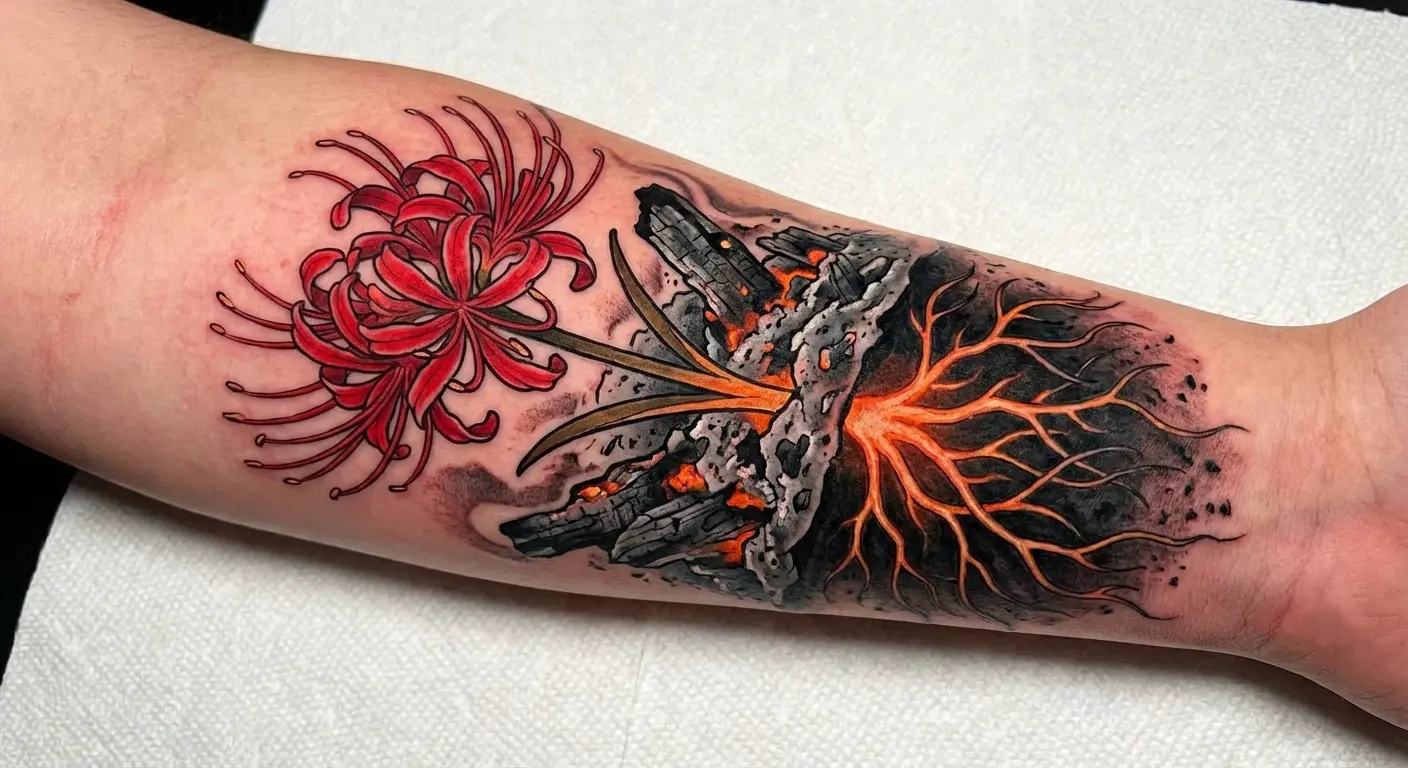
Spider lilies love fire. Seriously. Burn an area to the ground and they’ll pop up by the hundreds within weeks. They’re weeds that thrive on destruction. Getting one with charred earth or burned stems works if you’re someone who got stronger from the thing that should have destroyed you. Not despite it. Because of it.
The contrast between the delicate flower and the fire damage amplifies both elements. You can include actual flame elements or just show the aftermath through blackened earth and ash. This resonates with people who’ve experienced trauma or loss and found unexpected growth in its wake.
The fire damage can be subtle or dramatic depending on how much emphasis you want on the destruction versus the renewal. Your artist needs to balance both aspects so neither overwhelms the other. Similar to how phoenix tattoo symbolism represents rising from ashes, a wildfire-scarred design captures the same themes of resilience through a botanical lens.
I’ve worked with burn survivors, trauma survivors, and people who’ve rebuilt their lives after devastating losses who chose this design. The specificity of the wildfire context makes it deeply personal while still being universally readable as a symbol of perseverance. This powerful approach speaks to those who’ve transformed pain into growth.
Trying to explain your vision to an artist when you can’t quite articulate what you want creates real frustration. You know you want something meaningful, something that captures the flower’s symbolism without looking like every other design out there.
Tattoo Generator IQ lets you visualize different approaches before you commit. You can test whether you want red or white, whether you need cultural elements or prefer botanical accuracy, whether placement on your spine hits different than placement on your forearm. The AI generates variations based on your descriptions, giving you concrete images to refine rather than abstract ideas to explain.
You walk into your consultation with clear references that show exactly what you’re after. This has been bridge the communication gap between clients who know what they feel but struggle to describe it and artists who need visual direction to understand the vision. The tool doesn’t replace your artist’s expertise. It clarifies your concept so they can apply that expertise more effectively.
Final Thoughts
Spider lily tattoos carry more weight than most flower designs. They’re not just pretty blooms you picked because you like red. They reference death, separation, memory, and the spaces between worlds. Getting one without understanding that context means you’re wearing symbolism you don’t fully grasp.
But understanding the context doesn’t mean you need to follow every traditional interpretation. You can engage with the meanings in ways that reflect your specific experience. The flower blooms after its leaves die. It appears suddenly in disturbed soil. It marks boundaries between life and death.
Those facts create a foundation, but how you interpret and visualize them becomes personal. Your piece should acknowledge the cultural and symbolic history while still being unmistakably yours. I’ve spent years helping people navigate that balance between respecting tradition and claiming personal meaning.
The designs I’ve covered here represent starting points, not templates. Take what resonates, discard what doesn’t, and work with your artist to create something that honors both the flower’s rich symbolism and your individual story.
Bottom line: If you can’t explain why you want a spider lily beyond “it looks cool,” wait. Get it when you have a reason. These flowers carry too much weight for impulse decisions.
