19 Diamond Tattoo Designs That Reveal More About Your Personality Than You Think
Table of Contents
Big, Bold Diamond Tattoos
-
The Shattered Diamond
-
Diamond Mandala Fusion
-
Blackwork Geometric Diamond
-
Diamond Snake Wrap
-
Sacred Geometry Diamond Portal
-
Diamond Crown with Dripping Ink
-
Diamond Skull Integration
Small and Subtle Diamonds
-
Finger Diamond
-
Behind-the-Ear Diamond Sparkle
-
Inner Wrist Diamond Outline
-
Ankle Chain Diamond Accent
-
Collarbone Diamond Constellation
-
Rib Cage Diamond Trio
Weird Creative Diamond Designs
-
Watercolor Diamond Explosion
-
Diamond Morphing Into Flower
-
Inverted Diamond Optical Illusion
-
Diamond With Constellation Map Inside
-
Melting Diamond
-
Diamond Forest Scene
TL;DR
Quick version: Diamond tattoos say more about how you handle change than about “strength” or whatever. Big ones are for people done hiding their mess. Small ones are for people who don’t need to announce anything. Weird creative ones are for people who don’t fit in boxes.
Placement matters more than size. A finger diamond hits different than a ribcage trio, even if they’re technically the same design.
Most people choose diamonds for the wrong reasons (strength, value, beauty). The overlooked angle? Diamonds represent your relationship with becoming, not being.
Pick based on what feels right, not what sounds meaningful when you explain it to people.
Why Your Diamond Tattoo Choice Says More Than You Think
I’ve looked at probably a thousand diamond tattoo designs in the last month, and I keep noticing something weird. People always say they want a diamond for “strength” or because diamonds are “forever,” but then they choose a shattered one. Or a melting one. Or they hide it behind their ear where nobody can see it.
The design people actually get tells a completely different story than the reason they think they’re getting it.
Most articles about diamond tattoos repeat the same tired stuff about strength and beauty. But they’re missing something way more interesting: your diamond tattoo choice shows how you actually process transformation under pressure.
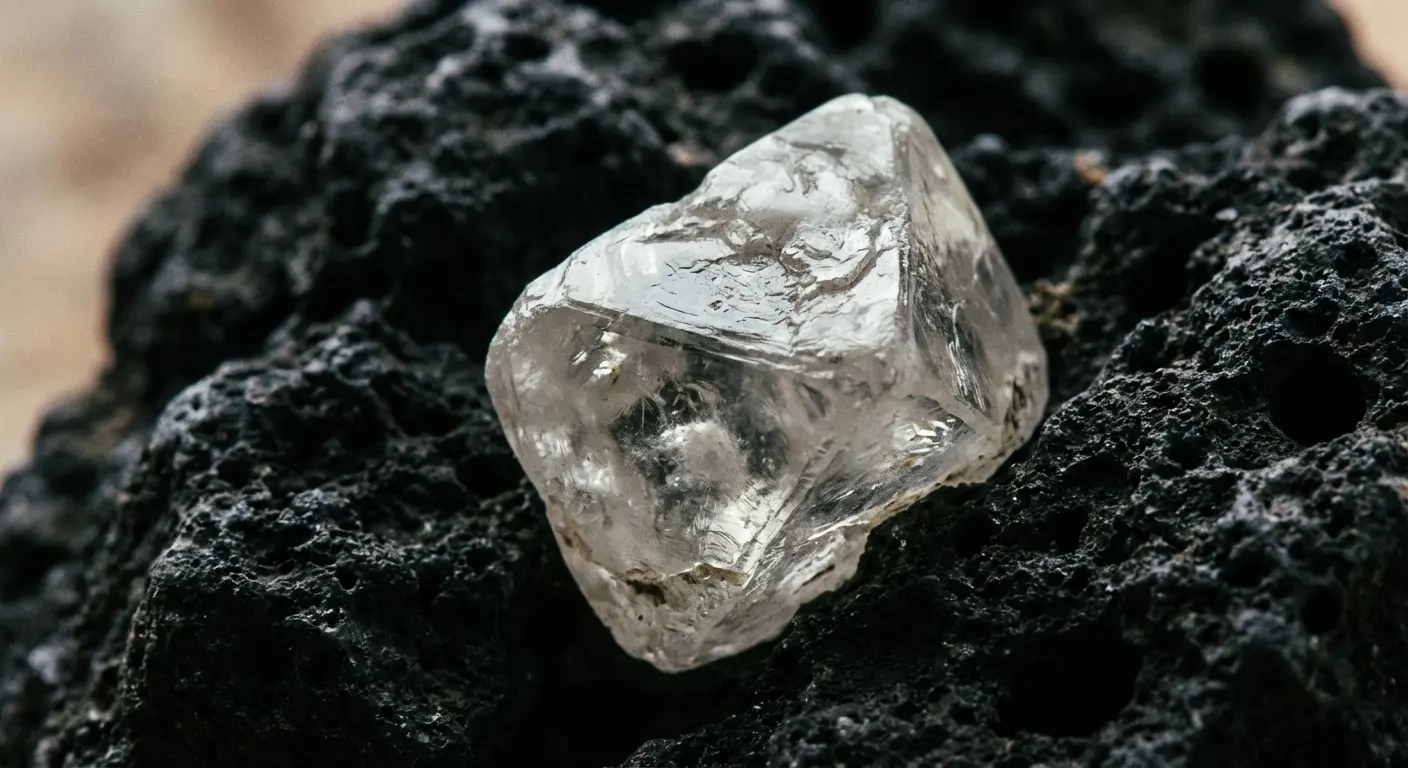
Yeah, we all know diamonds form under pressure. But think about what that actually means for a second. Millions of years of being crushed, and the result is something clear. Not something hard. Something you can see through. That’s the part that gets me.
Are you drawn to shattered diamonds because you’re reclaiming brokenness? Do geometric diamonds appeal to your need for control and precision? Once you see it this way, you can’t unsee it. Your diamond tattoo choice is basically a personality test you’re wearing on your skin.
This matters because most people get tattoos based on who they wish they were, then spend years looking at something that doesn’t feel quite right.
Body art is a bigger deal than people think. Consider that Lucky Diamond Rich, holder of the Guinness World Records title for most tattooed person living (male), has spent more than 1,000 hours (over 41 days total) having his body modified by tattoo artists, with coverage exceeding 200% through multiple layers of ink. I bring this up because when you’re talking about diamond tattoos specifically, you’re already way past “decoration.” You’re in commitment territory.
Big, Bold Diamond Tattoos
These aren’t subtle nods to resilience. They’re announcements.
Bold diamond tattoos are for people who’ve stopped apologizing for taking up space. You’ll notice these designs typically incorporate elements of destruction, chaos, or transformation rather than pristine perfection. That’s on purpose. Choosing a large, complex diamond piece means you’ve moved past the need to appear polished all the time.
You’re comfortable with the messy middle parts of becoming. These hurt more and show more, so you’re probably not getting one unless you’ve already figured some shit out about yourself. If you’re still figuring out your identity, these might feel too permanent. But if you’ve arrived somewhere definitive about yourself? These designs announce that arrival.
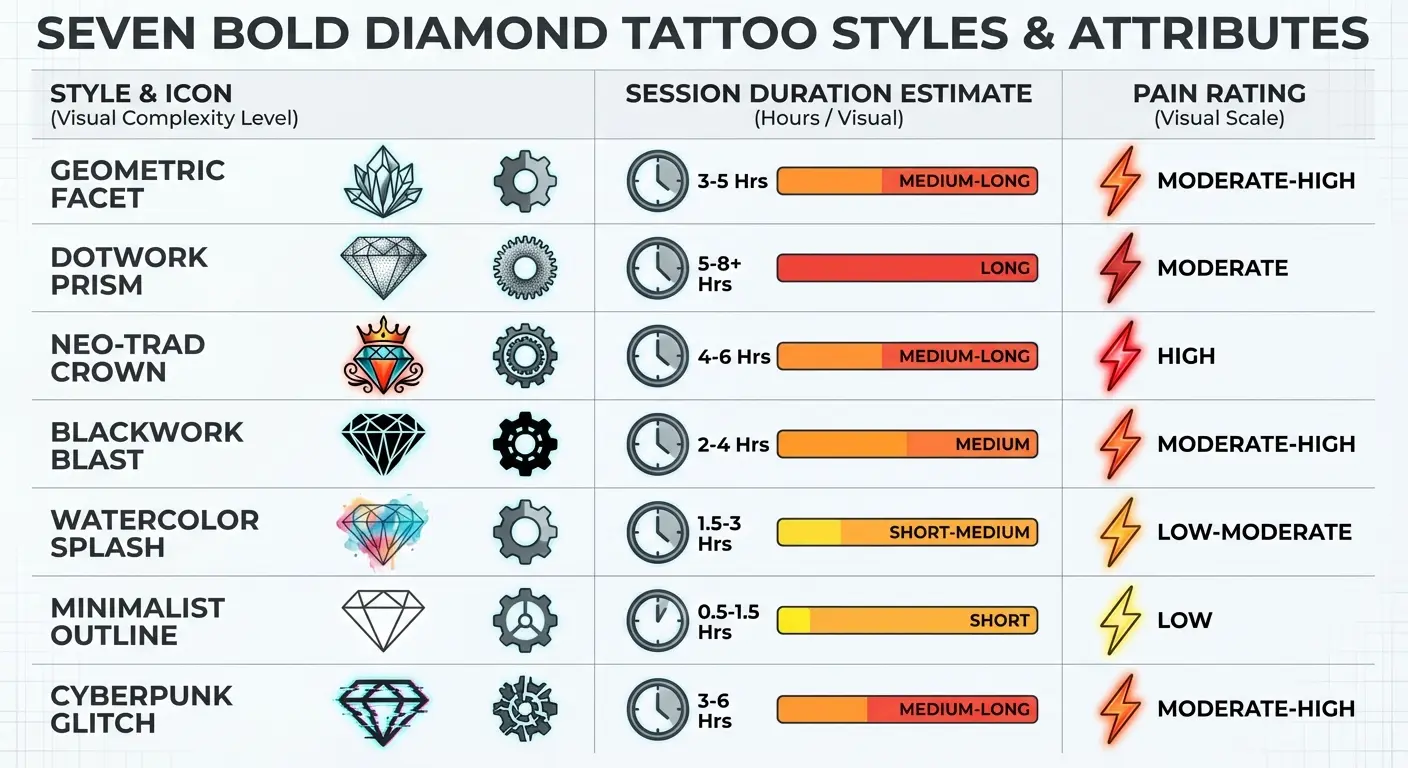
Look, I made you a table because this stuff actually matters when you’re planning:
|
Design Complexity |
Typical Session Time |
Pain Level (1-10) |
Best For |
|---|---|---|---|
|
Shattered Diamond |
3-5 hours |
6-7 |
People reclaiming brokenness as strength |
|
Mandala Fusion |
4-8 hours |
5-7 |
Multi-cultural identity integrators |
|
Blackwork Geometric |
2-4 hours |
7-8 |
Minimalists who value clarity |
|
Snake Wrap |
4-6 hours |
6-8 |
Those understanding cyclical transformation |
|
Sacred Geometry Portal |
5-10 hours |
6-7 |
Spiritual seekers connecting personal to universal |
|
Crown with Dripping Ink |
3-5 hours |
5-6 |
Success questioners and expectation subverters |
|
Skull Integration |
4-7 hours |
6-8 |
Death-aware motivators |
But honestly? Pain tolerance is so individual that these numbers are basically useless. Your ribcage might be fine while your ankle is hell.
1. The Shattered Diamond
Cracks radiating from the center, fragments held together by thin geometric lines, sometimes with pieces floating away entirely.
This one’s for people who’ve experienced significant rupture (maybe your marriage ended, maybe you quit the job everyone thought you were crazy to leave, maybe you just woke up one day and realized you’d been performing a version of yourself that wasn’t real) and refuse to pretend it didn’t fundamentally change them. You’re not hiding the damage or pretending you’re “fixed.”
The shattered diamond acknowledges that breaking apart was necessary for reformation.
Placement matters here. Forearm or thigh placements keep it visible to you as a daily reminder. Upper back or shoulder blade placements make it something you carry but don’t constantly confront. Consider incorporating subtle color in the cracks (deep blue, gold, red) to represent what filled the spaces after breaking.
This will probably run you $300-800 depending on your city and artist.
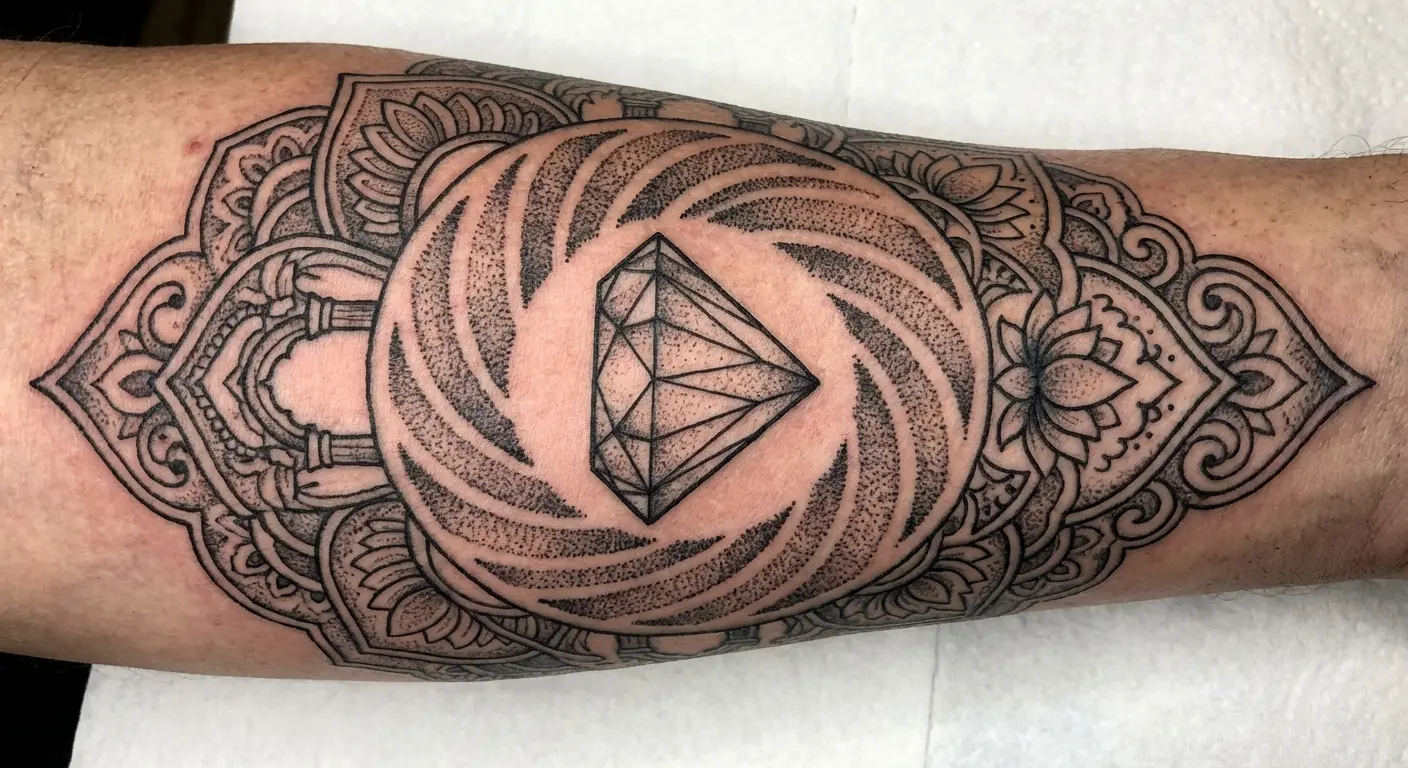
2. Diamond Mandala Fusion
A diamond shape serving as the center point for expanding mandala patterns, creating this hypnotic blend of Western symbolism and Eastern spiritual geometry.
Quick note on mandalas: if you’re not from a culture where these are sacred, do some thinking about why you want one and talk to your artist about respectful approaches.
This appeals to people who reject either/or thinking. You’ve probably built an identity from multiple cultural influences, spiritual practices, or philosophical frameworks. The diamond grounds the design in something recognizable while the mandala patterns add layers of personal meaning that aren’t immediately obvious to observers.
This design scales beautifully from small (inner forearm) to large (full back piece). The repetitive pattern work requires an artist skilled in precision, so don’t rush the artist selection process. Check their healed work, not just fresh photos on Instagram. Many people add personal symbols hidden within the mandala sections, creating a design that shows more upon closer inspection.
3. Blackwork Geometric Diamond
Solid black geometric diamond with supporting angular patterns, negative space creating the actual diamond shape, heavy saturation throughout.
You’re drawn to this if you value clarity, decisiveness, and stripped-down aesthetics. There’s no softness here, no gradients, no room for interpretation. Blackwork diamond designs appeal to people who’ve simplified their lives on purpose and want their body art to reflect that commitment to essentialism.
The bold contrast ages exceptionally well compared to detailed realistic work, which matters if you’re thinking long-term. Placement on areas with minimal fat distribution (forearm, shin, upper chest) keeps the lines crisp longer. These designs typically take less time than you’d expect, but the solid black saturation means more intense healing.
Don’t cheap out on this. Seriously.
4. Diamond Snake Wrap
A snake coiling around or through a diamond structure, scales detailed, sometimes with the snake appearing to squeeze or protect the diamond.
This combination hits different than either element alone. Snakes represent transformation through shedding, while diamonds represent transformation through pressure. Together? You understand that change requires both release and endurance.
This design works particularly well as an arm band, thigh piece, or wrapping around the calf. The movement of the snake adds dynamic energy to the static geometry of the diamond. Think about whether you want the snake protecting the diamond (you guard what you’ve become) or constricting it (you’re aware of how your own patterns can limit you).
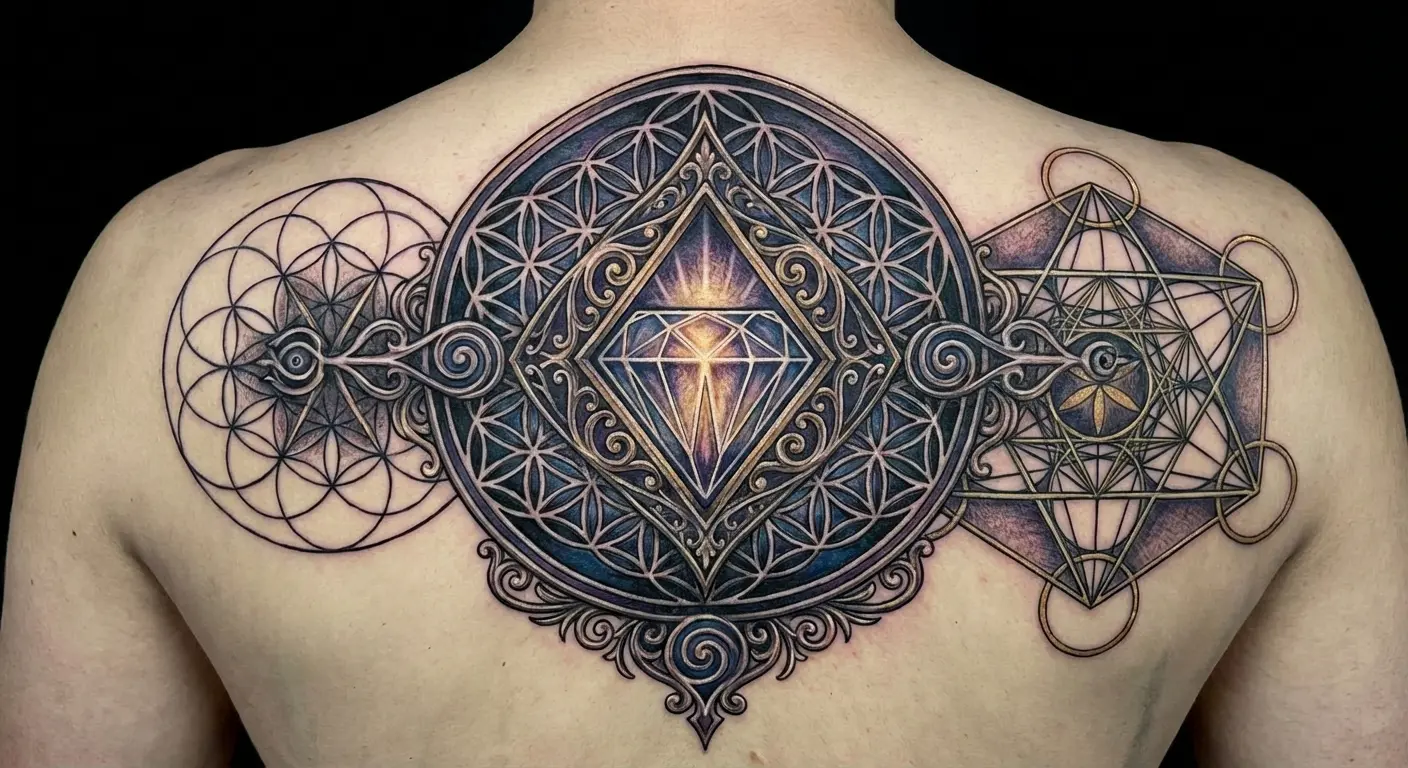
5. Sacred Geometry Diamond Portal
A diamond shape serving as the gateway or focal point for intricate sacred geometry patterns (flower of life, Metatron’s cube, Platonic solids), often with a sense of depth or dimension.
There’s something comforting about believing your individual journey connects to these universal patterns. I’m not going to lie, this sounds a bit pretentious, but stay with me.
These designs require significant space to execute properly. Anything smaller than 4×4 inches loses the detail that makes the geometry meaningful. Upper arm, thigh, or back placements give your artist room to work.
Many people choose to leave the very center of the diamond empty or place a personally significant symbol there, creating a focal point within the larger pattern. When this is done well it’s incredible.
6. Diamond Crown with Dripping Ink
A diamond integrated into or replacing jewels in a crown, with ink appearing to drip or melt from the structure.
This subverts traditional crown symbolism entirely. You’re not celebrating royalty or status. You’re commenting on the weight of expectations, the performance of success, or the fluid nature of achievement. The dripping element adds impermanence to what’s supposed to be eternal.
This design attracts people who’ve achieved traditional success markers but found them hollow or complicated. Placement behind the ear, on the neck, or on the inner bicep keeps it somewhat private, which fits the introspective nature of the symbolism.
The drip style requires an artist comfortable with that specific technique, so review portfolios carefully. Ask to see photos from clients who’ve had the tattoo for 2+ years.
7. Diamond Skull Integration
A skull where the eye sockets, teeth, or cranium structure incorporates diamond shapes or geometry, creating this memento mori piece with added layers.
You’ll probably like this if you hold death awareness as a motivating force rather than a morbid fixation. The diamond elements elevate the skull beyond standard mortality symbolism, suggesting that even in death or endings, there’s structure and perhaps value.
This works as a statement piece (upper arm, chest, thigh) where the detail can be appreciated. Think about whether you want the diamonds to appear as if they’re part of the skull’s natural structure or as if they’re emerging from or replacing bone. That choice shifts the meaning from “death creates value” to “value exists within death.”
The skull integration can look really cheesy if not done right. Find an artist who specializes in this style.
Small and Subtle Diamonds
Small doesn’t mean less meaningful.
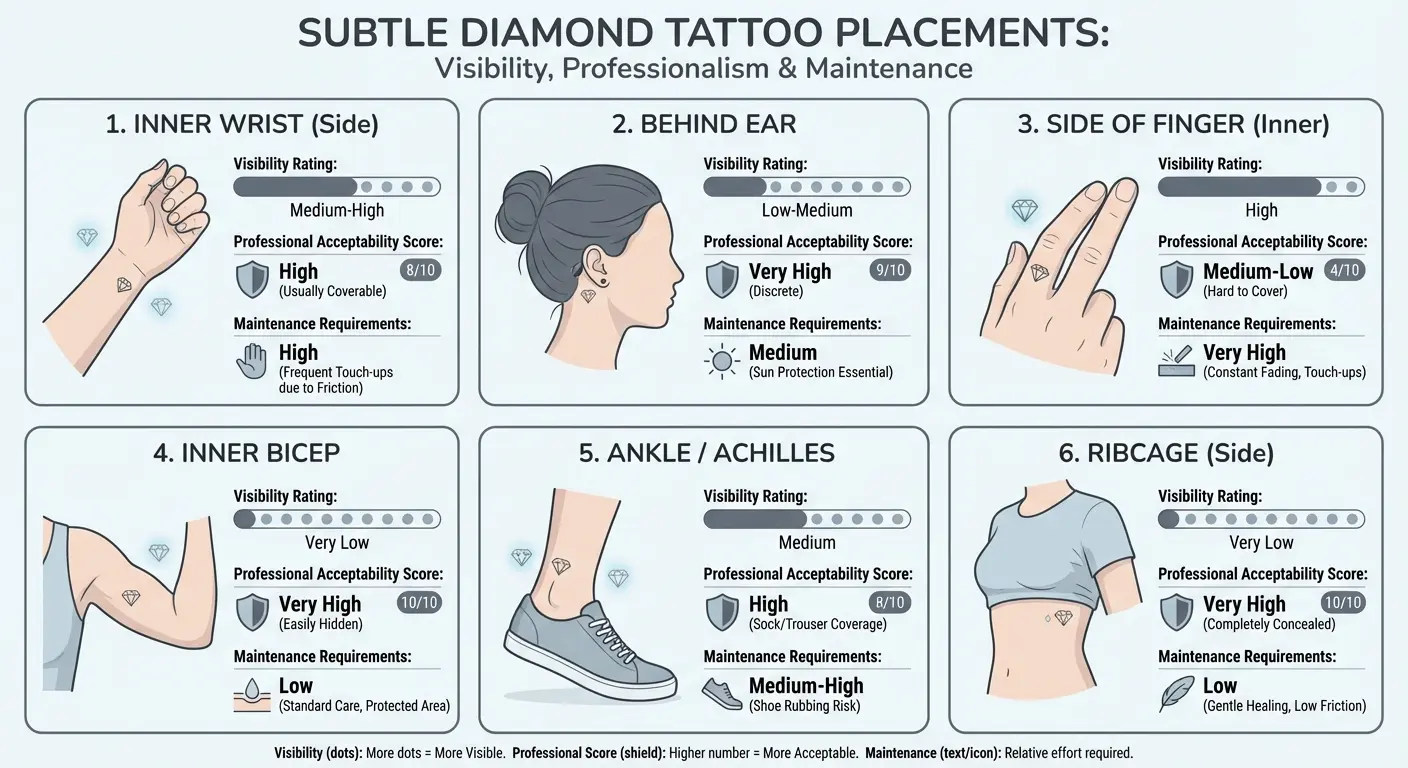
These subtle diamond designs are for people whose confidence doesn’t require external validation. You’ve noticed that the most secure people rarely announce their worth loudly. These placements and sizes create intimacy. They’re for you first, observers second.
The subtlety also allows for professional flexibility, which matters if you work in conservative industries but still want meaningful body art. What’s interesting is how small diamond tattoos mess with the usual tattoo logic where bigger equals more meaningful. Turns out a tiny diamond on your finger can mean just as much as a full sleeve.
These designs prove that impact isn’t always about visibility.
8. Finger Diamond
A simple diamond outline or small filled diamond on the finger, typically on the side of the finger between knuckles or on the finger pad.
Okay, real talk: finger tattoos are having a weird moment right now. But here’s the thing about this placement that most people don’t get. Finger tattoos fade faster than almost any other placement due to constant friction and cell turnover. Choosing one anyway means you’re comfortable with impermanence and maintenance.
My artist told me, “Finger tattoos are a commitment to maintenance, not permanence.”
The finger diamond works particularly well for people who use their hands in their work. Tattoo artists get these a lot, which is kind of meta. It integrates your identity with your primary tool.
Consider sizing carefully. Too small and it becomes a blur within a year. Too large and it overwhelms the limited space. You’ll need touch-ups every few years. Factor that into your decision.
9. Behind-the-Ear Diamond Sparkle
A tiny diamond with minimal line sparkle details, placed behind the ear where it’s only visible when hair is up or moved aside.
This is peak “if you know, you know” placement. You’re not hiding it, but you’re not announcing it either. Behind-the-ear tattoos are for people who’ve cultivated mystery as part of their personal brand. You show things slowly, in layers, when you choose.
The pain level here surprises people. The buzzing gets inside your head, especially behind the ear. It’s more intense than you’d expect for such a small piece, which adds another layer of meaning. You endured something uncomfortable for something only occasionally
visible.
Keep the design minimal. The area doesn’t hold complex detail well.
10. Inner Wrist Diamond Outline
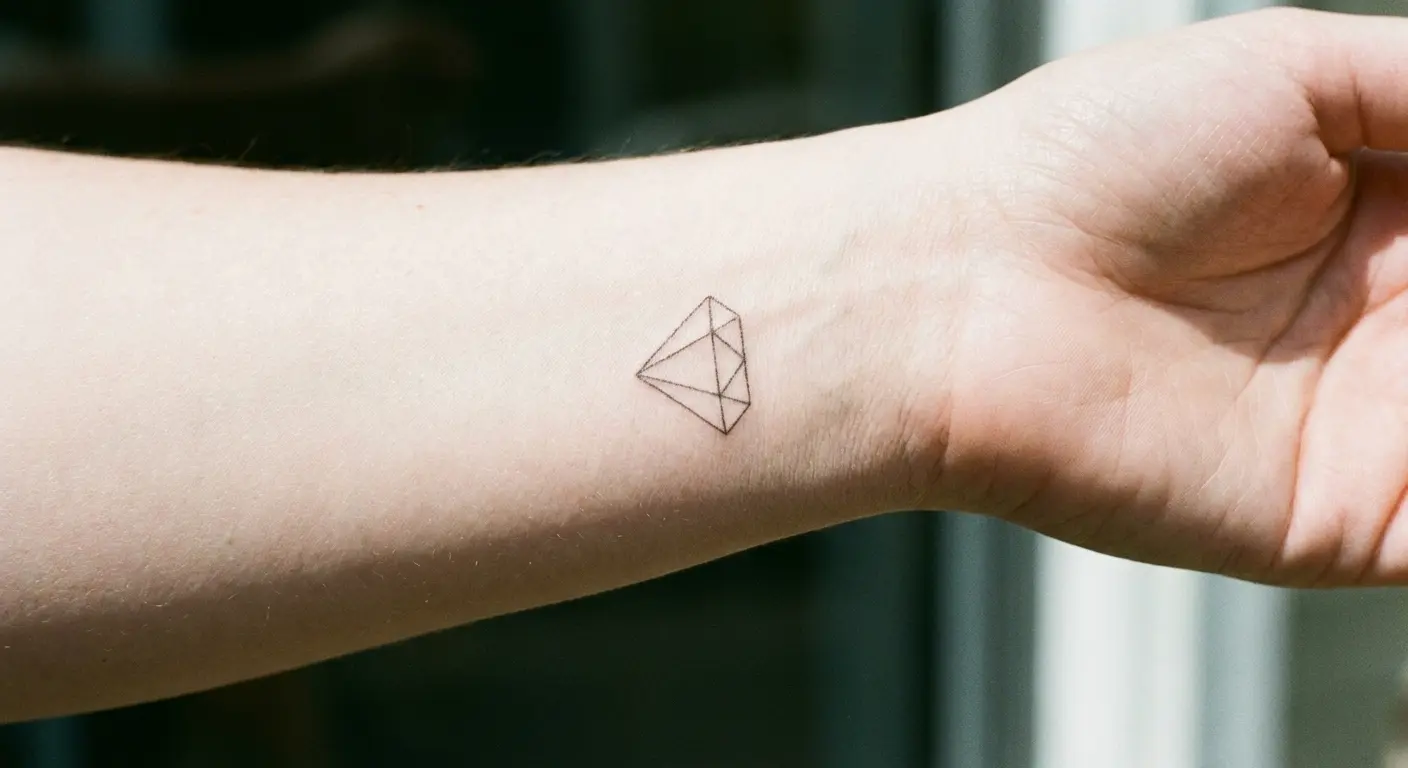
A simple diamond outline, typically 1-2 inches, placed on the inner wrist where you can see it throughout the day.
This placement is deeply personal despite being somewhat visible. Your inner wrist faces you more than it faces others, making it primarily a self-reminder rather than a social signal. The outline style rather than filled keeps it light and versatile. You can dress it up or down depending on context.
Consider line weight carefully. Too thin and it fades into a blur. Too thick and it loses the delicate quality that makes this placement work. This heals relatively quickly and hurts less than you’d expect.
Side note: I’ve seen people add tiny details inside the diamond over time (initials, dates, small symbols), turning it into a growing piece.
11. Ankle Chain Diamond Accent
A diamond incorporated into an ankle chain or bracelet design, creating the illusion of jewelry that’s permanent.
This appeals to you if you’re drawn to adornment but want to subvert the temporary nature of accessories. You’re making decoration permanent, which is an interesting statement about commitment to beauty or aesthetics as identity rather than as variable expression.
Ankle placement keeps it somewhat seasonal (visible in summer, hidden in winter), giving you control over when it’s part of your presentation. The chain design requires an artist skilled in fine line work. Review healed photos of their work specifically, not fresh photos.
Ankles can be tricky for ink retention due to proximity to bone and constant movement. A good artist will tell you if your idea won’t work. Listen to them.
12. Collarbone Diamond Constellation
Multiple small diamonds arranged along the collarbone in a constellation pattern, sometimes connected by fine lines, sometimes floating independently.
This creates visual interest in an area that naturally draws attention. Collarbone tattoos work particularly well for people whose style includes necklines that showcase this area. You’re deliberately decorating a space that’s already a focal point.
The constellation arrangement suggests you see yourself as part of a larger pattern or system. Each diamond can represent significant people, moments, or values, creating a personal map that appears decorative to others.
Pain level here is significant due to proximity to bone. The area also moves constantly with breathing and shoulder movement, requiring a steady artist. Ribcage tattoos hurt in this specific way where you can’t catch your breath.
13. Rib Cage Diamond Trio
Three diamonds in descending or ascending size, placed vertically along the rib cage, sometimes with minimal connecting elements.
Rib tattoos are notoriously painful, which means choosing this placement adds a layer of earned meaning. You didn’t take the easy route. The trio arrangement creates rhythm and movement while maintaining simplicity.
Three is significant across multiple cultural and spiritual traditions (past/present/future, mind/body/spirit, birth/life/death), allowing you to layer personal meaning onto a visually clean design. This placement stays private unless you choose to reveal it, giving you complete control over who sees it and when.
One client told me, “I got the rib cage trio because I wanted something that was just mine. My partner didn’t even know about it for six months.”
Consider breathing patterns during the tattoo process. The constant movement of your ribs makes this challenging for both you and your artist.
Weird Creative Diamond Designs
Okay, this next section is where it gets fun.
These designs reject the rigid geometry typically associated with diamonds. You’ll probably like these if you’re comfortable with contradiction and complexity. Traditional diamond tattoo approaches emphasize structure, permanence, and clarity. These transformative designs embrace fluidity, change, and ambiguity.
They’re for people whose identities don’t fit neat categories, whose stories include paradoxes, whose self-concept includes multitudes.
The creative approach also tells people you’re not bound by tattoo conventions or expectations. You’re willing to take risks with permanent body art, which usually means you’re willing to take risks in other areas of life. These designs often become conversation starters because they subvert expectations, so think about whether you’re comfortable explaining your choices to curious observers.
There’s this artist, Monki Diamond, who’s spent over a decade traveling around doing deeply personal pieces that blend cultural symbolism with individual transformation narratives. I mention her because the transformative diamond designs remind me of her approach. Nothing is standard, everything is customized to the person’s story.
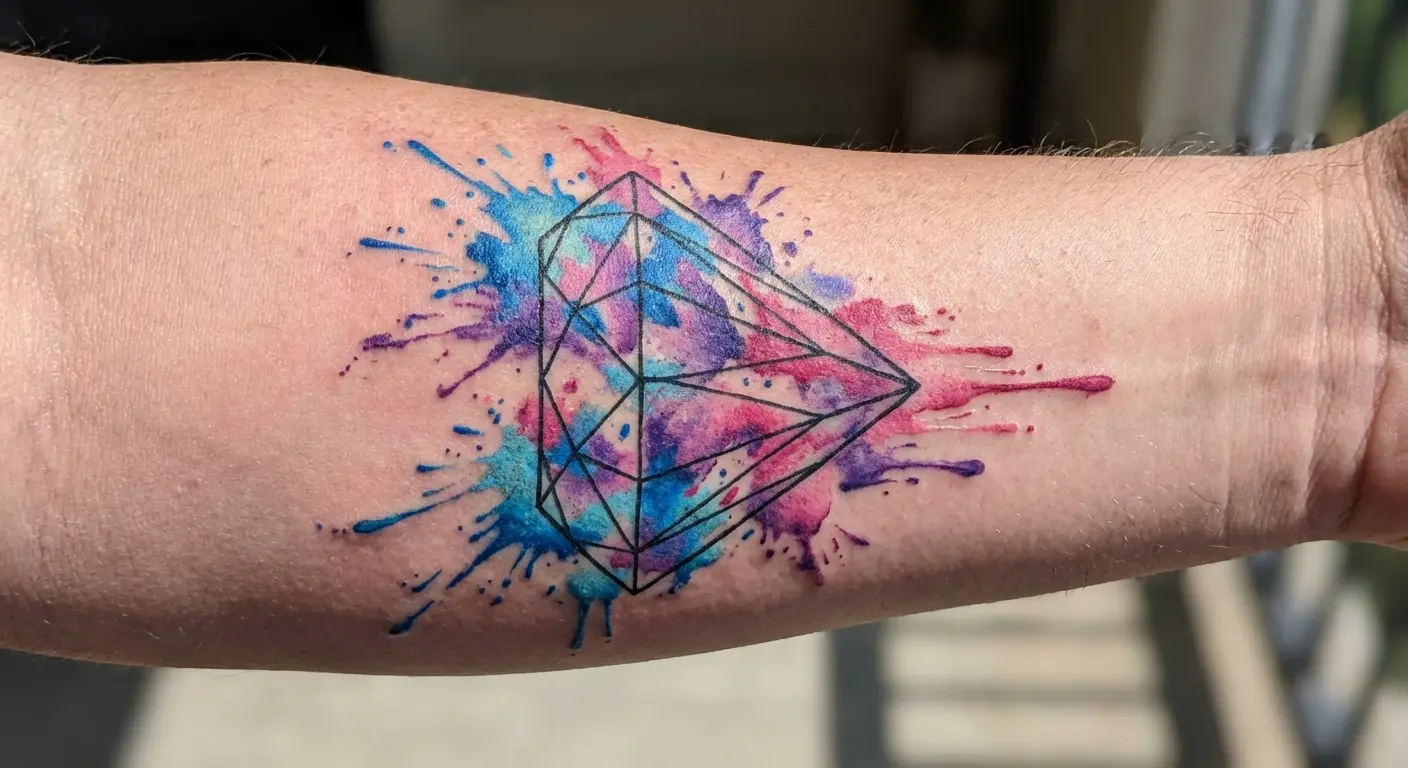
14. Watercolor Diamond Explosion
A geometric diamond outline with watercolor-style color bursting from or surrounding it, creating this contrast between rigid structure and fluid expression.
This design captures something true about the human experience: we contain both structure and chaos. The watercolor technique requires an artist specifically skilled in that style. Not every tattoo artist can execute it well.
Side note: watercolor tattoos are controversial in the tattoo community. Some artists refuse to do them because they don’t age well. Others have perfected techniques that last. Do your research, but also know you’re stepping into a whole debate.
Some people hate the psychological analysis angle. Skip to the designs if that’s you. But for those still with me, research aging patterns for watercolor tattoos. They fade differently than traditional work, requiring more frequent touch-ups. Think about whether you’re committed to that maintenance.
Bold will age better than fine line. That’s just physics.
15. Diamond Morphing Into Flower
A diamond shape that transitions seamlessly into flower petals, creating a hybrid image that’s both geometric and organic.
This appeals to people who’ve deliberately cultivated softness after periods of necessary hardness, or vice versa. The transformation element is key. You’re not combining two images. You’re showing one becoming the other, which suggests active change rather than static duality.
Placement affects the flow of the transformation. Vertical placements (forearm, calf, spine) allow the morph to follow your body’s natural lines. Think about which element you want at the top. Starting with the diamond and ending with the flower suggests softening. Reversing it suggests building structure from natural beauty.
The personalization of diamond tattoos has even extended into commercial jewelry markets, where brands like A. Dalumi and Nishikawa introduced their “Tattoo Your Diamond” campaign that allows consumers to engrave custom messages of love directly onto diamond girdles. Proves that the impulse to make diamonds deeply personal transcends both skin and stone.
16. Inverted Diamond Optical Illusion
A diamond design that appears three-dimensional or creates an optical illusion of depth, sometimes seeming to sink into the skin or project outward.
This requires serious technical skill to execute properly. You’re drawn to this if you appreciate craft and technique as much as meaning. The illusion element adds playfulness to a typically serious symbol. You’re someone who doesn’t take yourself too seriously despite caring deeply about things.
This design works best on relatively flat areas (outer forearm, upper back, thigh) where the illusion can be appreciated without body contours disrupting the effect. Black and gray typically works better than color for maintaining the illusion.
Think about how it will photograph, since these designs often look different in person than in photos. I’ve seen some of these that look absolutely unreal in person but fall flat in pictures.
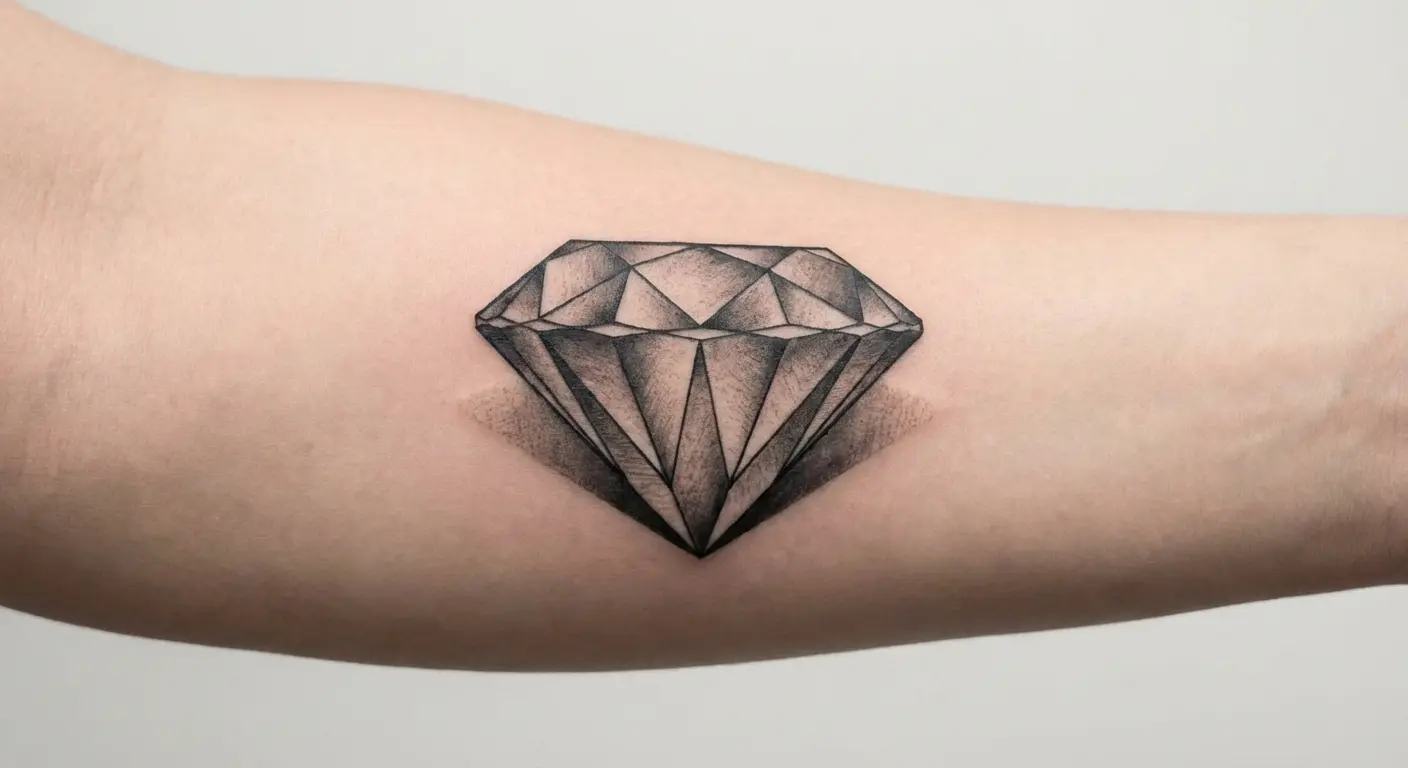
17. Diamond With Constellation Map Inside
A diamond outline filled with a specific constellation map, star chart, or celestial pattern, often representing a significant date or location.
This personalizes the diamond symbol in a way that’s meaningful to you but not immediately obvious to others. You’re embedding your story within a universal symbol. The constellation can mark a birth, death, meeting, or any moment you’ve designated as transformative.
This design requires research. You’ll need accurate star charts for your specific date and location, which means working with your artist to ensure astronomical accuracy if that matters to you. Some people prefer artistic interpretation over accuracy, which is equally valid. Decide which approach aligns with your intention before starting.
Or maybe you just think diamonds look cool and I’m reading way too much into this.
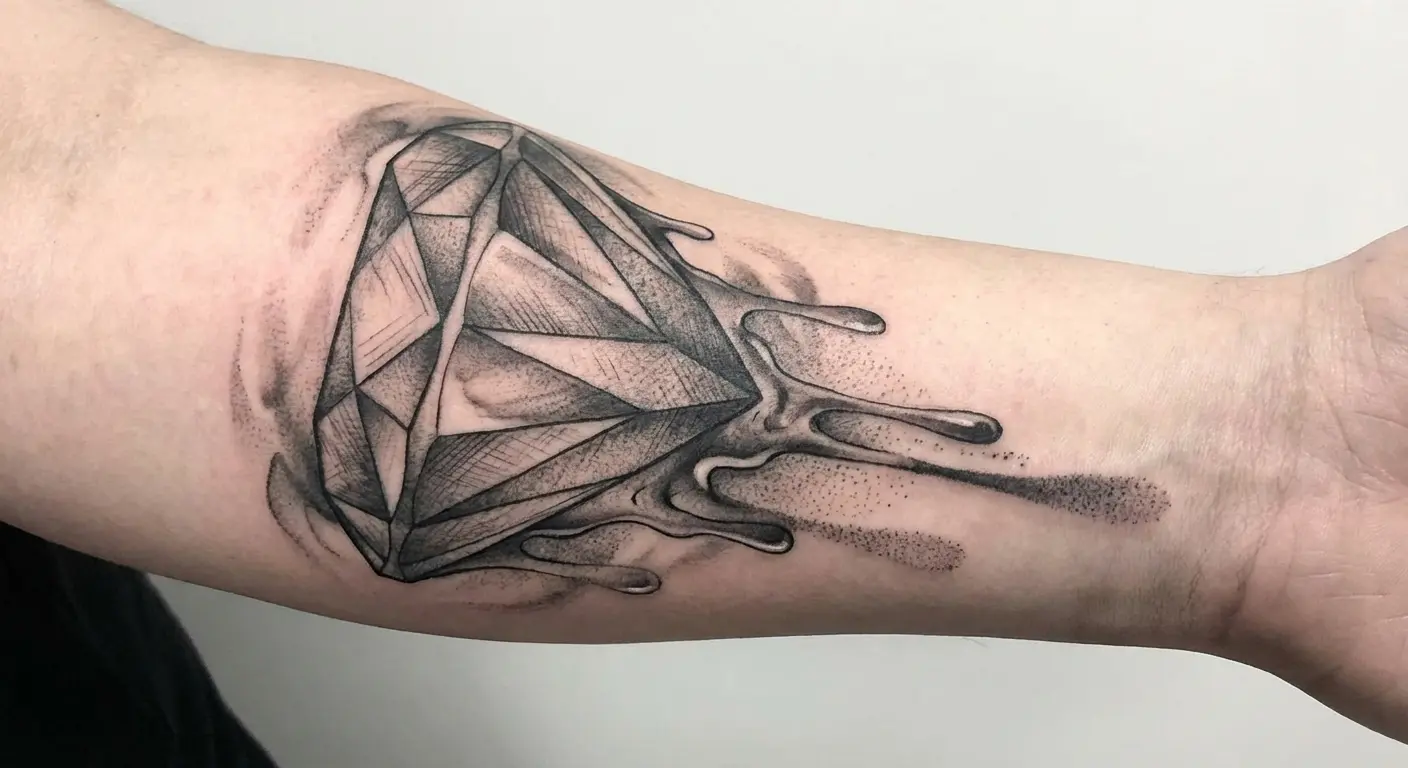
18. Melting Diamond
A diamond that appears to be melting, dripping, or dissolving at the edges, challenging the entire concept of permanence that diamonds supposedly represent.
Why would anyone want a melting diamond? You’re attracted to this if you’ve watched something you thought was unbreakable break. Maybe it was a relationship, a belief system, a career path, or your understanding of yourself. The melting diamond doesn’t mourn that loss. It documents it honestly.
This design works particularly well in black and gray, where shading can create realistic melt effects. Color can work too, but it shifts the tone from contemplative to more graphic. Placement on areas with natural shadow (inner bicep, side ribs, back of calf) enhances the melting effect.
The irony of making something permanent that depicts impermanence isn’t lost on people who choose this design. That’s exactly the point.
19. Diamond Forest Scene
A landscape or forest scene contained entirely within a diamond shape, creating a window effect into nature.
This one’s probably my favorite on the whole list. It appeals to people who find their resilience and clarity through nature rather than through urban hustle or social achievement. The diamond frame elevates a simple landscape into something more structured and intentional. You’re not just appreciating nature. You’re consciously choosing it as your foundation.
The scene inside can be realistic or stylized, detailed or minimal, depending on your aesthetic preferences. Trees work particularly well because their vertical lines complement the diamond’s geometry. Think about whether you want the scene to break the diamond’s borders in places, suggesting nature can’t be fully contained, or keep it strictly within the lines, suggesting you’ve found peace within boundaries.
Obviously there are a million other diamond variations I’m not covering. I’m leaving out traditional diamond ring-style tattoos because honestly, they bore me. There’s a whole category of diamond plus animal combinations I didn’t get into.
Choosing Your Diamond Design Without Overthinking It (But Also Not Rushing It)
We’ve covered nineteen distinct approaches to diamond tattoos, each showing different aspects of how you process transformation, pressure, and identity.
You’ve probably noticed patterns in which designs resonated and which left you cold. That gut response matters more than intellectual analysis. Your body knows what it needs to carry. The designs that made you feel something (excitement, recognition, slight discomfort) are worth exploring further. The ones that seemed cool but didn’t land emotionally? Let those go.
Most people try to choose the “right” design based on what it should mean rather than what it means to them. A shattered diamond isn’t inherently more meaningful than a finger diamond. Size and complexity don’t correlate with significance.
What matters is alignment between the design and your psychological reality right now. Not who you want to be. Not who you used to be. Who you are in this moment, with all the contradictions and complexity that includes.
You might be thinking this is all BS and you just like how diamonds look. Fair enough. Get what makes you happy.
But I’ve noticed after looking at hundreds of these that the people who are happiest with their diamond tattoos years later are the ones who picked something that felt right, even if they couldn’t explain why at the time.
Final Thoughts
Diamond tattoos work because they’re honest about transformation. They acknowledge that valuable things form under pressure, that change requires both time and force, and that what we become is often more interesting than what we were.
The specific design you choose matters less than your willingness to be honest about why you’re drawn to it. A diamond tattoo chosen because it looks cool will always feel slightly off. One chosen because it captures something true about your relationship with becoming will feel right even years later when your taste changes.
Look, I’ve thrown nineteen designs at you. Maybe one jumped out. Maybe you’re more confused than when you started. That’s fine.
Here’s the only advice that matters: get the tattoo that makes you feel something when you look at the reference image. Not the one that sounds the most meaningful when you explain it. Not the one that fits your aesthetic the best. The one that does that weird thing where you keep coming back to it.
Your body knows what it needs to carry around. Trust that, even if you can’t explain why yet. The meaning will catch up.
Yes, I’m aware I’m psychoanalyzing people based on their tattoo choices. Let me have this.
