16 Dog Paw Tattoos That Tell Stories Artists Usually Miss
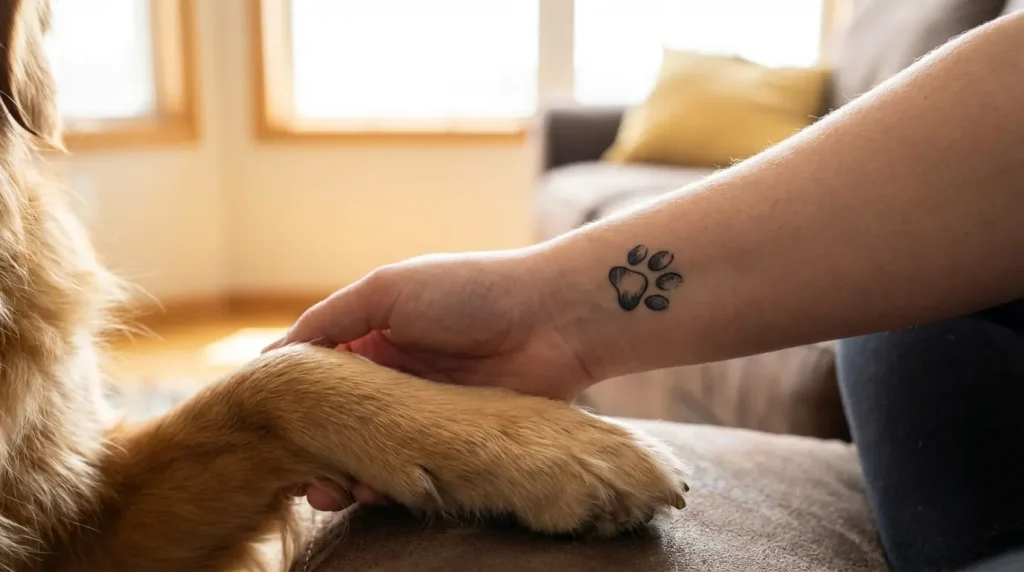
Everyone’s getting dog paw tattoos now, but here’s the thing: 90% of them are memorials. Which is fine, I guess, but why wait until your dog is dead to honor them? While plenty of people have gotten unique tattoos that are exact replicas of their dog’s paw according to Bored Panda’s compilation of personalized paw print designs, most artists and clients still default to treating these designs purely as memorial pieces.
That misses so much of what a paw print can actually mean. Living relationships. The specific way your dog’s personality shows up in their walk. Moments that deserve recognition while your dog is still here, demanding your attention and leaving actual muddy prints on your floors.
Here are sixteen approaches that expand what a dog paw tattoo can be. Not the generic stuff. Designs that tell YOUR specific story.
Table of Contents
Prints That Honor the Bond
- Single Paw Over Your Heart
- Walking Trail Up Your Spine
- Muddy Paw on Your Shoulder
- Paw Inside a Heartbeat Line
- Overlapping Prints from Multiple Pets
Prints That Capture Personality
- Asymmetrical Paw for the Three-Legged Fighter
- Watercolor Splash Behind the Print
- Geometric Paw with Sacred Geometry
- Minimalist Line Art Paw
- Paw Print Filled with Florals
- Negative Space Paw in Solid Black
Prints That Mark Moments
- Dated Paw from Adoption Day
- Paw Transforming into Birds
- Dual Paws (Puppy and Senior)
- Paw with Your Dog’s Name in the Pad
- Actual Ink Print Replica
TL;DR
Don’t wait until your dog dies to get the tattoo. Capture the weird specific details (three legs, muddy prints, actual personality). Placement matters more than you think. And for god’s sake, stop defaulting to the generic black paw print. Make it yours.
Prints That Honor the Bond
Placement first. Because honestly? A tiny paw on your wrist means something totally different than the same design over your heart.
Your dog is alive right now. Stealing your spot on the couch. Why are you waiting to honor that?
These five designs focus on where you put them and what that positioning means to you. Not about artistic complexity. Just about acknowledging how your dog has shaped who you are.
| Placement | Visibility Level | Pain Level (1-10) | Professional Coverage | Best For |
|---|---|---|---|---|
| Over Heart | Medium | 6-7 | Easily covered by most clothing | Single dog, primary bond |
| Spine Trail | Low to Medium | 7-9 | Covered by shirts | Multiple prints, movement representation |
| Shoulder | Medium to High | 4-5 | Tank tops reveal, sleeves cover | Casual, authentic “muddy” aesthetic |
| Forearm/Ribs/Collarbone | High | 5-8 (varies by location) | Forearm visible, ribs/collarbone coverable | Heartbeat line integration |
| Forearm or Calf | High (forearm) / Medium (calf) | 4-6 | Forearm always visible, calf seasonal | Multi-pet households |
1. Single Paw Over Your Heart
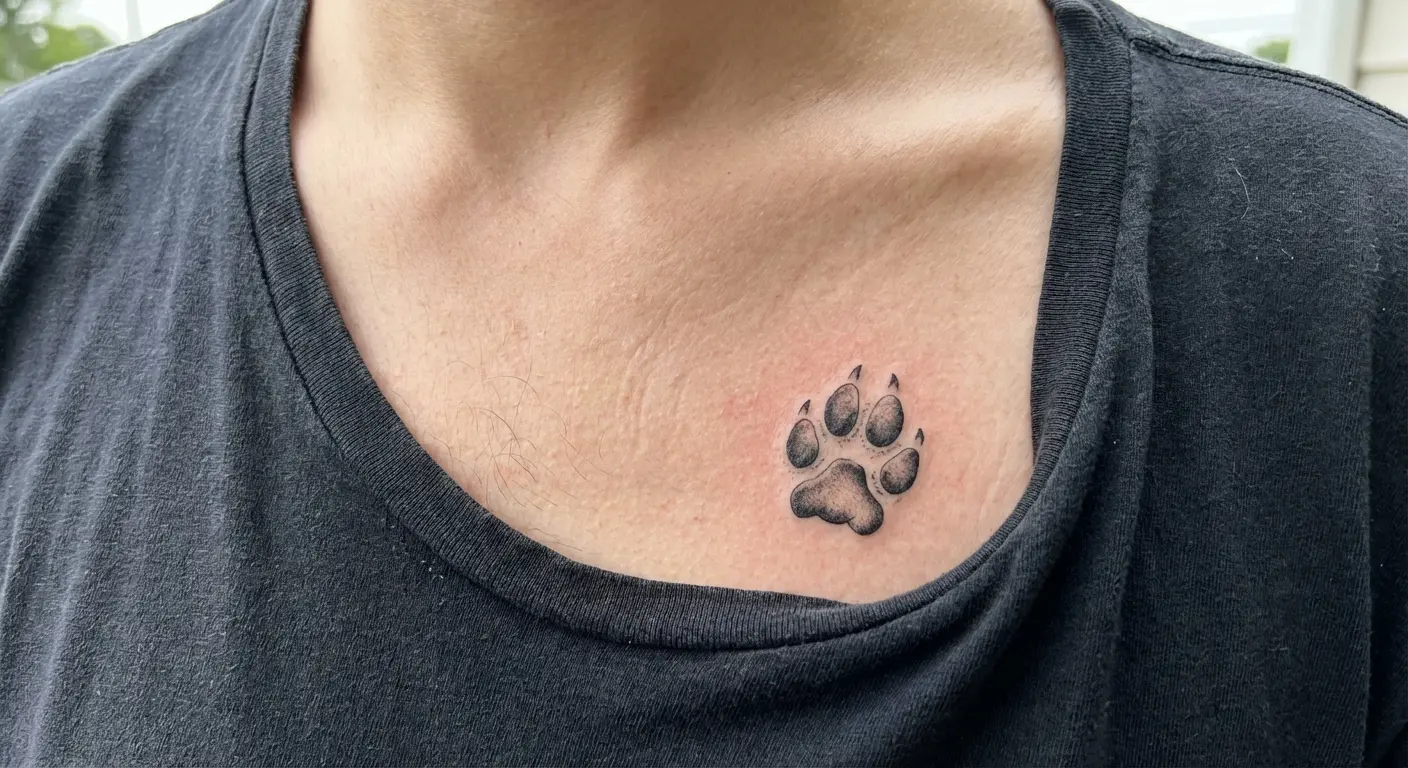
Over your heart. Yeah, it’s obvious. That’s the whole point.
You’re literally putting your dog above everything else, and you want people to know it. This placement tells everyone exactly where your dog sits in your emotional hierarchy, and you’re not apologizing for it.
Size it to match your actual dog’s paw. Not scaled up for drama or down for cuteness. Just their actual paw. Artists can capture this with single-needle technique for fine detail or bold traditional lines for a more graphic look. The key is anatomical accuracy to your specific dog’s paw structure. Some breeds have rounder pads, others more elongated. A Rottweiler’s paw looks nothing like a Beagle’s. Those details matter.
Some people add their dog’s name in tiny script along one toe pad, but the design stands strongest when it’s just the print itself. When considering heart tattoo placement and symbolism, the chest area carries particular emotional weight that makes this especially meaningful.
2. Walking Trail Up Your Spine
Your dog walks beside you. Or more accurately, pulls you forward on the leash while you try to maintain some illusion of control.
This design translates that movement into permanent form by placing a series of paw prints ascending your spine. The spacing between prints can reflect your dog’s actual gait. Larger breeds have wider strides. Smaller dogs take more frequent steps. You can start at your lower back and work up to your shoulder blades, or reverse the direction.
The number of prints varies based on your torso length and desired coverage, but odd numbers (five or seven) tend to create better visual flow than even counts.
Easy to cover for professional settings. Visible when you choose to show it. The vertical placement follows your body’s natural lines, creating movement that feels organic rather than forced. Plus, there’s something powerful about carrying your dog’s path literally on your back. A physical reminder of how they’ve walked through life with you.
3. Muddy Paw on Your Shoulder
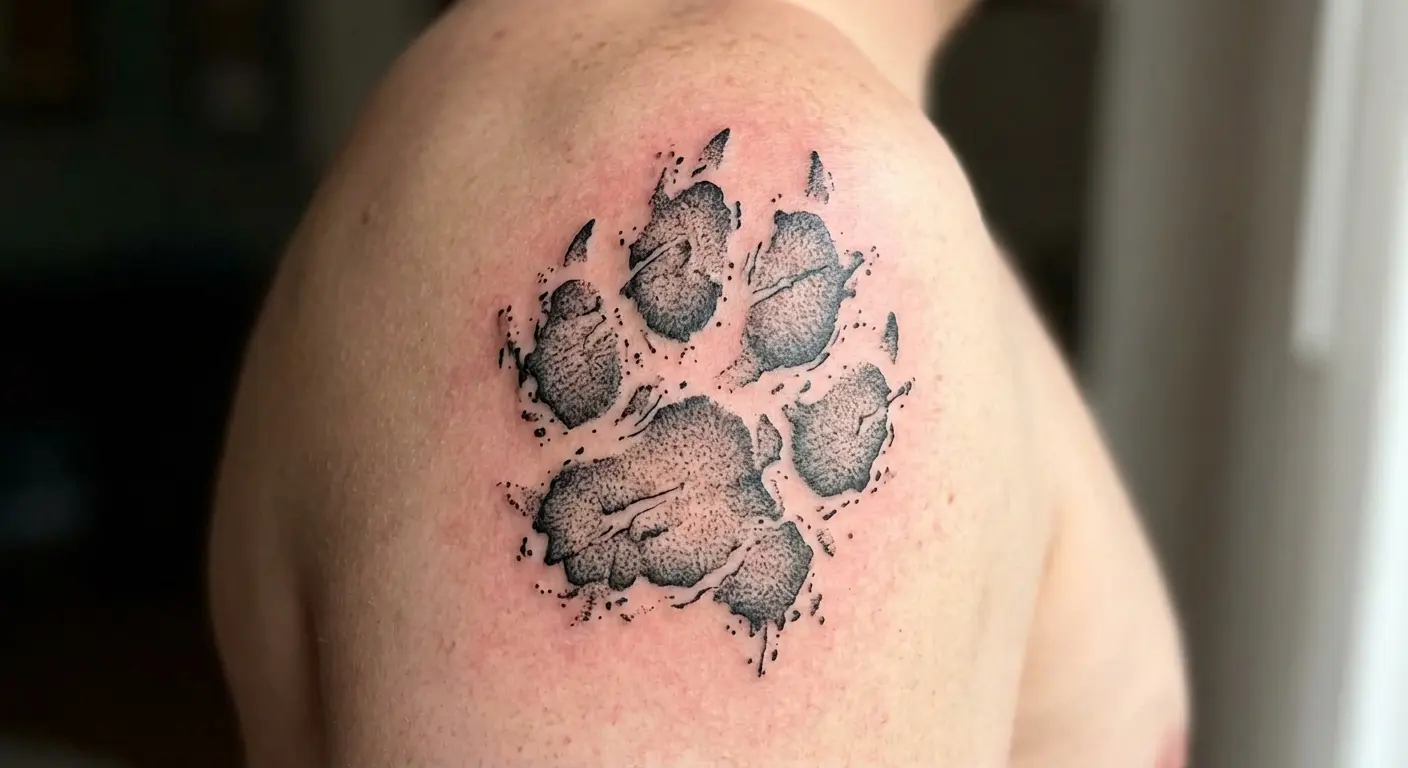
Real dog paws aren’t clean and perfectly symmetrical. They leave muddy prints on your clothes, your floors, and occasionally your face when your dog gets overexcited.
This design embraces that messy reality. Add splatter details and irregular edges around the main paw print. The “muddy” effect comes from stippling or light watercolor techniques that suggest your dog just walked through something they shouldn’t have. Because that’s what dogs do.
Placement on the shoulder makes it visible in tank tops but coverable with sleeves.
You’re not going for pristine. You want the chaos, because that’s what living with a dog actually looks like. Kayla Harren got muddy paw prints tattooed on her shoulder. She told My Modern Met: “It looks exactly like the muddy paw prints Doodle leaves all over the house. Now I have one of my very own to carry around forever and ever.”
That’s it. That’s the whole point. Imperfection over perfection.
4. Paw Inside a Heartbeat Line
Heartbeat line tattoos have become common enough that they risk feeling generic. But add your dog’s paw print inside one of the peaks, and suddenly it becomes something specific to your relationship.
The EKG-style line runs horizontally (usually on the forearm, ribs, or collarbone), and the paw print sits where the heartbeat spikes highest. This acknowledges what dog owners already know: your dog affects your heart rate. Whether that’s the calm that comes from petting them or the spike of panic when they eat something they shouldn’t.
The line itself should be delicate enough that the paw remains the focal point. Some people add their dog’s actual heartbeat pattern (captured at a vet visit) instead of a generic EKG line, which adds another layer of personalization.
Your dog changes you on a cellular level. Now you have proof inked on your skin.
5. Overlapping Prints from Multiple Pets
If you’ve loved more than one dog (or you’re a multi-dog household right now), this design stacks their paw prints in a layered composition. The prints can overlap partially or fully, creating depth through varying line weights and shading.
Each paw should be sized proportionally to the actual dog it represents. Your Great Dane’s print will dwarf your Chihuahua’s, and that size difference tells part of your story. Placement works best on flatter areas like the forearm or calf where the overlapping elements read clearly.
You can add small identifiers (initials, dates, or tiny symbols) near each print if you want, but the varying sizes often communicate which dog is which without additional labeling.
This design grows with you. If you add another dog to your family later, there’s room to incorporate their print into the existing composition. Popular variations include these evolve over years as people add new layers, creating a living timeline of all the dogs who’ve shared their lives.
Prints That Capture Personality
Your dog isn’t a generic representation of their breed. They have quirks, physical characteristics, and personality traits that make them specifically them.
This section moves beyond basic paw prints into designs that capture those individual details. Tattoos that only make sense for your particular dog. Whether that’s because of a physical difference, an artistic style that matches their energy, or design elements that reflect how they move through the world.
6. Asymmetrical Paw for the Three-Legged Fighter
Dogs who’ve lost a leg don’t move the same way four-legged dogs do. Their paw prints reflect that reality.
Three prints instead of four. Asymmetrical spacing. Heavier weight on the front paw. That’s what a tripod dog’s gait looks like.
You might show three prints instead of four in a walking sequence, or emphasize how one front paw carries more weight through deeper shading and bolder lines. This isn’t about highlighting disability. It’s about honoring how your dog adapted and kept living fully despite the change.
The design works on areas where you can show movement: forearm, calf, or shoulder blade. Including the specific details of how your dog compensates when they walk makes this deeply personal rather than generically inspirational.
Your three-legged dog doesn’t move like anyone else’s three-legged dog. That limp, that compensating hop. That’s YOURS. Every tripod dog moves differently, and capturing your specific dog’s pattern means no one else will have this exact design.
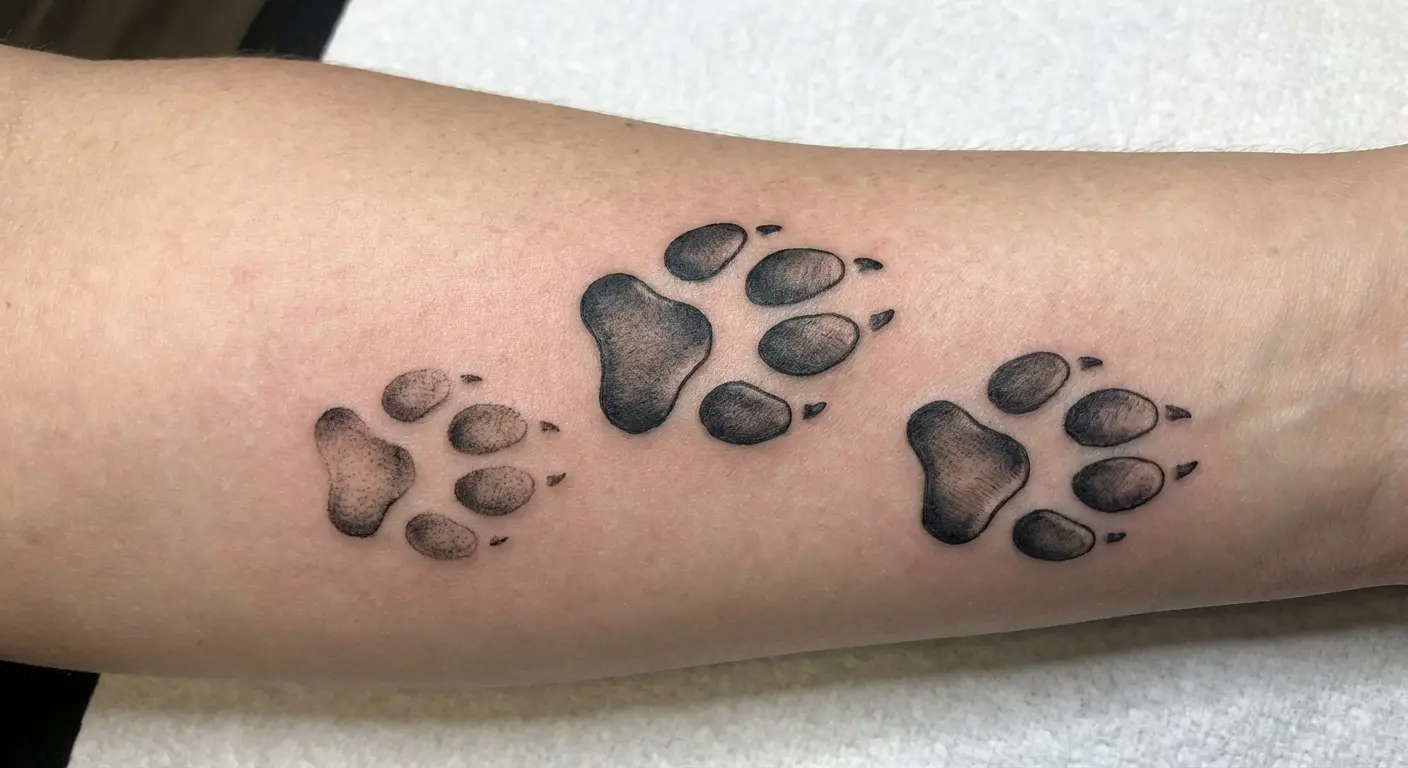
7. Watercolor Splash Behind the Print
Some dogs have chaotic, exuberant energy that a simple black outline can’t capture.
Watercolor techniques add that sense of movement and personality through color bleeds and soft edges behind a more defined paw print. The colors you choose can reflect your dog’s coat (golden yellows for a retriever, blue-grays for a husky, warm browns for a chocolate lab) or just colors that feel right for their energy.
The watercolor element shouldn’t overwhelm the paw itself. You want the print to remain the anchor while the color suggests motion and vitality around it.
This style requires an artist experienced in watercolor tattoos since the technique differs significantly from traditional tattooing. The colors will fade faster than solid black, so expect touch-ups every few years to maintain the vibrancy.
But if your dog is the type who bounces off walls and brings chaos wherever they go, this approach captures that energy better than any static design could.
| Design Style | Longevity | Touch-Up Frequency | Best Placement | Skill Level Required |
|---|---|---|---|---|
| Watercolor Splash | 3-5 years before fading | Every 2-3 years | Upper arm, thigh, shoulder blade | Advanced (watercolor specialist) |
| Geometric/Sacred Geometry | 7-10+ years | Every 5-7 years | Upper arm, thigh, back | Advanced (precision line work) |
| Minimalist Line Art | 5-8 years | Every 4-6 years | Wrist, ankle, behind ear | Intermediate to Advanced |
| Floral Fill | 5-7 years | Every 3-5 years | Forearm, shoulder, thigh | Intermediate |
| Negative Space | 8-10+ years | Minimal, every 6-8 years | Any flat area | Intermediate |
| Traditional Black | 10+ years | Minimal, every 8-10 years | Anywhere | Beginner to Intermediate |
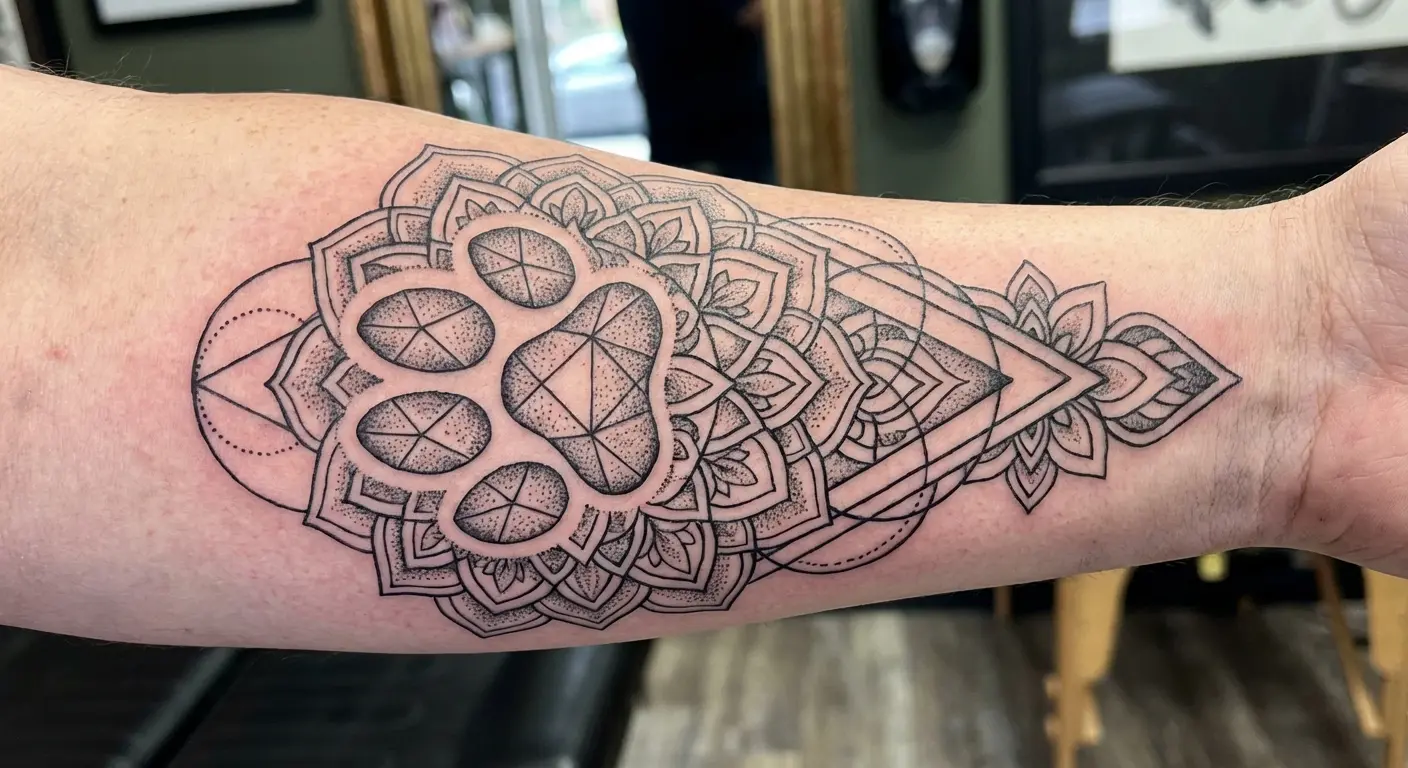
8. Geometric Paw with Sacred Geometry
Geometric designs bring structure and symbolism to organic shapes. This approach takes a dog paw print and incorporates it into sacred geometry patterns. Think flower of life, Metatron’s cube, or custom mandala designs.
The paw might sit at the center of the geometric pattern, or the pattern might form the paw itself through intersecting lines and shapes. This works particularly well if you’re drawn to more abstract or spiritual tattoo styles but still want to honor your dog.
You’re creating something that functions as both a tribute to your dog and a standalone piece of geometric art. If you’re drawn to structured designs, exploring geometric tattoo design principles can help you understand how to balance sacred geometry with organic paw print shapes.
Put it on your upper arm, thigh, or back. Anywhere with enough space for the geometric elements to read clearly. This style appeals to people who see their dogs as part of something larger. A connection that transcends the simple human-pet relationship.
9. Minimalist Line Art Paw
Minimalism means reducing a design to its essential elements without losing recognizability. A minimalist paw uses single, continuous lines or very few strategically placed lines to suggest the paw shape without filling it in completely.
This style appeals to people who want something subtle and modern rather than bold and traditional. The challenge? Making sure the minimal lines still read clearly as a paw print from a distance. Your artist needs to nail the proportions and angles so the design doesn’t just look like random curved lines.
Works anywhere on the body but looks particularly sharp on wrists, ankles, or behind the ear where the small scale matches the delicate line work. The fineline tattoo approach shares similar principles with minimalist designs, emphasizing precision and restraint over bold coverage.
Best for people who prefer understated elegance over dramatic statements.
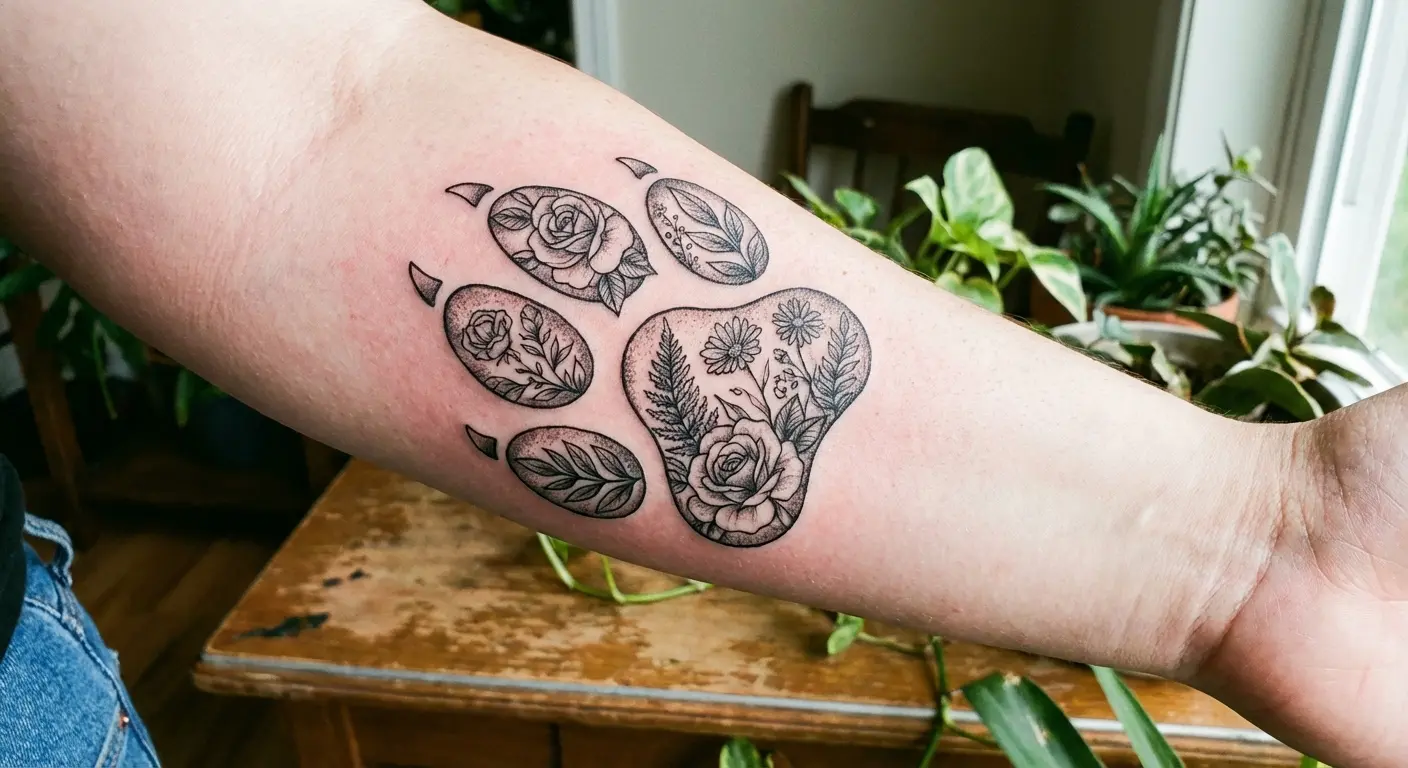
10. Paw Print Filled with Florals
Instead of solid black or shading inside the paw pads, this design fills the negative space with detailed floral elements. You can choose flowers that have personal meaning. Your birth flower. Flowers from your wedding. Blooms your dog liked to destroy in your garden.
The florals soften what could otherwise be a stark, graphic paw print and add a layer of natural beauty to the design. The flowers should be detailed enough to be identifiable but not so complex that they compete with the paw outline for attention.
This style works well for people who want a nature-inspired tattoo that incorporates their dog rather than a dog-focused tattoo with nature elements added as an afterthought.
Larger areas (thigh, shoulder, or forearm) give your artist room to include intricate petals and leaves. These ideas transform a simple memorial into something that celebrates both your dog and the beauty they brought into your world.
11. Negative Space Paw in Solid Black
This design flips the usual approach. Create a solid black shape (circle, square, or organic blob) and leave the paw print as uninked skin within it. The negative space technique creates strong contrast and makes the paw print pop visually.
You can add texture to the black background (stippling, brush strokes, or geometric patterns) to keep it from feeling flat. The size of the background shape determines how bold the overall design reads. A small black circle with a paw print cutout on your wrist feels delicate. A large black rectangle with a paw cutout on your calf makes a statement.
This approach works well if you want something graphic and modern that doesn’t rely on color or complex shading to have impact. The paw becomes the light within the darkness, which carries its own symbolism about how dogs illuminate our lives.
This design ages exceptionally well since solid black holds its saturation longer than most other styles.
Prints That Mark Moments
Your relationship with your dog isn’t static. It’s made up of specific moments and transitions. The day you brought them home. The gradual graying of their muzzle. The way they’ve changed you.
These last five are about time. Moments. The stuff that slips away if you don’t grab it.
You’re not just getting a paw print. You’re marking a specific point in your shared timeline. Freezing a memory that matters before it slips away into the general blur of years spent together.
12. Dated Paw from Adoption Day
The date you adopted your dog (or the day they were born) sits below or integrated into the design. This grounds the tattoo in a specific moment rather than floating in general “I love dogs” territory.
The date can be in Roman numerals for a classic look, standard numbers for clarity, or even coordinates of the shelter or breeder location where you found each other. The paw print itself should be sized and styled to match your preferences from the earlier sections, but the date adds context.
Years from now, even if the specific memory of that first day blurs, the date reminds you of when your life changed.
Some people place the numbers underneath in a straight line, others curve them around the paw’s outline. Popular variations include dates cleverly hidden within the pad details themselves in creative designs.
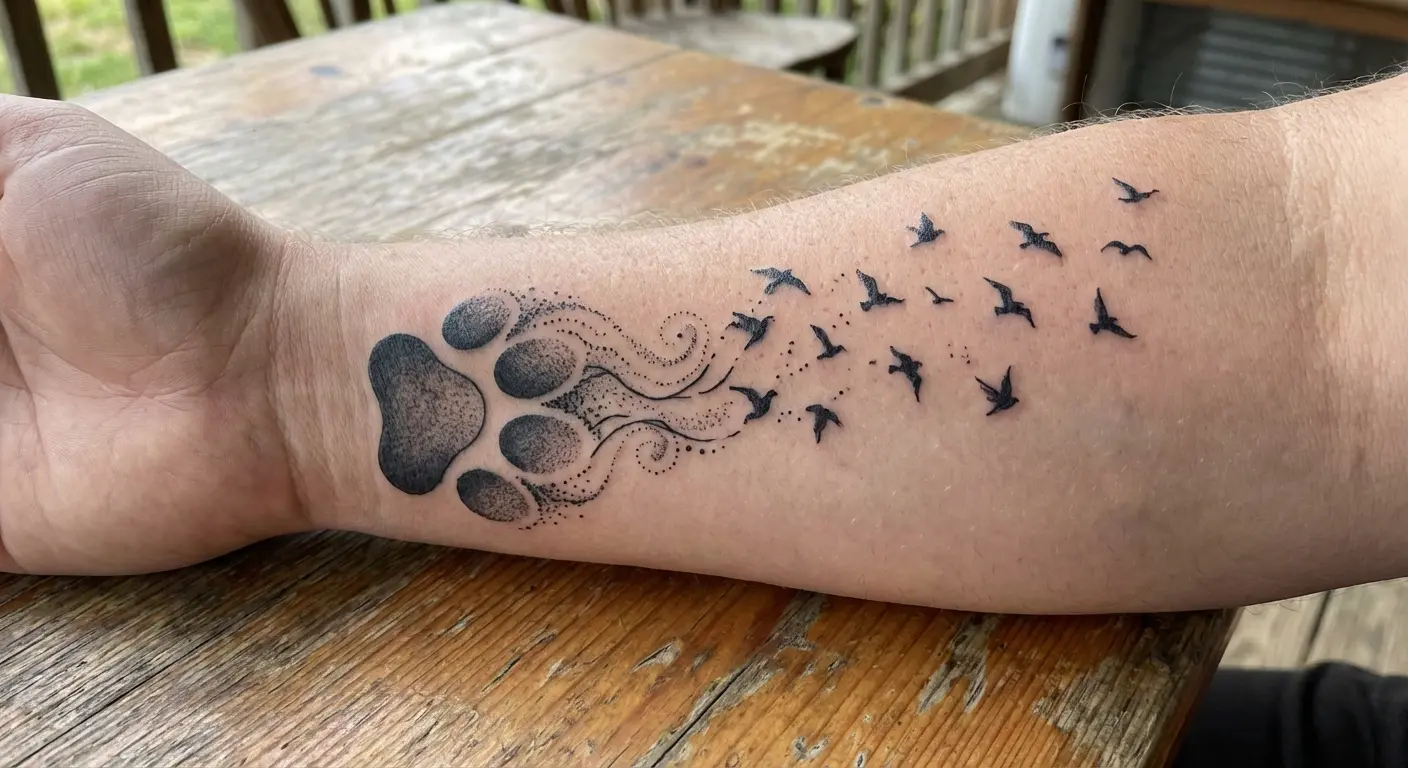
13. Paw Transforming into Birds
This design shows a paw print dissolving or transitioning into a flock of birds in flight. It’s often used as a memorial piece (the birds representing the dog’s spirit or freedom after death), but it doesn’t have to be.
The transformation can represent how your dog helped you feel free, changed your perspective, or lifted you out of a difficult period. The number of birds varies based on your design preferences and available space. The paw should be clearly defined on one end while the birds emerge from the opposite side, creating directional flow.
Works well on the forearm, shoulder blade, or ribs where the vertical or diagonal movement has room to develop. The style can range from realistic birds to simple silhouettes depending on your overall aesthetic preferences.
Choose a bird species that means something to you rather than defaulting to generic songbirds. Maybe crows if your dog had a dark sense of humor, or hummingbirds if they were small and impossibly energetic.
14. Dual Paws (Puppy and Senior)
Your dog’s paws change as they age. Puppy paws are disproportionately large, pads soft and unmarked. Senior dog paws show wear, maybe some toe pad irregularities or arthritis-related changes.
This design places two paw prints side by side or overlapping: one from when they were young, one from their current age. It’s a way of honoring the entire journey rather than freezing them at one stage.
If your dog is still alive, you can get their current paw print now and plan to add the eventual final print later (though that’s emotionally complex and not for everyone).
The size difference between puppy and adult paws can be dramatic depending on the breed. Works best on flatter areas like the forearm or thigh where both prints have space to read clearly without distortion.
The dual prints tell a story of growth, aging, and all the years between. A visual timeline of a life shared.
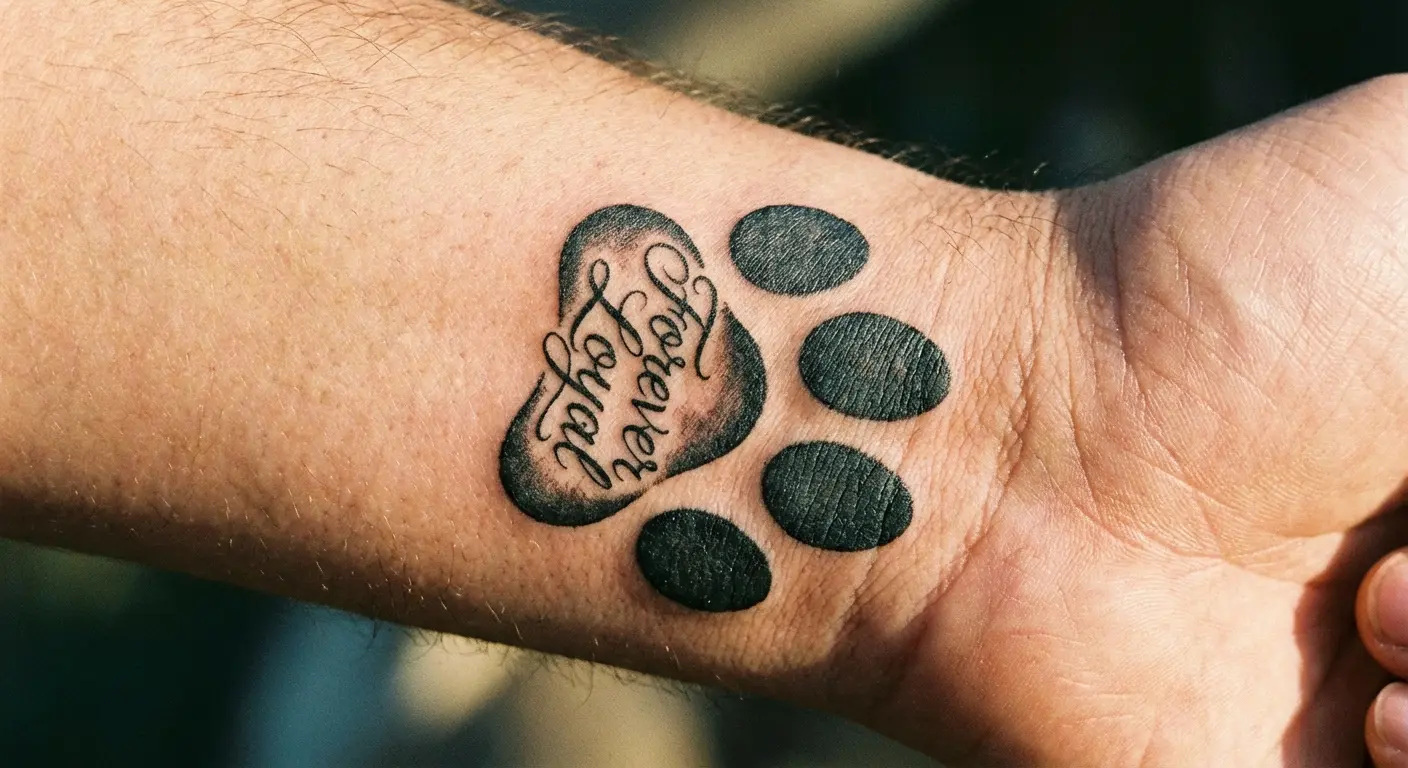
15. Paw with Your Dog’s Name in the Pad
Instead of adding the name as a separate text element, this design incorporates your dog’s name into the actual paw pad using creative lettering that follows the pad’s curve. The name becomes part of the paw structure rather than a label attached to it.
This requires careful planning with your artist to ensure the letters remain legible while conforming to the organic shape of the pad. Shorter names work better than longer ones for readability. You can use the main pad for the name or distribute letters across multiple toe pads if the name is very short.
The style of lettering should match your overall aesthetic (script for traditional, clean sans-serif for minimalist, decorative fonts for ornate designs). For those incorporating text, understanding name tattoo design approaches can help ensure your dog’s name integrates seamlessly with the paw print structure.
This keeps the design unified rather than feeling like two separate elements placed near each other.
16. Actual Ink Print Replica
This is the most literal approach: getting your dog’s actual paw print (captured with non-toxic ink or paint) and having your tattoo artist replicate it exactly, imperfections included.
The result shows the unique characteristics of your specific dog’s paw. Asymmetries. Pad wear patterns. Toe spacing. Things a generic design can’t capture. You’ll need a clear print to work from, which means either getting your dog to cooperate with the ink process or working from a print your vet captured.
The tattoo should maintain the organic irregularities of the original print rather than “cleaning it up” into a perfect version. Those imperfections are what make it authentically yours.
Works anywhere on the body and at any size, though larger versions show more of the subtle details that make the print unique.
The mud clump between the toes? The uneven pressure? That scar from the glass? That’s the real stuff. That’s what you want. Some people bring in prints that show all of it. Those details matter because they’re real, and reality beats perfection every time when you’re trying to capture something you love.
Turning Your Vision into Reality
You’ve got ideas now. Maybe a few of these designs resonated or sparked something new. The gap between “I want this tattoo” and “I have the exact design I’m ready to get inked” can feel frustratingly wide.
You know what elements matter to you (placement, style, specific details about your dog), but translating that into a visual reference your tattoo artist can work from is its own challenge.
Look, if you’ve read this far and still can’t visualize your design, use Tattoo Generator IQ. Upload your dog’s actual paw print, test different styles, adjust the placement. You’ll get high-res images to show your artist instead of trying to explain it with hand gestures.
That’s what it’s for. The high-resolution output gives your tattoo artist a clear reference to work from, which means less time explaining and more time perfecting the final piece on your skin. You can walk into your consultation with actual visuals instead of vague descriptions and Pinterest screenshots that don’t quite match what you’re imagining.
Final Thoughts
Here’s the thing: your dog isn’t a generic golden retriever from a stock photo. They’re the specific weirdo who eats socks and loses their mind over the mailman. Your tattoo should reflect that.
When you think about what your dog specifically means to you (the bond, their personality, the moments that mattered), you can create something that tells your actual story rather than a stock version of “I love dogs.”
Whether you’re honoring a three-legged fighter, capturing the muddy chaos your puppy brings into your home, or marking the specific date when your life changed for the better, these designs prove there’s room for creativity and personalization in what could otherwise be a predictable choice.
Your dog isn’t generic. Your tattoo shouldn’t be either.
