18 Traditional Tattoo Flash Designs That Are Smarter Than They Look
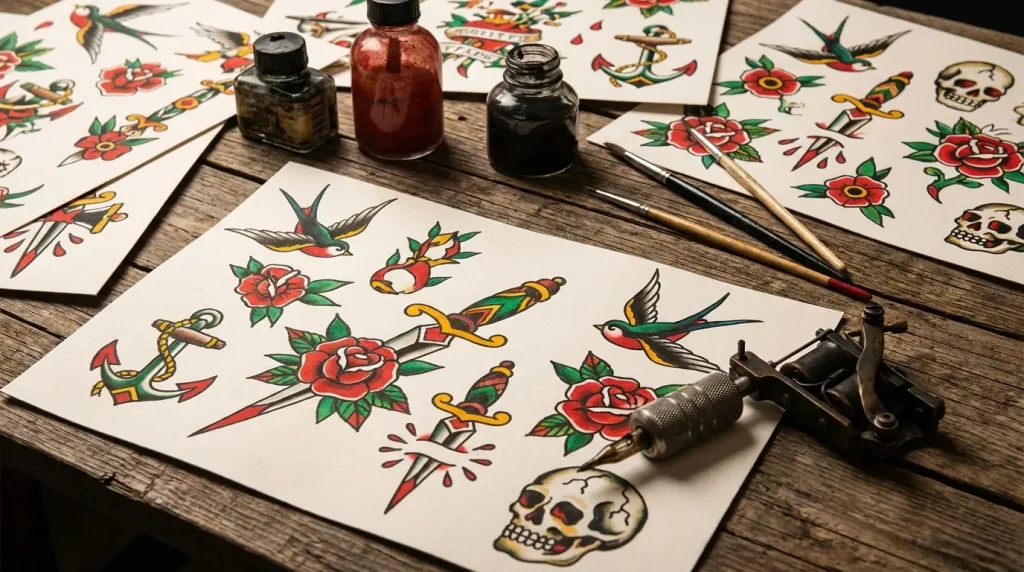
Table of Contents
-
The Misunderstood Icons
-
The Dagger Through the Heart
-
The Panther Head
-
The Sacred Heart
-
The Clipper Ship
-
-
The Overlooked Workhorses
-
The Single Rose
-
The Barn Swallow Pair
-
The Traditional Eagle
-
The Horseshoe
-
The Dice
-
-
The Cultural Shapeshifters
-
The Hula Girl
-
The Tiger
-
The Gypsy Woman
-
The Dragon
-
The Koi Fish
-
-
The Technical Showcases
-
The Banner Scroll
-
The Spider Web
-
The Nautical Star
-
The Traditional Snake
-
TL;DR
Flash sheets aren’t lazy. They’re strategic as hell. Each design tests specific skills and carries multiple meanings depending on placement and color choices. Understanding why these 18 designs became standards helps you customize them in ways that actually matter instead of just picking something off the wall.
Why Traditional Flash Gets Misread
Walk into any tattoo shop and those flash sheets on the walls? Most people see them and think “how original, another anchor.” I get it. They look like clipart from 1952. But here’s what nobody tells you: those sheets represent some of the smartest problem-solving in tattoo history. Not the most creative, necessarily. The smartest.
These sheets weren’t created because artists lacked imagination. They emerged because busy shops needed efficient systems for walk-in clients who wanted quality work without spending hours in consultation. Flash designs historically served as ready-made designs for walk-in customers who wanted a quick tattoo with minimal fuss, though their role has shifted from being simply catalysts of convenience to more artistic presentations that showcase an artist’s creativity and personal style.
Think about what traditional flash solved. A client walks in, points at a design, and the artist knows exactly what technical challenges they’re facing. No miscommunication about style. No unrealistic expectations about healing. No surprise when the client sees the finished work.
Traditional tattoo flash functioned as a universal language between artists and clients before the internet existed. Each design on those sheets was a technical demonstration. Can this artist handle smooth color gradation? Do they understand how to make bold lines that won’t blow out over time? Can they work quickly without sacrificing quality?
The designs that became vintage tattoo flash standards weren’t random. They solved specific problems. They showcased particular skills. They aged well on skin. Understanding old school tattoo techniques helps reveal why these specific designs became industry standards.
I’m about to break down eighteen traditional tattoo flash designs that carry way more complexity than their simple appearance suggests. You’ll learn what technical skills each design tests, what symbolic meanings they carry beyond the obvious, and why they became permanent fixtures on flash sheets worldwide.
The Misunderstood Icons
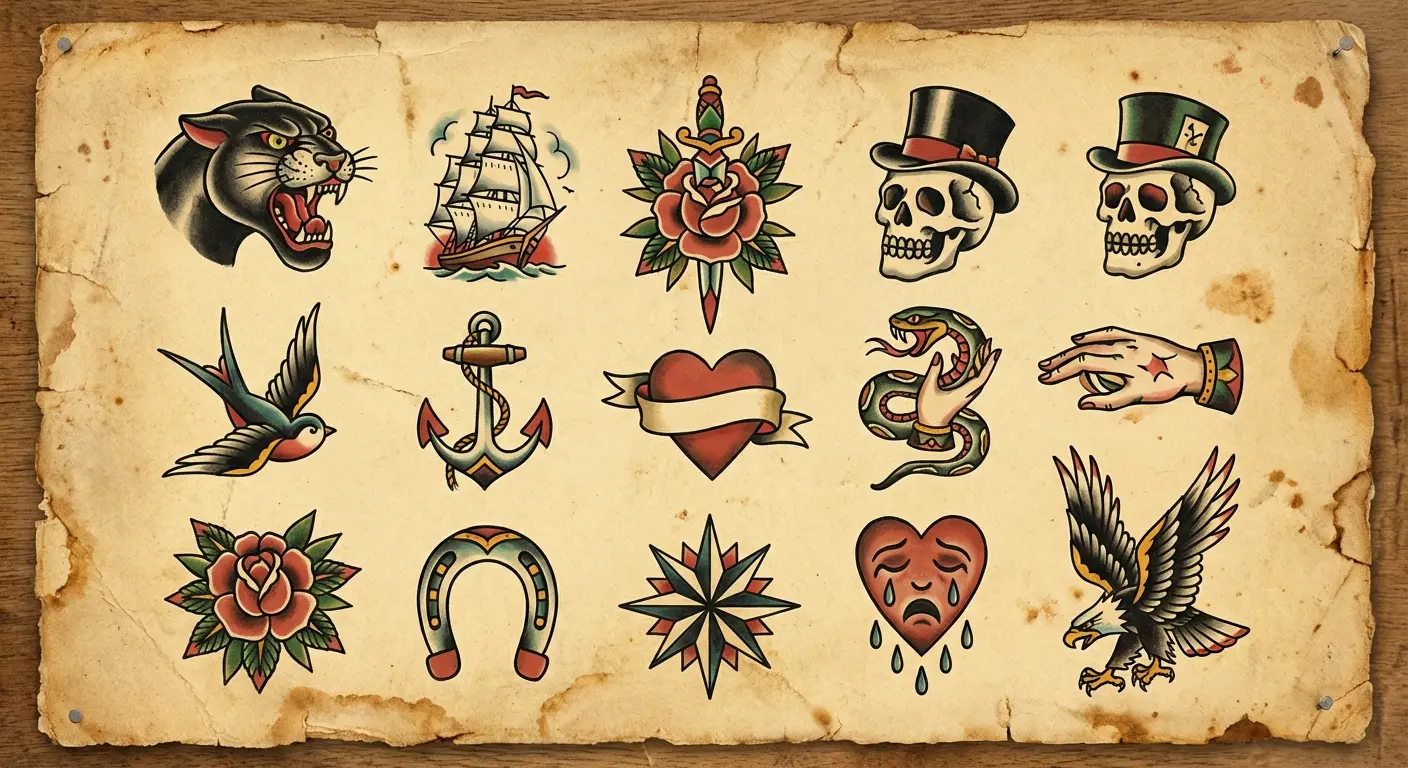
You’ve seen these four designs a thousand times. And you probably dismissed them as boring. That’s fair. They look simple. But simple and easy aren’t the same thing, and these designs will humble even good artists.
1. The Dagger Through the Heart
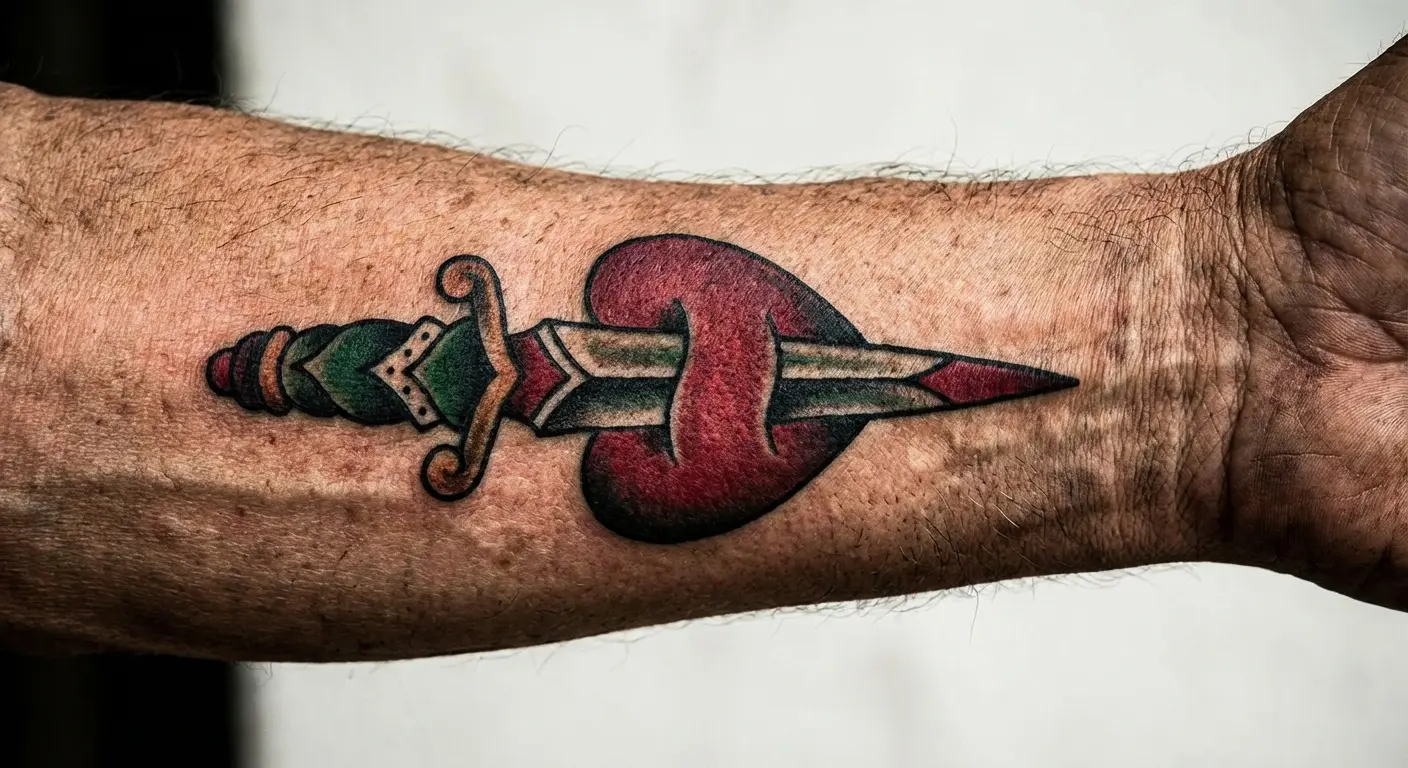
This design looks straightforward until you actually try to execute it. The dagger through the heart demands perfect symmetry while creating the illusion of three-dimensional depth within the flat, bold aesthetic that defines traditional work.
Most people see this and think “breakup tattoo.” Sure, heartbreak is one interpretation. But historically, this traditional tattoo flash design represented betrayal, loss of a loved one, or military sacrifice depending on what elements surrounded it. Add roses and you’re talking about lost love. Include military insignia and you’re honoring fallen comrades. The context completely changes the meaning.
This is where you separate the competent artists from the exceptional ones. Your line work can’t waver even slightly. And that dagger needs to look like it’s actually going through the heart, not just sitting on top of it. You’re creating depth with shading while keeping those bold outlines that make traditional work readable from across the room. It’s harder than it looks. Way harder.
Color choices matter more than most people realize. A red heart with a black dagger carries different energy than a black heart with a silver dagger. The heart tattoo carries meanings that extend far beyond simple romance in traditional flash contexts. Artists use this design to demonstrate their color packing ability, how well they can saturate solid areas without patchiness or blowouts.
Placement affects how this design reads over time. Put it on your chest and it stays relatively stable as you age. Put it on your forearm and you need to account for how the skin moves and stretches with daily use. Good artists adjust the design’s proportions based on where it’s going.
2. The Panther Head
The panther head became royalty in traditional flash tattoo collections because it requires masterful black shading within a bold framework. This isn’t a design you can fake your way through.
Military personnel and bikers popularized this design in the mid-20th century. It represented fierce independence and the refusal to back down. But beyond the symbolism, this design became a standard because it shows an artist’s shading range. You’re working with gradients of black and gray while maintaining those strong outlines that define the style.
The snarling expression and three-quarter view angle became standardized for good reason. That specific angle shows enough of the face to convey aggression while fitting cleanly into the compact spaces that flash designs require. Full profile views don’t have the same impact. Straight-on views lose the sense of motion and danger.
Vintage tattoo flash artists used the panther head as a technical benchmark. Can you create smooth gradations from solid black to light gray without muddying the transitions? Can you render facial anatomy in a stylized way that still reads as a panther and not a generic cat? These questions separate artists who understand traditional work from those just copying designs.
The design ages incredibly well when executed properly. Black ink is the most stable pigment in tattooing. A well-done panther head looks sharp decades later, while poorly executed versions turn into muddy blobs as the ink spreads over time.
3. The Sacred Heart
Religious imagery dominates traditional tattoo flash art, but the Sacred Heart stands out for its layered complexity. This design tests multiple technical skills simultaneously: flame rendering, fine detail work in thorns and blood drops, and color gradation that creates depth without losing boldness.
The roots trace back to Catholic iconography, representing divine love and sacrifice. But in tattoo culture, the Sacred Heart evolved to represent devotion, remembrance, or sacrifice in secular contexts. You don’t need to be religious to appreciate the symbolic weight of a heart surrounded by flames and thorns.
The technical demands get interesting fast. You’re balancing ornate details with the bold simplicity that traditional flash requires. Too much detail and the design gets muddy as it ages. Too simple and you lose the ornate quality that makes the Sacred Heart distinctive. Finding that balance requires understanding how skin accepts ink and how designs transform over years of sun exposure and natural aging.
The flames present a particular challenge. They need to feel dynamic and alive while maintaining the graphic quality of traditional work. The thorns require precise line work that stays crisp. The drops of blood need careful placement and shading to appear three-dimensional.
Color choices affect the entire design’s energy. A red heart with yellow flames carries different visual weight than a black heart with red flames. Artists use this design to prove their understanding of color theory within the constraints of traditional tattooing’s limited palette.
This design ages exceptionally well when executed with proper technique. The bold outlines hold the composition together as the finer details settle into the skin. Vintage tattoo flash versions from skilled artists still look striking decades later, which is why the Sacred Heart remains a traditional flash staple.
4. The Clipper Ship
Nautical flash dominates traditional flash sheets, but the clipper ship is the pinnacle of technical line work in the style. This design became a standard test piece because it demands skills that apply across all traditional work.
Parallel lines, perspective, fine detail in rigging, wave patterns. The clipper ship requires all of these within a bold framework. You can’t hide sloppy line work in a design with this much detail. Each line of rigging needs to be parallel and evenly spaced. The perspective must be convincing enough to create depth without photorealistic rendering.
The symbolism runs deeper than “sailor tattoo.” A clipper ship in calm seas means journey and adventure. The same ship in stormy waters means struggle and the hope of safe return home. The number of sails, flag details, and accompanying elements create a customizable template within a standardized design.
This traditional tattoo drawing requires significant skin real estate. You can’t shrink a clipper ship down to wrist size and maintain the detail that makes the design impressive. It needs space to breathe, which is why you typically see these on backs, ribs, or thighs.
Placement affects the overall composition significantly. A ship on the ribs can follow the natural curves of the body, creating a sense of motion. A ship on the back can be larger and more detailed. Understanding how body placement affects the design’s impact is part of what makes this a technical showcase piece.
Artists who can execute a clean clipper ship prove they understand the fundamentals of traditional work: bold outlines, strategic detail, and composition that reads clearly from a distance while rewarding closer inspection.
|
Design Element |
Technical Challenge |
Symbolic Meaning |
Ideal Placement |
|---|---|---|---|
|
Dagger Through Heart |
Symmetry, 3D depth in 2D style |
Betrayal, loss, sacrifice |
Chest, upper arm, forearm |
|
Panther Head |
Black gradient shading, facial anatomy |
Independence, ferocity, courage |
Shoulder, thigh, chest |
|
Sacred Heart |
Fine detail with bold lines, flame rendering |
Devotion, sacrifice, remembrance |
Chest, back, upper arm |
|
Clipper Ship |
Parallel lines, perspective, rigging detail |
Journey, adventure, homecoming |
Back, ribs, thigh |
The Overlooked Workhorses
These five designs appear so frequently on traditional flash sheets that people stop seeing them. But there’s strategic brilliance behind their ubiquity. They kept shops running during walk-in heavy periods because they’re quick to execute, highly customizable, and nearly impossible to mess up when done by a competent artist. Nearly.
5. The Single Rose
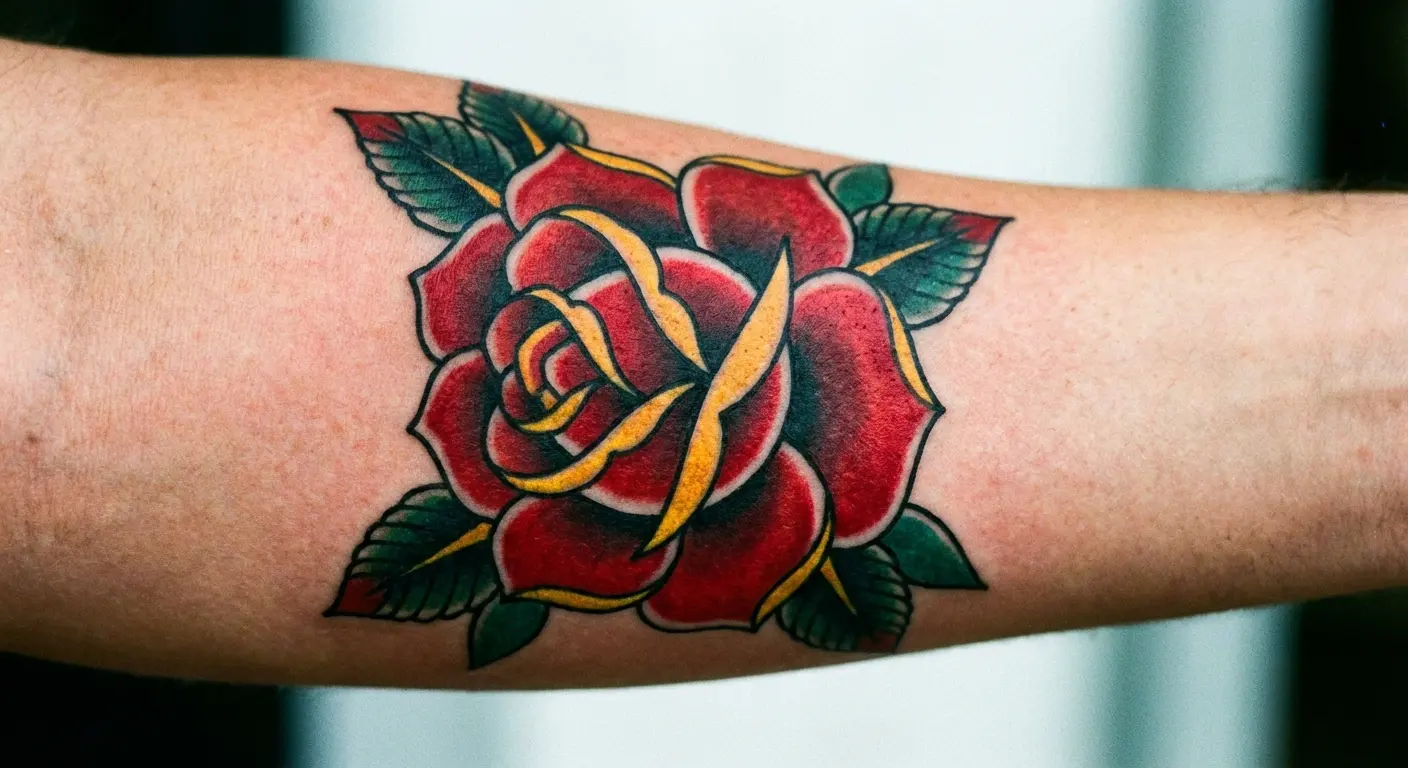
You’ll find roses on virtually every traditional tattoo flash sheet ever printed. There’s a reason beyond aesthetics: this design allows artists to demonstrate color theory, shading technique, and organic form rendering in a universally recognizable image.
The rose’s symbolic flexibility makes it endlessly customizable. Red roses mean love and passion. Black roses represent loss or remembrance. Yellow roses signify friendship. White roses indicate purity or new beginnings. The same basic design transforms completely based on color choices.
Most people miss this entirely: the specific rose angles and petal arrangements on flash sheets are optimized for different body placements and skin textures. A rose viewed from above works better on rounded surfaces like shoulders. A side view rose fits better on flat areas like the forearm. Artists developed these variations through decades of trial and error.
A well-executed traditional rose should have bold outlines with soft color gradation. That balance reveals an artist’s skill level immediately. Can they pack color smoothly without patchiness? Can they create soft transitions while maintaining crisp edges? The rose answers these questions.
These tattoos are designed to withstand the test of time, resisting fading while still looking crisp, bright, and legible thanks to thick lines and deeply saturated colors, which stand up to wear and aging, ensuring your ink retains its boldness whether it’s seen sunlight or shower water.
The rose rarely stands alone in compositions. It pairs with daggers, skulls, banners, and almost any other traditional element. That versatility makes it essential vocabulary in american traditional flash. You need to understand how to render a clean rose before you can build more complex pieces around it.
6. The Barn Swallow Pair
Swallows appear in pairs on traditional flash tattoo sheets for both symbolic and compositional reasons that most people completely miss. These birds historically represented nautical miles traveled (one swallow per 5,000 miles) and guaranteed safe return home for sailors.
The technical genius lies in the mirrored composition. Creating two birds that are matching but not identical requires understanding how to render motion and maintain visual balance. Put these on curved body parts like collarbones or shoulders and you see why the mirrored design works so well. The symmetry creates visual harmony even on asymmetrical placements.
This design shows an artist’s ability to work with limited color palettes. Typically you’re looking at blue, red, yellow, and black. That’s it. Within those constraints, artists need to create birds that feel alive and dynamic. The wings spread in flight, the slight variations in positioning, the way the birds mirror each other without looking copy-pasted. These details matter.
The specific pose became standardized because it solves practical problems. Wings spread in flight creates a horizontal composition that fits well on shoulders, chest, and collarbones. It also proves the artist’s ability to render feathers and create a sense of motion within the static, bold aesthetic of american traditional flash tattoos.
This design functions as a technical warm-up for more complex pieces. Get the swallows right and you’ve demonstrated you can handle symmetry, color application, and organic forms within traditional constraints. That’s why you see them so frequently on flash sheets. They’re a reliable test of fundamental skills.
7. The Traditional Eagle
The American traditional eagle represents patriotism on the surface, but its real value on flash sheets is demonstrating feather rendering and bold color application. This design tests whether an artist can create texture through line work while handling large areas of color saturation.
Eagles carry heavy symbolic weight: freedom, strength, military service. That makes them consistent sellers. But from a technical perspective, the eagle challenges artists to make feathers appear detailed without compromising the bold aesthetic that defines traditional work.
The standardized poses on vintage tattoo flash sheets (spread wings, clutching objects, profile views) solve common application problems on different body parts. Spread wings work well on chests and backs where you have horizontal space. Profile views fit better on arms and legs where the canvas is more vertical. These variations developed through practical experience, not random preference.
Creating texture in feathers requires understanding how to use line work strategically. Too many lines and the design gets muddy. Too few and it doesn’t read as an eagle. The balance requires technical skill and experience with how ink settles into skin over time.
Large areas of color saturation present their own challenges. Can you pack yellow or red smoothly across a large area without patchiness? Can you maintain consistent color density throughout the design? The eagle answers these questions clearly. Poor execution shows up immediately in uneven color or blown-out lines.
8. The Horseshoe and Dice
Look, I’m grouping these together because they’re both quick flash staples that test geometric precision more than artistic vision. The horseshoe seems almost too simple to warrant space on traditional flash sheets. But it’s a technical efficiency masterpiece.
Perfect curves, consistent line weight, symmetry. The horseshoe demands all of these in a design that takes less than an hour to execute. That makes it perfect for walk-in clients who want something quick and meaningful. It also makes it a reliable test of an artist’s clean execution.
The horseshoe carries clear symbolic meaning: luck and protection. But the orientation matters. Points up means the luck stays in. Points down means the luck pours out. Some people prefer points down, believing luck should flow freely. Others insist on points up to keep good fortune contained. Understanding these interpretations helps you customize even simple american traditional flash.
Dice appear on traditional flash because they represent a perfect test of geometric precision and shading consistency. This design proves an artist’s ability to create three-dimensional forms using traditional techniques: bold outlines with strategic shading.
The symbolism is straightforward: luck, risk-taking, fate. Popular among gamblers and people who embrace uncertainty. But the real value is in the technical demands. Creating perfect squares with consistent dot placement and convincing shadows requires more skill than the simple appearance suggests.
Dice almost always appear as a pair showing specific numbers. Seven is most common, representing luck in gambling culture. But the number combination can be customized to represent significant dates, lucky numbers, or personal meaning. That flexibility within a standardized format makes dice reliable traditional tattoo drawing material.
Our comprehensive guide to dice tattoo meanings explores deeper into gambling and fate symbolism if you’re considering this design.
Both designs function as technical foundations for more complex geometric work. Master clean dice and horseshoes and you’ve proven you can handle precision and spatial relationships. That’s why they remain staples on trad tattoos flash sheets despite their apparent simplicity.
The Cultural Shapeshifters
These five designs carry complex cultural histories that have evolved significantly over decades. They originated in specific cultural contexts but have been adapted, reinterpreted, and sometimes appropriated as they spread through tattoo culture. We need to approach these with nuance, acknowledging both their artistic value and the cultural sensitivity they require.
10. The Hula Girl
Okay, we need to talk about the cultural baggage here, because it’s heavy and most flash sheets just ignore it completely. This design originated in mid-century American tattoo culture, particularly among sailors and military personnel stationed in Hawaii. But it represents both cultural appreciation and problematic stereotyping depending on execution and intent.
The technical appeal lies in rendering flowing fabric, creating movement in a static image, and working with skin tone colors that require careful application. From a pure craft perspective, the hula girl challenges artists to depict motion and feminine form within traditional style constraints.
But we can’t ignore the cultural issues. This design often reduces Hawaiian culture to exotic decoration, perpetuating stereotypes about Pacific Islander women. Modern artists approach it with more cultural awareness, sometimes working directly with Hawaiian clients to create respectful interpretations that honor the culture rather than commodifying it.
Flash designs don’t exist in cultural vacuums. They require thoughtful consideration beyond pure aesthetics. If you’re drawn to this american traditional flash design, ask yourself why. Are you honoring a genuine connection to Hawaiian culture, or are you attracted to a romanticized stereotype?
Some artists have stopped offering this design entirely. Others have reimagined it in ways that show respect for Hawaiian traditions. The key is recognizing that traditional flash evolved in a different cultural context, and we have the responsibility to approach these designs with more awareness than previous generations did.
11. The Tiger
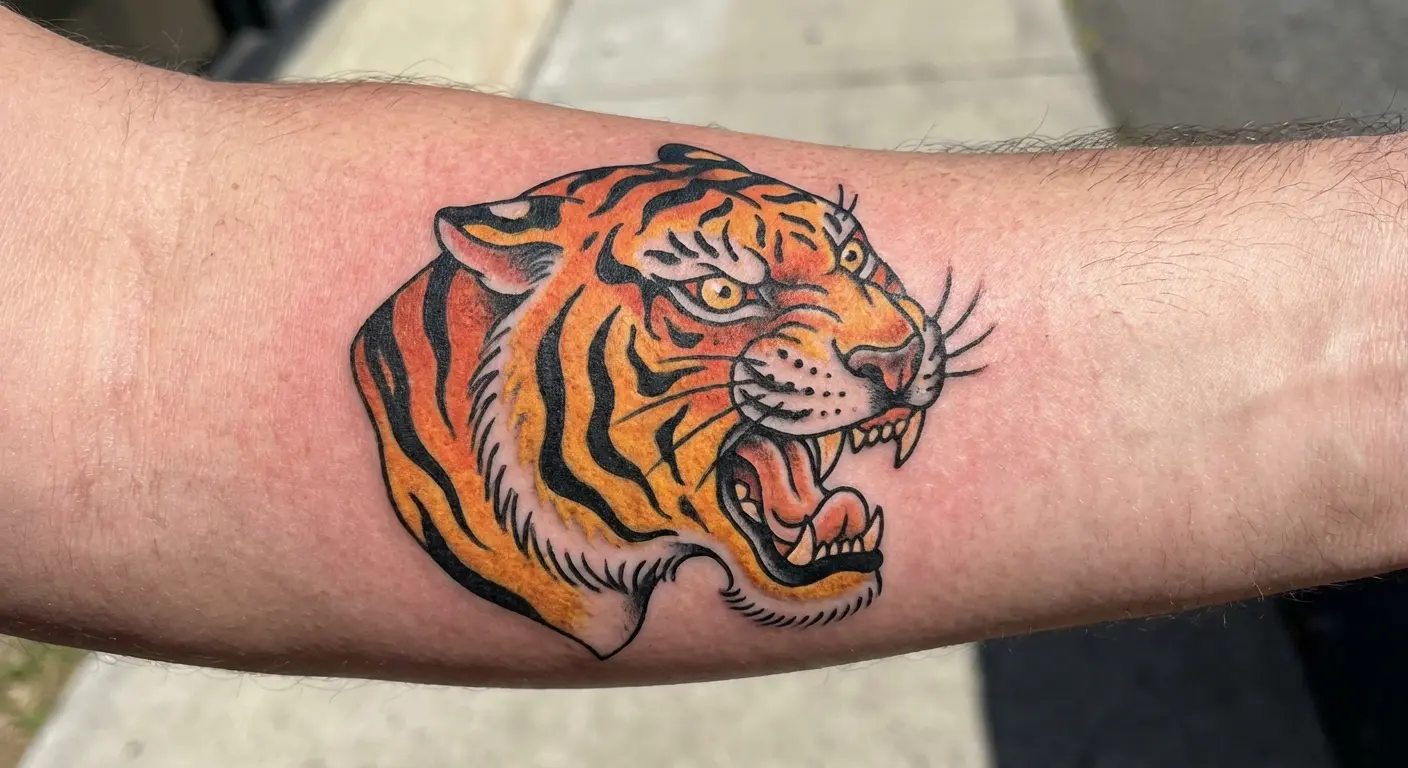
Tigers dominate traditional tattoo flash sheets because they demonstrate advanced shading techniques and bold color work simultaneously. This design migrated from Asian tattoo traditions into American traditional style, creating a hybrid that shows cross-cultural artistic exchange.
The technical challenge involves rendering striped patterns that maintain readability while creating depth through color gradation. Orange to yellow transitions, black stripe work that creates volume rather than just pattern. These elements test an artist’s understanding of how color and shading work together.
The symbolism varies significantly across cultures. Western contexts emphasize strength and courage. Asian traditions focus on protection and power. That cultural crossover makes the tiger particularly interesting for examining how traditional flash art evolves across boundaries.
The snarling profile view became standardized because it solves compositional problems on curved body surfaces. That specific angle shows enough of the face to convey ferocity while fitting into the compact spaces that flash designs require. It also shows the artist’s ability to render facial anatomy in a stylized but recognizable way.
Color application reveals skill level immediately. Can you create smooth gradations from bright orange to pale yellow? Can you pack those colors densely enough that they’ll stay vibrant as the tattoo ages? The tiger answers these questions within the first few sessions.
12. The Gypsy Woman
I need to address this design’s problematic naming and the harmful stereotypes it perpetuates against Romani people. It appears on vintage tattoo flash sheets because of orientalist fascination and fortune-telling mystique, but it carries cultural baggage that requires critical examination.
The technical appeal lies in rendering facial features, flowing hair, and ornate jewelry within traditional style constraints. From a craft perspective, this design tests an artist’s ability to depict feminine beauty and intricate details while maintaining bold readability.
But the cultural harm outweighs the technical interest. This design reduces Romani culture to exotic stereotypes, perpetuating harmful misconceptions about an already marginalized community. The romanticized “fortune teller” imagery ignores the real discrimination and persecution Romani people face.
Modern artists increasingly avoid this traditional tattoo flash design entirely. Some have significantly reimagined it with cultural sensitivity, renaming it “fortune teller” or “mystic woman” to distance from ethnic stereotyping. But even those attempts don’t fully address the underlying issues.
This serves as a case study in how flash designs can carry harmful cultural baggage that requires critical examination rather than blind reproduction. Understanding this history helps you make more informed, respectful design choices. Just because something appears on vintage flash sheets doesn’t mean we should continue reproducing it without question.
13. The Dragon
Dragons bridge Eastern and Western tattoo traditions on traditional flash sheets, creating fascinating hybrid designs that show different artistic approaches. American traditional artists adapted Asian dragon imagery, simplifying complex scales and flowing forms into bolder, more graphic interpretations.
The technical showcase involves creating serpentine movement, rendering scales that maintain pattern consistency, and handling fire or smoke elements. These challenges require understanding how to balance detail with the bold simplicity that defines american traditional flash art.
The symbolism shifts dramatically between cultures. Eastern traditions emphasize wisdom and protection. Western contexts focus on power and danger. That cultural flexibility makes dragons particularly rich for customization while maintaining recognizable imagery.
Dragons work exceptionally well in traditional style despite their Asian origins. The bold outlines and limited color palette enhance the design’s impact rather than limiting it. You get the mythological weight of dragon imagery with the graphic punch of American traditional execution.
Scale rendering presents particular challenges. Each scale needs to be distinct enough to create texture but consistent enough to maintain pattern integrity. Too much variation and it looks chaotic. Too much uniformity and it looks mechanical. Finding that balance requires experience and understanding of how patterns read on curved body surfaces.
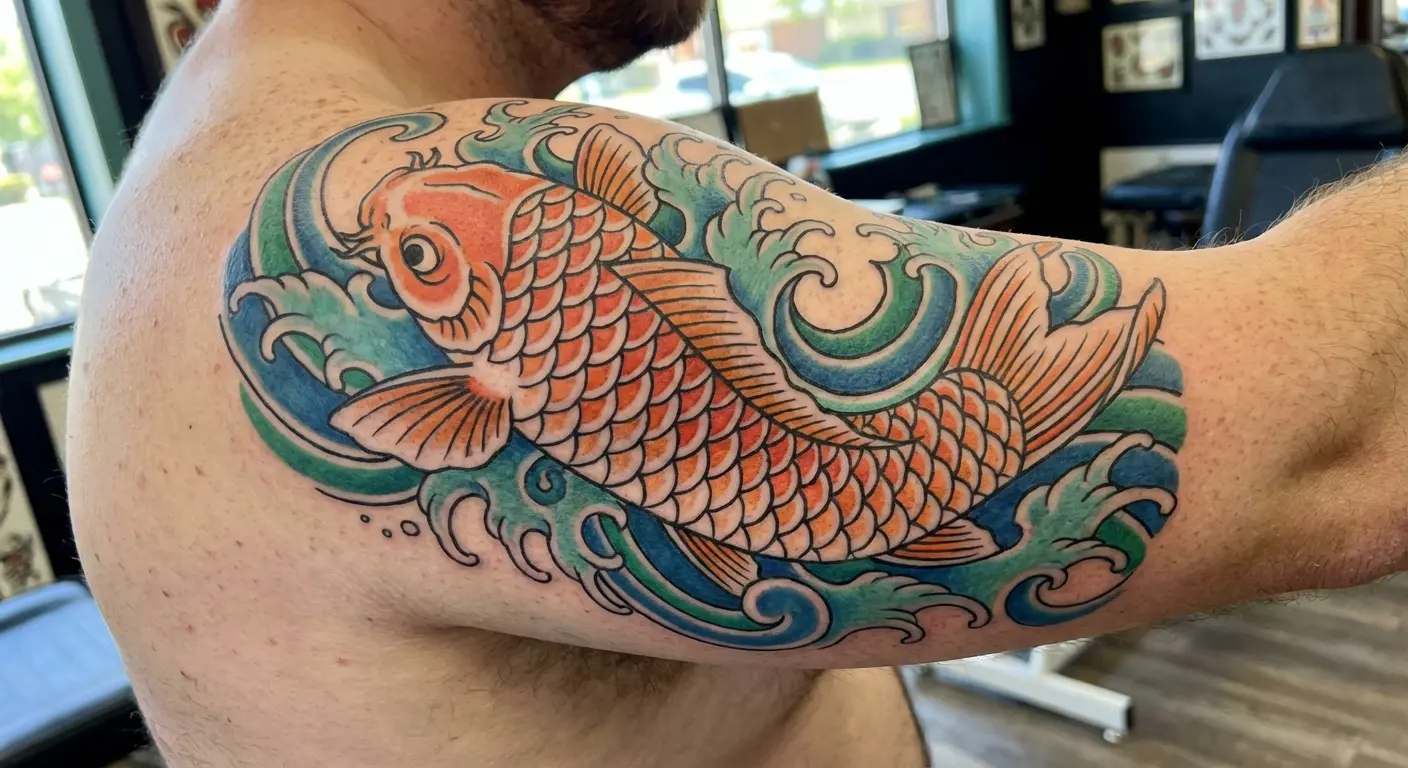
14. The Koi Fish
Koi fish represent another successful cross-cultural adaptation in traditional flash, though they require careful handling to avoid cultural appropriation. These designs migrated from Japanese irezumi into American traditional style, maintaining symbolic significance while adapting to different technical approaches.
The challenge lies in rendering scales, creating flowing movement, and handling water elements within traditional style constraints. Koi need to feel like they’re swimming, which means capturing motion in a static image while maintaining the bold graphic quality of traditional work.
Koi direction matters symbolically. Swimming upstream represents perseverance and overcoming obstacles. Swimming downstream suggests going with the flow or completed struggles. These meanings come from Japanese tradition, where koi swimming upstream eventually transform into dragons.
Color choices carry different meanings that Western traditional tattoo flash sometimes ignores. Red koi represent love and bravery. Black koi symbolize overcoming obstacles. Yellow koi indicate wealth and prosperity. Blue koi suggest tranquility and reproduction. Understanding these traditional associations helps create more meaningful customizations.
Exploring koi fish tattoo meanings reveals how these designs bridge Eastern and Western traditions when approached with respect and understanding.
This design shows how flash can facilitate cultural exchange when approached thoughtfully rather than through superficial borrowing. The best traditional koi interpretations honor the Japanese origins while adapting the imagery to American traditional technical requirements.
The Technical Showcases
These final four designs exist primarily to demonstrate specific technical skills. They’re not necessarily the most symbolic or culturally significant, but they’re essential for artists to master because they test fundamental techniques that apply across all traditional work. These designs function as both standalone pieces and technical building blocks for more complex compositions.
15. The Banner Scroll
Banners appear on almost every traditional tattoo flash sheet because they’re endlessly customizable and test an artist’s ability to create dimension through shading. This seemingly simple design requires sophisticated understanding of light sources, ribbon physics, and lettering integration.
Making a flat ribbon appear three-dimensional using only bold outlines and strategic shading, that’s the core technical challenge. Then you need to add custom text that flows naturally with the banner’s curves. The lettering can’t look pasted on. It needs to follow the ribbon’s movement and perspective.
Certain banner shapes became standardized because each variation solves different compositional problems. Simple scrolls work well for short text. Elaborate ribbons accommodate longer phrases. Torn paper effects add visual interest while maintaining readability. These variations developed through practical application, not aesthetic preference alone.
This design rarely stands alone but functions as a crucial element in larger compositions. Banners add names, dates, meaningful phrases, or thematic text to otherwise purely visual designs. That versatility makes them essential vocabulary in simple american traditional flash.
The real skill shows in how seamlessly the banner integrates with surrounding elements. Does it look like an afterthought, or does it feel like an organic part of the overall design? That distinction separates competent work from exceptional execution.
16. The Spider Web
Spider webs carry controversial symbolism (prison time and white supremacy in some contexts) but remain traditional flash tattoo standards because they test radial symmetry and fine line work. I need to acknowledge the problematic associations while examining the pure technical challenge.
Creating perfectly spaced concentric circles with radiating lines that maintain consistency across curved body surfaces, particularly elbows and knees where this design traditionally appears, requires geometric precision that serves as a technical benchmark for traditional artists.
Context and placement affect interpretation significantly. An elbow web has different connotations than a web incorporated into a larger Halloween-themed piece. Understanding a design’s multiple meanings helps you make informed decisions about whether it’s appropriate for your situation.
The geometric precision required makes this a legitimate technical test. Can you maintain consistent spacing as the web expands outward? Can you adapt the pattern to fit a curved surface without distorting the geometry? These questions have practical answers that reveal skill level.
Some artists have stopped offering this design because of its associations with racist ideology. Others continue using it in specific contexts where the symbolism is clearly divorced from hate group imagery. This shows how flash designs evolve not just technically but culturally, and we have responsibility to consider those evolving meanings.
17. The Nautical Star
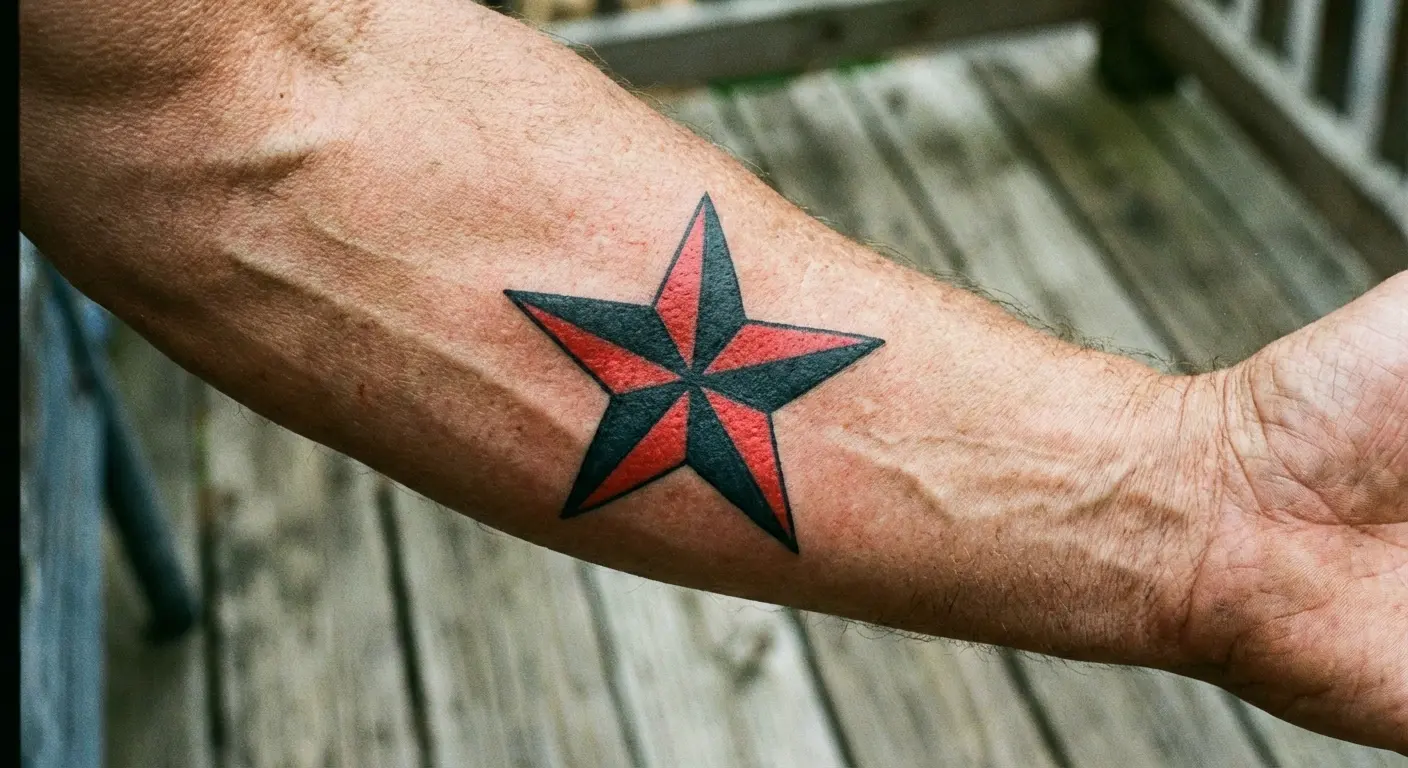
This five-pointed star with alternating shading became a vintage tattoo flash staple because it demonstrates perfect geometric construction and consistent shading technique. It originated as nautical symbolism representing the North Star and safe navigation, but evolved into a broader symbol of guidance and protection.
The technical challenge lies in creating five identical points with perfectly alternating light and dark shading that maintains consistency across the entire design. This tests whether an artist can work with geometric precision while maintaining the hand-drawn quality that traditional work requires.
Too perfect looks machine-made. Too loose looks sloppy. Finding that balance requires understanding how to execute clean geometry with human touch. The nautical star reveals immediately whether an artist has mastered that balance.
Certain color combinations became standard because they solve visual problems. Black and red creates high contrast that reads well from a distance. Black and white offers classic simplicity. These choices aren’t arbitrary, they’re based on decades of experience with what works on skin.
The star tattoo has evolved from purely nautical symbolism to represent guidance and personal direction in contemporary contexts.
This design functions as a technical foundation for more complex geometric work. Master the nautical star and you’ve proven you can handle precision and pattern consistency. That makes it essential practice for american traditional flash that incorporates geometric elements.
18. The Traditional Snake
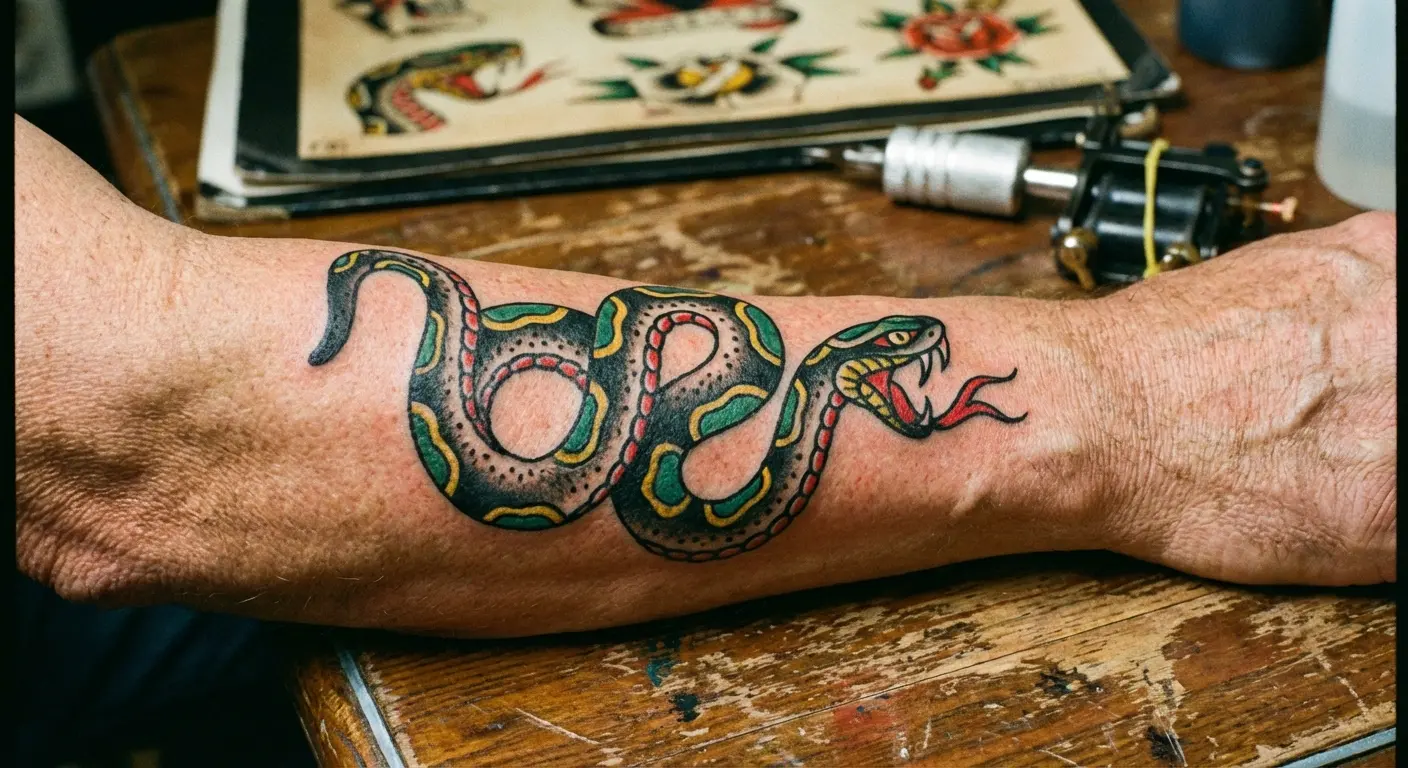
Snakes appear constantly on traditional flash because they solve a crucial compositional problem: filling long, curved spaces on the body. Arms, legs, ribs, these areas benefit from designs with natural flow, and snakes provide exactly that.
This design tests an artist’s ability to create flowing movement, render consistent scale patterns, and handle the transition from thick body to thin tail. Those technical demands make it valuable beyond its symbolic meanings, which vary widely depending on context.
Danger, transformation, healing, temptation. Snakes carry all these associations and more. That symbolic flexibility makes them highly customizable through accompanying elements and specific species choices. A cobra carries different energy than a rattlesnake. A snake wrapped around a dagger means something different than a snake coiled around roses.
The technical showcase involves maintaining pattern consistency across a curved form. Each scale needs to be similar enough to create visual coherence but varied enough to avoid mechanical repetition. Creating depth through scale shading while maintaining bold outlines requires understanding how patterns read on three-dimensional surfaces.
The snake’s head requires precise facial anatomy in a stylized form. Too realistic and it clashes with traditional aesthetic. Too abstract and it loses recognizable features. Finding that balance tests an artist’s ability to simplify forms without losing essential character.
Certain snake poses became standardized because each variation solves different placement challenges. Coiled snakes fit well in compact spaces. Striking snakes create dynamic energy. Snakes wrapped around objects integrate well into larger compositions. These variations developed through practical problem-solving in busy shops.
The traditional flash culture remains vibrant in contemporary tattoo communities, with Friday the 13th flash sales becoming a beloved tradition where shops across Texas and beyond offer special flash designs at discounted rates, demonstrating how these pre-designed sheets continue to serve their original purpose of providing quick, accessible tattoos while building community around the art form.
From Flash to Finished Design
You understand flash now. You recognize the technical demands, the symbolic depth, the strategic thinking behind these standardized designs. But most people get stuck right here: how do you move from appreciating these designs to getting one that feels personal?
The frustration is real. You love the bold aesthetic of traditional tattoo flash, but you don’t want the exact same design that’s been tattooed thousands of times. You want something that maintains the technical integrity of American traditional work while feeling uniquely yours.
Tattoo Generator IQ bridges that gap. It functions as a digital traditional flash art tool that responds to your specific vision. You can explore traditional style variations, blend elements from multiple flash designs, and create something that honors the technical requirements while incorporating personal meaning.
Test different color combinations. Adjust specific elements. Generate multiple variations before committing to skin. The tool gives you artist-ready references that your tattoo artist can work from directly, eliminating miscommunication about style and expectations.
Think of it as having access to an infinite flash sheet that adapts to your preferences. You maintain the bold lines, limited color palettes, and designs that age well (all the technical foundations that make traditional work timeless). But you customize the symbolic details, color choices, and accompanying elements that reflect your specific story.
Final Thoughts
Flash sheets were never meant to be copied exactly. They’re visual vocabulary that skilled artists and informed clients use to communicate efficiently. Understanding the technical reasoning and symbolic depth behind these eighteen traditional tattoo flash designs transforms them from generic clipart into sophisticated starting points for meaningful custom work.
The best traditional tattoos balance respect for the style’s technical requirements with personal customization that makes each piece unique. Bold lines that won’t blow out over time. Limited color palettes that age gracefully. Designs with enough visual weight to remain readable decades from now. These technical foundations make traditional work timeless, regardless of which specific flash design you start with.
The real power of flash literacy is knowing which elements to preserve and which to adapt. Preserve the technical foundations (the line weight that prevents blowouts, the color saturation that resists fading, the composition that reads clearly from across the room). Adapt the symbolic details, the accompanying elements, the specific customizations that make the design reflect your story rather than someone else’s.
Dig deeper into any design that speaks to you. Understanding its history reveals why certain technical choices matter. Knowing the multiple symbolic interpretations helps you customize meaningfully rather than superficially. Recognizing the compositional strategies helps you work with your artist to adapt the design for your specific body placement.
Traditional tattoo flash isn’t a limitation on creativity. It’s a foundation that supports it. These eighteen designs became standards because they solved real problems: technical challenges, symbolic needs, compositional requirements. They represent generations of artists refining what works on skin, what ages well, what communicates clearly.
When you walk into a shop now, you’ll see those flash sheets differently. Each design represents specific technical mastery. Each variation solves particular placement challenges. Each color choice affects how the tattoo will look in five, ten, twenty years.
You’re equipped now to be a better collaborator with your tattoo artist. You understand why they might suggest adjusting a design’s proportions for your placement. You recognize when color choices will affect longevity. You can discuss modifications that maintain technical integrity while adding personal meaning.
That’s the difference between getting a tattoo and getting a tattoo you’ll value for decades. Flash knowledge transforms you from passive recipient to informed participant in the creative process.
