25 Celtic Tattoos That Actually Honor the Symbolism (Not Just the Aesthetic)
Table of Contents
Ancient Protectors: Symbols That Guard and Ground
-
Trinity Knot (Triquetra)
-
Dara Knot
-
Shield Knot
-
Celtic Cross
-
Quaternary Knot
-
Serch Bythol
-
Solomon’s Knot
-
Sailor’s Knot
-
Celtic Tree of Life
Warriors and Wanderers: Designs for the Bold
-
Celtic Wolf
-
Celtic Dragon
-
Celtic Warrior
-
Claddagh
-
Celtic Stag
-
Raven with Knotwork
-
Celtic Sword and Shield
-
Boar with Spiral Patterns
-
Hound of Culann
Living Legacy: Patterns That Connect Past to Present
-
Celtic Spiral (Triskelion)
-
Endless Knot
-
Celtic Mother Knot
-
Shamrock with Knotwork
-
Celtic Family Knot
-
Ancestral Band
-
Ogham Script Integration
TL;DR
Celtic tattoos aren’t just pretty loops. Every knot, spiral, and symbol meant something specific – protection, family, eternity, the works.
The unbroken line in Celtic knotwork represents eternity and interconnectedness, which makes placement and flow critical. Many popular “Celtic” designs are actually Victorian-era interpretations, not authentic ancient symbols. If you care about historical accuracy, this matters.
Scale? It completely changes everything. Intricate knotwork needs enough size or the details blur into solid black over time. I’ve seen it happen.
Here’s how to actually approach this: Figure out what the symbol means. Then, and only then, worry about how it’ll look on your body. Backwards gets you a pretty tattoo you don’t connect with. The intricate knots and symbols of ancient Celtic art have captivated people worldwide, with the rich history and spiritual depth embedded in these motifs making Celtic symbols one of the most popular choices for tattoos globally. These celtic tattoo designs carry deep meanings representing concepts like love, loyalty, and strength. Knowing what these patterns meant to the Celts changes how you think about your tattoo. These weren’t decorative – they were how people talked about life, death, family, and identity before they had an alphabet.
Ancient Protectors: Symbols That Guard and Ground
Protection symbols first. The Celts didn’t mess around with decorative tattoos – these were spiritual armor.
The knotwork in this category features unbroken lines representing eternity and how everything connects to everything else. Geometric precision requires a skilled artist to execute properly. These celtic tattoo designs work really well as standalone pieces or as foundational elements in larger compositions.
Look, knowing what these patterns actually meant? It changes everything. You’re not just getting pretty lines – you’re tapping into how people talked about existence, protection, family, and identity long before they even had a written alphabet. Here’s the thing about meaning vs. aesthetics: in five years, you’ll either still feel connected to your tattoo or you’ll be explaining “I just thought it looked cool.”
Okay, I made a chart because I kept getting the same questions:
|
Symbol Type |
Primary Meaning |
Ideal Placement |
Minimum Recommended Size |
How Hard to Pull Off |
|---|---|---|---|---|
|
Trinity Knot |
Divine trinity, three realms |
Wrist, ankle, behind ear |
2-3 inches |
Easy |
|
Dara Knot |
Strength, wisdom, roots |
Forearm, back, thigh |
4+ inches |
Don’t let a rookie try this |
|
Shield Knot |
Protection, four elements |
Chest, shoulder blade, forearm |
3-4 inches |
Medium |
|
Celtic Cross |
Faith union, eternity |
Spine, forearm, calf |
3-6 inches |
Medium-High |
|
Celtic Tree of Life |
Interconnection, rebirth |
Back, thigh, side |
5+ inches |
Complex |
Note: These are minimums. Go bigger if you can – your 50-year-old self will thank you.

1. Trinity Knot (Triquetra)
The Trinity Knot.
Everyone wants this one. Three points, one line, instantly recognizable. It’s been around since before Christianity – originally representing the triple goddess or the three realms of earth, sea, and sky. Then Christians came along and said “Holy Trinity,” and now it means both depending on who you ask.
Here’s what matters for tattoo purposes: those three loops need equal visual weight, and the overlapping sections need clear depth or the whole thing looks flat. One continuous line, three points. That’s why it works so well small – there’s not enough going on to turn into a blurry mess when your skin does its thing over the years. This celtic knot tattoo remains one of the most recognizable and versatile choices available.
Wrist, ankle, and behind-the-ear placements work beautifully for this symbol. It scales up fine too for shoulder or chest pieces when you add surrounding elements, but the basic design is strong enough to stand alone. The triquetra’s simplicity is deceptive because poor line weight or uneven spacing destroys the entire effect.
2. Dara Knot
The Dara Knot. Roots. That’s it – that’s the whole concept, and it’s perfect.
Derived from “doire” (Irish for oak), this knot is all about strength and wisdom, but not the quiet, library kind – the deep, weathered, “I’ve-seen-some-shit” kind that comes from being rooted in something bigger than yourself. The Celts revered oak trees as sources of power and connection to the divine. The Dara knot abstracts that root system into interlocking lines.
This one’s complex. Multiple overlapping sections that create a dense, almost maze-like appearance. This density means you need plenty of space – think forearm or larger – to maintain clarity. Quick tangent: I once had a client who wanted to shrink a Dara knot to thumbnail size. I showed her what that would look like in 5 years – basically a black blob. She went with the forearm placement. Smart.
The Dara knot works really well for people going through transitions or seeking to establish stronger foundations in their lives. Placement on the upper arm, back, or thigh gives you enough canvas to let the intricate root patterns breathe without losing definition. This celtic tattoo demands respect for its complexity and rewards careful execution with stunning visual impact.

3. Shield Knot
This four-cornered design was used on shields and in battle contexts as a protective symbol. The square or diamond shape with intricate knotwork in each corner creates a contained, powerful presence that looks damn good in tattoo form.
The shield knot’s practical because of its versatility in orientation. You can place it as a diamond, square, or even rotate it to fit specific body contours without losing its protective symbolism. The four corners often represent the four elements or four directions, adding layers of meaning beyond basic protection.
Chest pieces over the heart, shoulder blade placements, and even forearm locations work well because the symmetrical design adapts to different body shapes. Watch how the corners align with your natural body lines because a tilted or awkwardly placed shield knot loses some of its grounded, stable energy. This celtic tattoo provides both visual balance and spiritual protection.
4. Celtic Cross
The nimbus – that circle connecting the cross arms – is what distinguishes Celtic crosses from standard Christian crosses. Its origins are debated. Some scholars believe it represents the sun, others say it’s a halo, and some argue it’s purely structural, keeping the stone crosses from breaking at the joints. Honestly, probably all of them depending on who made it and when.
Regardless of its original purpose, that circle creates a focal point that makes the design more visually interesting and symbolically rich. Celtic crosses range from simple outlines to elaborate pieces covered in knotwork, spirals, and zoomorphic patterns.
Size and detail level need to match. A small celtic tattoo outline works on an ankle or wrist, but if you want intricate knotwork filling every surface, you’re looking at a back piece or full sleeve component. The vertical nature of crosses makes them ideal for spine, forearm, or calf placements where the elongated shape complements your body’s natural lines. This celtic tattoo style has remained popular for good reason, bridging spiritual meaning with artistic beauty.

5. Quaternary Knot
Four distinct sections radiating from a center point. This knot represents the four seasons, four elements, or four stages of life, depending on your interpretation. The symmetry appeals to people who appreciate balance and order, and the design’s contained nature makes it work as either a standalone piece or a repeating element in bands or borders.
Quaternary knot – four sections, totally readable even small. The four clear sections maintain definition better than more complex knots, making it suitable for wrist, ankle, or behind-the-ear placements without sacrificing detail.
You can also scale it up and add internal patterns within each of the four sections, creating a more elaborate celtic tattoo that still maintains its core symbolism. The center point often gets emphasized with a dot or small circle, which helps anchor the design and gives the eye a resting place.
6. Serch Bythol
Two trinity knots joined to create a unified design, the Serch Bythol represents eternal love and the joining of body, mind, and spirit between two people. It’s less commonly seen than other celtic knot tattoo designs, which makes it appealing if you want something recognizably Celtic but not overdone.
The dual nature of this symbol makes it really meaningful for couples or for representing the balance between different aspects of yourself. Each trinity knot maintains its individual integrity while connecting to form something greater, which is a powerful metaphor for healthy relationships.
Placement considerations should account for the horizontal nature of two connected knots: forearm, upper back, or chest placements work better than trying to force it into a vertical space. I’ve seen beautiful variations where each trinity knot has different internal patterns or colors while maintaining the overall unified structure. This celtic tattoo celebrates connection and partnership in elegant form.
7. Solomon’s Knot
This interlaced square pattern appears in Celtic art but also in Roman mosaics and other ancient cultures, suggesting a universal appeal to its geometric perfection. Four loops create a symmetrical, contained design that represents the intersection of the spiritual and physical worlds.
The Solomon’s knot works really well as a small to medium celtic tattoo because its clear geometric structure maintains definition even at reduced sizes. You’ll often see it used as a protective symbol or as a representation of eternal love, similar to the more commonly known infinity symbol but with deeper historical roots.
The square format makes it ideal for placements where you want something contained and balanced: upper arm, shoulder, or even as part of a larger composition where it serves as a grounding element. Consider adding subtle shading in the negative spaces to create depth without cluttering the clean lines.
8. Sailor’s Knot
Two interwoven ropes forming a square knot, this design comes from Celtic maritime traditions and represents the connection between sailor and sea, or between two people who are bound together. The rope texture adds a realistic element that contrasts nicely with the more abstract patterns in other knot tattoos.
Sailor’s knot? People get it immediately. Even people unfamiliar with Celtic symbolism can recognize the rope structure and understand the binding metaphor.
You can play with rope thickness, shading techniques to create dimensional ropes, or even add rope details – fraying or weathering – to add character. Forearm, bicep, and calf placements work well because the square format fits nicely into those spaces without requiring awkward stretching or compression of the design. This celtic tattoo bridges traditional maritime heritage with timeless symbolism.
9. Celtic Tree of Life
Branches reaching upward and roots reaching downward, connected by an intricate trunk, all contained within a circle. This design represents the connection between heaven, earth, and the underworld, as well as the cycle of life, death, and rebirth.
The Celts believed trees were ancestors of humans and doorways to other worlds, making the Tree of Life one of the most spiritually significant symbols. Just as tattoo meaning varies across cultures, the Celtic Tree of Life carries layered symbolism that differs from similar designs in other traditions.
Modern interpretations range from highly detailed realistic trees with Celtic knotwork worked into the branches and roots, to completely abstract versions where the entire tree is formed from interlocking knots. Size matters big time here. A detailed tree with distinct branches, leaves, and roots needs serious space – think back, thigh, or full side piece – while simplified versions can work on smaller areas.
The circular border that usually contains the tree creates a natural frame that helps the design feel complete and contained. This makes it work well as a standalone celtic tattoo rather than requiring integration into a larger composition.

Warriors and Wanderers: Designs for the Bold
Warriors. The Celts were obsessed with them, and it shows in the art.
These celtic tattoo designs have movement, aggression, and power in ways that the more meditative knot patterns don’t. Celtic warrior imagery combines realistic animal or human forms with abstract knotwork, creating a hybrid style that feels both grounded and mystical. The animals in Celtic art weren’t decorative but represented specific qualities the Celts admired: loyalty, cunning, strength, courage.
Choosing a celtic tattoo from this category signals something different than choosing a protective knot or spiritual symbol. You’re claiming qualities you want to embody or recognize qualities you already possess. These celtic tattoos for men have remained popular, though they resonate with anyone drawn to their bold energy and powerful symbolism.
10. Celtic Wolf
Wolves represented loyalty, family bonds, and fierce protection in Celtic mythology. The typical celtic tattoo combines a realistic or stylized wolf with knotwork patterns worked into the fur, body, or surrounding space.
You can go full profile with a howling wolf head, a complete wolf in motion, or an abstract wolf formed entirely from interlocking knots. The challenge? Too much knotwork and the wolf becomes illegible; too little and it’s just a wolf tattoo without the Celtic connection.
Placement depends heavily on your chosen layout. A wolf head looks great on the shoulder, upper arm, or calf, while a full-body wolf in motion needs the length of a forearm, thigh, or side piece. The wolf’s gaze direction matters – looking forward feels aggressive and protective, looking back or to the side creates a more contemplative mood.
Celtic knot designs have recently made headlines in unexpected ways. In 2025, Maine Senate candidate Graham Platner covered a controversial tattoo with a Celtic knot featuring a dog (Seacoast Online), stating it was “far more in line with my opinions.” The incident highlights how Celtic imagery continues to be chosen specifically for its positive cultural associations and meaningful symbolism, even in high-stakes public contexts where tattoo choices face intense scrutiny.
11. Celtic Dragon
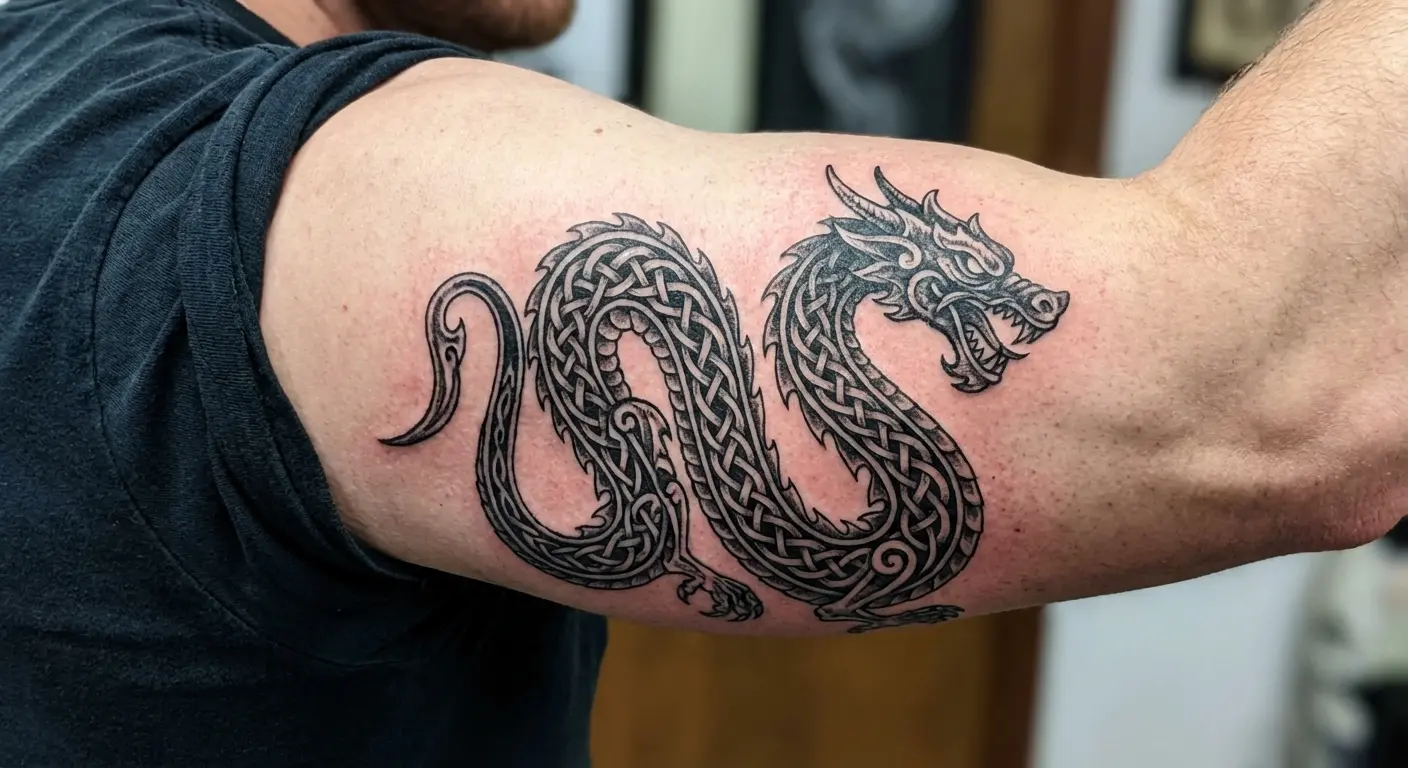
Celtic dragons differ from Asian dragons in their serpentine, wingless form and their association with sovereignty and power rather than wisdom and luck. These creatures guarded treasures and represented the power of the earth itself. Way easier to wrap around an arm than their Asian cousins with all those legs and whiskers going everywhere, honestly.
A celtic dragon tattoo usually shows an elongated, snake-like body coiled or intertwined with itself, often with knotwork patterns forming the scales or body segments. The serpentine nature makes Celtic dragons incredibly versatile for wrapping around arms, legs, or torsos in ways that complement your body’s natural curves.
You can create dramatic movement by having the dragon spiral around a limb or create a more contained design with the dragon coiled into a circular or oval shape. Scale texture provides an opportunity to add more knotwork or patterns, adding complexity without cluttering the overall celtic tattoo design. The dragon’s head becomes the focal point, so ensure your artist gives it enough detail and character to anchor the entire piece.
12. Celtic Warrior
Full human figures are less common in authentic Celtic art than abstract patterns, but warrior imagery does appear in Celtic mythology and art. A celtic warrior tattoo usually shows a stylized fighter with traditional weapons – spear, sword, or shield – and may work knotwork into the clothing, armor, or surrounding space.
These celtic tattoo designs work best as larger pieces because capturing human proportions and warrior details while maintaining the Celtic aesthetic requires plenty of space. Back pieces, full sleeves, or thigh placements give you room to develop the warrior’s form, weaponry, and any background elements or knotwork integration.
Do you want a static, posed warrior or an action scene – mid-battle or charging forward? That decision changes everything about the composition and energy of the piece. Adding specific clan symbols, shields with particular knot patterns, or weapons with decorated hilts personalizes the design beyond generic warrior imagery. This celtic tattoo embodies courage and martial prowess in visual form.
13. Claddagh
Hands holding a crowned heart represent love, loyalty, and friendship in this distinctly Irish symbol. While technically not ancient Celtic – it originated in the 17th century in the fishing village of Claddagh – it’s become so associated with Irish identity that it fits naturally into this category. The Claddagh technically isn’t ancient Celtic – it’s from the 1600s. But try telling that to someone who’s convinced it’s been around since the druids. (It hasn’t.)
The Claddagh’s clear symbolism makes it immediately readable even to people unfamiliar with Celtic culture. You can keep it simple with clean outlines or elaborate it with knotwork worked into the crown, heart, or hands. Each element can have different knot patterns, or the entire Claddagh can be formed from a single continuous line of knotwork.
Size flexibility is one of the Claddagh’s strengths. It works as a small, delicate celtic tattoo on wrist or ankle, or scales up beautifully for shoulder or chest placements when you add surrounding elements or internal patterns. The orientation matters if you’re following the traditional ring custom – heart pointing toward your body means you’re taken, pointing away means you’re available – though most people ignore this in tattoo form and just choose the orientation that fits their placement best.
14. Celtic Stag
Representing nobility, pride, and connection to the forest, the stag appears frequently in Celtic mythology as a messenger between worlds. A celtic stag tattoo usually emphasizes the impressive antlers, often working knotwork into the antler structure or showing the antlers formed entirely from interlocking patterns.
The stag’s regal bearing makes it a powerful choice for people who value dignity, grace, and strength without aggression. Layout options range from a simple stag head with elaborate antlers to a full-body stag in a forest setting with knotwork trees and spirals.
The vertical nature of antlers makes stag celtic tattoo designs really effective on forearms, calves, or as part of a sleeve where the antlers can extend upward naturally. The stag’s posture matters – a head held high conveys confidence and alertness, while a lowered head creates a more introspective or peaceful energy.
15. Raven with Knotwork
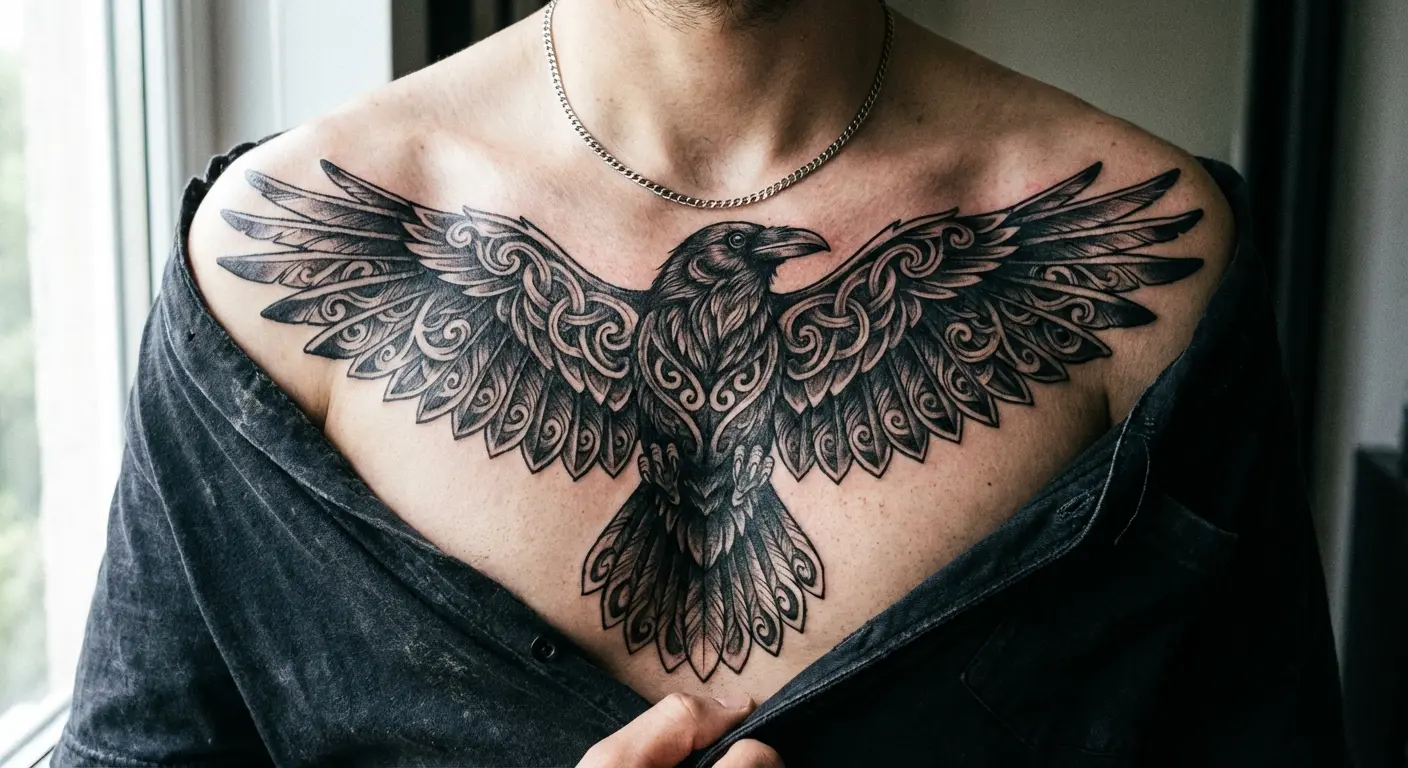
Ravens served as messengers and symbols of prophecy in Celtic mythology, associated with the Morrigan – goddess of war and fate. A raven tattoo with Celtic elements usually shows the bird in profile or with wings spread, working knotwork into the feathers, surrounding the bird, or forming a background pattern.
The raven’s black coloring creates natural contrast against the skin, making even smaller versions of this celtic tattoo highly visible and striking. You can emphasize different aspects depending on what the raven means to you: a perched raven feels watchful and wise, a raven in flight suggests freedom and transition, and a raven with a celtic knot tattoo in its beak or talons adds a layer of symbolism about carrying messages or wisdom.
Placement flexibility is good because ravens work in both vertical and horizontal layouts, though the wing spread in flight versions requires adequate width. Chest, upper back, or thigh work better than narrow spaces like forearms.
16. Celtic Sword and Shield
Weapons in Celtic art represent not just physical strength but spiritual warfare and protection. A sword and shield design usually shows both items decorated with intricate knotwork, either crossed in a traditional heraldic style or arranged in a more dynamic layout.
The straight lines of the sword contrast beautifully with the curved, flowing nature of celtic knot tattoos, creating visual interest through that juxtaposition. These celtic tattoo designs work best as medium to large pieces because capturing the detail in both the weapons and the decorative elements requires space.
Forearm placements work well for a single sword with knotwork, while crossed sword and shield layouts need the width of a chest, back, or thigh. Do you want historically accurate Celtic weapon designs or more stylized versions? That affects the overall vibe. Adding specific knot patterns to the shield that represent personal values or family heritage personalizes the design beyond generic warrior imagery.
17. Boar with Spiral Patterns
The boar represented courage, ferocity, and hospitality in Celtic culture. Warriors wore boar imagery into battle, and boar hunts were tests of bravery. A celtic boar tattoo usually shows the animal in profile with prominent tusks and bristled back, working spiral patterns or knotwork into the body or surrounding space.
The boar’s compact, muscular form makes it ideal for contained placements like shoulder, upper arm, or calf where the design doesn’t need to wrap or stretch. Spiral patterns work really well with boar celtic tattoo designs because they can represent the bristled hair along the spine or create movement around the charging animal.
You can emphasize either the aggressive, warrior aspect – boar with tusks prominent, charging forward – or the noble, dignified aspect with the boar standing still, head raised. The stocky proportions mean this celtic tattoo maintains its impact even at medium sizes, unlike more elongated animals that lose definition when compressed.
18. Hound of Culann
This legendary hound from Irish mythology connects to the hero Cú Chulainn and represents loyalty, protection, and sacrifice. A hound tattoo with Celtic elements usually shows a lean, muscular hunting dog with knotwork worked into the body, collar, or surrounding elements.
The hound’s athletic build creates natural lines that complement body contours, making it work well for placements that follow muscle groups: outer thigh, calf, or upper arm. Less common than wolves or dragons, which appeals to people who want recognizable celtic tattoo imagery without choosing the most obvious symbols.
The hound’s alert posture and forward gaze create a sense of vigilance and readiness that resonates with people who see themselves as protectors. Consider adding specific knotwork patterns that represent what you’re protecting or loyal to, turning the celtic tattoo into a more personal statement beyond the general symbolism.
Living Legacy: Patterns That Connect Past to Present
Family. Legacy. Connection. That’s what this section is about.
While the warrior and protection symbols look backward to Celtic history, these patterns look both backward and forward, acknowledging ancestry while claiming Celtic identity in the present. The emphasis here is on connection rather than individual strength, on belonging rather than standing apart.
You’ll notice these celtic tattoo designs often have elements that can be personalized or added to over time, making them living tattoos that can grow with your life circumstances. The patterns in this category tend toward the abstract and geometric, requiring precision in execution but offering flexibility in interpretation. These celtic tattoos carry meaning that evolves as your understanding of your own heritage deepens.
19. Celtic Spiral (Triskelion)
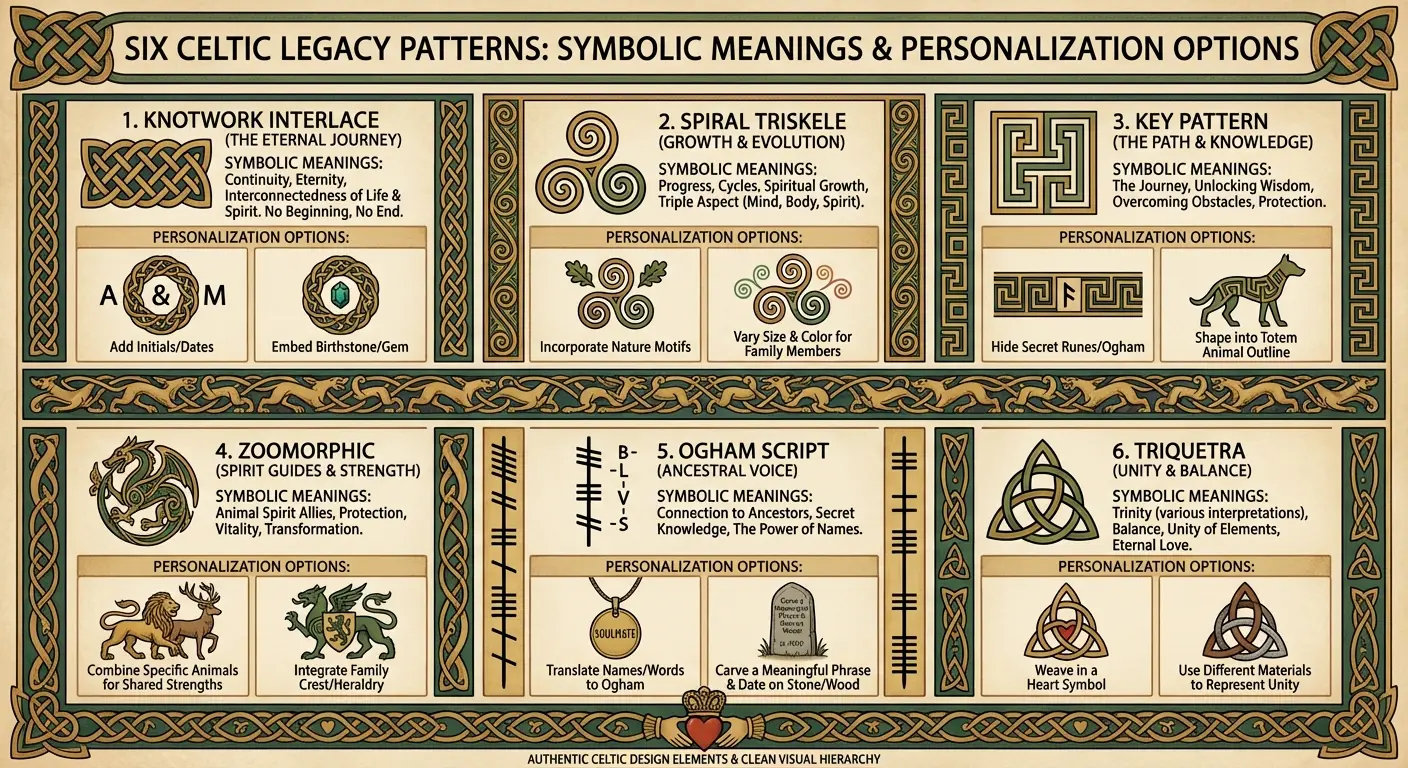
Three spirals radiating from a center point, the triskelion represents motion, progress, and the three realms or stages of life. This is one of the oldest Celtic symbols, appearing on ancient stone carvings throughout Ireland and Scotland.
The continuous motion implied by the spirals creates dynamic energy even in a static tattoo. The triskelion’s rotational symmetry means it looks balanced from any angle and works on curved body surfaces without distortion. For those seeking small tattoo ideas with cultural depth, the triskelion offers ancient symbolism in a compact, versatile form.
Small versions look great on wrists, ankles, or behind the ear, while larger versions can add more spiral elements or knotwork between the main three spirals. The direction of the spiral rotation – clockwise or counterclockwise – carries different meanings in some interpretations, though this is debated among scholars. The negative space between the spirals creates the visual impact as much as the spirals themselves.
The spiral’s historical significance is remarkable. Carvings found in County Meath, Ireland, date back to around 3200 B.C., predating the pyramids of Egypt. In celtic tattoos, spirals aren’t merely decorative; their different directions and forms convey deeper meanings. A single spiral often represents a person’s growth or development over time and their connection to cosmic energy, while a double spiral moving in opposite directions symbolizes the journey of life and the transition from one stage to another.

20. Endless Knot
A single line that weaves over and under itself with no beginning or end. This pattern represents eternity, interconnectedness, and the complexity of existence. The endless knot appears in Celtic art and also in Buddhist and other cultural traditions, suggesting a universal human fascination with infinity and connection.
Celtic versions? More angular, less rounded than Buddhist ones. This celtic knot tattoo requires mathematical precision because uneven spacing or inconsistent line weight destroys the meditative, balanced quality that makes it work.
The more you stare at it, the more you see – viewers follow the line’s path and discover new crossings and patterns. Medium sizes work best because too small and the crossings become muddy, too large and the design can feel empty or sparse. Placement on flat surfaces – upper back, chest, or thigh – works better than curved surfaces that might distort the geometric precision.
|
Design Element |
Symbolic Meaning |
Best For |
Personalization Options |
Aging Considerations |
|---|---|---|---|---|
|
Celtic Spiral |
Progress, motion, life stages |
First-time Celtic tattoo seekers |
Direction of rotation, number of spirals |
Ages great – thick lines don’t blur |
|
Endless Knot |
Eternity, interconnection |
Philosophy/spirituality enthusiasts |
Line thickness, internal patterns |
Good but needs precision initially |
|
Mother Knot |
Maternal bonds, family |
Parents, family-focused individuals |
Loops for each child, birthstones |
Can expand over time |
|
Family Knot |
Generational connection |
Multi-generational families |
Strand for each member |
Complex versions need size |
|
Ancestral Band |
Lineage, heritage continuity |
Heritage-conscious individuals |
Pattern sections for family traits |
Wraps hold structure well |
|
Ogham Script |
Personal messages, names |
Privacy-seekers, language lovers |
Any word/name in Ogham |
Linear nature preserves well |
21. Celtic Mother Knot
Two hearts intertwined or a stylized figure with loops representing children, the mother knot celebrates maternal bonds and family connections. This is a more modern interpretation of Celtic knotwork rather than an ancient symbol, but it uses authentic Celtic design principles.
The flexibility of the mother knot design allows for personalization: adding loops or knots for each child, working in birthstones or colors, or connecting it to other family-related symbols. Placement often goes over the heart, on the shoulder blade, or on the forearm where you can see it easily.
The emotional weight of this celtic tattoo means it carries different significance than purely aesthetic Celtic patterns. You’re making a statement about what matters most to you, not just appreciating beautiful knotwork. Think about how the design might evolve if your family grows, either leaving space for additions or choosing a design that feels complete as-is. This celtic knot tattoo resonates deeply with those who prioritize family bonds.
22. Shamrock with Knotwork
The three-leafed shamrock – not the four-leafed clover – represents Ireland itself and carries associations with St. Patrick and Irish Christianity. Combining the simple shamrock shape with intricate celtic knot tattoos creates a design that’s immediately recognizable as Irish while maintaining artistic complexity.
Each leaf can have different knot patterns, or the entire shamrock can be formed from a single continuous line of knotwork. This celtic tattoo works across a wide size range because the shamrock shape is simple enough to read at small sizes while offering enough surface area for detail when scaled up.
Placement flexibility is excellent: small shamrocks work anywhere, while larger versions suit shoulders, calves, or upper arms. The shamrock’s cultural specificity makes it a clear statement of Irish heritage or connection, which is either exactly what you want or too limiting depending on your relationship to Irish identity. Adding a stem with more knotwork or working the shamrock into a larger Celtic layout expands the design beyond the simple leaf shape.

23. Celtic Family Knot
Interwoven lines representing each family member, united in a single continuous pattern. These celtic tattoo designs are highly personalized, with the number of strands or loops corresponding to specific people. Similar to how name tattoo designs incorporate personal identity, family knots weave individual strands into unified patterns.
The beauty of family knot designs is their flexibility: you can create a simple version with a few strands or an elaborate layout with multiple generations represented. The challenge is maintaining visual clarity while working in enough elements to represent everyone you want to include. Working with an artist who understands both celtic knot tattoo principles and layout is critical because poorly planned family knots become illegible tangles.
Placement depends on size and complexity: simple versions work on wrists or ankles, while elaborate multi-generational designs need the space of a back, thigh, or full sleeve section. Do you want the design to potentially expand – leaving space for future family members – or do you want it to represent a specific moment in time? This celtic knot tattoo becomes a wearable family tree.
24. Ancestral Band
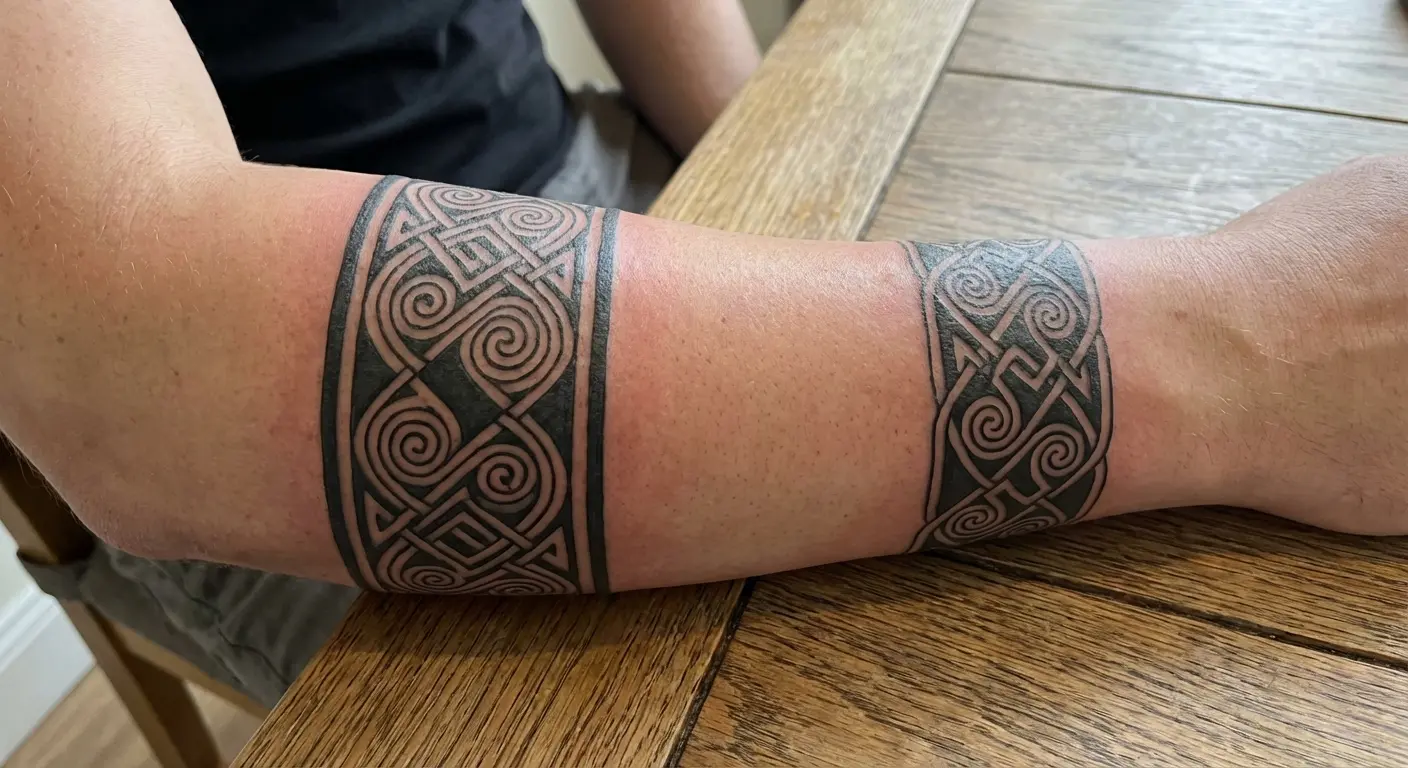
A continuous band of Celtic patterns circling an arm, leg, or finger represents unbroken lineage and connection to ancestors. These bands can work in various knot patterns, spirals, or symbolic elements that represent specific family traits, origins, or values. The circular nature emphasizes continuity and the endless chain of generations.
Band celtic tattoos require careful planning because they wrap around a body part that changes diameter as muscles flex or as you move. What looks perfectly aligned and spaced when your arm is relaxed might gap or compress awkwardly when you bend your elbow. Working with an artist experienced in band tattoos ensures proper sizing and pattern flow.
You can go with a simple, repeating pattern or create a more complex band where different sections represent different aspects of your heritage. Forearm and bicep bands are most common, but ankle, wrist, and even finger bands work for smaller-scale versions.
Think about how the band will look from different angles because unlike flat celtic tattoo designs, bands need to work from 360 degrees. These celtic tattoos serve as constant reminders of where you come from.
25. Ogham Script Integration
Ogham is an ancient Irish alphabet where letters are represented by lines and notches along a central stem. Working Ogham script into celtic tattoo designs allows you to include specific words, names, or phrases that carry personal meaning while maintaining the geometric, linear vibe of Celtic art.
You can use Ogham as a border element around other celtic knot tattoo designs, work it into the central stem of a tree of life, or create a standalone Ogham inscription with decorative knotwork at the ends or corners. For those interested in ancient alphabets, our Ogham tattoo generator translates modern text into historically accurate script.
The linear nature of Ogham makes it ideal for placements that follow body lines: along the forearm, down the side of the calf, or along the collarbone. Most people won’t be able to read Ogham, which creates a layer of privacy for personal messages while still looking distinctly Celtic.
Research the proper Ogham characters because modern interpretations and transliterations vary, and you want to ensure your chosen words translate accurately. Combining Ogham with other Celtic elements creates a celtic tattoo design that’s both deeply personal and visually connected to Celtic artistic traditions.
Bringing Your Celtic Vision to Life Without the Usual Frustrations
You’ve absorbed a lot of information about Celtic symbolism, design considerations, and placement options. The gap between understanding what you want and getting it designed is where most people get stuck.
Finding an artist who specializes in Celtic work, communicating your vision effectively, and going through multiple revision rounds can stretch over weeks or months. Look, I’m obviously biased here – I built this tool. But here’s the actual problem it solves:
You can input the specific Celtic symbols that resonate with your story, specify whether you want traditional or modern interpretations, and generate multiple design variations in seconds. The AI understands the structural requirements of celtic knot tattoos – those unbroken lines and symmetrical patterns we’ve discussed – and creates designs that maintain artistic integrity while working in your personal elements.
Is it perfect? No. Will it replace your artist? Hell no. But it gets you 80% of the way to a clear reference. You’re not replacing your tattoo artist but giving them a clear, detailed reference that shows exactly what you envision. Artists consistently tell us they’d rather work from a specific visual reference than try to interpret verbal descriptions of “a celtic knot tattoo but with more loops and maybe a tree.”
Generate your celtic tattoo design, refine the details until it matches your vision, then bring that high-resolution reference to your consultation. You’ll spend less time explaining and more time discussing placement, sizing, and the technical execution that turns a great design into a great tattoo.
Final Thoughts
Celtic tattoos carry weight beyond their aesthetic appeal. The symbols we’ve covered represent centuries of spiritual belief, cultural identity, and artistic tradition.
Choosing a design because it looks cool isn’t wrong, but knowing what those patterns meant to the Celts changes how you think about your tattoo. These weren’t decorative – they were how people talked about life, death, family, and identity before they had an alphabet. You’re not just getting a tattoo but connecting to a visual language that communicated complex ideas about existence, protection, family, and identity long before written language became widespread.
The technical demands of celtic tattoo designs – those precise lines, symmetrical patterns, and intricate crossings – mean you need an artist with specific skills, adequate sizing for your chosen complexity level, and placement that complements rather than distorts the patterns.
Side note – Victorian-era “Celtic” designs are everywhere, and most of them are about as authentic as Lucky Charms. If your reference image looks like it came from an 1890s book illustration, that’s why.
Whether you’re claiming Celtic heritage, appreciating the artistic tradition, or resonating with specific symbols’ meanings, your celtic tattoo should reflect genuine connection rather than surface-level attraction. Just as proper tattoo aftercare preserves your investment, choosing celtic tattoo designs with authentic symbolism ensures lasting personal significance.
Here’s what drives me crazy: someone wants a detailed Dara knot on their finger. Their finger. I show them the reality, they get it bigger, and then they’re happy. Just trust the artist on sizing.
The designs that age best are the ones chosen with intention, executed with skill, and placed with consideration for how they’ll live on your body. Celtic knot tattoos aren’t trendy or temporary but timeless patterns that have maintained their power and appeal for thousands of years. After about year three, wrist tattoos under two inches start losing detail. The ink spreads – not much, maybe a millimeter in each direction – but on a small design that’s enough to blur fine lines together.
That’s the legacy you’re joining when you choose to wear these symbols. These celtic tattoos connect you to something larger than yourself – a continuous thread of meaning that stretches back millennia and forward into whatever comes next.
So yeah. Celtic tattoos. They’ve lasted thousands of years for a reason – the designs work and the meanings matter. Just make sure yours is big enough, find an artist who knows their knotwork, and actually understand what you’re putting on your body.
That’s it.
