17 Anime Tattoos That Won’t Make You Cringe in Five Years
Table of Contents
-
Tattoos for People Who’ve Been Through Some Shit
-
Guts’ Brand of Sacrifice (Berserk)
-
Edward Elric’s Transmutation Circle (Fullmetal Alchemist)
-
Itachi’s Crow Dispersion (Naruto)
-
Spike Spiegel’s Rose (Cowboy Bebop)
-
Homura’s Hourglass (Madoka Magica)
-
Thorfinn’s Broken Blade (Vinland Saga)
-
-
Designs That Look Good Even If You Quit Anime
-
Tanjiro’s Hanafuda Earrings (Demon Slayer)
-
The Ouroboros (Fullmetal Alchemist)
-
Totoro’s Umbrella Scene (My Neighbor Totoro)
-
Akira’s Capsule Bike (Akira)
-
Rei’s Plugsuit Pattern (Neon Genesis Evangelion)
-
Mugen’s Sunflower Field (Samurai Champloo)
-
-
Character Portraits (And Why Most Fail)
-
Monkey D. Luffy’s Determined Grin (One Piece)
-
Levi’s Undercut Profile (Attack on Titan)
-
Vash’s Crying Smile (Trigun)
-
Ashitaka’s Curse Mark (Princess Mononoke)
-
Gon’s Transformation Eyes (Hunter x Hunter)
-
TL;DR
-
Symbols age better than faces. Way better.
-
Your artist doesn’t need to watch the show, just needs good references
-
Color fades fast on sun-exposed skin. Budget for touch-ups every few years.
-
If explaining the tattoo requires a full plot summary, pick something else
-
Black and grey usually beats color for anime designs
-
Small details blur as tattoos age. Keep it simple.
-
Character portraits need a $200+/hour artist minimum or they’ll look like garbage
-
Wait at least a year after finishing the series. If you still want it, get it.
Most Anime Tattoos Fail Because You Got Them During a Binge
I watched my friend get Naruto’s face tattooed on his forearm in 2015. Last year, he started wearing long sleeves year-round. The tattoo’s technically fine, actually well-executed. But he chose it during a three-week binge, and now he can’t remember why that specific screenshot mattered so much.
Most anime tattoos fail for exactly this reason. You’re obsessed with Attack on Titan for three months, you get Eren’s titan form on your calf, and two years later you’re explaining to dates why you have a naked giant on your leg.
The tattoos that last? They meant something before you decided to get them tattooed. You’ve been thinking about the Brand of Sacrifice for three years, carrying that image in your head, using it to explain parts of yourself to other people. That’s different from whatever you binged last weekend.
Anime started hitting Western audiences back in the 1970s with shows like Astro Boy and UFO Robot Goldrake, which represented an absolute novelty for audiences primarily accustomed to Western cartoons. What began as Saturday morning cartoons has evolved into sophisticated body art, though not everyone’s making sophisticated choices about it.
Here’s what I’ve learned from watching hundreds of people get anime tattoos: the ones who never regret them chose designs that work as standalone symbols. They picked imagery that functions without requiring encyclopedic knowledge of the source material.
Think about it this way. In fifteen years, you might not remember every plot point from Fullmetal Alchemist. But the concept of equivalent exchange? The reality that shortcuts cost more than the long path? That sticks. That’s worth marking your body for.
Tattoos for People Who’ve Been Through Some Shit
These designs work because they’re tied to characters’ worst moments. Not their coolest fights or their most badass scenes, but the points where they broke and had to rebuild themselves.
I’m talking about visual representations of survival, moral complexity, hard-won wisdom. The kind of imagery that resonates whether you’ve watched the show or not, because it speaks to universal experiences of trauma and transformation.
When you’re considering these designs, ask yourself: does this represent something I’ve already lived through? Not something I think is cool, but something I’ve survived?
1. Guts’ Brand of Sacrifice (Berserk)
Guts carries a brand that literally attracts demons. It’s a mark of the worst night of his life, permanent proof that he survived something that should have destroyed him. Yet he keeps fighting.
I have this one on my shoulder. Got it in 2018. Still don’t regret it.
The design itself is deceptively simple: a circle with intersecting lines. Which means it scales beautifully from small neck placement to larger interpretations. You can keep it stark and clean or add textural elements that suggest it’s burned into your skin.
Some people include the slight bleeding effect from the manga. Don’t. It looks sick in the panels but on your neck it looks like you have a permanent wound. Skip it.
What makes this work long-term? It doesn’t require context to communicate weight. People unfamiliar with Berserk still recognize it as a mark of something survived. Something that changed you but didn’t destroy you.
Placement on the neck creates the most direct reference to Guts, but honestly? The brand works anywhere. Chest, back, shoulder. The key is choosing a location that feels significant to you, where you’ll see it or feel it regularly enough to remember what it represents.
Fair warning: everyone gets the Brand of Sacrifice. I’m not saying don’t, I’m saying know you’re getting the anime equivalent of a tribal armband. It’s popular for a reason, but it’s very popular.
2. Edward Elric’s Transmutation Circle (Fullmetal Alchemist)
Equivalent exchange isn’t just an anime concept. It’s how life actually works. You don’t get something for nothing. Shortcuts cost more than the long path. The universe keeps its books balanced.
Ed’s transmutation circle, particularly the human transmutation circle from the series’ central tragedy, works because geometric designs age exceptionally well. Lines stay crisp, the circular format fits natural body contours, and you can scale it up or down without losing structural integrity.
When considering symbolic tattoos that carry deeper meaning, transmutation circles represent consequences. The price of trying to bypass fundamental rules.
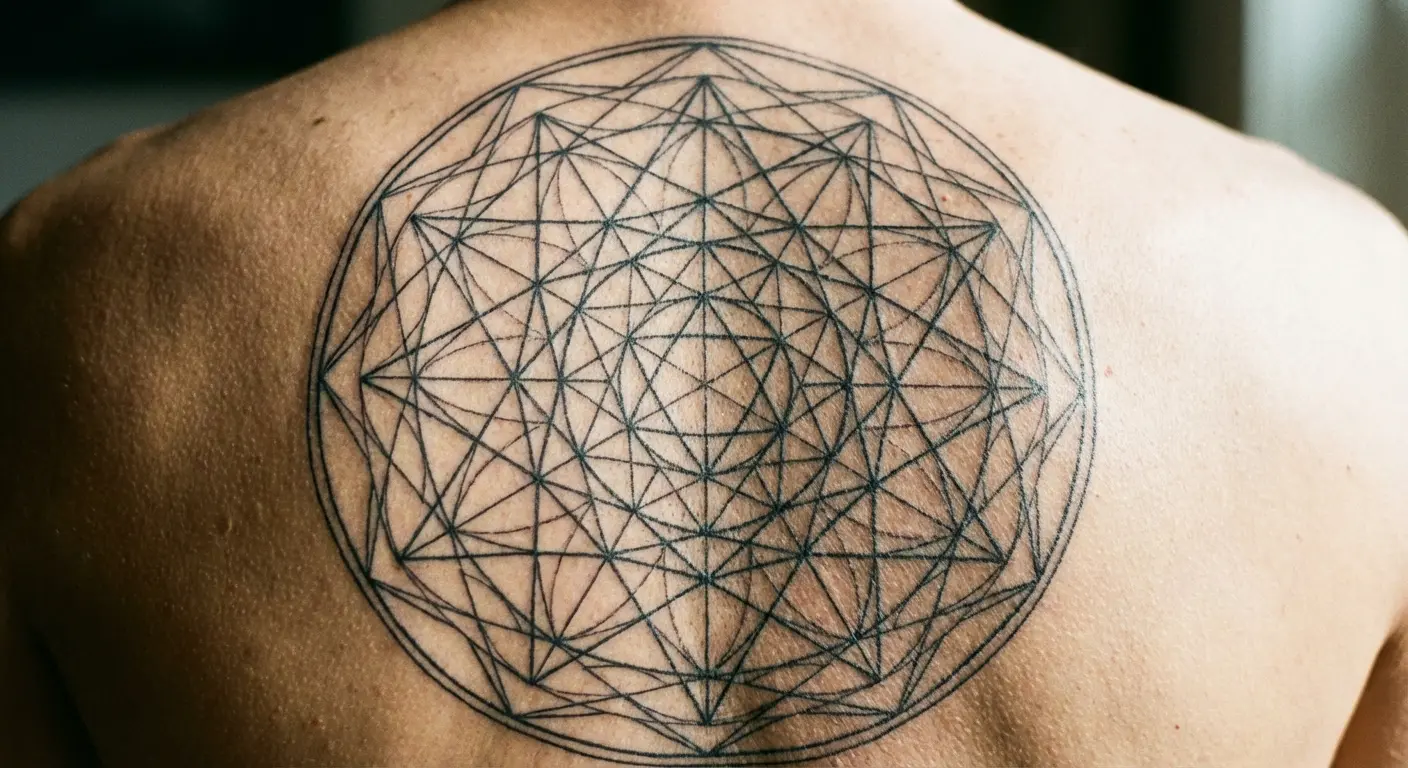
Everyone wants to cram every alchemical symbol from the series into one design. Don’t. Choose one meaningful circle and commit to it fully. The human transmutation circle carries more emotional weight because it represents the brothers’ greatest mistake and their journey to understand what truly matters.
Placement on your back or shoulder blade creates interesting symbolism. You’re carrying this knowledge, this reminder of what happens when you try to cheat fundamental laws, in a place you can’t always see but always feel.
The circle can be personalized with elements from your own life while maintaining recognizability. Some people add small details that reference their own equivalent exchanges. Just don’t go overboard. Restraint produces better results.
This one typically runs $300-500 depending on size and detail level. Expect 2-4 hours for a solid piece.
3. Itachi’s Crow Dispersion (Naruto)
Itachi made choices that destroyed his reputation to save people who would never know what he sacrificed. If you’ve ever done the right thing and gotten shit for it, you get why this resonates.
The visual of Itachi dissolving into crows captures transformation, loss, and the way truth disperses into fragments that only make sense when you step back far enough to see the whole picture.
You don’t need Itachi’s face in the design. The crows themselves, arranged in the dispersal pattern, communicate the concept to those who know while remaining striking abstract imagery to everyone else.
This flows naturally into sleeve compositions. Crows can scatter across your arm, creating movement that works with your body’s natural lines. Some people incorporate a single Sharingan eye among the crows, others keep it purely about the birds and the negative space they create.
Black and grey serves this design better than color. The drama comes from contrast and the suggestion of movement, not from vibrant plumage.
Realistic versus stylized crows is a choice you’ll need to make with your artist. Realistic crows add weight and drama, while stylized versions can integrate more seamlessly with other tattoo elements if you’re planning a larger piece.
Expect to pay $400-800 for a half-sleeve version. Full sleeve with this as the centerpiece? You’re looking at $2,000-4,000 over multiple sessions.
4. Spike Spiegel’s Rose (Cowboy Bebop)
“You’re gonna carry that weight.”
Spike’s relationship with his past, represented through roses and the woman he couldn’t save, speaks to anyone who’s built a new life while knowing they’re still fundamentally shaped by old wounds.
The rose itself is traditional tattoo imagery, which means it ages well and doesn’t immediately read as anime to casual observers. But fans recognize the specific context: Julia, the red rose, the whole aesthetic of beautiful things touched by violence and regret.
A single rose with a dropped petal captures the loss without being heavy-handed. Adding thorns or a single drop of blood references the violence that permeates Spike’s world. Keeping it clean and simple emphasizes the beauty of what was lost rather than how it was lost.
This works particularly well for people who want an anime tattoo that doesn’t announce itself. Your artist can approach it as a traditional rose with specific shading and placement that fans will recognize while others simply see a well-executed classic design.
Whether to include thorns, blood, or keep it clean depends on how you want to shift the emotional register. Each choice tells a slightly different story about how you carry your past.
Traditional rose tattoos start around $150 for small pieces, $300-600 for something substantial.
5. Homura’s Hourglass (Madoka Magica)
Look, Madoka Magica is dark as hell, and if you know, you know.
Homura resets time again and again, trying to save Madoka, and each iteration corrupts her further. That exhaustion of fighting the same battle repeatedly, of loving someone so much you’ll destroy yourself trying to save them, captures something about obsessive devotion and the cost of refusing to let go.
The hourglass itself is visually strong. You can render it realistically or stylize it, incorporate the purple and black color scheme from Homura’s magical girl design, or keep it stark and simple.
The sand flowing through becomes a metaphor for time running out, for efforts that never quite succeed, for the slow erosion of hope. Some people show the hourglass nearly empty (time running out, exhaustion winning). Others show it mid-flow, still fighting, still trying. A few show it shattered, the moment of breaking, of finally giving up or transforming into something else entirely.
This design works for people comfortable with darker emotional territory. It’s not about triumph or resilience. It’s about the specific pain of repetitive failure and the question of when persistence becomes self-destruction.
The choice of showing the hourglass full, empty, or mid-flow communicates different stages of struggle. Think about where you are in your own cycle when making this decision.
Expect $200-400 for a clean hourglass design, more if you’re adding complex shading or color work.
6. Thorfinn’s Broken Blade (Vinland Saga)
Thorfinn spends years consumed by revenge, then has to figure out who he is when he chooses to put down the sword. That broken blade represents the end of one identity and the terrifying freedom of having to build a new one.
Visually, a broken blade creates interesting tension. Weapons are symbols of strength and capability, but a broken one suggests either defeat or deliberate choice to stop fighting. The context determines which meaning dominates, and that ambiguity works in your favor.
You can show just the blade, snapped in half with the break point emphasized. Or include a hand releasing it, letting it fall, choosing to let go of what once defined you.
This works for people who’ve had to fundamentally rebuild themselves. Who’ve recognized that the thing they thought made them strong was actually keeping them trapped.
Whether to include Thorfinn’s hand holding the broken blade or present it as a standalone object shifts the focus. The hand adds human connection and the moment of choice. The blade alone becomes a more universal symbol of broken violence.
Simple broken blade designs run $150-300. Add the hand and you’re looking at $300-500 depending on detail level.
Designs That Look Good Even If You Quit Anime
Some anime imagery functions as strong visual art independent of narrative context. These pieces work because they’re gorgeous first and referential second.
That hierarchy matters when you’re thinking about permanence. You might stop watching anime. You might move past your current obsessions. But good design is good design, and these pieces maintain their visual power regardless of your relationship with the source material.
7. Tanjiro’s Hanafuda Earrings (Demon Slayer)
Simple. Bold. Works anywhere.
These earrings carry Tanjiro’s family history and connect him to the original sun breathing user. They’re instantly recognizable to Demon Slayer fans but also function as traditional Japanese design to everyone else.
The circular format and the rising sun imagery create a clean, bold design that scales well. You can get them small behind your ear (meta and visually interesting), larger on your forearm or chest, or incorporate them into a broader Japanese traditional sleeve.
The red and black color scheme is bold without being overwhelming, and the geometric precision means they’ll age well as the lines settle.
Some people get matching pairs, one on each arm or behind each ear. Others use a single earring as an accent piece in a larger composition. Both approaches work.
Small versions behind the ear run $100-200. Larger forearm pieces are $200-400.
8. The Ouroboros (Fullmetal Alchemist)
The homunculi bear this mark, and it represents both their creation and their limitation. They’re trapped in cycles determined by their sins, consuming themselves in pursuit of what they lack.
FMA’s ouroboros is distinctive (a serpent or dragon devouring its tail, often with wings), but the symbol itself predates the series by millennia. That gives you flexibility. You can get the FMA-specific version or use a more traditional ouroboros that nods to the series while remaining visually rooted in alchemical and mythological tradition.
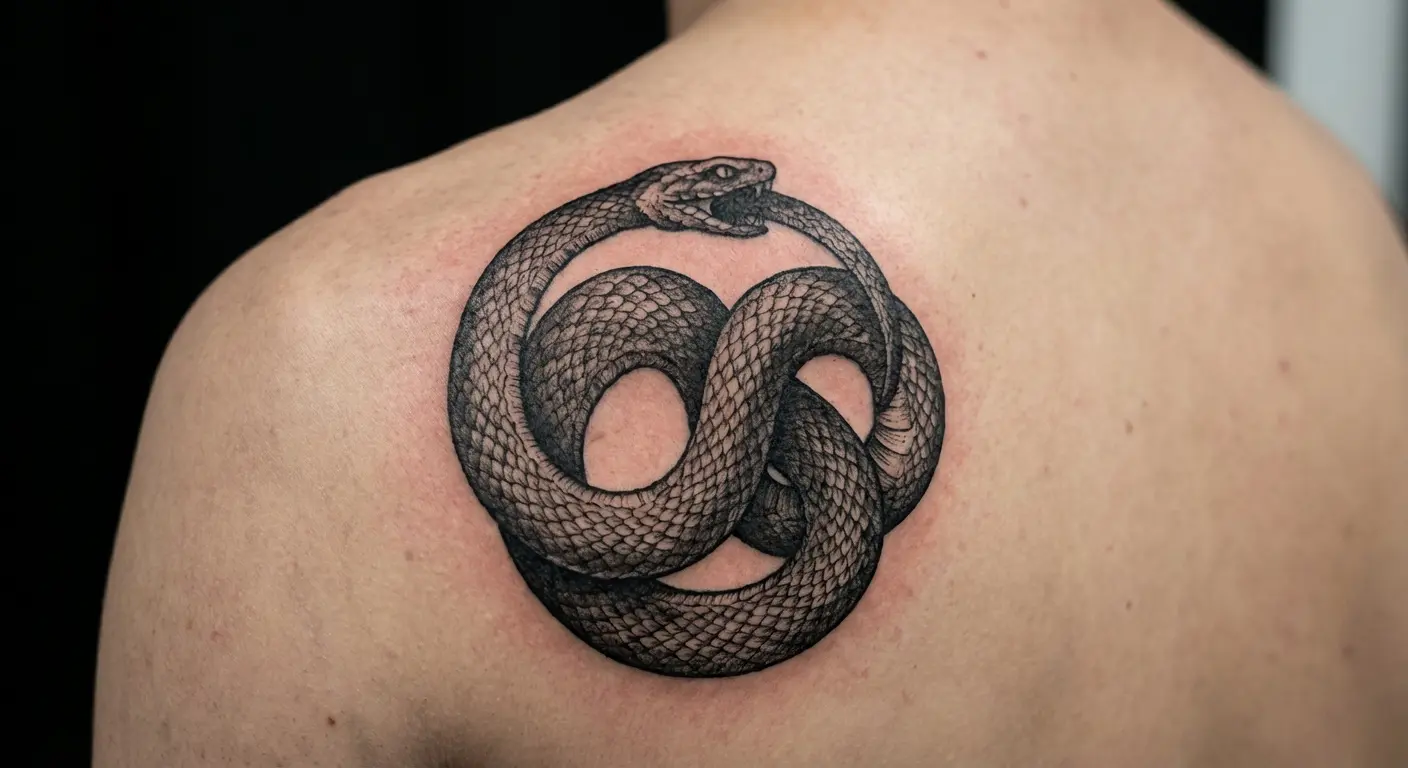
Placement matters here. The homunculi wear their marks on different body parts: Lust’s chest, Envy’s thigh, Greed’s hand. You can reference those placements or choose your own based on what the cycle represents in your life.
Black and grey emphasizes the symbol’s weight and ancient quality. Color (particularly red or gold) makes it more dynamic but potentially more anime-specific.
The ouroboros asks questions rather than providing answers. Are you trapped in a cycle or is the cycle itself the point? Is consumption destruction or transformation? That ambiguity gives the design longevity.
Expect $200-500 depending on size and detail. Add wings or complex scaling and you’re looking at $400-700.
9. Totoro’s Umbrella Scene (My Neighbor Totoro)
Totoro standing at the bus stop with Satsuki and Mei, rain falling, the umbrella creating shelter and connection. This scene captures something about finding magic in waiting, about unexpected kindness, about the way small gestures create profound comfort.
The composition works vertically (full scene with the bus stop sign, all three figures, rain) or horizontally, cropped to focus on Totoro with the umbrella.
Silhouette versions are surprisingly powerful. You lose detail but gain iconic simplicity. Detailed versions let you include Totoro’s texture, the girls’ expressions, the specific quality of Miyazaki’s rain.
This is one of the few anime tattoos where color genuinely enhances rather than complicates. Totoro’s grey, the blue umbrella, the green leaves, the warm glow of the bus’s headlights. These colors aren’t garish, they’re naturalistic and gentle, which means they age well.
Black and grey works too, particularly if you want something more subdued. The scene’s emotional power doesn’t depend on color. Composition choices matter. Vertical for the full scene runs $400-700 depending on size. Horizontal cropped versions are $300-500. Rain adds atmosphere but also complexity, so discuss with your artist whether it serves the piece.
10. Akira’s Capsule Bike (Akira)
Kaneda’s bike is a design icon that transcends Akira itself. The sleek red capsule, the way it suggests speed even standing still, the cyberpunk aesthetic that influenced decades of sci-fi design.
Chris Burton, a tattoo artist who transitioned from working at prestigious institutions like MoMA and the Whitney Museum, told Anime Herald in a 2024 interview that “Akira was Earth-shattering for me. That’s something I’ll still watch every couple of years.” His perspective reflects how foundational anime works continue to inform contemporary tattoo aesthetics.
You can show it in profile (classic, emphasizes the bike’s lines), from a three-quarter view for more dynamic dimension, or incorporate motion lines and speed effects for kinetic energy. Some people include Kaneda riding it, others prefer the bike as a pure design object.
That red is crucial. It’s not just any red, it’s the specific vibrant shade that makes the bike pop against Neo-Tokyo’s neon chaos. Your artist needs to nail that color or the design loses something essential.
This works for people who love design itself, not just anime. Motorcycle enthusiasts recognize it as an iconic design. Cyberpunk fans see it as a foundational aesthetic element.
Expect $500-900 for a solid bike piece with proper shading and that signature red. Add Kaneda and you’re looking at $800-1,500.
11. Rei’s Plugsuit Pattern (Neon Genesis Evangelion)
The plugsuit patterns in Eva aren’t just costume design. They’re visual representations of how the pilots interface with their mechs, how they’re reduced to components in a larger system, how identity gets subsumed by function.
Rei’s white and blue pattern, or Asuka’s red and orange, or Shinji’s purple and green, works as pure geometric abstraction. You can take a section of the pattern and use it as an armband design, wrap it around your forearm or calf, or incorporate it into a larger Eva-themed piece.
These patterns are bold color blocks with precise lines and interface elements. They look technical, almost like circuit boards or medical diagrams, which creates interesting tension when placed on organic human skin.
Some people include the spine-like interface elements that run down the suits’ backs. Others focus purely on the color blocking and geometric precision. Both approaches work.
Which sections of the pattern work best depends on your body’s natural contours. Your artist can help you identify which geometric elements will flow with your anatomy rather than fight against it.
Armband-style plugsuit patterns run $300-600. Larger pieces incorporating multiple pattern elements are $600-1,200.
12. Mugen’s Sunflower Field (Samurai Champloo)
The sunflower samurai quest drives Samurai Champloo’s plot, but the sunflower fields themselves represent something else: beauty in the search, meaning in the wandering, the way journeys matter more than destinations.
Sunflower fields create natural visual flow. Rows of flowers leading toward a horizon, or a close-up perspective that emphasizes individual blooms with others receding into background. You can include tiny figures (Mugen, Jin, Fuu) walking through the field, or let the flowers stand alone as pure landscape.

This works as a contemplative piece. It’s not dramatic or action-focused, it’s about space, growth, the patient unfolding of a journey whose endpoint matters less than the walking itself.
Color brings this alive: yellows, golds, that specific late-afternoon light. But black and grey can work if you focus on texture and depth. The key is creating that sense of expansiveness, of fields that continue beyond what the tattoo can show.
Whether to include figures in the field or let the flowers stand alone changes the narrative. Figures add human scale and story, while flowers alone become meditation on growth and patience.
Sunflower field pieces typically run $400-800 for medium-sized work, $800-1,500 for larger landscape compositions.
Character Portraits (And Why Most Fail)
For the love of god, stop getting character faces unless you have $2,000 and access to a top-tier portrait artist. I’m begging you.
Character-based anime tattoos require exceptional skill because anime faces are stylized in ways that don’t translate directly to skin. When it comes to character work, manga-style tattoos rely on clean and defined lines as fundamental elements, with outlines that are often thick and well-defined, clearly separating different elements of the design. This technical precision becomes crucial when capturing character expressions and transformation moments.
I’ve seen incredible portrait work that’s 15 years old and still looks amazing. I’ve also seen portraits that looked rough after six months. The difference? Artist skill and proper aftercare.
If you’re going the portrait route, budget accordingly and find an artist who specializes in this work. Don’t trust your buddy’s cousin who does tattoos in his kitchen.
13. Monkey D. Luffy’s Determined Grin (One Piece)
Luffy’s grin isn’t just happiness, it’s defiance. It’s the expression he makes when everyone says something’s impossible and he decides to do it anyway.
Portrait tattoos are risky because they require exceptional artist skill and because faces age unpredictably on skin. But Luffy’s grin is distinctive enough and simple enough (in terms of the core expression) that it translates better than more subtle facial work. The straw hat helps, providing a strong visual anchor and instant recognizability.
You can show just the face and hat, clean and iconic. Include his scar under his eye to add history. Or incorporate his jolly roger or the X scar on his chest if you’re going larger.
Black and grey can work, but Luffy’s design benefits from color. The red vest, the yellow straw hat with its red band, these aren’t just aesthetic choices, they’re part of the character’s visual identity. Just know that bright colors require more maintenance over time.
Whether to show damage (scars, blood) or keep it clean depends on which version of Luffy resonates with your experience. The battle-worn version speaks to perseverance through hardship. The clean version emphasizes pure optimism.
Good Luffy portraits start at $500 for small, simple versions. Larger, detailed pieces with color run $800-1,500. Don’t cheap out on this.
14. Levi’s Undercut Profile (Attack on Titan)
Levi’s profile is instantly recognizable: the undercut, the sharp features, that expression of controlled intensity that suggests violence held in check by will.
Profile views work better for anime portraits than front-facing because they create cleaner lines and more dramatic shadows. You’re working with the natural contours of the face rather than trying to capture the complexity of a straight-on view.
Some people include elements of his ODM gear, the blades, or motion lines suggesting movement. Others keep it purely about the face and expression. Adding too much risks cluttering what should be a clean, powerful image.
The expression is everything here. Levi’s not smiling, he’s not neutral, he’s in that state of focused readiness that defines his character. Your artist needs to capture that specific quality.
Whether to include his gear, how much background detail serves the design, these are all considerations worth discussing with your artist during the design phase.
Profile portraits of Levi typically run $400-700 for clean line work, $700-1,200 for more detailed pieces with shading and background elements.
15. Vash’s Crying Smile (Trigun)
Vash smiles while crying, maintains his goofy persona while carrying immense pain, chooses mercy repeatedly despite what it costs him. If you’ve refused to let trauma turn you cruel, this hits different.
Capturing both the smile and the tears without making it look confused requires serious skill. The expression needs to read as simultaneously genuine and heartbreaking, not as technical failure.
His distinctive spiky blonde hair and sunglasses help with recognizability, but the core of the design is that expression. Some people include his red coat or his prosthetic arm, others keep it focused on the face.
This works in color (the red coat, the blonde hair, the specific blue-green of his eyes) or black and grey if you focus on the expression and let the emotional content carry the design.
Whether to include his distinctive hair and glasses, how much scarring to show, these factors all contribute to creating a piece that works long-term.
Vash portraits are complex. Budget $600-1,000 minimum for something that captures the emotional nuance properly.
16. Ashitaka’s Curse Mark (Princess Mononoke)
Ashitaka’s curse gives him incredible strength while slowly killing him. The mark spreads across his arm, representing corruption, the cost of violence, the way necessary actions can still destroy you.
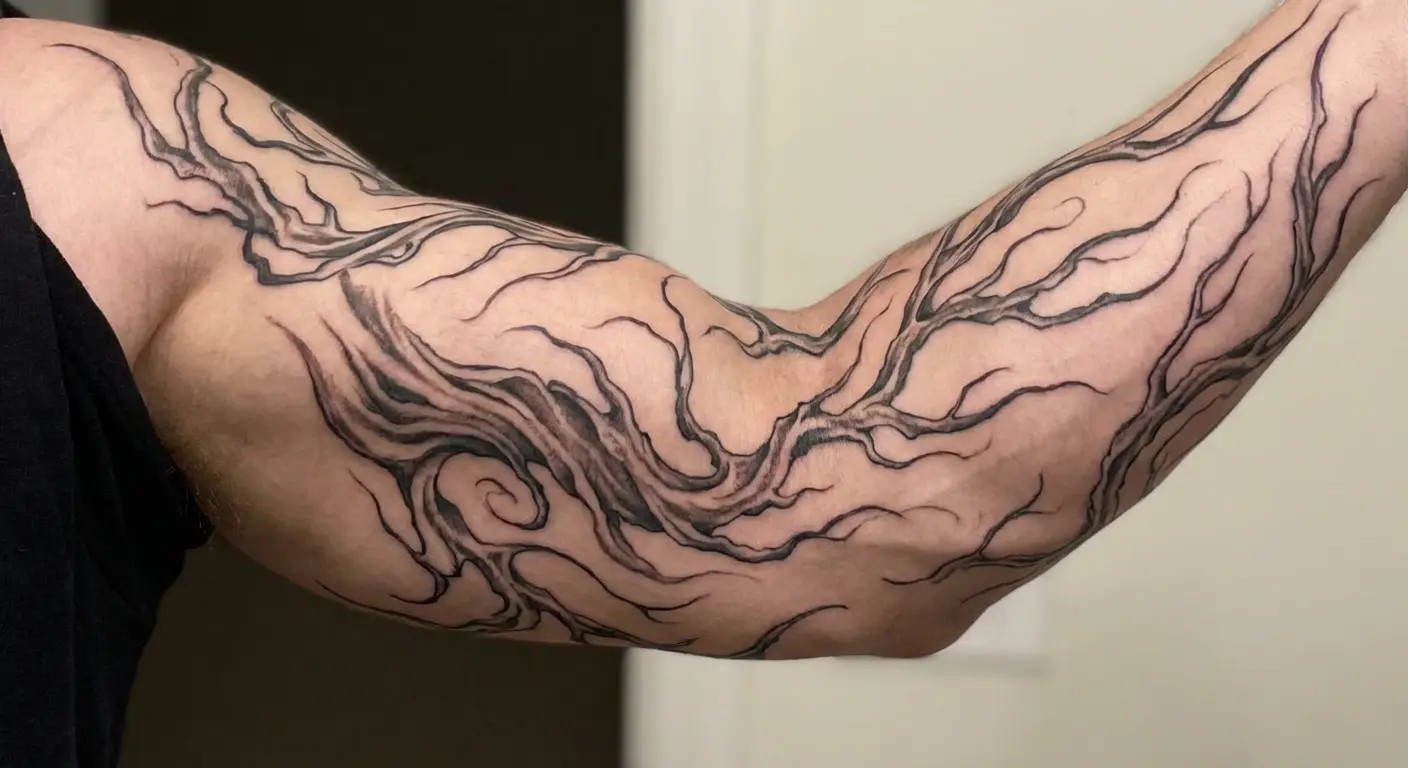
This design works because it’s both specific to the film and universally readable as a representation of internal corruption or struggle. You can show it as the contained mark (early in the film, still controlled) or as the spreading, consuming version that nearly overtakes him.
The mark flows naturally along an arm, following muscle contours and creating visual movement. Some people incorporate the texture of corrupted flesh. Others keep it more symbolic, showing the mark without the grotesque elements.
Placement on your arm creates interesting resonance. You’re putting Ashitaka’s burden on your own limb, carrying a visual reminder of how power and destruction intertwine.
How much of the arm to show, whether to include the corrupted flesh texture, how the mark’s progression can be captured in a static design, these decisions shape the final piece’s emotional impact.
Curse mark tattoos range from $300-500 for simple versions to $700-1,200 for elaborate spreading designs that cover significant arm real estate.
17. Gon’s Transformation Eyes (Hunter x Hunter)
Gon’s transformation in the Chimera Ant arc shows what happens when single-minded determination consumes everything else. His eyes in that moment communicate absolute focus purchased at the cost of his future, his values, everything that made him who he was.
Eyes are powerful focal points. They’re what we look at first in any face, what communicates emotion most directly. Gon’s transformed eyes (golden, intense, devoid of his usual warmth) capture that specific moment of becoming something monstrous in pursuit of a goal.
You can show just the eyes, powerful and minimal, leaving interpretation open. Or include more of the transformed face, more obviously Gon, more dramatic, requiring more space.
This design works for people who’ve recognized their own capacity for self-destruction, who’ve seen how determination can become obsession.
Whether to show just the eyes or include more of the transformed face, how to handle the intensity without making it overwhelming, these considerations matter.
Eye-focused designs run $200-400. Full transformation face portraits are $600-1,000 depending on detail level.
Before You Commit: What Your Artist Actually Needs
Your artist doesn’t need to watch anime. I know, I know, you want someone who gets it. But what you actually need is someone who can draw clean lines and adapt 2D images to 3D skin.
Show them references. Let them do their job.
Anime is drawn for screens and pages, not for the three-dimensional, aging, moving canvas of human skin. Direct translation usually fails. Colors that pop on screen can look garish on skin. Details that work in a still frame get lost when the design moves with your body.
Understanding proper tattoo aftercare is essential, but first you need to ensure your artist can translate anime imagery to skin effectively.
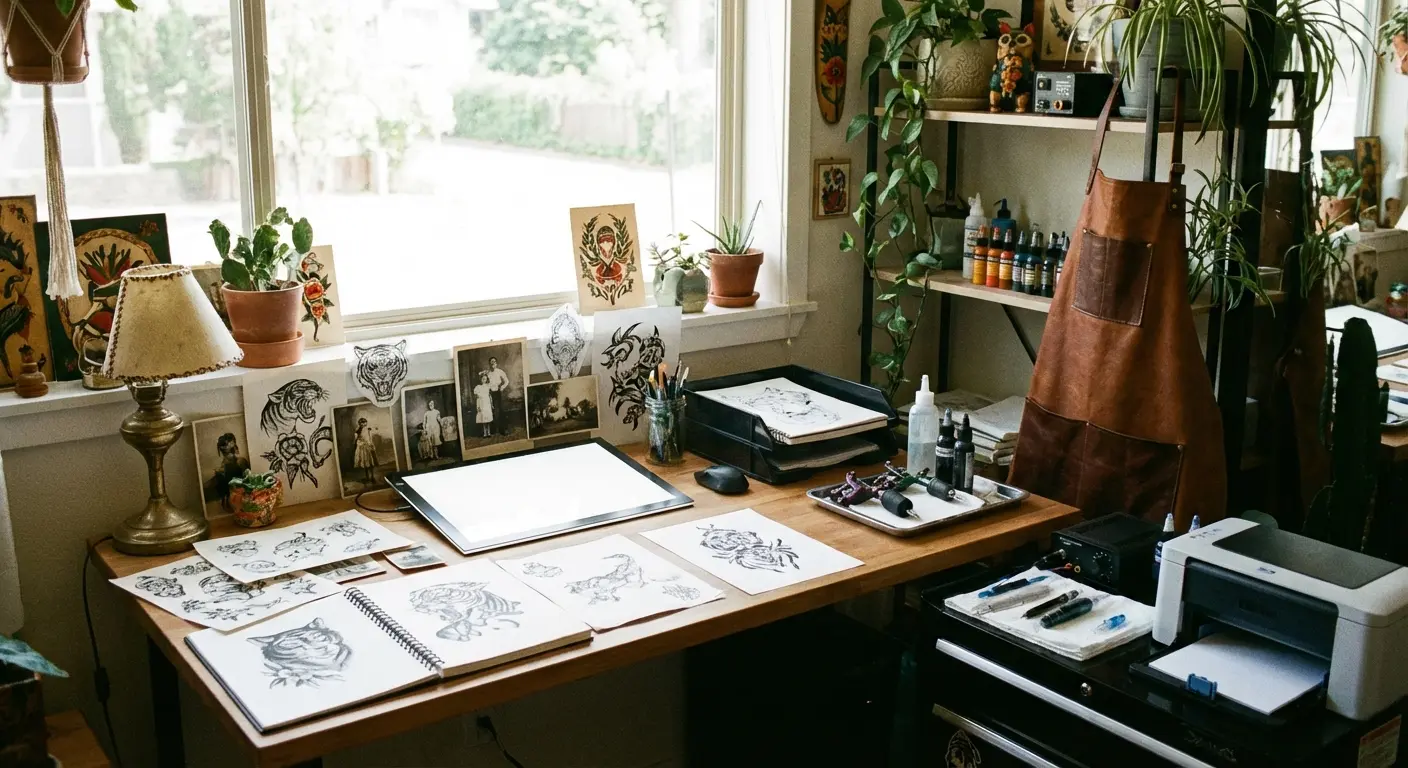
The conversation you need to have is about essence, not accuracy. What makes this design meaningful? What elements are non-negotiable? Where can we adapt for the reality of tattooing?
Style compatibility matters enormously. If you want Totoro, an artist who specializes in hyperrealistic portraits might not be your best choice. If you want Levi’s profile, someone whose style is loose and watercolor-influenced will struggle.
Bring multiple reference images. Grab screenshots from different episodes if you can: front view, side view, close-ups. Include images that capture the mood you’re going for, even if they’re not exact matches.
Size and placement aren’t afterthoughts. Some designs require space to breathe. Cramming a complex scene into a tiny area creates muddy, unreadable results.
Color maintenance is real. Bright colors fade faster than black and grey, particularly on sun-exposed areas. If you’re getting Luffy’s red vest or Tanjiro’s earrings, you’re committing to touch-ups every few years.
Trust your artist’s concerns about detail density. If they say a design has too many small elements that will blur together as it ages, they’re probably right. Simplification isn’t dumbing down your vision, it’s ensuring the design still looks good in ten years.
The Question Nobody Asks
Will you still care about this anime in twenty years? Maybe not. Will the emotional truth it helped you articulate still matter? Yeah, probably.
People worry about outgrowing anime tattoos in ways they don’t worry about outgrowing tribal bands or traditional roses. That anxiety usually has less to do with the tattoos themselves and more to do with internalized shame about taking cartoons seriously.
Here’s the reframe: you’re not tattooing a show, you’re tattooing what the show helped you understand about yourself. Guts’ Brand of Sacrifice isn’t about whether you’ll still read Berserk in 2045. It’s about carrying a reminder that trauma marked you but didn’t define you.
You’ll encounter people who dismiss anime tattoos. Some of those people have equally meaningful tattoos of anchors they’ve never dropped or compasses that have never guided them anywhere. The meaning isn’t in the image’s literal content.
That said, execution matters. A poorly done anime tattoo that looks bad will read as juvenile regardless of the depth of meaning behind it. A well-executed piece that demonstrates artistic skill earns respect even from people who’ve never watched anime.
If you’ve been thinking about a specific anime image for years, if it keeps coming back to you, if you find yourself using it to explain parts of yourself to others, that’s different from getting a tattoo of whatever you’re currently binge-watching.
Half the anime tattoos I see are from shows people watched once in 2019. That’s not enough time to know if it matters.
Finding Your Artist
Start by researching artists in your area, or artists worth traveling to, who have demonstrated skill in styles that complement your chosen design.
Instagram and artist portfolios are your friends here. Don’t just look at their anime pieces if they have them. Look at how they handle similar technical challenges in other work. Do their geometric designs have crisp lines? Do their portraits capture expression? Does their color work show understanding of contrast and saturation?
If you’re in LA, check out artists who specialize in anime work at shops like Chronic Ink or Guru Tattoo. If you’re in New York, Third Eye Gallery has artists who understand how to adapt anime imagery. Do your research for your specific area.
During consultations, bring your reference images and be clear about what matters most. “I want Itachi’s crow dispersion, and the movement is more important than getting his face exactly right” gives your artist useful information.
Ask how they’d adapt the design. Red flag: “I’ll just copy it exactly as is.” Green flag: “We’d need to simplify some elements and adjust the composition to work with your arm’s natural shape.”
Budget reality: A good Brand of Sacrifice runs $200-400 depending on size and detail. Expect to book 2-3 months out for a reputable artist in a major city. A full sleeve? You’re looking at $3,000-7,000 and 20+ hours over multiple sessions.
If the quote seems high, it probably reflects the time and skill required. If it seems suspiciously low, that’s usually a warning sign about quality.
Trust your gut during consultations. If an artist dismisses your ideas, seems annoyed by questions, or makes you feel stupid for caring about anime, keep looking.
Don’t be afraid to consult with multiple artists before committing. This is permanent. Taking time to find the right match isn’t indecisiveness, it’s due diligence.
Ribs hurt like hell. Everyone says it, and it’s true. That Homura hourglass on your ribcage? You’ll earn it. Expect sessions to take longer than expected, especially for complex or large pieces. Bring snacks, stay hydrated, and speak up if you need breaks.
After the tattoo, follow aftercare instructions precisely. Your artist has done their part, now you need to do yours. Proper healing makes an enormous difference in how the final piece looks.
When You’re Ready to Move From Concept to Skin
You know which design resonates. You understand what it represents. But there’s still that gap between the concept in your head and the confidence to commit to putting it on your body permanently.
Visualizing how anime imagery translates to tattoo format is genuinely difficult. You’re trying to imagine something that doesn’t exist yet, trying to predict how a design will look on your specific body in a medium you’re not trained in.
Full disclosure: I built a tool for this because I was tired of people showing up with Pinterest screenshots. It’s called Tattoo Generator IQ, and yeah, I’m biased, but it actually helps.
You can describe your anime tattoo concept (Guts’ Brand of Sacrifice on your neck, Itachi’s crow dispersion flowing down your arm, Totoro’s umbrella scene as a shoulder piece) and see multiple interpretations of how it could look adapted for actual tattooing.
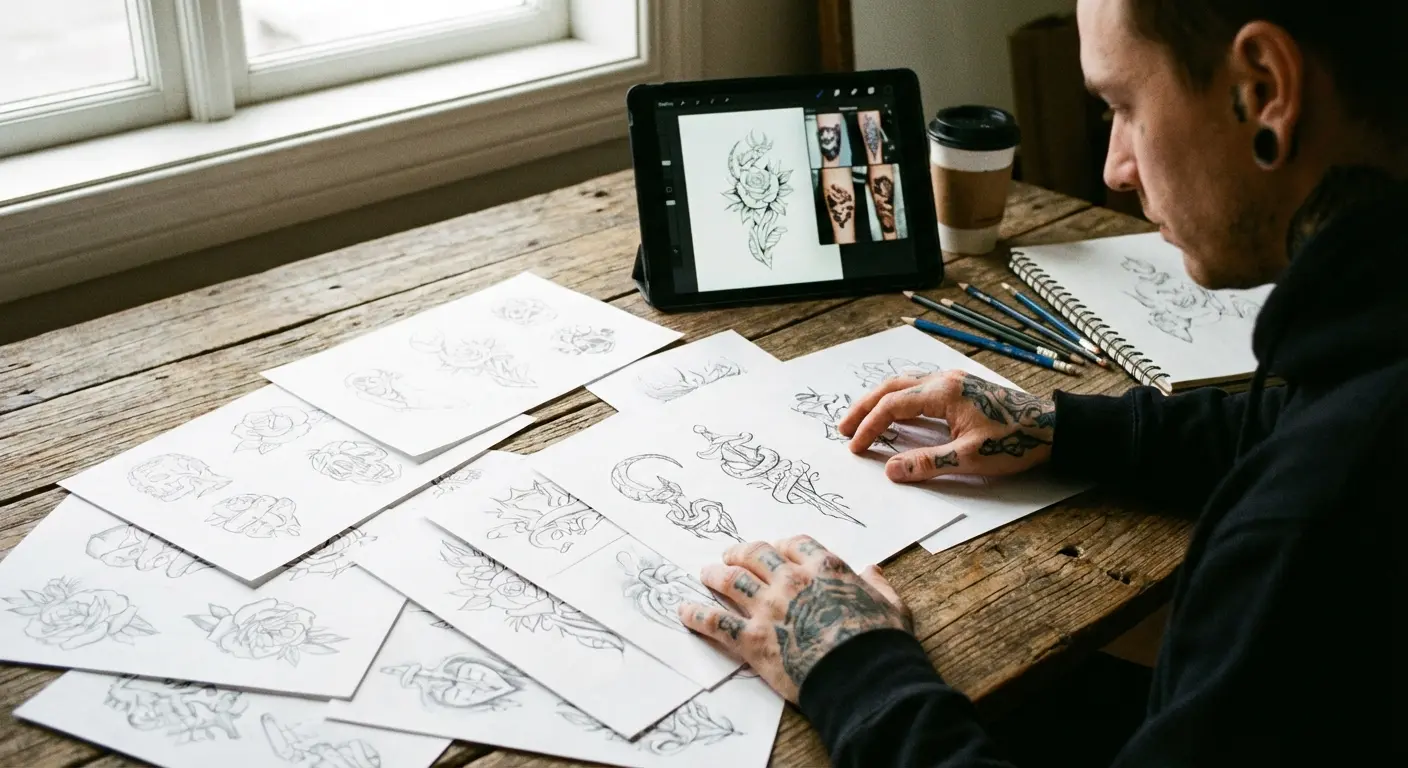
The AI understands both anime aesthetics and tattoo requirements, so you’re not just seeing screenshots slapped onto skin, you’re seeing thoughtful adaptations that account for how designs need to change to work as permanent body art.
This isn’t about replacing your tattoo artist. It’s about showing up to your consultation with clear visual direction, with examples of what you’re hoping for, with the confidence that comes from having explored different approaches to your concept.
Generate a few variations, see which elements work best, figure out what size and placement make sense for your concept. Then take those AI-generated designs to your consultation as reference points. Your artist will refine and improve them, but you’ll be starting from a much stronger foundation than “I want something from this anime but I’m not sure what.”
Final Thoughts
The anime tattoos that work ten, twenty, thirty years from now are the ones that captured something true about who you were when you got them and what you’d learned by that point.
Fandom evolves. Your relationship with specific series will change. But the emotional truths those series helped you articulate, the moments when a character’s choice or a visual metaphor crystallized something you’d been struggling to understand about yourself, those remain valid regardless of whether you ever rewatch the show.
Your body is already a record of your life. Scars from childhood accidents, marks from growth spurts, the way your hands show what work you’ve done. Adding intentional marks that represent what you’ve learned, what you’ve survived, what you’ve chosen to value just makes that record more deliberate.
People will have opinions. Some will get it immediately, recognizing the specific reference and what it represents. Others will see interesting art without knowing the source. A few will dismiss it as cartoon nonsense.
Karen from accounting will have opinions. Who cares? Karen has a “Live Laugh Love” sign in her cubicle.
Choose designs that have already proven their staying power in your life. Work with artists who respect both the source material and the medium of tattooing. Trust that meaning doesn’t require universal recognition.
Look, if you’re getting a tattoo from Sword Art Online, I’m judging you a little. That’s on me. But also, maybe reconsider.
Get the tattoo or don’t. Just don’t get it because you’re on episode 47 of a binge. Give it a year. If you’re still thinking about it, it’s probably right.
If you’re in Japan, be aware that tattoos still carry stigma. That Totoro piece might keep you out of onsens and some gyms. In the US, nobody cares unless you’re going into finance or law, and even then, placement matters more than content.
Your anime tattoo doesn’t need to justify itself to anyone but you. If it captures something real, if it functions as the reminder or celebration or memorial you need it to be, then it’s doing exactly what a good tattoo should do.
The strongest pieces are the ones where the design has already lived in your mind for years, where you’ve tested its meaning against your actual life experience, where you know it represents something that won’t fade when the show itself becomes a distant memory.
Wait, I should mention: don’t put this on your face. I know Lil Xan has face tattoos and he’s doing fine (is he?), but unless you’re already heavily tattooed and committed to that life, keep anime off your face and hands. Future you will thank present you.
One more thing. My friend with the Naruto tattoo? He’s getting it covered up next month. Not because the tattoo is bad, but because he’s finally ready to admit it never really meant what he thought it meant. He’s replacing it with something simpler, something that actually represents a lesson he learned rather than a show he binged.
That’s the difference. That’s what this whole guide is about.
Choose wisely. Wait longer than you think you need to. Work with artists who challenge you to refine your vision. And remember that the best tattoo is the one that still makes sense to you when everything else has changed.
