Arrow Tattoo Meaning: What Your Direction Says About Where You’ve Already Been
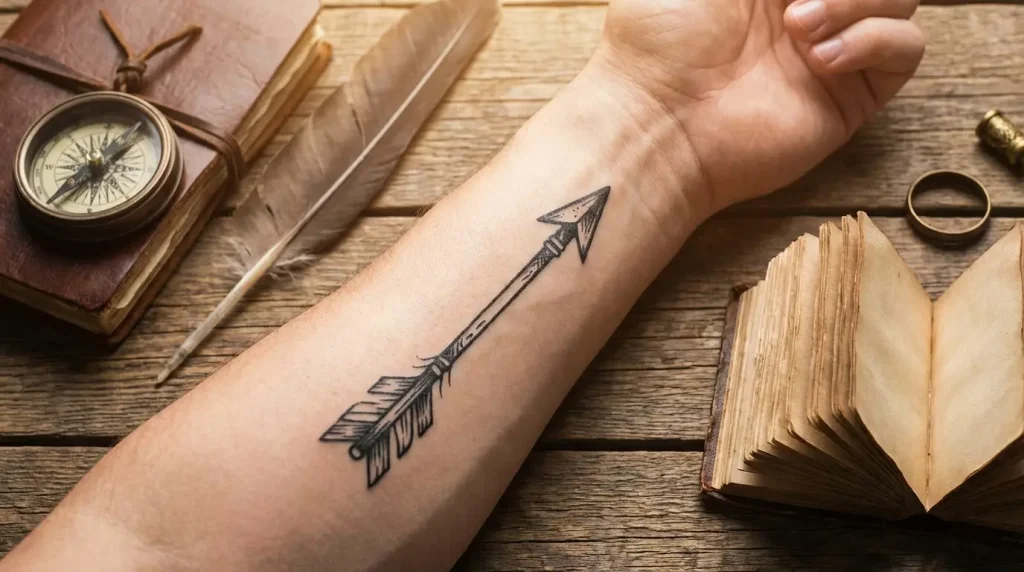
Table of Contents
-
Why We’ve Been Reading Arrow Tattoos Backwards This Whole Time
-
The Cultural Amnesia Problem: What We Lost When Arrows Became “Minimalist”
-
Single Arrow Meanings: The Overlooked Temporal Element
-
Double Arrows, Crossed Arrows, and the Geometry of Contradiction
-
Broken Arrows and the Mythology of Incompleteness
-
Arrow and Bow Combinations: Why Context Destroys Symbolism
-
Tribal Arrows vs. Modern Linework: Same Symbol, Opposite Philosophy
-
Placement Psychology: Your Arrow’s Direction Isn’t What You Think It Means
-
When Your Arrow Tattoo Needs More Than Generic Symbolism
TL;DR
-
We interpret arrow tattoos as future-focused symbols, but their deepest meanings point to past decisions and completed journeys
-
The “keep moving forward” interpretation erases centuries of cultural significance where arrows represented protection, survival, and already-won battles
-
Direction matters less than you’ve been told (an upward arrow doesn’t automatically mean progress, and a downward one isn’t negative)
-
Broken arrows carry inverted meanings across different traditions (peace in some, unfinished business in others)
-
Modern minimalist arrows and traditional tribal arrows represent opposing philosophical frameworks, not aesthetic preferences
-
Arrow tattoo placement creates meaning through the body’s natural lines and energy flow, independent of the arrow’s drawn direction
-
Color choices in arrow tattoos often contradict the intended symbolism because we apply modern color psychology to ancient symbols
Why We’ve Been Reading Arrow Tattoos Backwards This Whole Time
You’ve seen the Instagram captions. The Pinterest boards. Arrow tattoos mean moving forward, staying focused, pushing toward your goals. We’ve decided arrows point to the future. Arrow tattoos are popular for their deep symbolism and minimalist style, representing direction and purpose as always pointed in one direction, symbolizing the pursuit of goals, focus, and determination.
But we’re missing something obvious.
An arrow only exists as a meaningful object after it’s been released. Before that moment, it’s potential. After impact, it’s evidence.
The arrow you’d tattoo on your body isn’t the one still in the quiver (that’s just a stick with feathers). It’s the one that already flew, already hit something, already completed its purpose.
This matters.
When you ink an arrow on your skin, you’re not creating a compass for where you’re going. You’re marking where you’ve been, what you’ve aimed at, what you’ve already chosen to release into the world. The arrow tattoo meaning extends beyond simple directional guidance. It’s a permanent marker of choices already made and paths already traveled.

The physical reality of archery is unambiguous. You can’t retrieve an arrow’s flight path. You can’t undo the release. The direction was chosen, the string was pulled, the target was either hit or missed. Past tense, all of it.
Most interpretations of arrow tattoo meaning you’ll find online ignore this completely. They’re so caught up in the motivational poster version of symbolism that they’ve forgotten what arrows actually do. We’ve turned a weapon and hunting tool into a self-help metaphor, and we’ve erased the more interesting interpretation in the process.
Your arrow tattoo isn’t about determination to keep going. It’s about having already gone, having already made the hard choice to aim and release, having already committed to a direction when the outcome was still uncertain. That’s the arrow tattoo meaning we should be talking about.
The Cultural Amnesia Problem: What We Lost When Arrows Became “Minimalist”
The thin-line arrow took over around 2014. You know the one: single black line, maybe a small triangle for the head, three tiny lines for fletching. Clean. Minimal. Empty.
We wanted it empty.
The minimalist arrow emerged specifically because it looked meaningful without requiring you to engage with where arrow symbolism comes from. It’s symbolism you can Instagram without doing homework. Aesthetically pleasing enough to photograph well but vague enough to mean whatever you need it to mean that day.
Arrows are one of the oldest symbols in history, scratched onto cave walls, inked onto papyrus scrolls, and also tattooed as permanent markers on skin. In ancient times, many cultures depended on arrows for defense, conquest, and sustenance, with the arrow symbolizing the dual ability to provide food through hunting or protect oneself through warfare.
Native American arrow symbolism operated on completely different logic. Arrows represented protection of the tribe, successful hunts that kept people fed, and defense against threats. A bundle of arrows meant strength through unity. A single arrow meant vulnerability but also self-reliance. Crossed arrows marked friendship between tribes or, in different situations, conflict and battle.
What’s missing? Anything about personal motivation or “finding your direction” or other individualistic interpretations we’ve grafted onto the symbol.
When exploring deeper tattoo meaning frameworks, understanding cultural context becomes essential rather than optional. The meaning of arrow tattoos shifts dramatically when you strip away the specific traditions that gave them coherence.
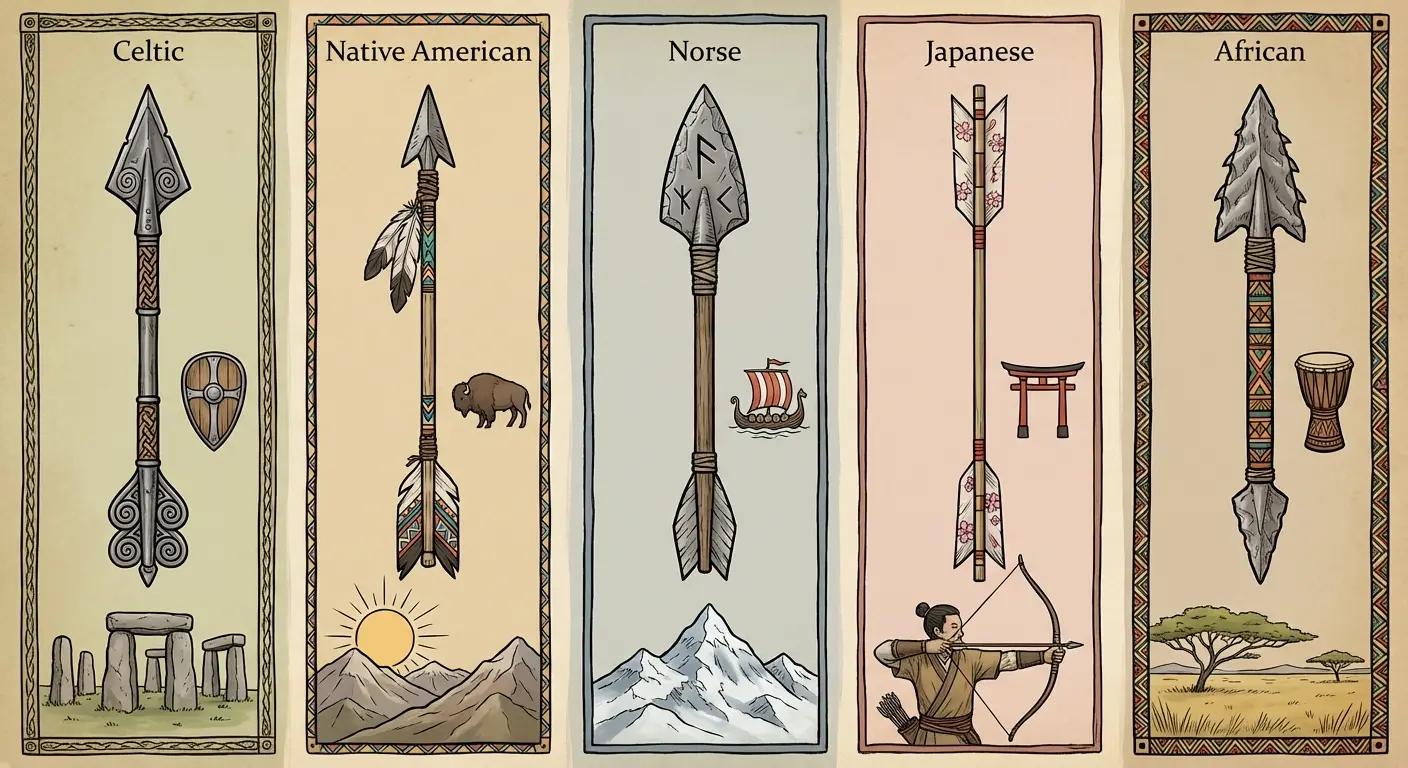
Japanese archery (kyudo) treated the arrow as an extension of spiritual practice. The arrow’s flight revealed the archer’s mental state, their harmony with the bow, their relationship to the present moment. Hitting the target was almost secondary to the quality of the release. Your arrow tattoo, in this lens, would represent a moment of achieved clarity, not ongoing striving.
Mongolian archery culture embedded arrows in survival and nomadic identity. Arrows weren’t philosophical. They were the difference between eating and starving, between defending your family and losing everything. An arrow symbol carried weight because it represented life-or-death competence.
Native American traditions used arrows to mark protection, unity through bundled arrows, and vulnerability through single ones. Survival and community defense mattered more than individual goals. But we interpret them as personal motivation now.
Japanese kyudo treated arrows as spiritual practice and mental clarity markers. Meditation and present-moment awareness drove the meaning. We’ve turned that into “forward progress” and achievement.
Mongolian culture saw arrows as practical survival tools and family defense. Hunting necessity gave them weight. We’ve reduced that to aesthetic choice and style preference.
Greek and Roman mythology connected arrows to divine power (Apollo), love and attraction (Cupid), and prophecy. Divine intervention mattered. We’ve flattened it into “following your path.”
Medieval heraldry used arrows to represent military readiness, swiftness, and determination in battle. Family lineage and battle preparation gave them meaning. We use them for minimalist self-expression.
We’ve taken all of this (centuries of specific cultural meaning, practical survival associations, spiritual practice systems) and flattened it into “stay focused on your goals.” We’ve forgotten everything.
You don’t have to adopt someone else’s cultural system for your arrow tattoo. But you should probably know what you’re simplifying away when you choose the minimalist version. The thin-line arrow is popular precisely because it’s been emptied of specific meaning. You’re getting a symbol that’s been culturally bleached. The symbolism of arrow tattoo designs has been reduced to whatever fits neatly in an Instagram caption.
Single Arrow Meanings: The Overlooked Temporal Element
A single arrow means you’re alone. Modern interpretations skip this completely.
In traditional contexts, a single arrow was easier to break than a bundle. It represented an individual separated from the group, someone operating without backup, someone whose success or failure rested entirely on their own skill. This wasn’t always positive. Sometimes it meant exile. Sometimes it meant a solo hunt borne of necessity, not choice.
The timing becomes crucial here. If your single arrow tattoo represents the pre-flight moment, you’re marking anticipation, the drawn bow, the held breath before release. That’s tension and potential energy. If it represents the in-flight moment, you’re marking transition, the space between decision and consequence. If it represents post-impact, you’re marking completion, evidence of an action you can’t take back.
Most people never specify which moment they mean. They just say “it represents my journey” and assume that covers it.
It doesn’t.

So which moment are you marking? The drawn bow before release? The arrow mid-flight? The arrow after impact?
If you’re commemorating a major life decision you already made (leaving a relationship, changing careers, moving across the country), the post-impact interpretation makes sense. You’ve already released that arrow. You’ve already made the choice. The tattoo marks that you did it, not that you’re thinking about doing it.
Consider someone who got a single arrow tattoo six months after leaving a decade-long corporate career to pursue freelance work. The arrow isn’t pointing toward their future as a freelancer. It’s marking the moment they made the leap, when they released themselves from the security of a steady paycheck into the uncertainty of self-employment. Three years later, whether the freelance career succeeded or failed, the arrow still accurately represents that past decision, that moment of release. The tattoo’s meaning doesn’t depend on the outcome. It depends on the action having been taken.
If you’re marking ongoing personal work (recovery, healing, growth), maybe you’re in the in-flight moment. The arrow’s already released but hasn’t hit its target yet. You’re in the uncertain middle, committed but not yet resolved.
The pre-flight interpretation (the one that’s all potential and no action) is probably the least honest for a tattoo. You’re permanently marking something that hasn’t happened yet? That’s wishful thinking made permanent, and it might not age well.
Your tattoo artist isn’t drawing a photograph of an arrow in motion. They’re drawing a static image that you’re interpreting as motion. The movement exists in your head, not on your skin.
Single arrows also carry the vulnerability piece. You’re marking yourself as someone who operates alone, who doesn’t have the strength-in-numbers protection. Depending on your life context, that might be empowering (self-reliance, independence) or it might be a wound you’re acknowledging (isolation, abandonment). The arrow tattoo symbol holds both possibilities.
Double Arrows, Crossed Arrows, and the Geometry of Contradiction
Two arrows pointing opposite directions supposedly represent conflict, or the tension between past and future, or the pull between two life paths. They also represent balance, equilibrium, and the necessity of opposing forces. Same design, contradictory meanings. Nobody seems bothered by this.
Crossed arrows get even messier. In some Native American traditions, crossed arrows symbolized friendship between tribes, a kind of peace treaty made visible. In others, crossed arrows meant war, conflict, a boundary being defended. In modern tattoo culture, we’ve decided it means whatever feels right to you in the moment, which is another way of saying it doesn’t really mean anything at all.
In 2016, Nick Jonas and his brother Joe got matching arrow tattoos on the back of their arms that point at each other (NBC). During a 2017 interview, Nick explained they got the arrows “so when we stand back-to-back, we got each other’s backs.” A literal interpretation of crossed arrows as protection and alliance that emerged from their personal reconciliation after the Jonas Brothers’ six-year breakup.
The geometry matters. Arrows crossing at their midpoints create an X, a symbol that carries its own separate meanings (multiplication, cancellation, marking a spot, indicating wrongness). You’re layering symbols on top of each other, and the meanings don’t necessarily cooperate.
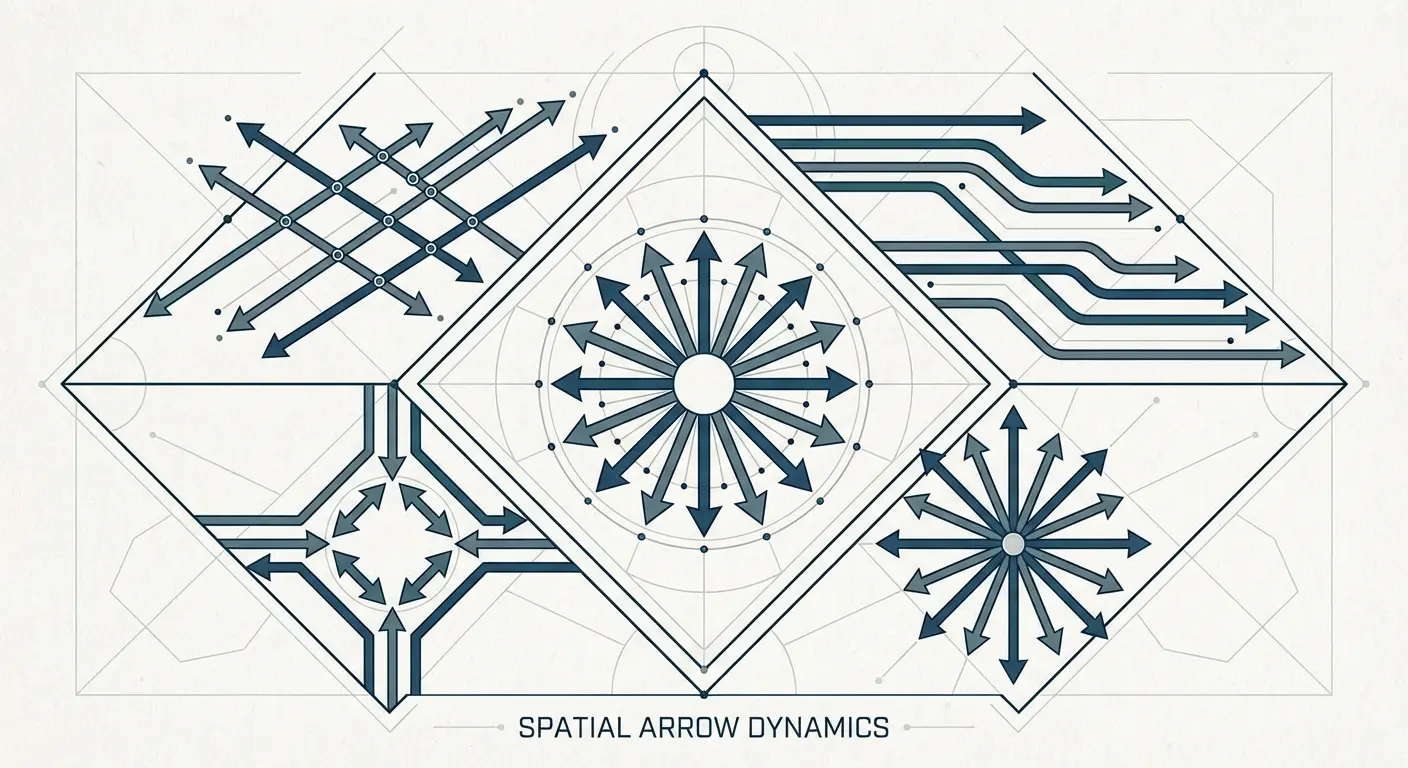
Parallel arrows pointing the same direction traditionally represented strength through unity, multiple hunters or warriors moving toward the same goal. They also represented competition (multiple arrows fired at the same target, only one wins). They also represented abundance (many arrows means a successful hunt, food for everyone). Pick your interpretation based on what sounds best for your Instagram caption, I guess.
Look, geometric arrangements of arrows were often specific to particular tribes, families, or contexts. They weren’t universal symbols that meant the same thing everywhere. When you strip them out of that specific context and apply them generically, you’re not honoring the tradition. You’re borrowing the aesthetic while ignoring the meaning system that gave it coherent significance. The meaning of arrow tattoo designs becomes diluted through this process.
Double arrows pointing toward each other create the visual suggestion of movement stopped, of forces meeting in the middle. That could represent compromise, mutual understanding, or deadlock and stalemate. The arrows aren’t going anywhere. They’ve hit each other instead of their intended targets. Is that peace or failure? Depends on what you needed those arrows to accomplish.
Circular arrangements of arrows (pointing outward from a center or inward toward one) create completely different meaning structures. Outward-pointing arrows suggest defense, protection of something central, radiating force. Inward-pointing arrows suggest convergence, multiple paths leading to the same conclusion, or (less optimally) being surrounded and targeted from all sides.
You can’t just arrange arrows in whatever pattern looks cool and assume the meaning will sort itself out. Geometry creates relationships, and relationships create meanings, and sometimes those meanings directly contradict what you think you’re saying.
Broken Arrows and the Mythology of Incompleteness
A broken arrow means peace. Or failure. Or a promise you couldn’t keep. We’re fine with all three meanings existing at once, apparently.
In some Native American traditions, breaking an arrow ceremonially represented the end of conflict, a weapon deliberately rendered useless to signal that war was over. The broken arrow was proof of commitment to peace, a visible sacrifice of the ability to fight. That’s completion, not failure. That’s a choice to end something, not an inability to finish it.
In other contexts, a broken arrow represented exactly the opposite: a hunt that failed, a shot that missed, a warrior who didn’t return, a promise that couldn’t be kept. The broken arrow was evidence of incompletion, of things left undone.

Country artist Lindsay Ell got two arrows tattooed on her ribcage pointed toward her heart, describing them as “unfinished by design. To be completed as life unfolds” (Taste of Country). Her producer Kristian Bush told her before the tattoo: “You get to have some scars you choose.” Embracing brokenness or incompleteness as an intentional artistic and personal statement rather than something to be fixed.
Similar to how broken heart tattoos navigate healing, broken arrows require clarity about whether brokenness represents damage or deliberate transformation.
Modern tattoo culture has added a third interpretation: the broken arrow as a symbol of healing, of acknowledging damage while moving forward, of being “broken but beautiful” or whatever other redemption narrative we’re applying this week. This interpretation doesn’t come from historical arrow symbolism. It comes from contemporary therapy language grafted onto an old symbol.
You need to know which story you’re telling.
If your broken arrow represents peace (conflict ended, weapons laid down, a conscious choice to stop fighting), then the brokenness is the point. The arrow’s purpose is fulfilled by being broken.
If your broken arrow represents failure or incompletion (a goal you didn’t reach, a relationship that ended badly, a version of yourself you couldn’t become), then the brokenness is the problem, not the solution. You’re marking something you’re still processing.
These look identical but mean opposite things.
A veteran who gets a broken arrow tattoo after completing PTSD treatment might be marking peace. The weapon is broken because the war is over, because they’ve chosen to lay down the fight-or-flight response that kept them alive in combat but damaged them at home. The break represents successful transition from warrior to civilian, a deliberate ending. Compare that to someone who gets a broken arrow after a failed marriage. Same visual symbol, but representing incompletion, a promise that broke, a trajectory that didn’t reach its intended target. The tattoo looks identical but carries opposite emotional weight.
If your broken arrow represents healing-in-progress (acknowledging damage while claiming resilience), you’re in a different space entirely. The brokenness is neither positive nor negative. It’s just a state you’re working through.
These aren’t interchangeable meanings. They’re fundamentally different relationships to the concept of brokenness itself.
There’s also the question of where the arrow broke. An arrow broken at the shaft means something different than an arrow broken at the head or broken at the fletching. The shaft breaking means structural failure, the whole thing collapsing. The head breaking means impact failure, hitting the target but not penetrating. The fletching breaking means guidance failure, losing the ability to fly straight.
Most broken arrow tattoos don’t specify. They just show a clean break somewhere in the middle, aesthetically placed for maximum visual impact. But if you’re claiming deep symbolism, these details probably matter.
Arrow and Bow Combinations: Why Context Destroys Symbolism
Adding a bow to your arrow tattoo reintroduces the human element. Arrows don’t fly themselves. Somebody had to draw that bow, aim, decide to release. You’re no longer marking just the action. You’re marking the decision-maker too.
A drawn bow with an arrow nocked represents maximum tension, the moment before commitment, all potential energy stored and waiting. This is anticipation made visible. You’re marking the space where you could still change your mind, where the outcome is still uncertain, where everything depends on what happens next.
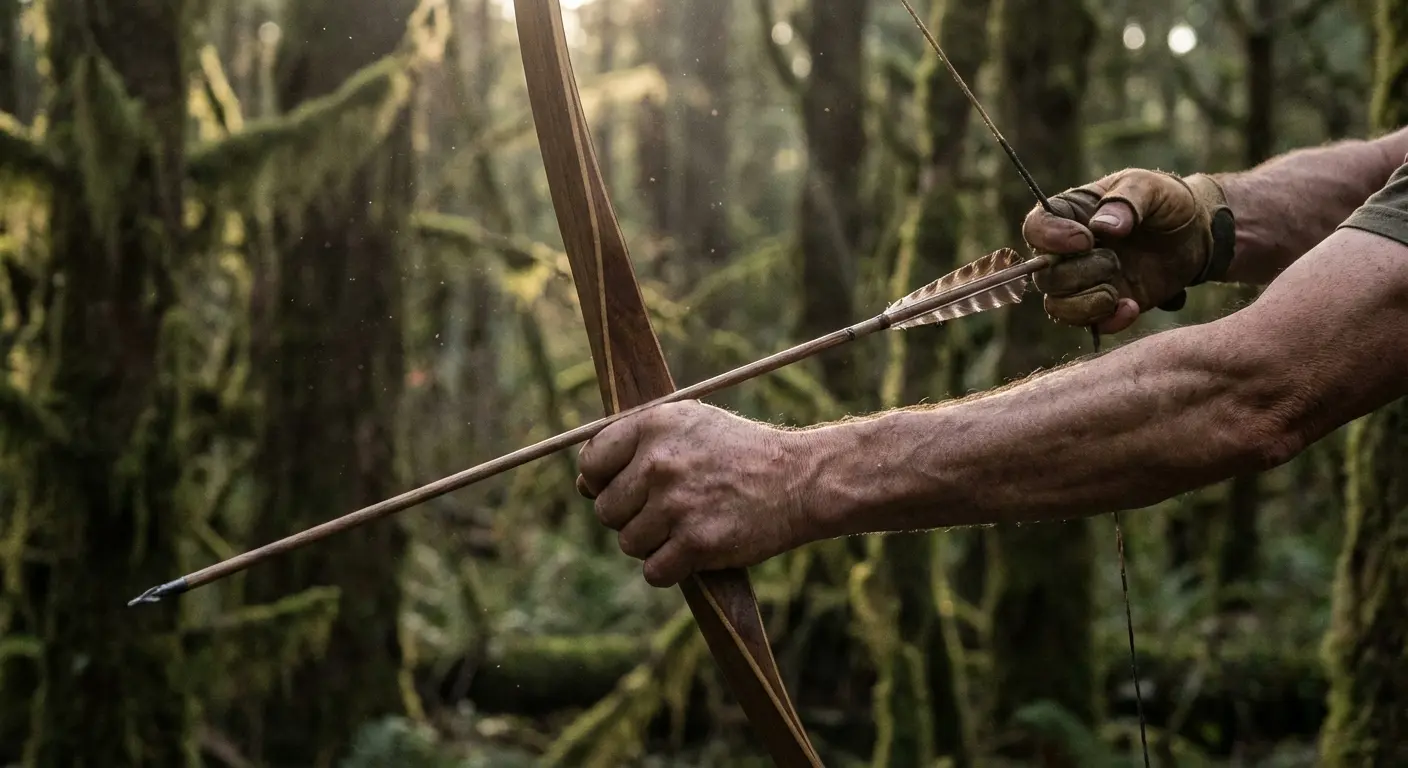
But you’re permanently marking indecision. You’ve committed to the tattoo, but the tattoo shows a moment before commitment. What does that say about your relationship to decision-making?
An arrow with bow combination symbolizes readiness for action and purposeful intent, an ideal design for those ready for new challenges and determined to move forward, representing the complete weapon system rather than just the projectile.
A bow with no arrow visible suggests potential without direction, power without purpose, capability without current application. You could shoot, but you’re not shooting. You’re marking your ability to act, not your action itself. That might be about restraint, about choosing not to use force you possess. Or it might be about perpetual preparation that never converts to actual movement.
A bow at rest (unstrung, or strung but carrying no arrow) represents dormant power, tools available but not currently employed. This is capability in storage. You’re marking that you have the means to act when necessary, but the necessity isn’t present right now.
The bow also introduces the question of whose hands are on it. Is this your bow, representing your agency and your choices? Or is this someone else’s bow, representing forces that aimed you, launched you, sent you toward a target you didn’t necessarily choose? That distinction completely changes whether this is an empowerment symbol or a symbol of being used as a tool by someone else’s intentions.
Someone who grew up in a military family and enlisted because it was expected might get a bow-and-arrow tattoo where the hands drawing the bow are ambiguous or absent. Representing being aimed and launched by family expectations, duty, or circumstances beyond their control. The arrow (their life trajectory) was sent by a bow they didn’t draw themselves. Contrast that with someone who gets a bow-and-arrow tattoo after making a difficult choice to leave their hometown and start over. The hands on the bow are clearly their own, representing full agency in the decision to release themselves toward a new target.
Arrow-and-bow combinations often look more complete than arrows alone, more like a full image rather than a fragment. But completeness isn’t always depth. Sometimes you’re just making the metaphor more literal, more obvious, less open to interpretation. You’re explaining the symbol instead of letting it speak.
There’s also the practical consideration that bows are larger, more complex designs that require more skin real estate and more detailed linework. You’re committing to a bigger piece, which means more pain, more time, more money, and less flexibility in placement. The bow might add meaning, but it definitely adds complications.
Tribal Arrows vs. Modern Linework: Same Symbol, Opposite Philosophy
Tribal arrow tattoos come from systems where symbols weren’t chosen. They were inherited, earned, or assigned based on your role in the community. You didn’t get to decide what your arrow meant. The tribe, the tradition, the cultural knowledge system decided that for you.
Modern minimalist arrow tattoos operate from the exact opposite premise: you get to decide what it means. Your arrow, your interpretation, your personal narrative. The meaning is whatever you say it is, and nobody else’s approach has authority over your choice.
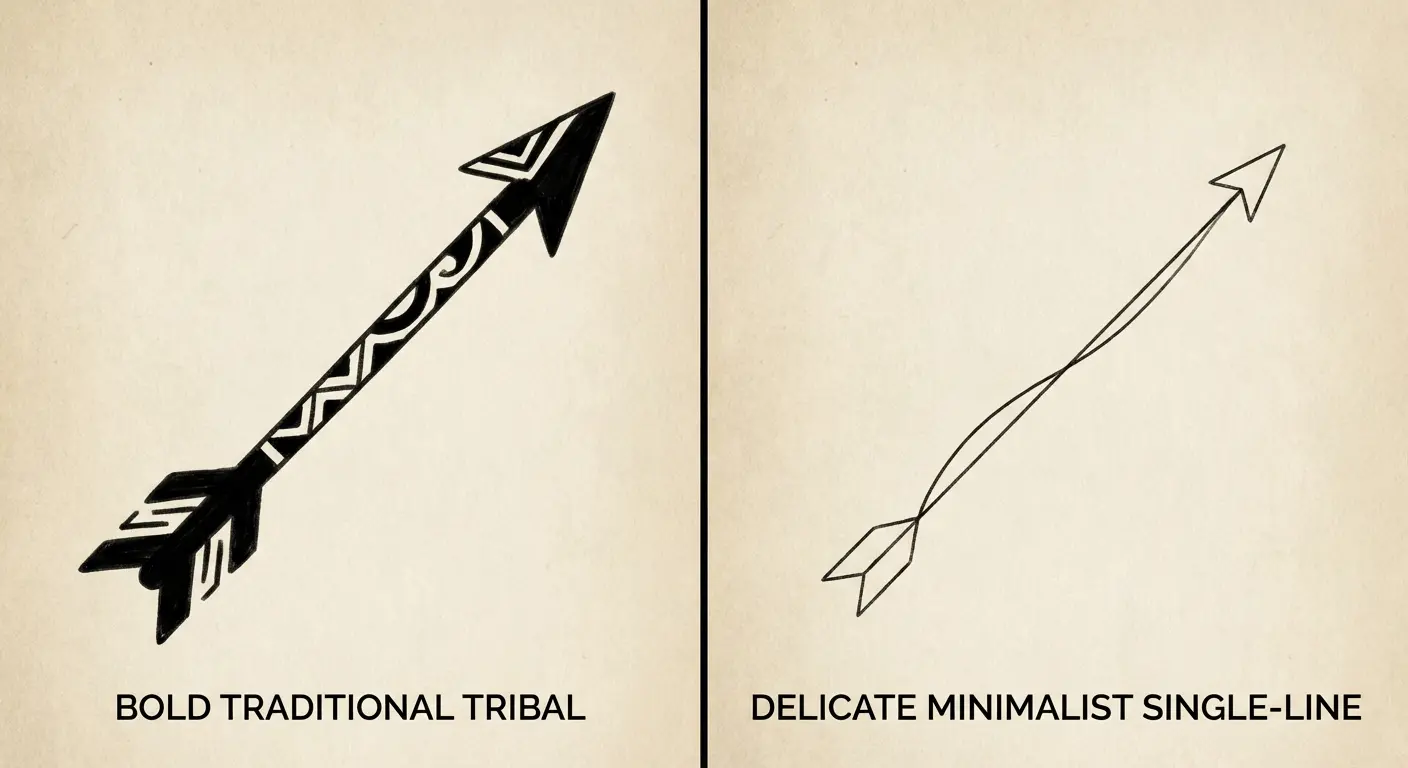
These aren’t just different aesthetic preferences. They’re incompatible meaning-making systems. One is collective, the other is individual. One is bound by tradition, the other is explicitly rejecting traditional constraints. One requires initiation into cultural knowledge, the other requires only personal conviction.
When you get a tribal-style arrow without being part of that tribe, you’re taking the aesthetic while rejecting the philosophical system that gave it meaning. You’re treating it as decoration, as a style choice, as something you picked because it looked cool. That’s fine, but you can’t then claim you’re honoring the tradition. You’re doing the opposite.
The linework itself tells the story. Tribal arrows use bold black lines, geometric patterns, negative space, and design elements specific to particular cultural traditions. Each element means something within that tradition’s visual language. You can’t just rearrange them for aesthetic effect without changing what they say.
Modern minimalist arrows use thin lines, simple shapes, and deliberately stripped-down design. The minimalism is the point. You’re signaling that you don’t need elaborate decoration or cultural authority to make meaning. You’re claiming that the simple line is enough, that your personal interpretation is sufficient, that meaning comes from individual intention rather than collective tradition.
Both approaches are valid, but you can’t have it both ways. You can’t claim the deep cultural resonance of tribal symbolism while using the individualistic meaning-making approach of modern minimalism. Pick a lane.
The irony is that modern minimalist arrows often claim to be “timeless” or “classic,” as if simplicity makes them universal. But they’re extremely contemporary, products of a specific cultural moment (roughly 2010s to present) that values minimalism, personal branding, and individual meaning-making over collective tradition. They’ll age into their era just as surely as tribal tattoos aged into theirs.
Placement Psychology: Your Arrow’s Direction Isn’t What You Think It Means
An arrow pointing up your spine doesn’t mean upward progress. It means you’ve marked your backbone, your literal central support structure. The direction barely matters. The location matters.
Your spine carries you. It holds you upright. It protects your spinal cord, the neural highway that connects your brain to everything else. An arrow there is about core strength, central support, the structure that makes everything else possible. Whether it points up or down matters less than the fact that you’ve marked your foundational architecture.
Arrows on forearms get interpreted as visible reminders, symbols you can see throughout your day, messages you’re sending to yourself and others. But forearms are also tools, extensions of your hands, the parts of you that reach out and manipulate the world. An arrow there might be less about reminder and more about marking your means of action, your ability to extend yourself into space, your reach.
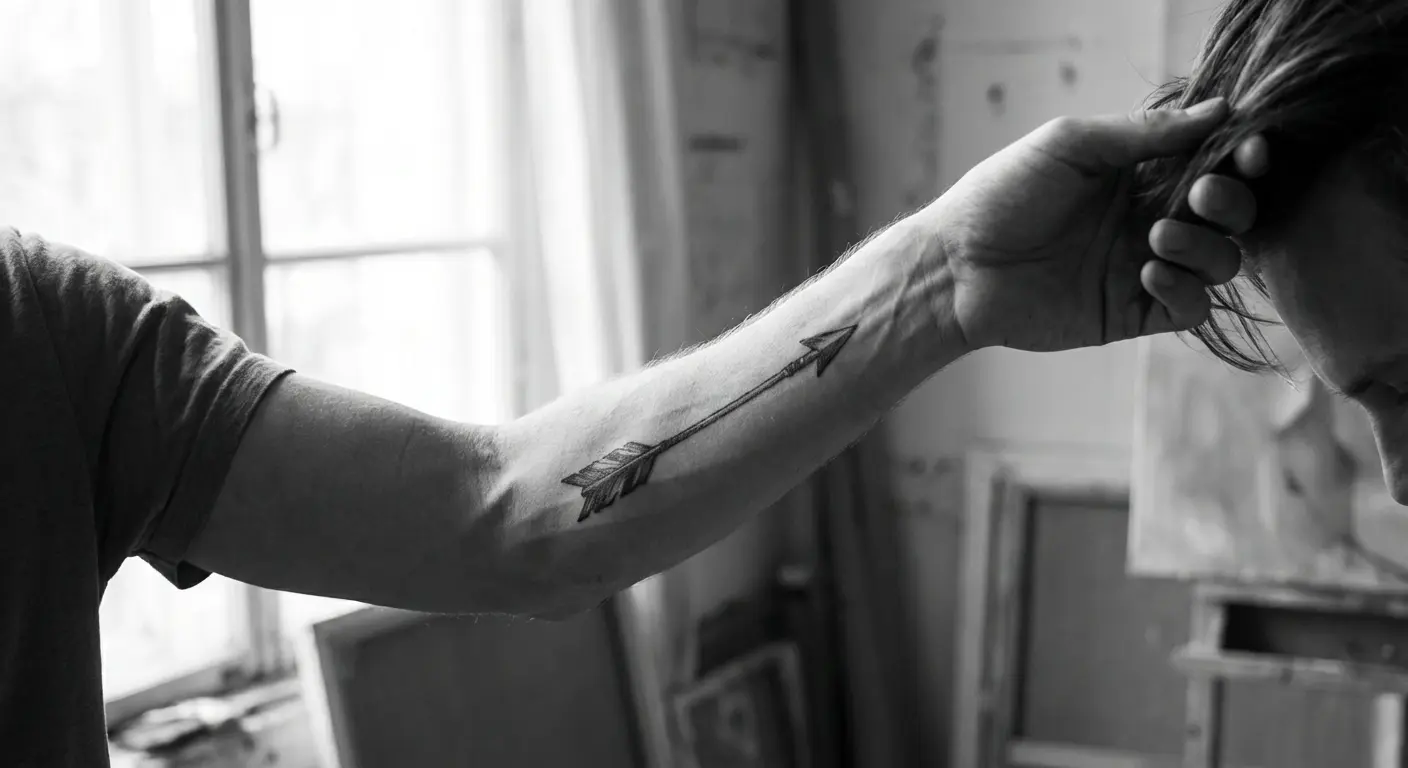
Understanding tattoo placement as meaning-making transforms how we interpret directional symbols across different body locations.
The dominant arm vs. non-dominant arm distinction creates another layer. Your dominant side is your action side, the one you use for precision and force. Your non-dominant side is your support side, the one that steadies and assists. Same arrow design, different meanings based purely on which arm you chose.
Arrows on the ribcage sit over your lungs and heart, the organs that keep you alive breath by breath, beat by beat. You’ve marked your life-sustaining systems, the involuntary processes that continue whether you’re paying attention or not. An arrow there is about survival in the most literal sense, about the body’s commitment to keeping you alive.
Behind-the-ear arrows are nearly invisible most of the time, revealed only when you tuck your hair back or turn your head. That’s a different kind of symbolism: the hidden message, the meaning that’s present but not advertised, the arrow that exists for you more than for public viewing.
Ankle arrows move when you walk. They’re animated by your normal movement, pointing in different directions as your foot flexes and extends. A static arrow design becomes dynamic through placement. You’re not marking a fixed direction. You’re marking something that shifts with every step.
Finger arrows are bold specifically because fingers are expressive, constantly moving, constantly gesturing, constantly visible in your own field of vision. You can’t ignore a finger tattoo the way you might forget about one on your shoulder blade. It’s always there, in your face, demanding acknowledgment.
The body’s natural lines and energy flow (whether you believe in energy flow or just in visual lines created by muscle and bone) interact with your arrow’s orientation. An arrow that follows the line of a muscle emphasizes that muscle’s purpose and movement. An arrow that cuts across natural lines creates visual tension, disruption, a symbol that refuses to cooperate with your body’s existing geometry.
Upward-pointing arrows supposedly mean progress, growth, reaching higher. Downward-pointing arrows supposedly mean grounding, stability, or (in negative interpretations) decline. But your body isn’t oriented to abstract concepts. It’s oriented to front and back, dominant and support, core and extremity, visible and hidden. Those orientations matter more than compass directions.
When Your Arrow Tattoo Needs More Than Generic Symbolism
You’ve read all of this, and you’re probably thinking: none of these generic meanings quite capture what I want my arrow tattoo to represent. The standard interpretations are too broad, too vague, too disconnected from your specific story and the specific meaning you’re trying to mark permanently on your body.
This is the gap that frustrates most people in the tattoo planning process. You know what you want your arrow to mean. You know which moment you’re marking (pre-flight, in-flight, post-impact). You know whether your broken arrow represents peace or incompleteness. You know what colors should mean in your personal system. But translating all of that into a visual design that communicates your specific meaning? That’s where the process usually breaks down.

You end up trying to explain your complex symbolism to a tattoo artist who’s working from reference images of generic arrows, or you scroll through thousands of existing arrow designs hoping one of them accidentally matches your intention, or you compromise and get something close enough even though it’s not quite right.
Much like choosing your first tattoo, arrow designs benefit from tools that translate personal meaning into visual specificity.
We built Tattoo Generator IQ specifically for this problem. You can input your specific meaning (not just “arrow” but “arrow representing the decision I made three years ago to leave my corporate job, post-impact, with elements that reference both the security I left behind and the uncertainty I chose”), select from authentic tattoo styles, and generate multiple design variations that incorporate your personal symbolism.
The AI creates options you can refine until the design matches your intention, not just the generic category of “arrow tattoo.” You get high-resolution files and placement guides to bring to your tattoo artist, so you’re walking in with a clear visual reference that already contains your specific meaning, not hoping they’ll intuitively understand what you’re trying to communicate.
Your arrow tattoo should represent your specific story, your specific moment, your specific cultural or personal system. Generic designs can’t do that. You need something built for your meaning from the start. Check out Tattoo Generator IQ to create arrow designs that match what you’re trying to say, not just what arrows typically represent.
Final Thoughts
Arrow tattoos have been flattened into motivational poster symbolism, and we’ve all suffered for it. The “keep moving forward” interpretation isn’t wrong exactly, but it’s incomplete to the point of being misleading.
Arrows represent actions already taken, targets already aimed at, decisions already made. They’re evidence of past commitment, not future intention. When you mark your body with an arrow, you’re creating permanent proof of something you’ve already released into the world, something you can’t take back, something whose outcome is already unfolding or already complete.
That’s heavier than the Pinterest version. It’s also more honest.
You now know that single arrows mean solitude and vulnerability as much as they mean strength. You know that broken arrows might represent peace or failure depending on which tradition you’re pulling from. You know that tribal arrows and minimalist arrows come from opposite philosophical systems. You know that your arrow’s color probably contradicts its intended meaning if you’re applying modern color psychology to indigenous symbols. You know that placement matters more than direction.
What you do with all of this is up to you. You can ignore it and get the thin-line arrow that looks good in photos. You can dig deeper into a specific cultural tradition and work within that system. You can build your own meaning approach and be intentional about every element.
Just don’t pretend the arrow tattoo symbol is simple. Don’t claim deep meaning while relying on shallow interpretation. Don’t borrow cultural aesthetics while ignoring cultural meaning systems. And don’t mark your body with a future-focused symbol when arrows have always been about the past.
Your arrow already flew. Your tattoo is just the evidence.
