
16 Cardinal Tattoos That Capture What Most Designs Miss: The Balance Between Grief and Joy
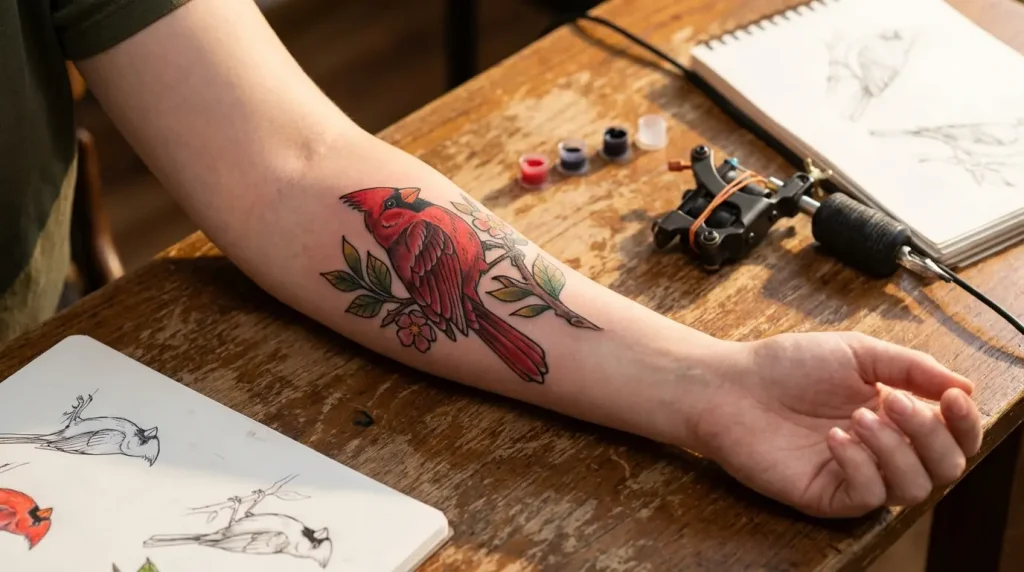
Table of Contents
Most cardinal tattoos get this wrong from the start. They lean too hard into the memorial angle, turning a vibrant bird into a grief monument. Or they go full decorative, missing the emotional weight entirely.
Here’s what actually works: designs that hold space for both. The loss and the hope. The remembering and the continuing forward.
I’m covering 16 approaches here. That’s probably overkill. But each one solves a specific problem with how cardinal tattoos usually get executed. Skip to whatever section calls to you, or read straight through if you’re the thorough type.
-
Paired Cardinals: Designs That Honor Connection
-
Male and Female Cardinal Perched Together
-
Cardinals in Mirror Flight Formation
-
Nesting Pair with Seasonal Elements
-
Yin-Yang Cardinal Composition
-
-
Remembrance Through Motion: Flying Cardinal Concepts
-
Single Cardinal Mid-Ascent
-
Cardinal Dissolving Into Geometric Shapes
-
Multiple Cardinals in Spiral Formation
-
Cardinal Breaking Through Floral Border
-
-
Subtle Statements: Small-Scale Cardinal Designs
-
Minimalist Cardinal Silhouette
-
Watercolor Splash with Simple Cardinal Form
-
Cardinal Feather with Hidden Bird Detail
-
Micro-Realism Cardinal Portrait
-
-
Realism That Speaks: Large-Format Cardinal Tattoos
-
Hyper-Realistic Cardinal Sleeve Integration
-
Cardinal Back Piece with Environmental Context
-
Forearm Realism with Dimensional Depth
-
Female Cardinal in Natural Habitat Setting
-
TL;DR
-
Paired cardinals solve the relationship representation problem better than single birds
-
Flight creates emotional movement that static poses can’t match
-
Small designs require ruthless detail selection or they become red blobs
-
Female cardinals are criminally underrated and often more interesting than males
-
Realism depends on weight and posture, not rendering every single feather
-
Your placement should work with your body’s natural contours, not against them
Paired Cardinals: Designs That Honor Connection
Cardinals mate for life. Both birds stay vibrant and active together year-round. This makes them perfect for representing ongoing relationships, not just memorializing loss.
The problem? Most paired cardinal designs fall into cheesy “his and hers” territory. Matching poses, symmetrical placement, zero visual interest.
What works instead: designs that acknowledge the visual rhythm between two distinct forms. The interplay. The space between them that suggests connection without codependence.
You might be honoring a partnership, a parent-child bond, or even the relationship between who you were and who you’ve become. Research shows that individuals with tattoos often experience enhanced self-perception and a stronger sense of identity, which makes paired cardinals particularly meaningful when representing relationships that shaped you.
1. Male and Female Cardinal Perched Together
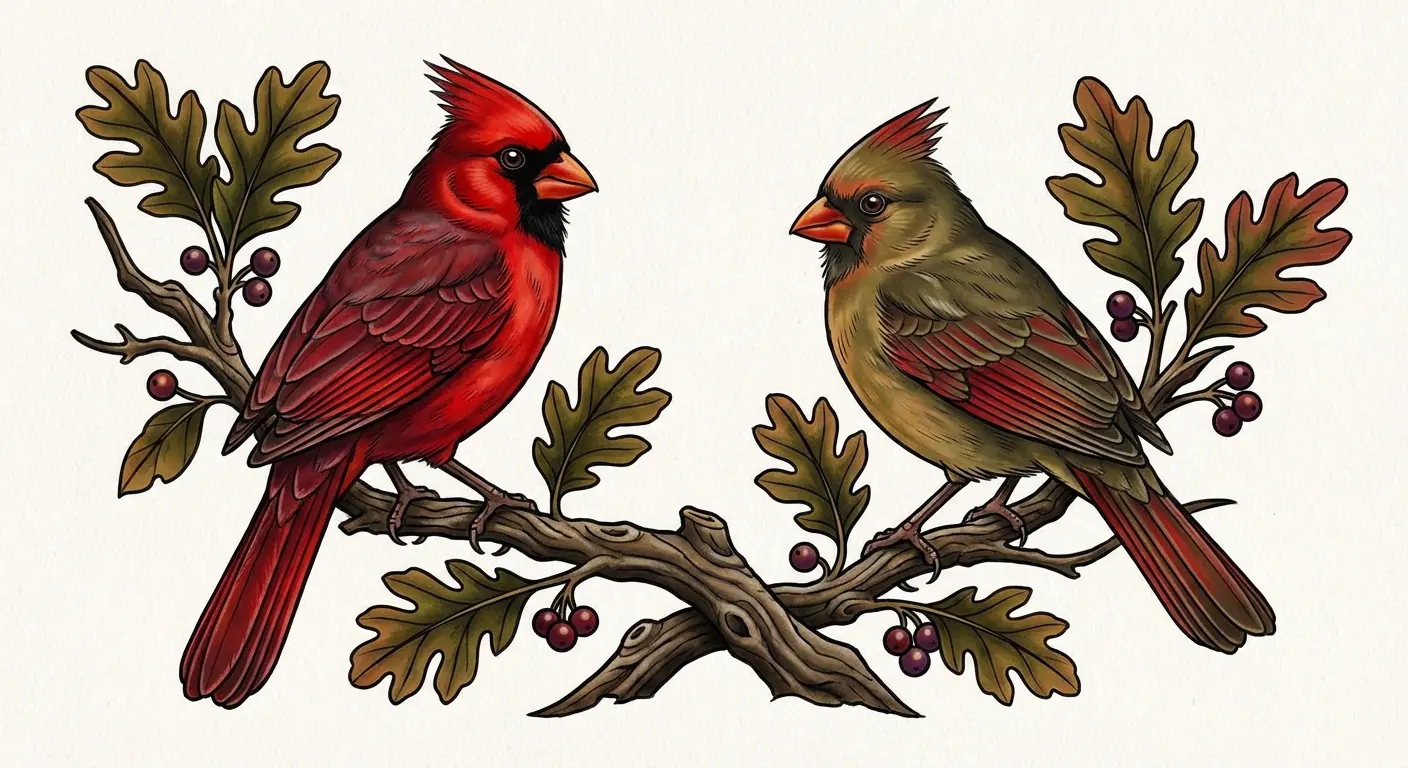
The male’s bright red against the female’s olive-brown with rust accents? That’s nature handling your color theory for you.
Put them on a single branch with slight space between their bodies. Not touching, which reads as forced. The male typically sits slightly higher or forward, which reflects actual cardinal behavior and adds compositional depth.
Best placement? Forearm where the branch follows your arm’s natural line, or shoulder blade where the birds curve with your scapula.
Your artist needs reference photos showing what female cardinals actually look like. Too many people (and some tattooers) default to making them pale red instead of their true coloring. That olive-brown body with rust-red accents creates the visual contrast that makes this work. Without it, you’ve got two red birds with slightly different saturation. Boring.
The color variation keeps the composition interesting without requiring artistic manipulation. You’re working with what’s already there.
2. Cardinals in Mirror Flight Formation
Flight symmetry has power, but perfect mirroring reads as decorative rather than meaningful.
Position two cardinals in flight with wings at different points in their stroke cycle. One bird’s wings fully extended upward while the other’s are mid-downstroke. This creates dynamic tension your eye wants to follow.
The mirror formation works as a chest piece where the birds flow outward from your sternum, or as a back piece spanning your shoulder blades. You’re creating a frame your body fills.
Most people don’t think about their breathing until they get a chest piece. Then that subtle rise and fall either makes the tattoo come alive or makes them wish they’d gone with their back. The movement adds another layer to the design that you won’t get with other placements.
This solves a common problem with memorial pieces: they feel static and heavy. Flight introduces movement and suggests continuation rather than ending.
3. Nesting Pair with Seasonal Elements
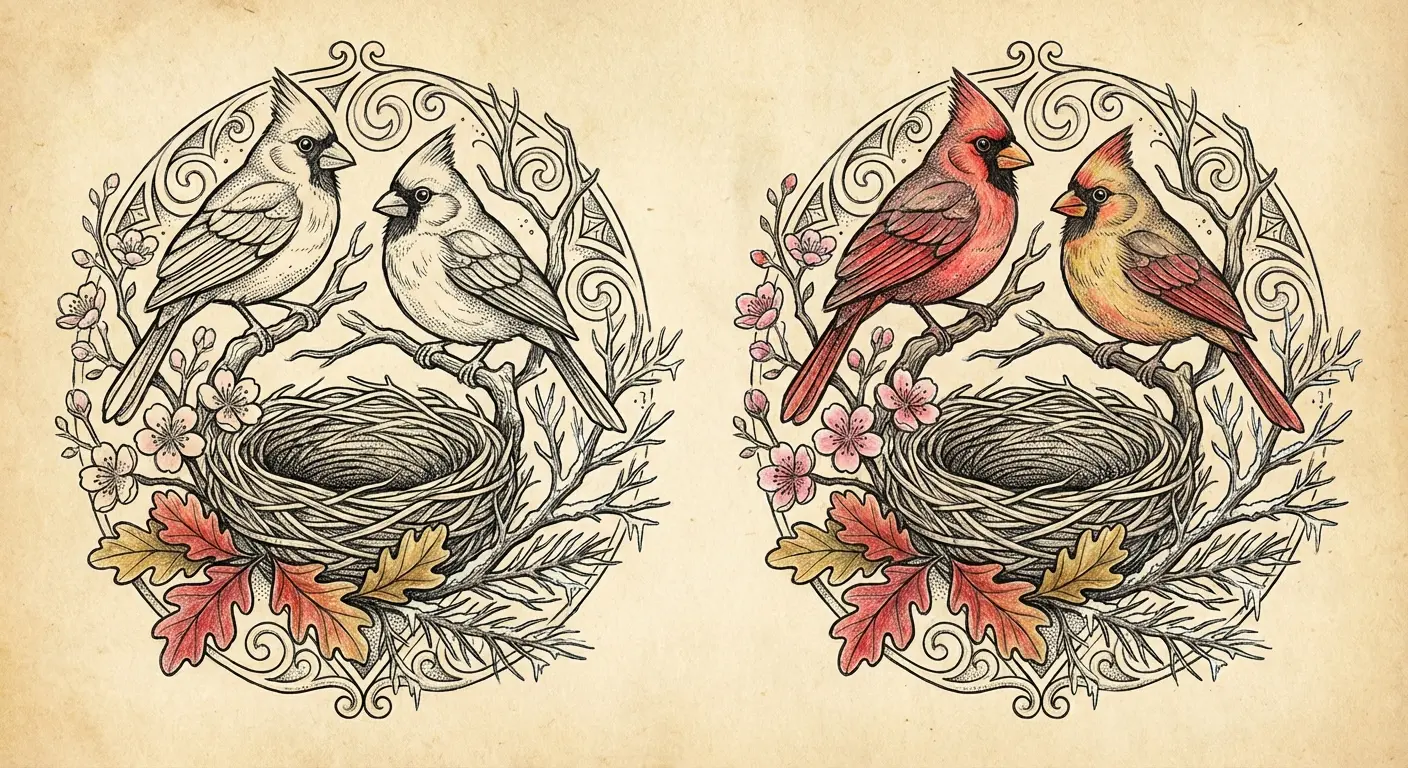
Cardinals don’t migrate. They’re visible year-round, adapting to seasonal changes. A nesting pair surrounded by elements from different seasons (spring blossoms, summer leaves, autumn berries, winter snow) tells a story about endurance.
This needs more space because you’re building environmental context. Thigh pieces or ribcage work. The nest becomes your central anchor point, with the cardinals positioned protectively around or within it. When you’re considering seasonal elements, remember that flower tattoo designs require similar attention to balancing detail with the primary subject.
The shift here is subtle but important. You’re not focusing on the birds themselves but on what they’re protecting or building together. That reframing changes the entire emotional tone from “beautiful birds” to “what these birds create together.”
Your artist needs to map out which season occupies which quadrant before starting. Too much seasonal detail overwhelms the birds. Too little makes the concept unclear.
I’ve seen this work beautifully when the artist commits to the environmental storytelling instead of making the birds compete with their surroundings.
4. Yin-Yang Cardinal Composition
You can integrate male and female cardinals into a yin-yang structure without it feeling gimmicky, but it requires restraint.
The birds should form the circular flow through their body positions and tail feathers rather than being stuffed into pre-drawn yin-yang shapes. One cardinal curves upward while the other curves downward, their bodies creating the S-curve division naturally. The male’s red and the female’s olive-brown provide the inherent light-dark contrast.
Shoulder cap or ankle placement works best. Anywhere you want circular composition that reads clearly from multiple angles.
The philosophical dimension is obvious but not heavy-handed: balance, duality, complementary opposites. What’s not obvious is how well this structure solves the “two birds” composition problem by giving them a clear spatial relationship that feels intentional.
I’ve watched clients struggle with designs that try to force two birds into rectangular or square compositions. The circular approach eliminates that awkwardness entirely.
Is this a bit on the nose symbolically? Maybe. Does it work visually? Absolutely.
Remembrance Through Motion: Flying Cardinal Concepts
Here’s what most cardinal tattoos get wrong: they’re too still. Too perfect. Too much like the bird is posing for a portrait.
Grief and memory aren’t static experiences. They move through us, change shape, sometimes feel close and sometimes distant.
Flying designs capture that fluidity. These four approaches use flight and motion to represent remembrance as an active, ongoing process rather than a frozen moment.
The cardinal’s association with deceased loved ones visiting is well-known. But flight specifically suggests that presence is dynamic, not fixed in one place or time. You’re creating something that honors memory without being consumed by it.
5. Single Cardinal Mid-Ascent
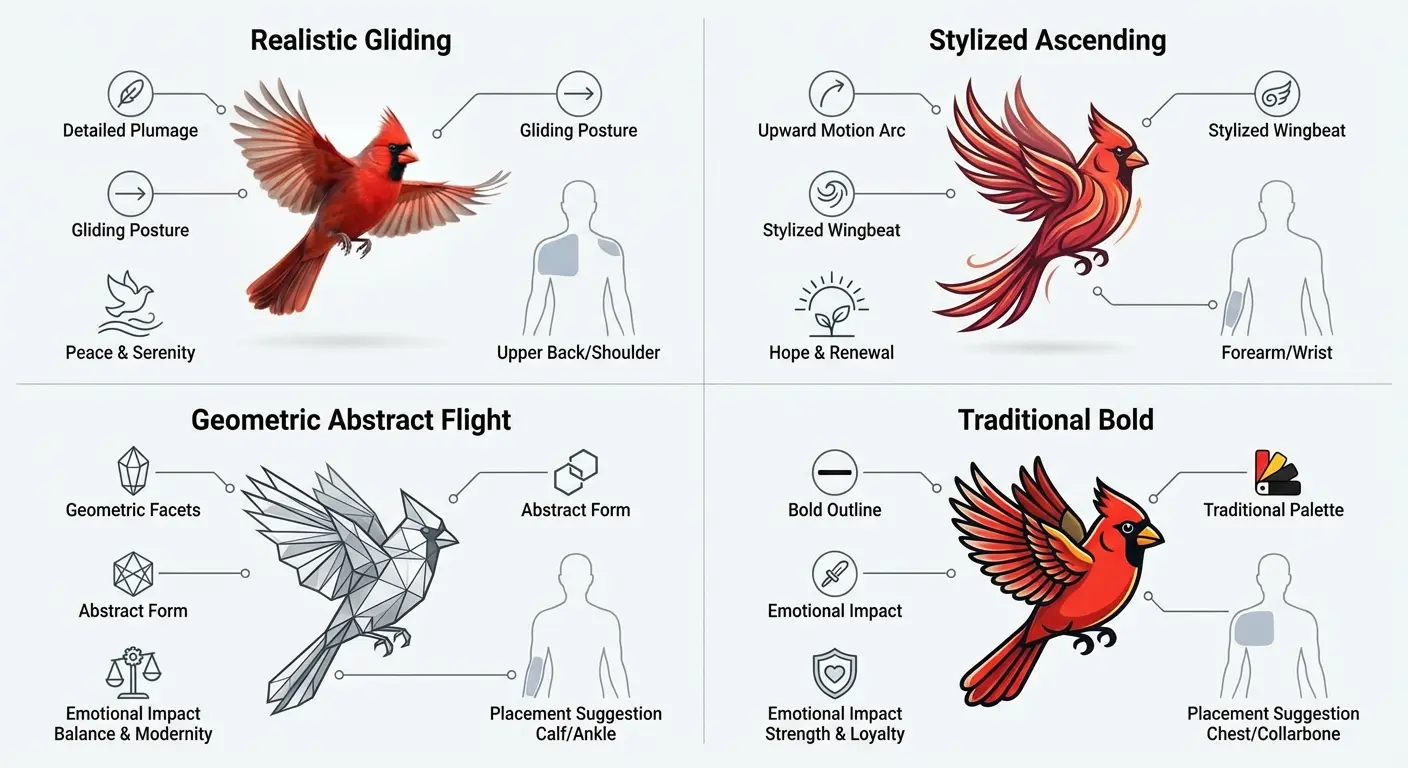
Upward flight carries obvious symbolism, but the power is in the specific moment you capture.
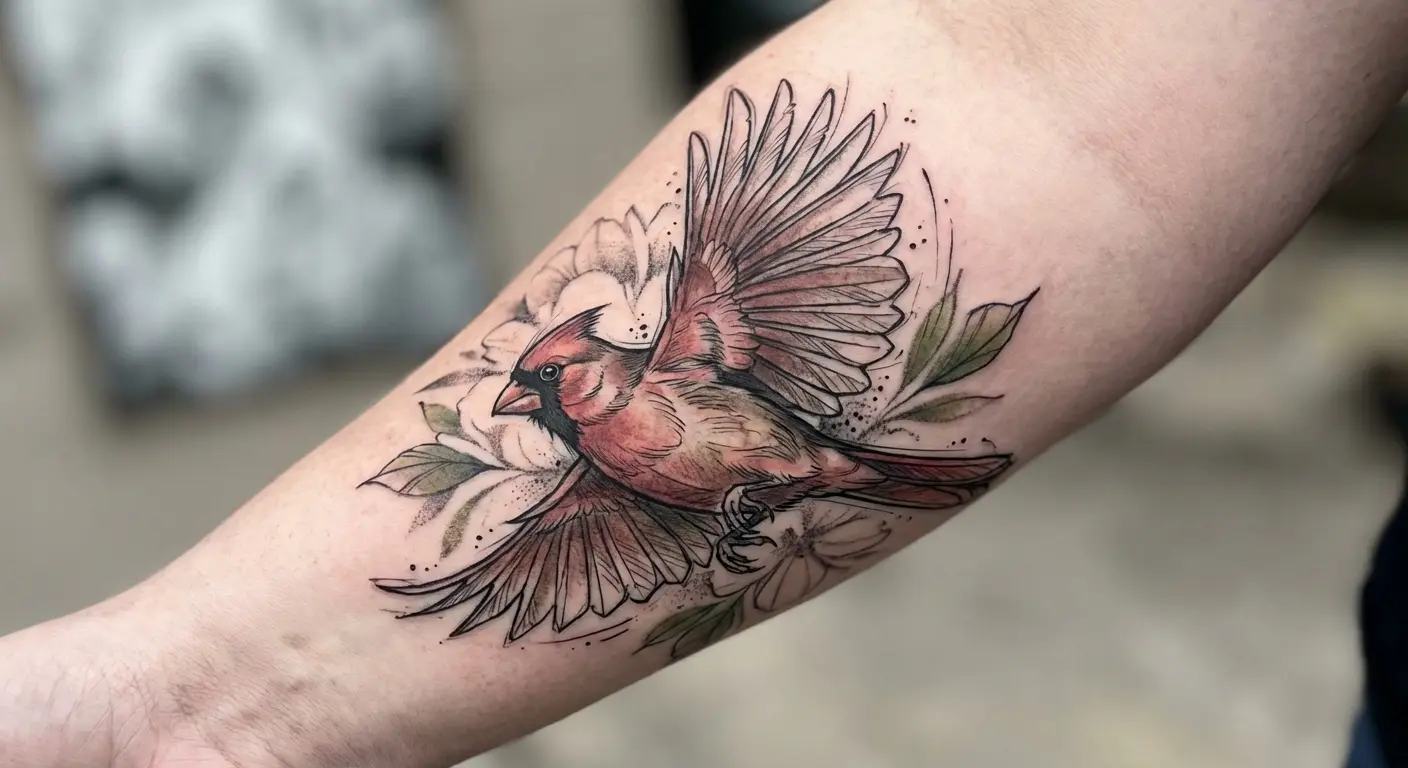
A cardinal at the beginning of ascent, with wings just starting to beat upward and body angled but not yet vertical, suggests effort and intention. You’re catching the transition point, which makes it feel immediate rather than already completed.
This reads very differently from a cardinal soaring with wings spread (triumphant but distant) or landing (conclusive). Mid-ascent keeps the emotional tone open and ongoing.
Forearm placement where the bird flies up toward your elbow, or calf where it ascends toward your knee. The vertical orientation uses your body’s natural lines to reinforce the upward movement.
Your artist needs to nail the wing position. If the wings are too symmetrical or too spread, you lose that sense of active flight and it becomes decorative.
This resonates particularly well with people who view their loss or transformation as an ongoing journey rather than a completed event. The motion matters.
6. Cardinal Dissolving Into Geometric Shapes
A cardinal in flight that gradually breaks apart into geometric shapes (triangles, lines, dots) as it moves across your skin creates a visual metaphor for how memory actually works.
The bird starts solid and detailed, then fragments into abstraction. You’re showing that remembrance becomes less about specific details and more about feeling and essence over time. The transition from realistic to abstract mirrors techniques used in geometric tattoo designs that blend organic and structured forms.
This needs significant space because the transition needs room to read clearly. Outer thigh, ribcage, or upper arm where you have several inches of relatively flat canvas.
The geometric style you choose matters tremendously. Sacred geometry (flower of life, Metatron’s cube) gives it spiritual weight. Simple line work keeps it modern and understated.
What makes this valuable is that it gives you permission to represent loss without making the entire tattoo about sadness. The dissolution isn’t destruction. It’s transformation into something that integrates with you, literally with your skin.
I’ve seen this done badly three times in the past year. The problem is always the same: the transition point. Too abrupt and it looks like the bird is exploding. Too gradual and the concept gets muddy. Your artist needs to find that sweet spot.
7. Multiple Cardinals in Spiral Formation
Three to five cardinals flying in a loose spiral pattern creates movement your eye follows naturally.
The spiral itself carries meaning across cultures: growth, evolution, life cycles. Having multiple birds suggests that what you’re remembering isn’t a single moment but an accumulation of presence and impact.
The birds should vary slightly in size and detail level. Most detailed cardinal as your focal point, others becoming progressively simpler as the spiral expands. This prevents visual chaos while maintaining the pattern’s integrity.
Upper back or chest placement because you need enough space for the spiral to complete at least one full rotation.
This is a multi-session piece if you want it done properly. Your artist needs to map the spiral carefully and ensure the birds relate to each other spatially.
This carries more emotional weight than a single bird because it acknowledges that loss and memory compound over time. You’re not remembering one thing. You’re carrying an accumulation.
8. Cardinal Breaking Through Floral Border
Borders and frames feel safe. Contained. Controlled.
A cardinal in flight breaking through or emerging from a floral border suggests that memory and presence can’t be contained by the structures we build around them.
You’re creating visual tension between the decorative, orderly border and the dynamic, living bird. The floral elements can carry their own meaning (roses for love, forget-me-nots for memory, holly for the cardinal’s winter habitat), but they function primarily as the thing being transcended.
Shoulder piece where the border wraps around your deltoid and the cardinal breaks free across your upper arm. Or thigh piece where the border encircles your leg and the bird escapes upward.
The key is making the breakthrough look effortless rather than violent. The cardinal shouldn’t be crashing through. It should be flowing past, as if the border was never really an obstacle.
Your artist needs to handle depth carefully here, using shading to make the border recede and the bird advance.
This works particularly well for people who feel they’ve outgrown certain limitations or want to represent transcendence of grief without denying its presence.
Subtle Statements: Small-Scale Cardinal Designs
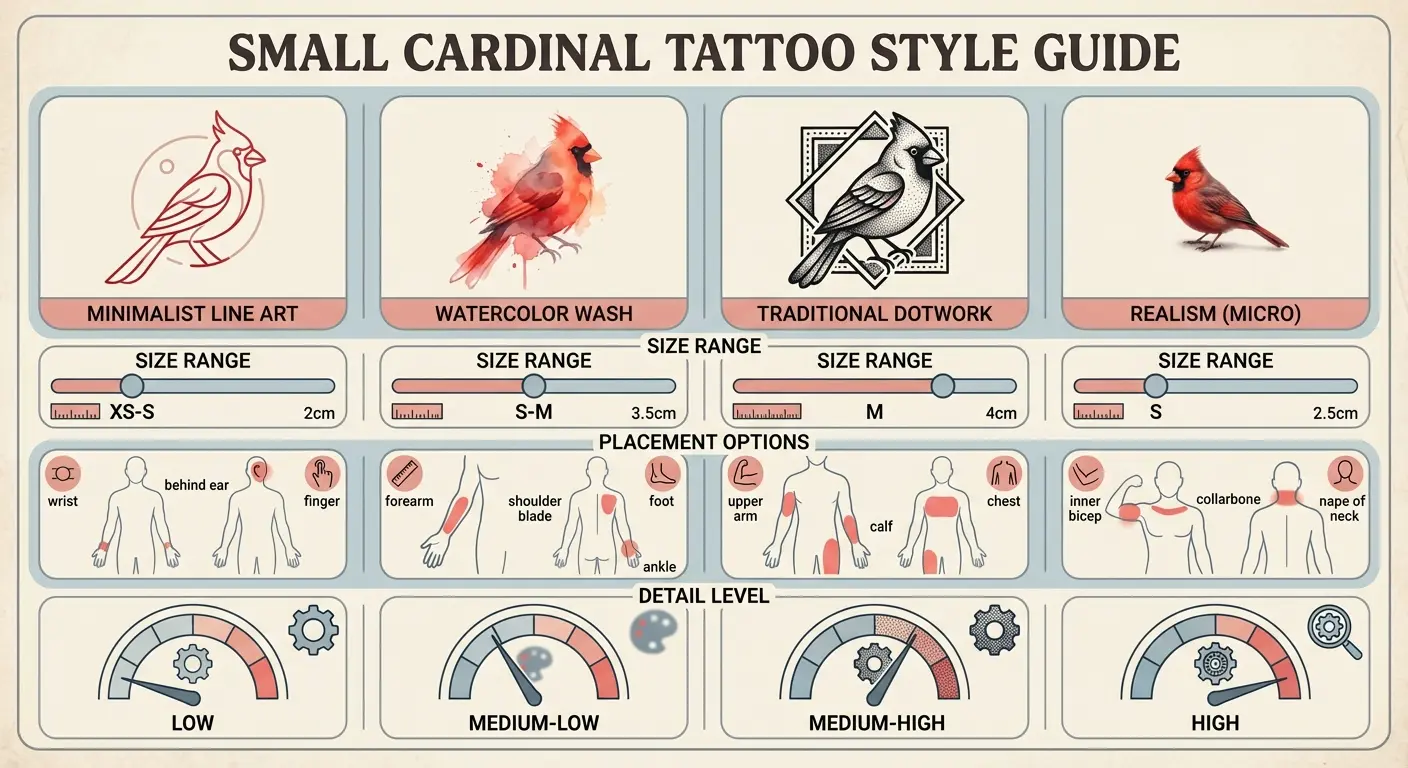
Small tattoos aren’t just shrunk-down versions of large designs. They require completely different approaches.
Cardinals are detailed birds. Distinctive crests, masks, beaks, specific feather patterns. Not all of that translates at small scale.
These four approaches work with the limitations of size rather than fighting against them. You’re making strategic choices about what to keep and what to let go.
Small designs serve different purposes than large ones. They’re often more personal, less visible, easier to place in unexpected locations. They invite closer looking rather than announcing themselves from across the room.
If you try to cram realistic detail into a two-inch space, you’ll end up with a red blob in five years. That’s just physics.
9. Minimalist Cardinal Silhouette
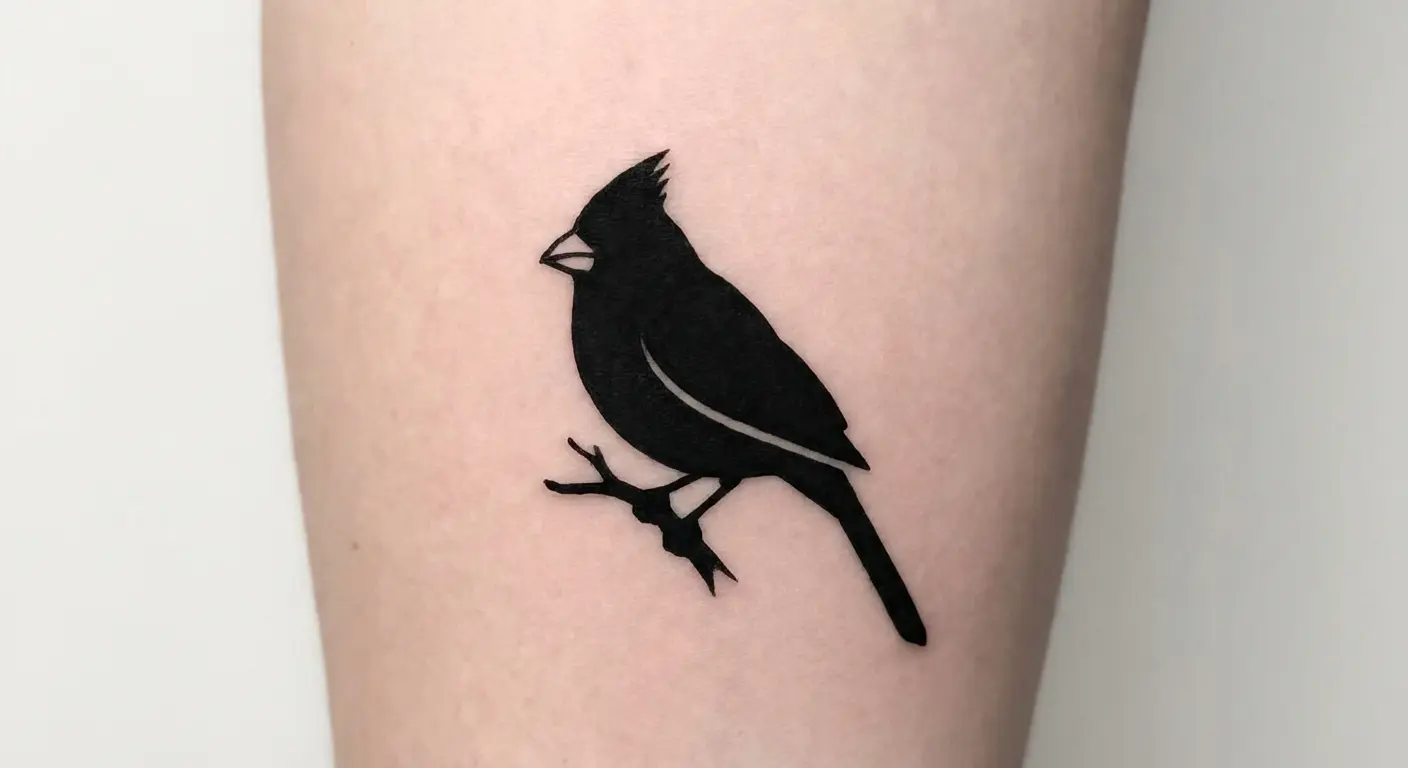
A solid black silhouette of a cardinal in profile captures the bird’s distinctive shape without requiring detailed feather work or color.
That crest is instantly recognizable. You’re working with pure form.
The silhouette should show the cardinal in a characteristic pose: perched with crest raised, or in flight with wings in a specific position that reads clearly as “cardinal” rather than generic bird. If you’re drawn to simplified forms, explore simple tattoo ideas that emphasize clean lines and instant recognition.
Behind the ear, inner wrist, ankle, finger. Size can go as small as one inch and still read clearly because you’re not asking the tattoo to convey texture or color variation.
What makes this successful is that it relies on your knowledge to complete the image. Anyone who knows cardinals will recognize it instantly. Others will see an elegant bird silhouette. That selective recognition can feel more intimate than a detailed, obvious cardinal that announces itself to everyone.
This ages particularly well because there’s no color to fade or fine detail to blur over time. The clarity maintains for decades.
10. Watercolor Splash with Simple Cardinal Form
Watercolor technique in tattoos gets criticized for aging poorly. That criticism has merit when the entire design is loose, abstract color.
But a simple cardinal outline or minimal detail cardinal with a controlled watercolor splash behind or around it gives you color and visual interest while maintaining a clear, readable form that will age well.
The cardinal itself should be done in solid black linework or minimal shading. The red, orange, and yellow watercolor elements suggest the bird’s coloring without trying to realistically render it.
Forearm, shoulder, or calf. 2-3 inches. The watercolor element needs to be contained enough that it doesn’t resemble random color splatter, but loose enough that it maintains that spontaneous, fluid quality.
Your artist’s watercolor technique matters tremendously here. You want someone who understands how to make it look intentional rather than messy.
I’ve seen too many designs where the watercolor element overwhelms the bird form instead of enhancing it. The bird should remain the focal point.
The watercolor trend peaked around 2018. The hype has cooled. In five years, you might wish you’d gone with solid linework. Just being honest.
11. Cardinal Feather with Hidden Bird Detail
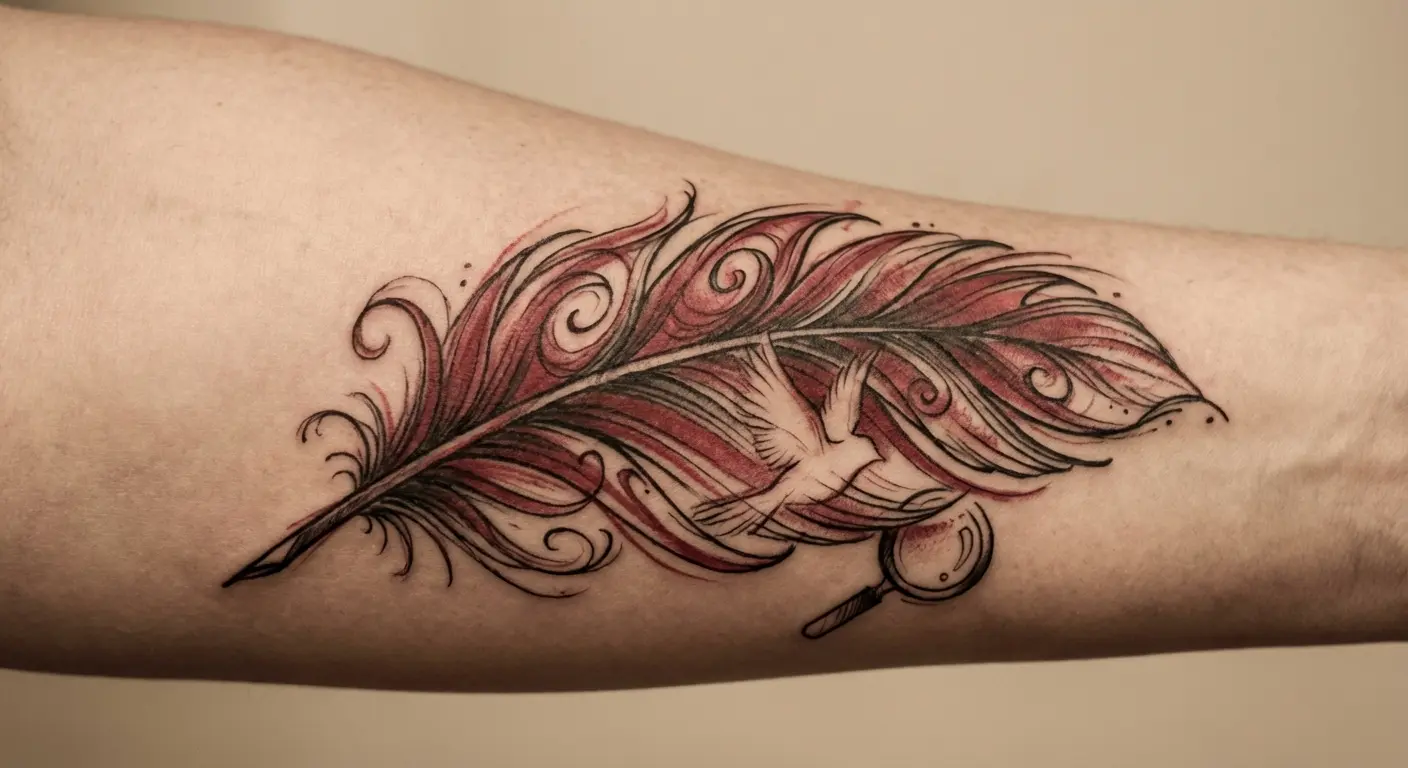
A single cardinal feather (red with black edging, distinctive in shape) works as a small, elegant tattoo on its own.
But incorporating a tiny, detailed cardinal into the feather’s structure (the bird forms the feather’s shaft, or is nestled within the barbs) adds a discovery element that makes people look twice.
You’re creating a design that reveals itself gradually. This works particularly well for people who want cardinal symbolism but don’t want an obvious bird tattoo. The feather reads as decorative first, meaningful second.
Side of the finger, behind the ear, inner wrist, along the collarbone. Feathers are naturally elongated and fit narrow spaces.
The hidden bird detail needs to be genuinely visible upon closer inspection, not so abstract that people need you to explain what they’re looking at.
Your artist should sketch multiple versions showing how the bird integrates with the feather structure before you commit. The bird should be positioned so its body follows the feather’s natural curve, making the integration feel organic rather than forced.
This offers layered meaning through its hidden-in-plain-sight approach.
12. Micro-Realism Cardinal Portrait
Micro-realism is technically challenging. Not every artist can execute it properly.
When done well, a tiny realistic cardinal portrait (1.5 to 2 inches) creates incredible impact. You’re proving that small doesn’t mean simple.
The key is limiting what you’re trying to show. A cardinal’s head and upper body in three-quarter view gives you the crest, the distinctive black mask, the bright red coloring, and enough detail to showcase realistic technique without trying to render an entire bird at tiny scale.
Placement should be on relatively flat areas where the skin doesn’t stretch or fold much: outer forearm, back of the shoulder, top of the foot.
Micro-realism requires an artist who specializes in this specific style. The line work needs to be precise, the shading needs to create dimension at small scale, and the proportions need to be perfect because any distortion is magnified when the whole image is only an inch or two.
There’s nowhere to hide mistakes at this scale. This demonstrates technical mastery in a way that larger pieces sometimes can’t.
I’ve watched clients choose this style specifically because they wanted something that showcased both their commitment to the cardinal’s meaning and their appreciation for technical excellence.
Fair warning: micro-realism can blur over time more than larger realistic work. The fine details are the first to go. You might need touch-ups every 5-7 years to keep it crisp.
Realism That Speaks: Large-Format Cardinal Tattoos
Realistic cardinal tattoos at large scale give you room to showcase the bird’s beauty without simplification or stylization.
But realism isn’t just about rendering every feather accurately. It’s about capturing weight, dimension, how light interacts with the bird’s form, and the subtle details that make it feel present rather than resembling a photograph transferred to skin.
These four large-format approaches commit fully to realism rather than mixing it with other styles. You’re essentially creating a window on your skin through which a cardinal appears.
Large-format realistic work requires significant time investment, financial commitment, and an artist with proven realism credentials. You can’t fake this style, and you can’t fix it easily if it’s done poorly.
The tattoo industry has seen significant evolution in how realistic work is approached. In 2025, Cardinal Ink expanded to over 8,000 square feet (News Herald), becoming one of the largest tattoo shops in the U.S., with owner Dustin Kaiser noting big demand for fine-line and realistic tattoos. That trend reflects how clients increasingly seek detailed, lifelike pieces that require both space and specialized expertise.
Budget for multiple sessions. Realistic work can’t be rushed. We’re talking 30+ hours for a full sleeve, $2,000-5,000+ depending on your artist and location. If that makes you hesitate, read no further.
13. Hyper-Realistic Cardinal Sleeve Integration
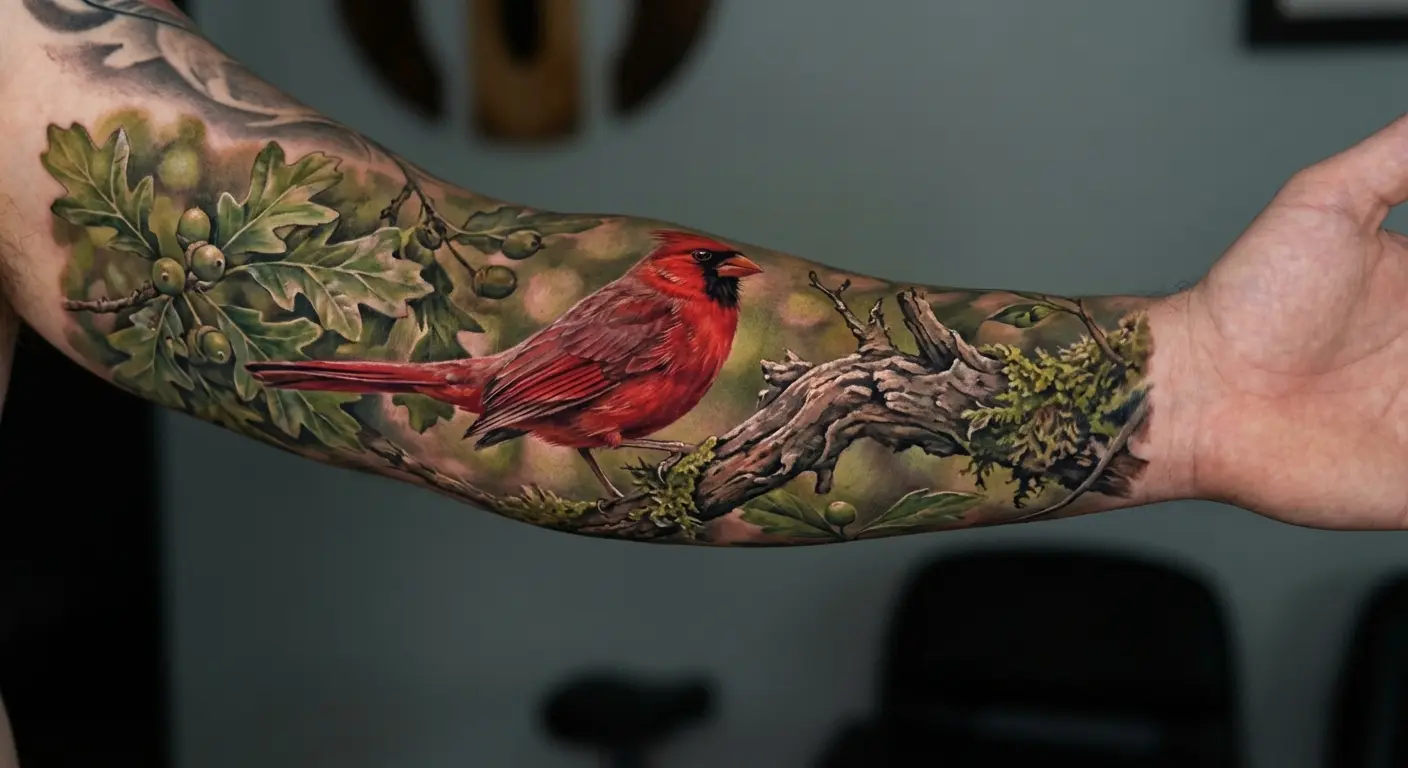
A sleeve that integrates a realistic cardinal (or multiple cardinals) with environmental elements creates a cohesive scene rather than a collection of separate images.
The cardinal becomes part of a larger narrative about habitat, season, or natural cycles. For a full sleeve, you might show a male cardinal on the upper arm with a female cardinal lower down, connected by branch work that flows around your arm and uses the negative space intentionally.
For those considering full sleeve integration, understanding Japanese sleeve tattoo composition principles can inform how environmental elements flow cohesively.
Your artist needs to plan how the design wraps around your arm, where the focal points land when your arm is in different positions, and how the composition works from multiple viewing angles.
Half-sleeve designs can focus on a single cardinal with enough environmental context to ground it. The integration is what makes this successful rather than just having a bird floating in empty space.
Sleeves are expensive and time-consuming. I’ve seen sleeves that took 30+ hours to complete properly because the artist refused to compromise on the detail level that makes realism convincing.
This becomes a commitment to the craft as much as to the symbolism. You’re investing in a piece that showcases both the cardinal’s meaning and the artist’s skill.
14. Cardinal Back Piece with Environmental Context
Your back offers the largest uninterrupted canvas on your body, which makes it ideal for realistic cardinal designs that include significant environmental storytelling.
A cardinal (or pair of cardinals) positioned within a realistic winter scene, autumn forest, or spring garden gives you room to build atmosphere and mood that smaller placements can’t accommodate.
The birds don’t need to dominate the entire composition. Sometimes a cardinal positioned in the upper third of your back with detailed environmental work below creates better visual balance than centering everything around the bird.
You’re building a complete scene where the cardinal is the emotional focal point but not necessarily the largest element.
Your artist should plan the composition so that key elements align with your spine and shoulder blades rather than fighting against your body’s natural structure.
Back pieces require you to commit without being able to watch the process or see the result easily in mirrors, which some people find challenging. This demands trust in your artist’s vision and execution.
I recommend doing a smaller piece with your chosen artist first to ensure their realistic style matches what you’re envisioning. The back will be with you forever, so that preliminary test run is worth the extra time.
15. Forearm Realism with Dimensional Depth
The forearm’s relatively flat surface and high visibility make it popular for realistic cardinal tattoos, but many designs fail because they don’t account for how your arm moves and rotates.
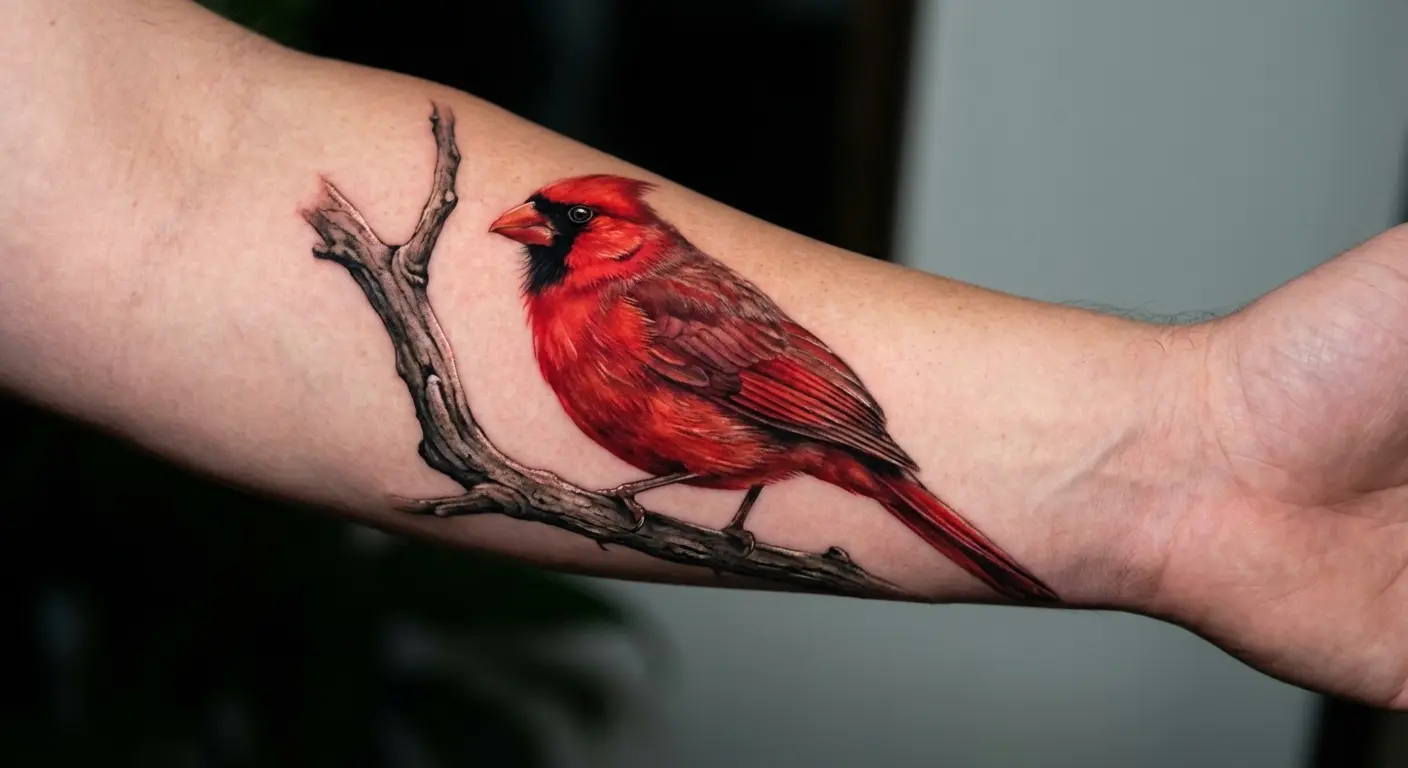
A realistic cardinal positioned on the outer forearm with environmental elements (a branch, some foliage) that wrap slightly toward the inner forearm creates dimensional depth that makes the bird feel present in space rather than pasted flat on your skin.
The shading underneath the bird, the way its feet grip the branch, the slight shadow cast by its body create the illusion of dimension.
Your artist should photograph your forearm from multiple angles and sketch the design accounting for how it appears when your arm is relaxed, when you’re flexing, when you’re rotating your wrist.
Forearm tattoos are constantly visible to you, which means they need to hold up under repeated viewing. Realistic work that cuts corners becomes more obvious over time as you notice inconsistencies in the shading or proportion.
This will be the piece you see most often throughout your day, so it needs to maintain its impact even after you’ve looked at it thousands of times.
Male cardinals on the forearm work particularly well because the bold red coloring creates strong contrast against most skin tones, making the dimensional shading more apparent and effective.
Red ink pops on pale skin. On darker skin tones, you’ll want your artist to use brighter, more saturated reds or the color will look muddy. This isn’t optional, it’s physics.
16. Female Cardinal in Natural Habitat Setting
Male cardinals get most of the attention because that bright red is visually striking.
But female cardinals offer something the males can’t: understated elegance and a color palette that creates interesting challenges for realistic tattooing.
The female’s olive-brown body with rust-red accents, her slightly more delicate build, and the way her coloring allows her to blend with natural environments make for sophisticated realistic pieces that don’t rely on shock value or bold color. The subtlety of female cardinal coloring shares aesthetic qualities with feather tattoo designs that emphasize natural tones and understated elegance.
A female cardinal in a natural habitat setting (foraging on the ground among fallen leaves, or perched in dense foliage) requires your artist to work with subtle color variations and achieve realism through form and shading rather than dramatic color contrast.
Thigh piece where you have space for environmental detail, or shoulder blade piece where the bird can nestle into the natural curve of your body.
What makes this valuable is that it represents an intentional choice to feature the less obvious option, which often carries its own meaning about recognizing beauty that doesn’t announce itself.
A 2020 example illustrates the personal connection people develop with cardinal tattoos: speech-language pathologist Liana Romano got a red cardinal tattoo to represent her love of birds and nature (NJ Monthly), choosing the cardinal specifically because “everyone can relate to it” and patients with Alzheimer’s disease respond positively to the recognizable imagery. This demonstrates how realistic cardinal tattoos can serve as conversation starters and memory triggers beyond their aesthetic value.
Female cardinal tattoos challenge the assumption that memorial or meaningful pieces need to be bold and immediately obvious. Sometimes the most powerful piece is the one that asks people to look more closely, to appreciate subtlety, to recognize that not everything meaningful needs to shout.
I’ve seen female cardinal tattoos become conversation pieces precisely because they’re unexpected. People anticipate seeing the bright red male, and encountering the female’s muted elegance instead creates a moment of recognition and appreciation that the male cardinal simply can’t replicate.
This demonstrates confidence in your choice and understanding of what cardinals represent beyond their most obvious visual characteristic. It speaks to a different aesthetic sensibility entirely.

Before you commit to any cardinal design, you’ll likely cycle through dozens of reference images, trying to articulate what you want to your artist, and wondering if the vision in your head will translate to your skin. Tattoo Generator IQ solves that communication gap by letting you generate multiple cardinal design variations instantly. You can experiment with paired cardinals versus single birds, test different poses and placements, and walk into your consultation with clear visual references that show your artist exactly what you’re after.
Final Thoughts
Cardinal tattoos carry weight that goes beyond their visual appeal.
The designs I’ve covered here prioritize the aspects that typical cardinal tattoo discussions overlook: the visual power of paired birds, the emotional accuracy of flight and motion in memorial pieces, the strategic choices required for small-scale work, and the technical demands of large-format realism.
What matters most isn’t choosing the “right” style or placement. It’s understanding why certain designs resonate with what you’re trying to express.
A cardinal tattoo that captures the balance between grief and joy, between remembering and continuing forward, will serve you better than one that defaults to obvious symbolism without considering how that symbolism functions visually on your specific body.
Your cardinal tattoo should feel uniquely yours, not interchangeable with anyone else’s. That specificity comes from making intentional choices about composition, detail level, color approach, and placement rather than accepting the first attractive cardinal image you find.
Take time with this decision. The cardinal isn’t going anywhere, and neither should you until the design feels completely right.
Find three artists who specialize in bird realism. Ask to see healed photos, not just fresh work. Pick the one whose portfolio makes you feel something.
Don’t rush this. I’ve covered up more bad cardinal tattoos than I care to count.
Whether you’re considering paired cardinals, a single bird in flight, a minimalist silhouette, or a full realistic sleeve, the sixteen approaches here give you frameworks for thinking beyond the standard options.
Your skin deserves more than a default choice. Your story deserves a cardinal tattoo that tells it properly.
