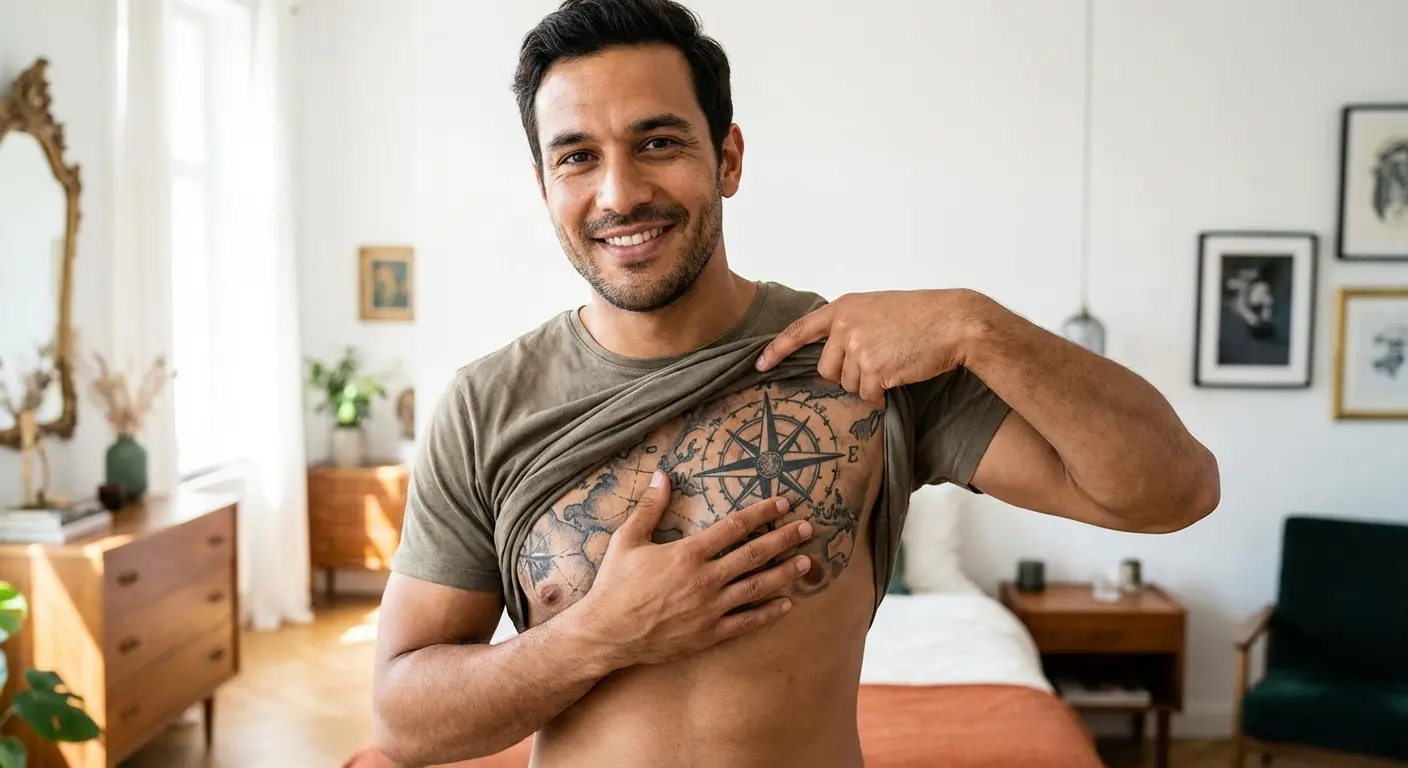
Chest Tattoo Cost: What Your Artist’s Quote Is Actually Hiding
Table of Contents
-
Why Chest Tattoo Pricing Doesn’t Follow the Rules You’ve Heard
-
The Real Cost Drivers Behind Chest Placement
-
How Your Pain Tolerance Secretly Affects Your Final Bill
-
Session Splitting: When One Tattoo Becomes Three Invoices
-
The Hidden Expenses Nobody Mentions During Consultation
-
Size Matters Less Than You Think (Here’s What Actually Does)
-
Artist Experience vs. Instagram Fame: Where Your Money Really Goes
-
Geographic Price Gaps That Make No Logical Sense
-
The Design Complexity Trap Most People Fall Into
-
Touch-Ups, Revisions, and the Long-Term Cost Reality
-
How to Actually Budget for a Chest Piece Without Getting Blindsided
TL;DR
Don’t have time for 4,000 words? Here’s what’ll cost you money:
-
Chest tattoos cost more because of TIME, not size. Multiple sessions mean multiple shop minimums plus weeks you can’t hit the gym between appointments.
-
Your body’s reaction to pain directly impacts cost. If you need breaks every 20 minutes, you’re paying for that extra time whether your artist mentioned it upfront or not.
-
Hidden costs include numbing cream, aftercare products, touch-up sessions, and the income you’ll lose taking time off work. All that stuff you can’t do while you’re healing adds up fast.
-
Design complexity affects price way more than square inches. A simple 8-inch design costs less than an intricate 5-inch piece that requires detail work.
-
You’re paying for an artist’s skill and reliability, not their follower count. High Instagram numbers don’t mean shit if they can’t execute consistently.
-
Geographic pricing reflects local economics, not talent. A $3,000 chest piece in Austin might cost $1,200 in Cleveland for identical quality.
-
Long-term costs matter more than initial quotes. Factor in touch-ups, sun damage repair, and aging ink when calculating what you’re really spending.
Why Chest Tattoo Pricing Doesn’t Follow the Rules You’ve Heard
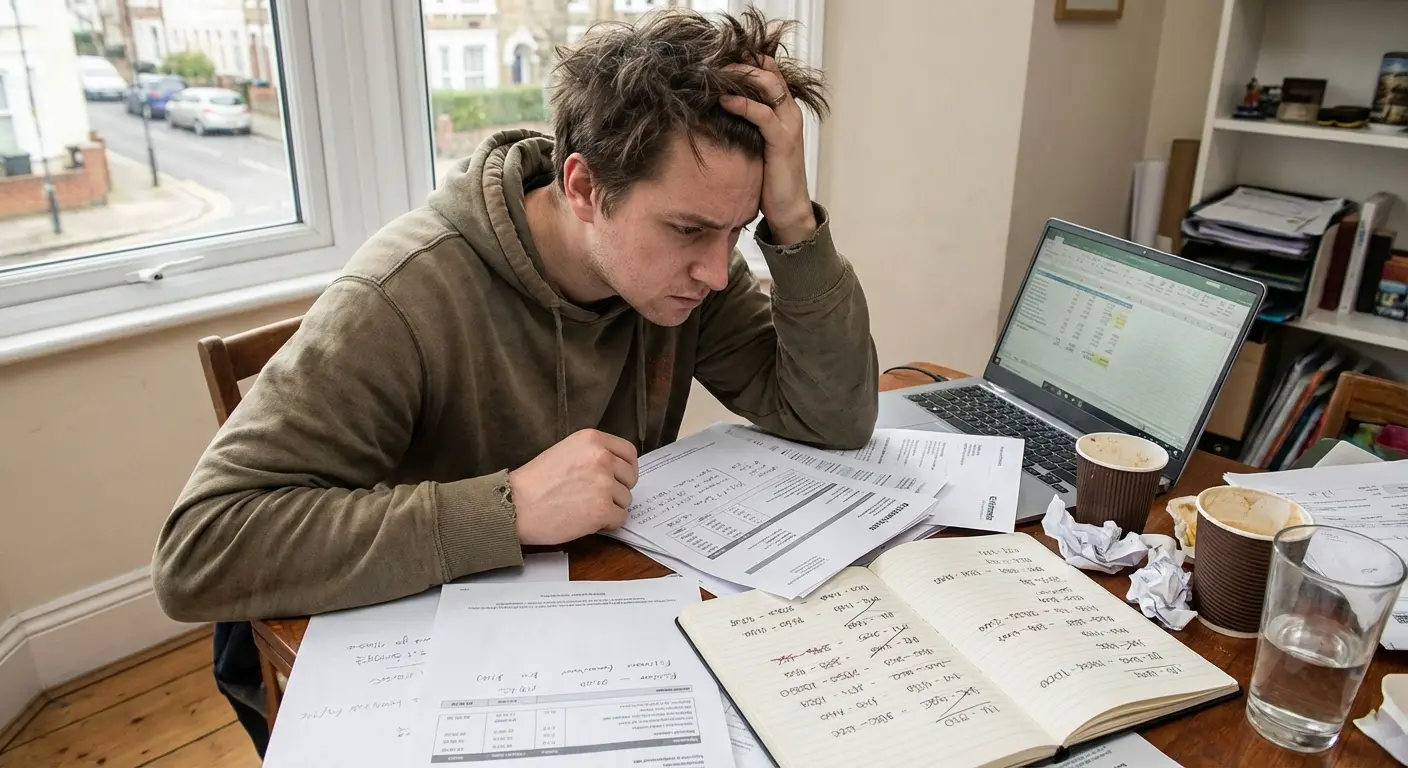
Your artist quotes you $2,000 for a chest piece. You budget $2,000. Then you’re somehow at $3,200 by the time you’re healed. What the hell happened?
You’ve probably seen those pricing charts floating around. Chest tattoos: $500 to $5,000 depending on size and detail. According to industry pricing data, a chest tattoo can cost from $500 to $2,000, depending on whether it’s a medium-sized tattoo covering part of the chest or a design that spans the entire chest. Yeah, that range is completely useless. Thanks for nothing.
Most pricing guides treat all tattoo locations the same, slapping on a simple hourly rate or size calculation. Understanding how much do tattoos cost requires looking beyond generic estimates, especially when it comes to chest placement. But chest tattoos are different.
The sternum hurts differently than the pectoral muscle. The collarbone area requires different needle techniques than the center chest. Your artist isn’t just tattooing a flat canvas. They’re working around curves, bones, and one of the most pain-sensitive areas of your body.
So here’s what actually happens: your artist quotes you based on how many hours they think they’ll need, but that estimate assumes you’ll sit still for the planned duration. Most people can’t. Chest tattoos require more breaks, more sessions, and more time managing client comfort than almost any other placement. It’s just how bodies work, and it’s gonna cost you more whether they tell you upfront or not.
Look, I’m going to break down the actual cost drivers that determine what you’ll pay. Some of these factors are within your control. Others aren’t, but knowing them helps you budget realistically instead of getting blindsided halfway through your piece.
The Real Cost Drivers Behind Chest Placement
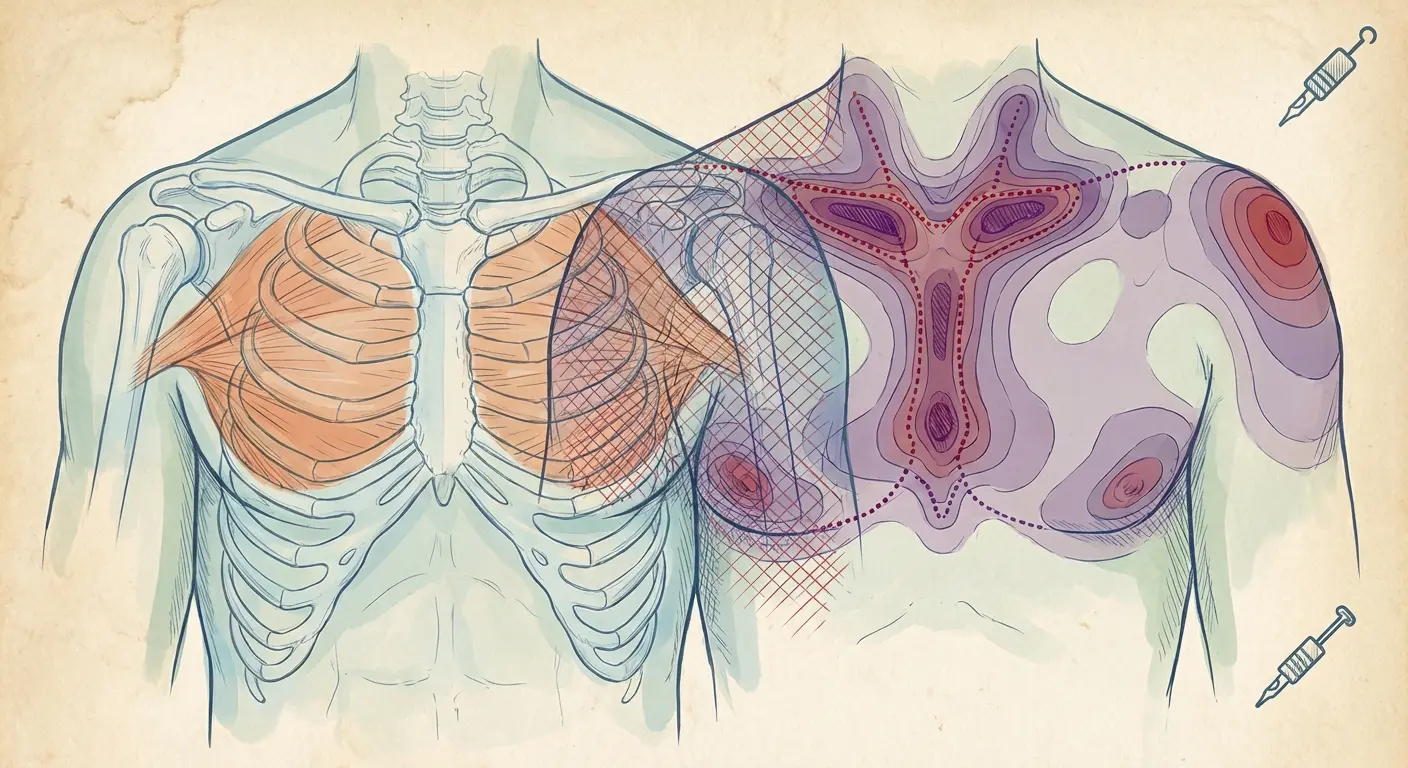
Chest skin behaves differently under a needle than arm or thigh skin. It’s thinner in some areas, stretched over bone in others, and moves with every breath you take. Your artist has to adjust their technique constantly, which slows everything down.
That technical difficulty translates directly to cost in two ways. First, artists with chest tattoo experience charge higher hourly rates because fewer artists have mastered the specialized techniques required. Second, the work simply takes longer than equivalent designs on flatter, more stable body areas.
Bone proximity creates immediate challenges. Tattooing directly over your sternum or collarbone requires lighter hand pressure and more frequent needle adjustments. This precision work takes longer than tattooing over muscle.
Breathing movement is constant. Your chest expands and contracts with every breath. Artists lose time waiting for the right moment to execute detail work, especially on line work and intricate shading.
Skin elasticity variations change across your chest. The skin around your nipples, along your collarbone, and over your sternum all have different tension and elasticity. Your artist can’t use the same needle depth or hand speed across your entire chest piece.
Pain management time adds significant duration to sessions. Managing client pain responses adds 20-40% more time to most chest sessions compared to less sensitive areas. Maybe more. I’ve seen it go longer.
|
Body Area |
Average Pain Level (1-10) |
Session Duration Tolerance |
Price Impact Factor |
|---|---|---|---|
|
Outer Bicep |
3-4 |
4-6 hours |
Baseline (1.0x) |
|
Thigh |
4-5 |
3-5 hours |
Low (1.1x) |
|
Chest (Pectoral) |
6-7 |
2-3 hours |
Moderate (1.3x) |
|
Chest (Sternum) |
8-9 |
1-2 hours |
High (1.5-1.7x) |
|
Ribs/Collarbone |
9-10 |
1-2 hours |
Very High (1.6-1.8x) |
Your artist isn’t padding their estimate when they quote you 15 hours for a design that would take 10 hours on your back. They’re accounting for the reality of working on one of the most challenging canvases the human body offers.
How Your Pain Tolerance Secretly Affects Your Final Bill
No artist will tell you during consultation that your pain tolerance is a pricing factor. It feels too personal, too judgmental. But here’s the reality: if you need to stop every 20 minutes, your artist is still charging for that time, and your tattoo will require more sessions to complete.
Most artists charge either hourly or by the piece. Hourly rates include break time. Piece rates assume a certain number of sessions based on average client endurance. When you exceed that average, you’re booking additional sessions, and each session comes with a shop minimum, usually $100-200 even if they only work 30 minutes.
You might book a chest piece quoted at 10 hours over two five-hour sessions. If you can only handle two-hour sessions because of pain, that same tattoo now requires five appointments instead of two. You’re paying the same hourly rate, but you’re also paying for five separate setup fees, five healing periods (during which you can’t work out or do certain jobs), and potentially five separate deposits or shop minimums depending on how your artist structures their pricing.
I know a guy who got quoted $2,400 for a chest piece. Twelve hours, three sessions, seemed straightforward. Except he couldn’t handle more than 90 minutes at a time because his sternum is apparently made of exposed nerve endings. What was supposed to be three 4-hour sessions turned into eight sessions over five months. Final cost? $3,600. He’s still bitter about it.
Some artists offer numbing cream, but it’s not free. Quality topical anesthetics run $40-80 per session, and they don’t eliminate pain completely. They might extend your tolerance from two hours to three, which helps, but you’re still adding that product cost to every session.
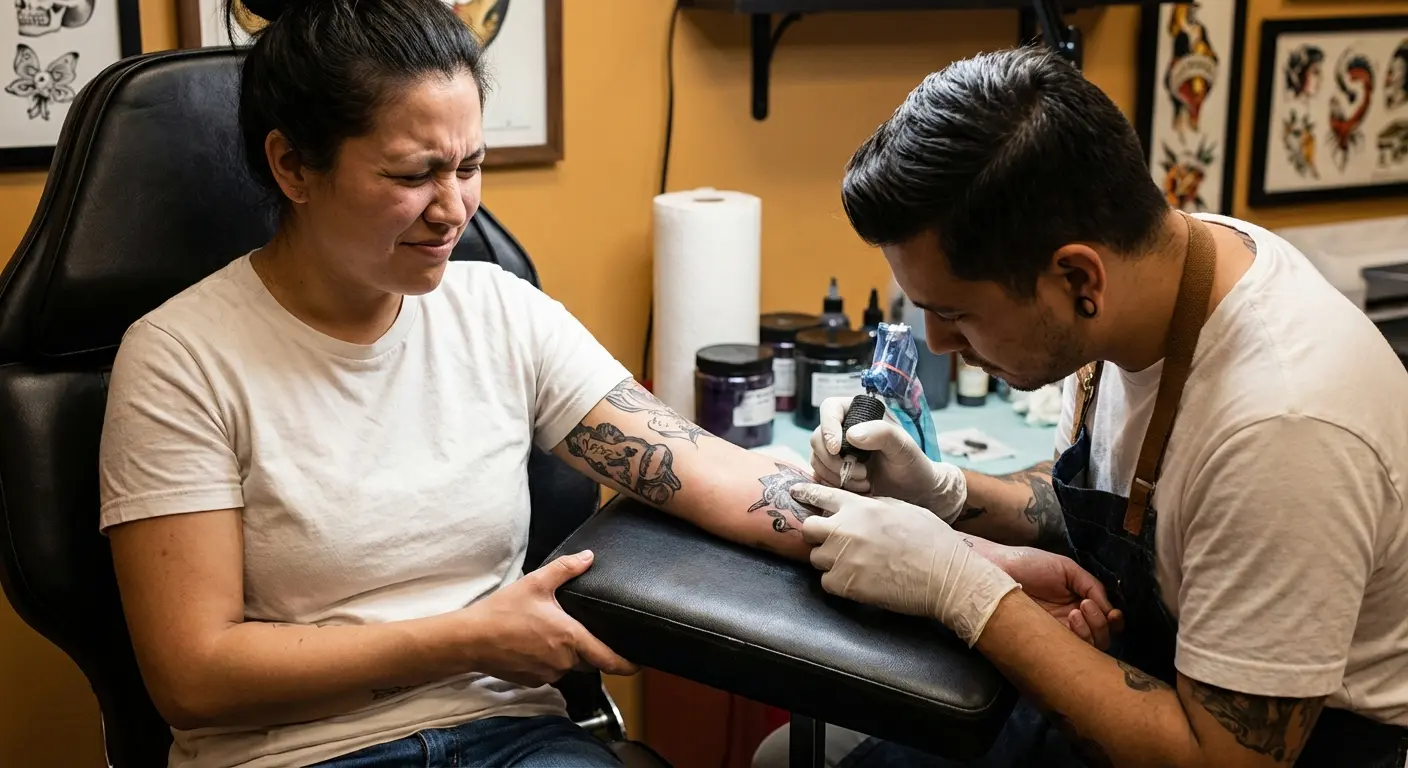
The financial impact compounds. Each additional session means more aftercare supplies, more days you need to avoid certain activities, and more time away from work if your job involves physical labor or uniforms that would irritate fresh ink.
I’m not suggesting you should just “tough it out.” Your comfort and the quality of the finished piece matter more than saving a few hundred dollars. But budget for the reality of your pain tolerance, not the ideal scenario where you sit perfectly still for five hours straight.
Session Splitting: When One Tattoo Becomes Three Invoices
Most chest pieces worth getting require multiple sessions. You can’t complete a detailed, well-saturated chest tattoo in one sitting, regardless of your pain tolerance. The skin can only handle so much trauma before it stops accepting ink properly.
Artists structure multi-session pieces in one of three ways. Some charge a deposit upfront (usually $200-500) and then hourly rates for each session. Others quote a total price and divide it across the planned sessions. A third approach involves charging per session with a rough estimate of total sessions needed.
The deposit-plus-hourly model gives you the most flexibility but the least cost certainty. If your tattoo takes longer than estimated, you keep paying hourly until it’s done. You’re not locked into a total price, which protects the artist but leaves your final cost open-ended.
Fixed-price-divided models give you cost certainty but less flexibility. You know your total spend upfront, but if you need to pause the project or can’t make a scheduled session, you might lose deposits or face rescheduling fees.
Per-session pricing feels most manageable in the moment (you’re only thinking about the next payment, not the total), but it often results in the highest total cost because there’s no incentive for the artist to minimize session count.
Before committing to an artist, ask these questions:
-
What’s the non-refundable deposit, and what does it cover?
-
Are you charging hourly, by the piece, or per session?
-
If hourly, does the rate include break time and setup?
-
How many sessions do you estimate for my design?
-
What happens if a session runs longer than estimated?
-
What’s your cancellation policy? (Some artists are dicks about this)
-
Do you require payment at the end of each session or invoice later?
-
Are touch-ups within the first year included?
-
What happens if I need to pause the project for financial or personal reasons?
You’ll also need to factor in healing time between sessions. Most artists require 2-4 weeks between chest tattoo sessions to allow proper healing. That’s 2-4 weeks where you’re not making progress but you’re still committed to the project, and you can’t book other work in that area with a different artist (doing so would be both disrespectful and potentially damaging to your piece).
The scheduling reality means your chest piece might span 3-6 months from first session to completion. Your financial situation could change during that time. Budget for the entire project before you start, not just the first session.
The Hidden Expenses Nobody Mentions During Consultation
Your artist quotes you $2,000 for your chest piece. You budget $2,000. Then you start adding up everything else, and you’re spending $2,600-3,000 by the time you’re healed and finished. According to tattoo industry pricing standards, artists typically charge around $100 an hour at least, with experienced artists able to charge more, but that hourly rate rarely accounts for the full spectrum of costs you’ll encounter.
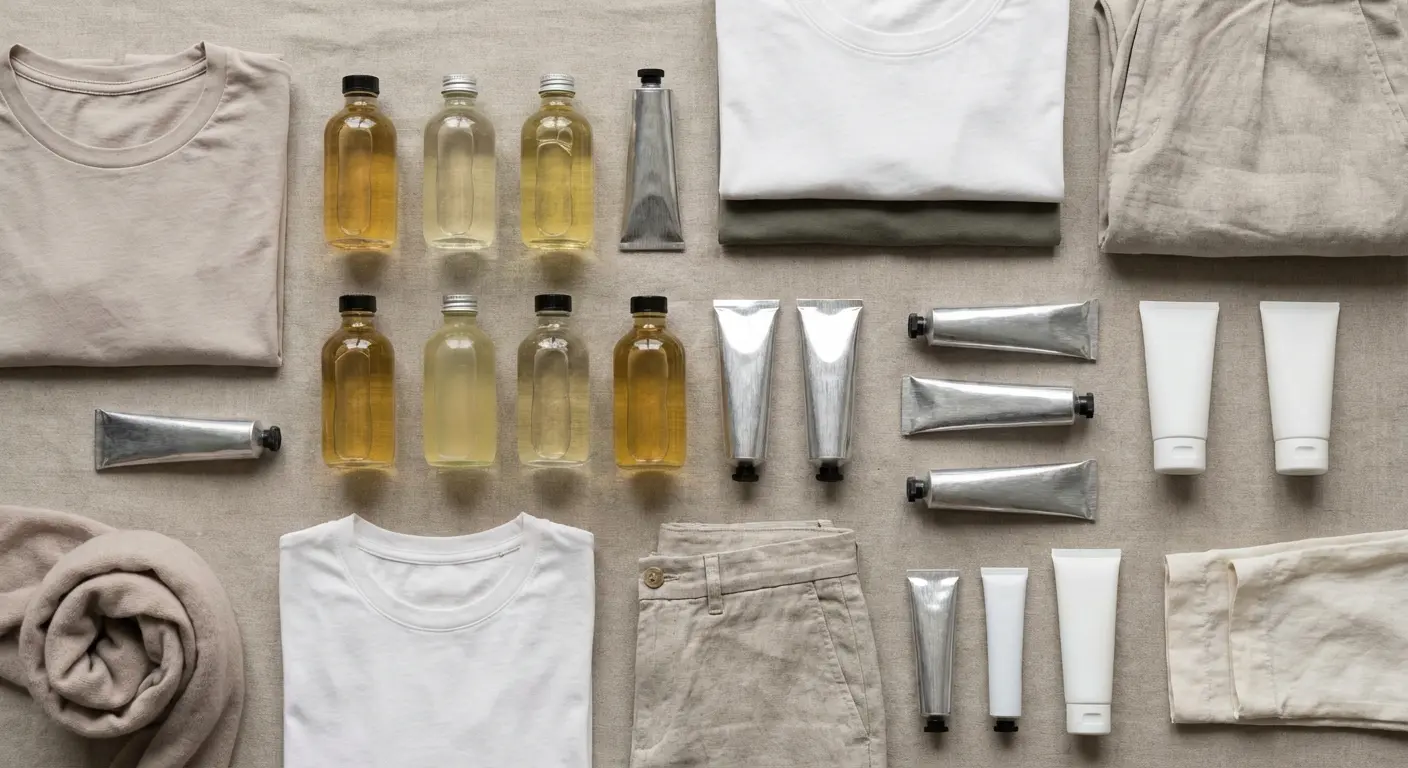
Aftercare products aren’t included in your tattoo price. You’ll need specialized soap, healing ointment, and eventually sunscreen for the rest of your life if you want your chest piece to stay vibrant. Budget $50-80 for the initial healing period and another $30-50 annually for ongoing sun protection. Understanding proper tattoo aftercare is crucial since those specialized products represent ongoing costs beyond your artist’s quoted rate.
Clothing becomes a consideration. Your chest piece will need to stay covered and protected during healing, but it also can’t be rubbed by tight fabrics. You might need to buy looser shirts, button-ups instead of pullovers, or specific fabrics that won’t irritate fresh ink. For most people, this means $50-150 in temporary wardrobe adjustments.
Work time matters more than people calculate. Each session requires recovery. If you do physical labor, work in a sterile environment, or wear uniforms, you might need to take days off after each session. Those lost wages or used PTO days are real costs of getting your tattoo.
This happened to someone I know. She’s a server, and she didn’t think about how her uniform’s fitted polo would rub against fresh ink. She took two unpaid days off after each of her four sessions and worked reduced shifts (losing tip income) for three additional days while her chest healed enough to tolerate the uniform. Across four sessions, she lost around $1,400 in wages and tips. Maybe more. She stopped telling me about it because I kept saying “I told you so.”
Touch-up sessions are standard for chest pieces but rarely included in initial quotes. The chest area experiences more friction from clothing and movement than areas on your back or legs. Plan for at least one touch-up session within the first year, usually $150-300 depending on what needs adjustment.
Gym memberships you can’t use for 2-4 weeks after each session. Pool or beach plans you’ll need to cancel during healing. All that stuff you can’t do while you’re healing adds up, especially for multi-session pieces.
Size Matters Less Than You Think (Here’s What Actually Does)
You’re comparing quotes. One artist charges $1,800 for a 6-inch chest piece. Another charges $1,500 for an 8-inch design. The second seems better until you realize the first design includes intricate mandala details and the second is bold traditional imagery with minimal shading.
Size determines cost only when complexity stays constant. A larger simple design costs more than a smaller simple one. But a smaller complex design almost always costs more than a larger simple one.
Color work requires multiple passes with different inks. Your artist needs to build up saturation gradually, especially on chest skin that doesn’t hold color as reliably as other areas. A full-color chest piece might require way more time than a black-and-grey version of the same design.
Fine line work and intricate details demand intense concentration and specialized needles. Your artist works slower on detailed sections because precision matters more than speed. A small geometric design with dozens of precise lines and perfect symmetry takes longer than a large design with bold, flowing shapes. If you’re considering a fine line tattoo design, remember that delicate precision work costs more per square inch than bold traditional styles despite the smaller size.
Realistic portraits or photorealistic elements require advanced shading techniques and constant reference checking. These designs can take at least twice as long per square inch than stylized or traditional designs. Sometimes more.
Custom illustration complexity also affects price. If you’re asking your artist to create an original design that blends multiple elements, incorporates specific symbolism, and requires revision rounds, you’re paying for design time before any tattooing begins. Some artists include basic design work in their tattoo price. Others charge separately for complex custom designs ($100-500 depending on intricacy).
|
Design Type |
Size |
Estimated Hours |
Typical Cost Range |
Primary Cost Driver |
|---|---|---|---|---|
|
Simple Bold Traditional |
8 inches |
6-8 hours |
$900-$1,600 |
Size and color saturation |
|
Geometric Mandala (Fine Line) |
5 inches |
8-12 hours |
$1,200-$2,400 |
Precision and symmetry |
|
Black & Grey Portrait |
6 inches |
10-15 hours |
$1,500-$3,000 |
Shading complexity and realism |
|
Full Color Japanese Traditional |
10 inches |
15-20 hours |
$2,250-$4,000 |
Color layers and detail density |
|
Minimalist Line Work |
4 inches |
3-5 hours |
$450-$1,000 |
Artist expertise in style |
The practical takeaway: don’t choose your design based solely on size to save money. A smaller, well-executed design that you love costs less than a larger mediocre piece you’ll want to cover up later. Focus on what you want, then find an artist whose style matches your vision and whose pricing fits your budget.
Artist Experience vs. Instagram Fame: Where Your Money Really Goes
An artist with 150K Instagram followers charges $250/hour. Another artist with 8K followers charges $120/hour. Both have 10+ years of experience and similar portfolios. What are you paying extra for? According to industry pricing data, experienced artists with 5+ years typically charge $150-$300 per hour, while pro or famous artists command $300-$500 per hour, but that fame doesn’t always correlate with superior technical execution.
Sometimes you’re paying for genuine mastery. The artist has developed techniques, built a reputation through consistent quality, and can command higher rates because their work is demonstrably superior. Their Instagram following grew because they’re exceptional.
Other times? You’re paying for marketing success. The artist got featured by tattoo influencers, paid for promotion, or happened to go viral. Their following grew faster than their skill development, and they raised rates to match their perceived market value rather than their ability.
How to tell the difference:
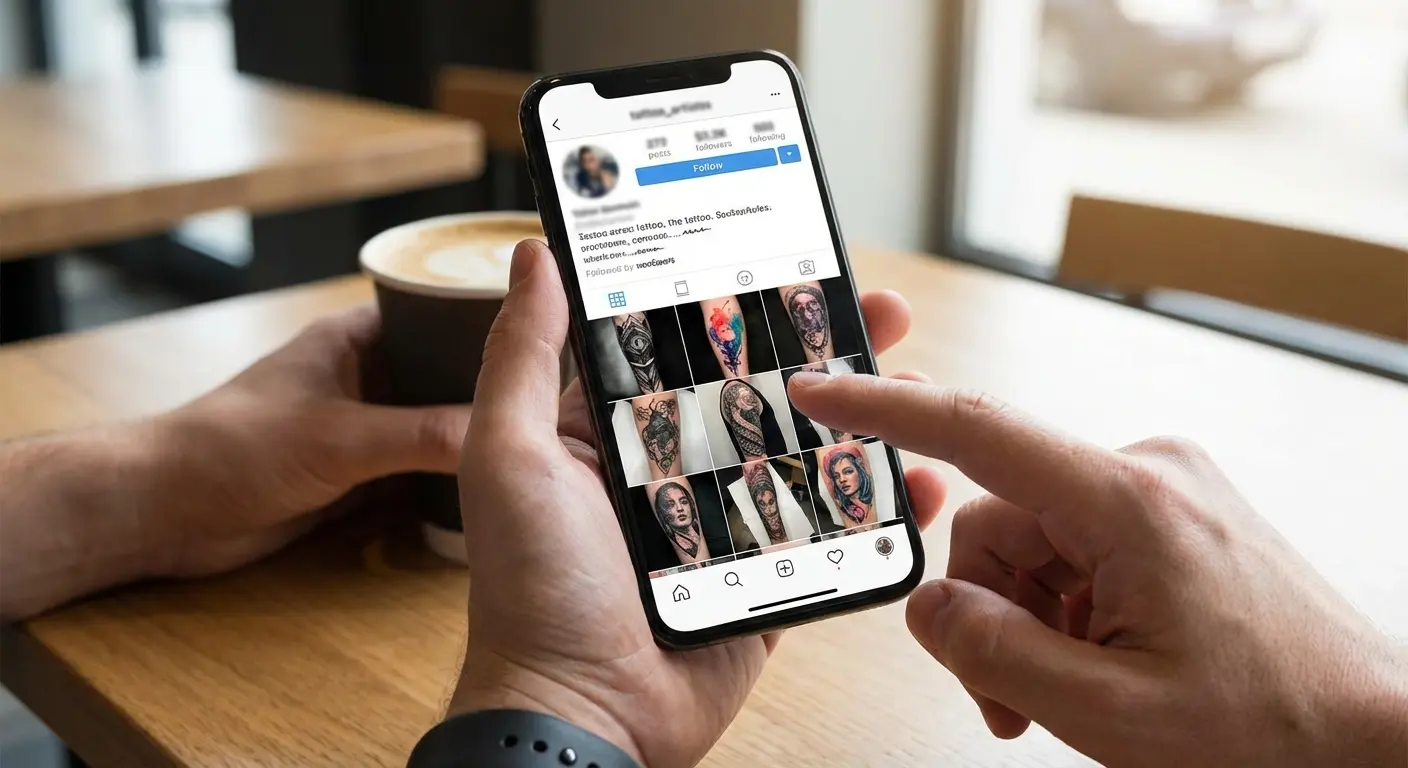
Look at consistency across their portfolio, not just their best pieces. Every artist posts their greatest hits on Instagram. Scroll back through years of work. Does the quality stay consistent, or do you see significant variation in execution? Consistent quality across hundreds of pieces indicates genuine skill. Sporadic excellence surrounded by mediocre work suggests you might be paying for their best day, not their average performance.
Check their chest tattoo portfolio specifically. An artist might be incredible at arm sleeves but inexperienced with chest placement. You want to see multiple healed chest pieces in their portfolio, not just fresh tattoos that look great before the client’s body has tested the ink placement and saturation.
Read reviews that mention the process, not just the result. “Beautiful tattoo” tells you nothing. “Artist took extra time to ensure my comfort and explained exactly what they were doing” tells you they’re professional and client-focused. Those qualities matter more than follower count when you’re sitting through multiple painful sessions.
Consider their booking timeline. Artists who are genuinely in high demand because of skill book 6-12 months out. Artists who are Instagram-famous but less skilled might have shorter wait times because clients don’t return for additional work or refer friends as enthusiastically.
Two artists in the same city both specialize in black-and-grey realism. Artist A has 180K followers and charges $350/hour with a 4-month wait. Artist B has 15K followers and charges $180/hour with an 8-month wait. After consulting with both, you discover Artist B has a waiting list because 60% of their bookings are repeat clients or referrals, while Artist A’s bookings come primarily from Instagram discovery. Artist B’s lower follower count reflects less time spent on social media marketing, not inferior skill. And their longer wait time despite lower prices signals that clients value their work enough to wait and return.
You’re not wrong to choose a more expensive artist with a strong social media presence. Sometimes they deserve every dollar they charge. Just make sure you’re paying for the skills you need (chest tattoo expertise, pain management, consistent quality) rather than the skills you don’t (great photos, viral content, influencer connections).
Geographic Price Gaps That Make No Logical Sense
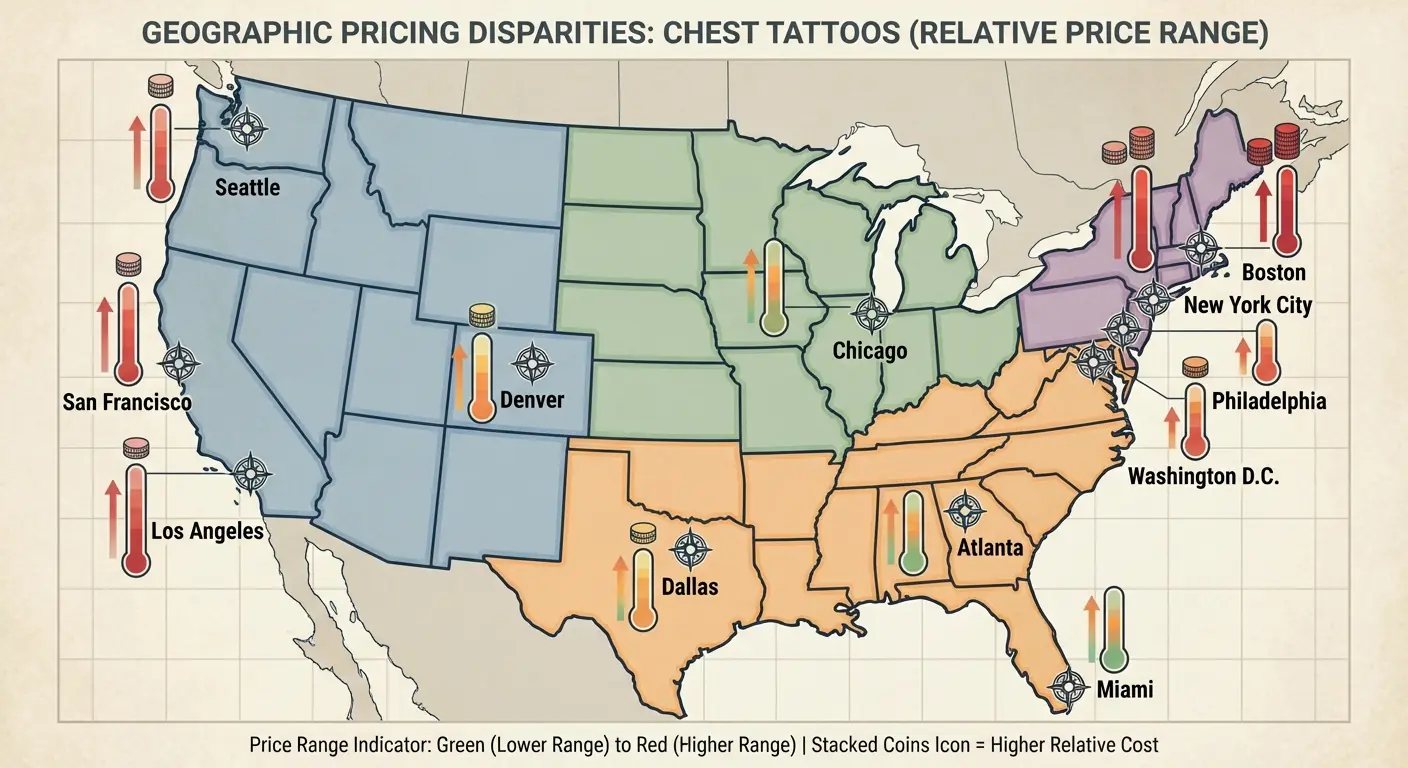
The same chest piece costs $4,500 in San Francisco, $2,200 in Denver, and $1,400 in Louisville. The artists have similar experience levels, comparable portfolios, and equivalent reputations in their local markets. The price difference reflects cost of living and local market expectations, not skill gaps.
High-cost cities inflate tattoo prices because artists face higher rent, licensing fees, and general business expenses. They pass those costs to clients. You’re not getting a better tattoo in Brooklyn than you’d get in Pittsburgh. You’re subsidizing more expensive real estate.
The travel calculation works for some people:
If you live in a premium-priced market and you’re looking at a $5,000 chest piece locally, you could potentially fly to a mid-tier city, pay $2,500 for the same quality work, spend $800 on flights and hotels across multiple sessions, and still save $1,700. The math works especially well for multi-session pieces where you’re spreading travel costs across the entire project.
The risks involve follow-up care. If something goes wrong during healing or you need touch-ups, you can’t easily pop back into your artist’s shop. You’re managing aftercare remotely, relying on photos and video calls instead of in-person assessment. For some people, that’s fine. For others, the peace of mind of having their artist nearby is worth the premium price. If you need your artist nearby for peace of mind, pay the premium. It’s worth it.
Look for artists in mid-size cities within a few hours of major metros. These artists often trained in or worked in expensive markets before relocating for better quality of life. They bring big-city skills with smaller-market pricing. You get the expertise without the geographic markup.
Don’t assume international artists offer better deals. Popular tattoo destinations like Seoul, London, or Melbourne charge rates comparable to or higher than US cities once you factor in currency exchange, travel, and the complexity of coordinating multi-session work across international trips.
(Look, I made you a worksheet because I’m neurotic about this stuff. Use it if you’re considering traveling for your tattoo.)
Local Option:
-
Artist quote: $______
-
Estimated sessions: ______
-
Total tattoo cost: $______
-
Travel cost: $0
-
Lost work time value: $______
-
Total local cost: $______
Travel Option:
-
Artist quote: $______
-
Estimated sessions: ______
-
Total tattoo cost: $______
-
Round-trip flights (× sessions): $______
-
Hotel nights (× sessions): $______
-
Meals and ground transport: $______
-
Lost work time value (including travel days): $______
-
Total travel cost: $______
Convenience Factors:
-
Can you easily return for touch-ups? (Yes/No)
-
Does the artist have experience with remote aftercare guidance? (Yes/No)
-
Are you comfortable managing healing without in-person check-ins? (Yes/No)
-
Do you have flexibility for multiple trips over 3-6 months? (Yes/No)
If total travel cost saves you 25%+ AND you answered “Yes” to at least 3 convenience factors, traveling may be worth considering.
The smartest financial move: identify the skill level you need, then find artists at that level in the most affordable market you can reasonably access. Sometimes that’s your hometown. Sometimes it’s worth a road trip.
The Design Complexity Trap Most People Fall Into
You’ve been collecting reference images for months. You want elements from six different designs combined into one chest piece, with photorealistic details, intricate patterns, and maybe some script work too. Your artist quotes you $6,000 and 20+ hours of work.
Complexity for its own sake drives up costs without always improving the tattoo. More elements mean more time, but they don’t automatically mean a better-looking piece. Sometimes they mean a cluttered design that doesn’t read well from a distance or that loses impact as the elements compete for attention.
Where complexity adds value:
Intentional layering that creates depth. When foreground and background elements interact purposefully, complexity enhances the design. You’re paying for artistic composition, not just technical execution.
Custom integration of meaningful symbols. If each complex element carries personal significance and the artist weaves them together coherently, the extra cost reflects genuine customization rather than generic decoration.
Style-appropriate detail. Some styles (Japanese traditional, realism, biomechanical) demand complexity to execute properly. You can’t do a simplified version without losing what makes the style work. While researching styles, exploring Japanese traditional tattoo designs can help you understand how certain styles inherently require more complexity and therefore higher costs.
Where complexity becomes a trap:
Trying to include everything you like in one piece. Your chest has limited real estate. Cramming too many ideas into one area creates visual chaos. You’ll spend more money and end up with a less effective tattoo than if you’d chosen a focused concept.
Adding complexity to justify a larger budget. Some people feel they should spend more to get something impressive. They add unnecessary elements to reach a price point that feels appropriate for a chest piece. The result: paying for filler that doesn’t enhance the core design.
Choosing photorealism when you prefer stylized work. Photorealistic portraits and scenes cost significantly more than stylized versions, but they’re not inherently better. They’re different. If you don’t have a specific reason to want photorealism, you might be overpaying for a style choice that doesn’t match your preferences.
Before committing to a complex design, ask yourself: does each element serve the overall composition? Could you remove anything without losing impact? The best chest pieces often have clear focal points and intentional negative space, not wall-to-wall detail. You might save $1,500-3,000 by simplifying your concept without sacrificing any of what makes it meaningful to you.
Touch-Ups, Revisions, and the Long-Term Cost Reality
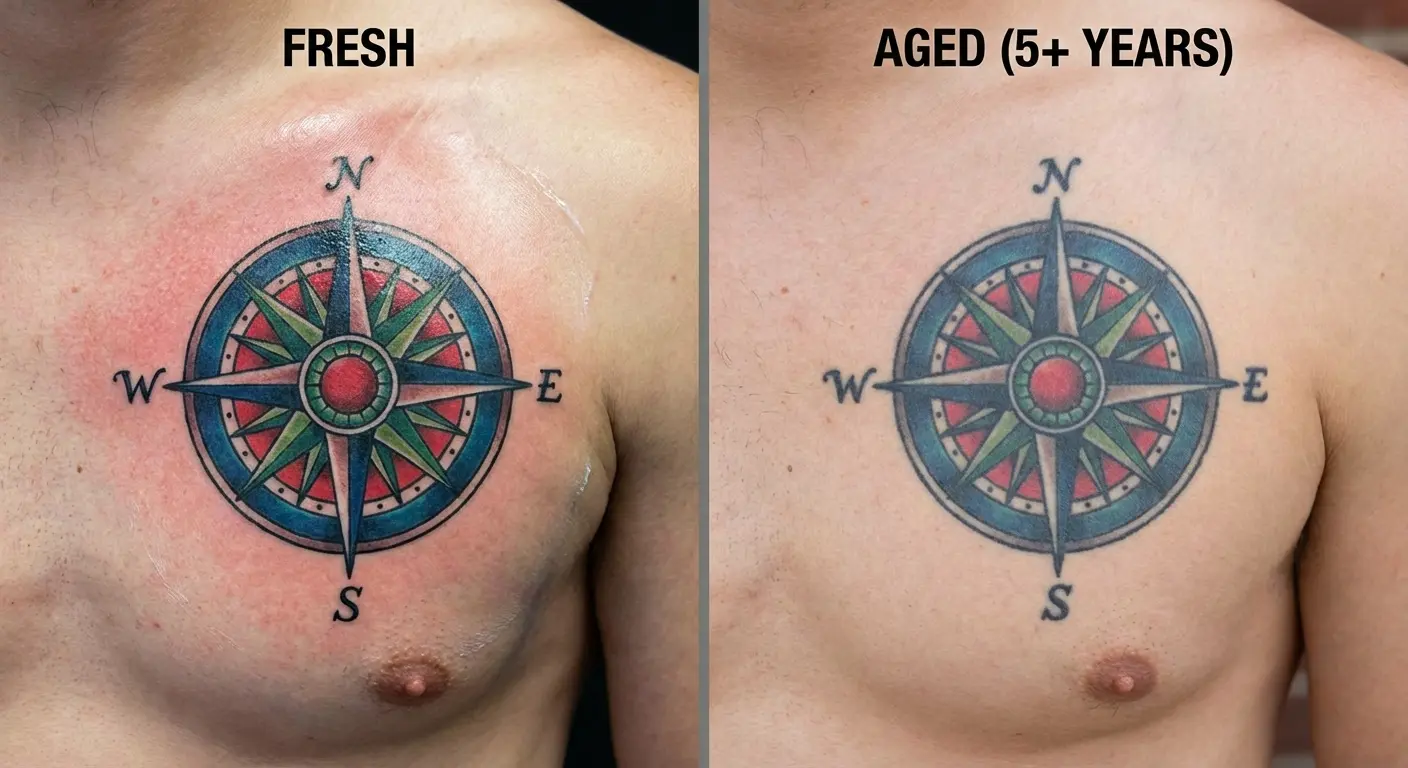
Your chest piece looks perfect when it’s fresh. Five years later, some lines have blurred, colors have faded in high-friction areas, and you’re wondering if you need work done. You probably do, and it’s going to cost you.
Chest tattoos require more maintenance than most other placements because of constant clothing friction, sun exposure (for people who go shirtless), and the stretching that occurs with weight fluctuations or muscle development. That maintenance has a price tag.
Most artists offer one free touch-up session within the first year if you followed aftercare instructions properly. After that, you’re paying for any revisions or refreshing work. Rates for touch-ups run 50-75% of the artist’s current hourly rate (which might be higher than when you got your original work if several years have passed).
Color work fades faster than black ink, especially reds and lighter colors. If you got a full-color chest piece, budget for color refreshing every 5-7 years if you want it to maintain its original vibrancy. Expect to pay $300-800 per touch-up session depending on how much area needs attention.
Line work holds up better but isn’t permanent. Bold lines stay crisp longer than fine lines. If you chose delicate line work for aesthetic reasons, you’re committing to more frequent touch-ups to maintain that delicate appearance. Fine lines might need attention every 3-5 years.
Factors that accelerate aging:
Sun exposure destroys tattoo ink faster than anything else. If you’re frequently shirtless outdoors (beach, pool, outdoor sports), your chest piece will fade significantly faster than someone who keeps it covered. The cost difference over 20 years could be $2,000+ in additional touch-up sessions.
Weight fluctuations stretch and compress your skin, distorting tattoo designs. Significant weight gain or loss (30+ pounds) can warp the composition of your chest piece. Fixing distortion is more expensive than standard touch-ups because it might require redesigning elements, not just re-inking faded areas.
Aging skin loses elasticity and changes texture. Your chest tattoo will look different at 50 than it did at 25, regardless of how well you maintain it. Some people choose to get refreshing work done every decade to adapt the design to their changing skin. Others embrace the aged appearance. Budget-wise, plan for at least $500-1,000 per decade in maintenance if you want your piece to stay sharp.
The lifetime cost of a $3,000 chest piece might be $5,000-7,000 when you factor in 30-40 years of touch-ups and maintenance. That’s not a reason to avoid getting the tattoo. It’s just information you should have when making the decision and planning your budget. You’re not buying a one-time product. You’re investing in something that requires ongoing care.
How to Actually Budget for a Chest Piece Without Getting Blindsided
You want a chest piece, but you don’t want to be that person who starts a project and can’t afford to finish it. Here’s how to build a budget that actually works.
Start with the artist’s quote and multiply by 1.4:
Your artist quotes you $2,500 for your chest piece. Your budget should be $3,500. That multiplier accounts for the hidden costs we’ve covered (aftercare, clothing, lost work time, potential additional sessions if you need more breaks than estimated, and first-year touch-ups). This buffer prevents financial stress mid-project.
Add session-specific costs separately:
For each planned session, budget an additional $100-150 beyond the tattoo cost itself. This covers numbing cream if you want it, premium aftercare products, and the meals or snacks you’ll need before and after. You should never get tattooed on an empty stomach, and you’ll need protein and hydration immediately after.
Calculate lost income realistically:
If you’ll need to take time off work, multiply the number of sessions by the days you’ll need off, then multiply by your daily wage. A four-session chest piece where you need one recovery day per session equals four days of lost income. For someone earning $200/day, that’s $800 that needs to be in your budget. Before committing to your design, exploring tattoo ideas for men with meaning can help you find concepts that resonate personally while keeping budget considerations in mind.
Plan for the full timeline, not just the first session:
If your chest piece will take six months to complete across multiple sessions, make sure your budget accounts for your financial situation staying stable for that entire period. Don’t start a project in January if you know you have major expenses coming in March. You’ll end up with an unfinished tattoo and a frustrated artist.
Build a dedicated tattoo fund:
Open a separate savings account or envelope and contribute regularly until you have 150% of the quoted price saved. The extra 50% handles unexpected costs (additional sessions, premium touch-ups, or complications during healing that require professional attention). You can always use leftover funds for your next tattoo if you don’t need the full buffer.
Consider payment plans carefully:
Some shops offer payment plans or accept credit cards. These options help with cash flow, but they also mean you’re paying interest on your tattoo if you can’t pay off the balance immediately. A $3,000 chest piece financed at 18% APR over 12 months costs you $3,300. That might be worth it for you, but factor the true cost into your decision.
Get multiple quotes before committing:
Consult with at least three artists whose work you respect. Compare not just their tattoo prices but what’s included. Does the quote include design time? Touch-ups? How do they handle sessions that run over the estimated time? Understanding the complete tattoo pricing structure helps you make informed comparisons. When evaluating how much does a tattoo cost across different artists, remember that the lowest quote isn’t always the best value if it doesn’t include essential services like design consultation or first-year touch-ups.
You might realize after this budgeting exercise that you need to wait six more months to save properly. That’s better than starting unprepared and either going into debt or leaving your chest piece unfinished. Your tattoo will still be there when you’re financially ready for it.
Trying Before You Commit (And Why That Matters for Your Budget)
Here’s a cost factor most people don’t consider: design revision fees and the price of changing your mind mid-project.
You consult with an artist, describe your vision, and they create a custom design. You pay a deposit (often non-refundable) and schedule your first session. Then you see the stencil on your chest and realize it’s not quite what you wanted. Making changes at this point costs you time, money, and potentially your relationship with the artist if you request significant revisions.
The smarter approach involves getting crystal clear on your design before you ever walk into a shop. You need to see multiple variations, test different placements, and understand exactly what you want before you’re committed to an artist’s interpretation.
We built Tattoo Generator IQ specifically for this phase of the process. You can generate dozens of design variations in different styles, see how they’d look on your chest, and refine your concept until you’re completely certain. You’re not paying an artist $200-500 for custom design work and revisions. You’re exploring unlimited options until you find exactly what you want, then bringing that clear vision to your artist as a reference. Using a chest tattoo generator allows you to visualize placement and sizing options before committing financially to an artist’s custom design work.
This approach saves you money in two ways. First, you avoid paying for multiple design consultations with different artists while you figure out what you want. Second, you reduce the risk of expensive mid-project changes because you’ve already tested and refined your concept thoroughly. Your artist will appreciate working with a client who knows exactly what they want. You’ll appreciate not wasting money on design revisions or, worse, committing to a chest piece you’re not completely excited about. Try Tattoo Generator IQ before you book your first consultation. The clearer your vision, the more efficient (and affordable) your tattooing process becomes.
Final Thoughts
Look, chest pieces are expensive and they hurt. But if you want one, you want one.
The complexity of the placement, the physical demands on both you and your artist, and the long-term maintenance requirements all contribute to costs that extend beyond the hourly rate you see advertised. This isn’t because artists are overcharging or trying to surprise you with hidden fees. It’s just the reality of getting work done on one of the most challenging areas of the body.
When people ask “how much does a small tattoo cost” or wonder about a sleeve tattoo cost for comparison, the answer always depends on these same hidden factors, but chest placement amplifies every cost driver we’ve discussed. A small tattoo cost on your chest might exceed what you’d pay for a larger piece on your arm simply because of placement challenges. Similarly, while a sleeve tattoo cost might seem comparable to a full chest tattoo cost at first glance, the chest typically requires more sessions and involves higher pain management time, potentially making it more expensive per square inch.
Understanding these factors doesn’t make chest tattoos cheaper, but it does make the investment more predictable. You can plan for the actual costs instead of the ideal scenario. You can choose artists based on the skills that matter for your specific project rather than generic popularity metrics. You can make informed decisions about design complexity, session planning, and long-term maintenance.
The best chest pieces are worth every dollar and every minute of discomfort. They’re bold, visible when you want them to be, and they make a statement that few other placements can match. Just make sure you’re financially prepared for the complete journey, not just the first step.
Don’t be the person who runs out of money halfway through and ends up with half a lion on your chest for two years while you save up to finish it. We’ve all seen that guy. Don’t be that guy.