16 Cross Tattoo Ideas That Actually Honor What the Symbol Means to You

Walk into any tattoo shop and you’ll see the same cross designs on the wall. Generic. Meaningless. The kind of thing people get because they need to fill space on their arm or they’re having a religious moment they’ll regret in six months.
This isn’t that.
We’re talking about crosses that actually connect to something: your heritage, a person you lost, a moment that changed everything. Crosses that look different because they mean something different. Not just pretty. Not just symbolic. Both.
Cross tattoos represent faith and spirituality for many, while others appreciate their beauty as a design: a duality that’s made them one of the most recognizable symbols worldwide, with meanings ranging from aesthetic appreciation to profound spirituality, according to VEAN Tattoo studios. The difference between a generic cross and one that means something? Intentionality.
So here’s what we’re looking at: cultural variations that connect you to ancestral lines, personal symbolism that turns crosses into commemorative pieces, strategic placement that makes the design work harder visually, and artistic techniques that push crosses beyond simple religious iconography. Small cross tattoos work best when they’re intentionally minimal, not just scaled-down versions of larger designs. And crosses get way more interesting when you layer meaning through multiple elements instead of relying on the cross shape alone.
Crosses That Carry Cultural Weight
Let’s talk about the cross variations nobody knows about. And I mean nobody. Byzantine? Coptic? Russian Orthodox with three bars? Most tattoo shops have never even drawn these.
These aren’t aesthetic choices you make because they look cool (though they do). They’re direct connections to specific faith traditions and ancestral lines that give your tattoo historical weight.
You’re claiming a piece of religious art history that’s been refined over centuries. Each variation has distinct visual elements that separate it from the standard Latin cross, which means your tattoo immediately signals depth to anyone who recognizes the style. These cultural variations offer some seriously compelling tattoo ideas with meaning that go way beyond generic religious imagery.
Quick reference:
- Byzantine Cross: Flared ends, Greek letters (IC XC NIKA), ornamental details from the Eastern Roman Empire (330-1453 AD). Best for Greek, Russian, Eastern European heritage.
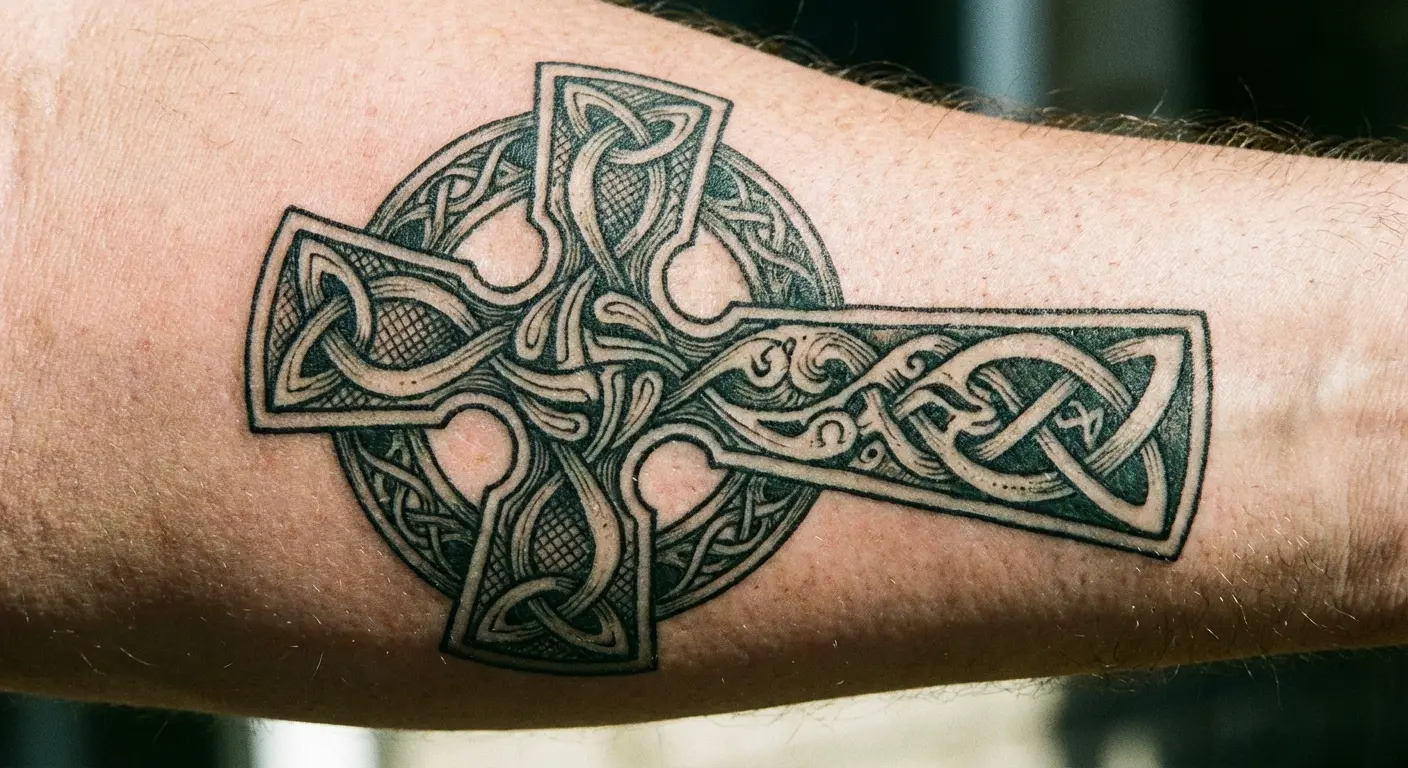
- Celtic Cross: Circle around intersection, interwoven knotwork patterns from Ireland/Scotland (5th century). Perfect for Irish/Scottish ancestry or eternal life symbolism.
- Russian Orthodox Three-Bar Cross: Three horizontal bars with slanted footrest from the Russian Orthodox Church (10th century). Great for theological narrative focus, choice/redemption themes.
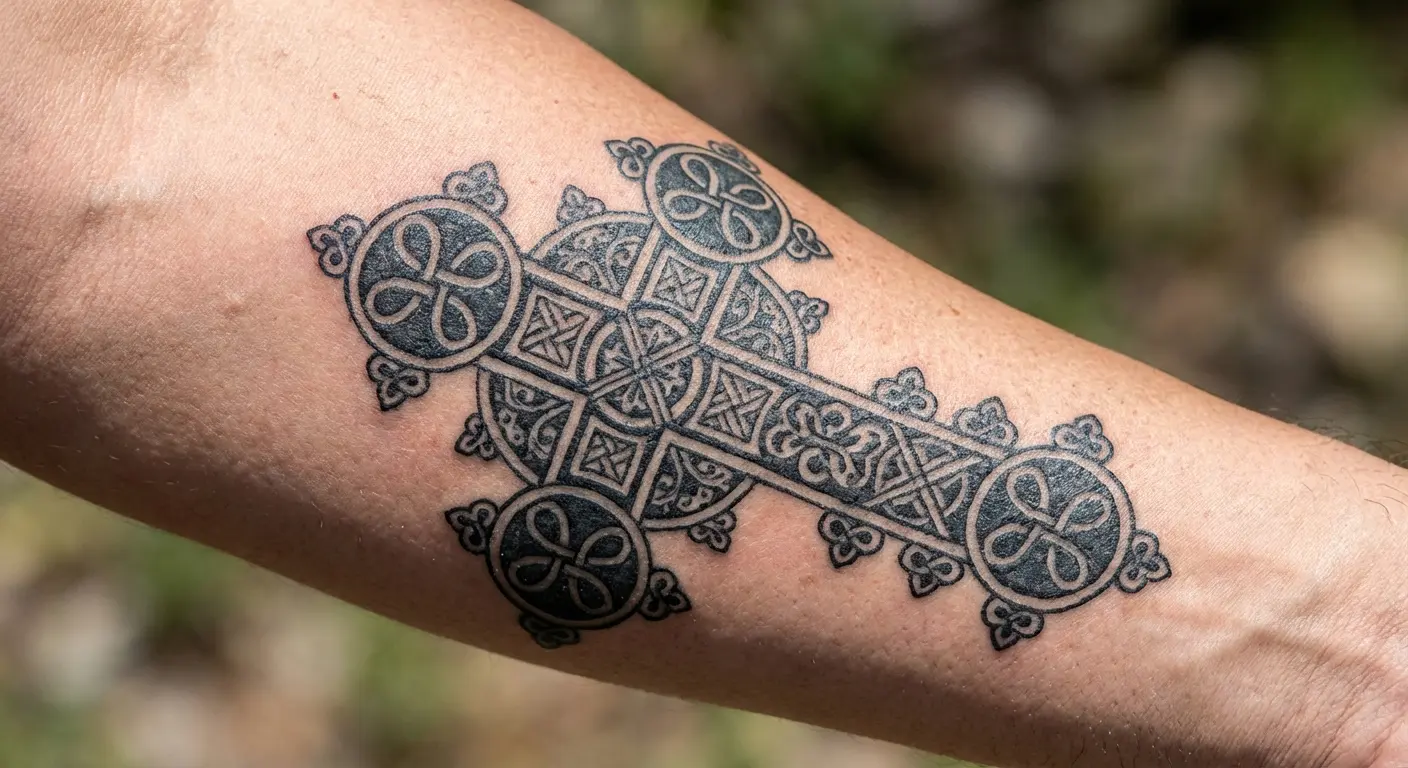
- Coptic Cross: Geometric patterns, interlocking circles and squares from Egyptian/Ethiopian Christianity (1st century). Ideal if you love mathematical precision and architectural aesthetics.
1. Byzantine Cross with Ancestral Roots
The Byzantine cross has flared ends and often includes Greek letters or ornamental details that trace back to the Eastern Roman Empire. This isn’t the cross you see in every American church. It’s the symbol that dominated Orthodox Christianity for over a millennium, and it still carries that imperial weight.
If you’ve got Greek, Russian, or Eastern European heritage, this cross connects you to that lineage in a way that feels earned rather than borrowed. The key is working with your tattoo artist to include authentic details – the IC XC NIKA inscription, for instance – instead of generic flourishes that water down the historical significance.
Size matters here. Byzantine crosses lose their impact when shrunk too small because the ornamental elements become illegible. These designs need room to breathe, which means committing to a placement with adequate real estate. Your forearm, upper back, or chest can handle the detail work that makes these crosses recognizable as Byzantine rather than just decorative.
2. Celtic Cross Reimagined Beyond the Knots
Everyone knows the Celtic cross has a ring around the intersection, but most designs get lazy with the knotwork and end up looking like clip art. The real power in this cross comes from understanding what those interwoven patterns represented: eternal life, interconnectedness, the fusion of pagan and Christian traditions.
Instead of defaulting to symmetrical knots, you can work with patterns that feel more organic and less like a coloring book page. Think about varying the line weight, letting some strands fade while others stay bold, or even breaking the circle to suggest movement rather than containment.
Cross tattoo ideas that challenge the expected version of a classic symbol always land harder than faithful reproductions. For those drawn to cultural symbolism, exploring Celtic tattoo traditions can deepen your understanding of these ancient patterns. The interwoven nature of Celtic cross designs also creates natural opportunities for adding personal elements – names woven into the knotwork, dates integrated into the circle, or birth flowers emerging from the patterns.
3. Russian Orthodox Three-Bar Cross
The slanted footrest on the bottom bar tells a whole theological story that most people miss. That angle represents the good thief and the bad thief crucified alongside Christ, with one side tilting toward heaven and the other toward hell.
It’s a small detail that completely changes the cross’s meaning from a simple religious symbol to a narrative about choice and redemption. This design works really well for people who want their faith visible but aren’t interested in explaining their tattoo to every curious stranger. Those who know will recognize it immediately. Those who don’t will just see an interesting cross variation.
The three-bar structure also creates natural visual balance that works across different body placements. The additional horizontal elements give your artist more options for positioning the design to follow your body’s natural lines. Whether you place it vertically along your spine or horizontally across your shoulder blade, the three bars create rhythm that a standard cross can’t match.
4. Coptic Cross with Geometric Precision
Coptic crosses lean heavily into geometric patterns and mathematical precision in a way that feels almost architectural. The Ethiopian and Egyptian Christian traditions developed these cross designs with interlocking circles, squares, and crosses that function as both religious symbols and complex visual puzzles.
What makes these crosses work so well as tattoos is how they translate to different sizes. The geometric nature means they maintain clarity whether you go large on your back or small on your wrist. You’re also tapping into one of the oldest continuous Christian traditions on earth – Coptic Christianity dates back to the first century – which adds layers of historical weight that standard designs simply can’t match.
The interlocking nature of Coptic patterns creates opportunities for color work if you want to move beyond black ink. Different geometric sections can carry different colors, creating a stained glass effect that references the architectural context where these crosses originally appeared.
Crosses Built for Personal Symbolism
Not everyone gets a cross for Jesus. Sometimes it’s just a shape that works – a vertical line, a horizontal line, an intersection. You can build a whole memorial inside that structure.
These designs use the cross as a foundation but fill it with deeply personal elements that transform the tattoo from a faith statement into a memorial or celebration. The cross becomes a container for your story rather than the story itself. This works really well if you want a cross tattoo but don’t necessarily connect with traditional religious imagery. You’re borrowing the visual power of the symbol while making it entirely your own.
The trend toward personalized cross tattoos reflects a broader shift in body art culture. Wedding ring tattoos, for instance, have seen a serious rise as couples increasingly opt for permanent ink on their ring fingers instead of traditional bands, according to Brides magazine. “Whether you don’t want to wear an actual ring every day or you want something that signifies your love permanently, ring tattoos are definitely on the rise,” explains Dani Egna, founder and CEO of INKED by Dani. This same desire for deeply personal, permanently meaningful body art drives the evolution of cross tattoos from generic religious symbols to customized commemorative pieces.
5. Cross Formed from Meaningful Dates
Numbers can construct the actual lines of the cross rather than just floating around it as decoration. Birth dates, death dates, wedding dates, sobriety dates – whatever marks a before-and-after moment in your life becomes the structural element.
The vertical line might be one date while the horizontal is another, creating a literal intersection of two significant moments. This works best with clean, sans-serif numerals that maintain readability when arranged vertically.
You avoid the trap of over-explaining your tattoo because the dates speak for themselves to the people who matter. Cross tattoo ideas like this function on two levels: immediate visual impact for strangers, deep personal meaning for you and your inner circle. The numerical nature also gives the design a modern, minimalist quality that appeals to people who want a cross without overtly religious aesthetics.
6. Floral Cross Using Birth Month Flowers
Every month has a flower. January’s carnation, June’s rose, December’s holly – you know the drill.
Build your cross out of these. Your birth flower forms the center, your kids’ flowers extend along the arms, your partner’s flower crowns the top. What you end up with is a family tree disguised as a cross, where every petal and leaf means something.
The design stays beautiful even if someone doesn’t know the symbolism, but for you it’s a walking garden of the people who matter most.
This also gives your tattoo artist room to show off their botanical illustration skills, which elevates the overall quality beyond standard cross ideas. The technique of integrating flower tattoo elements with cross structures creates deeply personal commemorative pieces. You can choose between realistic botanical rendering or more stylized interpretations depending on your aesthetic preferences and how the flowers need to fit together structurally.
Here’s a quick guide to birth flowers and their meanings:
January – Carnation: Admiration, love. Ruffled petals work well in clusters.
February – Violet: Faithfulness, wisdom. Small delicate blooms, suitable for fine detail.
March – Daffodil: New beginnings, rebirth. Trumpet-shaped with a bold silhouette.
April – Daisy: Innocence, purity. Simple petals radiating from center.
May – Lily of the Valley: Sweetness, humility. Bell-shaped flowers on curved stems.
June – Rose: Love, passion. Classic petals, highly recognizable.
July – Larkspur: Dignity, grace. Tall spikes with multiple blooms.
August – Gladiolus: Strength, integrity. Sword-shaped leaves, dramatic flowers.
September – Aster: Wisdom, faith. Star-shaped petals, intricate centers.
October – Marigold: Warmth, creativity. Full round blooms, textured petals.
November – Chrysanthemum: Loyalty, devotion. Layered petals, complex structure.
December – Holly: Protection, good fortune. Spiky leaves with berries, strong contrast.
The beauty of this design is its scalability. You can start with just your birth flower and add family members’ flowers over time, building the cross gradually as your family grows or as you’re ready to commemorate additional people.
7. Coordinate Cross Marking Sacred Ground
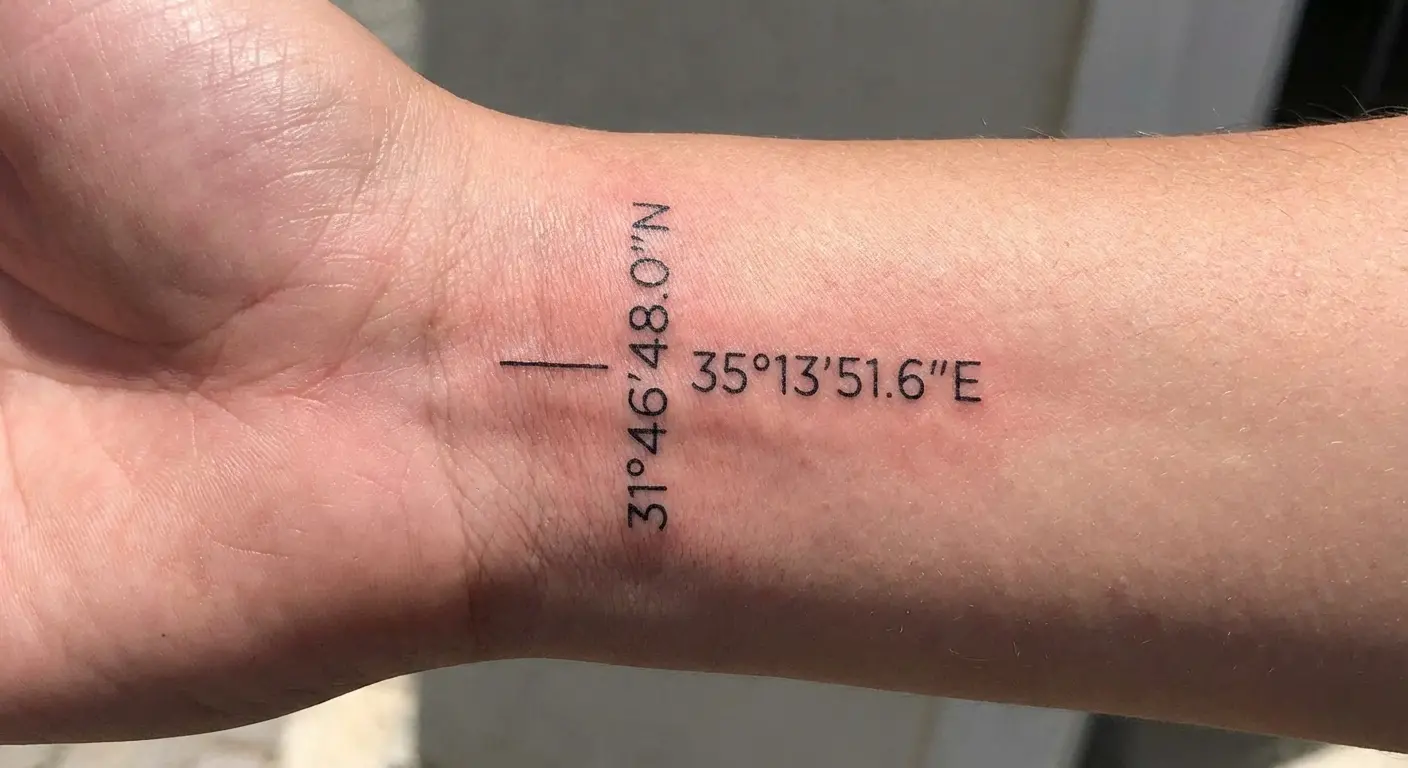
GPS coordinates of the place where everything changed – where you got sober, where you scattered ashes, where you got married, where you survived something that should’ve killed you – can form the cross itself. The numbers run along the vertical and horizontal axes, creating a cross that points to an exact spot on earth that holds your story.
This design appeals to people who want their tattoos to function as permanent bookmarks in their personal history. You’re literally wearing the coordinates of your most significant geography.
Small cross tattoos work really well with this concept because coordinates are inherently detailed, and shrinking them too much makes them illegible. The numerical precision of coordinates also creates a modern, technical aesthetic that contrasts nicely with the ancient symbolism of the cross. You’re merging contemporary GPS technology with one of humanity’s oldest symbols, which creates interesting visual tension.
8. Name-Integrated Cross Design
Names can weave through the cross structure or form its actual shape through careful lettering arrangement. This goes beyond simply writing “Mom” across a standard cross.
You’re using the letters themselves as architectural elements, where the vertical stroke of a “T” becomes part of the cross’s upright, or the crossbar of an “A” extends to form the horizontal beam. It requires collaboration with a tattoo artist who understands typography and spatial composition, but the result is a cross that can’t exist without that specific name.
The person and the symbol become inseparable, which is exactly the point when you’re memorializing someone whose faith defined them. This builds on established name tattoo design principles while adding symbolic depth through the cross structure. The challenge is maintaining legibility while also creating a recognizable cross shape, which means you’ll probably need multiple design iterations before finding the right balance.
Crosses That Challenge Traditional Placement
Where you put your cross matters as much as what it looks like. Most people default to the upper arm, chest, or back because that’s where they’ve seen cross tattoos before.
But placement can completely change how the symbol functions and what it communicates. We’re looking at positions that make the cross work harder visually by following body contours, occupying unexpected real estate, or creating interaction between the tattoo and your natural anatomy. These placements aren’t about being different for difference’s sake. They’re about making the cross feel integrated with your body rather than stamped onto it.
9. Finger Cross That Stays Visible
A cross on the side of your finger stays in your line of sight constantly, which makes it function more as a talisman than decoration. Every time you type, drive, eat, or gesture, you see it.
That constant visibility serves people who use their cross as a grounding symbol or reminder rather than just a statement of faith. The challenge with finger tattoos is longevity – they fade faster than other placements – but for people who want that ever-present visual anchor, the maintenance is worth it.
Keep the design simple because fingers don’t offer much real estate, and overly detailed crosses turn into blurry blobs after a few years. A clean outline or solid silhouette will age better than intricate shading or tiny details. You’ll probably need touch-ups every few years to maintain the clarity, so factor that into your decision.
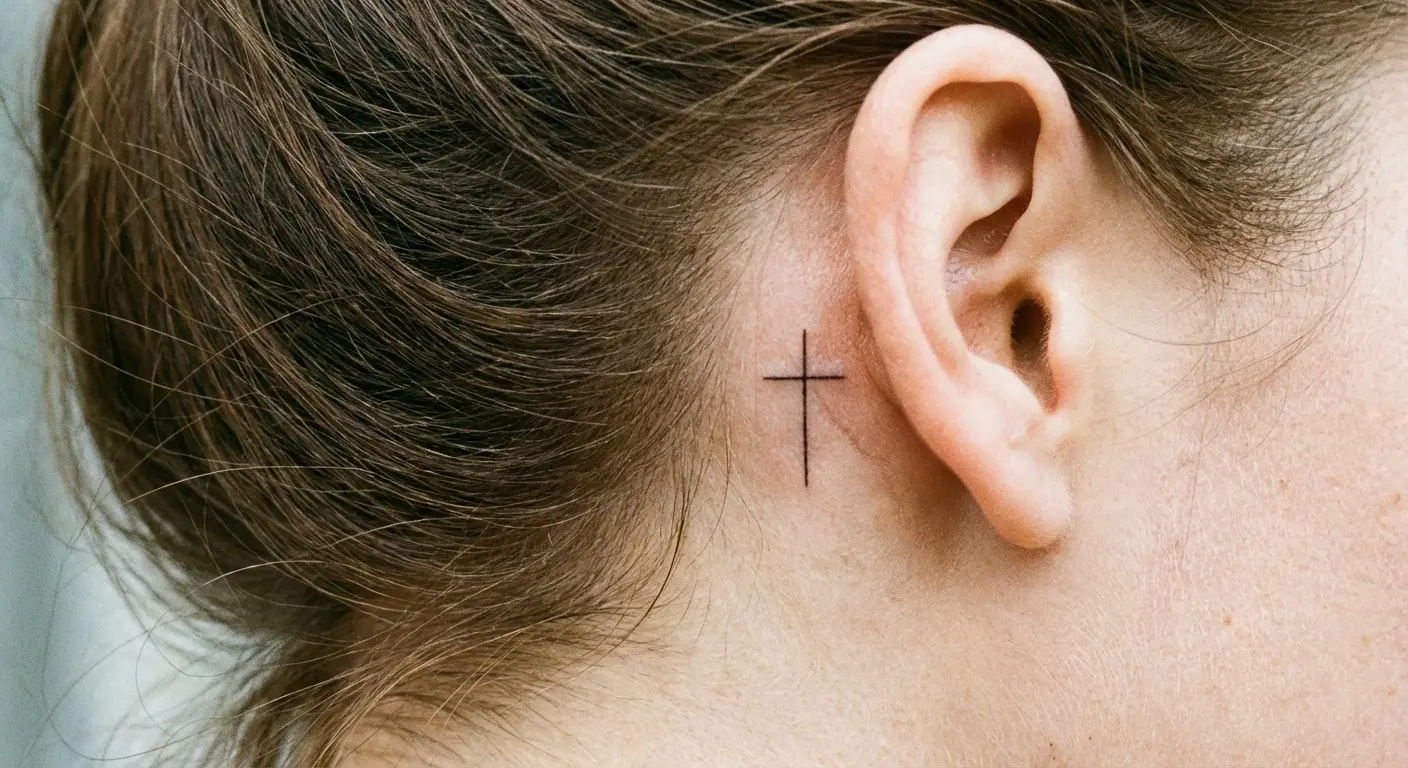
10. Behind-the-Ear Micro Cross
This placement hides the cross until you want to reveal it – pulling your hair back, turning your head – which creates an element of choice in who sees your tattoo. It’s there for you and the people close enough to notice, but it doesn’t broadcast to every room you walk into.
Behind-the-ear crosses work best when they’re genuinely small and precise rather than trying to cram too much detail into a tiny space. The curve of the ear creates a natural frame that can enhance the design if your artist accounts for it.
This spot also tends to
This spot also tends to be less painful than people expect, which is a bonus if you’re getting your first tattoo. The skin is thin, but the area is small enough that even if it hurts, you’re done quickly. These ideas appeal particularly to people who want the symbol for personal reasons but work in professional environments where visible tattoos might be complicated.
11. Ribcage Cross Following Your Anatomy
Your ribs create natural horizontal lines that a cross can either align with or deliberately cut across. A vertical cross that runs parallel to your side body creates a slimming visual effect and feels like it’s part of your structure.
Alternatively, positioning the cross to run perpendicular to your ribs creates visual tension that makes the tattoo feel more dynamic. This placement hurts more than fleshier areas – your ribs are right under the skin with minimal padding – but the pain creates a kind of earned quality that some people value.
The cross becomes something you suffered for, which adds another layer of meaning to an already symbolic image. The ribcage also offers significant space for larger designs that incorporate additional elements. You can extend the cross down toward your hip or up toward your shoulder, creating a piece that flows with your torso rather than sitting as an isolated image.
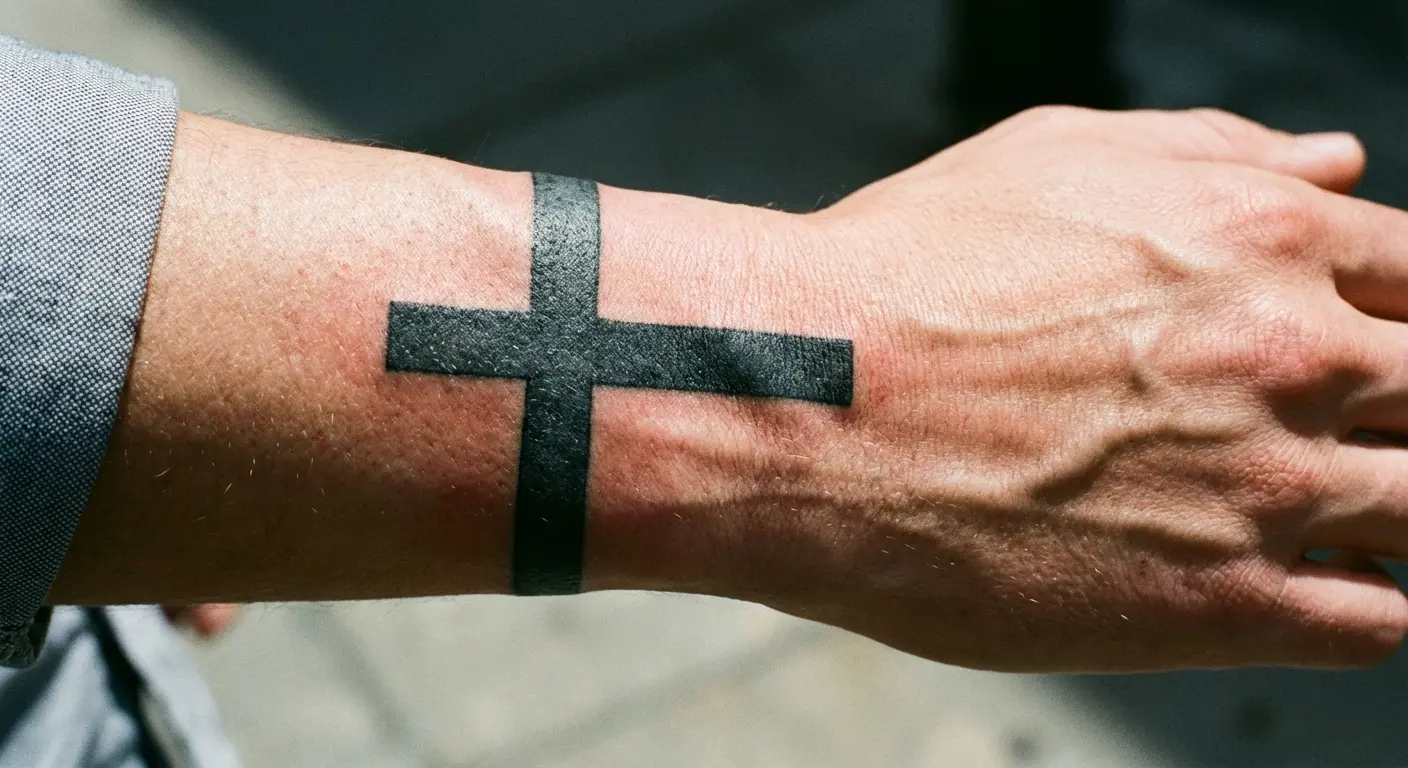
12. Wraparound Wrist Cross
A cross that wraps around your wrist creates a bracelet effect, transforming the symbol from a static image into something that interacts with your movement. The vertical beam runs along the inside of your wrist while the horizontal wraps around the circumference, creating a cross that reveals itself fully only when you rotate your arm.
This design works really well for people who want a cross that feels like adornment rather than proclamation. It’s intimate and personal, visible primarily to you unless you deliberately show someone.
The wraparound approach also solves the problem of wrist tattoos looking awkward from certain angles because the design is built to be viewed from multiple perspectives. You can incorporate additional elements along the band – dates, names, coordinates, or small symbols that have personal meaning – turning the cross into a comprehensive story told around your wrist.
The wrist placement also means you see your tattoo constantly, which serves people who use their cross as a daily reminder or touchstone. Just be aware that wrist tattoos are highly visible in professional settings, so consider your work environment before committing to this placement.
Crosses Designed for Visual Impact
Some crosses prioritize artistic execution over traditional symbolism. These designs use the cross as a starting point for exploring visual techniques that push the tattoo into fine art territory.
You’re not abandoning the meaning of the cross, but you’re refusing to let it be boring. These approaches appeal to people who want their tattoo to function as a conversation piece and a gallery-quality image, not just a symbol. They require tattoo artists with specific technical skills – solid black work, script lettering, watercolor techniques, geometric precision – so you’ll need to research artists whose portfolios demonstrate mastery in your chosen style.
Cross tattoos for men often lean toward these bolder visual approaches, though the techniques work equally well regardless of gender. The key is finding an artist whose aesthetic sensibility matches your vision.
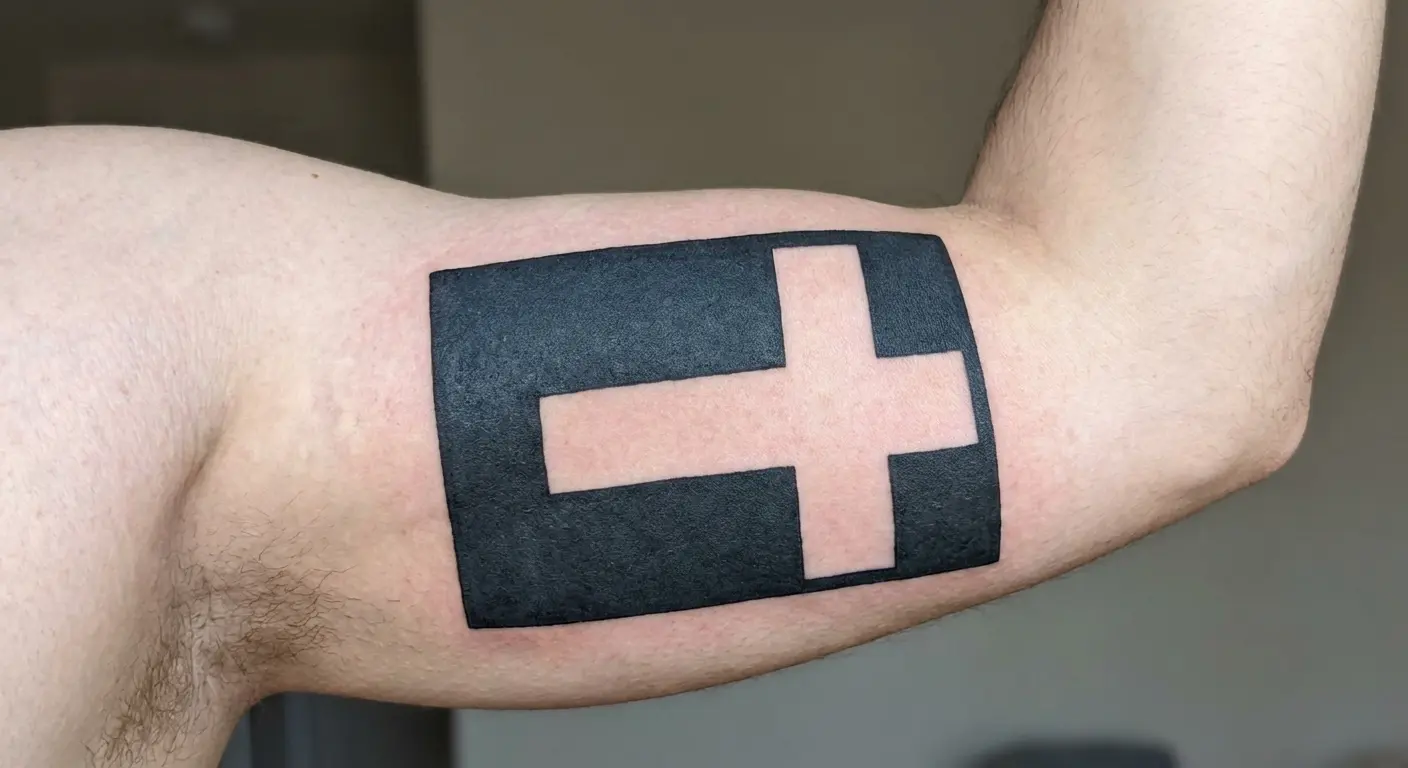
13. Negative Space Cross in Solid Black Panel
Instead of tattooing the cross itself, you tattoo everything around it, leaving the cross as unmarked skin within a solid black rectangle or circle. The cross exists as absence rather than presence, which creates a striking visual reversal that catches attention immediately.
This technique works because it’s unexpected. Our brains are wired to focus on marked areas, so a design that makes the unmarked area the focal point creates cognitive interest.
The solid black background also gives the tattoo bold visual weight that simpler line crosses can’t match. You need an artist who specializes in solid black work and understands how to create clean edges, because any wavering in the border destroys the effect. This approach shares technical demands with blackout tattoo techniques that require precision and experience with solid coverage.
Negative space crosses age well because there’s no fine detail to blur over time. The high contrast between black ink and skin stays sharp for decades. You can also expand the design later by adding elements around the black panel without disrupting the cross itself.
14. Cross Constructed from Script
A meaningful passage, prayer, or quote can be arranged so the words themselves form the cross shape. The vertical beam might be one verse while the horizontal is another, or a single passage can wrap and flow to create both axes.
This requires serious typographic skill from your artist because the words need to remain legible while also functioning as structural elements. When done well, you get a cross that rewards close reading. From a distance, people see the cross shape. Up close, they discover the text.
This layered revelation makes the tattoo more engaging than designs that give up all their meaning at first glance. Cross tattoo ideas that incorporate text work really well for people whose faith is deeply connected to specific scriptures or writings. You’re creating a visual representation of the words that ground your beliefs, which adds conceptual depth to the physical image.
Font choice matters enormously here. Script fonts can be beautiful but often sacrifice legibility when arranged vertically or wrapped around curves. Sans-serif fonts maintain clarity but might feel too modern for religious text. Work with your artist to test different typefaces and see what balances readability with aesthetic appeal.
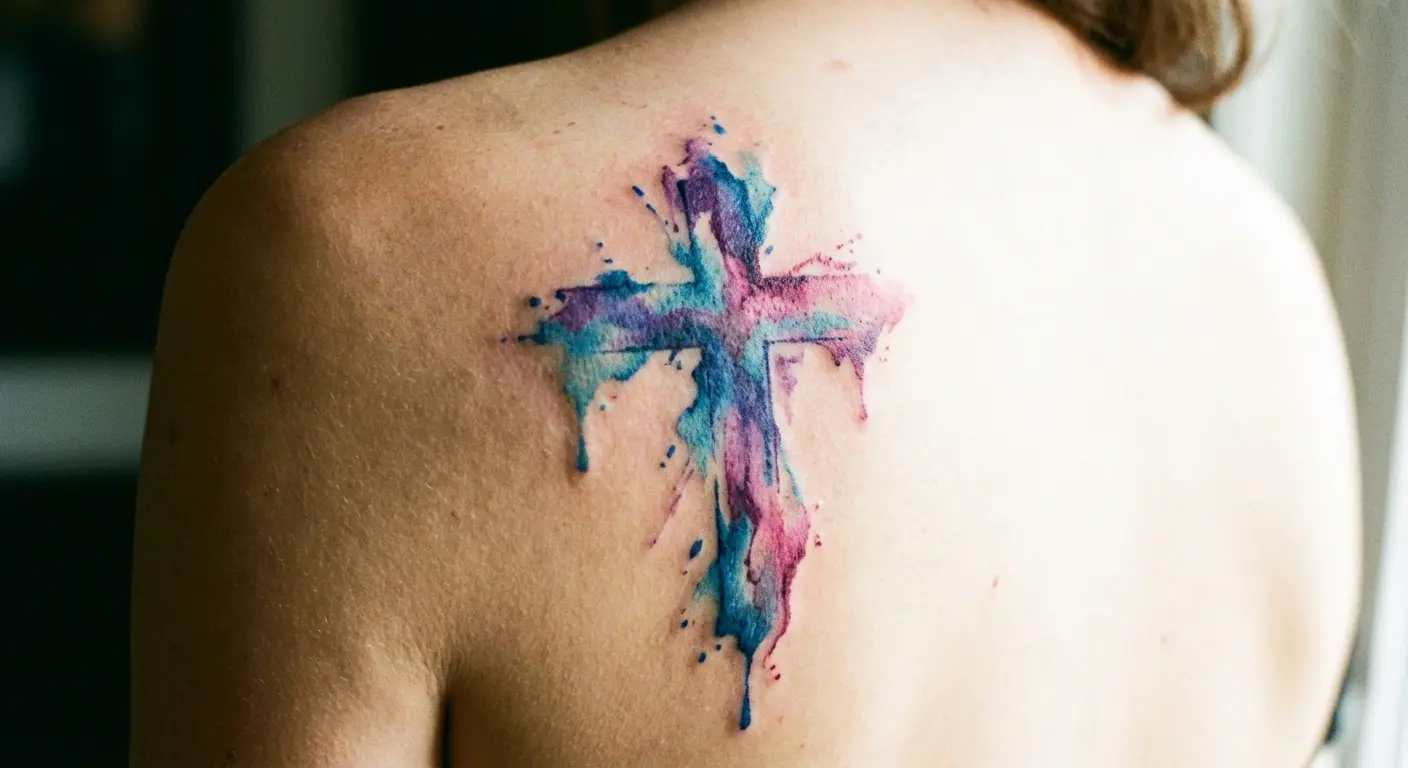
15. Watercolor Cross Breaking Boundaries
Watercolor techniques let the cross dissolve at its edges into color washes and splashes that feel more painting than traditional tattooing. The cross maintains enough structure to be recognizable but refuses to be contained by hard lines.
This approach appeals to people who connect with faith as something fluid and evolving rather than rigid and defined. The technical challenge is finding an artist who can execute watercolor tattoos that age well – the style has a reputation for fading poorly if not done correctly.
You want someone who builds a strong structural foundation even if the final appearance is loose and painterly, because that foundation keeps the tattoo legible as it ages. The watercolor effect works really well when you’re combining the cross with other elements. Flowers, birds, or abstract shapes can emerge from the color washes, creating a composition where the cross is the anchor but not the only focal point.
Color choice significantly impacts how the design reads. Soft pastels create a gentle, contemplative feeling. Bold, saturated colors make a stronger statement. Monochromatic washes in blues or grays can reference traditional religious art while maintaining the watercolor aesthetic.
16. Cross Emerging from Geometric Patterns
Sacred geometry, mandala patterns, or abstract geometric designs can build up around and through a cross, making it feel like the cross is either emerging from mathematical order or dissolving into it. This creates visual complexity that rewards extended viewing. The more someone looks, the more patterns and relationships they discover.
It’s an effective approach for people who see spiritual meaning in mathematics, pattern, and structure. The cross becomes part of a larger system rather than an isolated symbol, which can represent how faith integrates with the rest of your worldview rather than sitting separate from it.
These ideas typically require multiple sessions because of the detail involved, so plan accordingly in terms of time and budget. The geometric elements also give you flexibility for future additions. You can expand the pattern outward over time, gradually building a larger piece that maintains visual coherence because the geometric structure provides a framework for new elements.
Precision is critical with geometric work. Lines need to be straight, circles need to be round, and symmetry needs to be exact. Even small deviations become obvious when you’re working with mathematical patterns. Find an artist who specializes in geometric tattoos and examine their portfolio closely for consistency and accuracy.
Before You Commit to Your Design
You’ve probably noticed that the most meaningful cross tattoos share one quality: they’re specific to the person wearing them. Generic designs pulled from flash sheets or Pinterest boards don’t carry the same weight because they’re not built around your particular story, heritage, or aesthetic preferences.
The gap between “I want a cross tattoo” and “I want THIS cross tattoo” is where the real work happens. If you’re struggling to visualize exactly how your ideas translate into an actual design, Tattoo Generator IQ lets you explore variations instantly. You can test different styles, see how personal elements integrate with the cross structure, and generate multiple versions until something clicks.
It’s useful for showing your tattoo artist exactly what you’re envisioning rather than trying to describe it verbally and hoping they interpret it correctly. You’ll walk into your consultation with a clear reference point instead of vague ideas, which makes the entire process more collaborative and less frustrating. The tool helps bridge the gap between concept and execution, especially when you’re combining multiple elements or trying to achieve a specific aesthetic that’s hard to articulate.
Final Thoughts
Cross tattoos work best when they resist the obvious. The symbol itself carries enough inherent meaning that your design doesn’t need to shout. What it needs is specificity.
Whether that comes from cultural tradition, personal symbolism, unexpected placement, or artistic execution doesn’t matter as much as the fact that your cross reflects something true about you. The designs we’ve covered here all share that quality of intentionality. They’re not crosses because crosses are popular. They’re crosses because the symbol serves a specific purpose in the wearer’s visual and spiritual vocabulary.
Your cross tattoo should do the same. Take the time to figure out what the symbol means to you beyond surface-level associations, and build your design from that foundation. The result will be a tattoo you’re still proud of decades from now, not just something that seemed appealing in the moment. Consider how the cross will age with you, how it fits with your existing tattoos or future plans, and whether the design will remain meaningful as your life evolves.
We’ve seen too many people rush into cross tattoos based on trends or impulse, only to regret the lack of personal connection later. Do the work upfront. Sit with your ideas. Test different variations. Consult with artists who understand both the technical execution and the symbolic weight of what you’re creating. Your cross tattoo is permanent – make sure it’s permanently meaningful.
