19 Dinosaur Tattoos That Work Better When You Stop Treating Them Like Museum Exhibits
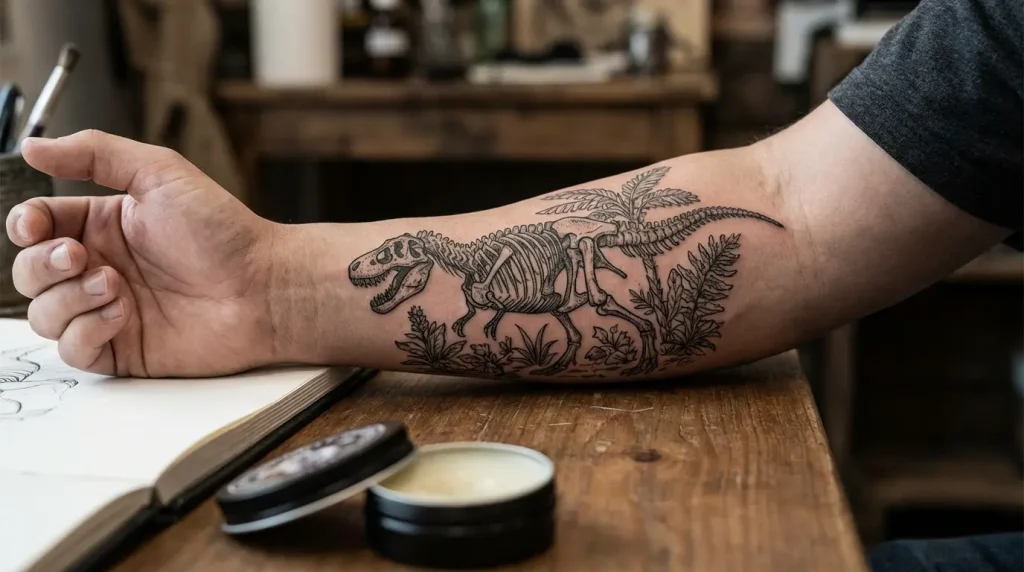
Look, we’re obsessed with dinosaurs. We make movies about them, build theme parks around them, and yeah, a lot of us want them permanently inked on our bodies. But here’s where most people screw it up: they treat their body like a museum wall. They want the scientifically accurate T-Rex, the textbook Velociraptor, the kind of thing you’d see behind glass with a little plaque explaining the Cretaceous period.
That’s not a tattoo. That’s a biology homework assignment you’re stuck with forever.
The tattoos that actually work are the ones that fragment, reimagine, and personalize these ancient creatures instead of trying to recreate them exactly as they appeared millions of years ago. Stop trying to make your skin a historically accurate exhibit. Start using dinosaurs as symbols for whatever you’re actually trying to say about yourself.
Table of Contents
Ancient Predators Reimagined as Personal Symbols
-
T-Rex Skull Fragment (Not the Full Skeleton)
-
Velociraptor Claw as Negative Space
-
Spinosaurus Sail Rendered in Watercolor Fade
-
Carnotaurus Horns Emerging from Skin
-
Allosaurus Jaw in Profile
Gentle Giants That Carry Different Weight
-
Brachiosaurus Silhouette Against Geometric Sun
-
Stegosaurus Plates as Minimalist Line Work
-
Triceratops Frill Outlined in Single Stroke
-
Diplodocus Neck Wrapping Around Forearm
-
Ankylosaurus Club Tail in Micro Detail
Prehistoric Scenes That Tell Your Story (Not Theirs)
-
Hatching Egg with Modern Botanicals
-
Footprint Trail Leading to Your Coordinates
-
Amber Preservation with Personal Objects
-
Pteranodon Mid-Flight Over Your Hometown Skyline
-
Volcanic Eruption Contained in Hourglass
Hybrid Concepts That Break the Paleontology Rulebook
-
Skeleton Merged with Constellation Map
-
Dino Outline Filled with Childhood Memories
-
Fossilized Bones Growing Living Flowers
-
Raptor Feathers Transitioning to Phoenix Flames
TL;DR
Most dinosaur tattoos look like museum posters. Don’t do that.
Fragment them. Just the skull, just the claw, just the distinctive part you actually care about.
Small doesn’t mean wimpy. It means strategic.
Mix prehistoric with personal: your coordinates, your flowers, your story.
Use the dinosaur as a metaphor for something (survival, change, childhood) instead of just… a dinosaur.
Ancient Predators Reimagined as Personal Symbols
Everyone makes the same mistake with predator tattoos. They want the full T-Rex or complete Velociraptor because that’s what looks impressive in movies and museums. But your skin isn’t a museum wall.
The tattoos that age best, hold meaning longest, and spark the most interesting conversations are the ones that isolate specific predatory features. You’re not claiming a scary lizard. You’re claiming the specific trait that means something to your own survival story, whether that’s the crushing power of a T-Rex jaw, the calculated precision of raptor claws, or the defensive aggression of Carnotaurus horns.
Less anatomical completeness often means more emotional impact.
|
Predator Feature |
Symbolic Meaning |
Best Placement |
Aging Consideration |
|---|---|---|---|
|
T-Rex Skull Fragment |
Intimidation through restraint, hidden power |
Forearm, shoulder blade |
High contrast maintains clarity as lines soften |
|
Velociraptor Claw |
Calculated precision, lethal intelligence |
Fingers, inner wrist, behind ear |
Negative space prevents line blur over time |
|
Spinosaurus Sail |
Artistic expression, standing out from the crowd |
Upper arm, thigh, ribcage |
Watercolor fades age gracefully with proper care |
|
Carnotaurus Horns |
Internal strength emerging, transformation |
Ankle, shoulder, thigh |
3D effects require skilled artist but reward long-term |
|
Allosaurus Jaw |
Elegant aggression, streamlined power |
Collarbone, ribcage, outer forearm |
Simple outlines remain readable for decades |
1. T-Rex Skull Fragment (Not the Full Skeleton)
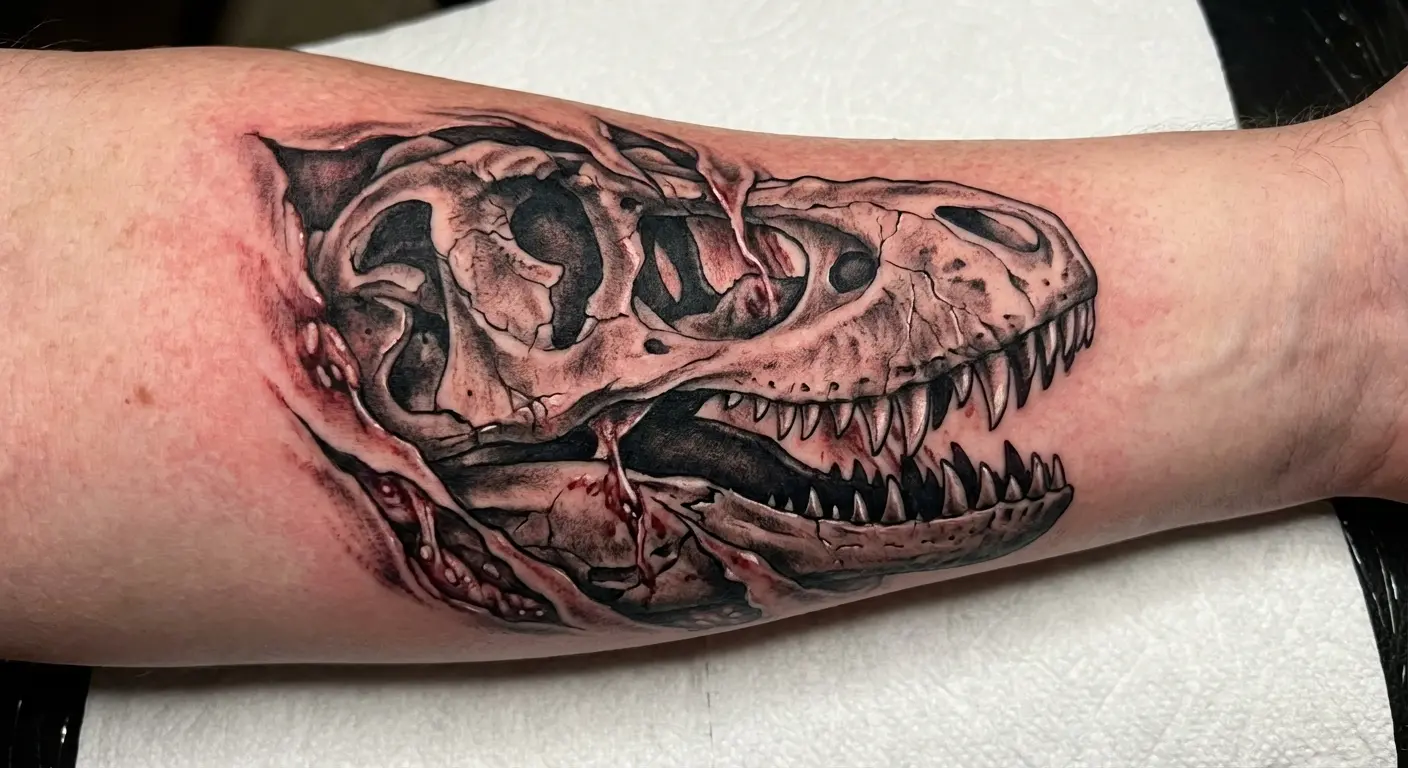
Full T-Rex skeletons look amazing in museums. On skin? They’re a cluttered mess, especially after a few years when the lines start bleeding together.
Just get the skull fragment. The eye socket and upper jaw, maybe. You get all the intimidation with none of the visual noise.
The missing pieces are the point. People’s brains fill in what’s not there, which makes them active participants instead of just viewers. It’s more threatening because of what you’re NOT showing.
Put it somewhere the fragment looks like it’s emerging from under your skin instead of just sitting on top. Forearm or shoulder blade usually work best.
The power of fragmentary designs as family symbols gained national attention when Purdue basketball player Evan Boudreaux and his family got matching T-Rex skull tattoos (Journal & Courier) to commemorate their father’s cancer survival and their shared passion for fossil hunting. The tattoos were mentioned on multiple Purdue basketball broadcasts, proving that fragmentary designs spark the kinds of conversations full skeletons never could.
When you’re working with a small concept, the fragment solves multiple problems simultaneously. You get immediate recognition without requiring extensive real estate. The design maintains its clarity over time because there are fewer competing details. Most importantly, you’re getting something that feels intentional rather than constrained by size limitations.
2. Velociraptor Claw as Negative Space
Okay, this is where you get to feel smart about tattoo technique.
Most people get raptor claws as solid black shapes. Fine, but they blur over time. Flip it: make your skin the claw and ink everything around it.
Stays crisp as it ages. Photographs better. Makes the claw look like it’s cutting through whatever surrounds it.
Perfect for small spaces. Fingers, behind your ear, inner wrist, places where regular tattoos turn into blobs. The negative space technique transforms a simple concept into something technically sophisticated. Your artist can adjust the surrounding context to match your aesthetic preferences: heavy blackwork for dramatic contrast, delicate line work for subtlety, or even color gradients that make the claw appear to slice through different dimensions.
3. Spinosaurus Sail Rendered in Watercolor Fade
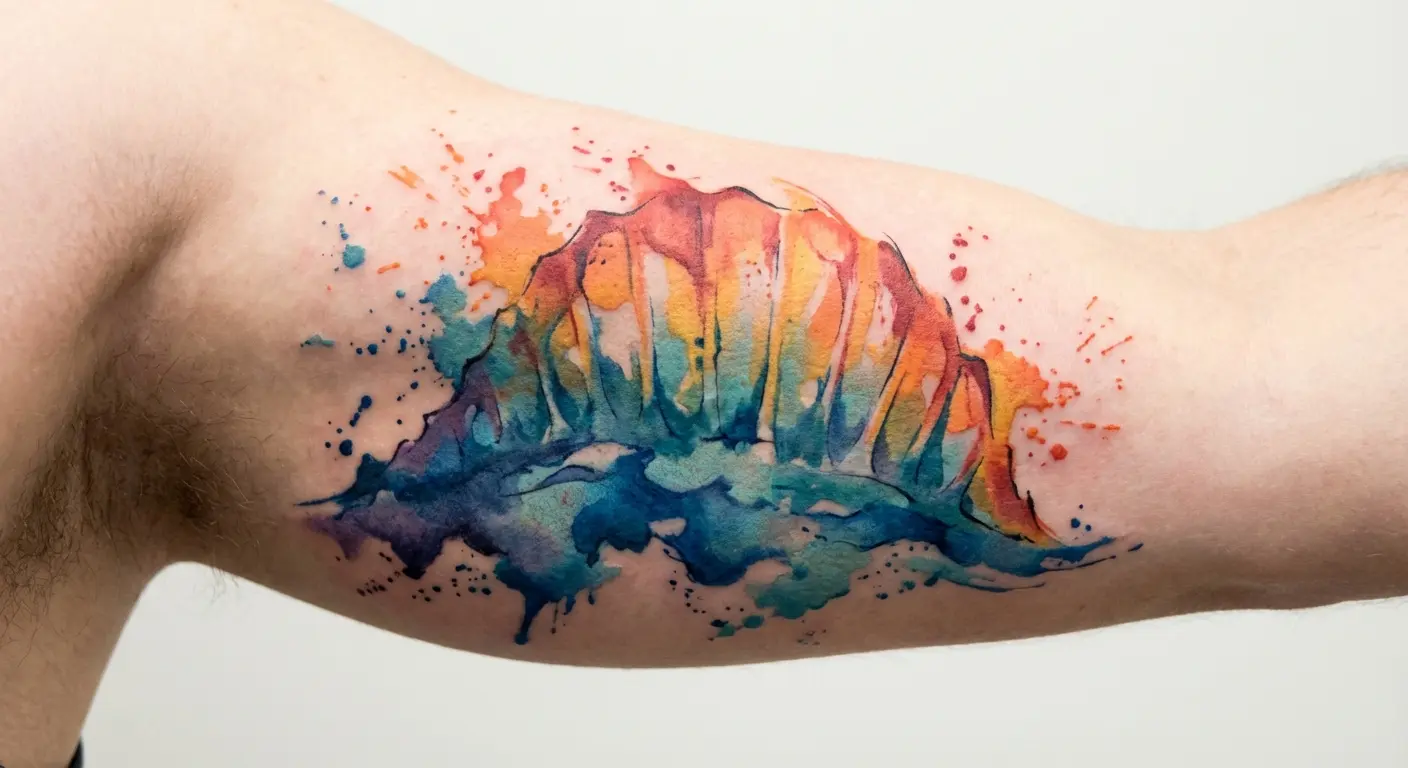
Spinosaurus gets overlooked because it’s less culturally iconic than T-Rex or Velociraptor, but that distinctive sail offers something those predators can’t: a natural canvas for color experimentation.
The sail’s vertical structure makes it perfect for watercolor techniques that fade from deep ocean blues at the base to sunset oranges at the peak. You get something immediately recognizable as dinosaur-related but doesn’t scream “I watched Jurassic Park too many times.”
This is for people who want something that feels more artistic than literal. The fade technique also gives your tattoo artist room to showcase their color blending skills, which means you’re more likely to get a piece they’re genuinely excited to execute.
Maybe extend the fade beyond the sail itself so the colors bleed into surrounding skin, creating an intentionally unfinished quality. The watercolor style ages differently than traditional linework. Colors soften and blend rather than blur, which creates a lived-in quality that many people find more appealing than the crisp edges of fresh ink.
4. Carnotaurus Horns Emerging from Skin
Carnotaurus remains relatively unknown outside paleontology circles, which makes its distinctive bull-like horns perfect for people who want tattoos that don’t immediately register as dinosaur tattoos.
Position these horns so they appear to pierce through your skin from underneath. It plays with viewers’ perception.
Are you the dinosaur, or is something prehistoric trying to break out of you? That ambiguity gives the design staying power because its meaning can evolve with you.
The technical execution requires an artist skilled in dimension and shadow work, but the payoff is worth it. This scales well from small applications (just the horn tips visible on an ankle) to large (full horn emergence with torn skin effects on a shoulder or thigh).
The emerging quality suggests transformation in progress rather than completion. You’re not displaying something you’ve already become. You’re showing something that’s fighting to surface.
5. Allosaurus Jaw in Profile
Allosaurus predated T-Rex by millions of years but possessed a jaw structure that was arguably more elegant: lighter, more flexible, capable of opening wider relative to skull size.
In profile, an Allosaurus jaw makes a cleaner silhouette than the bulkier T-Rex equivalent. Perfect for simple applications along the collarbone, ribcage, or outer forearm where the natural curve of your body can mirror the jaw’s arc.
Render it as pure outline without internal detail. You’re turning scientific accuracy into graphic design. This ensures the design remains readable from a distance and ages gracefully because there are no fine details to blur. You can always add complexity later (teeth details, shading, background stuff) but you can’t simplify an overly detailed tattoo once it’s already on your skin.
The profile orientation also means something. Which way is the jaw facing? Toward your hand suggests forward aggression. Toward your shoulder suggests guarding what’s behind you. These subtle orientation choices add layers of meaning without requiring additional visual stuff.
Gentle Giants That Carry Different Weight
Why would anyone get an herbivore tattoo?
Because they’re not about size or strength. Herbivore tattoos are about surviving by being smart, not scary. Different energy entirely.
While everyone else is getting predators to look tough, you’re choosing creatures that survived by being better at reading environmental changes and more committed to long-term survival than short-term dominance. These five designs work because they let you claim those qualities without having to explain them. The visual language does the work for you.
Briony from Tricera-Tats tattoos dinosaur-themed designs about once a week, with skulls being a particular favorite, demonstrating that while predators get attention, the consistent demand comes from people seeking designs that balance recognition with personal meaning. Exactly what gentle giants provide.
These work really well as small options because their distinctive silhouettes remain recognizable even at minimal scale, and their inherent gentleness makes them less aggressive design choices for visible placements on hands, neck, or behind the ear. You’re not trying to intimidate anyone. You’re declaring your values through visual shorthand.
6. Brachiosaurus Silhouette Against Geometric Sun
Brachiosaurus gives you that iconic long-necked shape everyone recognizes without requiring detailed rendering.
Position the silhouette against a geometric sun (think line work rays or a segmented circle rather than realistic solar imagery) and you get instant visual balance: organic prehistoric curve meeting modern mathematical precision.
This juxtaposition works because you’re acknowledging something ancient while framing it through contemporary aesthetic choices. The geometric sun also solves a practical problem: it gives the tattoo a defined border, which helps it read as a complete composition rather than a floating thing.
This scales beautifully from tiny size (behind the ear, showing just the neck and head against a minimal sun) to medium (full body on forearm with elaborate geometric background). Think about placement where the dinosaur’s upward gaze follows your body’s natural lines. The geometric framing technique works similarly to how geometric tattoo designs balance organic subjects with mathematical precision, creating visual tension that keeps viewers engaged.
The upward reach of the Brachiosaurus neck suggests aspiration without aggression, growth without conquest. You’re not dominating anything. You’re reaching for something higher.

7. Stegosaurus Plates as Minimalist Line Work
Stegosaurus plates are instantly recognizable even when reduced to their most basic geometric forms: a series of triangular or diamond shapes along a curved baseline.
Perfect for minimalist applications where you want maximum recognition with minimum ink. A single-line interpretation running along the spine, following the curve of a shoulder, or wrapping around a wrist makes movement without clutter.
Here’s the thing: each plate can represent something specific to you. Family members, significant years, places you’ve lived. It reads as aesthetic dinosaur art to strangers but carries personal meaning for you.
The spacing between plates also matters. Tight spacing means urgency and tension, while generous spacing suggests calm and deliberation. You’re controlling the rhythm through these small decisions, which means the same basic concept can convey vastly different energies depending on execution.
8. Triceratops Frill Outlined in Single Stroke
The Triceratops frill offers one of the most distinctive shapes in dinosaur anatomy: a semi-circular crown that’s part protection, part display.
Render it as a single continuous line. No shading, no interior detail, just the outer contour. You’re turning it from literal dinosaur anatomy into something closer to abstract art or even a halo effect.
This works really well for little placements on the inner arm, ankle, or behind the knee where the curved shape can follow your body’s natural contours. The single-stroke technique also ages exceptionally well because there’s only one line to maintain rather than multiple pieces that need to stay aligned as your skin changes over time.
You can position it so the frill appears to crown something else in your existing tattoo collection, or stand alone as a subtle nod to childhood dinosa
ur obsessions.
The simplicity is deceptive. A well-executed single-stroke frill requires precision and confidence from your artist. There’s nowhere to hide mistakes when you’re working with one continuous line.
9. Diplodocus Neck Wrapping Around Forearm
Diplodocus possessed one of the longest necks in dinosaur history, which makes it uniquely suited for tattoos that need to wrap around cylindrical body parts.
A neck design that spirals around your forearm, calf, or even a finger makes natural movement that works with your body instead of fighting against it.
Where you put the head and tail ends matters. Head reaching toward your hand (suggesting forward motion and intention) or tail tapering toward your elbow (suggesting something trailing behind you, perhaps representing past experiences you’re moving beyond).
This scales across sizes but shines in small applications because the neck’s length makes impact without requiring large areas of coverage.
Maybe leave the body itself implied rather than fully rendered, letting the neck tell the whole story. This fragmentary style gets visual interest through what’s missing rather than what’s included. Viewers fill in the gaps, which makes them more invested in understanding the tattoo.
10. Ankylosaurus Club Tail in Micro Detail
Everyone focuses on Ankylosaurus’s armored body, but the club tail is where the real visual interest lives: a natural weapon that’s simultaneously organic and geometric.
Render just the club in micro detail. Show the individual bony plates, the texture variations, the way it connects to the tail. You get a small design that rewards close examination without being busy or cluttered from a distance.
This is brilliant for small placements on fingers, behind the ear, or on the inner wrist where people will naturally lean in to see it clearly. The club’s rounded, almost mechanical appearance also makes it one of the few dinosaur bits that can read as abstract or decorative to people who don’t immediately recognize it, giving you the option to explain its meaning or let it remain mysterious.
Maybe add subtle motion lines or impact cracks to suggest the club mid-swing.
The defensive nature of the club carries its own symbolism. Ankylosaurus didn’t hunt or chase. It stood its ground and made attacking it too costly. That’s a different kind of strength than what predator tattoos communicate.
Prehistoric Scenes That Tell Your Story (Not Theirs)
Most dinosaur scene tattoos fail because they’re trying to recreate moments from prehistory that have nothing to do with your life.
You weren’t there when the asteroid hit or when the first egg hatched. But you can use prehistoric imagery as a framework for your own narrative, inserting personal symbols, meaningful coordinates, or contemporary stuff that transforms the ancient scene into something current and intimate.
These five designs show how to build tattoos that use dinosaurs as supporting characters in your story rather than the main plot. This solves the biggest problem with cute dinosaur concepts: they often feel disconnected from the person wearing them, existing as decoration rather than declaration. By making yourself part of the prehistoric scene, you’re getting tattoos that can’t be replicated because they’re built from your specific experiences.
|
Scene Element |
Personal Integration Method |
Symbolic Function |
Complexity Level |
|---|---|---|---|
|
Hatching Egg |
Birth month flowers, hometown botanicals |
New beginnings, transformation |
Medium – requires botanical detail |
|
Footprint Trail |
GPS coordinates, significant dates |
Journey, direction, progress |
Low – clean lines and simple numbers |
|
Amber Preservation |
Childhood objects, family heirlooms |
Protection of memories, honoring the past |
High – translucent coloring requires skill |
|
Pteranodon Flight |
Hometown skyline, college campus |
Ancient meeting modern, roots and wings |
Medium – balance of detail vs. simplicity |
|
Volcanic Hourglass |
Personal extinction events, life phases |
Necessary endings, time’s passage |
High – movement within containment |
11. Hatching Egg with Modern Botanicals
Dinosaur eggs represent beginnings, but generic hatching egg tattoos feel incomplete because they’re not hatching into anything specific to you.
Surround the cracking egg with botanicals that matter to your life. Your birth month flower, plants from your hometown, that specific herb your grandmother grew in her garden. You’re turning the scene from prehistoric moment to personal rebirth narrative.
The dinosaur emerging from the egg can be rendered realistically or abstractly depending on your preference, but the botanicals should be detailed enough to be identifiable because that’s where your story lives.
This design works really well for people marking major life transitions: career changes, recovery milestones, geographical moves. The hatching egg becomes visual shorthand for “I’m becoming something new.”
Think about placement where the egg sits at a natural focal point (shoulder, chest, thigh) with botanicals extending outward to integrate with surrounding skin or future tattoo additions. The botanicals can grow in any direction you choose, creating asymmetry that feels organic rather than composed.
12. Footprint Trail Leading to Your Coordinates
Dinosaur footprints carry inherent directionality: something massive moved through space and left evidence of its passage.
Use a trail of prints that leads to or from your meaningful coordinates. Birthplace, where you met your partner, location of a significant decision. You get a design that’s simultaneously prehistoric and deeply current.
The footprints themselves can vary in size and species to represent different life phases or influences, with the trail making a visual path your eye naturally follows toward the coordinates.
This scales from tiny versions (three small prints leading to minimal coordinate numbers on an ankle) to larger pieces (dramatic trail across a ribcage or down a leg).
The coordinates can be rendered in various styles: Roman numerals, standard digits, even subtly incorporated into the footprint shapes themselves, depending on how explicitly you want to declare their significance. The coordinate integration technique shares conceptual DNA with tattoo ideas with meaning that transform personal data into visual narratives.
Direction matters here. Are the prints walking toward the coordinates or away from them? That choice changes everything about what the tattoo communicates.
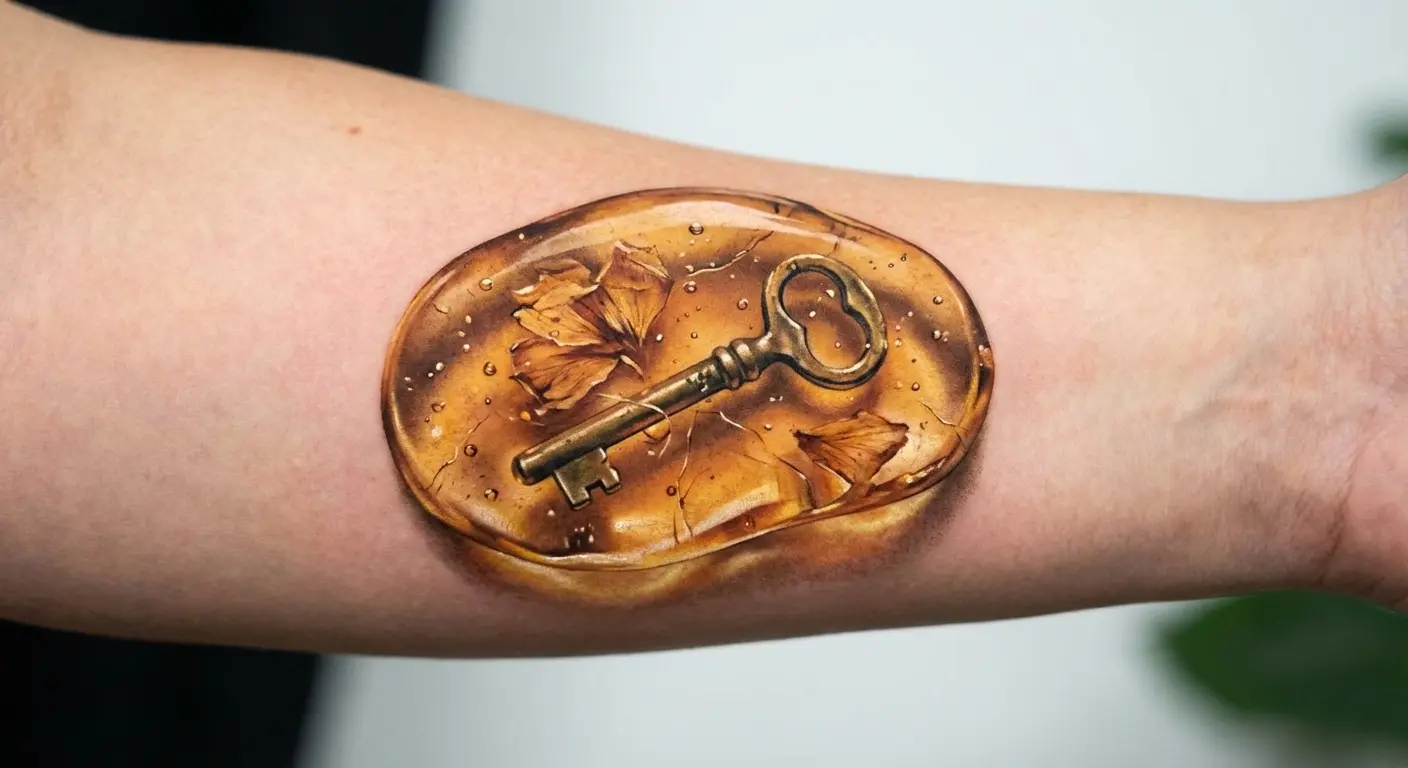
13. Amber Preservation with Personal Objects
Amber-preserved dinosaur fragments represent perfect preservation of ancient moments, but your amber doesn’t need to contain prehistoric specimens.
Imagine amber-style preservation surrounding objects from your own life: your grandmother’s ring, a childhood toy, a symbolic key, musical notes from a meaningful song.
The amber effect (golden translucent coloring with internal bubbles and imperfections) makes a frame that suggests these objects are being protected and honored the same way museums protect dinosaur DNA. This design works because it uses dinosaur-adjacent imagery (the amber preservation method) without requiring literal lizards on your skin, making it perfect for people who love dinosaur ideas but don’t want explicit reptilian anatomy.
The amber can be shaped organically, following irregular blob patterns that mimic natural resin, or geometrically, contained within clean borders depending on your aesthetic preferences. The translucent quality requires an artist skilled in color layering and depth creation, but the result is a tattoo that looks three-dimensional and catches light in interesting ways.
14. Pteranodon Mid-Flight Over Your Hometown Skyline
Pteranodons weren’t technically dinosaurs (they were flying reptiles), but they’re close enough in popular imagination to count, and their wingspan makes perfect framing for horizontal compositions.
Position a Pteranodon in flight over a simplified silhouette of your hometown skyline, college campus, or another meaningful location. You get instant narrative: something ancient and wild moving through your personal geography.
This works because it doesn’t try to make the prehistoric and contemporary stuff match stylistically. The contrast is the point. The Pteranodon can be rendered with detailed texture and shading while the skyline remains as simple outline, or vice versa, depending on which part you want to emphasize.
This scales well for various placements but shines on the ribcage, outer thigh, or across the shoulder blades where the horizontal wingspan has room to stretch. The flying motion suggests freedom and perspective. You’re looking at your hometown from above, with the distance and objectivity that only time and elevation provide.
15. Volcanic Eruption Contained in Hourglass
Volcanic eruptions contributed to dinosaur extinction, but contained within an hourglass, that destructive force becomes a meditation on time, inevitable change, and how catastrophic endings make space for new beginnings.
The hourglass frame gives the volcanic imagery clear boundaries while the flowing lava and ash can be rendered to look like they’re moving through the hourglass chambers, with dinosaur silhouettes visible in the smoke or fleeing from the destruction.
This design works for people processing their own extinctions: ended relationships, abandoned careers, versions of themselves they’ve outgrown. It acknowledges that some things need to end completely before transformation becomes possible.
The hourglass can be ornate or minimal depending on your style preferences, but the volcanic scene inside should have enough movement and detail to be visually interesting.
Think about placement on the forearm or outer calf where the vertical hourglass shape follows your body’s natural lines, making the contained chaos feel even more deliberately framed. The containment is what makes this powerful. You’re not denying the destruction, you’re acknowledging that it has boundaries and duration.
Hybrid Concepts That Break the Paleontology Rulebook
The most interesting dinosaur tattoos happen when you stop respecting the boundaries between prehistoric fact and creative fiction.
Paleontologists might cringe, but your skin isn’t a peer-reviewed journal. These four hybrid designs take dinosaur parts and merge them with concepts they could never have encountered: star maps, modern memories, living florals growing from dead bones, mythological creatures from entirely different cultural traditions.
This solves the biggest limitation of straight dinosaur tattoos: they’re historically fixed, locked into a specific time period that ended 65 million years ago. By breaking them open and filling them with contemporary or timeless stuff, you’re getting designs that can evolve in meaning as your life changes.
These work really well for people who loved dinosaurs as children but want tattoos that feel age-appropriate and conceptually sophisticated rather than nostalgic.
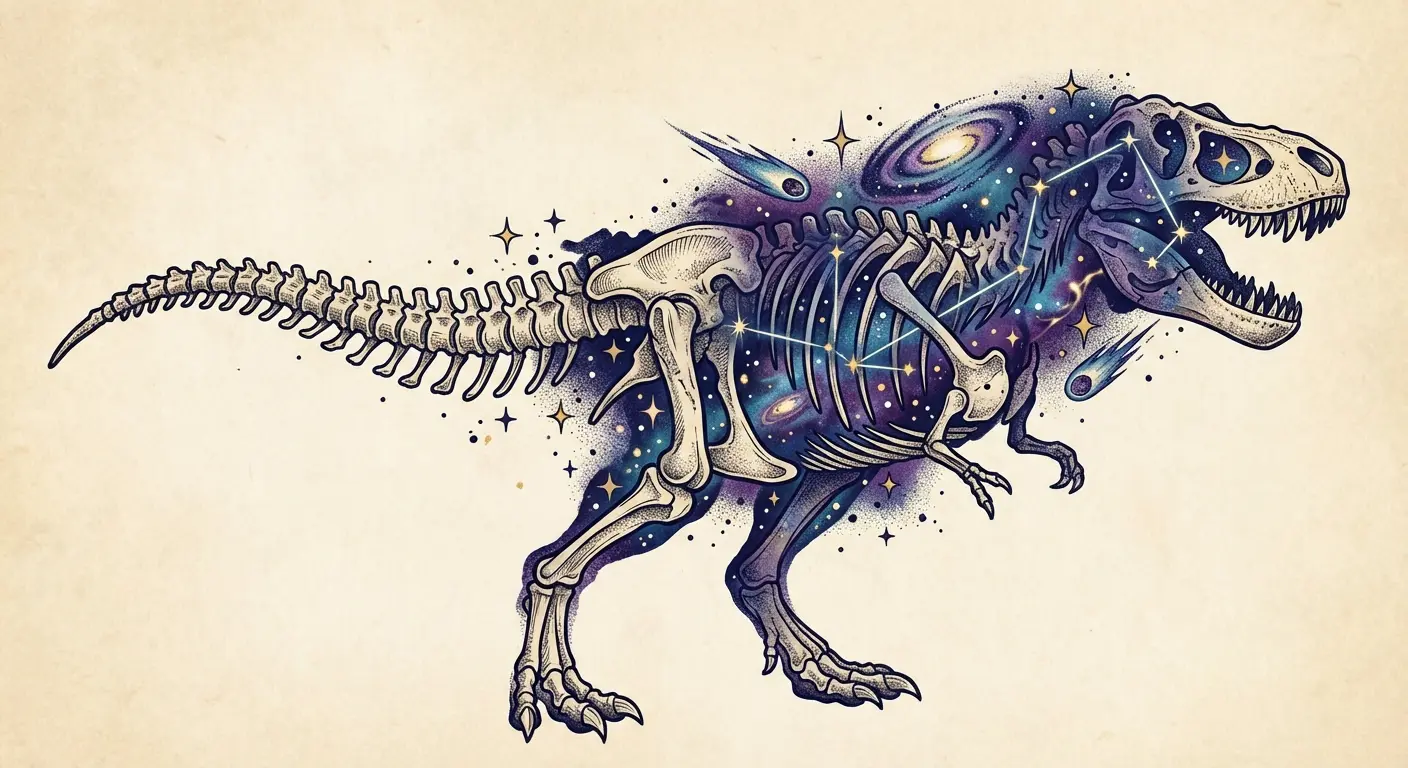
16. Skeleton Merged with Constellation Map
Dinosaur skeletons and constellation maps share similar visual DNA: both are dot-and-line systems that reveal underlying structure.
Merge them so dinosaur bones gradually transform into star patterns, or where the skeleton’s structure is literally mapped using constellation points connected by lines.
This works on multiple symbolic levels. Both dinosaurs and constellations represent humanity’s attempt to understand our place in vastly larger timescales: geological versus cosmic. The dinosaur skeleton concept typically feels heavy and death-focused, but adding celestial stuff introduces possibility and wonder. You’re not showing something dead; you’re showing how death becomes part of larger patterns.
This requires careful planning around which constellations to include: your birth constellation, stars visible from meaningful locations, or random patterns that simply make the best visual flow.
How dramatically you want the transition from bone to star to occur determines whether this reads as subtle or dramatic. This transformative style mirrors how phoenix tattoo meaning explores death-to-rebirth narratives through mythological frameworks.
17. Dino Outline Filled with Childhood Memories
Simple dinosaur outlines make perfect containers for photographic or illustrative content that has nothing to do with prehistory.
Imagine a T-Rex silhouette filled with scenes from your childhood: your first house, family photos, toys you loved, places you explored. The dinosaur shape acts as a frame that immediately signals “this is about childhood” without requiring explanation, since dinosaurs are so culturally linked to that life phase.
This turns potentially generic cute dinosaur concepts into something deeply personal and unreplicable. The internal imagery can be rendered in various styles: realistic black and grey, illustrative line work, even abstract color blocks representing different memories, depending on how literal you want the memories to read.
This works best at medium to large scale where the internal details have room to breathe, with placement on the thigh, back, or upper arm where the dinosaur shape can be substantial enough to contain complex imagery.
The outline becomes a window into your past, and the choice of which dinosaur species frames those memories adds another layer of meaning.
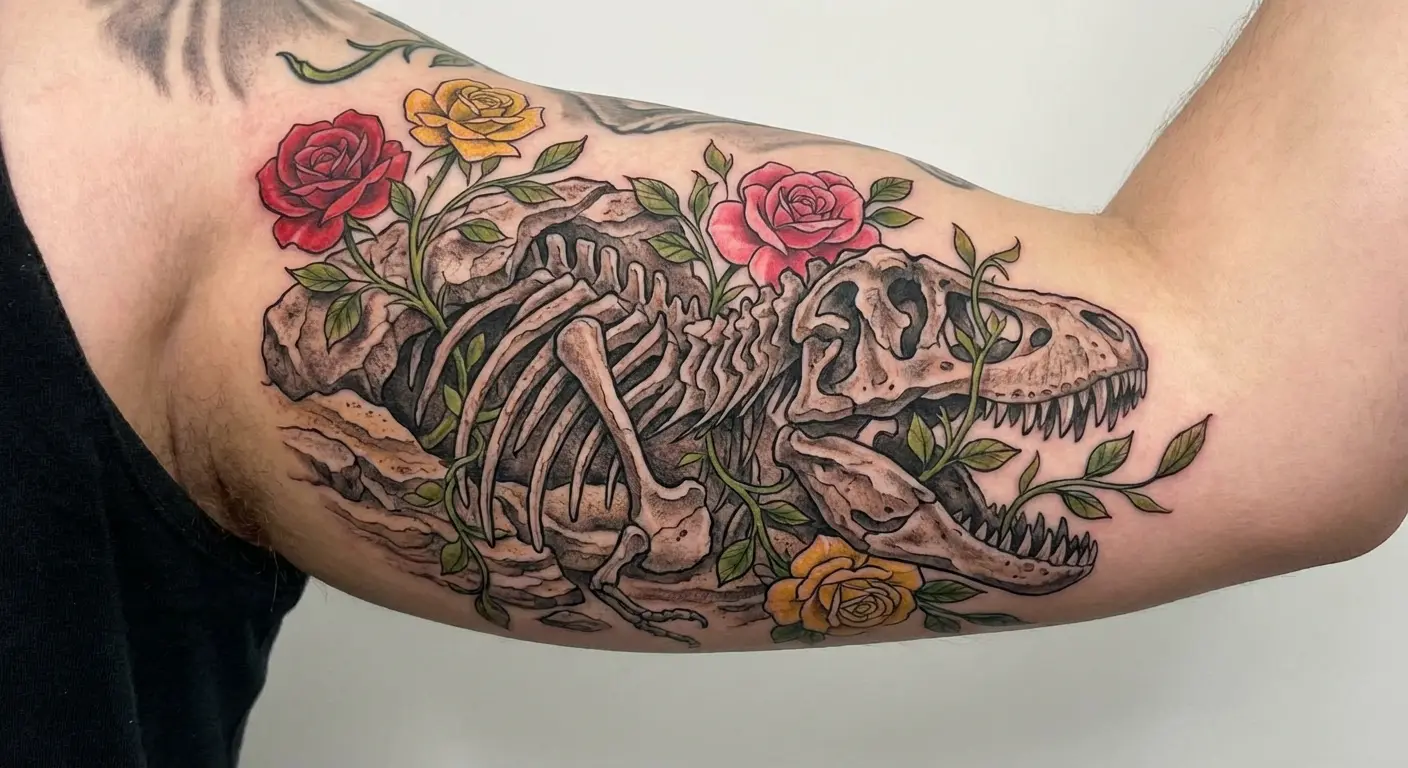
18. Fossilized Bones Growing Living Flowers
Fossils represent death and preservation, but what happens when you show them as the foundation for new life?
Dinosaur bones rendered in fossil style (stone texture, embedded in sediment layers) with living flowers, vines, or other botanicals growing from the cracks and hollow spaces makes powerful imagery about how endings feed beginnings.
This works for people processing grief, celebrating recovery, or marking the ways they’ve grown from difficult experiences. The contrast between dead bone and living plant should be emphasized through color choices (grey and brown fossils against vibrant florals) or texture differences that highlight rough stone versus delicate petals.
The specific flowers you choose can carry their own meanings, adding another layer of personalization.
This scales across sizes but requires enough space for both parts to be clearly readable, making it ideal for forearm, calf, or shoulder blade placement. The botanical integration technique works beautifully with flower tattoo symbolism to create layered narratives about growth from decay.
19. Raptor Feathers Transitioning to Phoenix Flames
Modern paleontology confirms many dinosaurs had feathers, but most dinosaur tattoos ignore this because scales look more traditionally reptilian and intimidating.
Use scientifically accurate raptor feathers as the starting point for a transformation into phoenix flames. Bridges prehistoric reality and mythological symbolism.
The feathers gradually shift from natural browns and greys into oranges, reds, and golds, making a simple design that’s about evolution, transformation, and how ancient things become legendary over time. This works really well for people who want tattoos that acknowledge both the scientific reality (feathers) and the cultural mythology (dinosaurs as monsters and marvels) without choosing between them.
The transition from feather to flame can happen gradually across a large piece or dramatically within a small space, depending on your available canvas and desired impact.
Think about placement where the flames can flow naturally upward (forearm, side of leg, shoulder) following your body’s lines while suggesting rising or ascending motion. The feather-to-flame transformation shares thematic resonance with feather tattoo meaning as symbols of transcendence and spiritual evolution.
You’ve spent hours scrolling through generic dinosaur tattoos that all look vaguely the same, or you’ve tried describing your vision to artists who keep defaulting to Jurassic Park references. We built Tattoo Generator IQ for moments when you know you want something prehistoric but can’t quite articulate how to make it yours.
Our AI-powered generator lets you combine stuff: raptor claws with your birth flowers, Triceratops frill with geometric patterns, tiny Brachiosaurus with your coordinates. See multiple variations instantly. You’re not locked into someone else’s interpretation of what dinosaur tattoos should look like.
Generate unlimited concepts, adjust colors and details in real time, and save high-resolution files your tattoo artist can work from. The consultation becomes collaboration instead of translation.
Whether you’re exploring small dino tattoos for a first piece or planning a complex design that integrates multiple personal symbols, the generator gives you control over every part. You can test different placements, experiment with styles, and refine your vision before committing to permanent ink. The dinosaur studio tattoo experience becomes more collaborative when you arrive with clear visual references that capture your unique vision.
Final Thoughts
Look, you’re going to get the tattoo you want. I’m not your dad.
But if you treat dinosaurs like museum exhibits, you’re going to end up with a museum exhibit on your skin. And museum exhibits are meant to be looked at from a distance, behind glass, by people who are only half paying attention.
Your skin isn’t a museum.
The tattoos that maintain their power over decades are the ones that fragment, personalize, and reimagine rather than reproduce. They use prehistoric imagery as a starting point for contemporary storytelling instead of an endpoint.
Your dinosaur tattoo doesn’t need to be paleontologically accurate to be meaningful. It needs to be emotionally accurate to your experience, visually strong enough to age well, and conceptually flexible enough to grow with you as your life changes. That’s what these nineteen approaches offer: ways to turn ancient creatures into current symbols that speak to who you are now and who you’re becoming.
