Dragonfly Tattoo Meaning: What Your Artist Won’t Tell You About Symbolism Versus Personal Truth
Why Dragonfly Symbolism Is More Personal Than Universal
You’ve probably read a dozen articles telling you dragonflies represent transformation, change, or living in the moment. That’s not wrong, but it’s also not particularly useful if you’re trying to figure out what a dragonfly means to you. While transformation is cited as the top meaning across the US and Europe according to tattoo symbolism guides, this generic interpretation often fails to capture the nuanced reasons individual wearers choose this imagery.
Most tattoo symbolism guides treat meaning as fixed, universal, and transferable. They assume everyone who gets a dragonfly tattoo is celebrating the same kind of change or seeking the same reminder about adaptability. But that’s bullshit, honestly.
The dragonfly on your skin isn’t carrying centuries of Japanese folklore or Native American wisdom unless you specifically want it to. It’s carrying whatever weight you assign it, and that weight can be completely divorced from traditional interpretations.
The Problem With Borrowed Meanings
So you go with the standard transformation story, and six months later you’re explaining your tattoo to someone and the words coming out of your mouth feel… wrong. Not quite what you meant.

Maybe your dragonfly isn’t about transformation at all. Maybe it’s about stillness (dragonflies can hover in place for extended periods). Maybe it represents your relationship with water, your childhood summers, or a specific person who loved these insects. Those meanings are just as valid, possibly more so, because they’re genuinely yours.
I know someone who got a dragonfly tattoo, and it had nothing to do with transformation. Their grandmother’s garden was full of dragonflies every summer, and those afternoons represented the only peaceful moments of an otherwise chaotic childhood. When strangers assume the tattoo represents “change and adaptability,” they’re projecting a narrative that erases the actual meaning: a specific place, a specific person, and the preservation of safety rather than transformation from it. The wearer finds themselves either explaining this complex truth or simply nodding along to the incorrect assumption, creating distance between their body art and its genuine significance.
You end up in this weird position where you’ve permanently marked your body with something super personal, then you’re explaining it using someone else’s words.
Permission to Start From Scratch
You don’t need cultural or historical justification for why a dragonfly matters to you.
The iridescent wings, the way they move, that specific memory of seeing one land on your hand when you were eight—these are sufficient reasons. We’ve been conditioned to believe tattoos require deep, defensible meanings, like we’re going to be quizzed on our symbolism choices. They don’t. Sometimes the meaning is simply “this creature captivates me” or “I want to carry this image with me.” That’s enough. It’s always been enough. The whole “but what does it MEAN” question is something we’ve imposed on ourselves, and you can just… not do that.
The Cultural Disconnect Between Meaning and Ink
Japanese culture associates dragonflies with strength, courage, and victory. Native American traditions connect them to renewal and spiritual growth. European folklore sometimes casts them as sinister (they were called “devil’s darning needles” in some regions).
Which interpretation should you use? None of them, unless you have a genuine connection to that specific cultural framework. Understanding the symbolism of dragonfly tattoo across different cultures can inform your choice, but it shouldn’t dictate it.
| Culture | Traditional Dragonfly Symbolism | Historical Context | When to Use This Meaning |
|---|---|---|---|
| Japanese | Strength, courage, victory, childhood nostalgia | Associated with warriors; featured in children’s song “Aka Tombo” (Red Dragonfly); Japan historically called “Dragonfly Land” (Akitsushima) | You have studied Japanese art/culture, use traditional irezumi style, or have personal Japanese heritage |
| Native American (Navajo) | Renewal, spiritual growth, connection between realms | Viewed as messengers between physical and spiritual worlds; symbols of purity and speed | You have connection to Native American traditions or the symbolism genuinely resonates with your spiritual practice |
| Chinese | Prosperity, harmony, good fortune, summer | Associated with positive energy and purity from muddy waters (especially with lotus flowers) | You’re incorporating Chinese artistic elements or the prosperity symbolism aligns with your intentions |
| European (historical) | Sinister forces, deception, “devil’s darning needles” | Medieval folklore cast them as dangerous or evil | Rarely used unless reclaiming negative symbolism or exploring dark aesthetic |
Cultural Appreciation Versus Aesthetic Borrowing
Getting a dragonfly tattoo in traditional Japanese style (irezumi) because you studied Japanese art history and feel connected to that aesthetic tradition is different from choosing it because it looks cool. Look, both are valid choices, but if you’re pulling from a specific cultural tradition, you should understand what you’re referencing. That doesn’t mean you need permission or approval, but it does mean doing the basic work of understanding context.
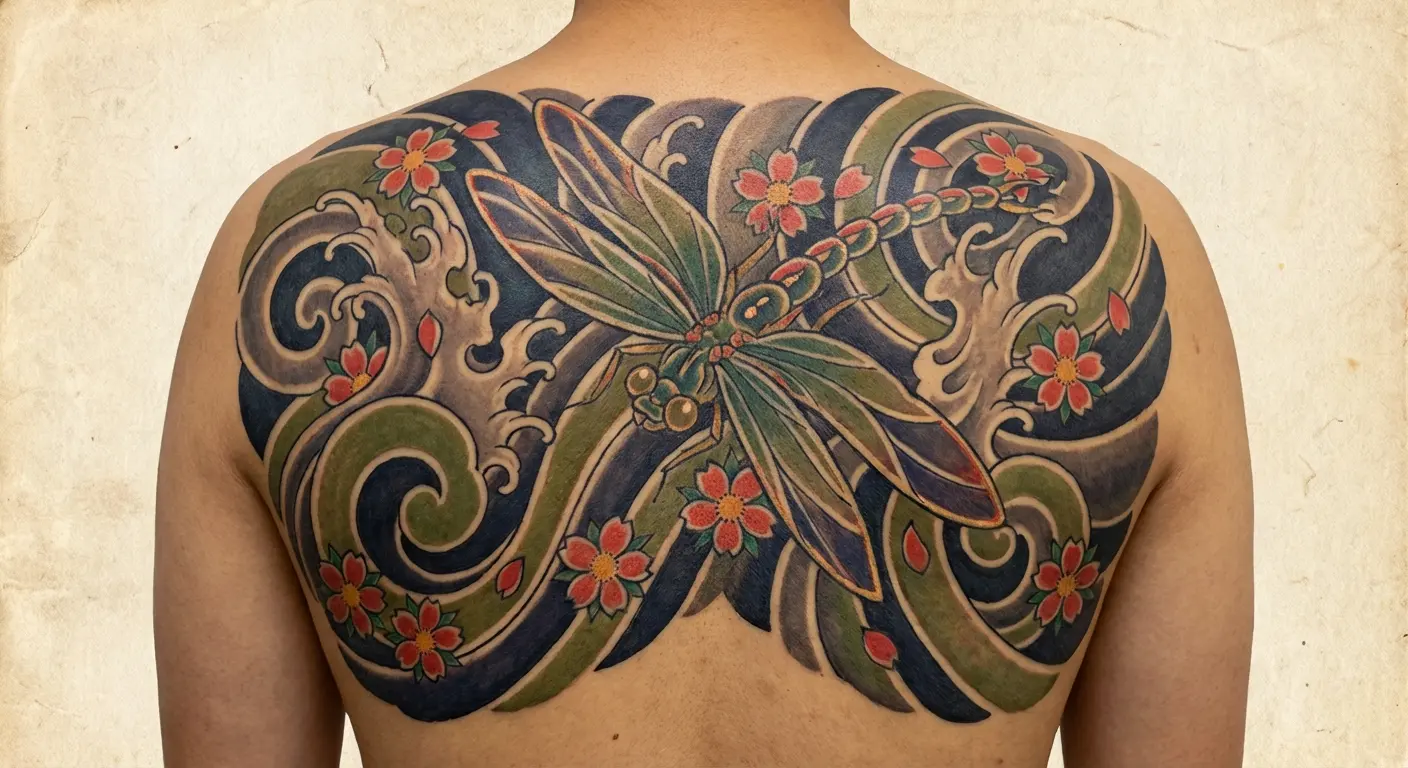
A dragonfly in Japanese tattooing appears alongside other elements (water, flowers, wind bars) that complete the symbolic narrative. According to tattoo culture research, while there’s a common misconception that the dragonfly is Japan’s national symbol (it’s actually the chrysanthemum), Japan does have a profound historical relationship with dragonfly imagery, with the country itself being called “The Dragonfly Land” (Akitsushima) in historical documents. In Japan, there’s this kids’ song about red dragonflies called “Aka Tombo” that everyone knows. It’s nostalgic, connected to childhood summers. That’s a completely different vibe than the warrior strength symbolism.
Understanding the symbolism of dragonfly tattoo within specific cultural contexts is similar to how Japanese traditional tattoo elements work together to create layered meaning.
Borrowing the aesthetic without understanding the symbolic language can result in imagery that reads as confused or superficial to people familiar with that tradition.
When Cultural Meaning Doesn’t Apply
You’re not required to adopt any cultural interpretation. If you grew up watching dragonflies near a specific lake and that’s your entire association, you don’t need to layer Japanese or Native American symbolism on top of that memory.
The question isn’t “which culture’s meaning should I use?” It’s “does this cultural context add something meaningful to my experience, or am I just using it to make my tattoo seem deeper?”
Transformation Isn’t Always About Change
Every dragonfly tattoo article mentions transformation because dragonflies undergo metamorphosis. Sure, that’s biologically accurate. But so what? That might have nothing to do with why you want one.
Transformation doesn’t always mean you became someone new. Sometimes it means you fought to stay yourself despite circumstances that tried to change you. Sometimes it means you’re still in the middle of the process and don’t know what you’re becoming yet.
The Myth of Complete Metamorphosis
Dragonfly nymphs live underwater for months or years before emerging as adults. The imagery is powerful: hidden development, sudden emergence, complete physical transformation. But applying that narrative to human experience feels forced more often than not.
The biological reality of dragonfly transformation is stark: I’ve seen studies that say a standard dragonfly can remain in its water nymph “child state” for 6 to 12 months, but after metamorphosing into adult form, they typically have only 2 weeks before they die. This dramatic compression (months of hidden development followed by brief, visible existence) creates compelling metaphorical possibilities, but it doesn’t map neatly onto human experience where transformation is rarely so definitive or time-bound.

Your transformation might not have a clear before and after. You might be someone who’s constantly shifting, never fully settling into a final form. Or you might be someone who’s remained fundamentally the same while everything around you changed.
Both of those experiences are valid reasons to connect with dragonfly imagery.
Transformation as Maintenance
What if your dragonfly represents the work of staying intact? The energy required to keep flying, to maintain your iridescence, to hover in place when everything around you is chaos?
That’s still transformation, just not the dramatic kind. It’s the daily, exhausting work of preserving yourself. That interpretation rarely appears in standard symbolism guides, but it’s closer to how transformation actually works for most people.
A healthcare worker got a dragonfly tattoo during the pandemic. She was working COVID ICU, and the whole transformation thing everyone kept saying felt insulting (like she was supposed to be grateful for trauma or some shit). Her dragonfly was about the fact that she was still showing up. Still doing the job. Not transformed, just… not destroyed yet. The dragonfly’s ability to hover (to maintain position against wind and current) captured the exhausting maintenance work of staying professionally functional while everything else fell apart. The transformation wasn’t about becoming someone different; it was about the energy expenditure required to remain recognizably yourself under sustained pressure. When people say “oh, transformation!” she usually just nods because explaining the real reason makes people uncomfortable.
Honoring Incomplete Change
You don’t need to have finished transforming to get a transformation tattoo. A dragonfly can represent where you are right now: still underwater, still developing, not ready to emerge but aware that emergence is coming.
That uncertainty is part of the meaning. The tattoo becomes a marker of this specific moment, not a celebration of completed change.
Death, Rebirth, and the Stories We Tell Ourselves
Some traditions connect dragonflies to death and the afterlife. They appear near water (a liminal space between worlds), they transform from one state to another, and they’re present during late summer. Former Olympian Lisa Curry got a pink dragonfly tattoo after her daughter Jaimi died in September 2020 and her mother Pat died in March 2022. She posted about it on Instagram saying “a dragonfly symbol represents hope, change, transformation and self-realisation” and serves as “a reminder to live life to the fullest and appreciate every moment.” Her choice demonstrates how dragonfly imagery can honor loss while maintaining forward momentum, though (and I want to be clear about this) this hopeful interpretation isn’t the only valid approach to grief.
If you’re getting dragonfly tattoos to process loss, the standard “death and rebirth” narrative might feel uncomfortably prescriptive.
When Rebirth Isn’t Part of Your Story
Rebirth implies something positive emerging from loss. That’s not everyone’s experience. Sometimes death is just death. Permanent, final, without redemptive transformation.
A dragonfly can honor that finality. It can represent presence near water where you scattered ashes, or the specific day you saw one and thought of someone you lost, or simply the beauty of something ephemeral. You don’t owe anyone a hopeful interpretation.

Survival Without Redemption
Maybe you survived something that almost killed you. Illness, trauma, whatever. And you’re tired of people saying it made you stronger or taught you lessons. Your dragonfly can just mean “I’m still here” without any of that redemptive bullshit attached to it.
Get a survival tattoo that doesn’t celebrate what you survived. The dragonfly can simply mark “I’m still here” without adding “and I’m grateful for what I learned.” Those are different statements, and only you know which one is true.
Ongoing Grief
Grief doesn’t end. Dragonfly tattoos can represent the ongoing nature of loss rather than the completion of a grief journey. They can be a permanent acknowledgment that you’re still carrying something, still processing, still in relationship with what you lost.
That’s a different use of death symbolism than most guides discuss, but it’s more honest to how grief actually works.
Color Psychology in Dragonfly Tattoos (And Why It Matters Less Than You Think)
Blue dragonflies supposedly represent peace and calm. Red ones indicate passion or energy. Green suggests growth and renewal. Purple connects to spirituality.
Color psychology in tattoos is mostly made-up nonsense that sounds authoritative. Your blue dragonfly doesn’t have to mean calm just because some chart says so.
Personal Color Associations Override Universal Ones
You’ve spent your entire life building associations with colors based on your experiences, preferences, and memories. Those associations are stronger and more meaningful than any symbolic system.
If yellow makes you think of illness (hospital walls, jaundice, warning signs), a yellow dragonfly isn’t going to successfully represent joy just because color psychology says it should. Your brain doesn’t work that way.
Aesthetic Choice as Valid Choice
You might choose colors simply because they look good together or because you want the tattoo to match other ink you have.
That’s completely reasonable. The meaning of your tattoo doesn’t have to justify every design decision. Sometimes colors are just colors, chosen for visual impact, not symbolic weight.
When Color Meanings Actually Matter
Color symbolism becomes useful when it aligns with what you already feel. If green genuinely represents growth in your personal symbolic language, then a green dragonfly reinforces that meaning. The color adds a layer that feels coherent and intentional.
The key is checking whether the symbolic meaning matches your actual association. If it does, use it. If it doesn’t, ignore it.
Placement as a Meaning Modifier
Where you put your dragonfly tattoo changes what it means to you, even if the design itself stays the same.
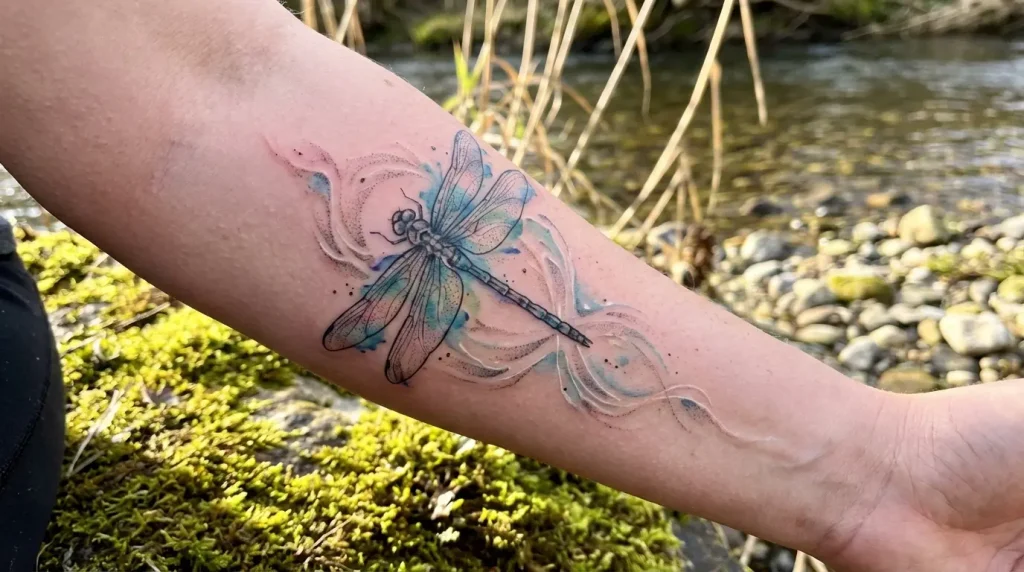
A dragonfly on your forearm is something you see constantly. It functions as a regular reminder, a visual touchstone you encounter dozens of times daily. A dragonfly on your back is something you rarely see but others notice. It’s more for them than for you (or it’s intentionally private, depending on how you think about it).
Visible Placements as Public Declarations
Hands, forearms, neck. These placements make your dragonfly tattoo part of how you present yourself to the world. The meaning becomes partially about what you’re willing to display, what you want others to know about you without asking.
That visibility can change the meaning over time. A transformation tattoo on your hand might start as a personal reminder but become a conversation starter, a way you explain yourself to others. The meaning shifts from internal to external.
Visible tattoos increasingly function as conversation catalysts rather than private symbols. Mental health advocate Jasmin C. shared her visible dragonfly tattoo with The Mighty, explaining: “The dragonfly symbolizes change, transformation, adaptability and self-realization. The change that is often referred to has its source in mental and emotional maturity and understanding the deeper meaning of life. Life is good.” Her choice to place this imagery where others can see it transforms the tattoo from personal reminder to public statement about mental health awareness, demonstrating how placement determines whether your symbolism remains private or becomes part of your social presentation.
Hidden Placements as Private Anchors
Ribs, upper thigh, back. These placements keep the meaning primarily between you and the tattoo. You have to intentionally seek out your reflection or a photo to see it. Other people only see it in intimate contexts.
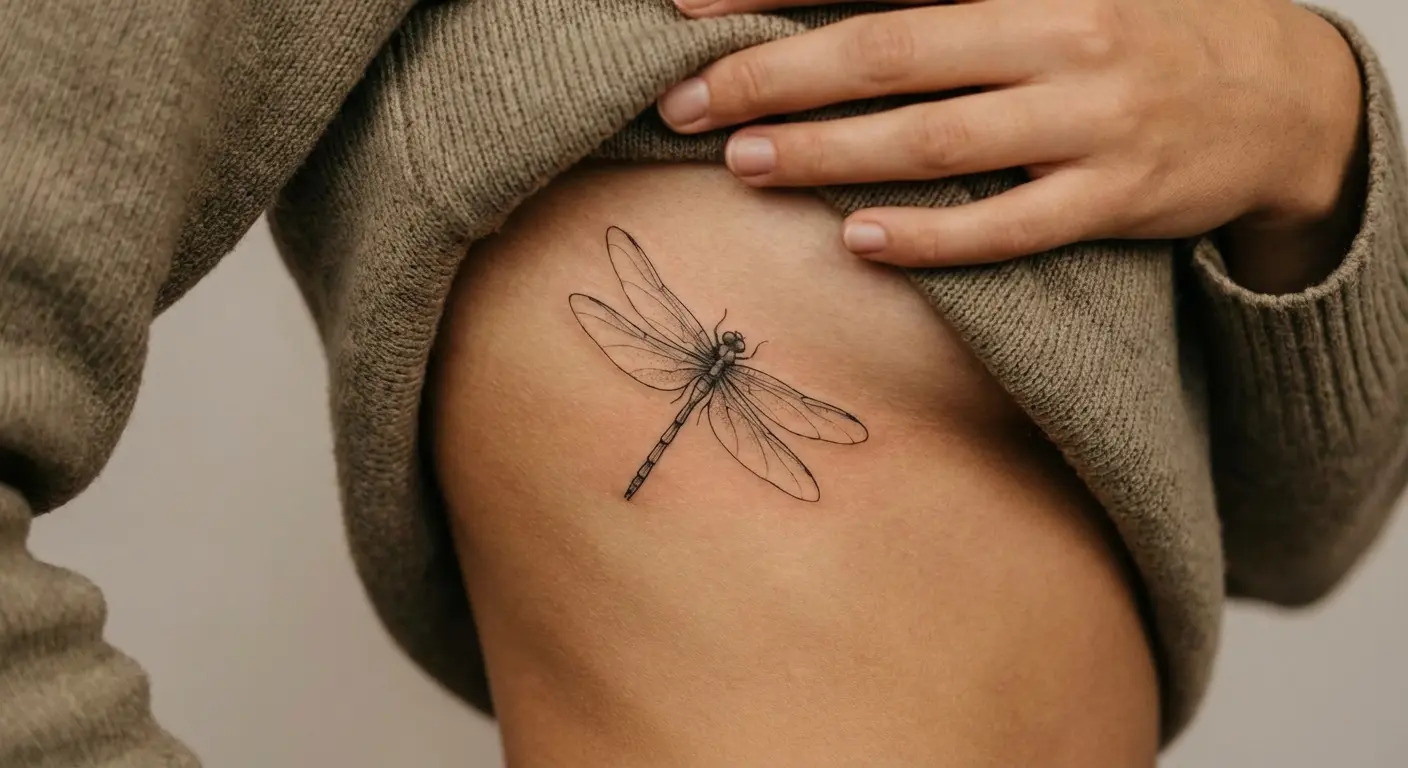
That privacy can make the meaning more stable. It doesn’t get diluted by constant explanation or public display. It remains yours in a way visible tattoos sometimes don’t.
Placement and Physical Sensation
Some placements hurt more than others, and that pain becomes part of the tattoo’s meaning. A dragonfly on your ribs or spine might carry the memory of sitting through difficult pain, which adds a layer of “I endured this” to whatever else it means.
You’ll also feel clothing move across certain placements, creating ongoing physical awareness. A dragonfly on your shoulder blade might brush against shirt fabric constantly, creating a subtle, repeated reminder of its presence.
Before committing to placement, think about:
- Visibility frequency: Do you want to see this tattoo daily, occasionally, or rarely?
- Professional considerations: Will this placement require covering in work contexts? Does that matter to you?
- Pain tolerance vs. meaning: Is enduring pain in a specific location part of the tattoo’s significance?
- Physical sensation: Do you want ongoing tactile awareness (clothing friction, movement) or minimal physical reminder?
- Aging and body changes: How might this placement change with weight fluctuation, pregnancy, or aging?
- Explanation burden: Are you comfortable with strangers asking about visible tattoos, or do you prefer privacy?
- Interaction with existing ink
- Symbolic body mapping: Does this body area hold specific meaning (heart area for emotional content, hands for action/creation, back for burden/protection)?
- Practical viewing: Can you see it without mirrors/photos, or is that irrelevant to its function?
- Intimate vs. public: Who gets to see this tattoo, and does that selectivity matter to its meaning?
When Traditional Symbolism Conflicts With Your Story
You might love dragonflies but hate the transformation narrative. You might connect to the imagery for reasons that have nothing to do with any established symbolic system. That creates a strange tension: you want the tattoo, but you don’t want the baggage.
Just as tattoo meaning can be deeply personal and diverge from convention, your dragonfly interpretation doesn’t need external validation. The significance of a dragonfly tattoo is entirely yours to define.
Rejecting Symbolism Entirely
You can get a dragonfly tattoo that means nothing beyond “I find this creature beautiful.”
That’s sufficient justification. Not every tattoo needs to be a symbolic statement or a narrative marker. Sometimes we overthink meaning because we feel we need to justify permanent body modification. But aesthetic appreciation is a valid reason for choosing imagery. Sometimes things just look cool. That’s enough.
Redefining on Your Terms
You can take dragonfly imagery and assign it completely personal meaning that contradicts traditional interpretations. Your dragonfly might represent stubbornness (they’re territorial and aggressive). It might represent your favorite color, your lucky number (if you saw four dragonflies once), or absolutely nothing.
The imagery is yours once it’s on your skin. You’re not bound by how others have used it.
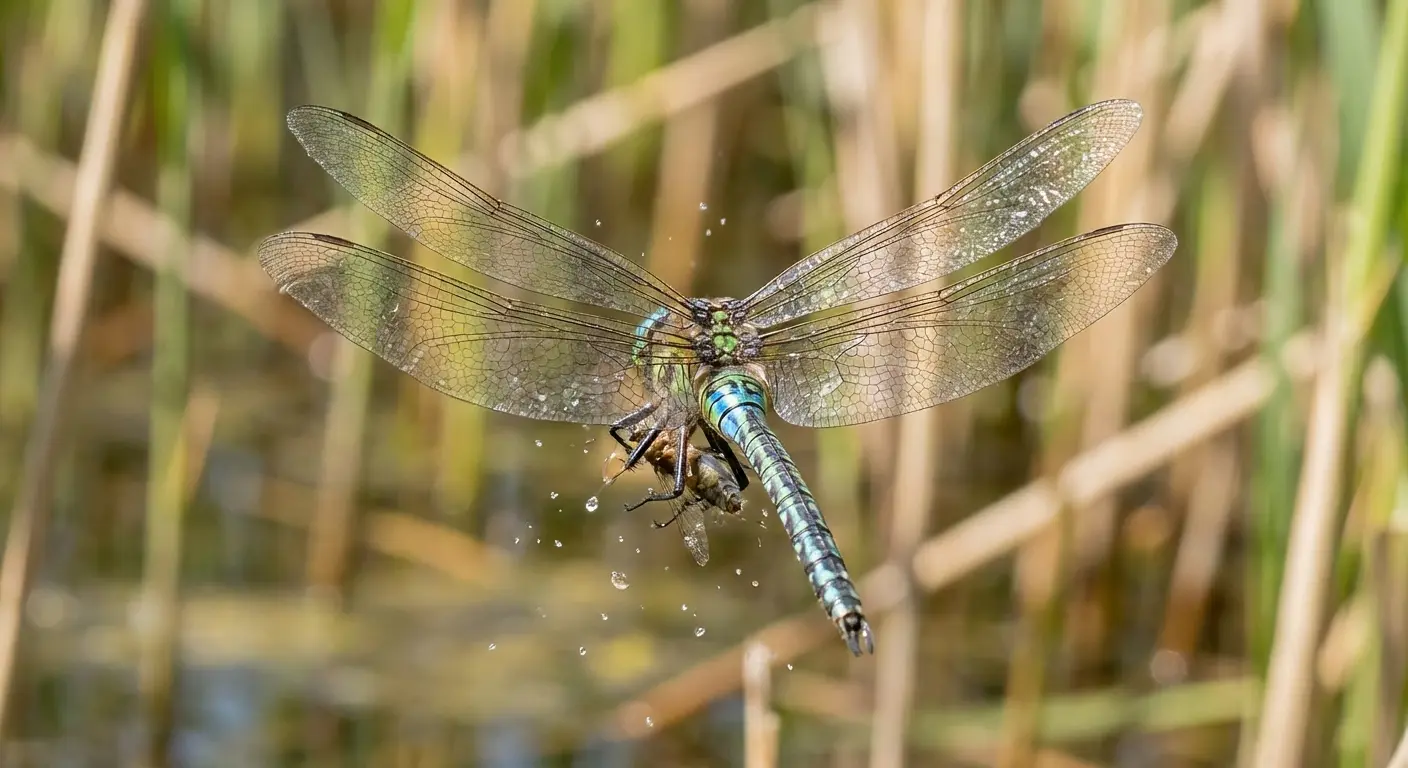
There’s an entomologist on Instagram who got a dragonfly specifically to fuck with people’s assumptions. She studies them, knows they’re vicious predators with a 95% hunting success rate, and she’s tired of the “delicate transformation” bullshit. Her dragonfly represents the reality she knows from fieldwork: they’re voracious predators, they’re territorial and aggressive, and they’ve existed largely unchanged for 300 million years (the opposite of transformation). When someone comments about her beautiful transformation symbol, she responds with dragonfly predation facts. I love this energy.
Handling Assumptions
People will assume they know what your dragonfly tattoo means. They’ll say “oh, transformation, right?” or launch into what they know about dragonfly symbolism.
You can correct them, agree noncommittally, or just let them believe whatever they want. Your tattoo’s real meaning doesn’t require their understanding or approval. Sometimes the easiest response is “something like that” and changing the subject.
When someone assumes they know your dragonfly’s meaning, you can:
Polite deflection:
“It means something personal to me” or “I just really love how they look.”
Honest boundary-setting:
“Actually, it means something different to me, but I’d rather keep that private.”
Educational correction (if you want to engage):
“Most people think that, but for me it represents [your actual meaning].”
Humor/deflection:
“Nope, I just thought it looked cool” or “It’s a long story I don’t usually get into.”
Complete shutdown:
“I’d rather not get into it” or just change the subject without answering.
Building Your Own Symbolic Framework
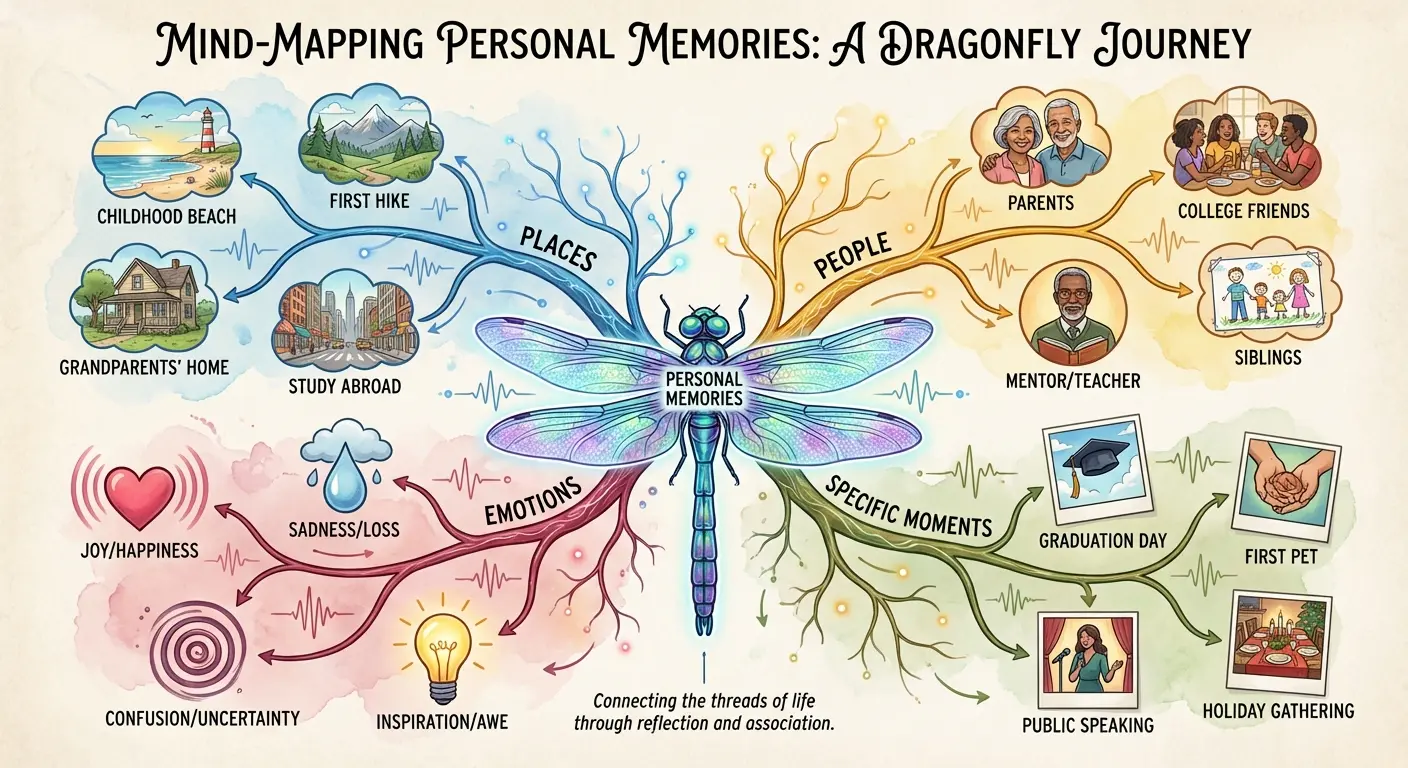
Creating your own symbolic language requires paying attention to your actual associations rather than inherited ones. What do dragonflies make you feel? What memories surface when you see them? What specific characteristics draw you to them?
Building personal symbolism works similarly across different subjects. Whether you’re exploring lotus flower tattoo meaning or dragonfly interpretations, the process starts with your authentic associations. The meaning of dragonfly tattoo should emerge from your lived experience, not borrowed narratives.
Mining Your Associations
Sit with the imagery for a while. Don’t rush to assign meaning. Notice what comes up when you look at dragonfly photos or watch videos of them flying. The meaning might be something you haven’t articulated yet, something that requires time to surface.
Your associations might be weird or specific or seemingly trivial. Maybe dragonflies remind you of a specific summer, a person, a place, a feeling you can’t quite name. Those associations are your raw material.
Combining Elements for Specificity
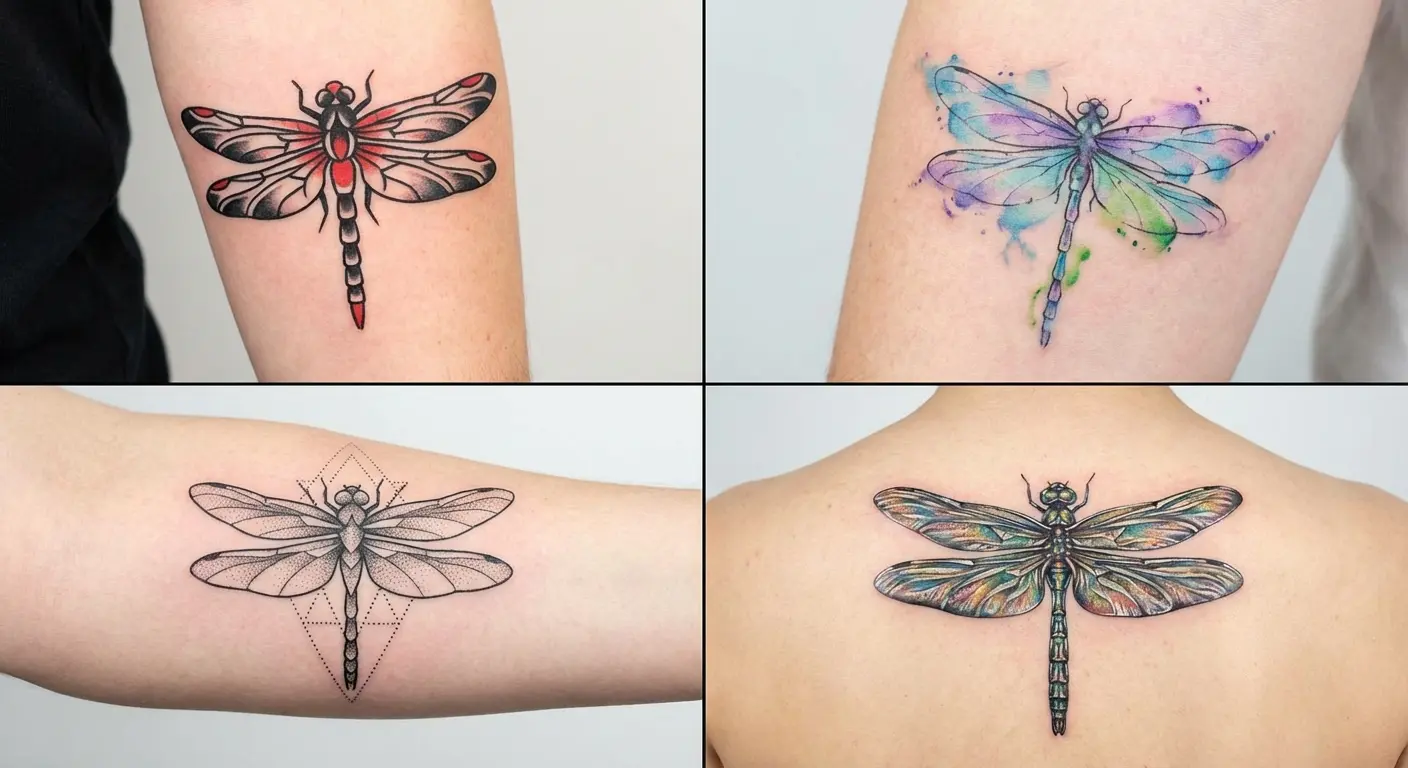
Adding other imagery to your dragonfly can narrow the meaning. A dragonfly with water creates different associations than a dragonfly with flowers or geometric patterns. These combinations let you build a more specific symbolic statement.
You might combine a dragonfly with elements from a specific memory (the type of grass that grew near where you always saw them, the specific flower that was blooming). That creates a symbolic landscape that’s entirely personal and largely unreadable to others. The meaning of a dragonfly tattoo becomes richer when you layer personal visual references that outsiders won’t necessarily decode.
Visualizing Before Committing
One of the biggest challenges in creating personal symbolism is knowing whether your concept will translate visually. You might have a clear idea of what you want your dragonfly to mean, but struggle to picture how that meaning becomes an actual tattoo design.
Side note: if you’re trying to figure out whether your concept will actually work as a tattoo, tools like Tattoo Generator IQ let you test variations before committing. I’m not saying you need it, but seeing your idea in different styles can help you figure out what you’re actually trying to say. Sometimes you’ll discover that your original concept needs adjustment, or that a completely different visual approach better represents your personal symbolism. Getting those variations in front of you quickly means you can refine your symbolic framework while it’s still flexible, before you’re sitting in a tattoo chair trying to explain something that exists only in your head.
Documenting Your Personal Meanings
Write down what your dragonfly tattoo means to you, even if you never show anyone. That documentation serves two purposes: it clarifies your thinking during the design process, and it preserves the meaning for future you.
Dragonfly tattoo meanings can fade or shift over time. What felt urgently important at 25 might feel distant at 45. Having a record of what you were thinking, what you were processing, what the imagery meant in that specific moment can be valuable later.
That documentation doesn’t lock you into a single interpretation forever. Meanings can evolve. But it gives you a baseline, a way to track how your relationship with the imagery has changed.
Okay, Real Talk
I’ve spent 3,000 words telling you that dragonfly tattoos can mean whatever you want. Which is true. But I also know that when you’re sitting in the chair, or looking at designs, or trying to explain your idea to an artist, you’re going to second-guess yourself. You’re going to wonder if you’re doing it “right.”
There is no right.
The transformation narrative? Ignore it if it doesn’t fit. The cultural meanings? Optional. The color psychology? Mostly bullshit.
Your dragonfly means what you say it means. It can be profound or it can be simple. It can honor something or just look cool on your arm. Both are fine.
Every dragonfly tattoo article mentions transformation because dragonflies undergo metamorphosis. That’s literally what they do. But applying that narrative to human experience often feels forced. Stop waiting for permission to interpret your own imagery. Understanding the meaning of the dragonfly tattoo starts with understanding yourself, not consulting symbolism guides.
The dragonfly means what you say it means, and that meaning can be as simple or as complex, as traditional or as unconventional, as you need it to be. You’re not translating universal symbolism onto your skin. You’re creating a permanent marker of something that matters to you, in language only you need to fully understand.
The only wrong answer is getting a tattoo that means something to everyone else but nothing to you.
The tattoo is already yours before the ink touches your skin. Everything else is just figuring out how to make the external image match the internal truth.
