23 Geometric Tattoos That Actually Work With Your Body (Not Against It)
What’s in Here
Designs that follow your muscles, designs that move with you, designs anchored to bones, and designs for asymmetrical spots.
The Quick Version
-
Don’t slap geometric patterns on your body randomly. Work with how your muscles and bones actually sit
-
What looks cool standing still might look weird when you move
-
Small details blur over time, huge designs can warp
-
Your sternum, spine, and joints are built-in alignment guides. Use them
-
Negative space matters as much as the lines themselves
-
Scale affects aging more than you’d think
-
Movement changes everything about how geometric patterns read
Designs That Follow Your Muscle Lines
Most people pick geometric tattoo placement based on visibility or pain tolerance.
Let’s flip that.
Your muscles create natural lines and curves that geometric patterns can either enhance or fight against. When you align angular designs with the way your body already moves and flexes, the tattoo becomes an extension of your physical form. Not decoration sitting on top of it. Geometric tattoo designs are distinguished by their precise lines and shapes that form patterns often inspired by nature, mathematics, and different cultures, according to Tattoo Smart’s analysis of geometric tattoo styles.
Here’s where muscle definition actually helps instead of hurts.
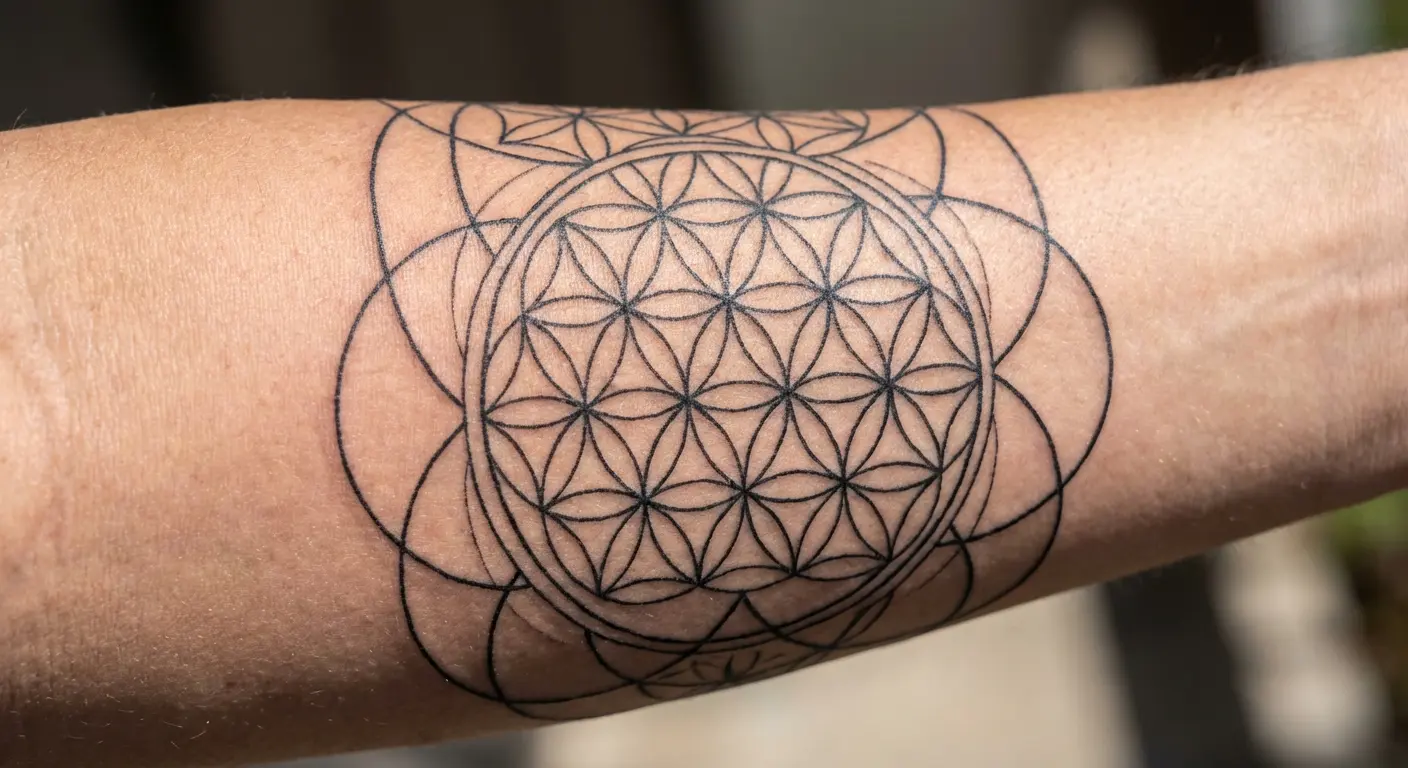
1. Forearm Sacred Geometry Bands
Forearm bands wrap around one of the most visible and frequently moving parts of your body.
The key isn’t just choosing a cool geometric pattern. It’s understanding how your forearm’s rotation affects the design. People rarely see your forearm from just one angle. The pattern needs to read clearly whether your palm faces up, down, or to the side. Go for patterns with rotational symmetry so they look intentional from multiple viewing angles.
Your forearm also tapers from elbow to wrist, so uniform band widths look awkward. Skilled artists will subtly adjust line weight or pattern density to compensate for this natural taper. These tiny adjustments are what separate a tattoo that looks like a sticker from one that looks like it grew there.
|
Sacred Geometry Symbol |
Best Forearm Placement |
Rotational Advantage |
Complexity Level |
|---|---|---|---|
|
Flower of Life |
Mid-forearm band |
Reads clearly from all angles due to circular symmetry |
Medium |
|
Metatron’s Cube |
Upper forearm (wider area) |
Central hexagon stays visible during rotation |
High |
|
Seed of Life |
Lower forearm near wrist |
Compact design maintains integrity with hand movement |
Low-Medium |
|
Vesica Pisces |
Inner or outer forearm linear |
Works well with natural taper, elongates arm visually |
Low |
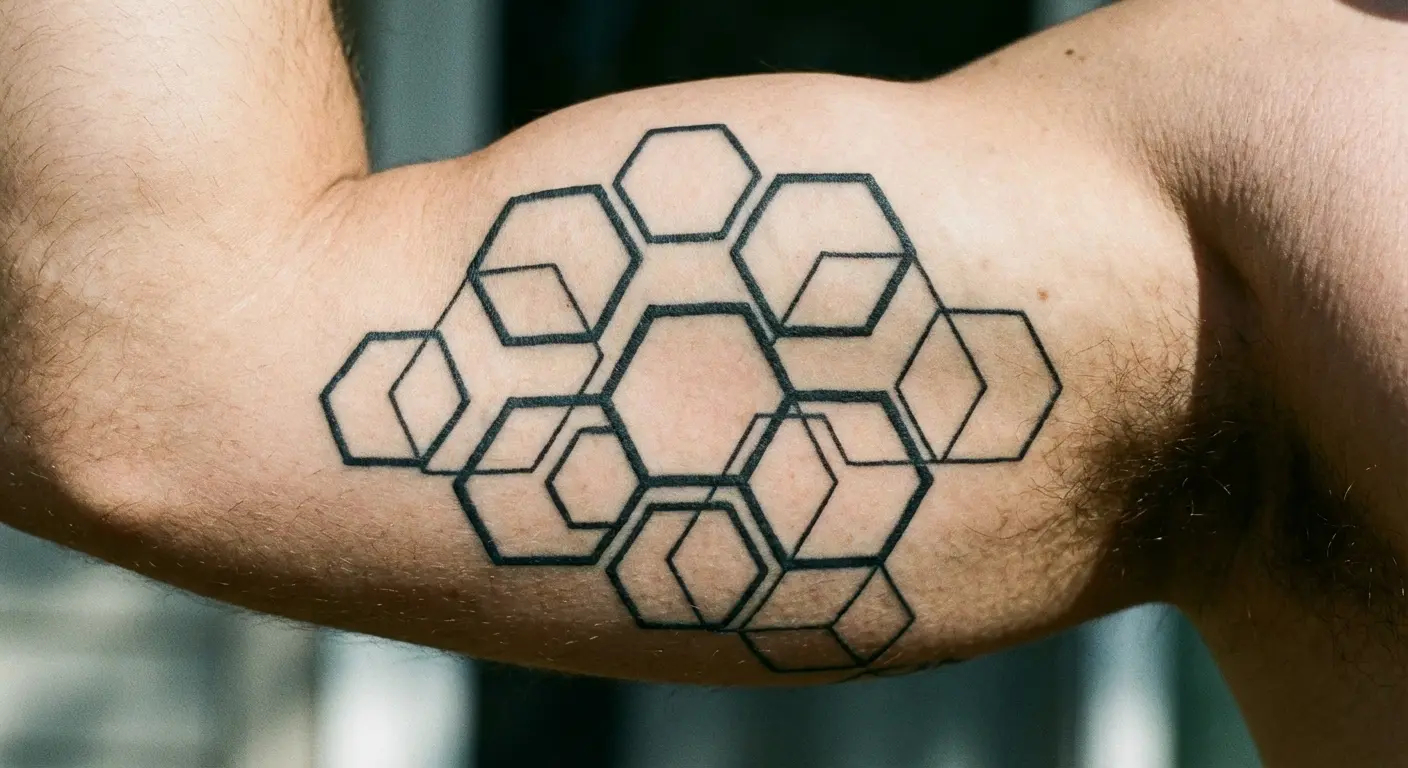
2. Bicep Hexagon Clusters
Your bicep expands and contracts more than almost anywhere else you’d put a tattoo.
That’s exactly why hexagons work. Six-sided shapes stretch without turning into weird ovals or skewed rectangles. Relaxed arm? Standard formation. Flexed? The whole cluster expands outward, but the angles stay sharp.
Where you put this matters a lot. Dead center on your bicep peak? Maximum distortion when you flex, which might be exactly what you want, that dramatic transformation. Shift it toward the inner or outer arm and the movement gets more subtle. Some people want that dramatic effect. Others prefer consistency. Neither’s wrong, but decide which you want before committing.
3. Calf Tessellation Wraps
Your calf muscle has a distinct oval shape that creates interesting opportunities for tessellation patterns. You know, those repeating shapes that fit together like bathroom tile.
The challenge? Your calf isn’t a cylinder. It’s wider in the middle and narrows at the ankle and behind the knee.
Tessellation wraps that ignore this reality end up looking compressed or stretched depending on where you’re viewing from. Smart designs account for this by gradually adjusting the scale of the tessellating shapes as they move up or down the leg. Start with larger triangles or diamonds at the widest part of your calf, then progressively reduce their size as the pattern approaches your ankle.
This creates the illusion of a uniform pattern while being carefully calibrated to your body’s specific dimensions. The design adapts to your anatomy instead of forcing your anatomy to accommodate it.
4. Shoulder Blade Mandala Extensions
Your shoulder blade moves more than you think.
Every time you reach forward, shrug, or rotate your arm, that bone shifts position under your skin. Mandala designs centered on the shoulder blade can use this movement to their advantage. Instead of treating the mandala as a static circular design, consider how the outer rings or geometric extensions can flow with your shoulder’s range of motion.
When your shoulder’s at rest, the mandala appears complete and centered. Reach forward, and the shoulder blade protrusion makes certain elements more prominent while others recede. This creates a subtle three-dimensional effect that flat placements can’t replicate. The design should have enough detail in the center to anchor it, with geometric extensions that can handle some distortion without losing coherence.
Designs That Create Visual Flow Through Movement
Static images of geometric tattoos don’t show you the full picture.
Your body bends, twists, stretches, and compresses all day long. Some placements naturally create visual flow as you move. Think of how a spine piece reveals itself as you bend forward, or how rib designs expand when you breathe deeply. We’re embracing the fact that your body’s constantly in motion, and your tattoos should enhance that instead of fighting it.
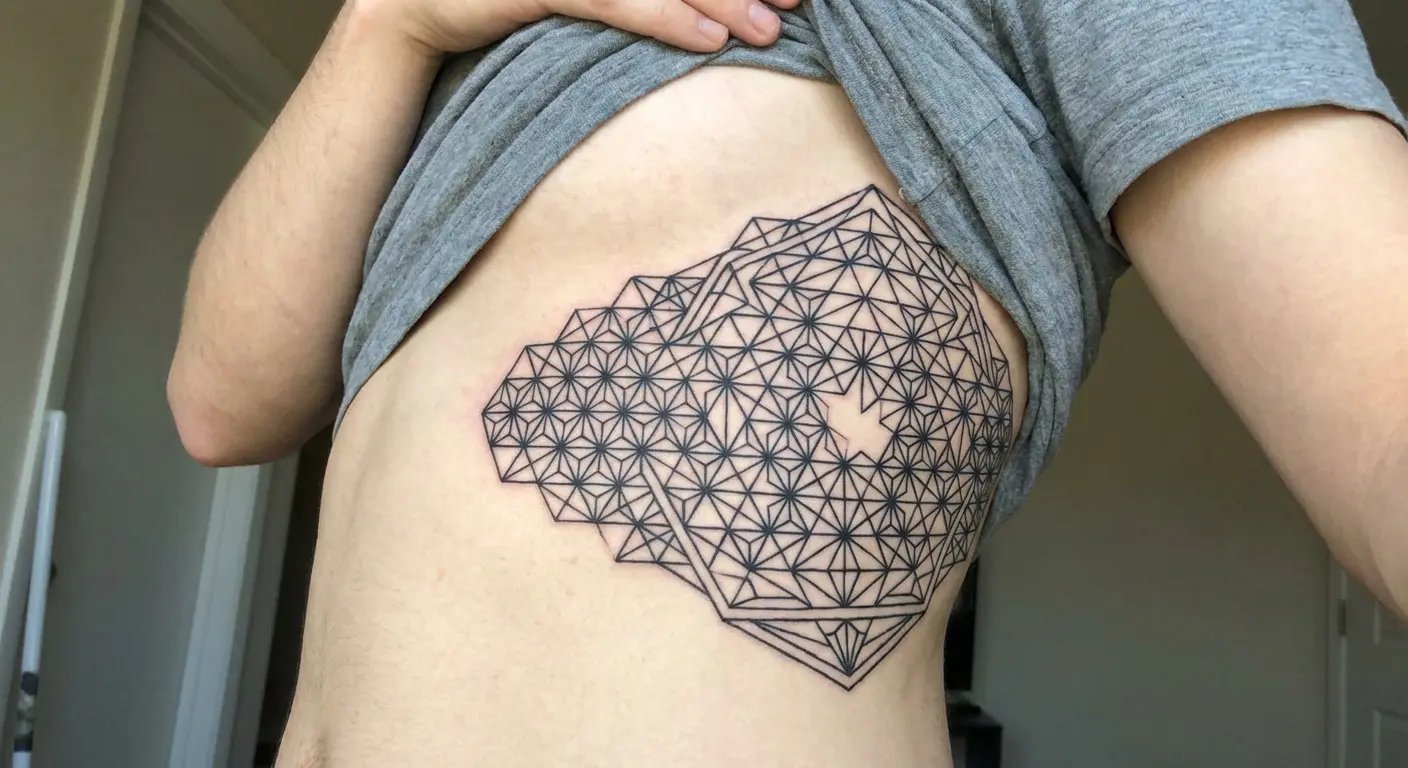
5. Rib Cage Expanding Polygons
Your rib cage expands with every breath.
Polygon designs (triangles, pentagons, hexagons arranged in expanding patterns) can mirror this biological rhythm. The trick? Orientation. Polygons arranged horizontally across your ribs will compress and expand most noticeably. Vertical arrangements stay more stable but lose that breathing effect.
You can also play with density. Tighter polygon clusters near your sternum with gradually loosening patterns as they reach your side create the illusion of the design literally opening up as your ribs expand.
This isn’t just aesthetic theory. When you’re wearing fitted clothing, these subtle movements catch light differently and create visual interest that static placements can’t match. Artists specializing in fineline tattoo techniques often excel at creating the precise geometric work needed for rib cage placements, where line quality makes or breaks the design.
Real talk: ribs hurt. Like, really hurt. And they hurt when you breathe for the first week of healing. Just FYI.
6. Spine Descending Triangle Chains
Your spine is the most obvious centerline on your body, but most spine tattoos don’t take full advantage of its segmented structure.
Triangle chains (equilateral or isosceles triangles linked point-to-base down your vertebrae) create a geometric emphasis on each spinal segment. When you bend forward, the triangles separate slightly. Stand straight, and they compress into a tighter formation. This variable spacing makes the design feel responsive to your posture.
The challenge? Making sure the triangles are sized and spaced so they align with your actual vertebrae, not some idealized version. Your artist needs to mark these with you in your natural standing position, then check alignment when you bend forward and arch back. The design better work in all three positions. I’ve seen too many spine pieces that look perfect standing but fall apart when the person moves.
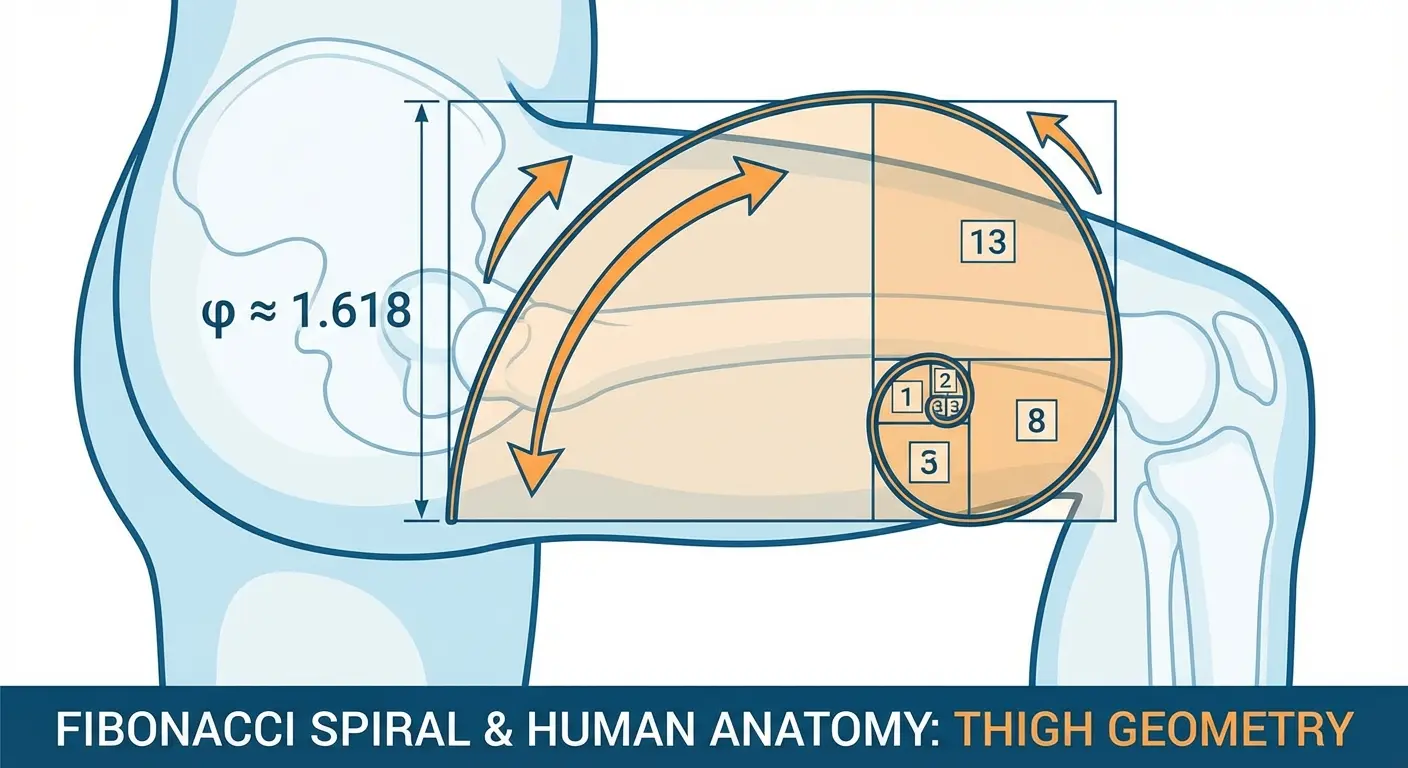
7. Thigh Spiral Fibonacci Sequences
Fibonacci spirals (geometric patterns based on the mathematical sequence where each number is the sum of the previous two) create natural-looking curves that work beautifully on the thigh’s cylindrical shape.
Your thigh rotates when you walk, and a well-placed Fibonacci spiral will appear to “unwind” as your leg moves through its stride. The spiral should start at a fixed point (usually the outer or inner thigh) and curve around toward the back or front. As you walk and your thigh rotates, different sections of the spiral become visible from the front.
This creates a sense of the pattern emerging and receding with your movement. The mathematical precision of Fibonacci sequences also means the spiral’s proportions will feel balanced even though they’re asymmetrical.
8. Chest Radiating Line Work
Your chest provides a broad, relatively flat canvas, but it’s not static.
Breathing, posture changes, and arm movements all affect how chest tattoos read. Radiating line work (geometric lines emanating from a central point, usually the sternum or slightly off-center) can emphasize your chest’s natural expansion. The lines can be simple and minimalist (single-weight black lines) or complex (incorporating dot work, varying line weights, or geometric shapes at specific intervals).
Make sure the radiation point is anatomically anchored. Centering it on your sternum makes sense for symmetrical builds, but if you have pronounced pectoral development on one side, a slightly off-center radiation point might look more balanced. These designs also interact interestingly with chest hair growth patterns (if applicable), creating natural texture variations.
9. Hip Bone Angular Accent Pieces
Hip bones create sharp, defined landmarks that geometric designs can either highlight or soften.
Angular accent pieces (small geometric clusters, usually incorporating triangles or sharp polygons) placed directly on or near the hip bone prominence create a visual echo of your skeletal structure. These work particularly well as part of larger designs, like a thigh piece or lower torso work, where the hip accent serves as a transition point.
The angular nature of these pieces means they can handle the hip’s movement without distorting. When you shift your weight or walk, the hip bone’s position changes, but angular geometry maintains its integrity better than curved or organic designs in this high-movement zone.
10. Ankle Rotating Cube Illusions
Your ankle rotates constantly as you walk.
Impossible cube illusions (geometric designs that appear three-dimensional or paradoxical) can play with this movement. A cube drawn in isometric perspective on your ankle will appear to rotate or shift as you move your foot. The illusion works because your brain’s trying to resolve the two-dimensional pattern into a three-dimensional object, and the ankle’s movement provides changing perspectives that enhance this effect.
These designs work best when sized appropriately. Too small and the illusion is lost, too large and it wraps awkwardly around the ankle’s curve. Centering the cube on the outer or inner ankle bone can make it look like the bone itself is part of the geometric structure.
Designs That Anchor to Specific Body Landmarks
Your body has built-in alignment guides.
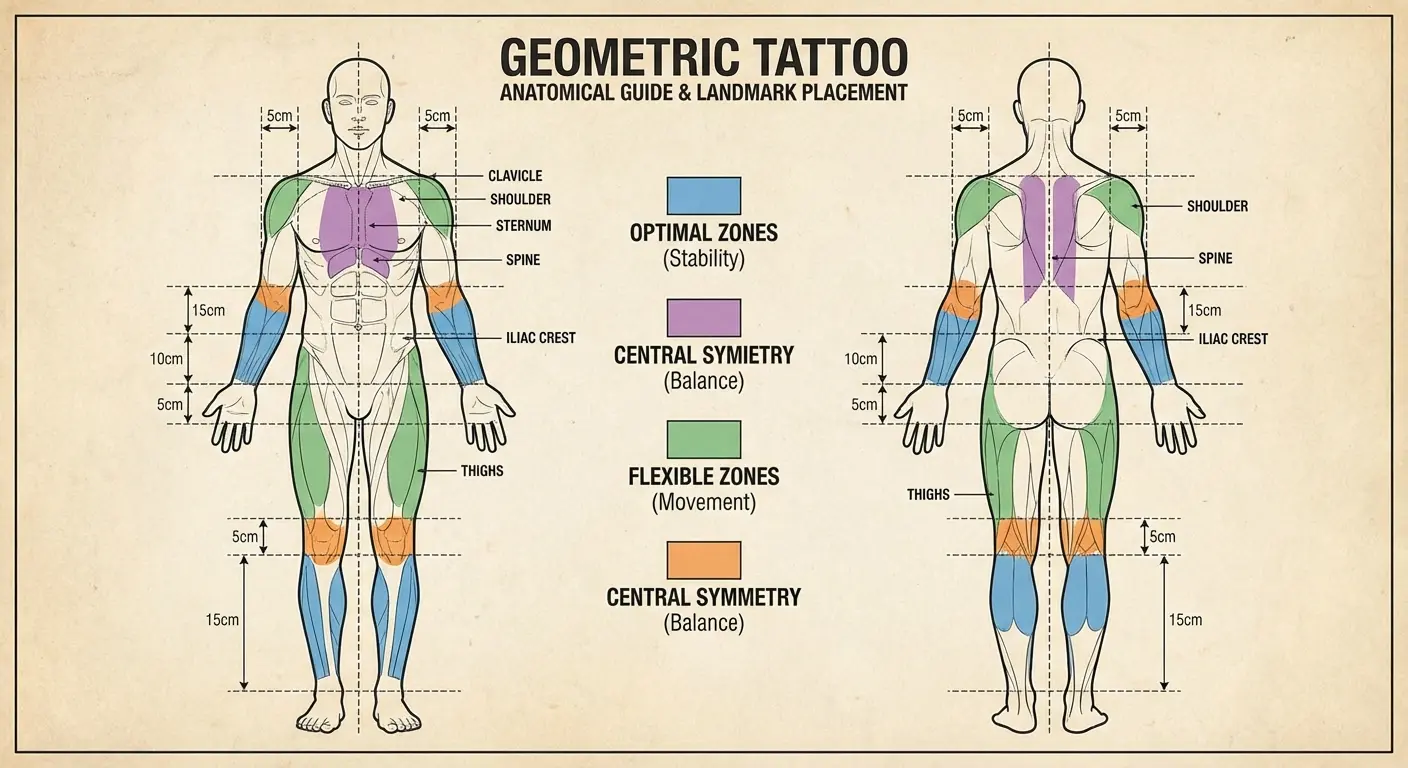
The sternum creates a perfect vertical centerline. Collarbones provide parallel horizontal references. The nape of your neck marks where your spine meets your skull. Geometric tattoos that anchor to these landmarks feel more integrated and intentional than designs placed arbitrarily.
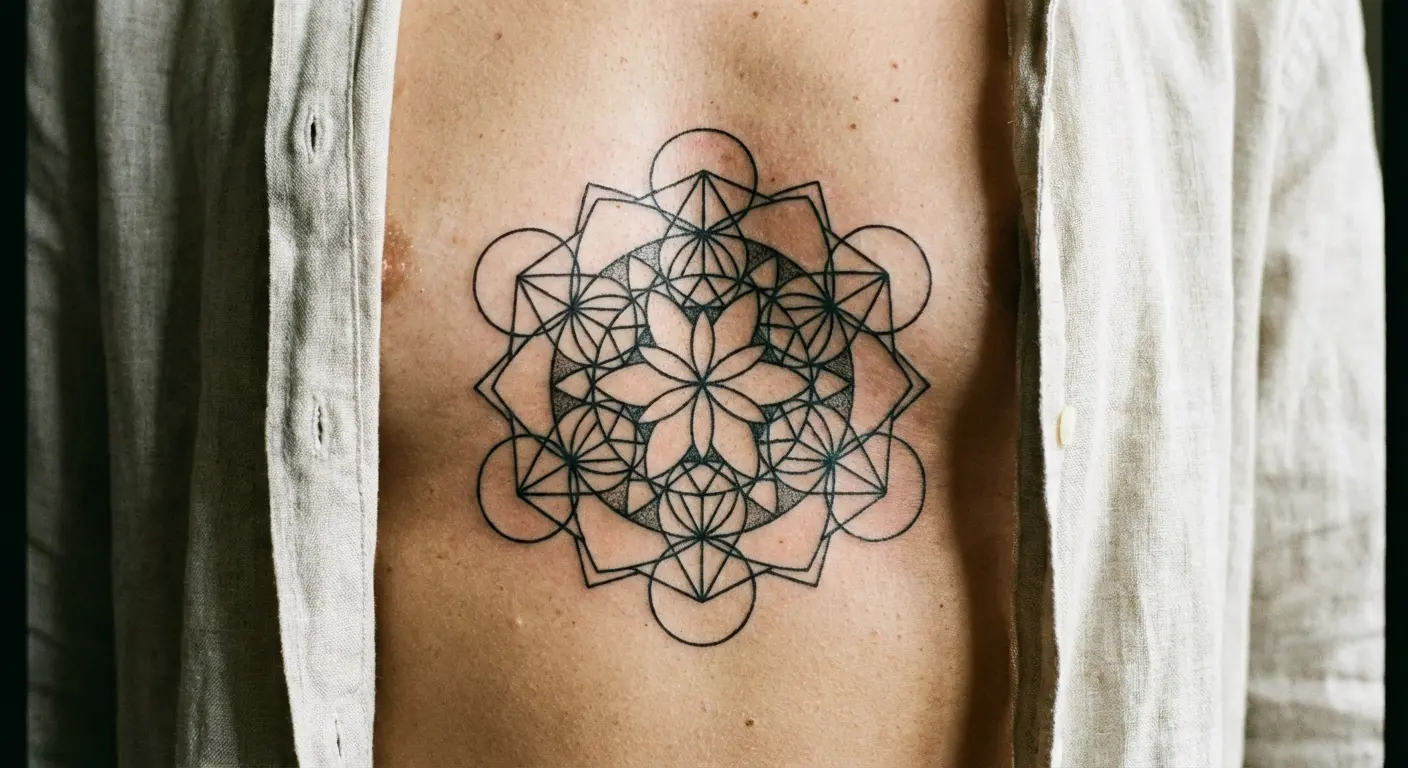
11. Sternum Centered Geometric Florals
The sternum is your body’s natural plumb line.
Geometric floral designs (flowers constructed from circles, triangles, and polygons rather than organic curves) centered on the sternum have built-in symmetry. Your sternum ensures perfect left-right balance without requiring the artist to measure and remeasure. These designs often incorporate mandala elements at the center with geometric petals or leaves extending outward.
The sternum placement also means the design sits at your body’s emotional center. Think heart chakra if you’re into that, or just the symbolic weight of chest-centered imagery. Geometric florals here can extend upward toward the collarbones, downward toward the solar plexus, or both, creating a vertical emphasis that elongates the torso visually.
Sternum pieces feel more personal and intimate than outer placements, which might influence your design choice.
12. Nape Triangle Foundations
The nape (back of your neck where it meets your skull) is a small but prominent placement.
Triangle foundations (a single triangle or small cluster of triangles) work here because the nape’s width is limited, but its visibility (especially with short hair or updos) is high. The triangle’s point can aim up toward the skull or down toward the spine, creating different visual effects. Point-up triangles feel ascending and energetic. Point-down triangles feel grounding and stable.
Nape triangles also serve well as starting points for larger back pieces. You can extend geometric patterns down from the nape triangle, using it as the foundation for spine work or shoulder blade designs. The nape’s position means these tattoos are easy to conceal (with hair down or a collar) but make a strong statement when revealed.
13. Wrist Compass Rose Minimalism
Your wrist’s inner surface is one of the most intimate tattoo placements.
Compass rose designs (geometric circular patterns with directional points) in minimalist form work beautifully here. The circular nature of a compass rose fits the wrist’s cylindrical shape, and the directional symbolism resonates with the wrist’s position at the end of your arm, literally pointing you in directions as you gesture and move.
Minimalist designs (thin lines, limited detail, maybe just the cardinal directions rather than all eight points) keep the design from overwhelming the small space. The wrist’s visibility also means this placement gets seen constantly by you, making it ideal for designs with personal navigational or directional meaning. For those exploring small tattoo ideas, wrist placements offer intimate, constantly visible options that serve as daily reminders.
The inner wrist’s thin skin does mean these can be more painful and may require touch-ups as they age.
14. Behind-Ear Micro Polyhedrons
The space behind your ear is tiny, but it’s also perfectly shaped for micro geometric work.
Polyhedrons (three-dimensional geometric solids like tetrahedrons, octahedrons, or icosahedrons) rendered in simple line work fit this placement’s scale. These designs are almost secret. Nobody sees them unless you tuck your hair back or turn your head just right.
Behind-ear placement also sits on relatively flat space (compared to the ear’s curves), making it easier to execute precise geometric line work. The challenge is size. Go too small, and the lines will blur together as the tattoo ages. Go too large, and the polyhedron wraps awkwardly around the ear’s curve. The sweet spot is usually around one to two inches maximum dimension.
15. Collarbone Parallel Line Systems
Your collarbones create natural parallel lines across your upper chest.
Geometric designs that echo or enhance these lines (parallel line systems, potentially incorporating dots, dashes, or geometric shapes at intervals) create visual harmony with your skeletal structure. These designs can sit directly on the collarbone (following its curve) or just below it (using the collarbone as a top boundary).
The parallel nature of collarbones (you have two of them, roughly symmetrical) means you can choose to tattoo one side for asymmetry or both for balance. Parallel line systems also have the advantage of aging well. Simple geometric lines without heavy shading or complex details maintain their clarity over decades.
|
Body Landmark |
Geometric Design Type |
Alignment Advantage |
Visibility Factor |
|---|---|---|---|
|
Sternum |
Centered mandalas, vertical line work |
Natural vertical centerline, perfect symmetry |
High (intimate) |
|
Spine |
Triangle chains, descending patterns |
Segmented structure guides spacing |
Medium (revealed with movement) |
|
Collarbone |
Parallel line systems, horizontal bands |
Natural parallel reference lines |
High (visible with most necklines) |
|
Hip Bones |
Angular accents, small polygon clusters |
Sharp anatomical landmarks anchor design |
Depends on clothing |
|
Wrist Crease |
Circular patterns, bracelet-style bands |
Natural horizontal boundary |
Very High |
|
Ankle Bones |
Centered cubes, symmetrical shapes |
Prominent bone creates 3D anchor point |
Seasonal |
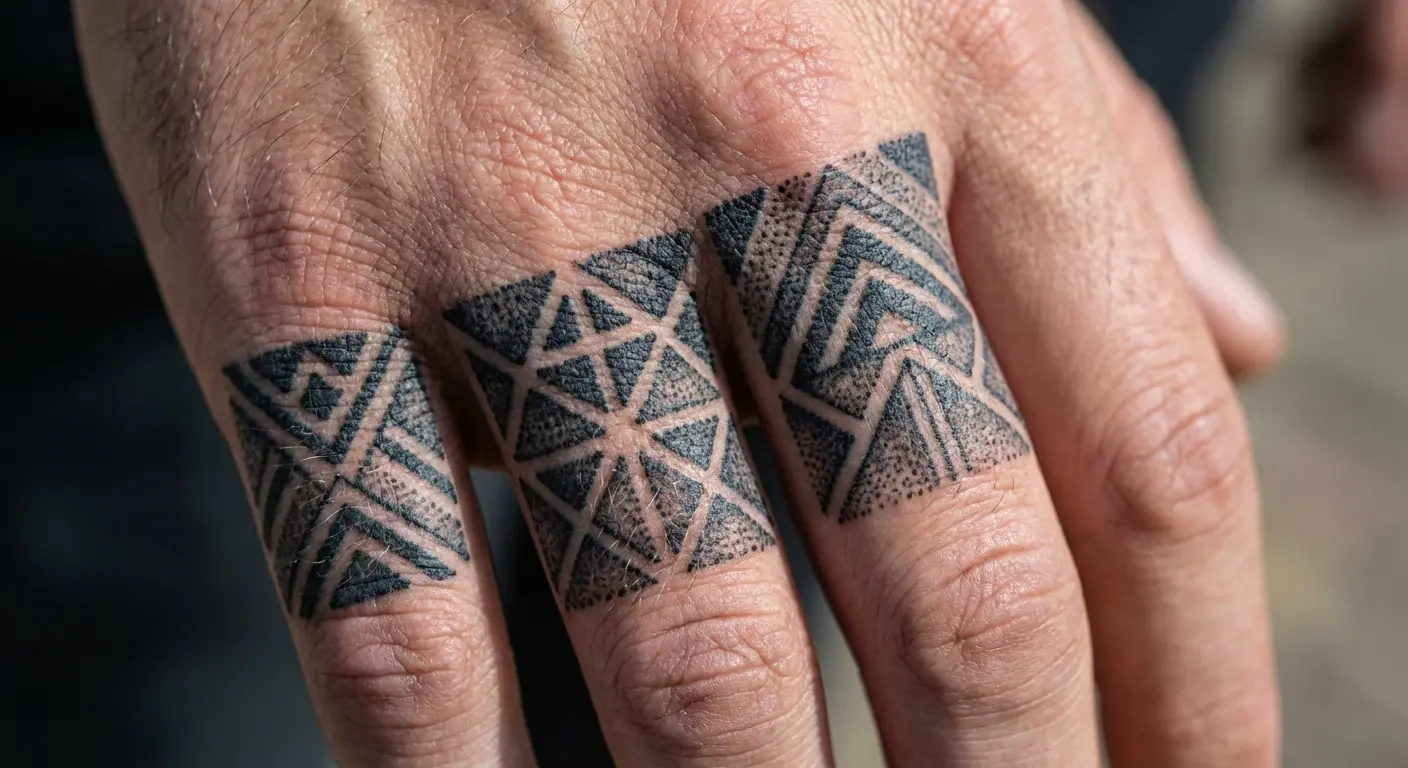
16. Knuckle Dot Matrix Patterns
Knuckle tattoos are notoriously difficult to execute and maintain.
But dot matrix patterns (geometric arrangements of dots forming larger shapes or patterns) handle the challenges better than most designs. Your knuckles bend constantly, and the skin stretches and compresses with each finger movement. Solid lines can break or blur, but individual dots in a geometric matrix can shift slightly without destroying the overall pattern.
Dot matrix patterns also allow for symbolic meaning (dots representing specific concepts, numbers, or personal markers) while maintaining geometric precision.
Size the dots large enough that they don’t blur into each other as the tattoo ages but small enough that the overall matrix reads as a cohesive pattern rather than random spots. Artists who create name tattoo designs often use similar dot matrix techniques for lettering on challenging placements like knuckles, where traditional solid fills fail quickly.
Knuckle tattoos fade fast and hurt like hell. You’ve been warned.
17. Inner Arm Golden Ratio Spirals
The inner arm (from elbow crease to armpit) is a long, relatively narrow space that’s perfect for golden ratio spirals.
The golden ratio (approximately 1.618, found throughout nature and classical art) creates spirals that feel naturally balanced. On the inner arm, these spirals can start small near the elbow and expand as they move toward the armpit, or vice versa. The inner arm’s length accommodates the spiral’s gradual expansion without requiring it to wrap around the arm’s circumference (which would distort the ratio).
Inner arm placement also means the design is visible to you when your arm is bent but concealed when your arm hangs naturally at your side. Golden ratio spirals can incorporate additional geometric elements (triangles, rectangles, or polygons that fit within the spiral’s curve) to add complexity without losing the fundamental mathematical elegance. Sacred geometry in tattoo art transcends simple aesthetics, embodying a language through which the universe communicates its intricate designs and profound mysteries, with tools like Sacred Geometry flash stamps providing artists with popular motifs such as the Flower of Life, Metatron’s Cube, and the Vesica Pisces, according to Tattoo Smart’s guide to geometric tattoo patterns.
The mathematical foundation gives these designs a timeless quality that trends can’t touch.
Designs That Adapt to Asymmetrical Body Zones
Not all body parts are symmetrical, and geometric tattoos don’t have to be either.
Your side torso is asymmetrical as hell. Stop trying to force perfect geometric symmetry on it. Some placements (side torso, upper back, outer thigh) have irregular shapes or natural asymmetry that makes perfectly balanced geometric designs look forced.
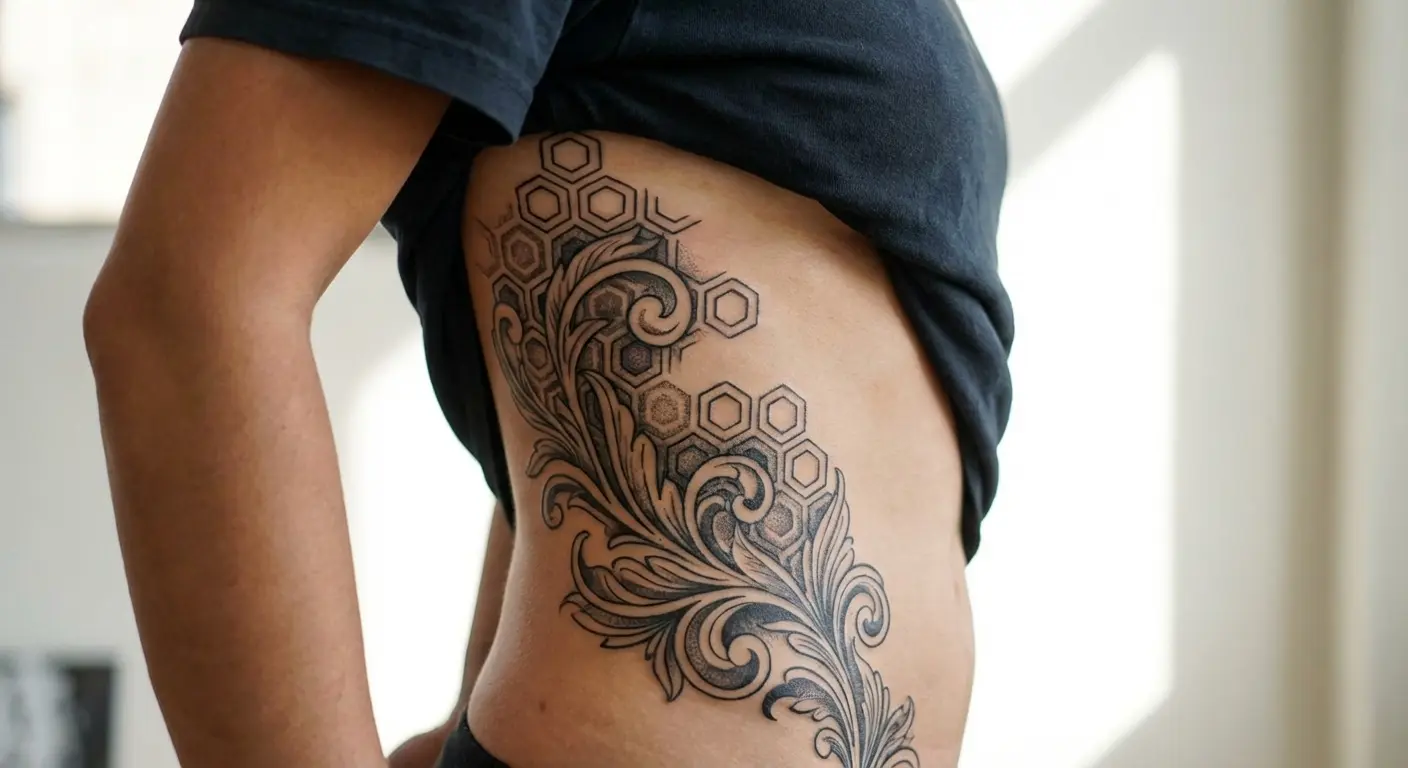
18. Side Torso Organic Geometry Blends
Your side torso curves from armpit to hip in a complex, asymmetrical line.
Organic geometry blends (geometric patterns that incorporate or transition into natural, flowing elements) work here because they can adapt to your body’s irregular contours. You might start with strict geometric shapes (hexagons, triangles, or polygons) near your ribs where the surface is relatively predictable, then allow those shapes to break apart, fragment, or flow into more organic patterns as the design moves toward your hip or lower back.
This approach acknowledges that forcing perfect geometric symmetry onto an asymmetrical canvas looks unnatural. The side torso also stretches significantly when you reach overhead or twist, so designs here need flexibility. Organic geometry blends handle this distortion better than rigid patterns because the organic elements can stretch and compress without looking “wrong.” The surge in geometric tattoo popularity has been significantly influenced by LA-based artist Dr. Woo, whose cult-following celebrity clients have helped propel sharp triangles and perfect circles paired with animals and cosmic shapes into mainstream tattoo culture, according to Refinery29’s coverage of geometric tattoo trends.
The pattern transitions from mathematical precision to natural flow, creating a design that feels both structured and alive.
19. Upper Back Asymmetric Crystal Formations
Your upper back (the area between your shoulder blades and below your neck) isn’t perfectly symmetrical.
One shoulder blade might sit slightly higher, or your spine might have a subtle curve. Asymmetric crystal formations (geometric representations of crystals or gems arranged in intentionally unbalanced compositions) work with these natural irregularities instead of fighting them. Instead of centering a perfectly symmetrical mandala that might highlight your body’s asymmetry, you can place crystal formations that cluster more heavily on one side or create diagonal movement across the upper back.
These designs often incorporate different crystal shapes (some tall and narrow, others wide and flat) arranged in compositions that feel balanced through visual weight rather than mirror symmetry. The geometric precision of each individual crystal maintains the style’s integrity while the overall arrangement adapts to your specific body.
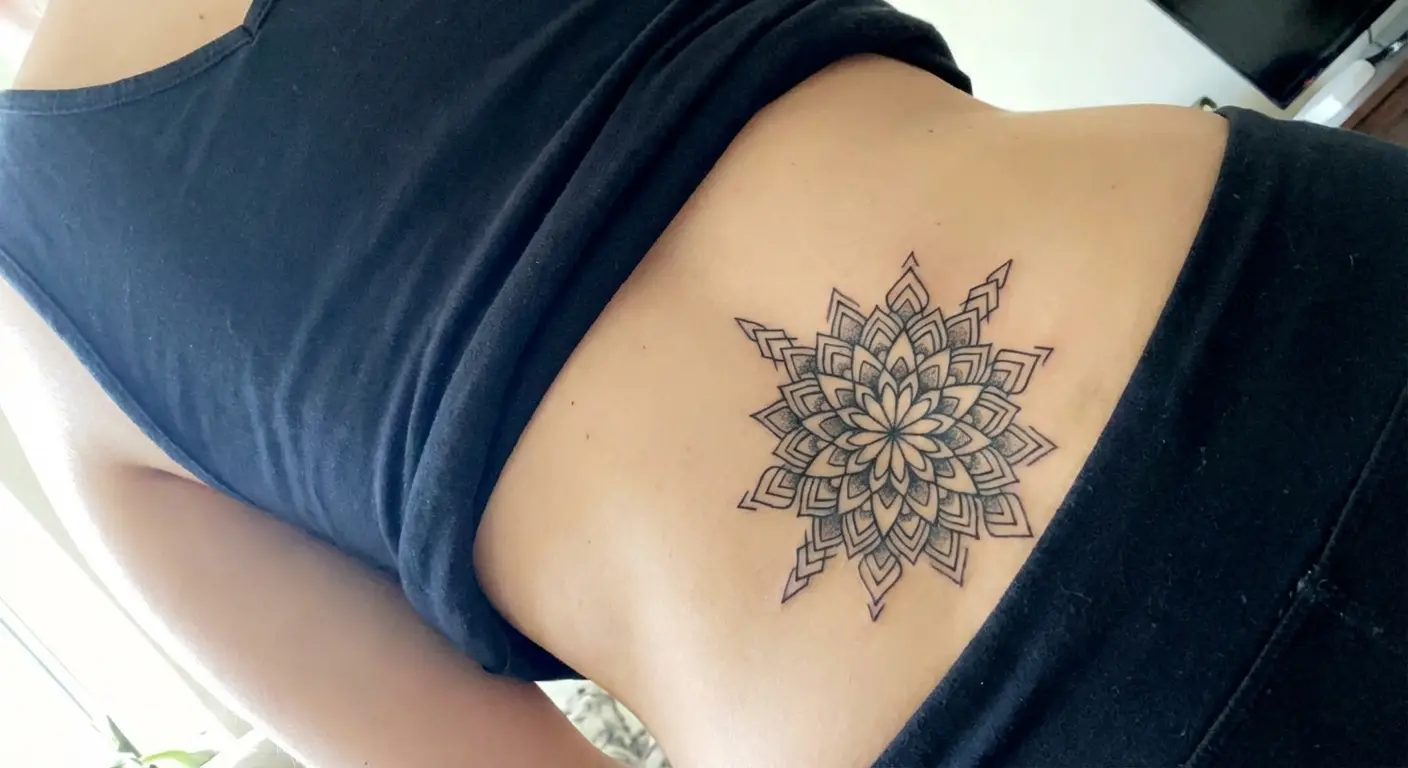
20. Lower Back Off-Center Mandalas
Lower back tattoos have a reputation, but off-center mandalas subvert expectations while solving a practical problem.
Your lower back’s width varies depending on your build, and perfectly centered mandalas can look cramped or lost in the space. Placing a mandala off-center (usually to the left or right of your spine, with geometric extensions reaching across) creates dynamic tension and allows the design to scale appropriately.
The mandala itself maintains perfect radial symmetry, but its placement acknowledges that your body isn’t a symmetrical canvas. Off-center placement also allows for future expansion. You can add geometric elements on the opposite side later, or extend the design upward along your spine, or wrap it around your hip. The mandala serves as an anchor point rather than the entire composition.
21. Outer Thigh Fragmented Shape Collections
Your outer thigh has significant surface area but an irregular shape (wider at the hip, narrowing toward the knee, with muscle definition creating valleys and peaks).
Fragmented shape collections (geometric shapes that appear broken, scattered, or in the process of assembling/disassembling) adapt well to this irregular canvas. Instead of trying to impose a uniform pattern, you can scatter triangles, polygons, or geometric shards across the outer thigh in a composition that follows your muscle definition.
Denser clusters might sit where the thigh is widest, with fragments becoming sparser as they approach the knee. This approach also creates interesting visual effects when you walk. The muscle movement makes the fragments appear to shift relative to each other, enhancing the sense of the design being in motion or transformation.
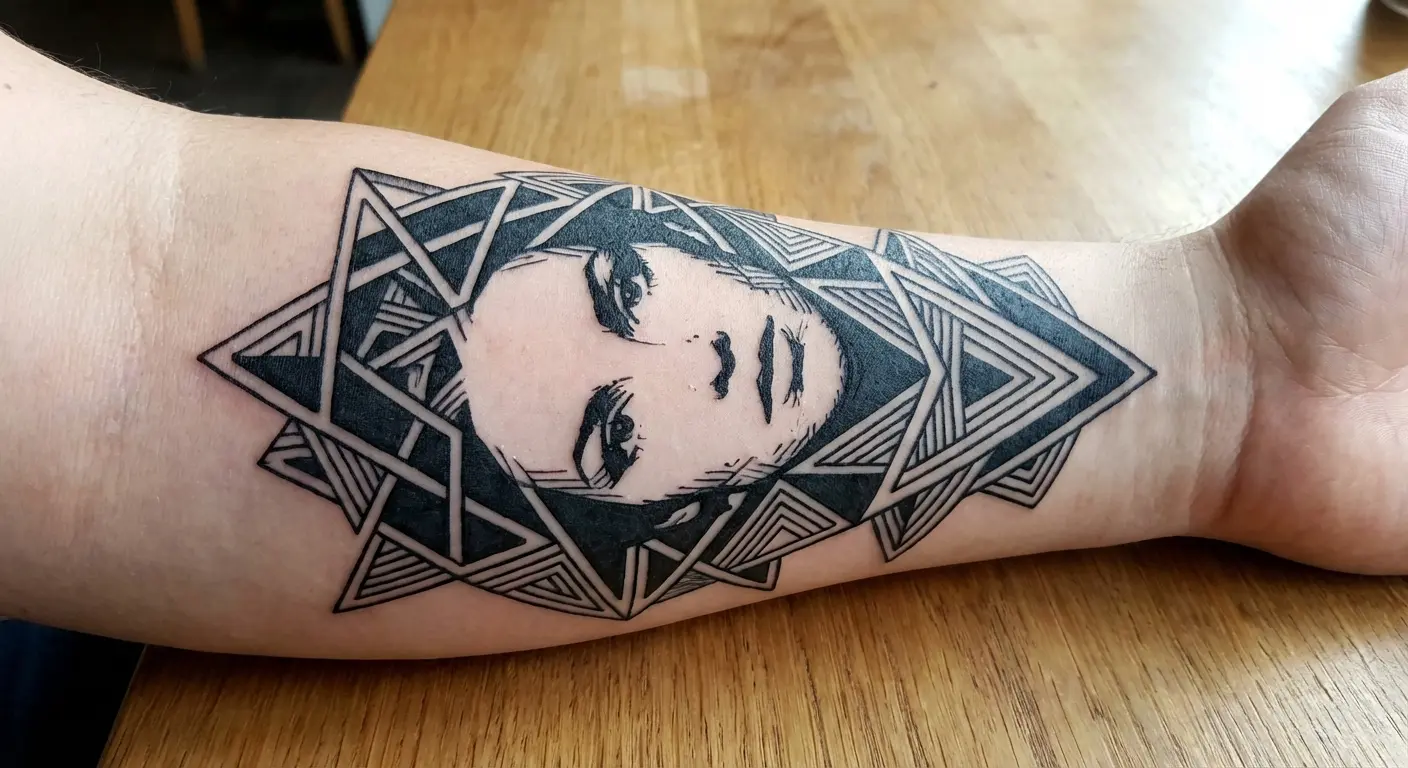
22. Inner Forearm Negative Space Geometric Portraits
Inner forearm placement offers a relatively flat, highly visible canvas.
Negative space geometric portraits (faces or figures constructed from geometric shapes where the un-inked skin creates the actual image) work powerfully here. The technique involves tattooing geometric patterns (triangles, lines, polygons) around and within a portrait, leaving skin blank where the portrait’s key features sit. Your natural skin tone becomes part of the design rather than just the background.
This approach requires careful planning because negative space designs are difficult to modify later. The inner forearm’s length accommodates portrait compositions well, and the placement means you see the design constantly (which matters for portraits of meaningful people or symbolic figures). Understanding tattoo meaning helps you choose portrait subjects that resonate with your geometric design’s symbolic intent. The geometric framework keeps these portraits from looking like traditional realism, giving them a modern, stylized quality that ages differently than photorealistic work.
23. Shoulder Cap Dimensional Cube Stacks
Your shoulder cap (the rounded top of your shoulder) is three-dimensional in a way that most tattoo placements aren’t.
Dimensional cube stacks (multiple cubes drawn in isometric perspective, appearing to stack or cascade across the shoulder) can use this natural roundness to enhance the illusion of depth. As the design wraps from the front of your shoulder to the back, the cubes can appear to recede into space or emerge forward.
The shoulder’s movement (rotating when you lift your arm, shifting when you shrug) adds another dimension to the illusion. Cube stacks work best when they’re sized to fit the shoulder cap’s curve without wrapping too far down the arm or across the chest. The design should feel contained on the shoulder itself, using the cap’s natural boundary as the composition’s edge. Exploring tattoo ideas with meaning can help you select geometric patterns that carry personal significance beyond pure aesthetics, turning these dimensional illusions into symbols that matter to you.
Bringing Your Geometric Vision to Life
You’ve seen how geometric tattoos interact with your body’s specific architecture.
The gap between concept and execution can feel overwhelming, especially when you’re trying to communicate precise geometric specifications to an artist. It’s hard to visualize how geometric patterns wrap around curved surfaces. Most people can’t imagine how a 2D design looks on their 3D body.
Okay, shameless plug time: this is exactly why we built Tattoo Generator IQ. Trying to explain “I want a fibonacci spiral on my thigh that accounts for how my leg rotates when I walk” to an artist is rough. The tool lets you input your placement preference (forearm, ribs, shoulder blade, wherever), specify the geometric style you want (sacred geometry, minimalist lines, tessellation patterns), and generate multiple variations that account for the body part’s specific dimensions.
The AI creates designs you can show your tattoo artist rather than trying to describe abstract geometric concepts verbally. You’ll get high-resolution references that demonstrate exactly how the pattern should flow, where the anchor points should sit, and how the design adapts to your chosen placement’s unique shape. It bridges the gap between “I want something geometric on my ribs” and walking into a consultation with a clear, detailed reference your artist can work from.
Here’s the Thing
Geometric tattoos aren’t just about choosing cool patterns.
They’re about understanding how those patterns interact with your body’s natural architecture, movement, and asymmetries. The designs that age best and feel most integrated are the ones that work with your anatomy instead of ignoring it. Your muscle lines, bone landmarks, and natural curves provide built-in guides that make geometric tattoos more cohesive and intentional.
Whether you’re drawn to sacred geometry that follows your forearm’s rotation, fibonacci spirals that unwrap as you walk, or fragmented shapes that scatter across your irregular thigh contours, the key is matching the geometric approach to your specific body’s reality. Take time to consider how your chosen placement moves, stretches, and changes throughout your normal activities.
The best geometric tattoo isn’t the most intricate one. It’s the one that looks like it belongs on your body specifically. Your body is already a work of art. We’re just adding geometric emphasis to what’s already there.
