16 Ghost Tattoos That Prove the Dead Can Be Drop-Dead Gorgeous
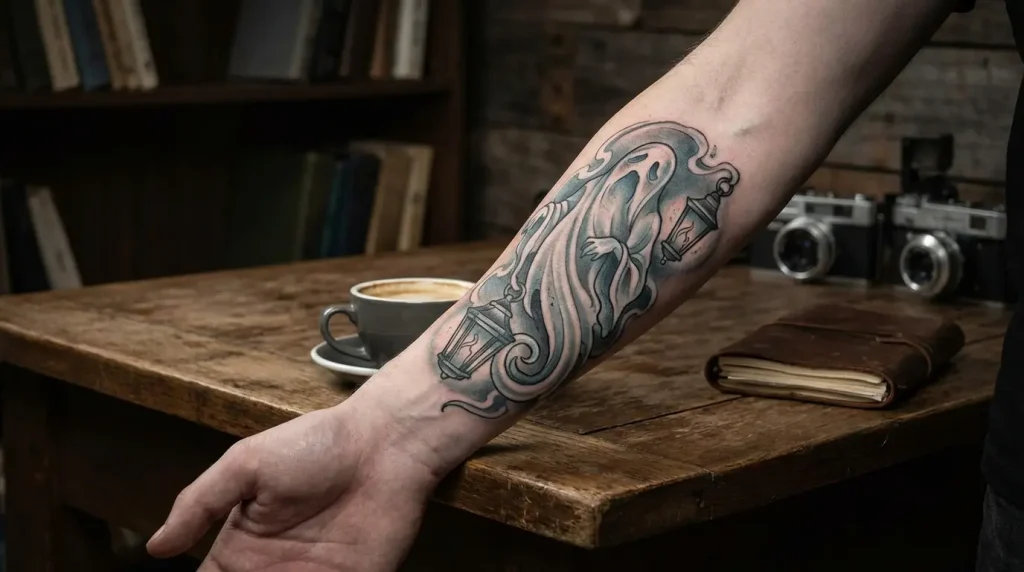
Look, ghost tattoos used to be the thing you’d regret getting drunk on Halloween. Not anymore. I’ve spent the last month looking at hundreds of ghost tattoos, and honestly? Some of them are gorgeous. Not in a spooky way, in a way that makes you understand why someone would want that on their body permanently. According to tattoo artists who specialize in this stuff, ghost tattoos are becoming increasingly popular for representing memory, loss, and connections that stick around even when people don’t. Here are sixteen that actually work, and why they work.
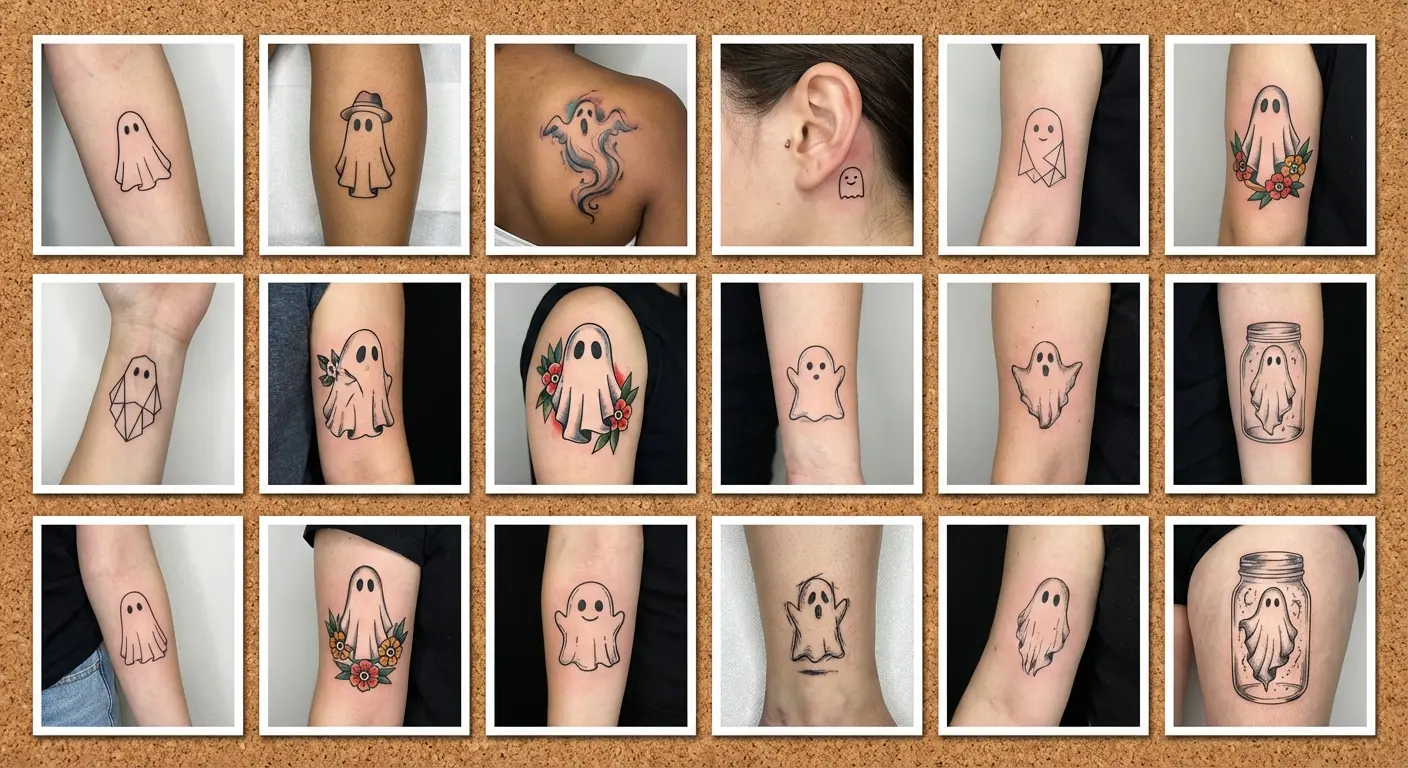
Table of Contents
Ghosts That Whisper (Not Scream): Minimalist Spirit Designs
-
Single-Line Phantom
-
Dot Work Specter
-
Micro Ghost Silhouette
-
Negative Space Apparition
-
Tiny Floating Sheet Ghost
Ghosts With Personality: Character-Driven Designs
-
Vintage Cartoon Ghost
-
Melancholic Spirit Portrait
-
Ghost Reading a Book
-
Dancing Ghost Duo
-
Ghost Holding Flowers
-
Ghost With a Pet Cat
Ghosts That Break the Mold: Unexpected Interpretations
-
Anatomical Ghost (Ribcage Showing Through)
-
Celestial Ghost (Stars and Moon Integration)
-
Geometric Ghost Construction
-
Ghost Mid-Transformation
-
Abstract Emotional Haunting
Quick Version If You’re in a Hurry
Simple ghost tattoos work because they’re not trying to prove anything. A few lines, maybe some dots, and you’re done. They also won’t look like blurry messes in 20 years.
Character ghosts (reading books, holding flowers, dancing) let you tell a story without explaining it to every person at the grocery store.
The weird ones (geometric, anatomical, abstract) are for people who want strangers to ask questions.
Basically, ghost tattoos let you be as obvious or as private as you want about what they mean.
Ghosts That Whisper (Not Scream): Minimalist Spirit Designs
First up, the designs that prove less is more. Most people assume ghost ink needs to be elaborate or spooky, but the minimalist approach hits harder. These work because they hint instead of screaming.
They’re particularly useful if you’re working with limited skin real estate or want something that reads clearly from a distance. The simplicity also means they age well. Fine lines stay crisp longer than heavy shading, and they won’t compete visually if you’re building a larger collection.
For those considering their first piece, these small tattoo ideas complement the minimalist ghost aesthetic and offer guidance on size and placement.
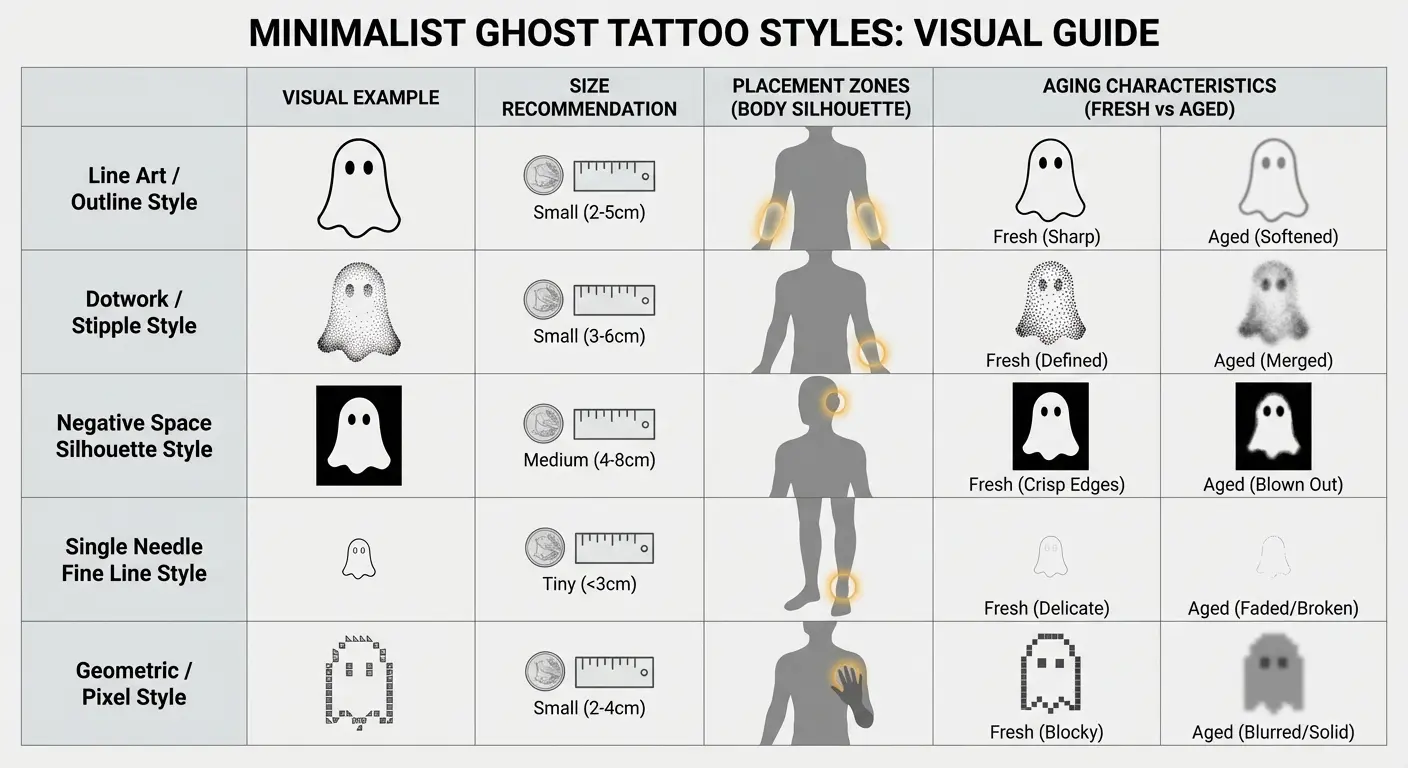
|
Design Type |
Minimum Size |
Best Placement |
Will It Age Okay? |
How Hard to Execute |
|---|---|---|---|---|
|
Single-Line Phantom |
2-4 inches |
Flat areas (forearm, outer bicep, ribs) |
Should hold up great |
Needs an artist with confidence |
|
Dot Work Specter |
1.5+ inches |
Low oil spots (outer arm, shoulder) |
Yeah, if done right |
Takes forever, needs precision |
|
Micro Ghost Silhouette |
1-2 inches |
Behind ear, finger, ribcage |
Solid black helps |
Depends on the artist |
|
Negative Space Apparition |
3+ inches |
Even skin tone areas |
Pretty good usually |
Tricky composition |
|
Tiny Floating Sheet Ghost |
1-4 inches |
Honestly anywhere |
Simple = better aging |
Most artists can handle it |
1. Single-Line Phantom
One continuous line. That’s it. The artist can’t lift the pen (or machine, technically), which is harder than it sounds. I watched someone mess this up once. There was this tiny hesitation mark where they second-guessed the curve, and it looked like the ghost had a stutter.
Best on flat areas. Your forearm, maybe your ribs if you can handle it. Anywhere the skin won’t warp the line when you move. Size-wise, 2-4 inches, though I’ve seen people go smaller and regret it when it just looks like a squiggle from a distance.
The whole point is ambiguity. From ten feet away, it might read as abstract art. Up close, the ghost reveals itself. This works great if you’re in professional environments where visible tattoos need to stay subtle.
Ask your artist about varying the line weight within the single stroke. Adds dimension without breaking the continuous flow. I’ve seen these hold up beautifully over decades because there’s no shading to blur or detail to lose.
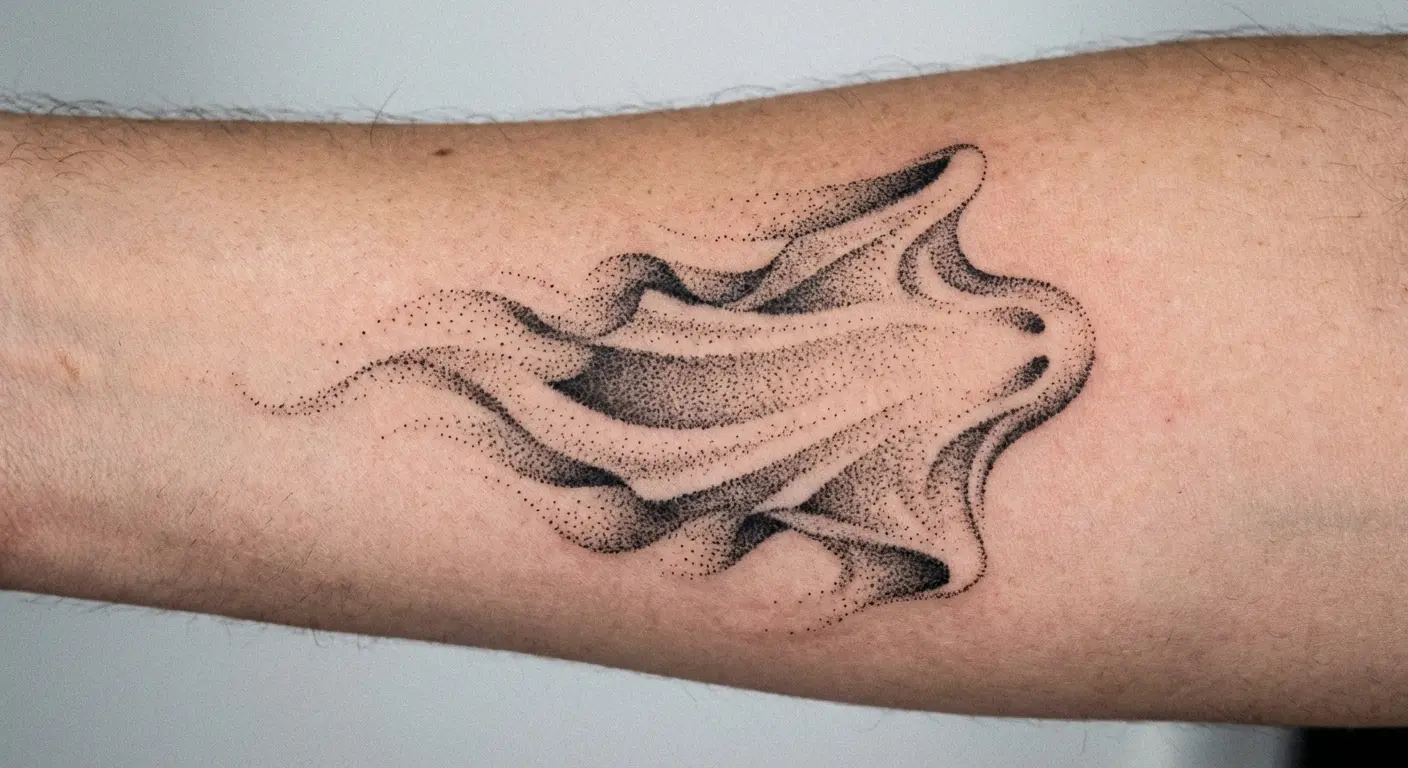
2. Dot Work Specter
Instead of lines, you get dots. Lots of them. Each one placed individually to create this fading, ethereal effect that solid ink can’t touch.
Takes forever. Each dot needs precision, and if your artist rushes it, you’ll end up with a muddy mess instead of a ghost. The upside? It looks different depending on the light. Sometimes it’s barely there. Other times it pops.
Go bigger than you think, at least 1.5 inches. Smaller and the dots blur together. Put it somewhere that doesn’t get oily. Outer arm, shoulder blade. Oil production makes dots spread over time.
This style came from traditional engraving and translates beautifully to skin. The stippling technique gives the spirit a quality that solid ink just can’t achieve, like it’s actually fading in and out of existence.
3. Micro Ghost Silhouette
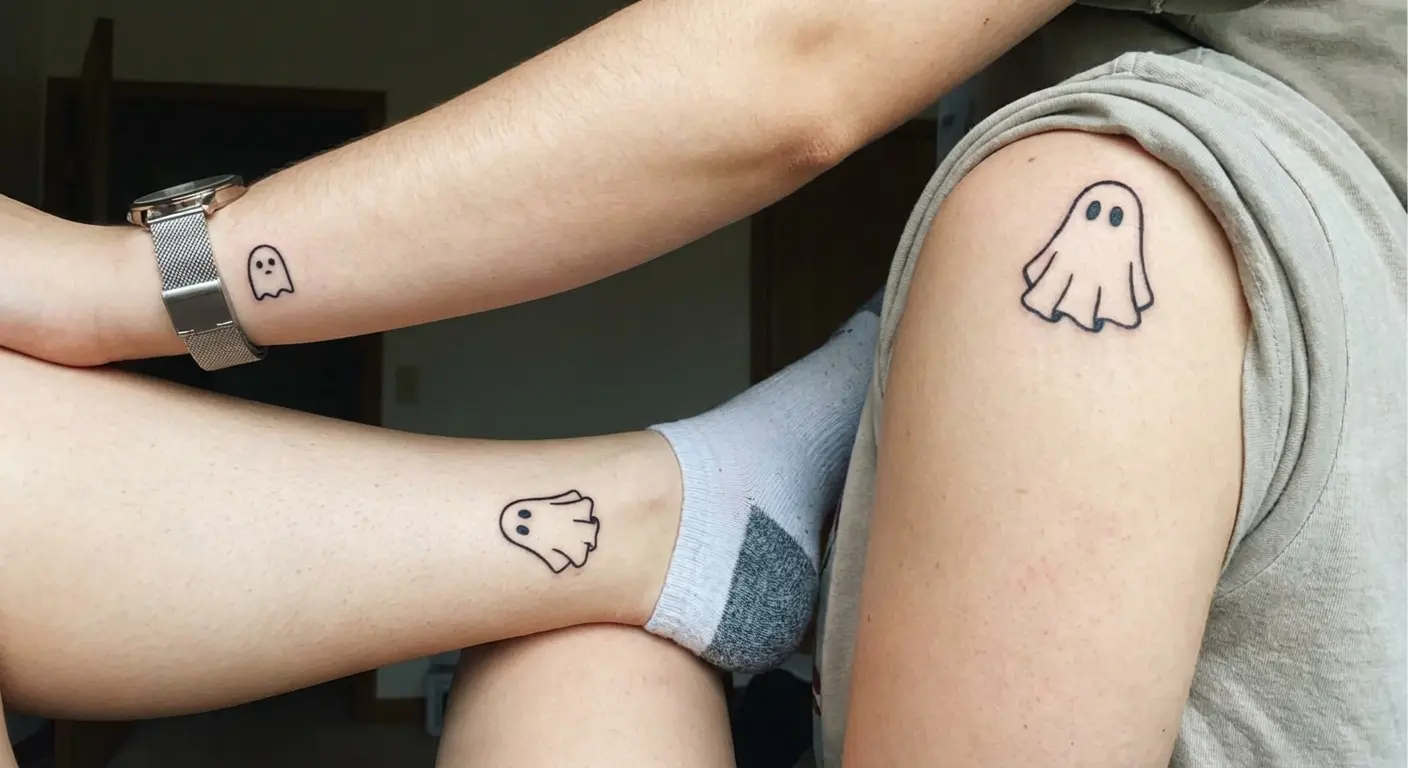
We’re talking thumbnail-sized ghosts here. Behind your ear, on your finger, along your ribcage where only you and people you choose will see them.
Here’s the thing though: fingers fade. Fast. Anyone telling you otherwise is lying or hasn’t had their finger tattoo long enough. You’ll need touch-ups, maybe multiple times. But if you want a tiny secret ghost that only certain people see, it might be worth the maintenance.
The detail becomes impossible at this scale, so the silhouette needs to be immediately recognizable. Think classic sheet ghost with two eye holes, maybe a slight wave to the bottom edge. These work great as memorial pieces without the heaviness of traditional memorial tattoos. You can add one for each person or pet you’ve lost without turning your body into a grief billboard.
The ink should be solid black rather than shaded because any gradient work will blur within a few years at this size.
4. Negative Space Apparition
This creates the ghost by inking around it rather than filling it in. Your skin tone becomes the ghost itself, surrounded by black or colored ink that defines its edges. The visual effect is striking because the ghost appears to glow, especially on lighter skin tones.
Darker skin tones can achieve something similar by using white ink for the surrounding area, though white ink requires more maintenance and touch-ups over time. The design challenge is making sure the negative space reads clearly as intentional rather than unfinished. This usually means the surrounding ink needs to be dense and purposeful, whether that’s solid black, heavy shading, or a patterned background.
Works best on areas where you have consistent skin tone. Avoid spots with lots of freckles or birthmarks that might interrupt the ghost’s silhouette. Size needs to be at least 3 inches for the negative space to register visually. Your natural skin becomes the focal point of the design, which is kind of poetic if you think about it.
5. Tiny Floating Sheet Ghost
This is the most recognizable design in the minimalist category. The classic bedsheet ghost reduced to its essentials. What makes it work is the floating quality, achieved by adding a small shadow beneath the ghost or positioning it among other small elements like stars, clouds, or flowers that establish its airborne nature.
Personalize these endlessly without losing the core design. Add a tiny object in the ghost’s “hands,” change the eye shape to convey different emotions, or include small details like stitching or patches on the sheet. These scale beautifully from 1 inch to 4 inches and work on virtually any body placement.
The practical advantage is that most tattoo artists can execute this competently, even if they’re not specialists in fine line or detailed work. Similar to fine line tattoo techniques, these rely on precision and clean execution to achieve their delicate aesthetic. I’ve seen these become the gateway ghost tattoo for people who want to test the waters before committing to larger pieces.
Ghosts With Personality: Character-Driven Designs
Okay, now we’re getting somewhere. Rather than generic spirits, these designs embed specific traits, actions, or relationships into the imagery. Ghost tattoos excel at representing the parts of yourself or your history that feel present but intangible.
You’re not limited to memorializing the dead, though these work beautifully for that. Represent past versions of yourself, relationships that ended but still shape you, or emotional states that stick around. The beauty is that people will ask about these tattoos, but you control how much you reveal. The surface-level answer (“I just like cute ghosts”) satisfies casual curiosity, while the deeper meaning stays yours.
The emotional depth possible in ghost narratives extends beyond visual design. Kristen Grainger & True North’s album “Ghost Tattoo” explores how the ghost concept translates into bluegrass storytelling, with tracks demonstrating how ghost imagery can carry messages about memory and emotional permanence across different artistic mediums.
6. Vintage Cartoon Ghost
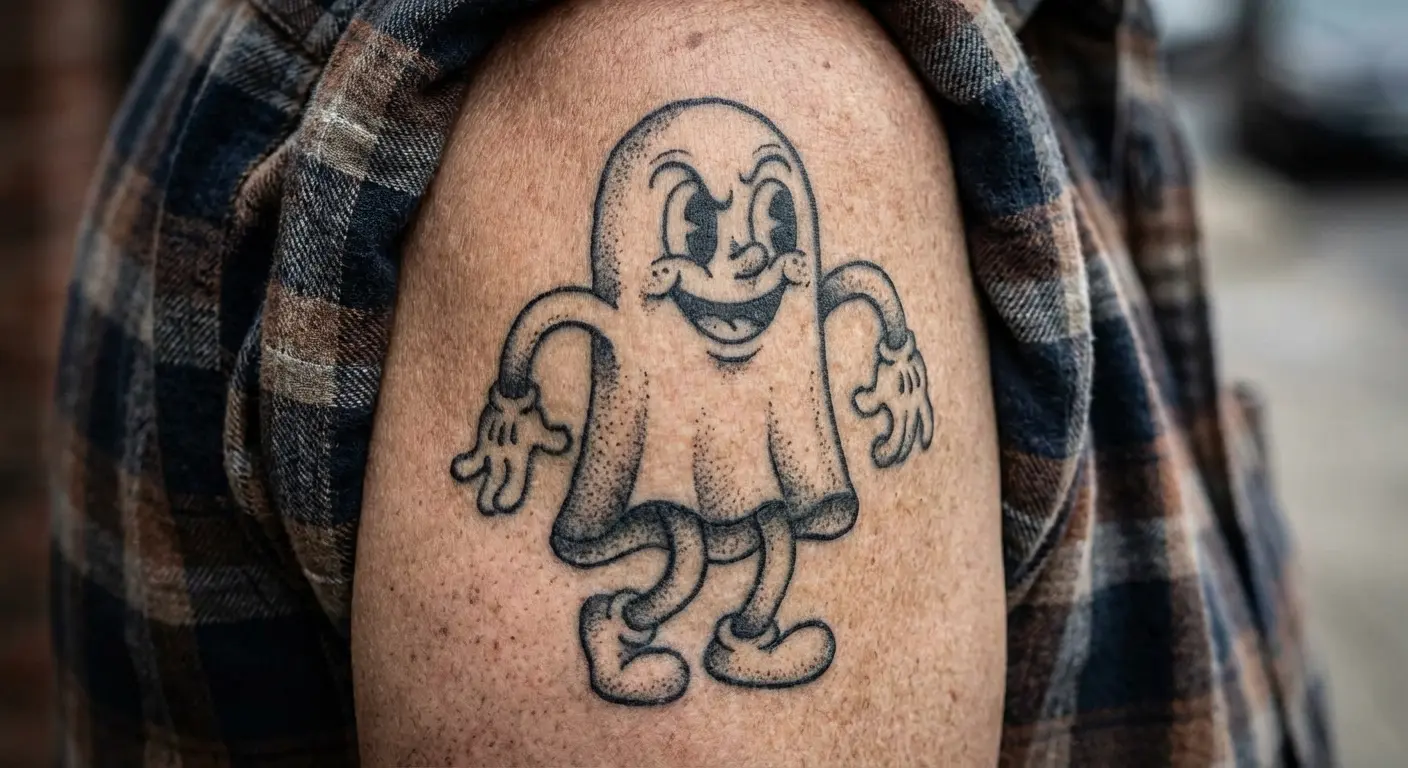
Fair warning: these are having a moment. Every third ghost tattoo I see is going for this 1930s rubber hose animation vibe. Which means in five years, they might feel dated in a way minimalist designs won’t.
That said, if you genuinely love the style and it means something specific to you, ignore me. Pull from 1920s-1940s animation aesthetics. Rubber hose limbs, pie-cut eyes, exaggerated expressions. These ghosts have personality baked into their design language.
Play with expression here to encode specific emotions. A winking ghost reads playful. A surprised ghost with hands on cheeks suggests ongoing astonishment at life. A grumpy ghost with crossed arms captures a mood. The beauty of vintage cartoon styling is that it’s inherently stylized, so anatomical accuracy doesn’t matter.
Size works from 3-6 inches typically, and these shine on areas with good visibility because the expressions deserve to be seen. Skip color unless you’re really committed to it. Most of these look better in black and grey anyway, and color means more touch-ups down the road.
7. Melancholic Spirit Portrait
This one gets me. A ghost that just looks sad. Lost. Like it’s still trying to figure out what happened.
Not scary. Not trying to haunt anyone. Just sad.
I think these resonate because they validate something: not all ghosts are angry or malevolent. Some are just confused. Some are grieving their own death. Some are still processing.
The execution is everything here. Tiny changes in the eye shape or mouth completely change what you’re looking at. You need an artist who understands faces, who can capture that specific type of melancholy you’re going for. Because there are different kinds of sad, and getting the wrong one means the tattoo doesn’t work.
These typically work best at 4-6 inches to give the facial features room to breathe. Placement leans toward areas you can see easily yourself, like inner forearm or thigh, because these often serve as personal reminders rather than displays for others. Shading becomes crucial here to create depth and dimension in the face, so budget for a longer session.
8. Ghost Reading a Book
Specificity makes this design memorable. The ghost isn’t just floating aimlessly. It’s engaged in an activity that suggests personality and interests. Customize the book title, add reading glasses, include a small lamp or reading nook setting, or show multiple books stacked nearby.
This works great for people who identify strongly with reading or learning but don’t want something as literal as a stack of books tattooed on them. The ghost element adds whimsy and suggests that your love of reading transcends physical limitations.
Decide whether the ghost holds the book with visible hands or arms, or whether the book simply floats in front of the spirit. Both approaches work, but they create different visual weight. Size needs to accommodate both the ghost and the book as distinct elements, usually 4-6 inches minimum.
Placement works well on areas where horizontal orientation makes sense (outer thigh, ribcage, upper back) so the book can be shown open and readable.
9. Dancing Ghost Duo
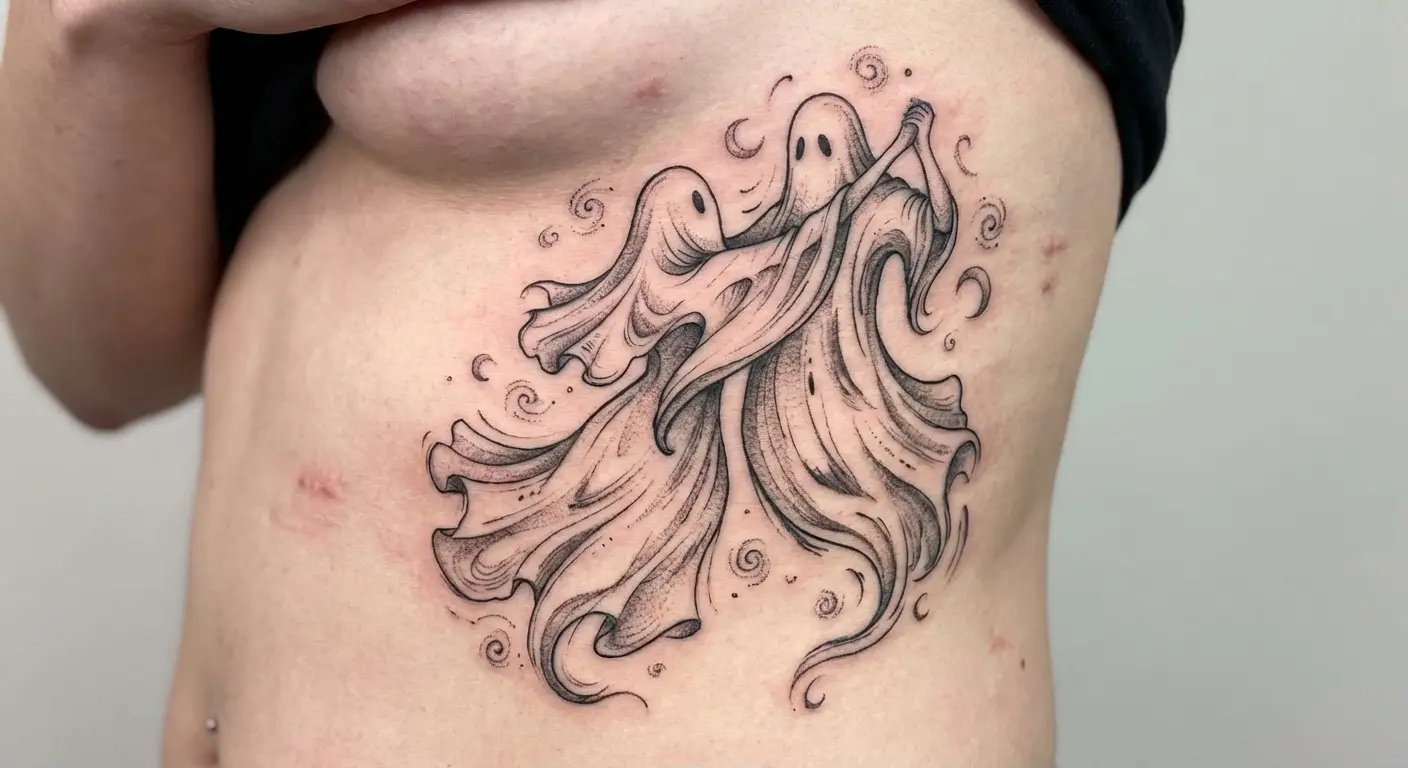
Two ghosts mid-dance, whether that’s a formal waltz, a playful swing, or an abstract movement. The relationship between the two spirits is what carries the meaning.
Make them identical, suggesting partnership between equals. Different sizes for parent-child or mentor-student dynamics. Contrasting expressions where one appears joyful and one reluctant. This design excels at representing relationships that continue to influence you even after they’ve ended or changed.
The movement implicit in dancing creates visual interest and allows for dynamic composition that works with your body’s natural curves. Make sure the two ghosts read as interacting rather than just floating near each other. This usually requires overlapping elements, shared eye contact, or physical connection points.
Size needs to be substantial enough for two distinct figures, typically 5-8 inches. Placement works best on areas with enough space for the composition to breathe: outer thigh, ribcage, upper arm wrapping toward shoulder. Two ghosts dancing. It’s sweet without being sappy, which is harder to pull off than you’d think.
10. Ghost Holding Flowers
The juxtaposition of death imagery with life imagery creates immediate visual tension that resolves into something tender. Choose flowers with specific meanings (roses for love, forget-me-nots for memory, marigolds for grief) or simply pick blooms you find beautiful. The ghost can be offering the flowers, receiving them, or simply holding them contemplatively.
This works particularly well for memorial tattoos because it acknowledges death while celebrating the beauty that person brought to your life. Flowers add color opportunities without requiring the entire ghost to be colored. Keep the spirit black and grey while the flowers pop with color, creating visual hierarchy that draws the eye.
When considering symbolic elements, explore how lotus flower tattoo meanings can complement ghost imagery to create layered symbolism about transformation and remembrance.
11. Ghost With a Pet Cat
This combination hits a specific emotional note: companionship that transcends conventional boundaries. The ghost can be holding the cat, playing with it, or simply existing alongside it. Cats have their own supernatural associations in various cultures, making them natural companions for spirits.
Customize the cat to resemble a specific pet (current or past) or keep it generic. The design works for people who want to represent the idea that love and connection persist beyond physical presence.
Balance the detail level between ghost and cat so neither overwhelms the other. If the ghost is simple line work, the cat should match that aesthetic rather than being hyper-realistic. Size typically runs 4-6 inches to give both elements adequate space.
Similar to black cat tattoo symbolism, combining feline imagery with ghost designs creates rich layers of supernatural and mystical meaning. Some bonds refuse to break even when everything else does.
Ghosts That Break the Mold: Unexpected Interpretations
These break the rules. We’re moving beyond traditional representations into territory where the concept of “ghost” becomes a design framework rather than a literal depiction.
The advantage is that these tattoos start conversations because they require a second look to understand what you’re seeing. They also tend to age interestingly rather than just aging well, because the unconventional approach means there’s no established reference point for how they “should” look over time.
The trade-off? You need an artist who can think conceptually and execute technical challenges like geometric precision, anatomical accuracy, or abstract composition depending on which design you choose.
|
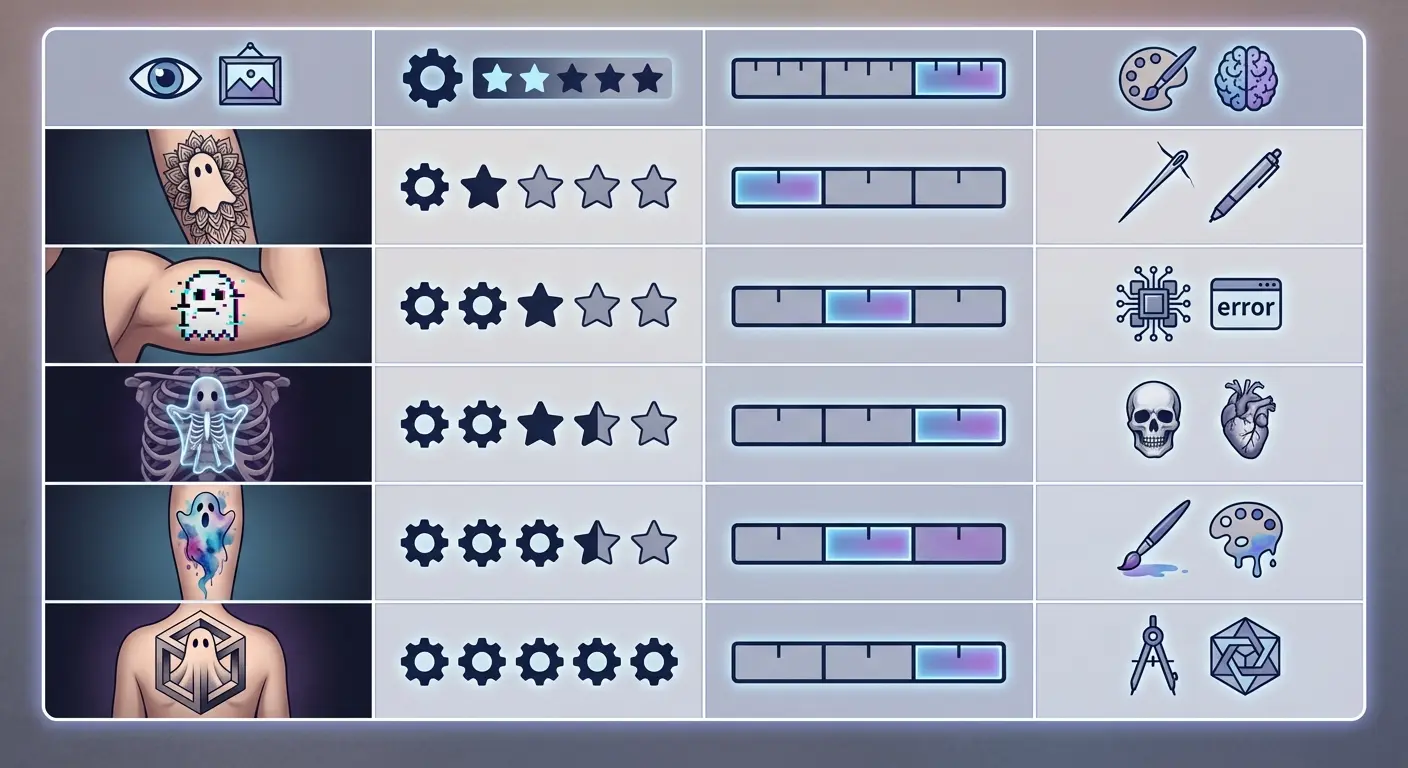
Unconventional Approach |
What It Means |
How Hard Is It? |
Size Range |
Find an Artist Who Does |
|---|---|---|---|---|
|
Anatomical Ghost |
Double-death effect; haunted by physical form |
Really hard, needs anatomy knowledge |
6-10 inches |
Medical illustration or realism |
|
Celestial Ghost |
Supernatural meets astronomical |
Pretty technical |
5-8 inches |
Fine line or illustrative |
|
Geometric Ghost |
Deconstruction into shapes |
Precision work, no room for error |
5-8 inches |
Geometric specialists |
|
Ghost Mid-Transformation |
Change, impermanence, nothing’s permanent |
Tricky gradient work |
5-9 inches |
Watercolor or abstract realism |
|
Abstract Emotional Haunting |
The feeling of being haunted |
Depends on complexity |
3-10 inches |
Abstract or experimental |
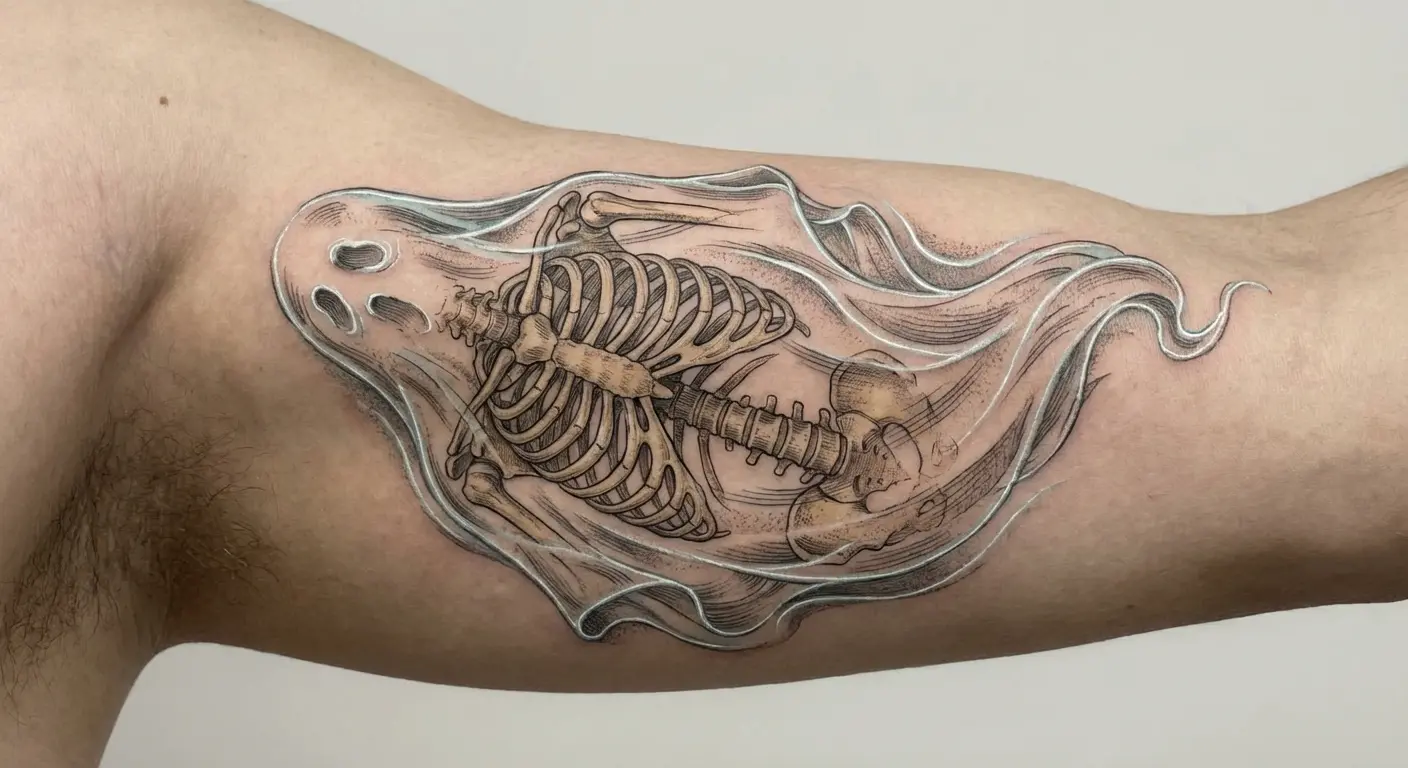
12. Anatomical Ghost (Ribcage Showing Through)
This one’s a commitment. A ghost with visible skeletal structure, particularly the ribcage, creating a double-death effect. You’re seeing both the spirit form and the bones that remain.
6-10 inches minimum, which means multiple sessions, which means money and time and sitting through some serious pain depending on placement. If you’re going for the back or chest (probably the best spots for showing a full ribcage), you’re looking at some of the more painful areas to get tattooed. Just being honest. The detail work alone will take hours.
Take this further by including other organs (a visible heart, lungs) or keeping it strictly skeletal. The concept is heavy: it’s a ghost that’s still haunted by its own physical form, unable to fully transcend.
You need an artist comfortable with anatomical drawing because incorrect bone proportions will be obvious to anyone with basic anatomy knowledge. Placement works best on flatter areas like back, chest, or outer thigh where the ribcage can be shown in proper proportion without distortion from body curves.
13. Celestial Ghost (Stars and Moon Integration)
The ghost form is constructed from or contains celestial elements. Stars forming its outline, a crescent moon as its head, constellations visible through its translucent body. This connects the supernatural with the astronomical, suggesting that spirits exist in the same vast, mysterious space as the cosmos.
Personalize this by using specific constellations that matter to you or by positioning the moon phase to match a significant date. The visual effect is stunning because it transforms the ghost from something earthbound and haunting into something expansive and beautiful.
Decide whether the celestial elements replace the ghost entirely or exist within a ghost outline. Both work, but they create different levels of abstraction. Size typically runs 5-8 inches to give the celestial details room to be recognizable.
Placement works well on areas where the vertical orientation emphasizes the cosmic scale: ribcage, outer thigh, full forearm. It’s a bridge between earth and sky, between what we can touch and what we can only wonder about.
14. Geometric Ghost Construction
The ghost is built from geometric shapes. Triangles, circles, hexagons arranged to suggest rather than depict a spirit form. This appeals to people who want ghost symbolism without figurative imagery.
The precision required for clean geometric work means you need an artist who specializes in this style. No room for error. The payoff is a design that reads as contemporary and architectural. Play with symmetry (perfectly balanced geometric ghost) or asymmetry where shapes seem to be falling apart or coming together.
Even something as intangible as a ghost can be deconstructed into fundamental shapes, suggesting that everything, including the supernatural, follows underlying structural rules.
Size needs to be large enough for the individual geometric elements to be distinct, typically 5-8 inches. Placement works best on areas where straight lines won’t be distorted by body curves: outer forearm, shoulder blade, outer calf. For those drawn to structural precision, geometric tattoo designs offer frameworks that can be adapted to create innovative ghost representations using sacred geometry and mathematical patterns.
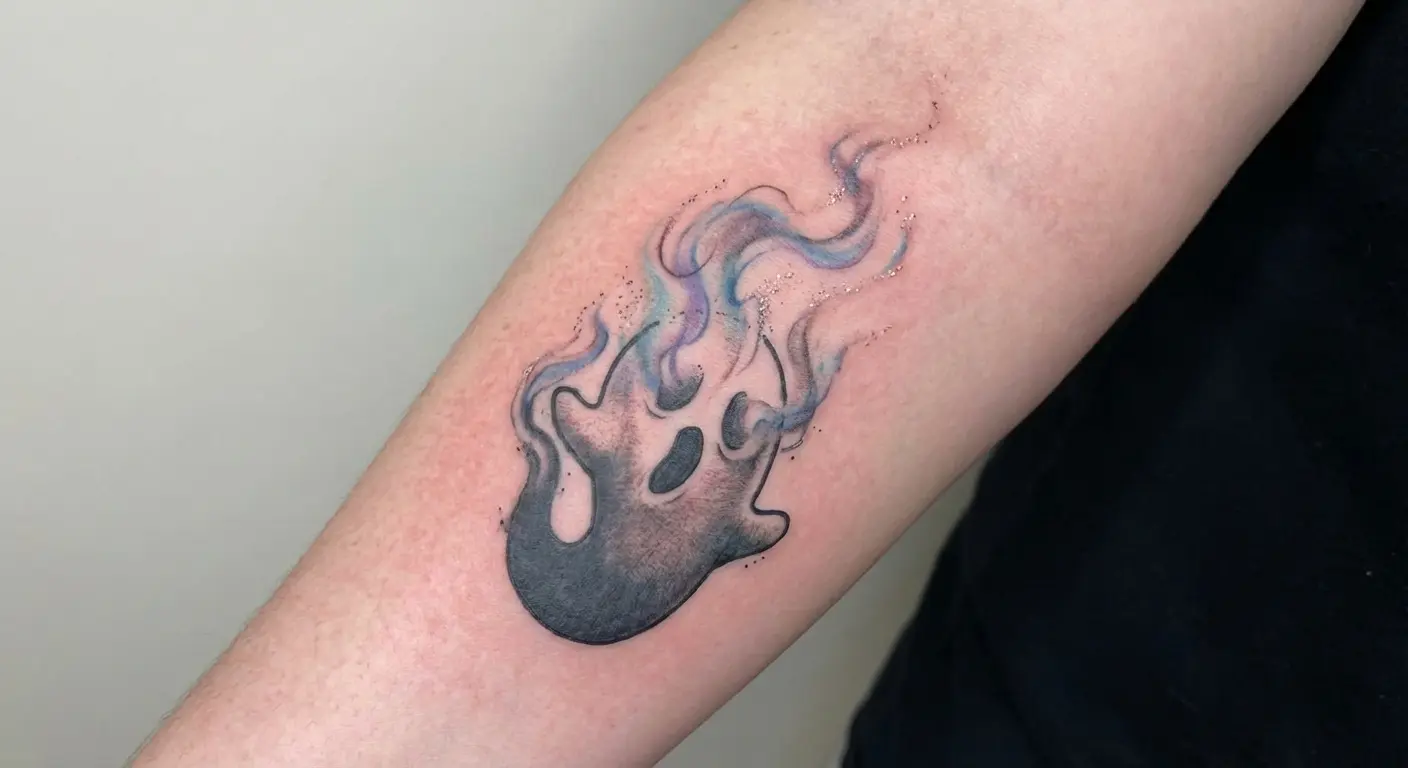
15. Ghost Mid-Transformation
This one’s tricky. You’re trying to capture a ghost that’s either becoming or un-becoming. Part solid, part dissolving into smoke or particles or whatever.
The concept is cool: change, impermanence, nothing stays the same. But executing it? That’s where it gets complicated. I’ve seen these go wrong when the transition looks accidental instead of intentional, like the artist just didn’t finish the tattoo.
You need someone who really gets gradient work. Stippling, watercolor techniques, line work that breaks apart gradually. It’s technical as hell. Not every artist can pull it off, and honestly, I wouldn’t try this as a first tattoo.
The transformation can move from human to ghost, ghost to nothing, or ghost to something else entirely (flowers, birds, geometric shapes). Control the direction and endpoint of the transformation based on what resonates with your experience.
Size runs 5-9 inches typically because you need space for both the recognizable ghost portion and the transformation effect. Placement works particularly well on areas where the transformation can follow your body’s natural flow: wrapping around the forearm, moving up the ribcage, flowing along the outer thigh.
16. Abstract Emotional Haunting
This is the most conceptual approach on the list. Rather than depicting a ghost figure, you’re creating an abstract composition that captures the feeling of being haunted. Swirling shapes, color gradients, fragmented forms, or layered textures that evoke presence without representation.
You might include small recognizable elements (an eye, a hand, a wisp of fabric) within the abstraction to anchor the “ghost” concept without defining it completely. This works for people who want tattoos that function more as emotional art than literal depictions.
The meaning stays entirely personal because there’s no obvious reading for outsiders. Describe this as whatever you want when people ask, or simply say it’s abstract art. You need an artist comfortable working without clear references, someone who can translate emotional concepts into visual composition.
Size varies widely, 3-10 inches, depending on complexity. Placement should consider how the abstract elements will interact with your body’s movement and how the composition will read from different angles.
Actually Getting This Tattooed
So you like one of these ideas. Cool. Now what?
Here’s the problem: explaining what you want to a tattoo artist is harder than you think. “I want a sad ghost holding flowers” could mean a thousand different things. Which flowers? How sad? What style?
This is where something like Tattoo Generator IQ actually helps. Plug in your idea, get a bunch of variations, figure out which direction you’re actually going for. You’re not going to use the AI design exactly (most artists won’t want to anyway), but at least you’re showing up to the consultation with something concrete instead of vague hand gestures.
Think of it as visual homework before the real work starts. Your artist can see exactly what elements you’re drawn to, which styles resonate, and how you envision the composition. Whether you’re pursuing minimalism or elaborate character-driven designs, having visual references accelerates the creative process.
One Last Thing
Ghost tattoos work because they’re vague enough to mean whatever you need them to mean. Grief, nostalgia, inside jokes, existential dread. It all fits under the same white sheet.
Look, some of you will regret these. That’s just statistics. Ghost tattoos are trendy right now, and trendy things age in weird ways. The minimalist ones will probably hold up better than the character-driven ones, just because simple designs are less tied to specific aesthetic moments. But also, maybe regret is okay? Tattoos are snapshots of who you were when you got them. Future you might cringe at current you’s choices. That’s life.
The technical stuff matters. Find a good artist, think about placement, consider how it’ll age. But not as much as making sure it actually means something to you. Or doesn’t. Some people just think ghosts look cool, and that’s fine too.
Ghost imagery means different things depending on where you’re from. Western sheet ghosts are different from Japanese yūrei, which are different from Mexican calaveras (though those are technically skulls, not ghosts, but the line gets blurry). Point is: if you’re pulling from a specific cultural tradition that’s not your own, maybe do some homework first. Or at least talk to your artist about whether what you’re asking for might be appropriative versus appreciative.
Whichever of these sixteen styles you’re drawn to, sit with it for a while. Look at it every day for a month. If you’re still into it, then yeah, put it on your body. Ghosts are patient. They can wait.
