21 Japanese Traditional Tattoos That Tell Stories Your Skin Will Never Forget
Table of Contents
Mythical Guardians & Protectors
-
Dragon (Ryu)
-
Phoenix (Hō-ō)
-
Foo Dog (Komainu)
-
Kirin
Warriors & Honor-Bound Figures
-
Samurai
-
Oni Mask
-
Hannya Mask
-
Geisha
Natural Elements & Seasonal Symbols
-
Cherry Blossom (Sakura)
-
Peony (Botan)
-
Chrysanthemum (Kiku)
-
Maple Leaves (Momiji)
-
Waves (Nami)
-
Wind Bars (Fūjin)
Sacred Animals & Creatures
-
Koi Fish
-
Tiger (Tora)
-
Snake (Hebi)
-
Crane (Tsuru)
Spiritual & Philosophical Icons
-
Lotus Flower (Hasu)
-
Fudo Myoo
-
Daruma
TL;DR
-
Japanese tattoos are a language, not a catalog. Learn the grammar and your design goes from pretty picture to actual story
-
Placement isn’t just about what looks cool (though that matters). Certain motifs belong on specific body areas for reasons that go back centuries
-
Combining elements follows rules. Break them if you want, but at least know what you’re breaking
-
Small doesn’t mean less meaningful if you understand which elements actually work at reduced scale
-
Background elements like water, wind, and clouds? They’re doing work, not filling space
-
Color choices carry specific meanings that can completely change what your tattoo says
-
Working with an artist who gets irezumi conventions makes all the difference between a tattoo that respects the tradition and one that just borrows the aesthetic
Introduction
Look, here’s what most tattoo guides won’t tell you about Japanese traditional work: it’s basically a visual language with grammar rules.
You’ve probably seen dozens of articles listing popular symbols with surface-level meanings. Dragon equals strength, koi equals perseverance, that kind of thing. And yeah, that information isn’t wrong. But it misses the deeper framework that separates authentic irezumi from Japanese-inspired decoration. Traditional Japanese tattoo culture operates on a visual language where elements interact, placements carry meaning, and backgrounds complete stories.
Think of it like knowing individual words versus understanding how to construct sentences. You can memorize “dragon” and “strength” all day, but if you don’t know the grammar, you can’t actually say anything meaningful.
We’re breaking down 21 core motifs across five thematic categories, but more importantly, we’re showing you how these pieces fit together. This knowledge helps you collaborate more effectively with your artist and ensures your tattoo communicates the complete message you intend, not just an approximation.
Japanese tattoo tradition has been around since approximately 5,000 B.C., according to Lone Star Tattoo, giving irezumi a significantly longer history than most Western tattoo traditions. This deep historical foundation explains why the symbolic language is so complex and why proper execution requires understanding centuries of accumulated meaning.
Mythical Guardians & Protectors
The guardian figures in Japanese traditional tattoos represent more than protection. They embody specific virtues and cosmic forces that shaped Japanese spiritual thinking for centuries. These aren’t just interchangeable symbols of strength. Each creature occupies a distinct role in the protective hierarchy.
Placement conventions for these figures also follow specific rules. A dragon wrapping around your torso tells a different story than one climbing your leg. We’re looking at four primary guardian archetypes and the narrative elements that activate their full symbolic potential.
|
Guardian Type |
Primary Protection |
Where It Works Best |
Key Visual Elements |
Classic Combos |
|---|---|---|---|---|
|
Dragon (Ryu) |
Wisdom, transformation, benevolent power |
Torso wrap, leg ascent, full back |
Clouds, water, jewels, 3-4 claws |
Waves, phoenixes, tigers |
|
Phoenix (Hō-ō) |
Renewal after hardship, peaceful transformation |
Back, full sleeves, chest |
Flames, paulownia trees, elaborate tail |
Dragons, cherry blossoms, clouds |
|
Foo Dog (Komainu) |
Spiritual boundaries, sacred space |
Chest (paired), shoulders, arms |
Open/closed mouths, clouds, architecture |
Always in pairs, sacred symbols |
|
Kirin |
Compassionate strength, righteous leadership |
Upper arm, thigh, side panel |
Clouds, flames that don’t burn, scales |
Peonies, sakura, wind bars |
1. Dragon (Ryu)
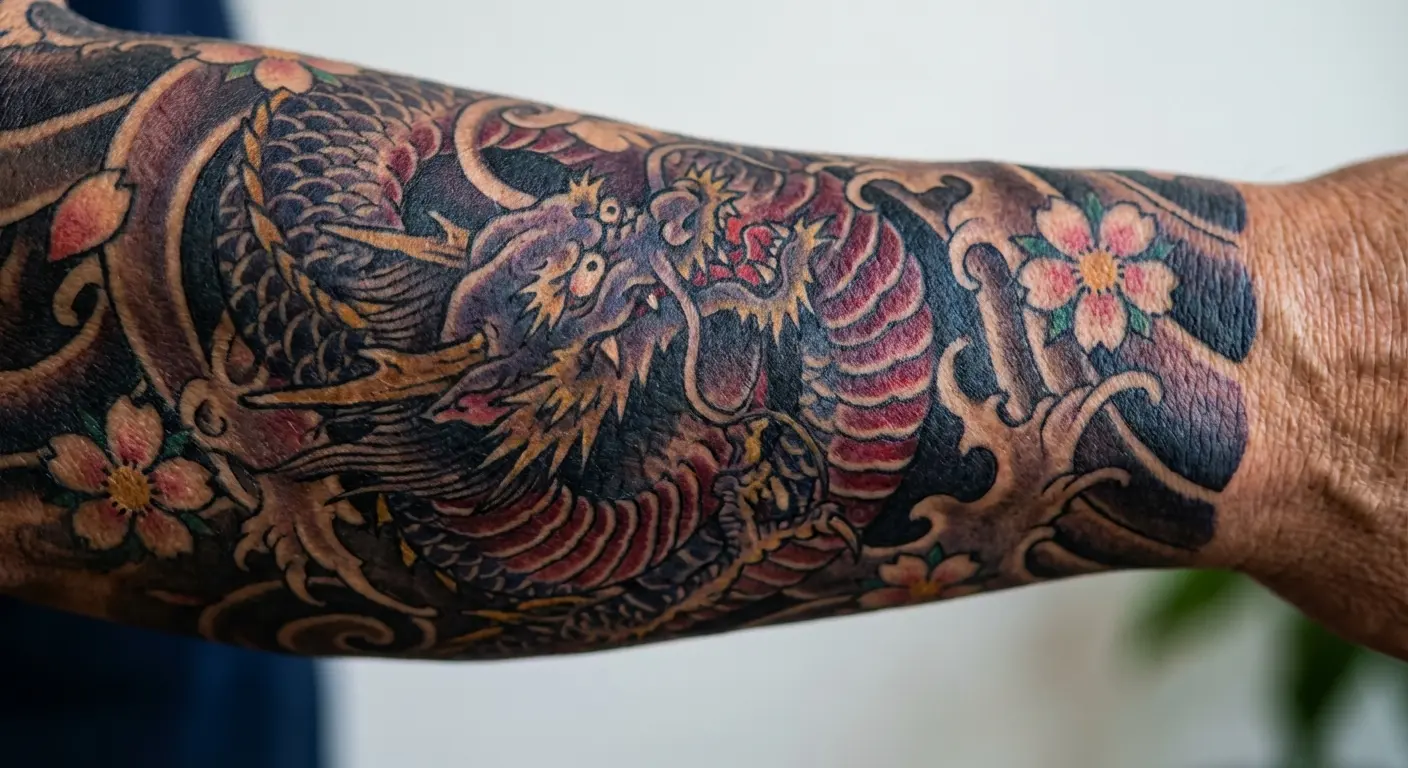
Japanese dragons differ fundamentally from their Western counterparts. You won’t find the fire-breathing destroyers of European folklore here.
Ryu are water deities. They’re associated with wisdom, transformation, and benevolent power. They control rainfall, rivers, and seas, making them life-givers rather than life-takers. Dragons typically move upward (ascending toward enlightenment) or coil around the body (providing continuous protection).
The number of claws matters. Three or four claws indicate a Japanese dragon, while five-clawed versions reference Chinese imperial dragons. Direction of movement, body position (ascending, descending, or coiled), and accompanying elements all modify the core meaning. A dragon clutching a jewel represents the pursuit of wisdom. One emerging from waves symbolizes overcoming challenges.
Color adds another layer. Black dragons represent wisdom and experience. Blue ones symbolize tranquility. Green dragons connect to nature. Gold versions indicate value and virtue.
Dragons are symbols of power in Japanese culture and are mostly considered good, not evil. Lone Star Tattoo notes there are two traditional postures in tattoos: ascending dragons are associated with striving for the heavens, while descending dragons symbolize the deliverance of good from on high. Both have connotations of striving for improvement and offering aid, making the directional choice critical in communicating your tattoo’s intended meaning.
2. Phoenix (Hō-ō)
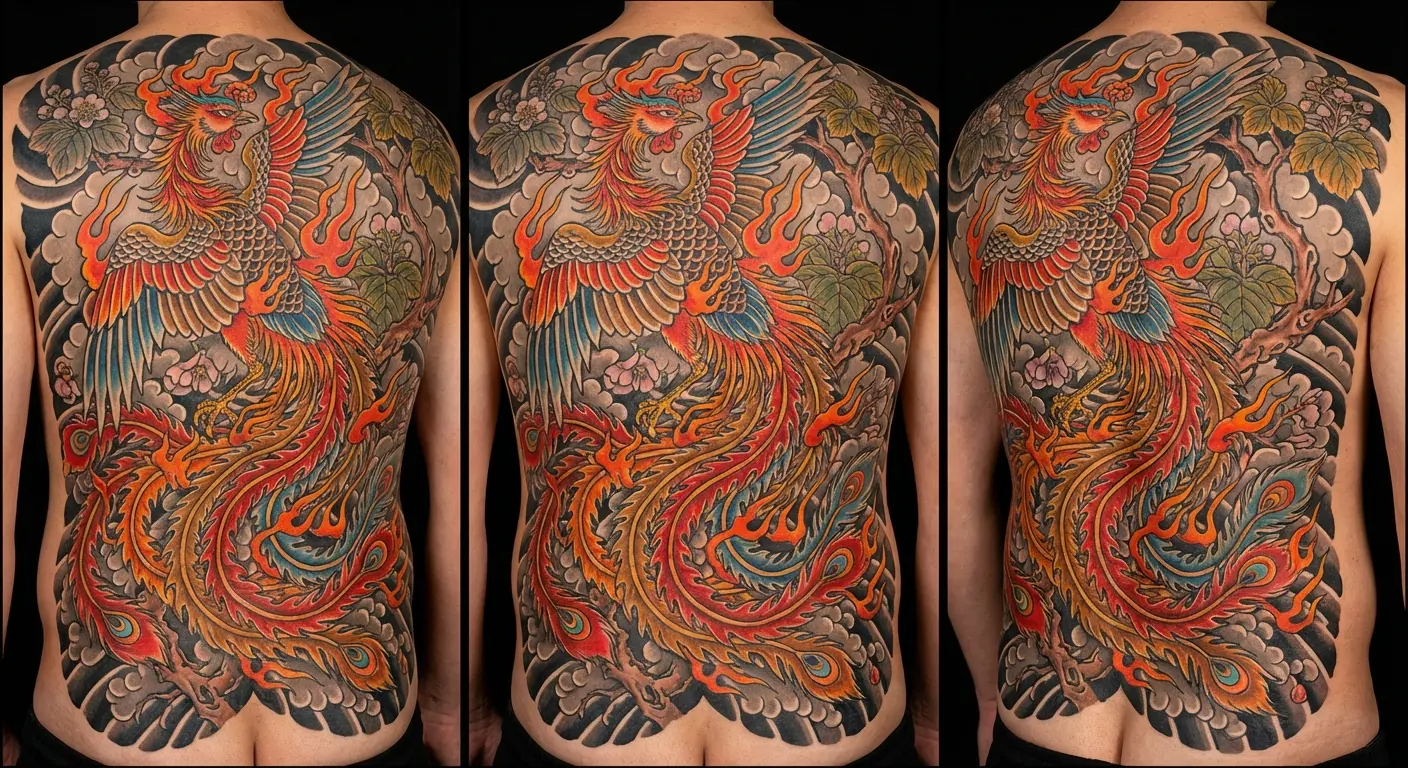
The Japanese phoenix is distinct from both Western and Chinese versions. It appears during times of peace and prosperity, making it a symbol of renewal earned through hardship rather than destruction and rebirth. This distinction matters when you’re choosing between a phoenix and other transformation symbols.
Hō-ō designs work particularly well for people who’ve emerged from difficult periods stronger than before, but the emphasis sits on the peaceful aftermath, not the struggle itself. The phoenix tattoo meaning extends beyond simple rebirth imagery, encompassing themes of imperial grace and earned tranquility.
Traditional compositions show phoenixes in flight (moving forward) or perched among paulownia trees (their sacred dwelling). Flames often surround the bird, but these represent purification and transformation, not consumption.
Pairing a phoenix with a dragon creates the ultimate balance symbol in Japanese culture, similar to yin and yang. This combination represents the union of imperial power (dragon) and imperial grace (phoenix). It frequently appears in large-scale irezumi designs covering the back or full sleeves. The phoenix’s elaborate tail feathers allow for stunning compositional flow, making it ideal for areas where the design needs to wrap or extend naturally.
3. Foo Dog (Komainu)
Komainu, often called foo dogs despite being lions, not dogs, serve as spiritual guardians stationed at temple and shrine entrances throughout Japan. They appear in pairs, with one mouth open (representing the sound “ah,” the beginning of all things) and one closed (representing “un,” the ending). Together they symbolize the totality of existence.
You’ll rarely see a single komainu in traditional work. The pairing is essential to the meaning. The open-mouthed version wards off evil spirits through vocal force, while the closed-mouthed partner provides silent, steadfast protection. Some people place one on each arm or leg to maintain the symbolic balance.
Komainu work exceptionally well as chest pieces (protecting the heart) or shoulder guardians. Their fierce expressions and dynamic poses create bold, immediately recognizable imagery that holds up across distance.
Background elements typically include clouds or sacred architecture, reinforcing their role as protectors of sacred space. Color variations affect the intensity. Red komainu appear more aggressive and active, while stone-gray versions emphasize permanence and unwavering dedication.
4. Kirin
The kirin (Japanese qilin) might be the most overlooked guardian in Western irezumi discussions, which is unfortunate because it carries profound meaning.
This chimeric creature has a dragon head, deer body, ox tail, horse hooves, often with scales and a single horn. It appears only in the presence of exceptional leaders or to herald significant positive events. It’s so gentle that it won’t even step on grass to avoid harming living things, yet it possesses the power to punish the wicked. This duality makes kirin tattoos perfect for people who value strength tempered by compassion.
Traditional compositions show kirin walking on clouds (emphasizing their celestial nature) or surrounded by flames that don’t burn (representing pure power without destruction). Because kirin appear rarely even in mythology, choosing this guardian signals that you’ve done your homework on Japanese symbolism.
The design works beautifully for upper arm or thigh placements where the creature’s elongated body can display in full. Pairing a kirin with sakura blossoms or peonies emphasizes the peace and prosperity aspects, while adding clouds and wind bars highlights its divine nature.
Warriors & Honor-Bound Figures
The human and humanoid figures in Japanese traditional tattoos embody complex moral and emotional states rather than simple virtues.
These aren’t straightforward hero images. Samurai represent the bushido code but also the burden of duty. Oni masks show demonic power but originated as protectors. Hannya masks depict feminine rage born from betrayal. Geisha symbolize refined beauty and the discipline required to achieve it. Each figure carries layered meanings that shift based on composition, expression, and surrounding elements.
5. Samurai
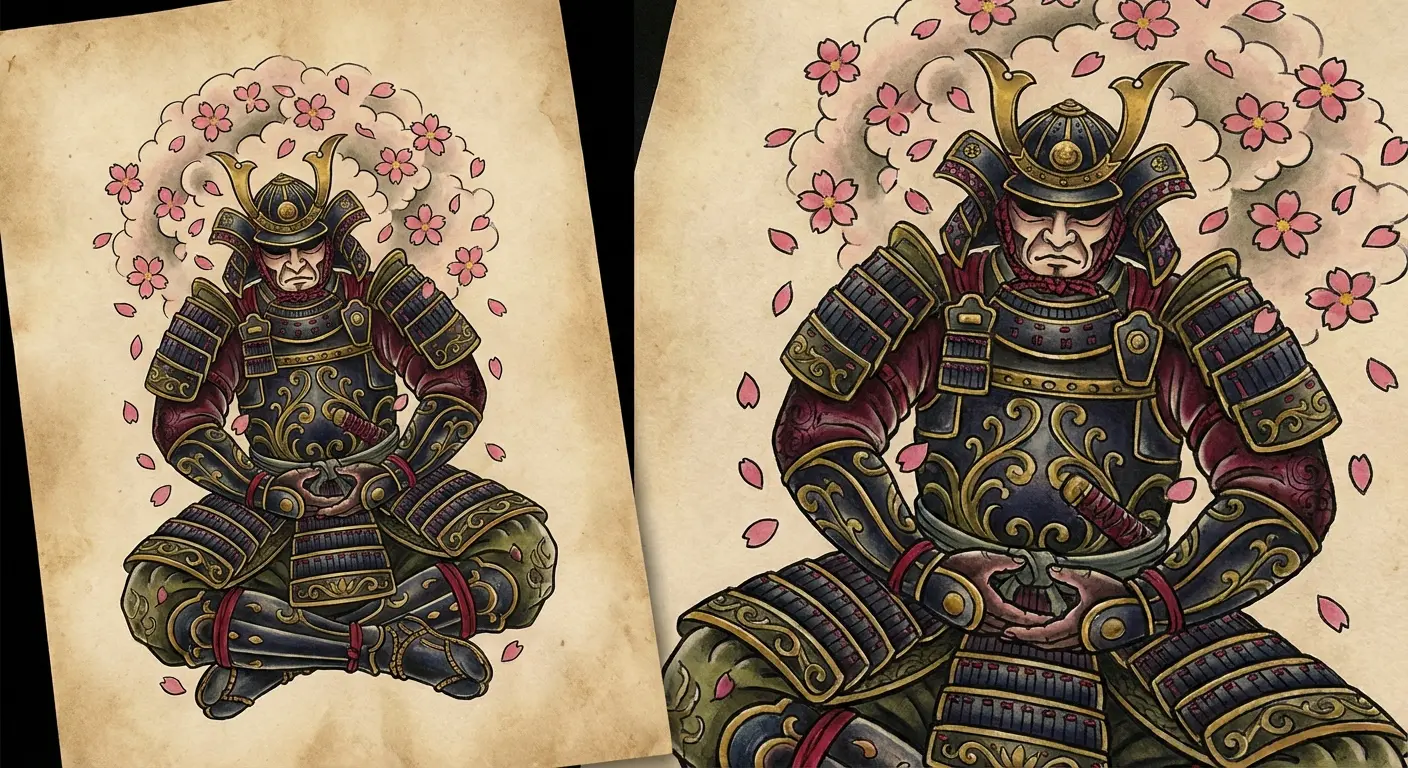
Samurai tattoos in the irezumi tradition don’t glorify violence. They represent the internal struggle between duty, honor, and personal desire that defined the warrior class.
You’ll notice traditional designs often show samurai in moments of contemplation or preparation rather than active combat. This reflects the bushido emphasis on mental discipline over physical prowess. The samurai’s posture, armor details, and facial expression all communicate specific aspects of the warrior code.
A samurai with lowered eyes shows humility and self-reflection. One gazing forward demonstrates readiness and resolve.
Including a katana emphasizes the “soul of the samurai” concept, but the sword’s position matters. Sheathed indicates controlled power, drawn suggests active defense of principles. Background elements typically include cherry blossoms (representing life’s transience, a core samurai meditation) or storm clouds (indicating the turbulent times warriors navigated).
Full samurai portraits work best as large-scale pieces. Back, chest, or full sleeve where the armor details and facial features can display with necessary clarity. Smaller interpretations might focus on iconic elements: a kabuto helmet, a mon (family crest), or crossed katanas.
6. Oni Mask
Oni occupy a fascinating space in Japanese folklore. They’re demons, yes, but they also serve as protectors and enforcers of cosmic justice. This duality makes oni mask tattoos more complex than simple “demon” imagery.
Traditional depictions show oni with wild hair, horns, fangs, and fierce expressions, often in vibrant red or blue skin tones. Red oni typically represent uncontrolled passion and anger, while blue oni symbolize sadness, depression, or more internalized negative emotions.
The expression intensity varies from terrifying to almost comical, and your choice affects the overall message. A snarling oni wards off evil through intimidation. One with a slight smirk suggests you’ve made peace with your inner demons and even find them amusing.
Oni masks pair effectively with other protective elements like clouds, lightning, and flames. They also appear alongside heroes they’re challenging, creating narrative tension in the composition. Placement often emphasizes the protective aspect. Shoulder oni “guard” your back, while forearm positions allow you to display the fierce face outward as a warning. The mask format (as opposed to a full oni figure) references Noh theater traditions, adding a layer of cultural performance and transformation to the symbolism.
7. Hannya Mask
The hannya mask represents a specific type of demon in Noh theater: a woman transformed by jealousy and rage into a horned creature. This isn’t a generic demon face. It’s a deeply gendered symbol exploring feminine anger, betrayal, and the consequences of unchecked emotion.
The mask’s expression cleverly changes based on viewing angle. From directly in front, it appears vengeful and fierce. From below, the expression softens to show the sadness and pain underneath the rage. This built-in duality makes hannya masks particularly powerful for people processing complex emotional experiences.
Artists emphasize different aspects through color and detail choices. A white hannya shows a woman in the early stages of transformation, anger beginning. Red indicates a fully transformed demon, rage consuming. Some designs include tears or softer eye details to emphasize the underlying sorrow.
Hannya masks work across various sizes, from small applications on the upper arm or calf to large-scale chest or back pieces. Pairing a hannya with cherry blossoms creates poignant contrast. Beauty and rage, transience and eternal emotion. Adding flames emphasizes the consuming nature of jealousy.
8. Geisha
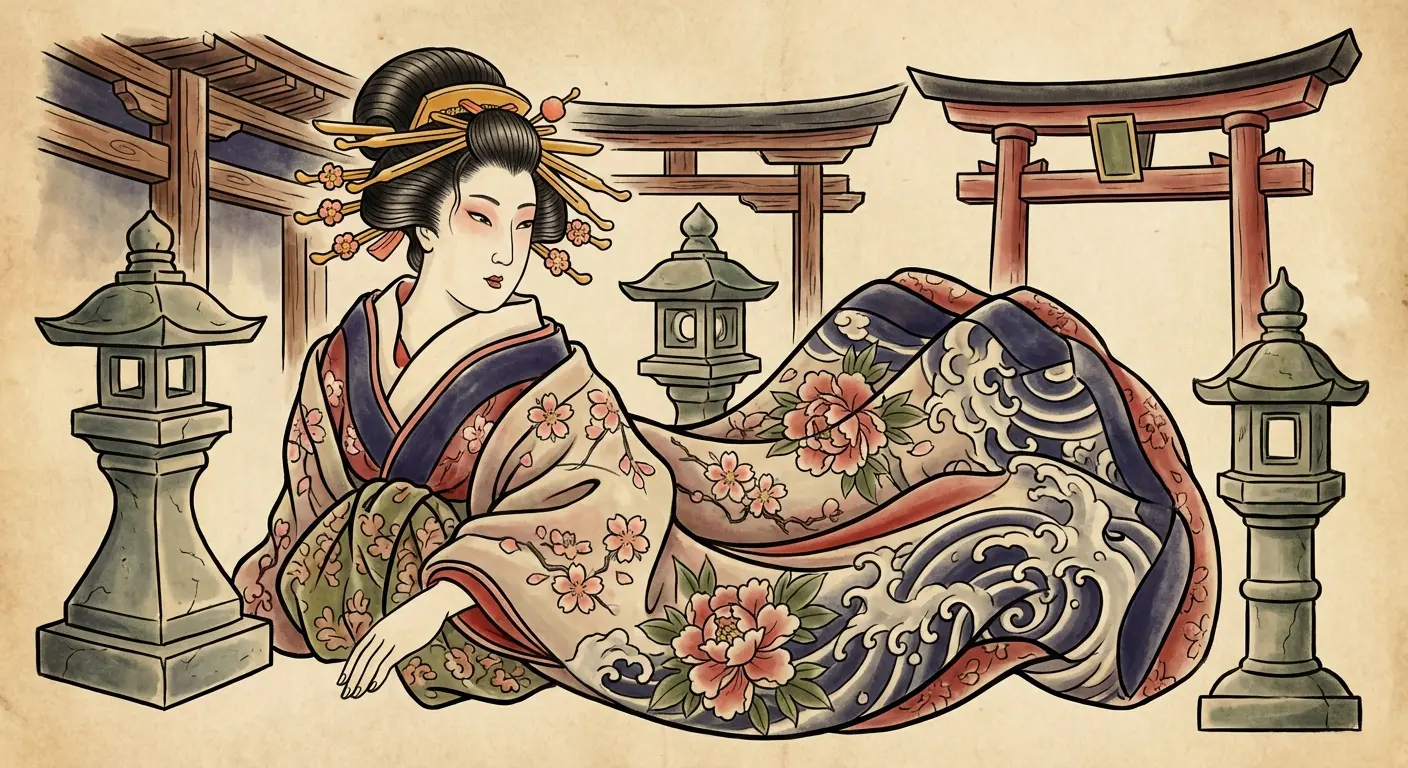
Geisha tattoos in irezumi tradition celebrate discipline, artistic mastery, and the refinement of beauty into an art form. These designs don’t objectify. They honor the years of training and cultural knowledge geisha embody.
Traditional compositions show geisha in elaborate
kimono with specific patterns. The fabric design tells its own story. They’re often holding instruments or fans, with cherry blossoms or maple leaves indicating the season.
The geisha’s expression and posture communicate different qualities. A slight smile with lowered eyes suggests mystery and reserve, while a direct gaze indicates confidence and mastery. Hair ornaments (kanzashi) aren’t random decorations. They indicate status, season, and occasion. Including these details accurately demonstrates respect for the cultural complexity.
Geisha tattoos pair beautifully with architectural elements like traditional buildings, bridges, and lanterns that establish setting and context. They work particularly well for people in creative fields or those who value the intersection of discipline and artistry.
Back pieces are where geisha designs really shine. You need that space for the flowing kimono and elaborate hairstyle. Color is essential. The kimono patterns, makeup details, and background elements all rely on precise color work to achieve the refined aesthetic that defines the subject.
Natural Elements & Seasonal Symbols
Here’s something most people get wrong: those cherry blossoms, waves, and wind bars in the background? They’re not filler. They’re not decoration. They’re doing actual narrative work, telling you when, where, and how the main action is happening.
Think of them like stage setting in a play. A samurai standing alone means something different than a samurai surrounded by falling sakura petals (spring, transience, awareness of mortality) or one in a storm (turbulent times, challenges).
Understanding which natural symbols pair with which primary subjects, and what those combinations mean, separates culturally informed irezumi from random Japanese-inspired imagery. We’re covering six core natural elements that appear across traditional designs, focusing on their narrative functions and symbolic associations.
9. Cherry Blossom (Sakura)
Sakura symbolizes life’s beautiful transience. The blossoms appear spectacularly and fade quickly, creating a natural meditation on mortality and the importance of appreciating each moment. This concept, mono no aware (the pathos of things), sits at the heart of Japanese aesthetic philosophy.
Cherry blossoms serve multiple functions in Japanese tattoos. They soften fierce subjects. A samurai with sakura becomes more contemplative. They indicate spring season, establishing temporal context. They add delicate visual texture to bold imagery. The blossoms appear in various states: tight buds (potential, new beginnings), full bloom (peak beauty, living fully), or falling petals (acceptance of endings, grace in decline).
Scattering petals create movement and flow in compositions, helping guide the eye across complex pieces. Sakura pairs naturally with almost any subject, but combinations with warriors, geisha, or dragons appear most frequently. The blossoms work across all scales, from small accent pieces to major compositional elements in large work.
Color choices affect the mood. Traditional pink creates soft, romantic atmosphere. White blossoms feel more pure and spiritual. Red sakura, less common, emphasize the blood-and-beauty connection in samurai culture.
10. Peony (Botan)
Peonies are the kings of flowers. Literally, that’s their nickname. They represent wealth, bravery, and honor in Japanese symbolism, earning their royal status through association with masculine courage and the willingness to take risks for worthy goals.
Traditional work shows peonies large and bold with layered petals creating depth and volume. They pair exceptionally well with lions (both symbols of courage and royalty), creating one of the most classic irezumi combinations. Peonies also complement dragons (wealth and power) and appear in samurai-themed pieces (honor and bravery).
The flowers typically appear in full bloom. Unlike sakura, which explores the full life cycle, peonies emphasize the peak moment of achievement and glory.
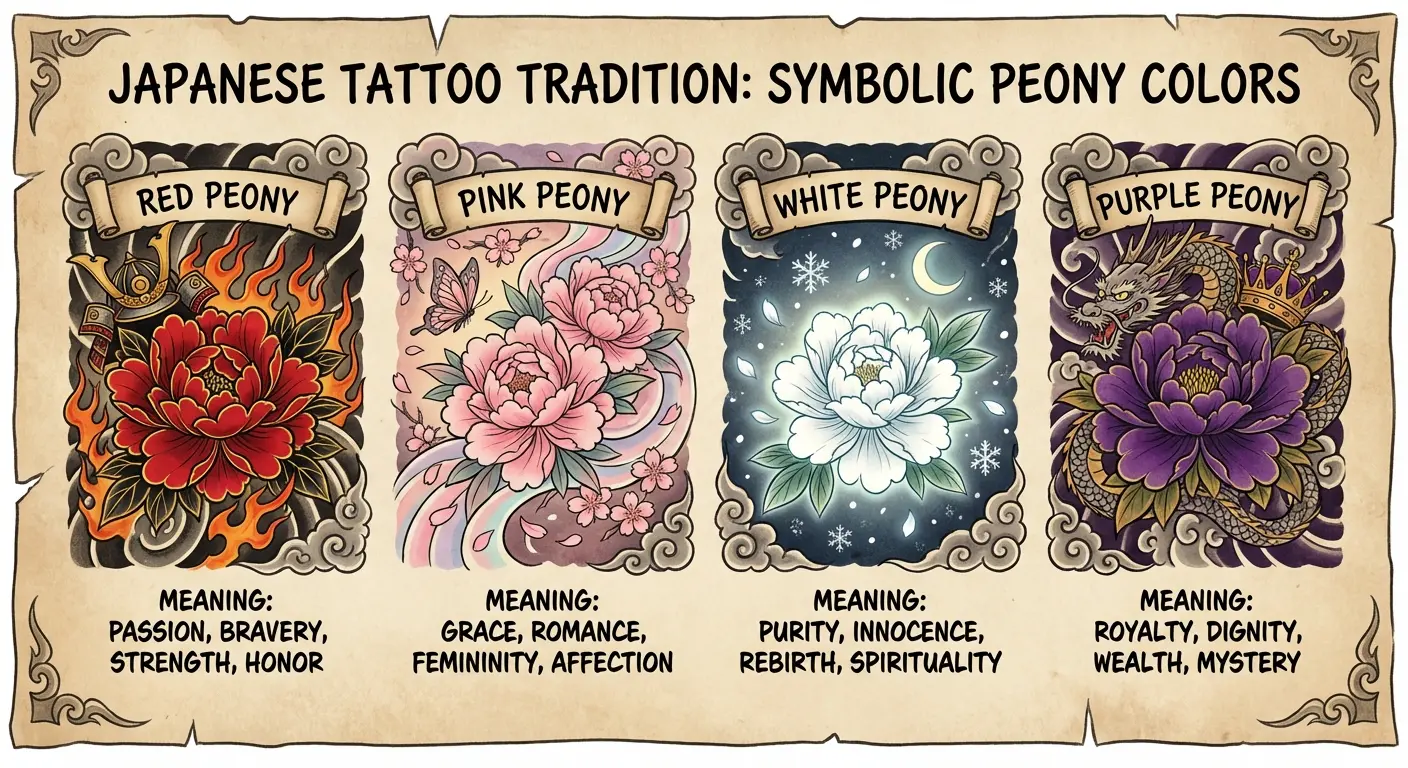
Color carries specific meanings. Red peonies indicate honor and respect. Pink versions suggest prosperity and good fortune. White peonies represent bravery and honor without the wealth associations. Purple peonies, rarer, connect to royalty and accomplishment.
Peony designs work well for chest pieces, shoulders, and thighs where the large, round flower heads can display their full detail. Background elements usually include leaves and stems (grounding the flowers in nature) or clouds (elevating them to symbolic status). The bold, structured form of peonies creates excellent contrast when paired with flowing, dynamic subjects.
11. Chrysanthemum (Kiku)
The chrysanthemum serves as the imperial seal of Japan, making it the most prestigious flower in Japanese culture. It represents longevity, rejuvenation, and nobility but also carries associations with death and mourning. Chrysanthemums appear at funerals and on graves. This duality gives kiku tattoos complex emotional resonance.
Chrysanthemums appear with precise, geometric petal arrangements radiating from the center, creating structured, almost architectural flowers in irezumi designs.
They pair well with phoenixes (both symbols of imperial power and renewal), dragons (nobility and wisdom), and occasionally appear in skull compositions (representing the honor found in accepting mortality). Chrysanthemum designs work across various scales because the flower’s structured form remains recognizable even when simplified.
Traditional colors include gold (imperial associations, highest honor), white (spiritual purity, mourning), and red (deep love, passionate commitment). Purple chrysanthemums indicate longevity specifically.
The flowers often appear in clusters or patterns rather than singly, referencing their use in textile designs and imperial imagery. Chrysanthemums work as focal points in chest pieces, complementary elements in sleeves, or connecting motifs that tie larger compositions together. Their structured, symmetrical form provides visual stability in designs featuring more chaotic, dynamic subjects.
12. Maple Leaves (Momiji)
Maple leaves represent autumn, the passage of time, and the beauty found in change and maturity. While sakura captures spring’s fleeting youth, momiji celebrates the richness of experience and the gorgeous transformation that comes with aging.
Maple leaves appear in vibrant reds, oranges, and yellows in traditional compositions, often shown floating on water or scattering in wind. They pair beautifully with deer (both autumn symbols), appear alongside warriors (representing the autumn of life, wisdom gained through years), and combine with water elements to show leaves floating downstream (time’s inevitable flow).
Momiji create excellent movement and texture in backgrounds, their pointed, distinctive shape remaining recognizable even in dense compositions.
The leaves work particularly well in sleeve designs where they can scatter across the arm, creating natural flow that follows the body’s contours. Color gradients within individual leaves, shifting from green to red, emphasize the transformation theme.
Some designs show momiji still on branches (change approaching but not complete), while others depict them mid-fall (active transformation) or settled on ground or water (acceptance of life’s seasons). Maple leaves soften aggressive subjects without diminishing their power, making them versatile additions to warrior, oni, or tiger compositions.
13. Waves (Nami)
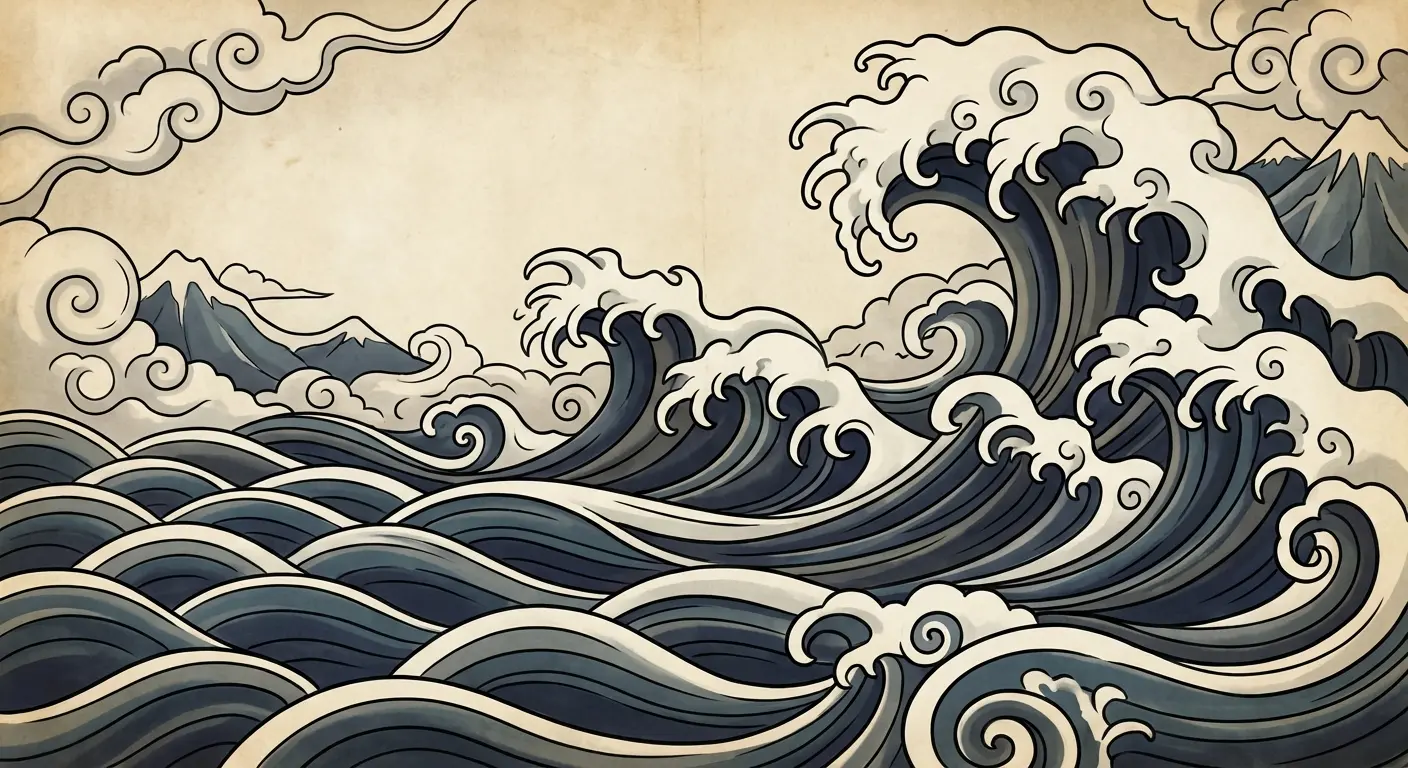
Water appears in countless traditional designs, but waves serve specific narrative and compositional functions beyond simple background. The distinctive wave style in irezumi, influenced by ukiyo-e prints (particularly Hokusai’s “Great Wave”), uses curved, claw-like forms that create dynamic movement and visual power.
Waves represent life’s challenges, the unstoppable force of nature, and the flow of time and emotion.
They provide context for water-associated creatures like dragons, koi, and sea creatures, and create dramatic contrast with stable, grounded elements. Wave intensity varies from gentle ripples (minor challenges, peaceful times) to towering, crashing walls of water (overwhelming obstacles, life-changing events).
A koi swimming upstream through aggressive waves tells a story of perseverance against serious adversity. A dragon emerging from calm water suggests power that doesn’t require dramatic demonstration.
Waves work exceptionally well as connecting elements in large-scale pieces, flowing around limbs and torso to unify separate design components. The curved forms complement body contours naturally.
Blue waves feel cool and controlled. Adding white foam caps increases drama and energy. Some designs incorporate red or black waves for more ominous, supernatural atmospheres.
14. Wind Bars (Fūjin)
Wind bars might be the most overlooked element in Japanese tattoo designs, yet they’re crucial for creating complete compositions. These stylized representations of wind and air movement, flowing ribbon-like forms, indicate movement, change, and the invisible forces that shape visible events.
Wind bars serve multiple purposes: they fill negative space without cluttering, create directional flow that guides the viewer’s eye, and add dynamic energy to static subjects.
Wind bars pair naturally with phoenixes (emphasizing flight and transformation), dragons (showing their command over sky and storm), and maple leaves or cherry blossoms (providing the force that scatters them).
The bars typically appear in colors that contrast with the primary subject. Black wind bars against colorful subjects, or colored bars against black-and-gray work. Their flowing, organic shapes create beautiful negative space and prevent compositions from feeling too dense or heavy.
Wind bars work particularly well in sleeve designs where they can wrap around the arm, connecting front and back elements into cohesive visual flow. They’re essential in back pieces for filling areas between major design components. Understanding how to use wind bars effectively separates amateur Japanese-inspired work from authentic irezumi composition.
Sacred Animals & Creatures
Animal symbolism in Japanese traditional tattoos draws from centuries of folklore, religious tradition, and natural observation. These aren’t generic spirit animals. Each creature carries specific meanings developed through its role in Japanese cultural narratives.
The way you depict these animals dramatically affects the message your tattoo communicates. A koi swimming upstream tells a completely different story than one swimming down. A tiger in bamboo suggests different qualities than one in storm clouds.
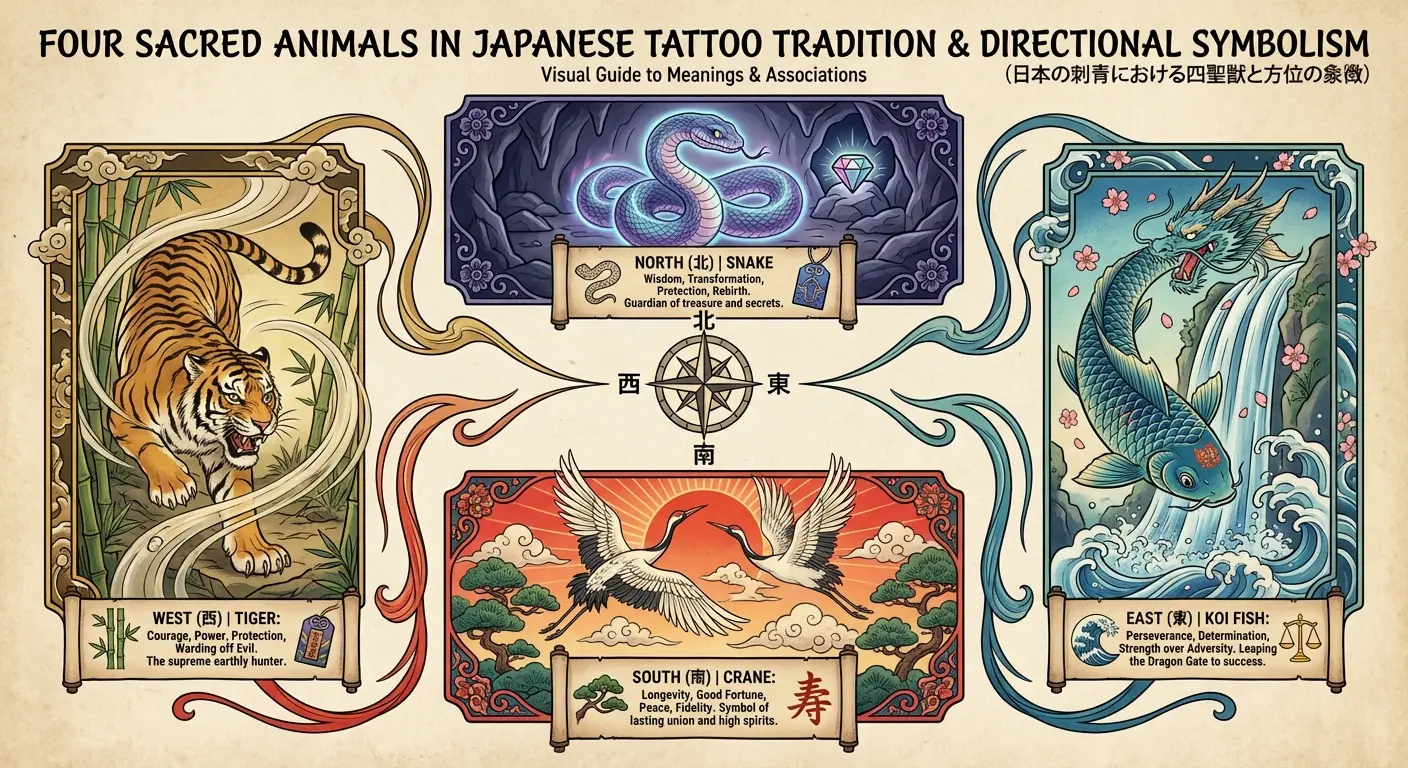
We’re examining four core animal figures and the compositional choices that activate their full symbolic potential.
|
Animal |
Core Symbolism |
Directional Meaning |
Color Significance |
Classic Combos |
|---|---|---|---|---|
|
Koi Fish |
Perseverance, transformation |
Upstream = struggle; Downstream = achievement; Leaping = decisive transformation |
Black = overcoming obstacles; Red = love/courage; Blue = tranquility; Gold = wealth; White = career success |
Waves, lotus, cherry blossoms, dragons (transformation complete) |
|
Tiger (Tora) |
Courage, protection, longevity |
Crouching = readiness; Leaping = decisive action; Roaring = vocal defense |
Orange/black = natural power; White = spiritual protection |
Bamboo, wind bars, maple leaves, dragons (earth vs heaven balance) |
|
Snake (Hebi) |
Wisdom, transformation, unpredictability |
Coiled = potential energy; Striking = active defense; Wrapped = protection/control |
White = fortune (Benzaiten connection); Black = mystery/hidden knowledge; Natural patterns = earthly wisdom |
Peonies, skulls, swords, dragons (earthly vs heavenly wisdom) |
|
Crane (Tsuru) |
Longevity, fidelity, good fortune |
Flight = spiritual ascension; Standing = dignity/patience; Paired = lifelong partnership |
White with black tips = purity and definition; Red-crowned = vitality/life force |
Pine trees, waves, clouds, rising sun |
15. Koi Fish
You’ve probably heard that koi represent perseverance and determination, referencing the legend of koi swimming upstream to become dragons. That’s accurate but incomplete.
The direction your koi swims, its color, and whether it’s shown before or after the waterfall transformation all modify the core meaning significantly. Upstream koi indicate you’re currently struggling against obstacles, still fighting toward your goal. Downstream koi suggest you’ve achieved your objective and now move with life’s flow rather than against it. Koi shown leaping from water represent ambition and the decisive moment of transformation.
Color symbolism is precise. Black koi represent overcoming significant obstacles, often associated with masculine energy. Red koi indicate strong, intense love or courage. Blue koi suggest tranquility and reproduction. Yellow or gold koi represent wealth and prosperity. White koi symbolize career success and academic achievement.
Traditional compositions show koi with detailed scales, flowing fins, and often include water elements like waves, ripples, and splashes to establish environment. Koi work beautifully across various placements. They’re among the most versatile irezumi subjects for adapting to different body areas while maintaining symbolic clarity.
16. Tiger (Tora)
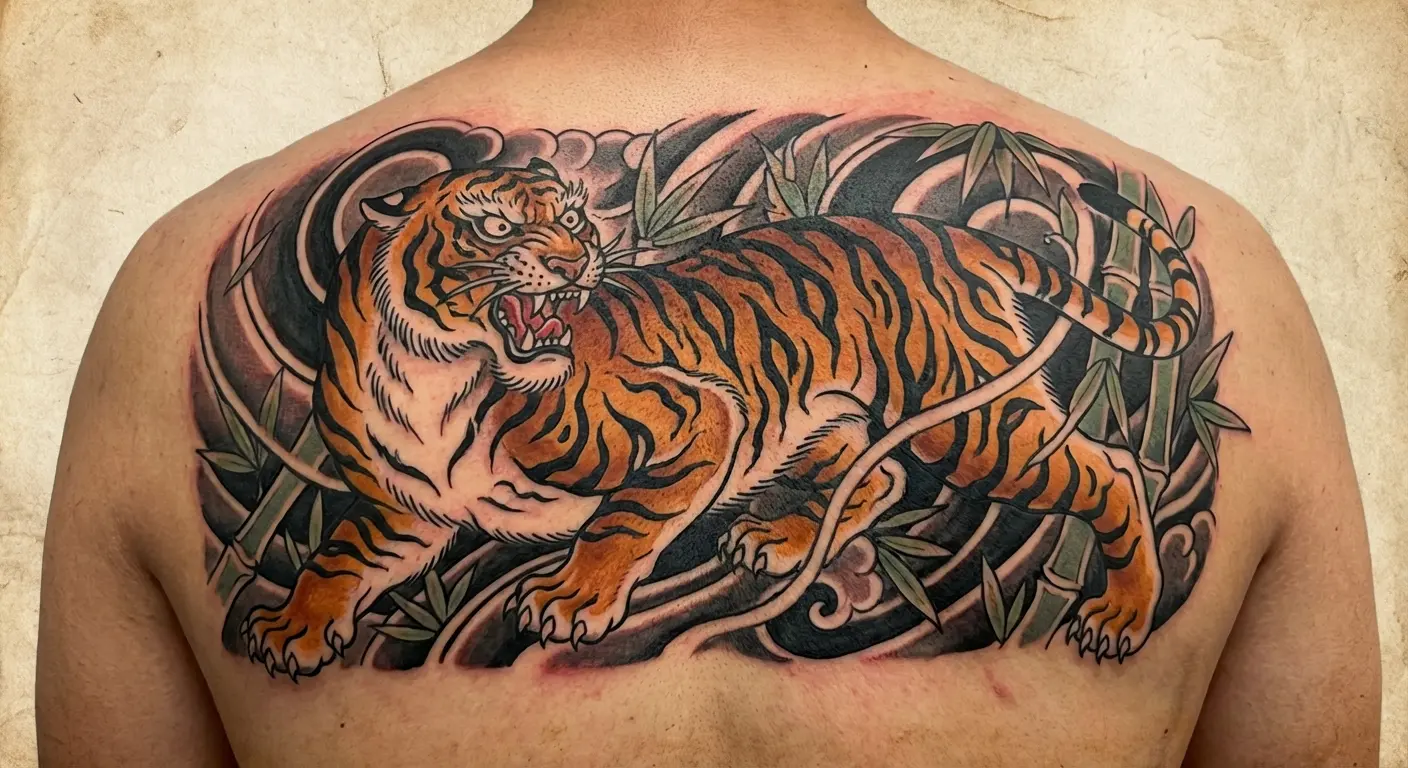
Tigers in Japanese tradition represent courage, long life, and protection against evil spirits and bad luck. They’re particularly associated with autumn and wind, making them natural pairings with maple leaves and wind bars.
Traditional designs show tigers in dynamic poses. Crouching (coiled power, readiness), leaping (active courage, taking decisive action), or roaring (vocal defense, warning against threats).
The tiger’s expression affects the overall message. A snarling tiger emphasizes protection and aggression, while a calm-faced tiger suggests confidence that doesn’t require demonstration.
Bamboo appears frequently in tiger compositions, representing the tiger’s habitat and the flexibility-with-strength concept. Wind bars and stormy backgrounds also show up often, emphasizing the tiger’s association with autumn winds. Most tigers appear in natural orange-and-black striping, though white tigers (rarer, more mystical) occasionally appear in designs emphasizing spiritual protection.
Tigers and dragons together? Classic power balance. Earth versus heaven, land versus sky. It’s the irezumi version of a greatest hits album.
17. Snake (Hebi)
Snakes carry complex, sometimes contradictory symbolism in Japanese culture. They represent wisdom, protection, and good luck, but also danger, unpredictability, and transformation through shedding skin.
Snakes appear coiled (potential energy, readiness), striking (active defense or attack), or wrapped around other elements (protection, possession, or control of that element) in traditional work. The snake’s position and what it interacts with dramatically affects meaning.
A snake coiled around a skull represents the cycle of life and death, wisdom gained through mortality. One wrapped around a sword suggests protection of warrior values or dangerous wisdom.
Snakes pair well with peonies (creating interesting texture contrast between scales and petals), appear with skulls (death and rebirth themes), and sometimes combine with dragons. Both are serpentine, but dragon represents heavenly power while snake represents earthly wisdom.
White snakes are particularly auspicious in Japanese folklore, associated with Benzaiten (goddess of fortune). Black snakes emphasize mystery and hidden knowledge.
Snakes’ flexible, elongated forms make them ideal for wrapping around limbs, following muscle contours, or creating connecting elements between separate design components in large-scale irezumi.
18. Crane (Tsuru)
Cranes represent longevity, good fortune, and fidelity in Japanese tradition. The belief that cranes live for a thousand years makes them powerful symbols of long life and enduring wisdom.
Cranes appear in flight (freedom, spiritual ascension), standing (dignity, patience), or paired (representing marital fidelity and lifelong partnership, as cranes mate for life) in traditional compositions.
The elegant, elongated form of cranes creates beautiful linear flow in designs, their long necks and legs providing graceful curves that complement body contours.
Cranes pair naturally with pine trees (both longevity symbols), appear with waves or clouds (establishing their connection to sky and water), and combine with rising sun imagery (auspicious new beginnings). The birds work well for people seeking symbols of enduring relationships, long life, or elegant strength.
Their association with peace and good fortune makes them less aggressive than many irezumi subjects, offering an alternative for those wanting traditional work without warrior or demon imagery.
Cranes translate effectively across various scales. Their distinctive silhouette remains recognizable in small applications, while larger pieces allow for detailed feather work and environmental context. White cranes with black wing tips create striking contrast, while red-crowned cranes (tancho) add symbolic color, red representing vitality and life force.
Spiritual & Philosophical Icons
The spiritual symbols in traditional Japanese tattoos represent philosophical concepts and religious figures that shaped Japanese thought across centuries. These designs carry deeper intellectual and spiritual weight than purely aesthetic or folklore-based imagery.
They’re not simply beautiful. They’re visual representations of complex ideas about enlightenment, perseverance, and spiritual protection. Choosing these symbols indicates engagement with Japanese philosophical traditions beyond surface-level appreciation.
We’re examining three core spiritual icons that appear in irezumi work, focusing on their proper context and the compositional elements that honor their religious or philosophical significance.
19. Lotus Flower (Hasu)
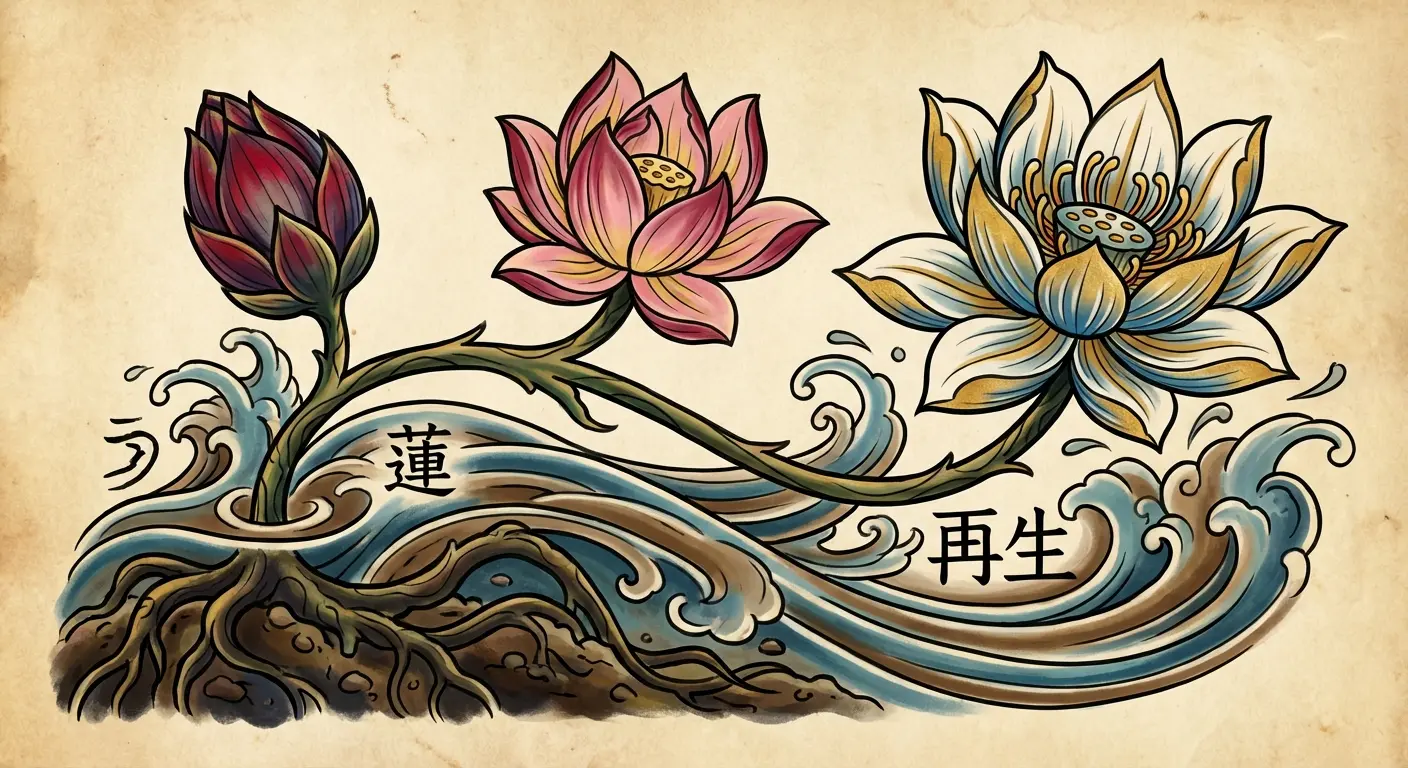
The lotus represents purity, enlightenment, and spiritual awakening in Buddhist tradition. Its significance comes from growing in muddy water yet emerging clean and beautiful, a metaphor for achieving enlightenment despite worldly suffering and obstacles.
The lotus shares tattoo meaning connections with other transformation symbols across cultures, though its Buddhist context gives it distinct spiritual weight.
Lotus appears in various stages of opening in traditional designs, each carrying specific meaning. Closed lotus buds represent the beginning of the spiritual journey. Partially opened flowers indicate progress toward enlightenment. Fully bloomed lotus flowers symbolize achieved enlightenment or full spiritual awakening. The number of petals can reference specific Buddhist concepts (eight petals represent the Noble Eightfold Path).
Lotus tattoos pair naturally with Buddhist figures like Fudo Myoo, Buddha, and bodhisattvas. They appear with koi (both represent transformation and spiritual achievement) and combine with water elements (showing the muddy origins from which purity emerges).
Color carries specific meanings. White lotus represents mental and spiritual purity. Pink lotus, most common, indicates the Buddha himself and spiritual perfection. Red lotus symbolizes the heart’s original nature, love and compassion. Blue lotus represents wisdom and knowledge. Purple lotus, rarest, indicates mystical spirituality.
Lotus designs work across various placements, from small symbolic pieces to major compositional elements in large-scale work.
20. Fudo Myoo
Fudo Myoo (Acala in Sanskrit) is one of the Five Wisdom Kings in Japanese Buddhism, representing immovable wisdom and unshakable resolve in the face of temptation or obstacles. He’s typically depicted with a fierce expression, fangs, sitting or standing in flames, holding a sword (to cut through ignorance) and rope (to bind evil and pull practitioners toward enlightenment).
This isn’t decorative demon imagery. It’s a specific Buddhist protector deity.
Fudo Myoo appears in full figure (requiring substantial space for proper detail) or as a face/bust portrait in traditional applications. The flames surrounding him (karura flames) represent purification and the burning away of earthly desires. His fierce expression serves protective purposes, frightening away evil and obstacles through intimidating appearance.
Fudo Myoo tattoos work best for people with serious Buddhist practice or those who deeply connect with the concepts of immovable determination and cutting through delusion. The imagery is too religiously specific for casual appreciation.
These designs typically require large spaces like back, chest, or full sleeve to render the figure with appropriate detail and respect. Background elements usually include flames, clouds, or rocky outcroppings (representing his immovable nature).
Colors follow traditional Buddhist iconography. His body often appears blue or black (representing immutability), flames are typically red and orange, and his attributes (sword, rope) appear in specific colors according to tradition.
The evolution of irezumi continues to adapt to contemporary culture while honoring traditional roots. Artist @fetattooer recently gained attention for reimagining Pokémon through the lens of Japanese irezumi, as covered by Inked Magazine. The artist transforms familiar characters into striking pieces that honor both pop culture and centuries-old artistry through dynamic linework, symbolic imagery, and flowing composition. This demonstrates how the fundamental principles of traditional Japanese tattoos (compositional flow, symbolic depth, and technical precision) can bridge ancient spiritual iconography and modern cultural references while maintaining the integrity of the art form.
21. Daruma
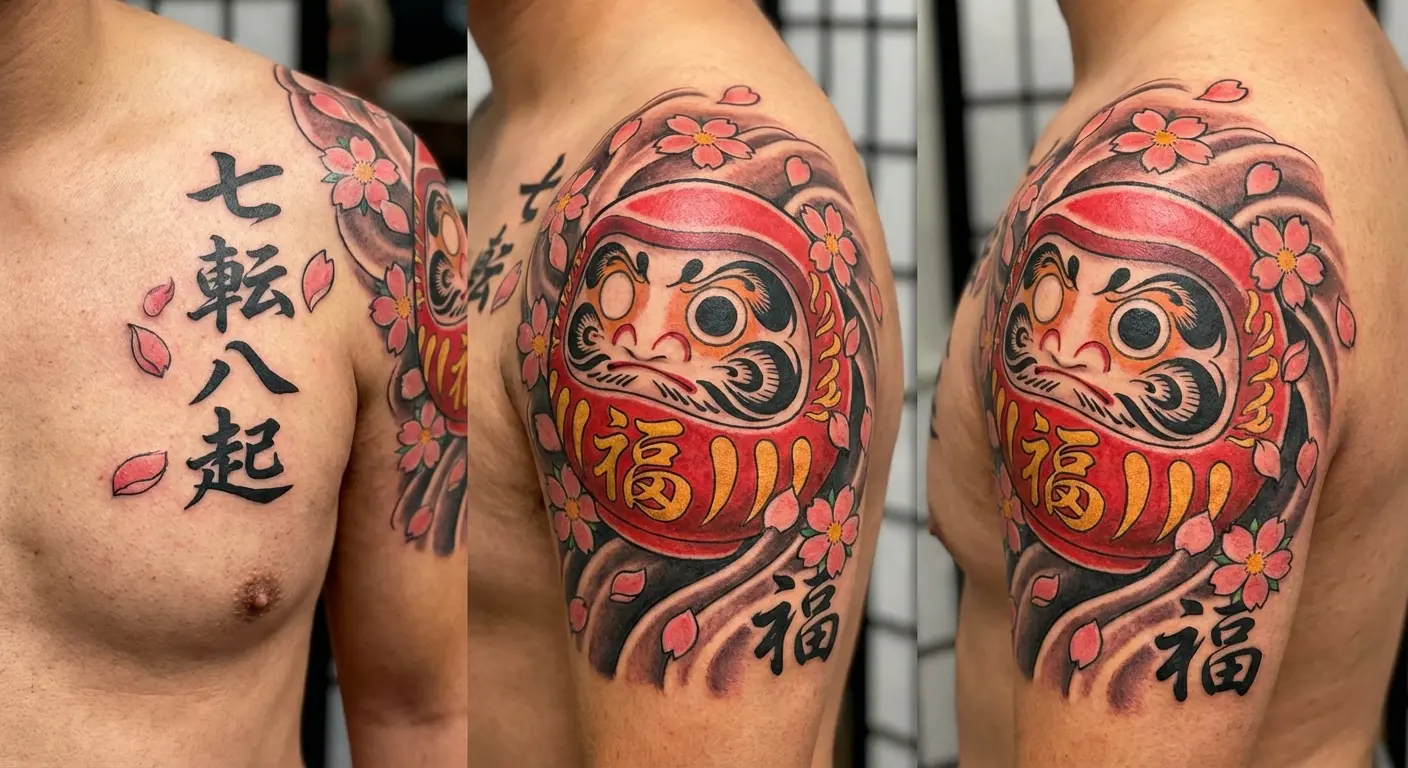
Daruma dolls represent Bodhidharma (founder of Zen Buddhism) and symbolize perseverance, goal-setting, and resilience. The traditional practice involves painting one eye when you set a goal and the second eye when you achieve it.
Daruma can appear with one eye (representing ongoing pursuit of goals), both eyes (celebrating achievement), or no eyes (representing the beginning of the journey) in traditional designs. The round, weighted-bottom form of daruma (they always right themselves when knocked over) creates the “fall down seven times, stand up eight” philosophy visually.
Daruma tattoos work particularly well for people who’ve overcome repeated setbacks or who value persistence over natural talent.
The bold, simple form translates effectively across scales. Daruma work as small pieces better than many complex irezumi subjects. The distinctive red color, most common, represents luck and fortune and creates strong visual impact. Other colors exist with specific meanings. White daruma represent mourning or purity. Yellow indicates security and prosperity. Gold brings wealth and fame. Purple promotes health and longevity.
Daruma pair well with cherry blossoms (transience and perseverance), appear with Japanese calligraphy (often displaying the kanji for “perseverance” or “patience”), and sometimes combine with other good-fortune symbols. The round form creates interesting contrast with angular or flowing design elements.
Bringing Your Vision to Life
Understanding these 21 traditional elements and their interconnected meanings gives you the foundation for creating authentic irezumi-inspired work. The real challenge comes next: translating your conceptual understanding into an actual design that works on your specific body, in your preferred placement, at your desired scale.
You’re probably feeling the gap between knowing what these symbols mean and visualizing how they’d look combined on your skin.
This is where most people get stuck. You understand the elements but can’t quite picture the complete composition. Tattoo Generator IQ addresses exactly this pain point. You can input the specific elements you’ve connected with (a dragon with maple leaves and wind bars, a tiger in bamboo, a lotus with koi), specify your preferred placement and size, and generate multiple design variations in seconds.
The AI understands traditional composition rules, how elements interact, which colors work together, and how designs should flow across body contours.
You’re not starting from scratch or trying to describe your vision to an artist before seeing any visual reference. You get to explore different arrangements, test various color schemes, and refine specific details until the design matches your intention.
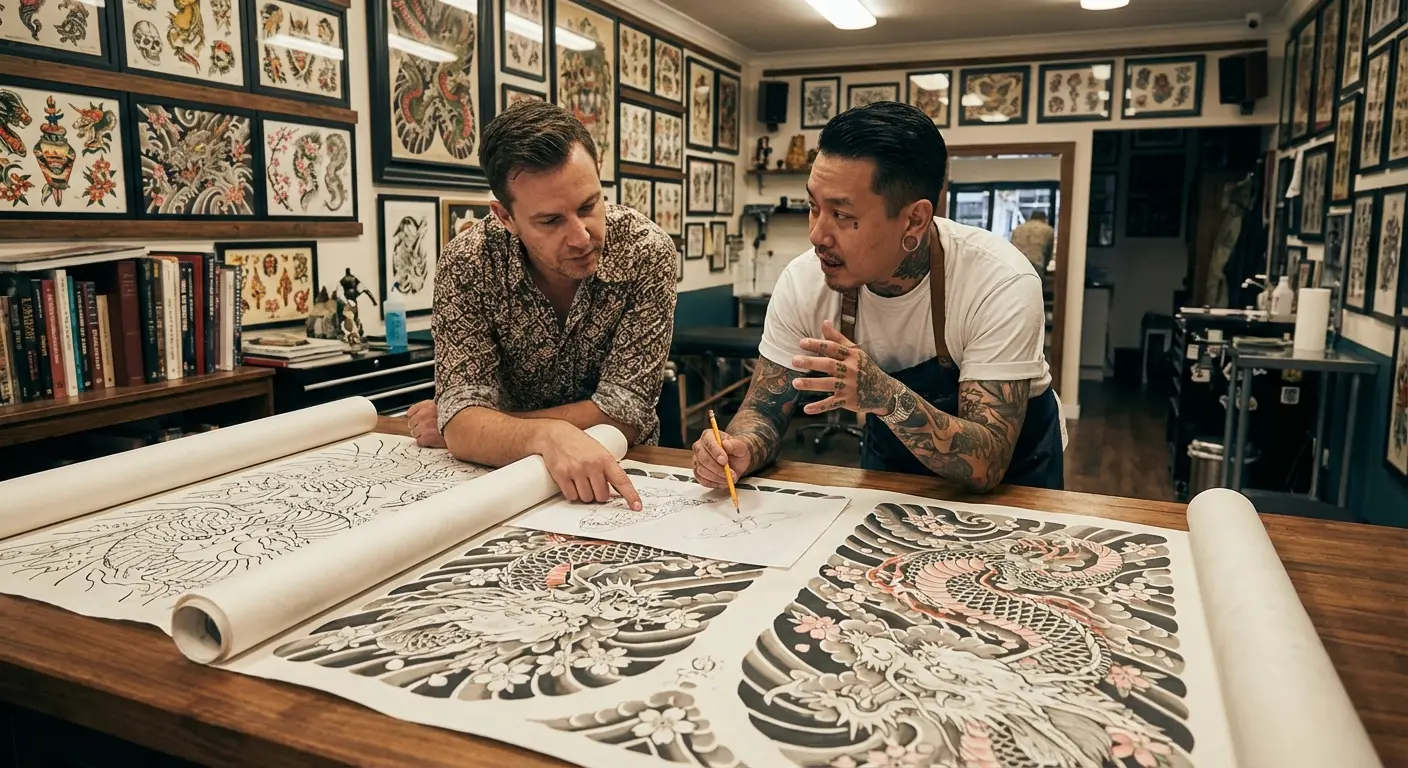
Then you bring that high-resolution, artist-ready reference to your tattoo artist, giving them a clear starting point for collaboration. This approach respects both the traditional art form and your personal vision, creating space for authentic irezumi-inspired work that tells your specific story.
Final Thoughts
Look, you can get a beautiful Japanese-style tattoo without knowing any of this. Plenty of people do. But understanding the grammar behind irezumi, how elements talk to each other, why placement matters, what those background waves are actually doing, that’s the difference between having a pretty tattoo and having one that actually says something.
Each element we’ve covered, from guardian dragons to philosophical daruma, carries specific meanings that shift and expand based on what you pair them with, how you orient them, and where you place them on your body.
This isn’t about memorizing a symbol dictionary. It’s about understanding the storytelling system so you can make informed choices that honor the tradition while expressing your personal narrative.
The difference between decoration and meaningful irezumi work lies in this compositional knowledge. You’re now equipped to approach your design with cultural awareness and symbolic precision. The symbols you choose, the way you combine them, and the care you take in respecting their traditional contexts all contribute to creating body art that functions as the Japanese masters intended: as a complete, readable story that lives on your skin.
Understanding comprehensive tattoo aftercare becomes especially critical with large-scale traditional work, where the investment of time, money, and physical endurance demands proper healing protocols to preserve the intricate details and vibrant colors that define quality Japanese tattoos.
Your tattoo will carry the weight and beauty of centuries of artistic tradition while remaining unmistakably yours.
