Lotus Flower Tattoo Meaning: What Your Ink Says About Your Relationship with Imperfection
Table of Contents
-
Why the Lotus Gets Misread
-
The Mud Matters More Than the Bloom
-
Cultural Context (Without Freaking Out About Appropriation)
-
Color Actually Changes Everything
-
Where You Put It Says More Than You Think
-
Design Elements That Tell Different Stories
-
When Your Lotus Becomes Just Another Pinterest Tattoo
-
Unexpected Symbol Pairings
-
The Design Process Nobody Talks About
-
Final Thoughts
TL;DR
Look, most people think lotus tattoos are about overcoming your past and moving on. But that’s not really how the plant works. The lotus stays in the mud. It blooms while still rooted in difficult conditions, not after escaping them. That’s the part everyone misses.
Different cultures emphasize different things (Buddhism focuses on detachment, Hinduism on divine creation, Egyptian mythology on daily rebirth cycles). Color matters way more than you probably think. And honestly? The lotus has gotten so popular that unless you personalize it, you’re probably getting the tattoo equivalent of “Live Laugh Love.”
I’m going to walk you through how to make this actually meaningful instead of just pretty.
Why the Lotus Gets Misread
Somewhere along the way, the lotus became the official tattoo of “I’ve overcome my past.” Which is weird, because that’s not really how the plant works.
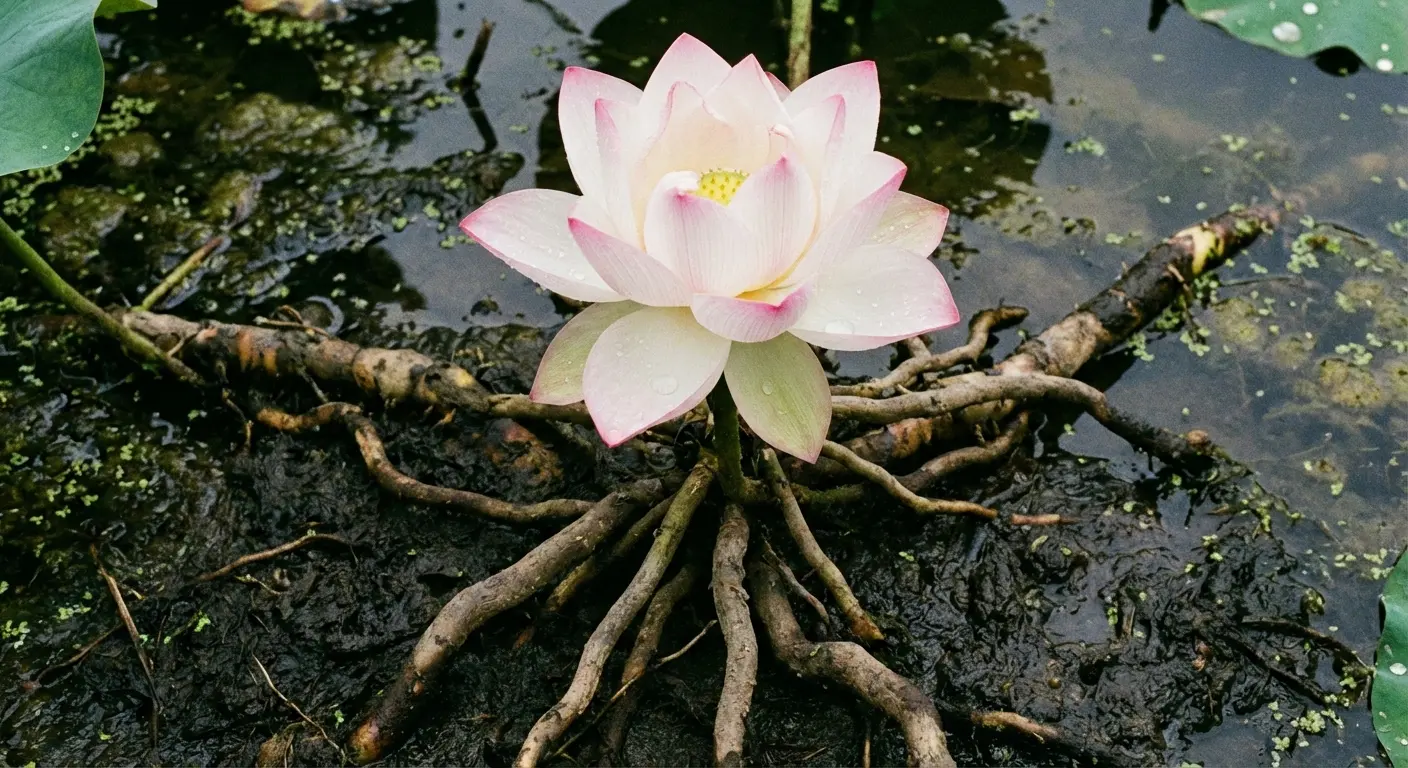
The lotus doesn’t escape the mud. It stays rooted there, blooming every single day while still anchored in murky water. This distinction matters because it completely reframes what your tattoo could mean. Beauty and struggle aren’t a before-and-after story. They’re happening at the same time.
Most people get lotus tattoos during transitional moments, expecting the ink to represent a finished transformation. But what if your lotus could represent something more honest? The ongoing practice of staying beautiful while still dealing with difficult conditions.
That’s what gets overlooked. Your lotus tattoo doesn’t have to announce that you’ve “made it.” It can acknowledge that you’re still in the mess and blooming anyway.
Brooklyn-based tattoo artist Tiaret Mitchell, who studies floral symbolism extensively, talks about how the lotus specifically symbolizes how “the murkiness and muddy patches in life help us deeply in our growth” for Buddhists, according to Allure’s feature on flower tattoo designs. This understanding shifts the symbol from simple triumph to ongoing practice.
The Aesthetic Trap
Okay, real talk about Pinterest.
You’ve seen countless lotus designs on Instagram. They’re gorgeous, symmetrical, often paired with mandalas or geometric patterns. And here’s what happens: the visual appeal starts driving the decision more than the actual meaning. There’s nothing wrong with wanting beautiful ink, but when aesthetics dominate, you risk getting a tattoo that looks profound without connecting to your experience.
The lotus has become a victim of its own photogenic nature. We screenshot designs because they’re pretty, then retrofit meaning onto them later. I’m guilty of this too, by the way.
Working backward from image to significance rarely produces tattoos you’ll still connect with a decade from now. Seoul-based artist Hongdam, whose delicate floral work has gained global popularity, reports that “a lot of my inquiries are for flower tattoos because of the different meanings behind them,” but emphasizes the importance of choosing designs that genuinely resonate rather than simply following trends (Glamour Magazine).
What the Plant Actually Does
The lotus performs something called thermoregulation. It generates heat to attract pollinators, maintaining a consistent temperature even when the surrounding environment shifts.
During blooming, the flower can stay warm regardless of external conditions. That’s a different kind of resilience than the “I rose above it all” narrative suggests, similar to how phoenix tattoo symbolism emphasizes renewal through continuous cycles rather than one-time transformation.
Your internal temperature (emotional, psychological, spiritual) can remain steady even when everything around you feels cold or chaotic. This biological fact offers a more nuanced understanding: self-regulation in unstable conditions. You’re not trying to escape the mud or the water. You’re learning to maintain yourself within it.
The Mud Matters More Than the Bloom
Every lotus interpretation mentions the mud, but most treat it as prologue. Here’s what’s actually wild: the muddier the water, the more vigorous the bloom. The plant requires that nutrient-rich, decomposing environment. Without it, you get a weaker flower or no flower at all.
The lotus doesn’t bloom despite the mud. It blooms because of it. And it never leaves.
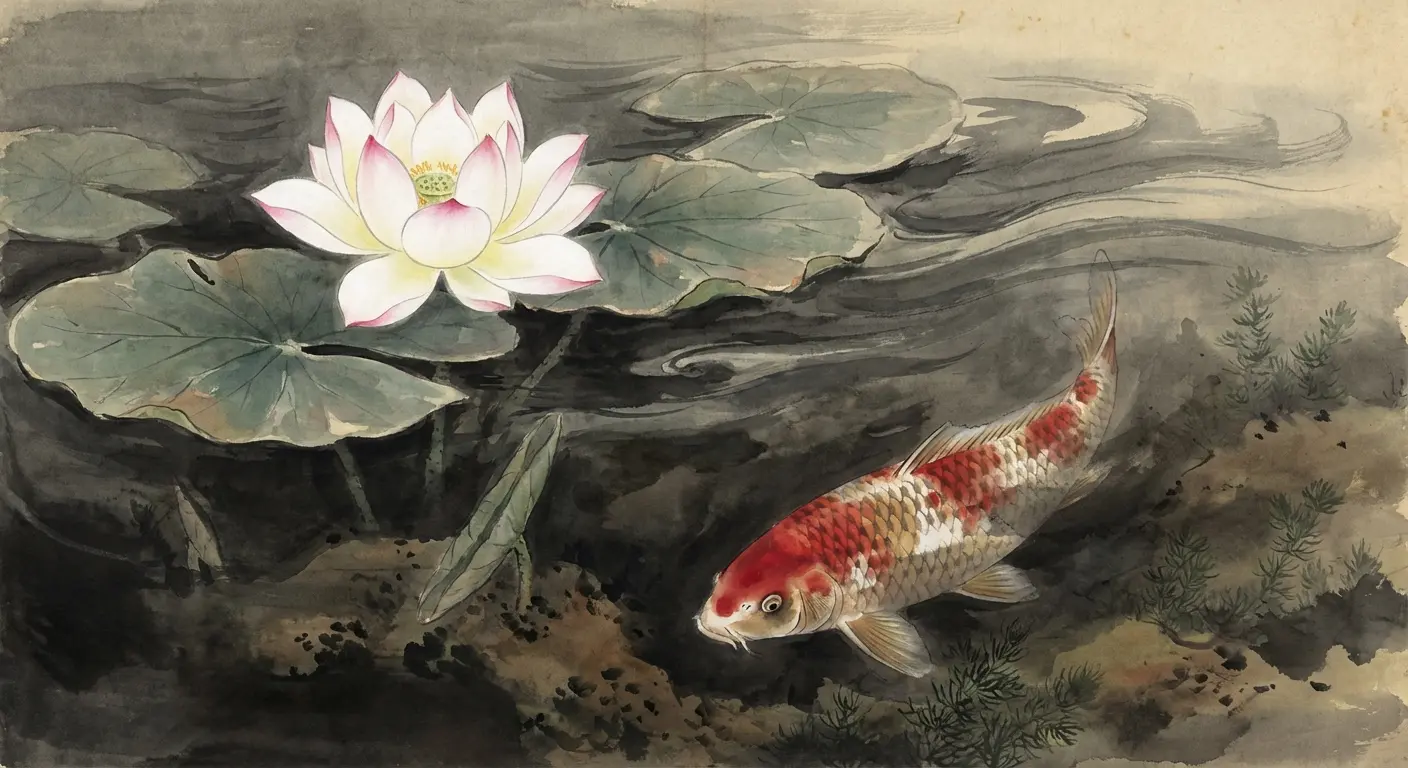
Tattoos that visually emphasize the roots, the murky water, or the submerged stem tell a more complete story than designs showing only the pristine flower floating in negative space. If you’re considering a lotus tattoo, ask yourself whether you want to represent only the beautiful outcome or the entire system that makes beauty possible.
Think about someone recovering from addiction. A design showing only the fully bloomed flower suggests the struggle is finished, past tense. But a design that includes visible roots extending into shadowed water acknowledges that recovery is ongoing. The mud (temptation, triggers, difficult days) remains present, and the person blooms not by eliminating those conditions but by maintaining their center within them.
Roots Showing vs. Roots Hidden
Design choice matters here.
Roots showing = you’re acknowledging what grounds you, even if it’s messy. You’re not interested in pretending you’re self-made or that you’ve disconnected from your origins.
Roots hidden or absent = you’re focusing on the present state, the current bloom, possibly because you’re still processing the past and aren’t ready to visually claim it yet.
Neither choice is wrong, but they tell different stories about where you are in your relationship with your own history. I’m personally biased toward designs that show the roots. I think they’re more honest. But that’s my baggage showing.
The Closed Bud Carries Its Own Weight
Not every lotus tattoo needs to show full bloom.
Buds represent potential, yes, but they also represent the choice to remain protected. A closed or partially open lotus can mean you’re in process, you’re not performing openness before you’re ready, or you’re honoring a slower timeline than the world expects.
There’s power in the not-yet-bloomed. We live in a culture obsessed with arrival, completion, and reveal. A bud pushes back against that pressure. It says “I’m becoming, and that’s enough right now.”
When Willow Smith, Jada Pinkett-Smith, and Adrienne Banfield-Norris got matching lotus tattoos in 2021, they chose a design showing three stages: bud, partial bloom, and full flower. Willow explained the significance on their show Red Table Talk: “The bud to the little blossom to the bloom also expresses the spiritual journey but also the three of us,” with each generation represented by a different stage (Capital XTRA). The design acknowledged that growth isn’t linear and that different life stages carry their own validity.
Cultural Context (Without Freaking Out About Appropriation)
The lotus carries weight in Buddhism, Hinduism, and ancient Egyptian mythology. You don’t need to practice these traditions to get a lotus tattoo, but understanding the specific meanings helps you make informed design choices.
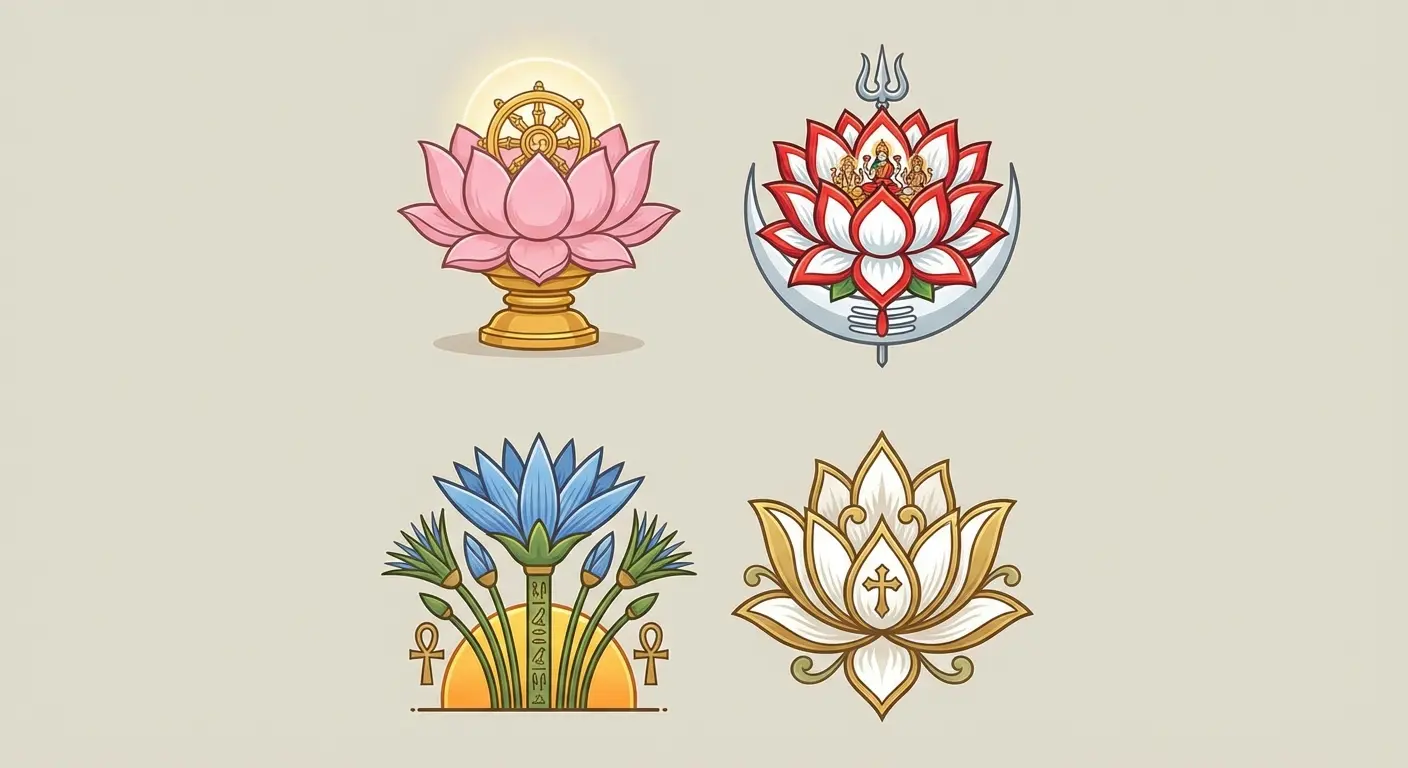
Buddhism emphasizes the lotus as a symbol of detachment (remaining unstained by the muddy water). Hinduism connects it to creation and divine beauty, with gods and goddesses often depicted on lotus thrones. Egyptian mythology links it to the sun and rebirth cycles, as the flower closes at night and reopens at dawn.
These aren’t interchangeable meanings. If detachment resonates with you, Buddhist-inspired design elements make sense. If you’re drawn to creation and fertility themes, Hindu-influenced imagery might fit better. Egyptian connections work well if you’re focused on daily renewal and cyclical time.
In Hindu tradition, the Padma (lotus) is often depicted with 1,000 petals to represent the expanding soul and spiritual awakening, according to Opal Lotus. This specific imagery connects to Lord Vishnu, Brahma, and other deities, making it particularly meaningful for those drawn to themes of divine creation.
|
Cultural Tradition |
Primary Symbolism |
Key Visual Elements |
Best For |
|---|---|---|---|
|
Buddhism |
Mental purity, detachment, freedom from attachment |
Eight petals (Eightfold Path), unstained appearance, often paired with Buddha imagery |
Processing boundaries, emotional detachment, spiritual practice |
|
Hinduism |
Divine creation, beauty, spiritual awakening |
Multiple petals (often 1,000), deity associations, chakra connections |
Fertility, creation, divine feminine energy, expansion |
|
Ancient Egypt |
Solar cycles, resurrection, eternal life |
Blue coloring, sun imagery, opening/closing petals |
Daily renewal, cyclical time, rebirth after dormancy |
|
Western Adaptation |
Personal growth, mental health recovery, feminine strength |
Varied styles, often minimalist or watercolor, personalized elements |
Contemporary meaning disconnected from religious context |
When to Actually Worry About Appropriation
Look, I think the appropriation panic around lotus tattoos is mostly overblown, but here’s where I think the line actually is:
You’re appropriating if you’re treating religious symbols as purely decorative without understanding or respecting their significance. You’re probably fine if you’ve done the research, you can articulate why specific elements matter to you, and you’re not mixing sacred imagery thoughtlessly.
The anxiety around appropriation sometimes prevents people from engaging with symbols that genuinely speak to their experience. My rule of thumb: if you’re only attracted to the aesthetic and couldn’t explain the symbolism to someone who asked, reconsider. If the lotus meaning aligns with your values or experiences, and you’ve taken time to understand the cultural context, you’re approaching it with enough respect.
The Western Adaptation Isn’t Wrong
Western tattoo culture has developed its own lotus language, somewhat divorced from Eastern religious contexts. That evolution isn’t automatically disrespectful. Symbols migrate and meanings shift across cultures and time periods.
The Western lotus often emphasizes personal growth, mental health recovery, or feminine strength. These meanings aren’t traditional, but they’re not empty either. You can honor a symbol’s origins while also allowing it to speak to your contemporary experience.
The thing is, know what you’re drawing from and what you’re adding. That’s awareness, not appropriation.
Color Actually Changes Everything
Color isn’t just aesthetic preference. In traditional symbolism, different lotus colors carry distinct meanings that fundamentally alter what you’re communicating.
Pink represents spiritual devotion and the Buddha himself (it’s considered the supreme lotus). White symbolizes mental and spiritual purity, the perfected state. Red signifies the heart, compassion, love, and passion. Blue (the rarest in nature) represents wisdom, knowledge, and victory over the senses. Purple connects to mysticism and esoteric Buddhism. Yellow or gold relates to spiritual ascension.
Black (which doesn’t occur naturally) has been adopted in modern tattooing to represent power, rebellion, or the shadow self, much like how understanding broader tattoo symbolism helps inform color choices.
According to Vanishing Tattoo’s comprehensive guide, Buddhist art uses specific color codes to signify different spiritual attainments: white for mental purity and spiritual perfection, red for compassion and the heart, blue for wisdom and intelligence, and pink is specifically reserved for the historical Buddha.
|
Lotus Color |
Traditional Meaning |
Modern Interpretation |
Visual Considerations |
|---|---|---|---|
|
Pink |
Spiritual devotion, the supreme lotus, Buddha himself |
Feminine strength, gentle transformation |
Pretty forgiving, looks good on most people |
|
White |
Mental purity, spiritual perfection, enlightenment |
New beginnings, clarity, innocence |
Needs a skilled artist or it’ll look washed out |
|
Red |
Heart, compassion, love, passion |
Romantic love, intense emotion, life force |
Bold choice, but it’ll last |
|
Blue |
Wisdom, knowledge, victory over senses |
Intellectual growth, calm strength, rare beauty |
Striking on skin, but can fade to green without quality ink |
|
Purple |
Mysticism, esoteric Buddhism |
Spiritual mystery, intuition, the unknown |
Trendy but can look like a bruise if your artist sucks |
|
Yellow/Gold |
Spiritual ascension, enlightenment |
Joy, optimism, divine light |
Tricky on lighter skin tones |
|
Black |
N/A (not natural) |
Shadow self, power, rebellion, integration of darkness |
Most durable, ages best, timeless |
Monochrome vs. Full Color
Black and grey lotus tattoos emphasize form, shadow, and structure. They tend to feel more timeless and can age better on skin. They also allow the linework and shading to do the storytelling without color’s emotional shortcuts.
Full color designs make immediate emotional impact and can communicate specific meanings through traditional color symbolism. They require more maintenance (touch-ups as colors fade) and can sometimes feel dated as color tattoo trends shift.
Watercolor lotus tattoos have surged in popularity but often lack the crisp definition that helps tattoos age well. If you’re drawn to the watercolor style, consider incorporating solid linework so the design maintains structure as the softer color elements fade.
Honestly? I’ve seen a lot of watercolor lotus tattoos that are already looking rough after just a few years.
Mixing Colors
A lotus that transitions from one color to another (say, from blue at the base to pink at the tips) tells a journey story. You’re moving from one state (wisdom) toward another (devotion).
Multicolored lotuses can represent complexity, the integration of multiple aspects of self, or refusal to be reduced to a single meaning. Just make sure the color combination is intentional rather than “I wanted all my favorite colors.” Your tattoo artist can help you understand which color transitions will read well on skin and which might muddy into an unclear visual message.
Where You Put It Says More Than You Think
Placement isn’t just about visibility or pain tolerance.
Visible placements (forearm, hand, neck, behind the ear) suggest you’re integrating the meaning into your public identity. You want the reminder accessible, and you’re comfortable with others asking about it.
Hidden placements (ribs, thigh, back, hip) indicate the meaning is more private. You’re processing something you’re not ready to explain to strangers, or the tattoo serves as a personal talisman rather than a conversation starter.
Placement near specific body parts adds another meaning layer. A lotus over your heart speaks to emotional transformation. On your spine, it might represent core strength or spiritual alignment. On your foot or ankle, it could symbolize your path or journey.
I knew someone who got a lotus on her ribs after her divorce. She specifically wanted it hidden because (and this is what she told me) she wasn’t ready to explain her whole messy story to every person who asked about her tattoo at the beach. Three years later, she added a visible lotus on her forearm. Same symbol, different relationship to it.
Size Matters (Usually)
Large-scale lotus tattoos (back pieces, full thigh, entire forearm) demonstrate commitment to the symbol. You’re not testing the waters.
Small, delicate lotus designs work beautifully but can sometimes indicate hesitation. You love the idea but aren’t quite ready to go bold. There’s no judgment here, just awareness. If you’re getting a small lotus because you’re uncertain, consider whether you’re ready for a permanent tattoo at all. If you’re choosing small because you appreciate minimalism and restraint, that’s different.
Single vs. Multiple Flowers
One lotus reads as personal, singular, focused. Multiple lotuses (especially in different stages of blooming) can represent different aspects of self, different life phases, or different people you’re honoring.
A lotus field or pond scene creates a more complex narrative. You’re not just one flower in isolation. You’re part of an ecosystem, a community, or a larger pattern.
Design Elements That Tell Different Stories
What you pair with your lotus changes what the lotus means.
A lotus alone is contemplative, self-contained. Add a koi fish swimming beneath it, and you’ve introduced perseverance and upstream struggle. Include a dragonfly, and you’re emphasizing change, adaptability, and the ephemeral nature of life.
Incorporate geometric patterns (sacred geometry, mandalas), and you’re connecting personal transformation to universal patterns or divine order. The lotus becomes part of a larger cosmic structure rather than just an individual symbol.
Water ripples around the lotus emphasize the impact of your transformation on your environment. You’re not blooming in isolation. Your growth creates waves.
A friend who’s a therapist got a lotus with visible roots extending into dark water, paired with small koi fish swimming upward through the mud. The lotus represents her clients’ resilience, the koi represent the ongoing struggle and determination required in healing work, and the visible roots acknowledge that transformation happens within (not apart from) difficult conditions. The combination creates a narrative about her professional calling that a simple lotus couldn’t convey alone.
Typography and Script Additions
Adding text to your lotus tattoo (quotes, dates, names, single words) can either enhance or diminish the design. Words make the meaning explicit, which reduces ambiguity but also reduces mystery.
If you’re adding text, make sure it’s not just restating what the lotus already communicates visually. “Rebirth” written under a lotus is redundant. A specific date that marks when your transformation began adds information the image can’t convey. A name honors someone who was your mud (the difficult relationship that forced your growth) or someone who witnessed your blooming.
Foreign language text (Sanskrit, Pali, hieroglyphics) connects to the lotus’s cultural origins but verify translations carefully. Tattoo regret often starts with misspelled or incorrectly translated words.
Realistic vs. Stylized Approaches
Realistic lotus tattoos (botanical illustration style, photorealistic shading) emphasize the flower’s natural beauty. They ground the symbol in the physical world rather than abstract spirituality.
Stylized or illustrative lotuses (bold lines, simplified shapes, graphic design influence) feel more iconic and can age better because they don’t rely on subtle shading that fades.
Abstract or geometric lotuses deconstruct the flower into shapes and patterns, appealing to people who want the meaning without the literal representation, similar to how fineline tattoo techniques create delicate, minimalist interpretations.
Each approach attracts different personalities and serves different purposes. Realistic designs suit people who want to honor the plant itself. Stylized designs work for those who relate to the concept more than the botanical reality.
When Your Lotus Becomes Just Another Pinterest Tattoo
The lotus has become trendy, which means it’s also become generic. Walk into any tattoo shop, and you’ll see flash sheets covered in lotus designs.
That popularity doesn’t invalidate the symbol, but it does mean you need to work harder to make yours meaningful rather than decorative. Clichés happen when symbols get repeated without personalization.
The solution isn’t avoiding popular symbols altogether. It’s adding elements that make the design specifically yours. Maybe your lotus includes a detail from your grandmother’s garden. Maybe the water surrounding it reflects a specific body of water that matters to you. Maybe the color palette matches something significant (your daughter’s birthstone, the sunset from a pivotal moment, the colors you were wearing when something shifted).
How to Make It Actually Yours:
-
What’s the actual moment this is about? Not just “my journey.” The specific Tuesday afternoon when something clicked.
-
Choose one design element that references something only you would recognize
-
Pick colors based on meaning, not just what looks pretty
-
Add or remove one typical element to disrupt expectations
-
Consider an unexpected pairing that reflects your experience
-
Ask yourself: “Could this exact design work for anyone, or is it specifically mine?”
The “Live Laugh Love” Problem
Some symbols become so ubiquitous they lose impact. The lotus risks becoming the tattoo equivalent of inspirational wall art.
How do you avoid this? By making design choices that aren’t the default. Most lotus tattoos show the flower from above, fully bloomed, floating in negative space. What if yours showed the side view, revealing the stem? What if it depicted the underwater portion more prominently than the bloom? What if you chose an unexpected color combination or paired it with a symbol that isn’t typically associated with lotuses?
When Minimalism Becomes Meaningless
The minimalist tattoo trend has produced thousands of tiny, simple lotus outlines. They’re pretty. They’re also often interchangeable.
A minimalist lotus can be meaningful if the simplicity itself is the point (you’re drawn to restraint, essentialism, or quiet strength). But if you’re going minimal because it’s trendy or because you think it’s less of a commitment, you might end up with a tattoo that doesn’t satisfy you long-term.
I’m going to be blunt here: the tiny minimalist lotus outline? That’s probably going to feel meaningless in five years. Maybe I’m wrong about this, but I’ve seen it happen too many times.
Unexpected Symbol Pairings
The usual lotus companions are koi fish, dragonflies, mandalas, and om symbols. These pairings are popular because they work, but they’re also predictable.
What if you paired your lotus with something unexpected?
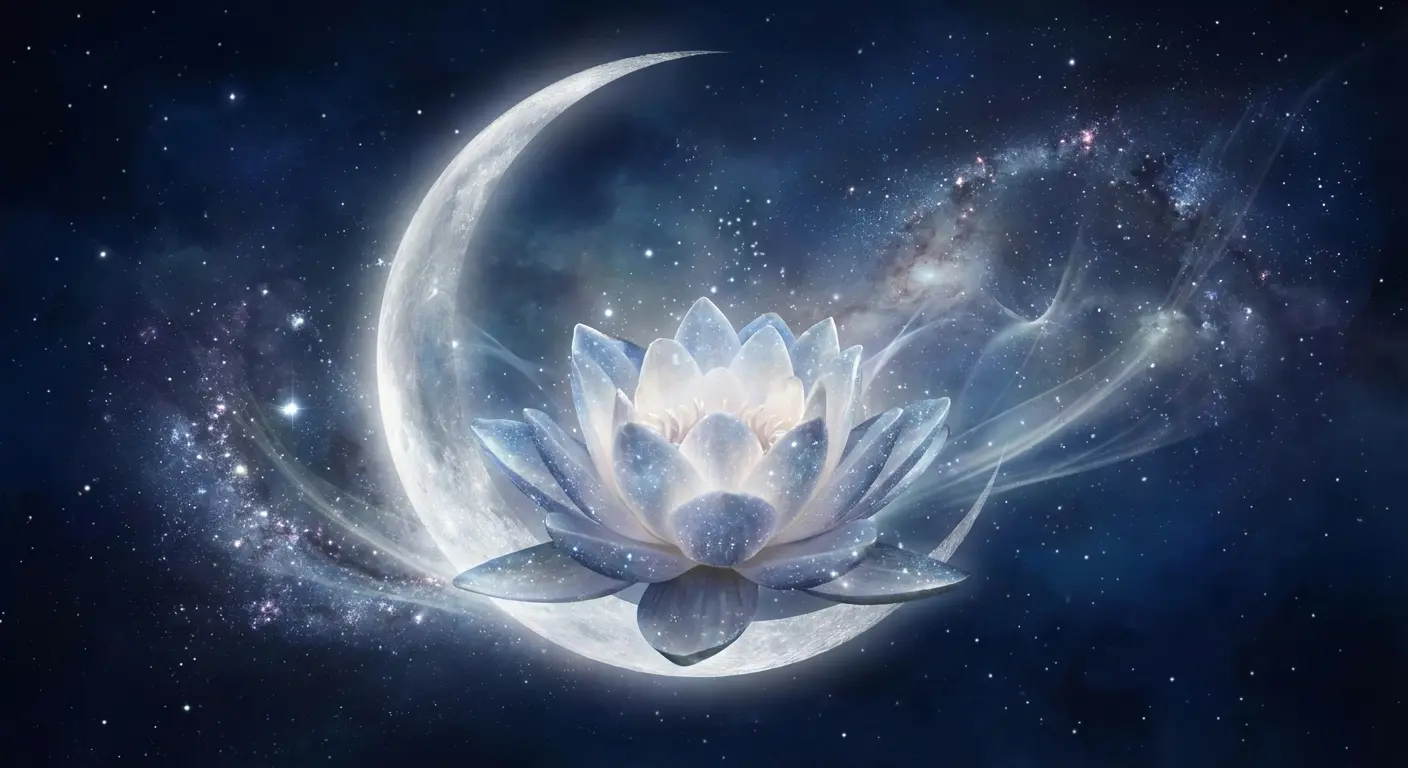
A snake (transformation, shedding skin, but with an edge that the lotus alone doesn’t carry). A moth instead of a butterfly (drawn to light but also to flame, transformation with risk). Phases of the moon (cyclical time, the daily closing and opening of the lotus petals mirrored in lunar cycles).
Architectural elements (pillars, arches, doorways) to emphasize the lotus as threshold or gateway. Anatomical elements (a heart, brain, or skeleton) to ground the spiritual symbolism in physical reality.
These unexpected combinations make people look twice. They disrupt the automatic reading and force a more careful interpretation.
Animals That Change the Lotus’s Energy
A lotus with a hummingbird feels joyful, light, focused on beauty and sweetness. A lotus with a raven or crow introduces mystery, intelligence, and a willingness to engage with death or shadow.
A lotus with a bee emphasizes community, productivity, and the interconnection between your blooming and the larger ecosystem. A lotus with a frog or toad (creatures that live in the same muddy water) acknowledges kinship with what’s ugly or overlooked.
These animals aren’t typically paired with lotuses, which makes them more interesting choices. They add complexity and prevent the design from reading as purely aspirational.
Celestial Bodies and Weather Elements
Pairing your lotus with the sun creates a connection to vitality, life force, and daily renewal (especially relevant given the Egyptian lotus-sun mythology). A lotus with the moon emphasizes intuition, feminine energy, and the hidden or subconscious aspects of transformation.
Stars around your lotus can represent guidance, hope, or the vast context in which your small bloom exists. Rain falling on your lotus speaks to nourishment, the necessity of difficulty, or tears as part of growth. Lightning adds drama and sudden revelation.
These weather and celestial elements expand the lotus’s meaning beyond personal transformation into relationship with larger forces.
Objects That Ground Abstract Concepts
A lotus growing from a book (knowledge as mud, wisdom as bloom). A lotus emerging from a teacup (domesticity, daily ritual, finding the sacred in the ordinary).
A lotus intertwined with scissors or shears (cutting away what no longer serves, active participation in your own transformation rather than passive blooming). A lotus with keys (unlocking, access, the flower as doorway).
These object pairings work especially well if you want your tattoo to reference a specific life domain (your career, your role as a parent, your creative practice) rather than just general spiritual growth.
The Design Process Nobody Talks About
Most people approach tattoo design backward. They find an image they admire, maybe make minor tweaks, then book an appointment. This process works fine if you want a decoration. It fails if you want a tattoo that remains meaningful years later.
The design process should start with meaning, not image. What specifically about the lotus resonates with you? Which aspect of the symbolism feels most true? Are you drawn to the daily blooming and closing (cyclical time, routine, sustainability)? The roots in mud (acknowledging difficulty as foundation)? The untouched petals despite muddy water (maintaining purity or boundaries in contaminated environments)?
Once you’ve identified your specific connection, design choices become clearer. You’re not just picking a pretty lotus. You’re making visual decisions that express your particular relationship with the symbol, much like exploring small tattoo ideas helps clarify what resonates before committing to larger pieces.
Before You Start Designing:
What aspect of the lotus metaphor resonates most deeply?
-
The roots in mud (difficulty as foundation)
-
The untouched bloom (maintaining self in contaminated environments)
-
The daily opening/closing (cyclical renewal)
-
The thermoregulation (self-regulation despite external chaos)
What moment, person, or experience does this represent? Be specific.
What MUST be included for this to feel true to you? List three non-negotiables.
The Sketch Phase Most People Skip
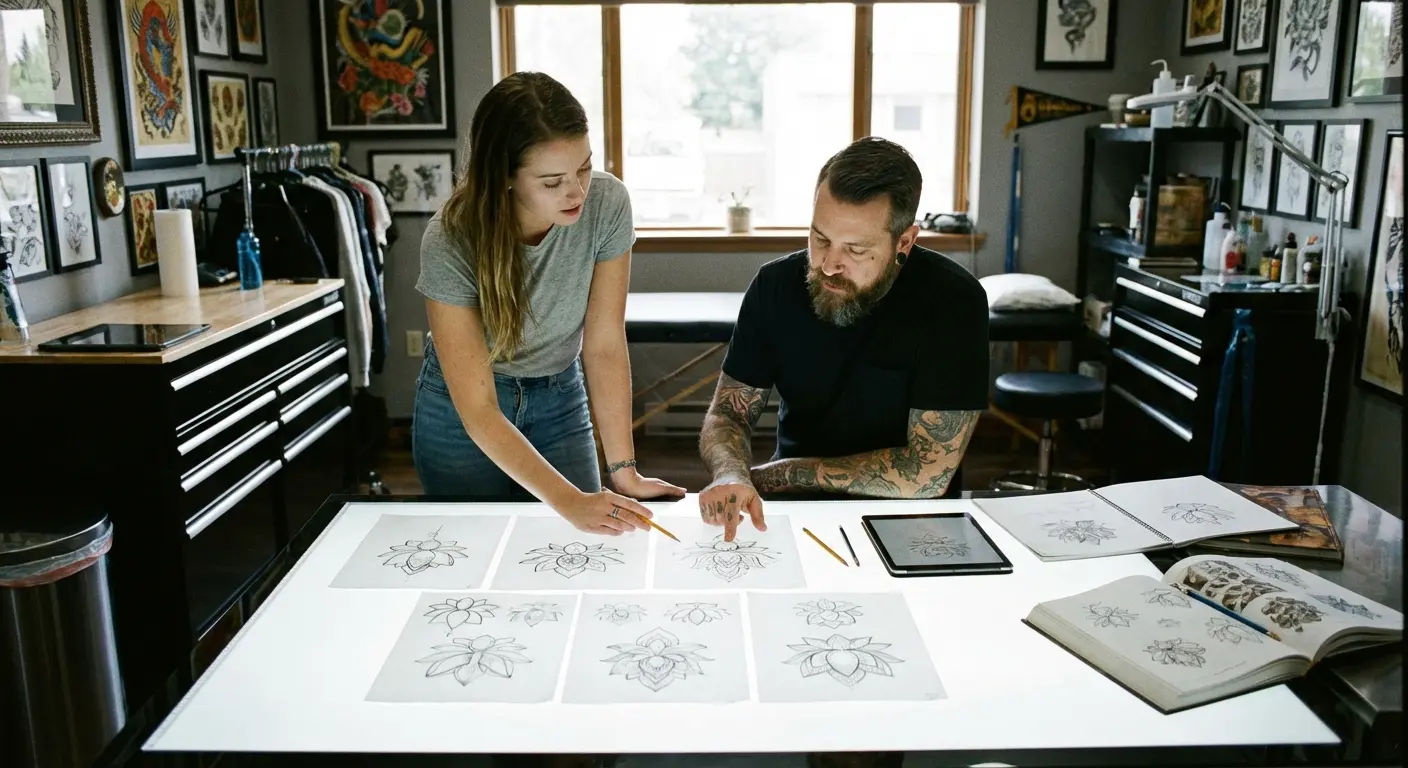
You don’t need to be an artist to benefit from sketching. Rough drawings (stick figures and basic shapes are fine) help you think through composition, placement, and scale.
Where does the lotus sit on your body? What angle are you viewing it from? What’s in the foreground and background? These spatial decisions affect meaning. A lotus viewed from above feels observational, contemplative. A lotus at eye level feels more confrontational or present. A lotus viewed from below (looking up at it) creates a sense of aspiration or reverence.
Sketching also reveals what you’re unconsciously prioritizing. Do you keep drawing the petals larger and the stem smaller? That tells you something about where your focus is, regardless of what you think you want.
Working with Your Artist (Not Dictating to Them)
Tattoo artists aren’t printers. They’re collaborators with expertise in what works on skin, how designs age, and how to translate concepts into ink.
You should arrive with clear ideas about meaning, preferred style, and reference images. You shouldn’t arrive with a final design you’re unwilling to modify. Good artists will push back on choices that won’t age well, won’t read clearly, or don’t suit your body. Listen to that feedback. They’ve seen hundreds of tattoos five, ten, fifteen years after application. You haven’t.
The best tattoos emerge from genuine collaboration where you bring the meaning and the artist brings technical knowledge about how to make that meaning last, similar to the careful planning involved in tattoo aftercare to preserve your investment.
If your artist says your design won’t work, listen to them. They know how ink ages on skin.
Testing Your Design Before It’s Permanent
Print your design at full size. Place it on your body where you’re planning the tattoo. Live with it for a few days.
Does it still feel right? Does the scale work? Does the placement make sense with how you move and dress?
This simple test catches problems before they’re permanent. You might discover the design you loved on paper feels wrong on your ribs, or the placement you imagined doesn’t work with your existing tattoos.
Some people use temporary tattoos or henna to test designs. Others use printed paper and medical tape. The method matters less than the practice of seeing the design on your body in your life before committing.
When You’re Stuck Between Design Options
You’ve narrowed it down to two or three lotus designs, but you can’t decide.
I’ve been playing around with this AI tool called Tattoo Generator IQ, and honestly, it’s pretty useful for this exact situation. You’re not looking for a final design to copy directly. You’re using technology to generate variations quickly so you can see what resonates and what doesn’t.
You input your concepts (lotus with roots showing, blue and purple color palette, geometric background elements) and it produces multiple variations in seconds. You’re essentially sketching with AI, exploring possibilities faster than traditional drawing allows.
The variations help you identify which elements are non-negotiable (you realize you need the roots visible in every version) and which are flexible (the geometric pattern could be behind or around the lotus, you’re not attached). This process clarifies your thinking before you ever sit in a tattoo chair.
I know, I know. I’ve spent this whole post telling you to make your tattoo deeply personal, and now I’m suggesting you use AI to design it. But hear me out. The AI-generated stuff isn’t going to capture the specific meaning you’re after. It’s just for visualizing possibilities. It’s another tool, like sketching or mood boards.
Final Thoughts
Your lotus tattoo will mean something different in five years than it does today. That’s not a design flaw. That’s the nature of permanent marks on changing bodies and evolving selves.
The goal isn’t to capture a fixed meaning forever. It’s to choose a symbol rich enough to grow with you, specific enough to remain personally relevant, and designed thoughtfully enough to age well both artistically and emotionally.
The overlooked truth about lotus tattoos? They’re not about transcending the mud. They’re about developing the capacity to bloom while still rooted in it, to maintain your temperature when the environment shifts, to close each night and open again each morning.
That’s not a one-time transformation. That’s a practice.
Choose design elements that reflect the specific aspect of the lotus that speaks to your experience, not the generalized inspiration-poster version. Work with an artist who understands both the technical requirements of good tattoo work and the symbolic weight you’re trying to carry. Test your design in real space on your real body before committing.
The lotus has been marked on skin for thousands of years across dozens of cultures. It’s become trendy, which means it risks becoming meaningless. Your job is to rescue it from that fate by making choices that are genuinely yours.
Show the mud. Choose unexpected color combinations. Pair it with symbols that complicate rather than reinforce the obvious reading. Make people look twice.
Look, maybe you just think lotus flowers are beautiful and you want one on your body. That’s fine. You don’t need a deep spiritual reason. I’ve spent way too many words analyzing lotus symbolism, but honestly? If you love it, get it. Don’t let people like me make you overthink it.
But if you do want it to mean something beyond aesthetics, put in the work. Because you’re not getting this tattoo to announce that you’ve arrived. You’re getting it to remind yourself that beauty and difficulty coexist, that roots matter as much as blooms, and that staying open while anchored in mess is its own kind of mastery.
