24 Old School Tattoos That Still Dominate the Industry (And Why They Never Left)
TL;DR
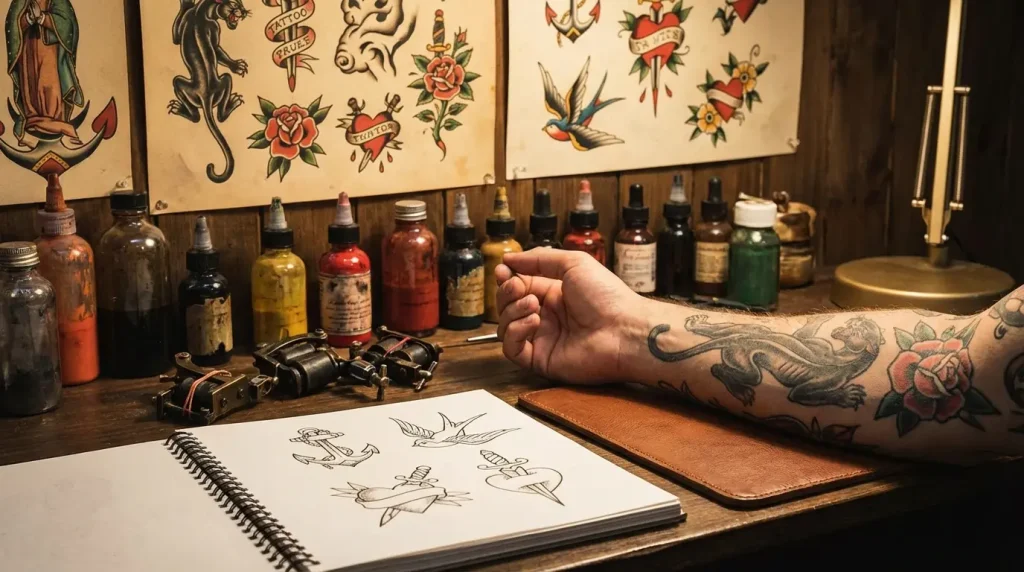
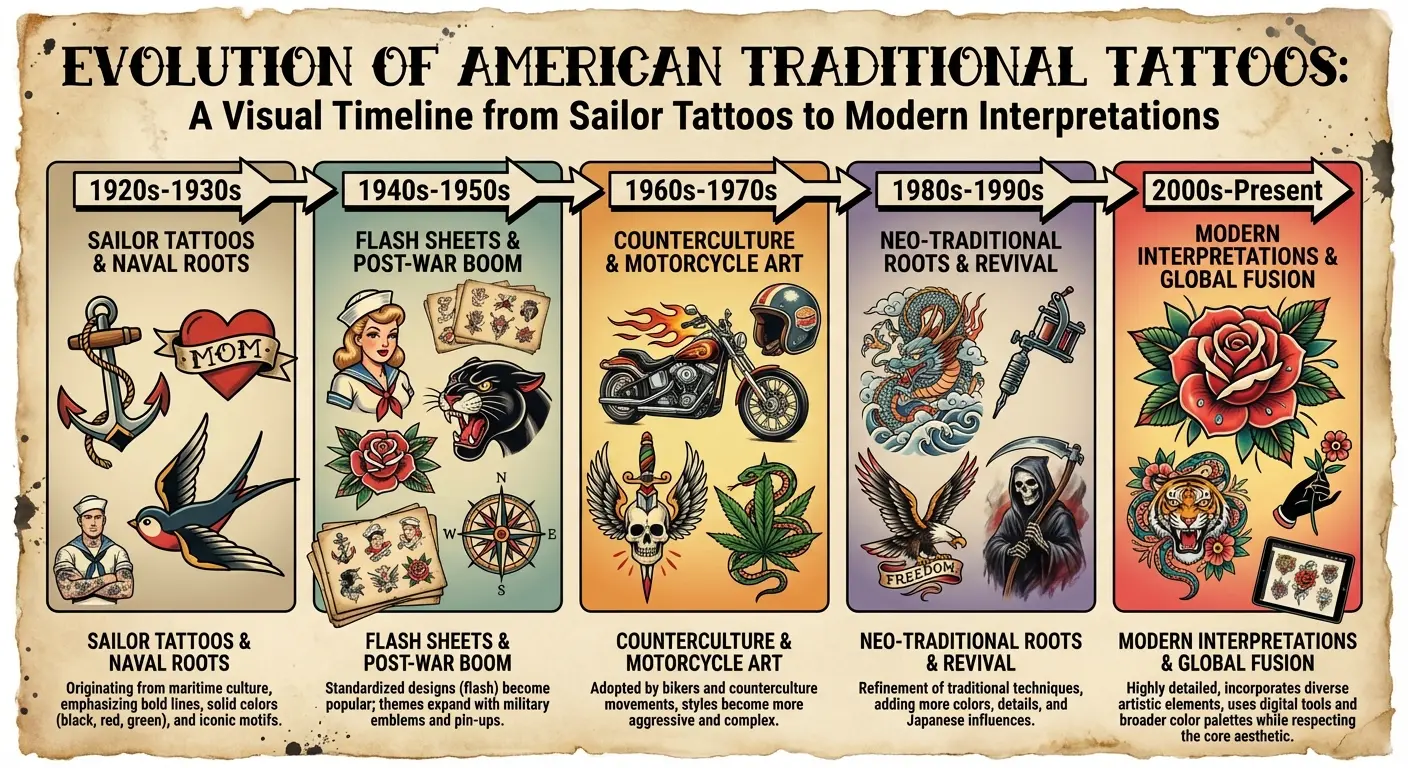
I’ve watched tattoo trends come and go for years, and you know what never disappears from shop flash boards? The same anchors, eagles, and daggers that sailors were getting in 1935.
There’s a reason for that, and it’s not nostalgia.
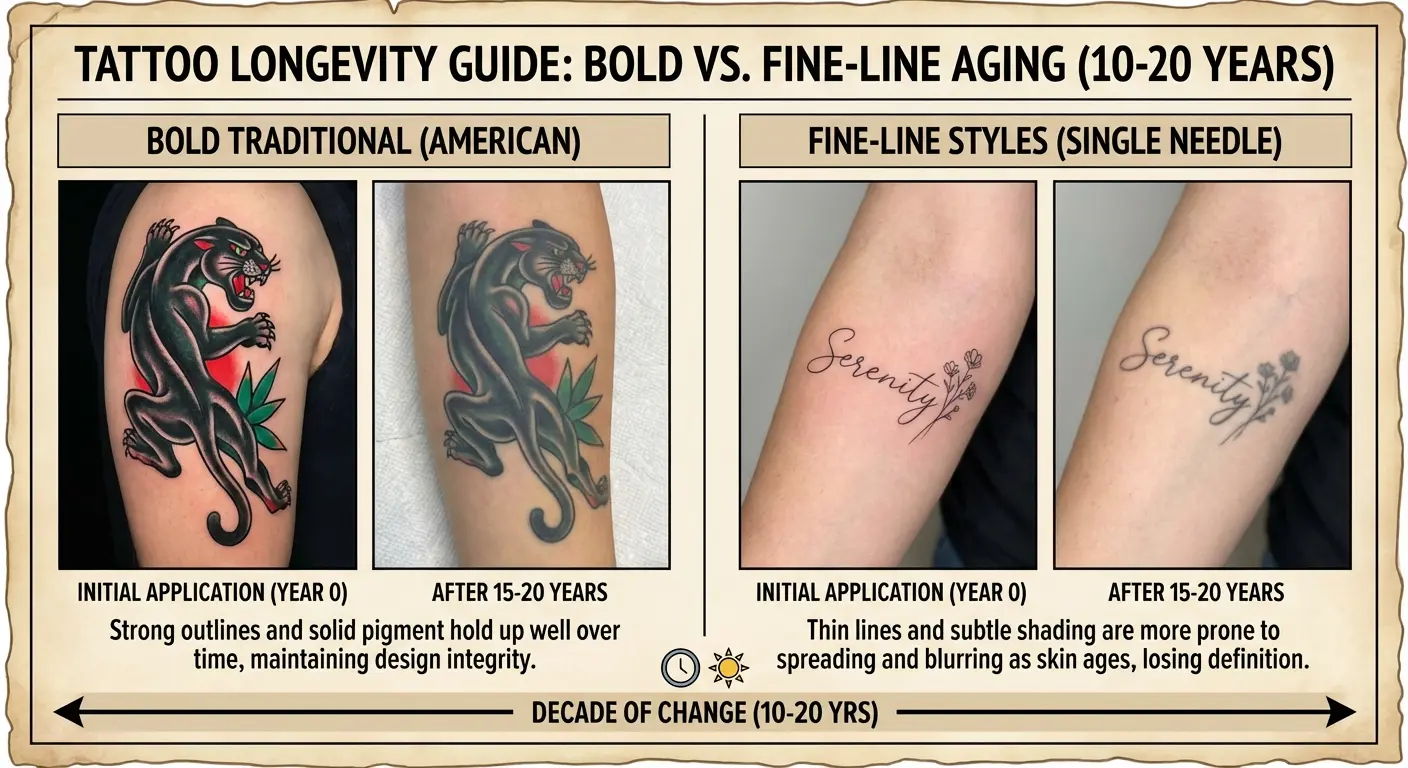
These designs were built with bold lines and limited color palettes because that’s what survives on aging skin. The technical constraints weren’t limitations but deliberate choices that ensured readability over decades. As far as longevity goes, traditional tattoos done at appropriate sizes are unmatched. They will hold up over time better than any of the other styles.
The technical foundation? “Bold will Hold.” Traditional style tattoo artists have lived by this since the early 20th century. Tattoos done technically well, with clear imagery and separation of the black, color, and skin within a design, will yield a tattoo with the longest lifetime possible.
Before you get an anchor tattooed on your forearm, you should probably know what it actually meant to the sailors who invented it. Modern tools can help you visualize how classic designs translate to your specific body placement before committing to permanent ink.
Symbols of Defiance & Freedom
We’re starting with the designs that sailors, soldiers, and outsiders wore as badges of independence.
These weren’t decorative choices. They were declarations.
The imagery centers on movement, exploration, and the refusal to be anchored (ironically) to societal expectations. What makes these designs endure? The fundamental human desire for autonomy hasn’t changed since the 1930s.
You’ll notice these designs share a visual language of motion and direction. Each piece tells a story about crossing thresholds, surviving journeys, and refusing to stay put.
1. The Classic Anchor
Here’s what most people miss about anchors: sailors didn’t get them to symbolize being grounded. They got them after crossing the Atlantic, as proof they’d survived something most people never attempted.
The anchor marked a threshold crossed, not a destination reached.
Are you commemorating an achievement or aspirationally claiming one you haven’t earned yet? Be honest. Sailors can spot a poser, and so can everyone else looking at your forearm.
The bold lines and symmetrical composition make anchors ideal for forearms and calves, where muscle movement won’t distort the shape over time. I’ve seen countless variations (anchors wrapped in rope, anchors with flowers, anchors with names), but the cleanest versions remain the most readable after 20 years of sun exposure and skin changes.
Forearms are the obvious choice. You’ll see it every day, which is either motivating or annoying depending on whether you still like the tattoo in five years. Calves work brilliantly for larger designs with rope or banner elements because you’ve got a stable foundation and less sun exposure. Shoulders create dynamic movement but can distort with significant muscle gain or loss. Chest placement works for memorial pieces or paired designs, but you need flat pectorals for proper symmetry.
2. Sparrow in Flight
Sparrows carried a specific meaning in maritime culture: they always found their way home. Sailors believed these birds would carry their souls to heaven if they died at sea.
You’re looking at a design that functions as both hope and insurance policy.
The technical execution requires precise line work in the wing feathers. This is where amateur artists fail. Sparrows work best on shoulders and chest, places where the bird appears to be taking off from your body rather than randomly floating.
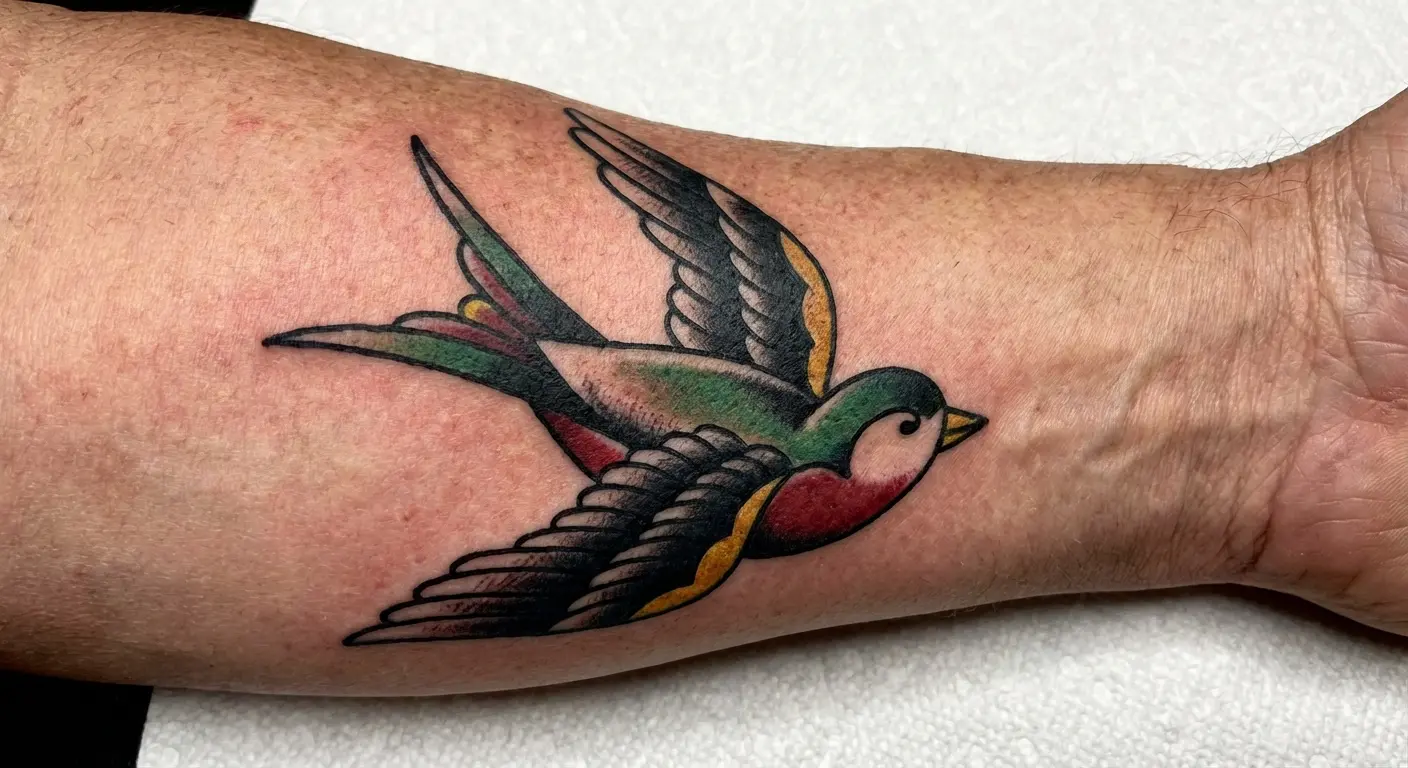
Single sparrow or a pair? That choice fundamentally changes the meaning from independence to partnership. This design has survived decades because the symbolism remains relevant regardless of whether you’ve ever set foot on a ship.
3. Nautical Star
Five-pointed stars helped sailors navigate by the North Star, so these tattoos became talismans for finding your way when everything else failed.
The geometric precision required for a clean nautical star is unforgiving.
Even a slight wobble in the line work becomes glaringly obvious because our brains are wired to detect asymmetry in familiar shapes. The star needs to sit on a relatively flat plane (inner forearm, outside of calf, chest) or the points will appear to bend unnaturally.
I see people try to place these on shoulders or knees where the underlying anatomy fights against the geometry. Don’t do that. The star’s power comes from its mathematical perfection, and compromising that for a trendy placement destroys what makes the design work.
4. Ship at Full Sail
Ships required serious real estate and commitment. You didn’t get a full-rigged ship on your chest unless you’d actually sailed around Cape Horn or survived a significant voyage.
The modern interpretation has gotten looser. Plenty of people get ships who’ve never set foot on a boat.
Does that make the design meaningless? Maybe. Or maybe the symbolism has evolved and I’m just being a purist. Probably the former.
Ships need space to breathe. Cramming one into a small area destroys the proportions and turns a majestic vessel into an unreadable blob.
Ribs, back, or thigh placements give the artist room to render the details that make the ship recognizable. Calm seas or stormy waves? That choice reveals whether you’re celebrating smooth sailing or hard-won survival.
5. Eagle with Spread Wings
Eagles became synonymous with American traditional tattoos after World War II, when servicemen wore them as symbols of national pride and personal ferocity.
The wingspan determines everything about this design’s impact.
A cramped eagle looks defeated, which completely undermines the symbolism. Chest pieces work brilliantly because the wings can extend across the pectorals, creating natural symmetry. Back pieces allow for even more dramatic presentations.
Eagle clutching something (arrows, snakes, banners) or flying free? Each variation communicates a different relationship to power and aggression.
The enduring appeal of traditional American imagery continues to shape contemporary tattoo culture. According to a recent panel of professional tattooers in San Francisco (The San Francisco Standard), American traditional remains one of the consistently popular styles in the industry. As one artist noted, “Right now, fine-line is popular, but American traditional is always going to stay popular. The thing about tattoos, man: Bold will hold.” This professional consensus reinforces why eagles, anchors, and other classic motifs continue dominating shop flash boards nearly a century after their introduction.
Love, Loss & Loyalty
Now we get to the painful stuff.
These designs don’t shy away from the fact that love hurts, relationships end, and loyalty sometimes costs you everything. The imagery refuses to be purely romantic or purely cynical. Instead, you get designs that hold contradictions: hearts that bleed, roses with thorns, daggers that wound the very thing they’re supposed to protect.
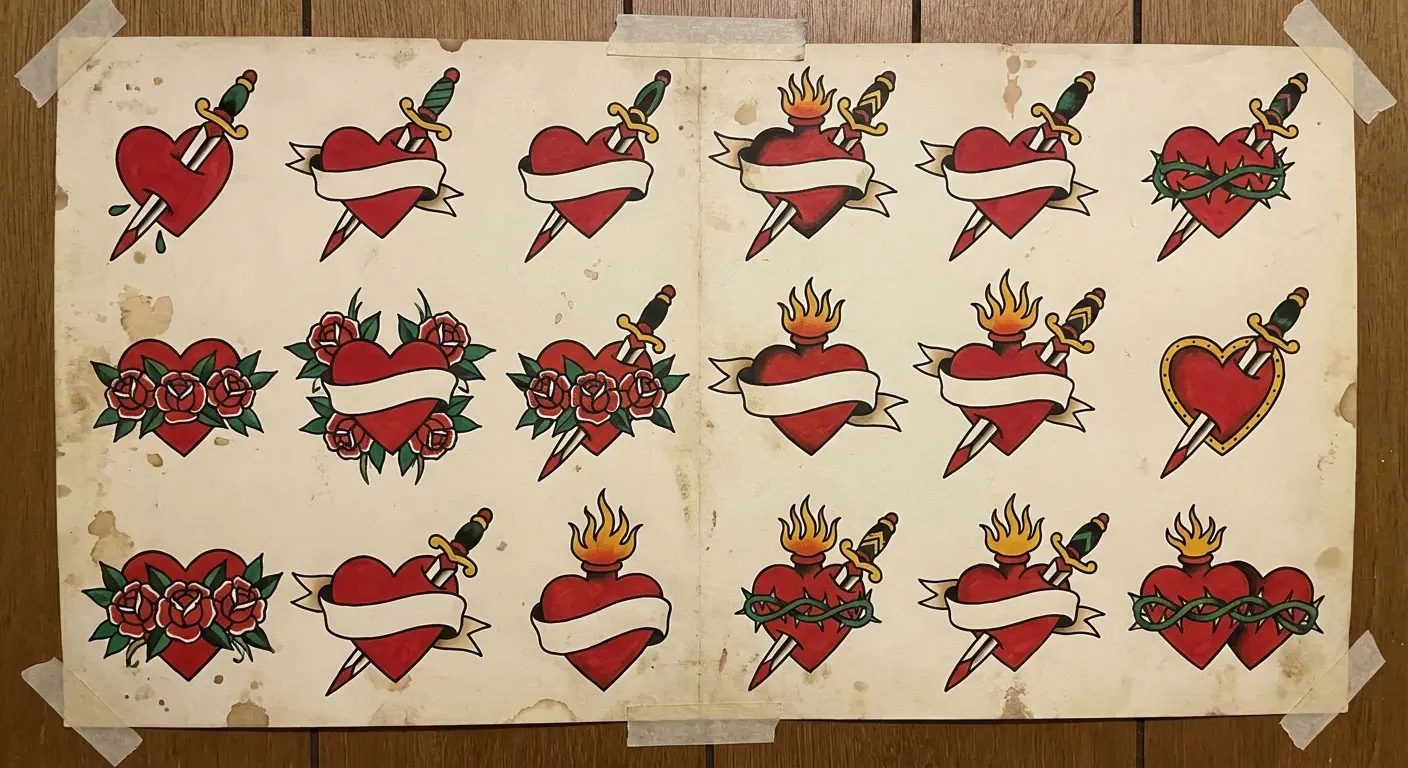
What I appreciate about these tattoos is their refusal to pretend that devotion is simple or painless. They acknowledge that the things worth being loyal to often require sacrifice.
When you’re choosing from this category, you’re not just picking pretty pictures. You’re selecting which emotional truth you’re willing to wear permanently. For designs that combine romantic symbolism with traditional aesthetics, exploring heart tattoo design options can help you visualize how classic motifs translate to your specific placement.
6. Heart with Banner
The banner exists to hold a name, but here’s what nobody tells you: names change.
Relationships end. People die.
The banner gives you options (you can get it reworked, covered, or left blank as a memorial). The heart itself needs to be bold and simple, with thick outlines that won’t blur into illegibility. Placement on the upper arm or forearm keeps it visible, assuming the tattoo is meant to be a public declaration rather than a private reminder.
I’d suggest thinking hard about whether you want to fill that banner immediately or leave it empty until you’re absolutely certain. This design has witnessed countless relationship changes, and the smart money says to wait.
7. Dagger Through the Heart
Betrayal, heartbreak, survival. The dagger piercing the heart captures all three simultaneously.
This isn’t a design for people in happy relationships. It’s for people who’ve been gutted by someone they trusted and lived to tell about it.
The drops of blood (usually three) add movement and narrative to what could otherwise be a static image.
Placement on the chest, directly over your actual heart, makes an obvious but powerful statement. Forearm placement creates distance, turning the tattoo into something you observe rather than something you embody. The dagger’s angle matters: pointing down suggests defeat, pointing up suggests defiance.
8. Swallow Pair
Two swallows represent a committed partnership, and unlike many couple tattoos, these age well because they function independently even if the relationship doesn’t.
Each bird can stand alone visually.
Sailors earned swallow tattoos after traveling 5,000 nautical miles, so a pair represented serious experience and endurance. The modern interpretation focuses more on the “always returns home” symbolism, which works for long-distance relationships or people who travel frequently for work.
Placement on the chest (one bird on each pectoral) creates beautiful symmetry. Matching tattoos with a partner can work, but make sure each person’s swallow faces the direction that makes sense for their body, not for the couple aesthetic.
9. Rose with Thorns
Beauty that defends itself.
The rose remains the most tattooed flower in old school tradition because it captures something essential about desirability and danger. The number of thorns, the openness of the bloom, and the presence of leaves all modify the meaning. A fully open rose suggests maturity and experience. A budding rose suggests potential. Dead or wilting petals add melancholy.
The thorns aren’t optional decorative elements. They’re the entire point.
A thornless rose is just pretty, which completely misses why this design endures. Roses stand for beauty and love, often accompanied by the sharp contrast of thorns symbolizing pain and loss, making them one of the most popular choices in traditional designs. Their enduring appeal comes from the ability to hold contradictions in a single image. The rose with thorns doesn’t pretend that love is painless or that beauty comes without cost.
Placement on the forearm, shoulder, or thigh gives the rose enough space to show detail in the petals without becoming a blurry red circle in 15 years.
10. Mom Banner
The most enduring traditional tattoo, period.
You can change your religion, your politics, your partner, your entire identity, but you can’t change who gave birth to you. Well, unless you’re adopted, or estranged, or have complicated family stuff, in which case maybe skip the Mom tattoo. For everyone else, it’s the safest name you’ll ever ink.
That permanence makes “Mom” tattoos uniquely safe in a way that almost no other name tattoo can claim. The heart surrounding the banner adds sentimentality that might feel excessive for other designs but works perfectly here. Placement is almost always on the upper arm or forearm, visible and unambiguous.
I’ve seen people try to modernize this with portraits or realistic roses, but the classic version communicates more with less. It’s not trying to be artistic. It’s trying to be true.
Warriors & Guardians
Animals in traditional tattoos aren’t cute. They’re not companions or spirit guides.
They’re projections of the qualities you need to survive: aggression, vigilance, territorial dominance, and the capacity for violence when necessary.
These designs emerged from a culture where physical toughness wasn’t optional, where showing weakness could get you hurt or killed. The animals chosen for traditional tattoos are predators or fighters, never prey. You won’t find deer or rabbits in classic American tattoo work, because those animals don’t communicate what these tattoos are meant to communicate.
That you’re dangerous when you need to be.
Modern interpretations sometimes try to soften these designs, adding flowers or making the animals look friendly. This completely misses the point and ruins the design. If you want a cute animal tattoo, get a cartoon. These designs work because they’re unapologetically fierce.
Panthers need solid black saturation or they look washed out. Don’t make them look friendly. Snakes require precision in the scales (not that mesh-pattern garbage I see everywhere). Tigers are complicated as hell and the striping must follow muscle contours or it looks flat. Bulldogs need that aggressive underbite or they’re just generic dogs. Dragons demand serious space and clarity about whether you’re doing Western or Eastern style (don’t mix them).
11. Panther Head
Panthers represented stealth, power, and the ability to attack from darkness. The snarling mouth with visible fangs isn’t decorative. It’s a warning.
Traditional panther tattoos show the animal in profile or head-on, muscles tensed, ready to strike. The bold black fill makes panthers ideal for old school technique, where solid color saturation was easier to achieve than subtle shading.
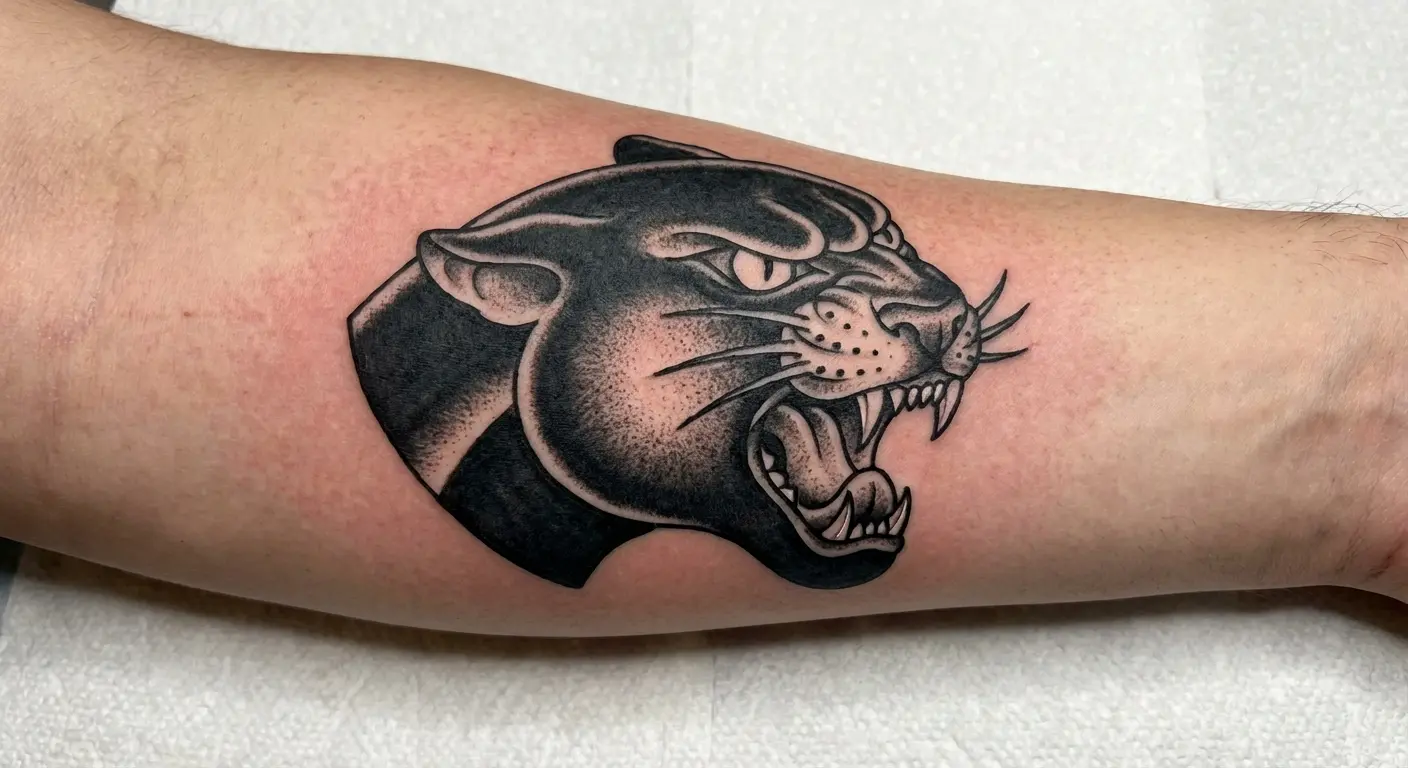
Placement on the chest, shoulder, or thigh allows the panther’s face to follow the natural contours of muscle. You’re choosing this design because you want to project danger, not because you like cats. Own that intention or pick something else.
12. Snake Coiled and Ready
Snakes in striking position capture the moment before violence, which is often more threatening than violence itself.
The coiled body creates a circular composition that works brilliantly for shoulders, knees, or anywhere you need a design that wraps around anatomy.
Traditional snake tattoos show an open mouth with fangs visible and tongue extended. The scales require precise line work that can’t be rushed. I see a lot of poorly executed snake tattoos where the scales look like a mesh pattern instead of individual protective plates.
Don’t do that.
Color choice matters: green snakes suggest poison, red snakes suggest aggression, black snakes suggest mystery. The snake doesn’t need additional elements to communicate its meaning. It’s already complete.
13. Tiger Face
Tigers were rarer than panthers in early American traditional work, which made them more exotic and valuable as tattoo subjects.
The striping pattern has to follow the underlying muscle structure, or the tiger will look flat and lifeless.
Traditional tiger tattoos show the animal snarling, often with exaggerated features (larger eyes, more pronounced teeth) that read clearly from a distance. Placement on the thigh or upper arm gives you enough canvas for the tiger’s face to have impact.
Small tiger tattoos lose all their power because the details become illegible. Don’t shrink this down and expect it to work.
14. Bulldog Profile
Bulldogs represented tenacity and the refusal to quit, even when outmatched. Military units adopted bulldog imagery, cementing the breed’s association with fighting spirit and loyalty.
The wrinkled face and underbite create a distinctive silhouette that’s immediately recognizable even in simplified form. Traditional bulldog tattoos often include a spiked collar, which adds to the “don’t mess with me” aesthetic.
Placement on the upper arm or calf works well because the bulldog’s stocky proportions fit those areas naturally. You’re not getting this because you own a bulldog. You’re getting it because you identify with stubbornness as a virtue.
15. Dragon in Combat Stance
Dragons in American traditional tattoos differ significantly from Japanese dragon imagery. These are Western dragons: winged, fire-breathing, guarding treasure or territory.
The combat stance (reared back, claws extended, mouth open) suggests active defense rather than passive power.
Dragons require significant space because their bodies, wings, and tails create complex compositions that can’t be simplified without losing impact. Back pieces, full sleeves, or thigh placements give dragons room to sprawl. Color choices typically include green, red, or black, with fire adding orange and yellow accents.
Dragons are among the most technically demanding traditional designs, so choosing an experienced artist isn’t optional. Don’t cheap out on a dragon tattoo. If your artist screws up the proportions, you’re stuck with a lizard.
Death & Rebirth
Traditional tattoos confront mortality directly instead of euphemizing it.
These designs emerged from communities where death was a constant companion (sailors, soldiers, motorcycle clubs), so pretending it didn’t exist wasn’t an option.
What’s remarkable is how death imagery refuses to be purely morbid. Skulls smile. Grim reapers look almost playful. The hourglass grows wings.
These designs acknowledge that death is inevitable while simultaneously suggesting that there might be something beyond it, or that the time before it matters more because it’s limited. When you choose death imagery, you’re not being dark for the sake of being dark. You’re making peace with the one certainty everyone shares.
16. Skull and Crossbones
Pirates, poison, danger, death. The skull and crossbones communicated all of these before it became a tattoo staple.
The symmetry of the design makes it technically straightforward, which is why it was popular among early tattoo artists working with limited equipment. The skull needs to be stylized rather than anatomically correct (old school isn’t about realism) with exaggerated features that read clearly.
Crossbones can be placed behind the skull or below it, depending on composition needs. Placement on the upper arm, chest, or hand (for the truly committed) keeps the warning visible. Adding a banner with “Death Before Dishonor” or similar phrases reinforces the defiant attitude these tattoos represent.
17. Grim Reaper Figure
Death personified, holding a scythe, often wearing a hooded robe. The Grim Reaper shows up when your time is done.
Traditional Reaper tattoos keep the face hidden or reduced to a skull, maintaining the figure’s impersonal nature. The scythe’s curve creates a natural flow that works well for forearm or rib placements. Some versions include an hourglass or clock, emphasizing the time element.
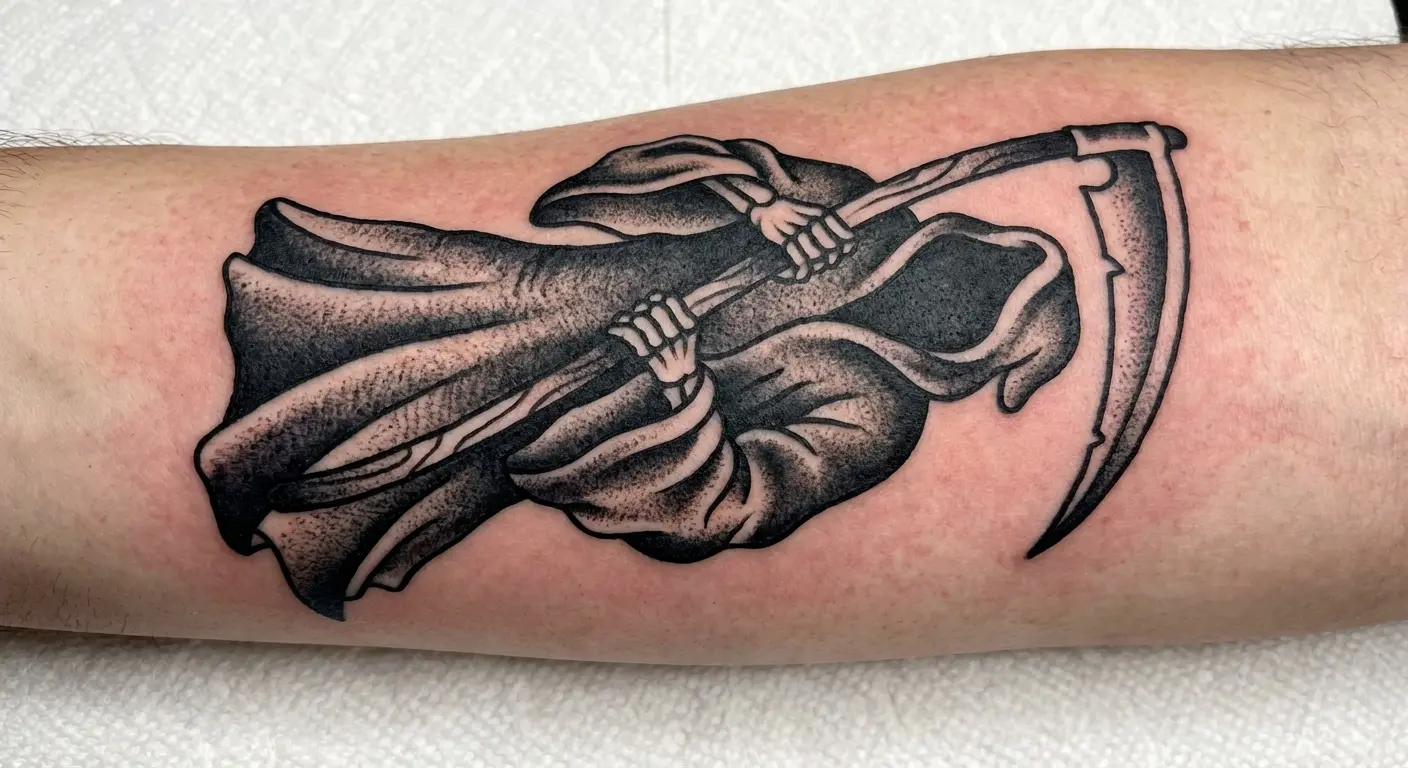
You’re getting this because you’ve thought about death enough to stop being afraid of it, or because you want to remind yourself that time is finite and shouldn’t be wasted.
18. Coffin with Roses
The coffin represents death, the roses represent life or love, and the combination suggests that beauty and endings are inseparable.
This design works as a memorial tattoo without requiring names or dates that might not age well emotionally.
Coffins are boring rectangles that need other elements to not look like a brown box floating on your arm. That’s why roses, banners, or other elements are usually added. Placement on the forearm or thigh gives the coffin enough length to maintain its proportions.
The number of roses can indicate the number of people being memorialized, or simply provide visual balance.
19. Skeleton Hand
Skeleton hands reaching, grasping, or gesturing create unsettling imagery that’s impossible to ignore. The bone structure provides built-in detail that translates well to bold line work.
Traditional skeleton hand tattoos often show the hand holding something (a rose, a dagger, a heart) or making a specific gesture: pointing, peace sign, middle finger. The metacarpals and phalanges need accurate proportions or the hand looks cartoonish instead of memento mori.
Placement on your actual hand creates a layered effect (bones over bones) that’s conceptually interesting but limits job prospects. Forearm placement gives you the visual impact without the professional consequences. These tattoos work as reminders that flesh is temporary, which sounds dark but can be liberating when you’re worried about superficial concerns.
20. Hourglass with Wings
Time flies.
The hourglass measures time passing, the wings suggest it’s escaping, and together they create urgency without panic.
Traditional hourglass tattoos show sand actively falling, which requires careful shading to indicate movement within a static image. Wings can be bird wings (suggesting natural passage) or bat wings (suggesting darker implications, though honestly bat wings feel like you’re trying too hard to be dark).
The hourglass shape works well vertically, making it ideal for forearm, calf, or side placements. You can add banners with phrases about time or leave the image to speak for itself. This design appeals to people who’ve wasted enough time to regret it and don’t plan to waste more.
Fortune & Fate
Gambling, luck, superstition.
These tattoos acknowledge that life includes elements beyond your control while simultaneously claiming some agency over chance.
Sailors and soldiers were notoriously superstitious, carrying talismans and getting tattoos they believed would influence their fortune. We know rationally that a horseshoe tattoo won’t make you luckier, but the psychological effect of wearing symbols of fortune can influence how you approach risk and opportunity.
These designs are less serious than the death imagery, more playful than the warrior animals, and more optimistic than the heartbreak tattoos. They suggest that you’re willing to take chances, that you understand odds, and that you’re not paralyzed by the possibility of failure. If you’re drawn to numeric symbolism in traditional designs, using a number tattoo generator can help you explore how lucky numbers integrate with classic imagery.
21. Horseshoe with Clover
Double luck.
The horseshoe needs to face upward (to hold the luck in) or the entire symbolic purpose fails.
Four-leaf clovers are rare in nature, which makes them valuable as luck symbols. Traditional versions keep both elements simple and bold, avoiding the temptation to add realistic shading or texture that will blur over time.
Placement on the upper arm, forearm, or calf keeps these symbols visible, assuming you’re using them as talismans rather than just decorative elements. Adding dice, cards, or other gambling imagery creates a themed piece about taking chances.
22. Dice and Playing Cards
Gambling imagery communicates that you’re comfortable with risk and understand that outcomes aren’t guaranteed.
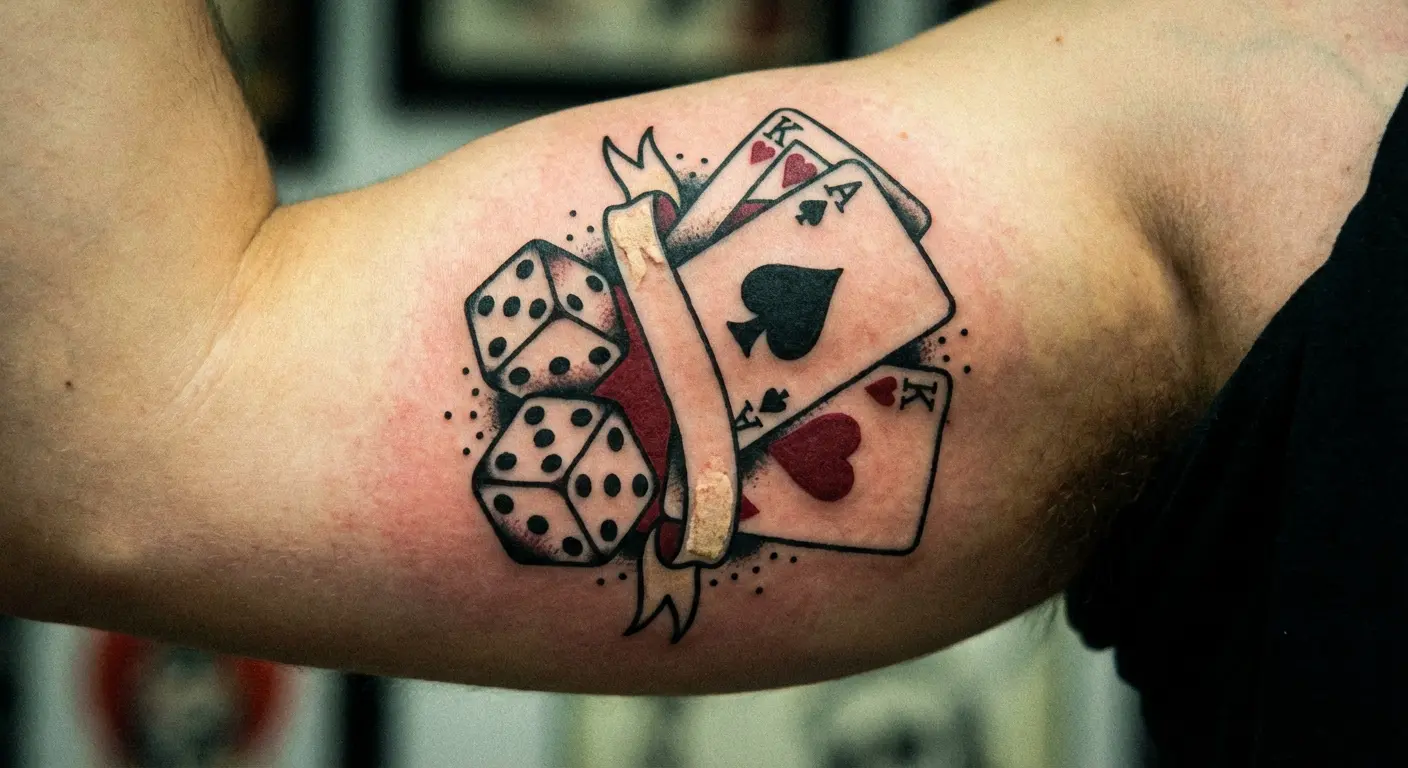
Traditional dice tattoos usually show specific numbers: lucky sevens, snake eyes. Playing cards can be a royal flush (the best possible hand), aces and eights (the dead man’s hand), or specific cards that hold personal meaning.
The flat surfaces of dice and cards make them technically easier to execute cleanly than organic shapes. Placement flexibility is high because these elements can be arranged horizontally, vertically, or scattered compositionally.
People combine dice and cards with money, drinks, or other vice imagery to create larger pieces about living dangerously.
Dice say you’re a risk-taker. Lucky 7s on both dice, or Snake Eyes (double 1s) if you’re feeling dark about your luck. Playing cards tell a story about specific outcomes and fate. Royal Flush means you’re claiming the best possible hand. Dead Man’s Hand (aces and eights) means you know the risks and don’t care. Horseshoes need to point upward or you’re literally spilling your luck out. The eight ball means you’ve been in difficult positions and survived despite the odds.
23. Lucky Number 13
Thirteen is unlucky in mainstream culture, which is exactly why it became lucky in outlaw and motorcycle subcultures.
Claiming 13 as your lucky number is an act of defiance against conventional superstition.
Traditional 13 tattoos are often just the number itself, rendered in bold block lettering or surrounded by minimal decoration (horseshoes, clovers, flames). The simplicity is the point. You’re not trying to make it pretty. You’re making a statement about rejecting societal fears and choosing your own beliefs about fortune.
Placement is often highly visible (hands, neck, forearms) specifically because the number is meant to provoke reactions.
24. Eight Ball
“Behind the eight ball” means you’re in a difficult position with limited options. Getting an eight ball tattoo acknowledges that you’ve been there, or that you’re currently there, or that you’re not afraid of ending up there.
The solid black circle with the white 8 creates strong visual contrast that ages exceptionally well. Traditional eight ball tattoos are straightforward (just the ball) or include pool cues, flames, or banners.
Placement on the forearm, shoulder, or calf gives the circular shape a stable foundation. This design appeals to people who’ve made questionable decisions and survived them, or who are currently making questionable decisions and don’t particularly care about the consequences.
Bringing Old School Into Your Reality
You’ve seen 24 traditional designs that have survived nearly a century of changing trends, evolving technology, and shifting cultural values.
The reason they’re still relevant isn’t nostalgia or retro appeal.
These tattoos were built on principles that transcend temporary aesthetics: bold lines that remain readable as skin ages, limited color palettes that don’t fade into muddy confusion, and imagery that communicates clearly from a distance.
But here’s the challenge: you can look at reference images all day and still have no idea how a design will actually look on your specific body.
A panther that looks fierce on someone else’s shoulder might look awkward on yours because of how your muscle structure sits. An anchor that works beautifully on a thick forearm can look spindly on a thinner arm.
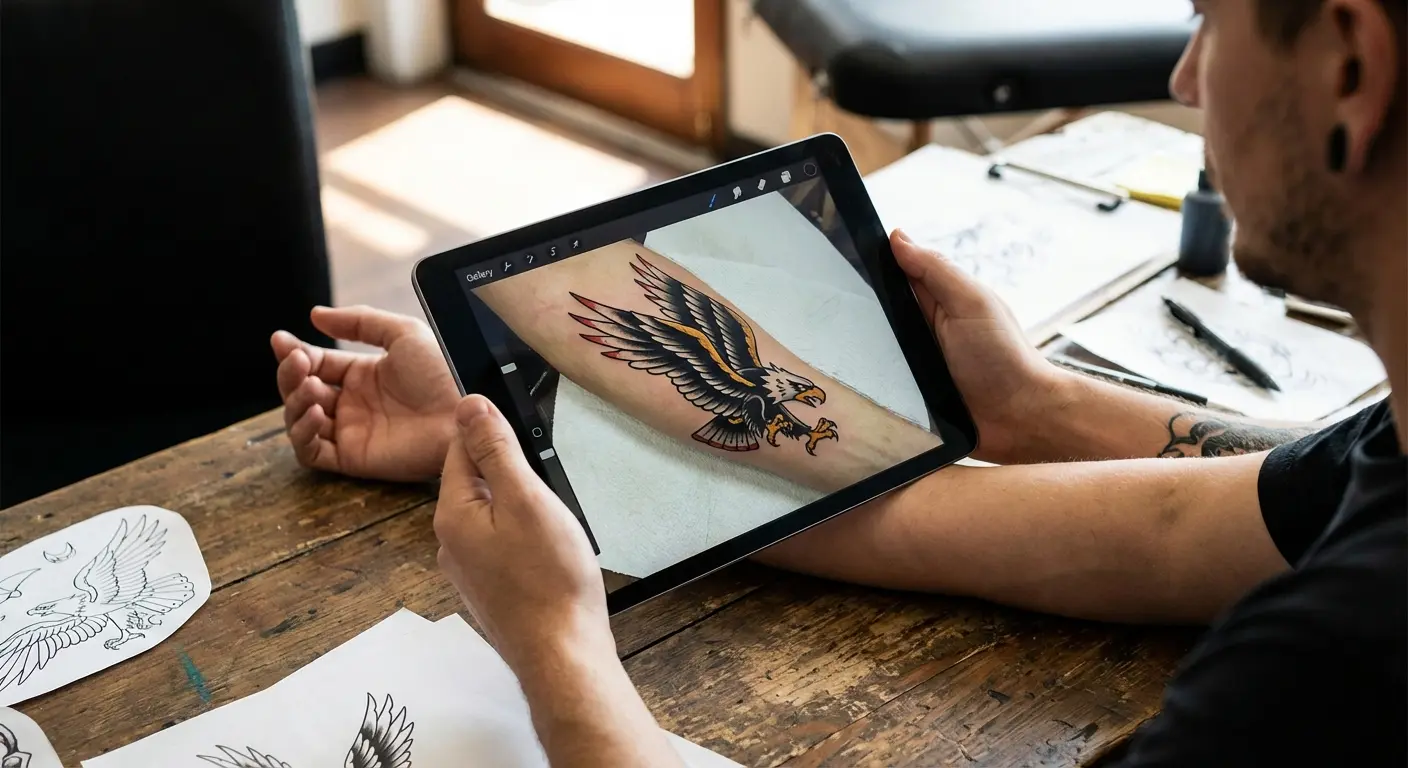
Look, I built a tool for this exact problem because I was tired of seeing people show up with Pinterest screenshots that looked nothing like what they actually wanted. Tattoo Generator IQ lets you test designs on your actual body before you commit. Yeah, it’s my product. Use it or don’t, but stop wasting your artist’s time with vague descriptions.
You can take any of these concepts and see how they translate to your intended placement before you sit in the chair. Adjust the size, test different color variations (traditional black and red versus full color), and generate multiple versions until you find the one that works for your body.
The tool gives you artist-ready references that communicate exactly what you want, which eliminates the frustrating back-and-forth that happens when you’re trying to describe a vision that exists only in your head. Whether you’re pursuing a full sleeve or individual pieces, exploring traditional tattoo generator options helps you experiment with compositions before committing to permanent ink.
Your tattoo artist will appreciate working from a clear reference instead of trying to interpret vague descriptions or low-quality Pinterest images. Generate your design, save the high-resolution file, and bring it to your consultation with confidence that you’re both looking at the same vision.
Final Thoughts
Traditional tattoos endure because they were never about being trendy.
They emerged from communities that needed permanent markers of identity, experience, and values in a world that tried to erase or ignore them.
The bold simplicity that defines traditional American tattooing wasn’t a stylistic choice made in a design studio. It was a practical response to the limitations of early equipment and the reality of how ink behaves in skin over decades.
When you choose a traditional design, you’re not just getting a vintage aesthetic. You’re choosing a tattoo that will remain readable and recognizable when you’re 70, that won’t require expensive touch-ups every few years, and that communicates clearly without needing explanation.
These designs have been tested on actual human bodies for nearly a century.
They work.
I got my first traditional tattoo at 22 (a swallow that was too small and poorly placed). Twenty years later, it’s the only one that still looks decent, because bold lines forgive a lot of mistakes. If you’re going to permanently mark your body, at least choose a style that’s already proven it can survive decades of regret, sun damage, and bad decisions.
Pick the tattoo that resonates with where you are in life, not where you wish you were or where you think you should be. Traditional tattoos are too honest to fake.
