16 Oni Tattoos That Reveal What Your Demons Really Mean
Table of Contents
-
Oni Masks That Mirror Your Inner Conflict
-
Oni Tattoos Rooted in Spiritual Protection
-
Modern Oni Designs That Break Traditional Rules
-
1. Split-Face Oni (Duality and Internal Battle)
-
2. Hannya-Oni Hybrid (Jealousy Transformed into Strength)
-
3. Laughing Oni (Finding Joy in Chaos)
-
4. Weeping Oni (Acknowledging Emotional Pain)
-
5. Shattered Mask Oni (Breaking Free from Facades)
-
6. Guardian Oni with Sacred Rope (Shimenawa Protection)
-
7. Oni Devouring Evil Spirits (Active Defense Against Negativity)
-
8. Temple Gate Oni (Threshold Protection)
-
9. Oni with Buddhist Prayer Beads (Redemption and Transformation)
-
10. Oni Surrounded by Ofuda Talismans (Spiritual Fortification)
-
11. Geometric Oni (Contemporary Sacred Geometry)
-
12. Watercolor Oni Explosion (Emotional Fluidity)
-
13. Minimalist Line-Work Oni (Essence Over Detail)
-
14. Neo-Traditional Oni with Pop Culture Elements
-
15. Blackwork Negative Space Oni (What’s Absent Defines What’s Present)
-
16. Surrealist Oni Morphing into Nature (Interconnected Existence)
-
Final Thoughts
TL;DR
-
Oni tattoos aren’t about evil, they’re about the internal shit we all deal with
-
Different designs express wildly different emotional states (not just “demons”)
-
Protective oni actually mean something specific, not just decorative badassery
-
Modern styles work if you know which rules you’re breaking and why
-
Color choices carry emotional weight beyond looking pretty
-
Pick the oni that makes you uncomfortable, not the prettiest one
-
Placement changes everything about how your design functions
-
The best oni tattoos force you to confront something real about yourself
Most people get oni tattoos wrong. The oni tattoo was originally a sign of recognition for the Japanese mafia, with yakuza wearing them as reminders of their code. Today, these designs have evolved into something different: symbols of personal transformation, inner strength, and the idea that we all carry darkness worth understanding rather than hiding.
Look, I’m not going to pretend I’ve got some special authority here. But I’ve spent years obsessing over how people choose their oni designs, and the meaningful ones always share one quality: they force you to look at something real about yourself. These sixteen designs represent different ways to have that confrontation, whether you’re trying to mirror your internal struggles, protect yourself spiritually, or break every traditional rule you can find.
Oni Masks That Mirror Your Inner Conflict
Everyone thinks oni tattoos represent evil or demons you’re fighting against. Sure. But that misses the deeper truth.
Oni mask tattoos work best when they reflect the internal struggles you’re actually wrestling with, not some abstract concept of darkness. Too many people grab designs from flash sheets that look impressive but mean absolutely nothing. They chose them because they looked cool on Pinterest.
These designs are mirrors. They show you the parts of yourself that society (or you) might want to hide. Not decorative choices. Visual confessions of complexity, acknowledging that you contain multitudes, including the uncomfortable ones.
The weight of an oni mask tattoo comes from how it externalizes what you’re feeling internally. When you look at your forearm and see that split face staring back, you’re reminded that your duality isn’t a flaw. It’s your reality.

Here’s what different oni mask tattoos express:
|
Oni Design Type |
Primary Emotion Expressed |
Ideal Placement |
Visual Longevity |
|---|---|---|---|
|
Split-Face Oni |
Duality, internal conflict |
Forearm, shoulder |
High (bold lines age well) |
|
Hannya-Oni Hybrid |
Jealousy, transformation |
Shoulder blade, chest |
High (traditional techniques) |
|
Laughing Oni |
Joy in chaos, resilience |
Ribs, thigh |
Medium-High (needs detail) |
|
Weeping Oni |
Vulnerability, emotional honesty |
Inner wrist, behind ear |
Medium (fine details soften) |
|
Shattered Mask Oni |
Breaking facades, authenticity |
Forearm, calf |
High (negative space ages well) |
1. Split-Face Oni: Duality and Internal Battle
Half-demon, half-human faces capture that exact moment of transformation we all experience. You know that feeling when you’re presenting your best self to the world while something darker churns underneath? That’s what this design shows.
The split can run vertically down the center or diagonally across the face. One side shows calm human features, the other reveals full oni rage. The most powerful versions maintain equal visual weight on both sides. Neither the human nor the demon dominates.
Placement matters significantly here. On your forearm, you can literally turn your wrist to show different aspects of yourself. The design works because it refuses to simplify your experience into “good” or “bad.” You’re both, simultaneously.
Some artists add color differentiation between the two halves. Others keep it monochromatic to emphasize that these aren’t separate entities. They’re the same face expressing different states. Your oni mask tattoo becomes a reminder that transformation isn’t linear. You don’t graduate from demon to human. You exist as both.

2. Hannya-Oni Hybrid: Jealousy Transformed into Strength
Hannya masks already represent jealous female demons in Japanese folklore, but blending them with traditional oni features creates something more interesting. This isn’t about gender-specific emotions. It’s about how consuming jealousy or betrayal can fundamentally change you, sometimes into something more powerful than you were before.
The horns grow larger, the teeth sharpen, but the eyes retain that distinctly human pain. These usually end up on the shoulder blade or chest, where they can remain partially hidden. The transformation isn’t complete, and maybe it shouldn’t be. That residual humanity keeps you grounded even when rage feels justified.
What makes this design powerful is how it acknowledges that negative emotions can be transformative without being destructive. Jealousy doesn’t have to consume you. It can forge you into something harder, sharper, more resilient.
The best versions show the transition happening in real-time. Hannya features bleeding into oni characteristics, creating visual ambiguity about where one ends and the other begins.
3. Laughing Oni: Finding Joy in Chaos
Most oni look furious or menacing, which is why a genuinely laughing oni hits different. This isn’t a sinister grin (that’s been done to death). This is full-throated, eyes-closed, belly-laughing joy in the face of absolute chaos.
You’ve probably experienced this: that moment when things get so absurdly bad that you just start laughing. The design features an open mouth with visible teeth, crinkled eyes, and sometimes tears of laughter. Placement on the ribs or thigh allows for larger compositions where the body language can match the facial expression.
People with this design tell me it reminds them not to take their darkness too seriously. Your demons don’t have to be grim all the time. Sometimes the only sane response to insanity is to laugh at it.
The technical execution requires an artist who understands facial expressions. A laughing face has specific muscle movements that differ from smiling or grimacing. Get this wrong and your oni looks confused instead of joyful. Get it right and you’ve got a design that makes people do a double-take every time.
4. Weeping Oni: Acknowledging Emotional Pain
Demons aren’t supposed to cry, which makes this design powerful for people who’ve been told to suppress their emotions. When exploring tattoo ideas with deeper meaning, the weeping oni stands out for people who’ve spent years being told to toughen up.
The tears can be subtle or dramatic, sometimes transforming into other elements like rain, rivers, or even blood. These work well as smaller pieces on the inner wrist or behind the ear, where they’re visible primarily to you.
The vulnerability of a crying demon challenges the toxic idea that strength means emotional shutdown. Your demons have feelings too, and acknowledging that doesn’t make you weak. It makes you honest.
This design speaks to people who’ve done the hard work of therapy or self-reflection. You’ve learned that ignoring pain doesn’t make it disappear. It just makes it fester.
Some versions show the tears freezing mid-fall or crystallizing into geometric shapes. Others let them flow freely down the face and off the design entirely.

5. Shattered Mask Oni: What Happens When the Facade Breaks?
The mask itself is cracking or breaking apart, revealing either emptiness or another face underneath. This design speaks to people who’ve spent years performing a version of themselves that wasn’t authentic.
Cracks can radiate from a central impact point, with pieces falling away or suspended mid-break. The negative space becomes crucial here. What shows through those cracks? Some people choose light, others darkness, some leave it intentionally ambiguous.
Forearm or calf placements allow the cracks to follow muscle contours, making the breaking feel more organic and less staged. I’ve seen versions where the cracks align with actual scars or stretch marks, integrating your body’s history into the design.
The shattered oni mask tattoo asks a difficult question: what happens when you stop performing? Who are you when the mask comes off? For some people, the answer is terrifying. For others, it’s liberating.
More artists are incorporating metallic ink into the cracks, making them catch light differently than the rest of the design. It creates this effect where the breaking points literally shine, suggesting that destruction can be beautiful.
Oni Tattoos Rooted in Spiritual Protection
You might not think of demons as protectors, but that’s exactly what oni represent in certain Japanese Buddhist and Shinto contexts. These aren’t decorative guardian angels with halos. They’re fierce protectors who scare away worse things.
While oni are traditionally depicted as demons, they are also believed to ward off other evil spirits, working as powerful supernatural guardians in Japanese culture. This dual nature makes them especially compelling as protective oni tattoo designs, representing both the darkness we acknowledge within ourselves and the fierce defense against external negativity.
Understanding the symbolic vocabulary around protection (ropes, talismans, positioning) makes these designs actually meaningful rather than just aesthetically Japanese. These elements work in their original religious contexts, and the translation to tattoo form requires intentionality.
We’re not talking about slapping a shimenawa rope on your design because it looks cool. We’re talking about understanding that the rope marks sacred boundaries and using it to define what you’re protecting and from what.
6. Guardian Oni with Sacred Rope: Shimenawa Protection
Shimenawa are those thick twisted ropes you see at Shinto shrines, marking sacred spaces and boundaries. Similar to how Japanese traditional tattoo designs use symbolic elements, shimenawa ropes transform the oni into a threshold guardian.
When incorporated into oni tattoos, they turn the demon into a threshold guardian. The rope can wrap around the oni’s horns, bind its arms, or create a border around the entire design. This isn’t about restraining the oni. It’s about focusing its protective energy toward a specific purpose.
Upper arm or shoulder placements work well because the rope can wrap around your arm’s circumference, creating that boundary-marking effect. You’re basically tattooing a spiritual perimeter on your body. Everything inside that boundary is sacred space. Everything outside is where the oni directs its protective aggression.
Some people add specific knot patterns to their shimenawa based on actual shrine practices. The knots aren’t random. They represent different types of protection or different deities being invoked.
The rope can be rendered in traditional black and grey or with subtle color to differentiate it from the oni itself. Some artists add texture to make it look woven. Others keep it smooth and stylized.

7. Oni Devouring Evil Spirits: Active Defense Against Negativity
You see a lot of passive protection symbols, but this design shows active spiritual warfare. The oni is mid-consumption, literally eating smaller demons, negative spirits, or abstract representations of bad energy. It’s visceral and sometimes uncomfortable to look at, which is precisely why it works.
The smaller spirits can be stylized or detailed, depending on your tolerance for complexity. Back pieces allow for multiple small spirits being consumed simultaneously, creating a hierarchy of threats. This appeals to people who don’t want passive protection. They want something that fights back.
These designs speak to people who’ve had to actively defend their mental health or sobriety. You’re not just warding off negativity. You’re destroying it. The oni becomes a visual representation of your refusal to let darkness win.
Some versions show the smaller spirits already partially consumed, dissolving into smoke or shadow. Others capture them whole, suspended in the oni’s mouth.
8. Temple Gate Oni: Threshold Protection
Japanese temple gates (torii or mon) often feature oni guardians on either side. Translating this into tattoo form means your oni isn’t floating in abstract space. It’s positioned within architectural context, suggesting it guards a specific threshold in your life.
The gate can be minimally suggested with just two pillars or fully detailed with traditional roof architecture. These work beautifully as larger pieces on the thigh or ribcage, where vertical space allows for proper gate proportions. You’re marking a boundary: certain energies don’t cross this point.
This design works well for people who’ve established firm boundaries in their lives. Maybe you’ve cut off toxic relationships. Maybe you’ve left a destructive career. Maybe you’ve simply decided that certain behaviors or thought patterns don’t get past your defenses anymore.
The architectural elements ground the design in physical reality. Your oni isn’t some abstract concept. It’s stationed at a specific location, doing a specific job.
Some people add additional protective elements to the gate itself: sacred inscriptions, hanging bells, or paper streamers. Each addition layers more meaning onto your design.
9. Oni with Buddhist Prayer Beads: Redemption and Transformation
Prayer beads (juzu or mala) in an oni’s hands or wrapped around its neck suggest a demon seeking enlightenment or already transformed through spiritual practice. Buddhism teaches that even demons can achieve enlightenment, which makes this design meaningful for people with complicated pasts.
The beads can be 108 (the traditional number) or simplified. Some designs show the oni meditating, others show it clutching the beads desperately. Forearm placement allows the beads to wrap around your arm, creating a tactile reminder. This isn’t about erasing your demons. It’s about bringing them along on your spiritual journey.
What strikes me about this design is how it rejects the binary of good versus evil. You don’t have to kill your demons to grow spiritually. You can transform them. The oni holding prayer beads says: I was destructive once, and I’m learning something different now.
People with this design who’ve been through addiction recovery, anger management, or significant trauma healing tell me the oni represents who they were. The beads represent the practice that’s changing them. Neither element disappears. They coexist.

Some artists add Sanskrit or Japanese characters to the beads themselves, inscribing specific mantras or intentions. Others keep the beads plain, letting their presence speak for itself.
10. Oni Surrounded by Ofuda Talismans: Spiritual Fortification
Ofuda are those paper talismans with sacred inscriptions you see at Japanese shrines. When surrounding an oni in tattoo form, they create a containment or amplification field, depending on your interpretation. Are the talismans keeping the oni’s power focused? Are they protecting you from the oni? Are they protecting the oni from external threats? The ambiguity is productive.
The talismans can be legibly inscribed with actual sacred text or stylized into abstract rectangles. These work well as half-sleeve designs where multiple talismans can float around a central oni figure, creating visual rhythm without overcrowding.
This design appeals to people who understand that protection requires multiple layers. One talisman isn’t enough. One defense mechanism isn’t enough. You need a system of fortifications working together. The oni provides the aggressive defense. The ofuda provide the spiritual framework.
Some clients research specific shrine talismans and incorporate their actual inscriptions. Others create fictional talismans with personal mantras or intentions written in Japanese characters. The authenticity matters less than the intentionality. What are you fortifying? Against what?
Placement affects how the talismans interact with the oni. On a forearm, they might float around the demon’s head. On a back piece, they might create a complete perimeter. Some versions show the talismans glowing or emanating energy. Others keep them simple paper rectangles.
Modern Oni Designs That Break Traditional Rules
Traditional oni iconography is powerful, but you don’t have to be bound by it. Contemporary tattoo artists are reinterpreting oni through modern art movements while maintaining the core symbolic weight. These aren’t disrespectful departures from tradition. They’re evolutions that make oni relevant to people whose aesthetic vocabulary includes street art, surrealism, and digital culture alongside traditional Japanese imagery.
The growing accessibility of tattoo artistry to younger generations is reshaping the industry. Britain’s youngest tattoo artist, 17-year-old Summer Fenton, recently qualified to work at Oni Tattoo Collective in Bury, Greater Manchester, showing how traditional symbols like the oni are being passed to new artists who will inevitably bring fresh perspectives to these ancient designs while respecting their cultural significance.
The key is maintaining intentionality. You’re not randomly mixing styles because it looks cool. You’re deliberately choosing which rules to break and why. Plenty of oni tattoos throw together geometric shapes, watercolor splashes, and traditional elements with no coherent vision. They fail because they’re trying to be everything at once.
The successful modern oni knows exactly which traditional element it’s preserving and which it’s reimagining.

11. Geometric Oni: Contemporary Sacred Geometry
Breaking the oni’s organic curves into angular geometric shapes creates tension between ancient symbolism and modern design language. Think triangular horns, hexagonal face plates, or the entire head constructed from intersecting polygons. These contemporary approaches share similarities with geometric tattoo designs that prioritize mathematical precision and symbolic structure.
This approach appeals to people who appreciate both the spiritual weight of oni and the mathematical precision of sacred geometry. Placement on areas with natural straight lines (like the shin or forearm) reinforces the geometric aesthetic.
Artists spend hours calculating the exact angles needed to maintain oni recognition while pushing the geometry as far as possible. Too geometric and it stops reading as oni. Too organic and you’ve lost the point.
Some versions incorporate sacred geometry patterns within the oni’s structure: flower of life, Metatron’s cube, or golden ratio spirals. The demon doesn’t lose its power by becoming angular. It gains a different kind of intensity.
12. Watercolor Oni Explosion: Emotional Fluidity
Traditional oni tattoos use bold, solid colors with clear boundaries. Watercolor techniques let those boundaries dissolve, with colors bleeding beyond the line work or existing without lines entirely. The oni’s rage or energy literally bleeds into surrounding space.
This works well for people whose emotional experience feels fluid rather than contained. The technique requires a skilled artist who understands how watercolor tattoos age (they do fade faster than traditional work, so factor that into your decision). Shoulder or upper back placements provide enough canvas for colors to splash dramatically without getting muddy.
Watercolor oni tattoos visualize emotional overflow. Your feelings don’t stay neatly contained within the lines society draws for you. They spill out, blend together, create unexpected combinations.
Color choice matters significantly here. Reds and oranges suggest rage and passion. Blues and purples suggest melancholy or introspection. Some artists mix warm and cool colors, creating visual tension that mirrors emotional complexity.

The watercolor can be contained within a traditional oni outline or allowed to replace the outline entirely. Each approach creates different effects. Contained watercolor suggests emotions held within a recognizable structure. Uncontained watercolor suggests complete emotional freedom, for better or worse.
13. Minimalist Line-Work Oni: Essence Over Detail
Stripping away all the decorative elements until you’re left with just essential lines creates an oni that’s more suggestion than statement. This approach aligns with fineline tattoo techniques that prioritize restraint and essential forms over elaborate decoration.
Single-needle or fine-line techniques capture the horns, basic facial structure, and maybe teeth. Nothing more. This design philosophy says: you don’t need elaborate detail to convey power. Sometimes restraint hits harder than excess.
These work beautifully as smaller pieces (inner wrist, behind the ear, side of finger) where detail would get lost anyway. The minimalism also ages well, as there’s less information to blur over time.
The challenge is identifying which lines are truly essential. Remove too much and you’ve got an abstract face that could be anything. Keep too much and you’ve failed at minimalism.
Some versions use varying line weights to create subtle depth. Others maintain consistent line thickness throughout.
14. Neo-Traditional Oni with Pop Culture Elements
Neo-traditional tattooing already blends classic techniques with contemporary imagery, so adding pop culture elements to oni designs isn’t as sacrilegious as it sounds. Oni with headphones, VR headsets, or integrated into cyberpunk aesthetics.
The key is making these additions meaningful rather than random. An oni with headphones might represent using music to manage your demons. A cyberpunk oni might explore how technology amplifies or transforms our internal darkness. These work as larger pieces (thigh, back, chest) where you have room to develop the concept fully.
The successful ones understand that they’re creating a dialogue between traditional symbolism and contemporary culture. The unsuccessful ones just slap a Supreme logo on an oni and call it innovative.
What makes this Japanese oni tattoo approach work is when the pop culture element genuinely adds meaning rather than just visual novelty. An oni wearing a gas mask in a post-apocalyptic setting says something about modern anxieties that a traditional oni can’t. An oni with circuit board patterns suggests how our demons have evolved in the digital age.
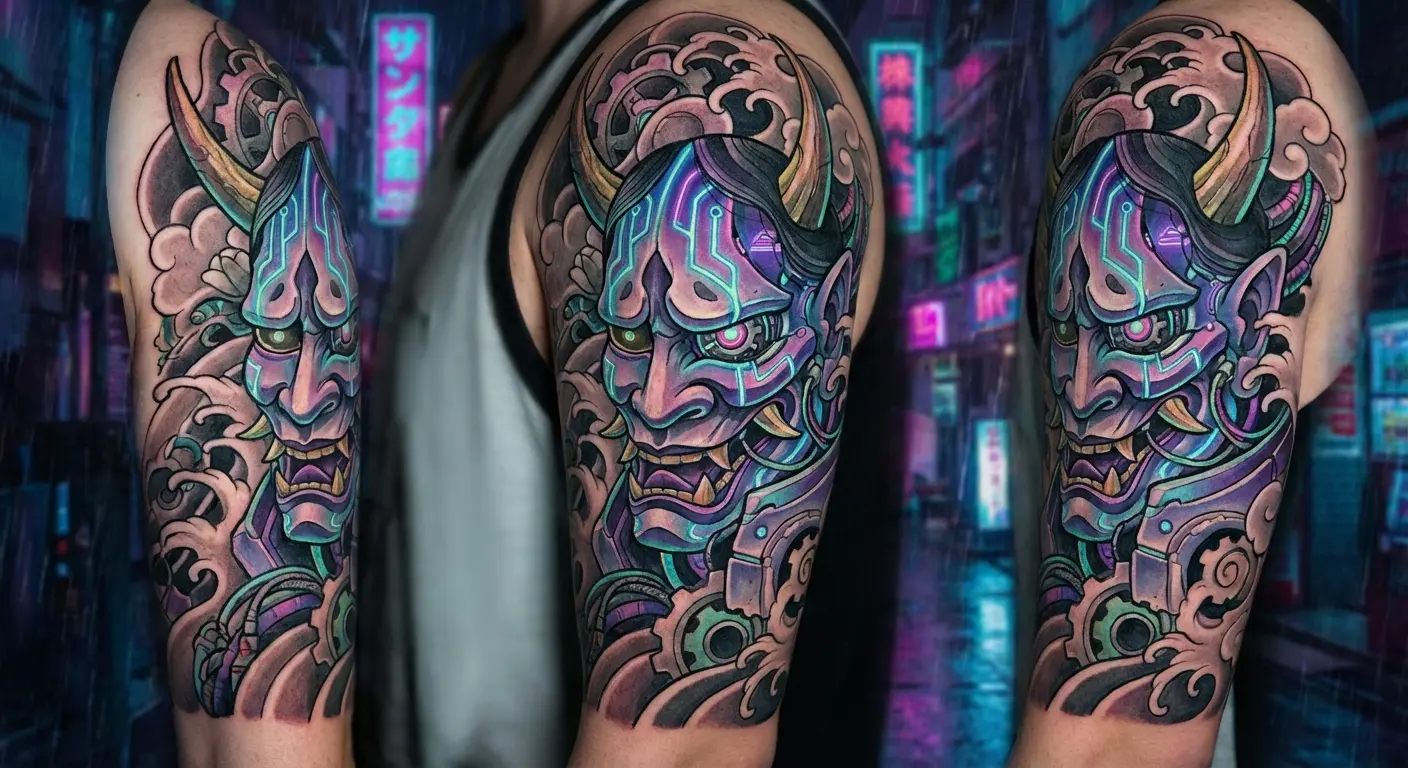
Color palettes often shift toward neon or synthetic tones in these designs. Traditional reds become hot pink. Traditional blacks become deep purples.
15. Blackwork Negative Space Oni: What’s Absent Defines What’s Present
Instead of tattooing the oni itself, you tattoo everything around it, using solid black to create the oni’s shape through absence. This reversal creates striking visual impact and philosophical weight. The demon is defined by what surrounds it, not by its own substance.
Blackwork also ages exceptionally well, as solid black doesn’t fade the way colored ink can. These designs require significant skin commitment (you’re covering large areas in solid black), so they usually appear on the calf, thigh, or upper arm where you have enough real estate.
The negative space oni asks: is a demon more powerful when it’s explicitly shown or when it’s implied? People drawn to this design tend to be more philosophically inclined. They appreciate the conceptual reversal as much as the visual impact.
Execution requires precise planning. The artist needs to map out exactly where the black goes to ensure the negative space reads clearly as oni. Too much black and the form disappears. Too little and it looks incomplete.
Some versions incorporate texture or pattern within the solid black areas. Others keep it completely flat. Additional elements (flowers, geometric shapes, other figures) can exist within the black field, creating layers of positive and negative space.
16. Surrealist Oni Morphing into Nature: Interconnected Existence
The oni’s form dissolves or transforms into natural elements: horns becoming tree branches, skin becoming water, hair becoming wind or fire. Like phoenix tattoo symbolism, the oni morphing into nature represents transformation and the cyclical nature of destruction and rebirth.
This approach draws from surrealist art movements while maintaining oni symbolism. It suggests your demons aren’t separate from the natural world. They’re part of the same interconnected system. The morphing can be subtle or dramatic, with clear transition points or ambiguous blending.
These work as larger, more complex pieces where the transformation can develop across significant space. Back pieces or full sleeves give you room to show the complete metamorphosis from oni to nature and back again. Versions where the oni dissolves into cherry blossoms, ocean waves, or mountain ranges.
The philosophical implication is profound: your darkness isn’t unnatural. It’s as much a part of the ecosystem as anything else. Fighting it might be less productive than understanding how it fits into your larger system.
Color choices often shift from traditional oni reds and blacks into natural tones: greens, blues, earth tones. The transition can be gradual or abrupt. Some artists maintain oni coloring throughout, suggesting that even when transformed into nature, the demon retains its essential character.

Look, if you’ve spent hours scrolling through generic oni designs wondering how to find something that actually means something to you, Tattoo Generator IQ lets you input the exact emotional or spiritual concept you’re exploring (whether that’s duality, protection, or transformation) and generates multiple unique interpretations in seconds. You’re not stuck choosing between cookie-cutter flash designs or spending months trying to explain your vision to an artist who might not get it. I know this sounds like a pitch, but if you can’t articulate what you want but you know exactly what you feel, it actually helps. Not perfect, but it beats the alternative.
Final Thoughts
Oni tattoos stop being meaningful the moment you treat them as purely aesthetic choices. These designs carry psychological and spiritual weight that demands intentionality. Whether you’re drawn to the mirror-like quality of psychological oni, the active protection of guardian designs, or the rule-breaking energy of modern interpretations, your oni should reveal something true about your relationship with your own complexity.
You’re not getting a demon tattooed on your body. You’re acknowledging that the scariest monsters are the ones you carry inside, and sometimes the bravest thing you can do is make them visible.
The oni tattoo that works isn’t the prettiest one or the most technically impressive. It’s the one that makes you slightly uncomfortable when you look at it because it’s showing you something real. Elaborate, expensive oni mask tattoos that mean nothing because they were chosen for Instagram rather than introspection exist everywhere. Simple, small oni tattoos that carry enormous weight because the person understood exactly what they were externalizing also exist.
Your demons deserve better than to be reduced to decoration. They deserve to be seen, understood, and integrated into who you are. That’s what a meaningful oni tattoo does. It doesn’t hide your darkness or celebrate it uncritically. It acknowledges that darkness as part of your complete self, worthy of the same attention and artistry as anything else you choose to carry on your skin.
The most powerful Japanese oni tattoo designs aren’t the ones that follow every traditional rule or break them all. They’re the ones that understand which aspects of tradition matter for your specific journey. Whether you choose an oni mask tattoo that mirrors your internal conflict, an oni tattoo that actively protects your boundaries, or a contemporary interpretation that speaks to your modern experience, the design should force you to confront something authentic about yourself. That confrontation, that willingness to acknowledge and integrate your darkness rather than hide it, transforms an oni tattoo from decoration into a tool for self-understanding.
