18 Peacock Tattoos That Reveal What Most Artists Won’t Tell You About Symbolism and Placement
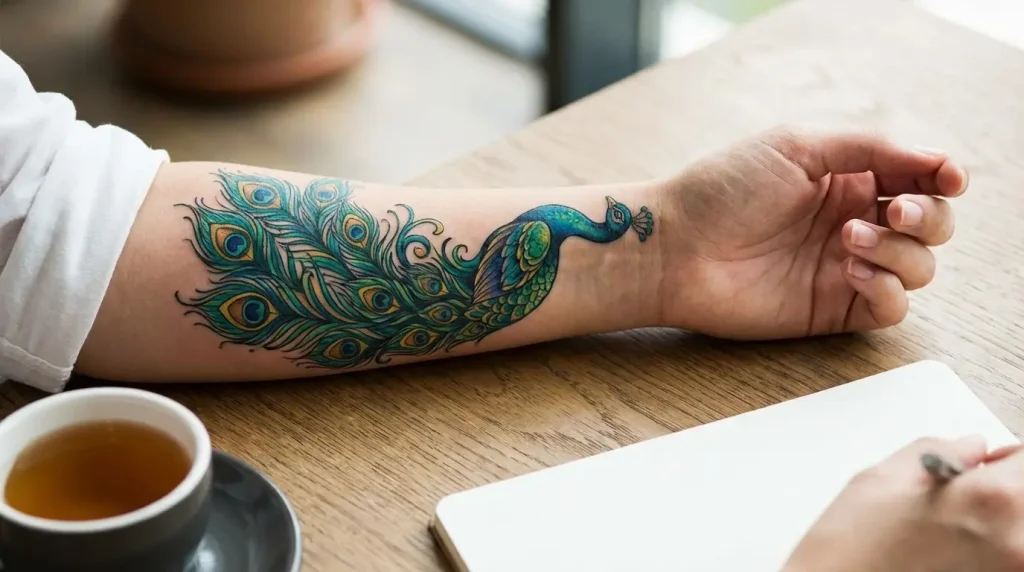
Table of Contents
-
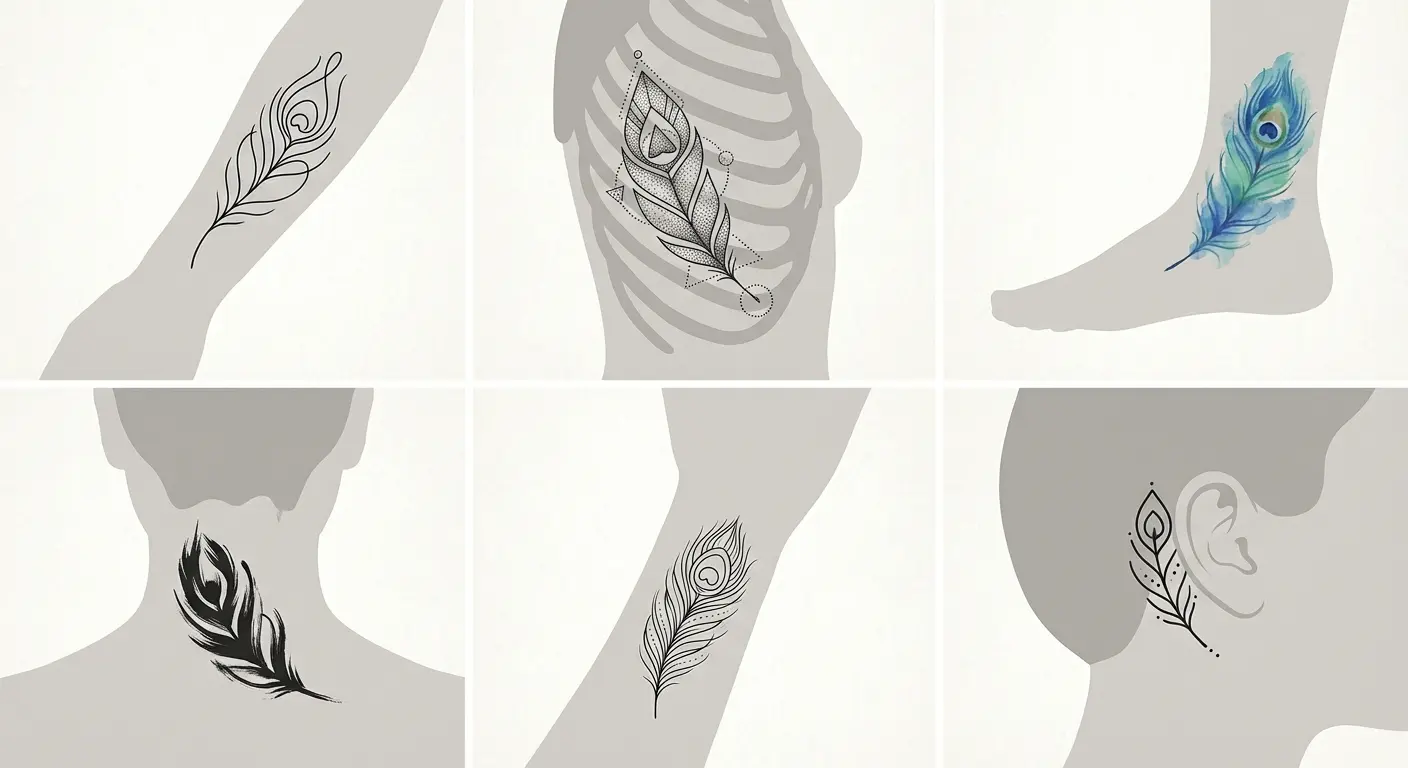
The Feather-Forward Designs (Minimalist Peacock Tattoos)
-
Single Feather Spine Placement
-
Watercolor Eye Feather on Forearm
-
Linework Feather Cluster Behind the Ear
-
Geometric Feather with Dotwork Shading
-
Micro Feather on Finger or Wrist
-
Inverted Feather Down the Ribcage
-
-
The Full-Body Statements (Maximalist Peacock Tattoos)
-
Spreading Peacock Across the Back
-
Thigh-to-Knee Cascading Tail Design
-
Chest Piece with Extended Wing Detail
-
Full Sleeve with Integrated Floral Elements
-
Side Body Design Following Natural Curves
-
Shoulder Cap with Trailing Feathers Down the Arm
-
-
The Unexpected Interpretations (Conceptual Peacock Tattoos)
-
Abstract Peacock Using Negative Space
-
Blackwork Peacock with White Ink Accents
-
Peacock-Phoenix Hybrid Transformation
-
Mandala-Centered Peacock Design
-
Skeleton Peacock with Exposed Bone Structure
-
Peacock Incorporating Personal Cultural Symbols
-
TL;DR
Look, most people think peacock tattoos are about vanity. They’re wrong. Protection, spiritual awakening, renewal…these meanings get buried under surface-level associations. Placement changes everything about how those eye patterns read on your body and how the whole thing ages. Most artists won’t explain this until you’ve already committed.
Single feather designs let you add more later. Full-body pieces lock you into that space forever. Black and grey work reveals structural details that color obscures, plus you skip the maintenance nightmare of keeping vibrant pigments fresh.
Here’s something wild: the bird’s natural asymmetry works better with your body’s contours than symmetrical designs. Forcing it into perfectly centered placements usually looks wrong. Combining elements with mandalas, florals, or cultural motifs creates more personal meaning than standalone imagery.
Understanding realistic versus stylized approaches helps you communicate with your artist without the frustration of mismatched expectations. Feather direction and eye placement guide viewer attention exactly where you want it.
Why Everyone’s Getting Peacock Tattoos Right Now
Peacock designs rank among the most requested in shops worldwide, according to tattoo artists who specialize in bird imagery. This isn’t just about visual impact. The bird appeals across genders and carries symbolic weight that goes way beyond pride or vanity.
But here’s what bugs me: people walk into consultations with zero understanding of what they’re actually committing to. They see a pretty bird on Pinterest and think that’s enough research.
It’s not.
The Feather-Forward Designs (Minimalist Peacock Tattoos)
Feather designs first because they’re the most misunderstood aspect of this whole thing. Most people gravitate toward the full bird without realizing a single feather carries the complete symbolic weight of the entire creature.
These minimalist approaches give you maximum meaning with strategic placement. They’re way easier to integrate into existing collections. The feather’s natural eye pattern (called an ocellus) has been used as a protective symbol across cultures for centuries. That gets lost when people only focus on the bird’s association with pride.
These designs prioritize the structural elements that make the work instantly recognizable while leaving room for your skin to breathe. I’ve watched too many people commit to massive pieces when a single feather would have delivered the same symbolic punch with a fraction of the commitment.
|
Design Approach |
Ideal Body Placement |
Session Time |
Visibility Level |
Best For |
|---|---|---|---|---|
|
Single Feather |
Spine, forearm, ribcage |
2-4 hours |
Adjustable by clothing |
First-timers, minimalists |
|
Feather Cluster |
Behind ear, shoulder blade |
1-3 hours |
Easily concealable |
Professional settings |
|
Geometric Feather |
Forearm, calf, shoulder |
3-5 hours |
Medium visibility |
Modern aesthetic lovers |
|
Micro Feather |
Finger, wrist, ankle |
30-90 minutes |
Always visible |
Subtle reminder seekers |
1. Single Feather Spine Placement
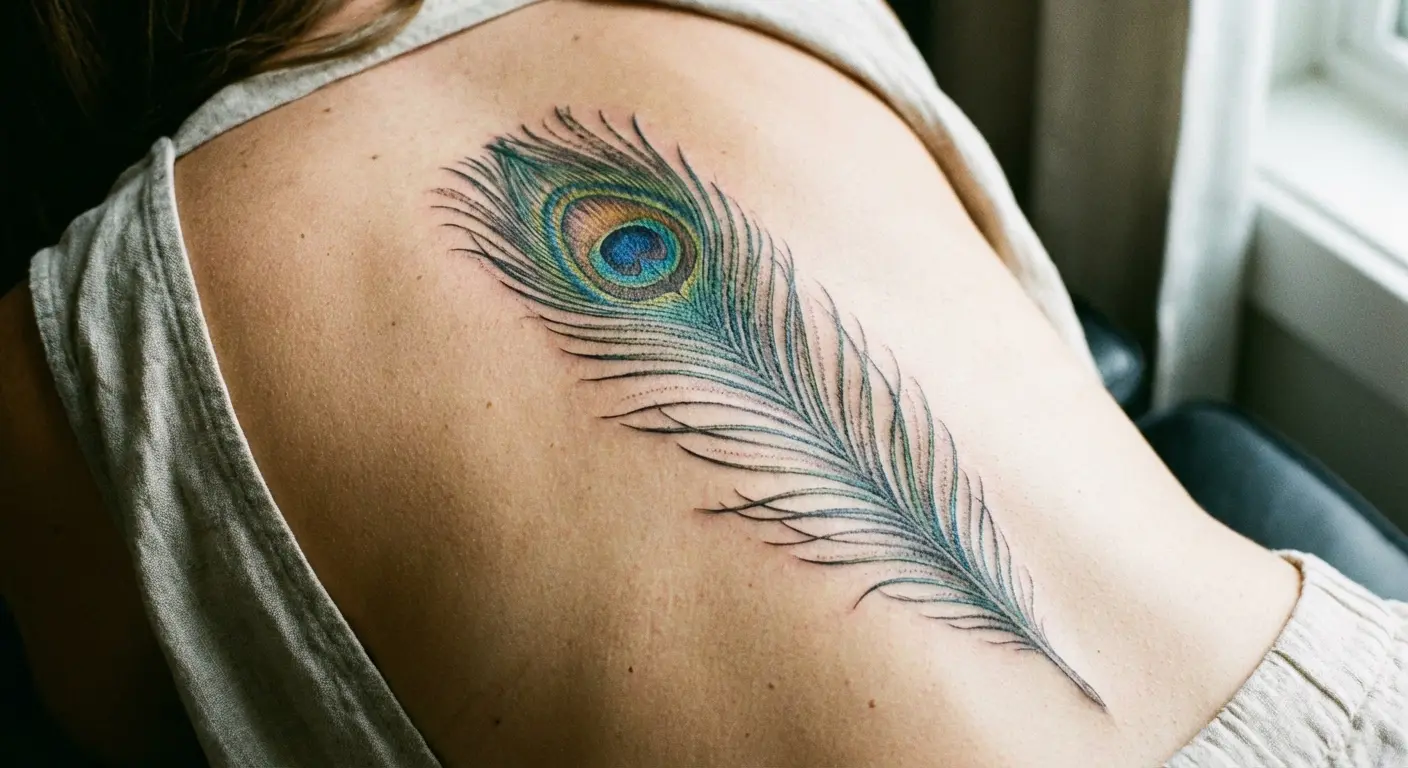
Spine tattoos follow your body’s central axis, and a peacock feather’s natural taper makes it anatomically perfect for this spot. The eye typically sits at the base of your neck or between shoulder blades, with the shaft extending down toward your lower back.
This positioning creates a protective symbol along your most vulnerable meridian (if you’re into that interpretation) or simply emphasizes your posture and movement. The design works in both color and black and grey, though you’ll want to consider how clothing interacts with it.
Tank tops and backless designs show it off, but you’ll rarely see it yourself without mirrors or photos. Your artist needs to account for the spine’s curve. The feather shouldn’t be perfectly straight or it’ll look wrong. I’ve seen artists try to force geometric precision onto curved anatomy, and it always reads as fighting your body rather than complementing it.
Placement along your spine also means varying pain levels as the needle moves from the meaty upper back down to the bony lower spine. Sessions can get intense. But the vertical real estate gives you room to incorporate impressive detail that smaller placements can’t accommodate.
Budget at least three hours for a detailed spine piece. Bring snacks. You’re gonna need them.
2. Watercolor Eye Feather on Forearm
Watercolor techniques transform the feather’s eye into an explosion of blues, greens, and purples that bleed beyond traditional outlines. Your forearm offers a flat canvas that people (including you) will see constantly, making it ideal for designs you want to interact with daily.
The watercolor approach works particularly well here because arm movement creates the illusion that the colors are shifting and flowing. You’re looking at more frequent touch-ups than traditional styles, though. Watercolor fades faster without strong outlines to anchor the pigment.
Real talk? The ethereal quality often justifies the maintenance.
Plenty of artists integrate splatter effects or let the colors trail off into your skin tone, which creates a less defined endpoint than bordered designs. This matters if you’re planning to add more ink later, since you won’t have hard edges to work around.
The colorful style demands an artist who understands color theory and how different pigments age on skin. Some watercolor work looks stunning fresh but turns muddy within a year if the artist doesn’t layer colors properly. Ask to see healed examples from their portfolio, not just fresh work that hasn’t been tested by time.
If they can’t show you healed watercolor pieces, keep looking.
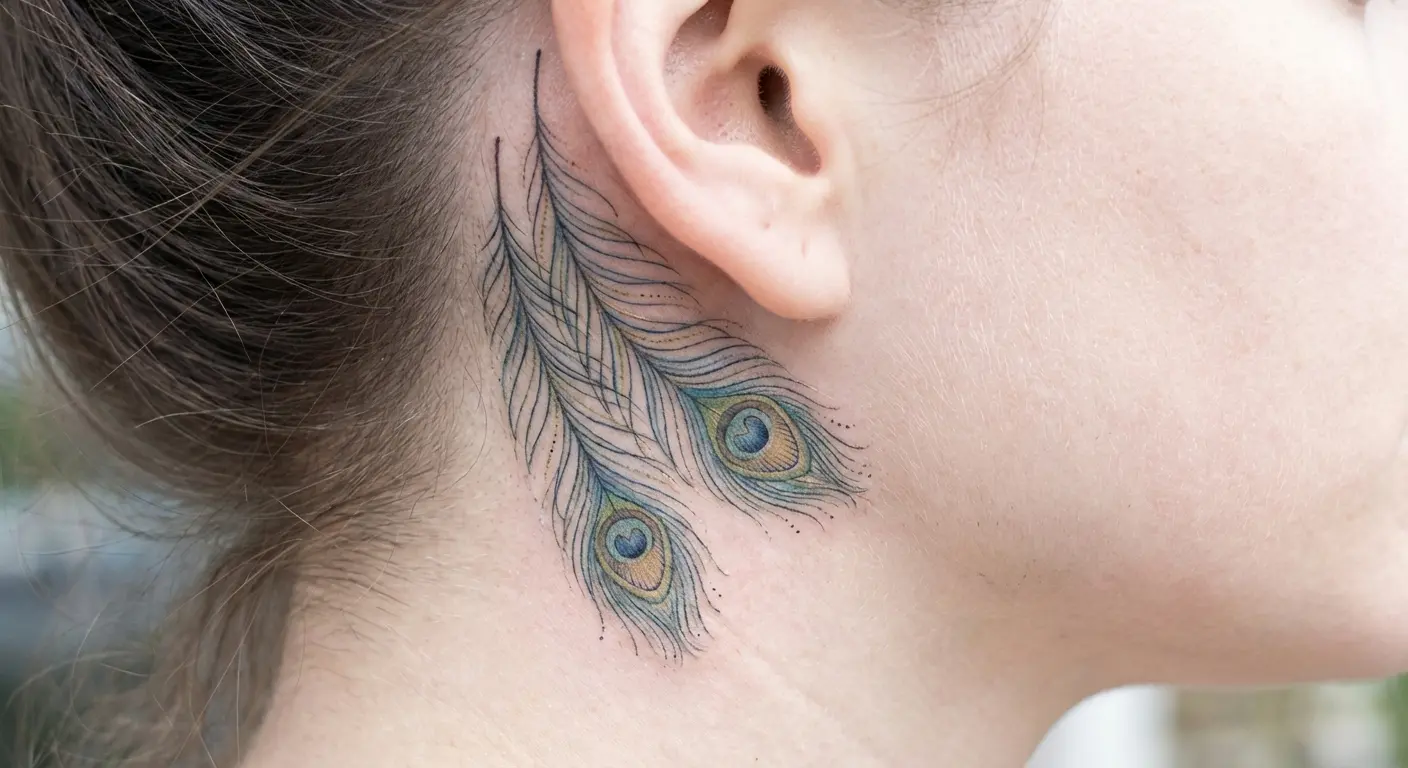
3. Linework Feather Cluster Behind the Ear
A cluster of three to five feathers in fine linework creates texture without overwhelming the limited space behind your ear. This spot is surprisingly visible to others during conversations (people see your profile more than you’d think), but it photographs beautifully when you pull your hair back.
Pain-wise, you’re right on the skull with minimal cushioning. Sessions are typically short and intense. The linework approach keeps the design crisp in a spot where color can blur faster due to thin skin and constant movement.
You need an artist who specializes in fine lines. Thick, heavy-handed work will look muddy in this location within a few years. When considering small tattoo placements and designs, behind-the-ear locations stay hidden until you want to reveal them, giving you control over professional presentation.
I’ve watched people get behind-the-ear pieces that looked perfect initially but spread into blurry messes because the artist used needles meant for larger work. The technical execution matters more in small spaces than almost anywhere else on your body.
Don’t cheap out on this placement. Seriously.
4. Geometric Feather with Dotwork Shading
Geometric interpretations break the feather into angular segments, often using sacred geometry principles or simple triangular faceting. Dotwork shading (also called stippling) builds dimension through thousands of tiny dots rather than solid fills or gradients.
This combination creates work that reads as both organic and constructed, which appeals to people who want nature-inspired designs without pure realism. The technique ages exceptionally well because dots don’t blur together the way solid shading can, and the geometric framework keeps everything structured even as your skin changes over time.
Placement flexibility is high since geometric designs adapt to various body parts without losing their impact. I typically see these on forearms, calves, or shoulder blades where there’s enough space for the dotwork detail to remain legible.
The precision required means longer session times than you might expect for the size. Each dot gets placed individually. Rushing the process shows in the final result.
Your artist needs a steady hand and serious patience. I’ve seen geometric work where the symmetry is off by millimeters, and those tiny discrepancies become glaring once you notice them. You can’t unsee that stuff.
5. Micro Feather on Finger or Wrist
Micro tattoos require artists with steady hands and clients with realistic expectations about longevity. A peacock feather scaled down to finger or inner wrist size loses most fine details, so the design needs to capture the essence through silhouette and the distinctive eye pattern.
Finger tattoos fade faster than almost any other placement due to constant friction, skin regeneration, and hand washing. You’re committing to touch-ups every few years if you want it to stay crisp.
Wrist placement lasts longer but still experiences more wear than protected areas.
The appeal here is subtlety and the ability to glance at your reminder throughout the day. Some people choose this as their first piece specifically because it’s small enough to test their pain tolerance and commitment level without major consequences.
The session is quick (usually under an hour), but the placement means everyone will see it unless you wear long sleeves constantly. Professional environments vary wildly in their acceptance of visible hand and wrist tattoos. Think about your career trajectory before committing to a spot you can’t easily cover.
If you’re in a conservative industry, maybe skip this one.
6. Inverted Feather Down the Ribcage
Flipping the feather so the eye sits near your hip with the shaft extending up toward your armpit creates unexpected visual flow. Ribcage tattoos hurt. There’s no gentle way to frame this. But they offer a large, relatively flat canvas that moves with your breathing and torso rotation.
The inverted orientation means the eye pattern draws attention downward rather than up, which can balance out your proportions if you’re planning a larger collection. This placement stays private under most clothing but reveals itself in swimwear or intimate settings.
Women need to think about how breast tissue and bra bands might affect the design’s visibility and comfort during healing. The ribcage expands and contracts constantly, so your artist should account for how the piece will look both at rest and in motion.
I’ve watched people get ribcage work that looked perfect while lying on the table but distorted strangely when they stood up and breathed normally. Your artist should have you sit up periodically during the session to check how the design moves with your body.
The pain level keeps most sessions shorter than back or arm work, which means you might need multiple appointments to complete detailed designs. Plan accordingly.
The Full-Body Statements (Maximalist Peacock Tattoos)
Full designs demand significant skin real estate and multiple sessions, but they showcase the bird’s complete symbolic and visual impact.
These aren’t starter tattoos.
You’re committing to hours in the chair, substantial financial investment, and a piece that will define how people perceive your body art collection. The bird’s natural drama (that fan of iridescent tail feathers, the elegant neck, the crown of plumes) translates into work that commands attention and conversation.
I’m focusing on placements that work with the bird’s proportions rather than forcing it into spaces where it’ll look cramped or distorted. Color versus black and grey becomes a critical decision here, since you’re covering enough area that the choice will significantly impact your overall aesthetic.
Full-body pieces also raise practical questions about pain management across different body zones, healing logistics for large work, and how the design will age as your body changes. In many cultures, the peacock naturally replaces its feathers annually, which is why peacock tattoos often represent growth, rebirth, and a rejuvenation of life. Potent meanings that carry even more weight when you’re dedicating significant body space to the imagery.
This biological reality transforms the symbolism from a simple beauty icon into a powerful representation of cyclical renewal and personal transformation. Clients going through major life transitions often choose large-scale pieces specifically because they want the symbolism to match the magnitude of their internal changes.
7. Spreading Peacock Across the Back
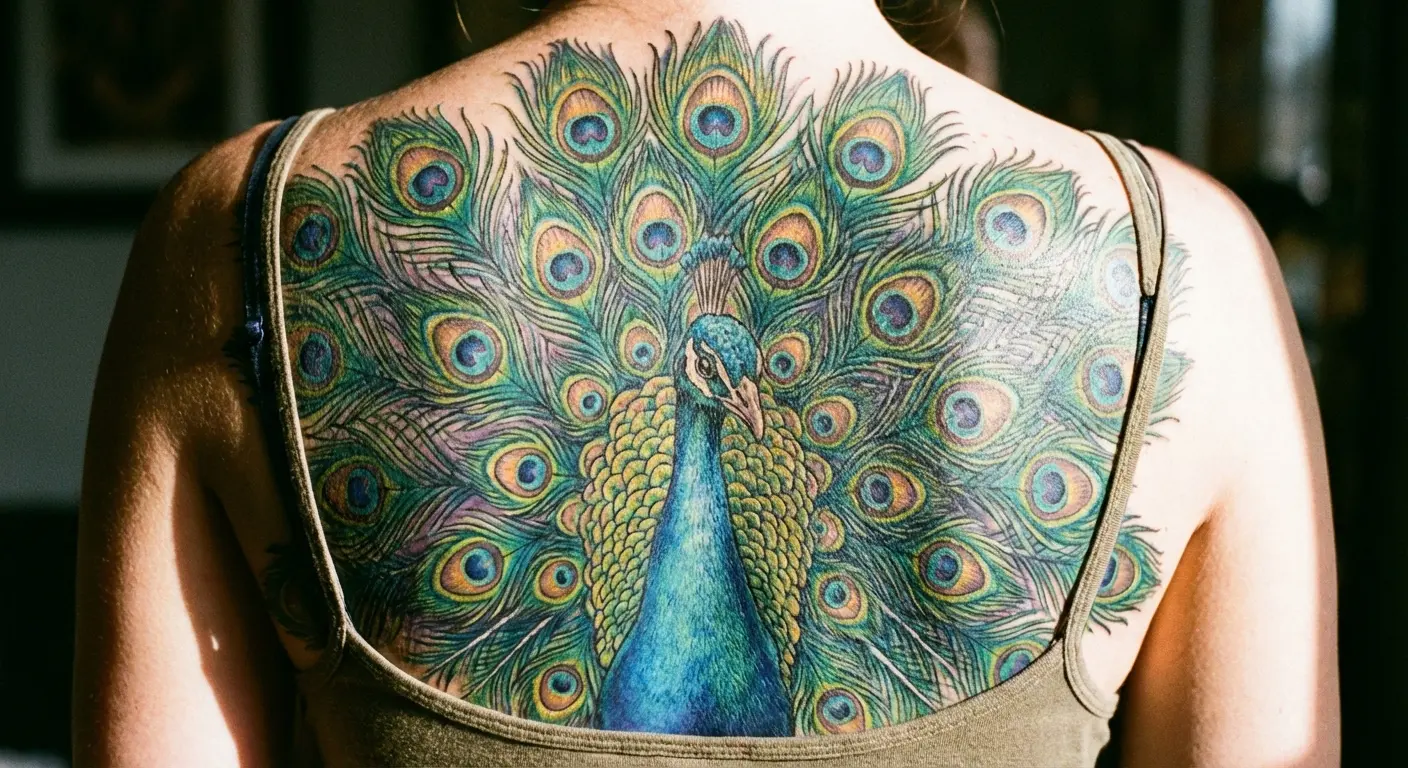
Your back offers the largest uninterrupted canvas on your body, perfect for a peacock with its tail feathers fully displayed. The bird’s body typically centers on your spine with the tail fanning out across your shoulder blades and upper back, though some designs extend all the way down to the lower back.
This placement lets the artist work with the bird’s natural proportions without cramping the composition. You’re looking at multiple sessions, anywhere from 15 to 40+ hours depending on detail level and color complexity.
Back tattoos heal relatively easily since the area doesn’t bend as extremely as joints, and clothing friction is minimal if you wear loose shirts during recovery.
The main drawback? You’ll never see it without photos or mirrors, which bothers some people more than they anticipate. Clients express genuine surprise at how disconnected they feel from back pieces because they can’t see them during daily life. The work becomes something you wear for others rather than yourself, which shifts the entire relationship with the piece.
Think about whether that dynamic works for your intentions before committing your entire back to a design you’ll rarely witness directly.
Budget $3,000 to $8,000 for a full back piece, depending on your city and artist’s reputation. Yeah, it’s expensive. Quality work costs money.
8. Thigh-to-Knee Cascading Tail Design
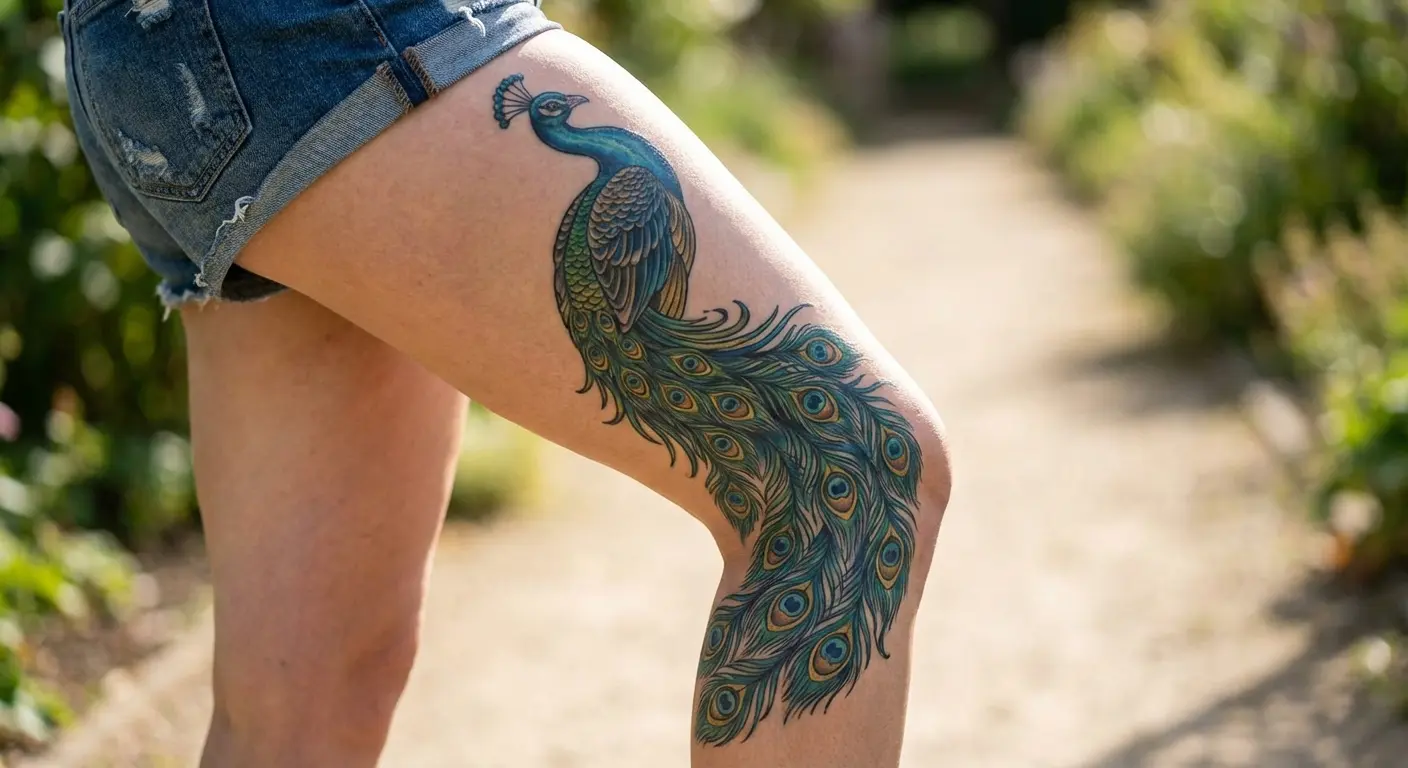
Thigh placements have blown up in popularity because they offer substantial space while remaining concealable under most professional attire. A peacock positioned with its body on your upper thigh and tail feathers cascading down toward your knee follows your leg’s natural length and creates movement as you walk.
The outer thigh provides flatter working space than the inner thigh and hurts less, though pain tolerance varies wildly between individuals. This placement works particularly well for people who want a large design without committing their torso or arms.
You can integrate the work with existing leg pieces or use it as the foundation for a full leg sleeve.
Think about how the design will look both standing and sitting, since your thigh changes shape between positions. Celebrity influence continues to shape tattoo trends, with Cardi B recently showcasing her massive thigh peacock tattoo after spending seven consecutive days getting touch-ups and additions to the decade-old design.
The rapper’s artist added vibrant flowers, a hot pink butterfly, and additional feathers to transform the piece into a more colorful and elaborate statement. This demonstrates how thigh work can evolve and expand over time without compromising the original vision.
Plenty of people start with a modest thigh piece and gradually expand it over years as their comfort with large-scale work grows. There’s no shame in starting small and building up.
9. Chest Piece with Extended Wing Detail
Chest work typically shows the bird from the front or side, emphasizing the wing structure and breast plumage rather than the tail feathers. The design often extends onto the shoulders or down toward the ribs, creating a frame around your upper torso.
For men, chest tattoos are frequently visible in casual settings (at the beach, pool, or when wearing open shirts). Women need to think about how the design interacts with breast tissue, cleavage, and how much they want visible in various necklines.
The sternum and area over the ribs rank among the most painful locations, though the meatier pectoral muscles hurt less.
Color saturation can be tricky on chest skin, which is often thinner and more translucent than other areas. This makes colorful work require more careful planning. Chest pieces can lose vibrancy faster than arm or back work because the skin doesn’t hold pigment as reliably. Your artist might need to go over sections multiple times to achieve the color depth you want, which extends session time and increases discomfort.
The chest also presents unique challenges for women regarding breast changes from weight fluctuations, pregnancy, or aging. A piece that looks perfect at 25 might distort by 40 if it’s positioned across areas that shift with breast tissue.
Honest conversations with your artist about long-term placement strategy will save you disappointment later. Don’t skip this talk because it feels awkward.
10. Full Sleeve with Integrated Floral Elements
Sleeve tattoos wrap around your entire arm from shoulder to wrist, and peacocks integrate beautifully with floral elements like peonies, chrysanthemums, or lotus flowers. Similar to how lotus flower tattoos blend with other imagery, peacock sleeve designs create cohesive compositions that tell visual stories as they spiral around your arm.
The bird might wind around your arm with tail feathers spiraling down, or it could perch among flowers with strategic feather placement filling gaps. Sleeves require planning the composition so it reads well from all angles, not just the outer arm.
You’ll want to think about how the design transitions at the elbow, where skin folds and stretches dramatically.
Full sleeves typically take 20 to 40 hours across multiple sessions. They’re impossible to hide in short sleeves, which still affects employment opportunities in certain industries (though this is changing, finally).
The arm’s cylindrical shape means your artist needs to account for distortion. Work that looks perfect when your arm is positioned one way might appear stretched or compressed from other angles. I’ve seen sleeve designs where the bird’s head looks normal from the front but weirdly elongated from the side because the artist didn’t plan for the arm’s rotation.
Make sure your artist photographs the stencil from multiple angles before starting. Catch those issues early.
|
Large-Scale Placement |
Canvas Size |
Average Sessions |
Pain Level (1-10) |
Concealment Potential |
Aging Considerations |
|---|---|---|---|---|---|
|
Full Back |
400-600 sq in |
6-12 sessions |
4-6 |
High (clothing dependent) |
Excellent – stable skin area |
|
Thigh-to-Knee |
150-250 sq in |
4-8 sessions |
5-7 |
High (pants/long skirts) |
Good – may shift with weight changes |
|
Chest Piece |
200-350 sq in |
5-10 sessions |
7-9 |
Medium (depends on neckline) |
Good – minimal stretching |
|
Full Sleeve |
180-280 sq in |
6-12 sessions |
4-7 |
Low (visible in short sleeves) |
Excellent – arm maintains shape |
|
Side Body |
250-400 sq in |
6-14 sessions |
8-10 |
High (rarely exposed) |
Fair – affected by weight/pregnancy |
11. Side Body Design Following Natural Curves
Side body tattoos run from your armpit down to your hip, following the natural curve of your torso. A peacock positioned vertically along this space can have its tail feathers follow your body’s contours, creating a design that emphasizes your shape rather than fighting it.
This placement offers a large canvas while remaining completely concealable under normal clothing. The side body includes some of the most painful real estate (ribs, especially), but also some more tolerable zones as you move toward the hip and obliques.
The design will shift with weight changes, pregnancy, or muscle gain and loss. You’re committing to work that will evolve with your body.
Artists sometimes use the natural hip bone as a perch for the bird or integrate the curve of the waist into the tail’s flow. The vertical orientation means sessions can be brutal because you’re lying on your side for hours while the artist works over bone and sensitive tissue.
Most people can’t handle more than three or four hours at a time in this position. A large side body piece might require six to ten separate appointments.
Budget both your time and pain tolerance accordingly. Don’t be a hero. Break it up into manageable sessions.
12. Shoulder Cap with Trailing Feathers Down the Arm
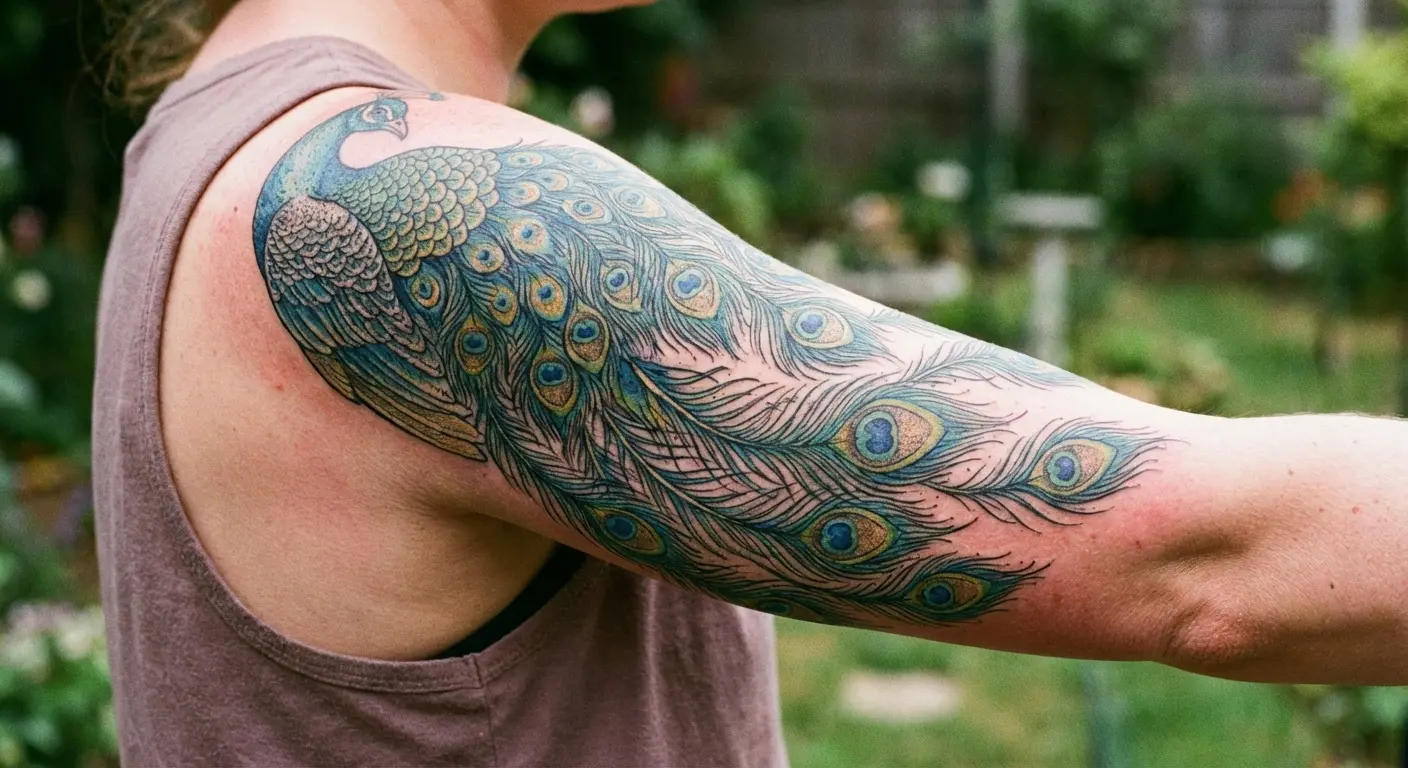
Shoulder cap tattoos sit on top of your shoulder with elements extending onto your upper arm, creating a natural transition point if you later decide to expand into a half or full sleeve. The bird’s body rests on your shoulder with tail feathers or wings trailing down your bicep and forearm.
This placement is partially visible in most casual clothing (tank tops, sleeveless dresses) but easily covered with short sleeves for professional settings. The rounded shoulder shape works well with the bird’s natural curves and provides a relatively low-pain area for tattooing.
You’ll want to think about how the design looks when your arm is in different positions, since the shoulder moves more than most body parts. The transition from shoulder to arm needs careful planning to avoid awkward gaps or cramped compositions.
I’ve seen shoulder pieces that look amazing when your arm hangs naturally but get weird when you raise it or rotate your shoulder forward. Your artist should have you move through different positions during the design phase to ensure the work functions with your full range of motion, not just one static pose.
Otherwise you’ll end up with something that only looks good in photos taken from one specific angle. Trust me, that gets old fast.
The Unexpected Interpretations (Conceptual Peacock Tattoos)
These designs push beyond traditional representations into territory that most listicles ignore completely. You won’t find these in flash books or standard shop portfolios.
They require artists who understand both technical execution and conceptual development.
I’m including them because the most meaningful work often comes from reinterpreting familiar symbols through personal or cultural lenses that matter to you specifically. Conceptual designs let you claim the symbolism (renewal, protection, spiritual awakening, beauty, pride) while creating something that doesn’t immediately read as “peacock tattoo” to casual observers.
This approach appeals to people who want layered meaning that reveals itself gradually rather than announcing itself immediately.
You’ll need to find an artist whose portfolio demonstrates both technical skill and creative problem-solving, since these ideas can’t be executed by someone who only works from reference photos. I’ve watched talented technical artists completely fail at conceptual work because they couldn’t visualize beyond what already exists.
Check their Instagram for original designs, not just recreations of popular styles.
13. Abstract Peacock Using Negative Space
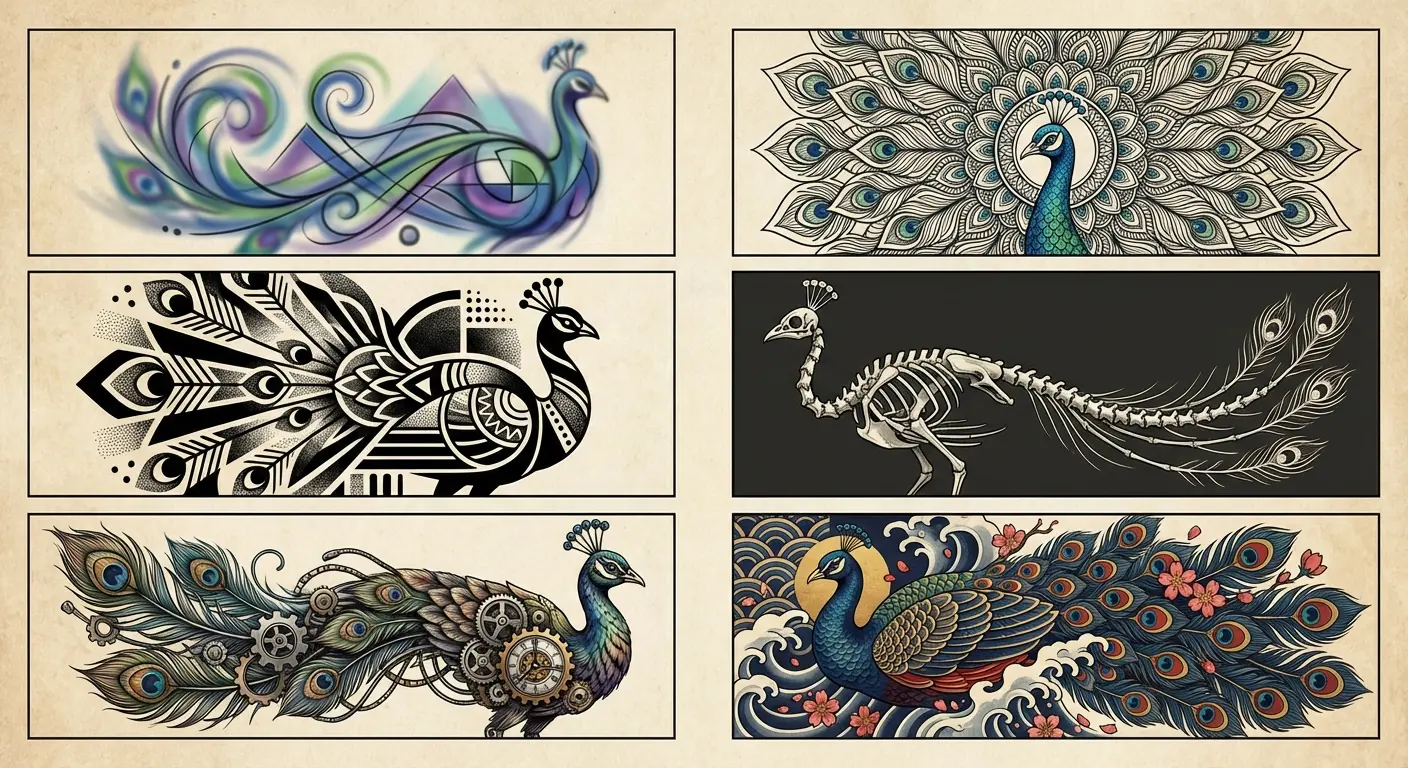
Negative space tattoos use your skin tone as part of the design rather than filling everything with ink. An abstract peacock might be suggested through strategic ink placement that lets your natural skin create the bird’s silhouette or key features.
The eye patterns in the tail feathers work particularly well with this technique since they’re already circular negative spaces surrounded by color in nature. This approach creates designs that are simultaneously bold and subtle, with high contrast but less ink coverage than traditional work.
Negative space requires precise planning because you can’t fix mistakes by adding more ink without changing the entire concept. The technique also ages differently than solid tattoos, since the contrast between inked and uninked skin remains sharp longer than gradients or soft shading.
I’ve seen negative space work that still looks crisp after a decade while fully saturated color pieces from the same era have faded significantly. There’s something to be said for letting your skin do some of the heavy lifting.
14. Blackwork Peacock with White Ink Accents
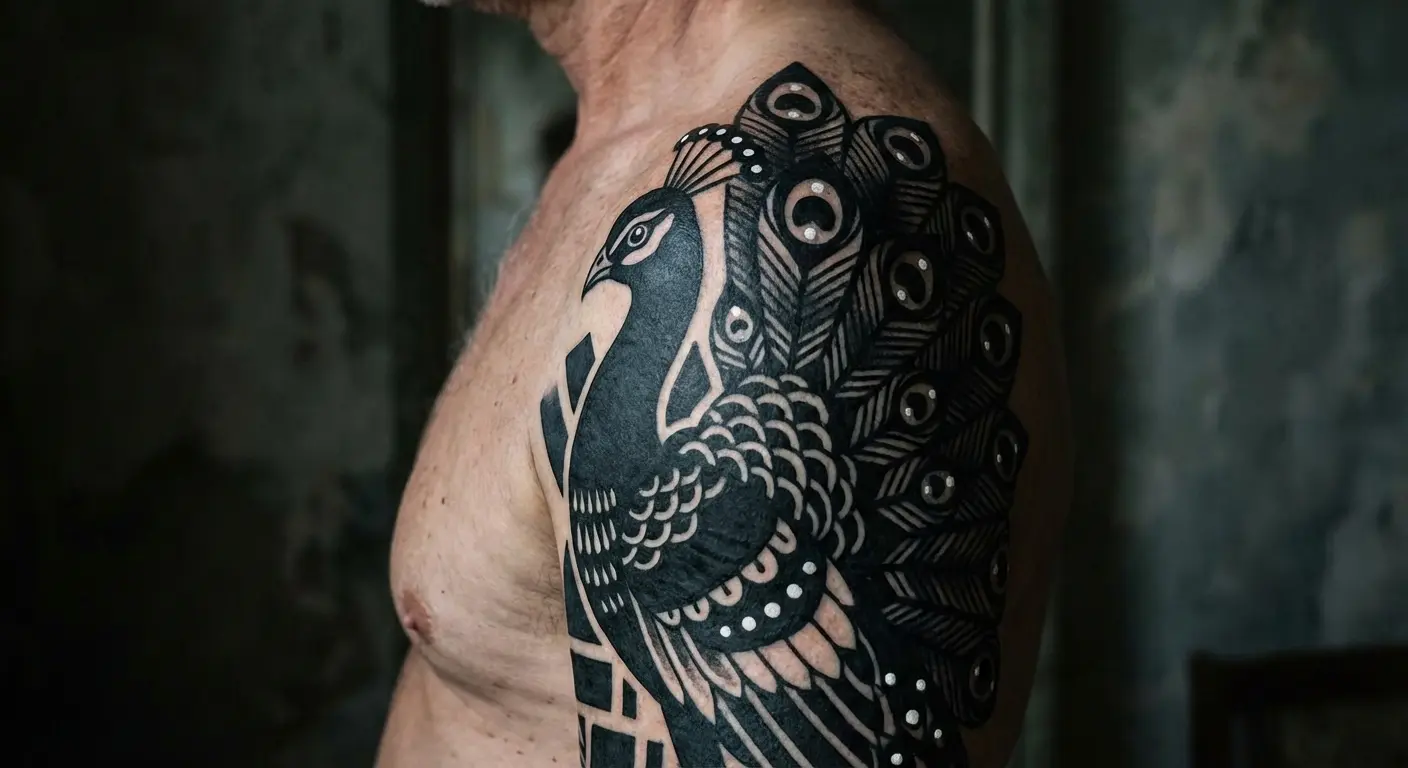
Blackwork tattoos use solid black ink to create bold, graphic designs, and adding white ink accents creates highlights and dimension that pure black can’t achieve. A blackwork peacock becomes a study in shape and form rather than color, which lets the bird’s structure shine without the distraction of the famous iridescent plumage.
White ink shows up best on darker skin tones and can fade to a subtle scar-like appearance on lighter skin. Some people love this effect, others hate it.
The technique works especially well for feather eye patterns, where white ink can create the illusion of light reflecting off the surface. Blackwork heals faster than color and typically requires fewer touch-ups over time. The bold, graphic nature makes the work read clearly from a distance while still offering detail up close.
Blackwork appeals to people who want dramatic pieces without committing to the maintenance schedule that vibrant colors demand. Color work needs touch-ups every five to seven years to stay fresh. Blackwork? You might never need a touch-up if it’s done right.
15. Peacock-Phoenix Hybrid Transformation
Combining peacock and phoenix symbolism and transformation imagery merges two powerful symbols of renewal and transformation. The design might show a peacock mid-transformation into a phoenix (or vice versa) or blend characteristics of both birds into a single creature.
This concept works for people whose personal narrative involves significant change or reinvention. The phoenix brings fire and resurrection symbolism while the peacock adds themes of beauty emerging from difficulty, since peacocks are associated with eyes and awareness.
Artists can play with the color transition from the bird’s blues and greens into phoenix reds and golds, creating a gradient that tells a story.
This hybrid requires an artist who can make the combination feel intentional rather than two separate designs awkwardly merged. I’ve seen hybrid work that flows seamlessly and others that look confused because the artist didn’t commit fully to the transformation concept.
If you’re going hybrid, go all in. Half-measures look like mistakes.
16. Mandala-Centered Peacock Design
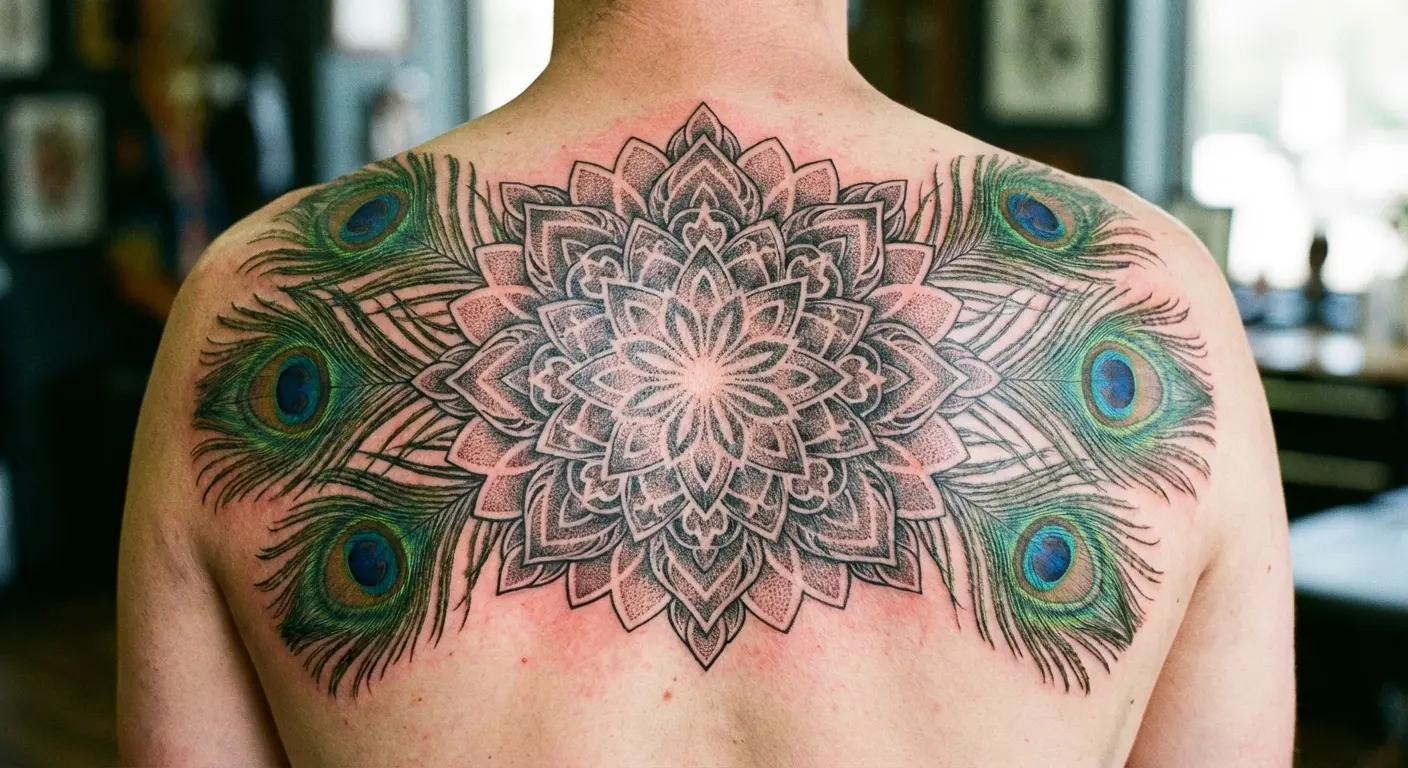
Mandalas represent wholeness and cosmic order, and integrating a mandala as the central element adds spiritual geometry to organic forms. The mandala might replace the bird’s body, with feathers radiating outward, or it could sit at the center of the tail’s display.
This fusion appeals to people drawn to both natural symbolism and sacred geometry. The mandala provides structure while the peacock elements add movement and life.
You’ll find this combination works across various placements since the circular mandala can anchor designs on shoulders, backs, or thighs. The level of detail in mandala work requires an artist experienced with precision linework and symmetry.
Color choices become interesting here since you can keep the mandala in black linework while rendering the peacock elements in full color, creating visual hierarchy that guides the eye from center outward.
Or go full color on everything. Your call. Just make sure the decision is intentional, not an afterthought.
17. Skeleton Peacock with Exposed Bone Structure
Anatomical or skeleton versions strip away the famous plumage to reveal the bone structure underneath. This memento mori approach transforms a symbol of beauty and vanity into a meditation on mortality and what lies beneath surface appearances.
The skeleton version works particularly well in blackwork or etching styles that emphasize the delicate bone structure. You’re making a statement about seeing through superficiality or acknowledging that beauty is temporary.
The tail feathers might remain intact while the body shows exposed bones, or the entire bird could be rendered as a skeleton with feathers suggested through negative space or minimal linework.
This interpretation requires an artist who understands both avian anatomy and how to make skeletal structures read clearly without becoming muddy or confusing. I’ve seen skeleton work that’s hauntingly beautiful and others that just look like a mess of lines because the artist didn’t understand the underlying anatomy well enough.
Ask to see examples of their anatomical work before committing. If they can’t show you clean skeletal designs, find someone else.
18. Peacock Incorporating Personal Cultural Symbols
Peacocks hold significance across multiple cultures (Hindu, Buddhist, Christian, Greek, Persian), and integrating symbols from your specific heritage creates deeply personal meaning. You might combine a peacock with Celtic knotwork, Japanese wave patterns, Polynesian tribal elements, or Indigenous geometric designs.
This approach moves beyond generic symbolism into territory that reflects your actual identity and background.
The key is finding an artist who respects and understands the cultural elements you want to incorporate rather than treating them as decorative add-ons. Research the specific meanings within your culture to ensure you’re representing them accurately.
I’ve seen powerful designs that use peacock feathers to frame cultural symbols or integrate traditional patterns into the feather structure itself. This customization ensures your work tells your story specifically rather than a generic narrative about beauty or pride.
Don’t grab symbols from cultures you’re not part of. Just don’t. It’s disrespectful and you’ll regret it when someone calls you out.
Bringing Your Peacock Vision to Reality
You’ve seen eighteen different approaches, from minimalist feathers to full-body statements to conceptual interpretations that push beyond traditional representations. Understanding tattoo symbolism and personal significance helps bridge the gap between inspiration and execution.
The gap between inspiration and execution is where most people struggle.
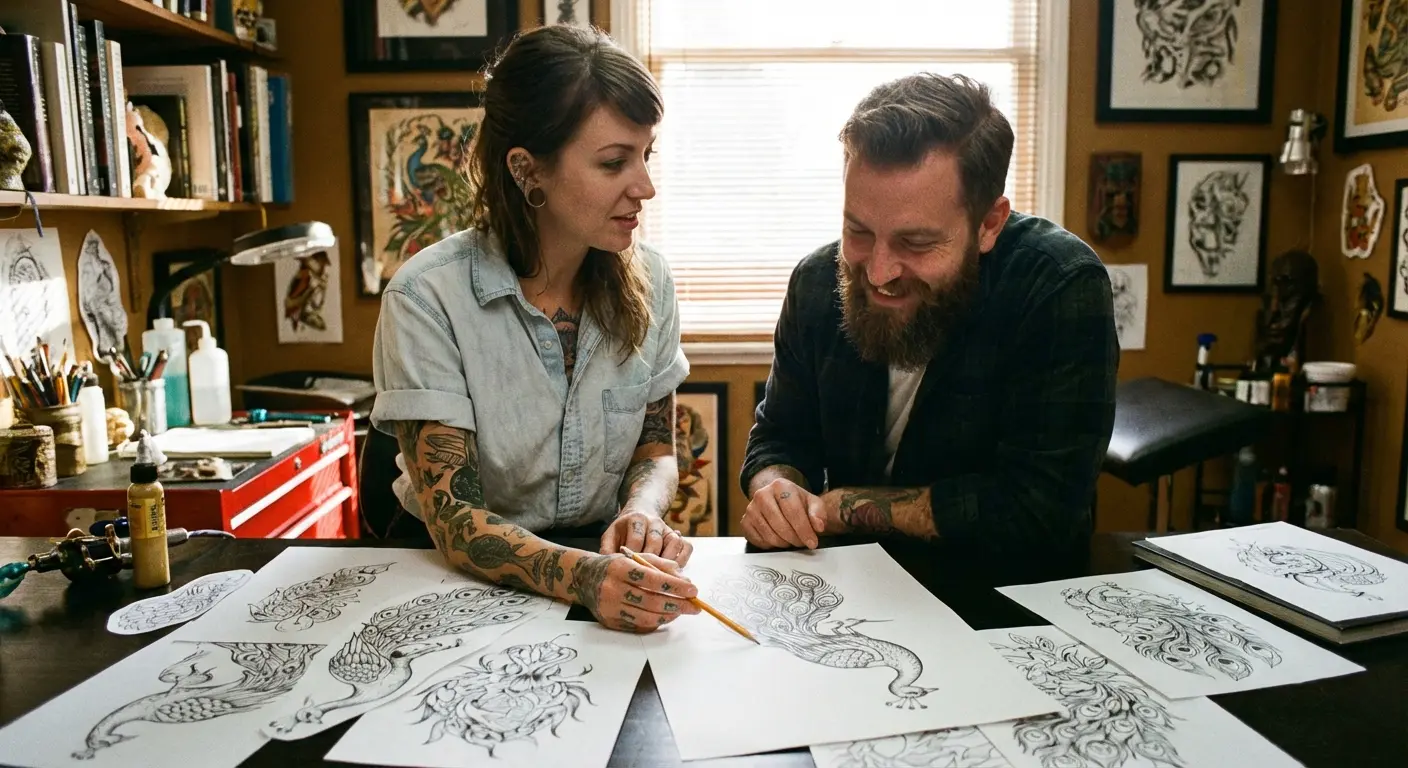
You know what resonates with you visually and symbolically, but translating that into a design your artist can work with requires clear communication and often multiple reference images. I built Tattoo Generator IQ specifically for this moment when you can feel what you want but can’t quite articulate it or find the exact reference that matches your vision.
You can experiment with different styles (watercolor versus blackwork, geometric versus realistic, colorful versus black and grey) and see how elements look in various placements before committing to permanent ink.
The AI generates multiple variations based on your specific preferences, letting you refine colors, adjust feather positions, or blend in those cultural elements that matter to your story. You’ll walk into your consultation with high-resolution designs that show your artist exactly what you’re envisioning, eliminating the frustration of trying to describe “something similar but different.”
Your artist gets a clear reference to work from, and you get confidence that what ends up on your skin matches what you’ve been imagining. The technology doesn’t replace your artist’s skill. It enhances communication so they can focus on execution rather than guessing at your intentions.
Bottom Line
Peacock tattoos carry more complexity than the obvious associations with vanity or showing off. The meaning shifts depending on which elements you emphasize (the protective eye patterns, the renewal suggested by molting, the spiritual awakening represented across cultures) and how you choose to render them.
Placement affects not just visibility but how the design ages, how much it hurts, and how well it integrates with your body’s natural movement and proportions.
I’ve covered feather-focused minimalism for people who want flexibility and subtlety, full-body statements for those ready to commit significant canvas space, and conceptual interpretations that push beyond standard imagery into personalized territory.
The real decision isn’t just “should I get a peacock tattoo” but rather which aspects of symbolism resonate with your story and how you want to carry that meaning on your body. Colorful work showcases the bird’s famous iridescence but requires more maintenance, while black and grey approaches emphasize structure and age more predictably.
You’re not just choosing a pretty bird. You’re selecting which layers of meaning you want to carry and how publicly you want to display them.
Take time with this decision, find an artist whose style matches your vision, and don’t settle for a design that’s close enough when you can create something that’s exactly right. Whether you choose a single feather or a full piece that spans your entire back, the symbolism and personal significance will make it uniquely yours.
I’ve watched people rush into tattoos because they looked cool in someone else’s portfolio, only to regret not taking the time to customize the design to their own story. Your skin is permanent real estate.
Treat the decision with the weight it deserves. Don’t be the person who realizes six months later that you should have gone bigger, smaller, more colorful, less colorful, different placement. Do the research now. Ask the questions. Sit with the design for a few weeks before booking.
And for the love of all that’s holy, don’t go to the cheapest artist you can find. Quality costs money. Save up and get it done right the first time.
