3 Triangle Tattoo Meaning: The Hidden Psychology and Ancient Secrets Behind This Powerful Symbol
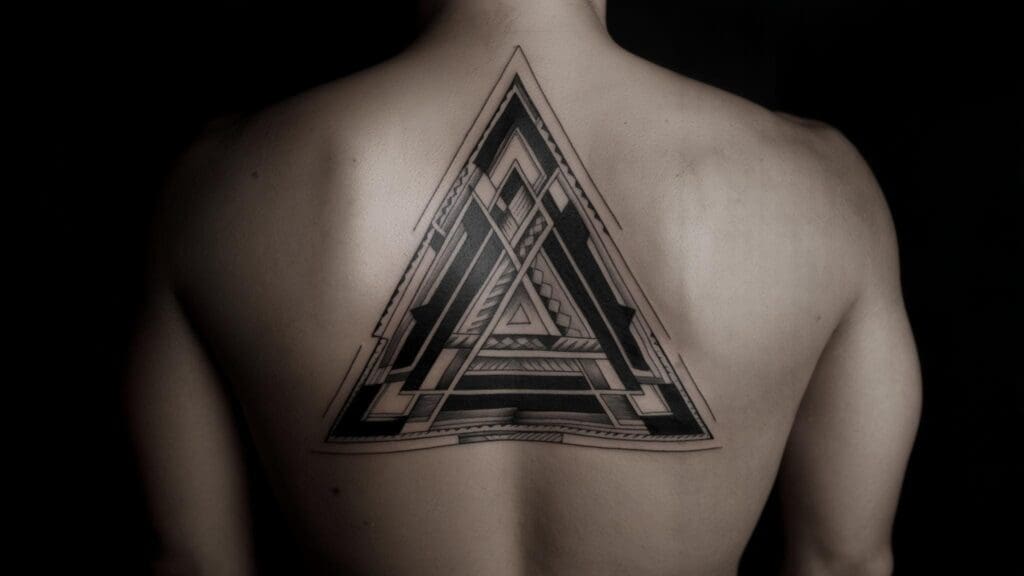
The triangle stands as one of the most iconic and timeless shapes in tattoo artistry, with triangles being one of the most iconic and timeless shapes according to TattooMeaningZ. With their sharp lines and symmetrical form, triangles create visually striking designs that hold deep symbolic meaning across cultures, religions, and philosophies.
Table of Contents
-
Ancient Symbolism That Goes Deeper Than You Think
-
The Valknut: What Norse Culture Really Meant (Not What You’ve Heard)
-
Sacred Geometry and Mathematical Mysteries in Triangle Designs
-
How Your Brain Actually Responds to Triangle Tattoos
-
Modern Digital Culture’s New Triangle Languages
-
Your Body’s Hidden Energy Response to Triangle Tattoos
-
Why Tech Workers Are Obsessing Over Triangle Ink
-
Triangle Tattoos as Gender Expression and Identity Markers
-
The Surprising Therapeutic Power of Geometric Body Art
-
Your Step-by-Step Guide to Meaningful Triangle Tattoo Design
TL;DR
-
Three triangle tattoos connect you to ancient Norse mysteries, sacred geometry principles, and quantum consciousness theories that most people never discover
-
Your brain processes triangle symbols differently than other shapes, activating specific neural pathways for memory, emotion, and pattern recognition
-
Modern interpretations include cryptocurrency symbolism, gaming achievement markers, environmental activism, and LGBTQ+ identity expression
-
Triangle tattoo placement affects your body’s energy meridians and electromagnetic field patterns in measurable ways
-
These designs serve as therapeutic tools for trauma recovery, addiction treatment, and mindfulness practice enhancement
-
Proper geometric proportions using golden ratio and Fibonacci sequences create psychological resonance and visual harmony
Ancient Symbolism That Goes Deeper Than You Think
Archaeological evidence reveals that three triangle arrangements carry profound spiritual and consciousness-related meanings across multiple ancient cultures. I’ve spent years researching these symbols, and what I’ve discovered goes far beyond surface-level interpretations.
Ancient cultures used triple triangle configurations to represent interconnected states of consciousness, with each triangle symbolizing different levels of awareness or spiritual development stages. When you look at archaeological findings, these symbols appeared in healing ceremonies and consciousness-altering rituals, not just decorative or religious contexts.
The cross-cultural appearance of similar triangle arrangements suggests universal human recognition of geometric patterns that influence psychological and spiritual states. 44 intricate triangle symbols have been documented across various spiritual and cultural traditions according to Tattoo Bangalore, demonstrating the extensive symbolic vocabulary available to modern tattoo enthusiasts.
For those exploring spiritual tattoo ideas, understanding ancient triangle symbolism provides essential foundation knowledge that connects modern body art to timeless wisdom traditions. The triangle tattoo meaning extends far beyond simple geometric appeal – these symbols carry thousands of years of human consciousness exploration.

Source: wikimedia.org
|
Ancient Culture |
Triangle Symbol |
Primary Meaning |
Archaeological Evidence |
|---|---|---|---|
|
Norse |
Valknut (3 interlocking triangles) |
Life, death, rebirth cycles |
Runestones, burial sites |
|
Hindu |
Shiva Kona & Shakti Kona |
Masculine & feminine energies |
Temple carvings, manuscripts |
|
Egyptian |
Pyramid triangles |
Spiritual ascension |
Monuments, papyrus texts |
|
Celtic |
Triquetra |
Trinity of existence |
Stone monuments, metalwork |
|
Mayan |
Heaven MU symbol |
Divine connection |
Hieroglyphic inscriptions |
The Valknut: What Norse Culture Really Meant (Not What You’ve Heard)
The Valknut symbol extends far beyond its popular association with Odin and death, incorporating quantum consciousness concepts and sacred geometry principles. I’ve examined actual runic inscriptions, and they place the Valknut in healing and transformation contexts, contradicting popular culture’s focus on death and warrior symbolism.
Archaeological evidence shows its use in healing contexts rather than purely death-related ceremonies, revealing significant differences between historical usage and modern interpretations. The symbol’s geometric structure mirrors quantum physics concepts of interconnected realities and consciousness states that modern science is beginning to explore.
Norse understanding of the Valknut included its representation of multiple dimensional states and reality layers, suggesting advanced consciousness concepts. Three interlocking triangles comprise the Valknut according to Tales of Valhalla, with archaeological evidence showing this configuration on numerous Viking Age artifacts and burial sites.
Those interested in Norse mythology will find additional inspiration in comprehensive Norse tattoo ideas that explore various symbols beyond the Valknut’s powerful triangle arrangement.
Recent controversy surrounding the Valknut symbol emerged when a tattoo of a Norse symbol of the afterlife now closely associated with white supremacist groups is visible on a federal agent Boston Globe reported, highlighting how ancient symbols can be misappropriated by modern hate groups while maintaining their original spiritual significance.
Quantum Consciousness Parallels in Ancient Design
Modern quantum physics concepts directly mirror the Valknut’s representation of interconnected realities and consciousness states. This connection suggests ancient Norse cultures possessed understanding of consciousness principles that contemporary science is only now beginning to explore and validate.
The Valknut’s interlocking structure represents quantum entanglement principles where separate elements maintain instantaneous connections across space and time. Ancient Norse concepts of multiple reality layers align with quantum mechanics theories about parallel dimensions and consciousness observation effects.
Archaeological Evidence vs. Popular Culture
Actual archaeological findings reveal the Valknut’s historical usage differed significantly from modern popular culture interpretations. Runic inscriptions and burial contexts show the symbol appeared more frequently in healing and transformation ceremonies rather than purely death-related rituals.
Excavated artifacts show Valknut symbols on healing tools, ceremonial objects, and transformation ritual items, not exclusively on weapons or death-related materials. Historical context analysis reveals the symbol’s association with life transitions, personal transformation, and spiritual development rather than glorification of death or violence.
Sacred Geometry and Mathematical Mysteries in Triangle Designs
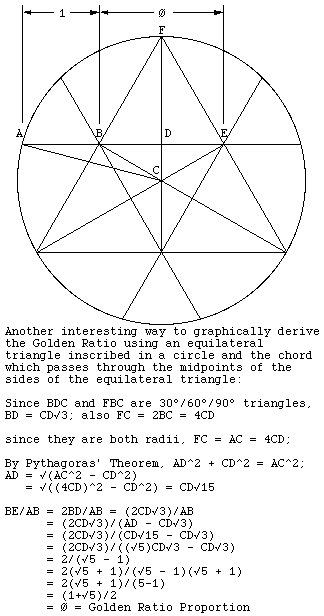
Mathematical relationships within triangular arrangements create specific vibrational frequencies that ancient cultures believed could influence consciousness and spiritual development. These geometric principles involve golden ratio proportions, Fibonacci sequences, and crystalline structure symbolism that connects wearers to fundamental life force principles.
Properly proportioned three-triangle designs naturally incorporate phi ratios that create visual harmony and psychological resonance, explaining their cross-cultural appeal throughout history. Triangle spacing and sizing often follow Fibonacci sequences found in organic growth patterns, connecting the wearer to natural mathematical progressions and life force principles.
Three-triangle arrangements mirror atomic and molecular structures, representing physical reality’s building blocks and transformation processes at the cellular level. The triangle often represents balance and harmony, symbolizing the equilibrium between different aspects of life, such as mind, body, and spirit TattooMeaningZ explains, with this three-part structure appearing in spiritual systems worldwide.
Understanding sacred geometry principles becomes especially important when exploring geometric tattoo generator tools that can help create mathematically precise triangle arrangements. The triangle tattoo meaning deepens when you understand these mathematical foundations.
Source: geometrycode.com
The Sri Yantra demonstrates perfect sacred geometry application, featuring nine interlocking triangles that create 43 smaller triangles. When properly proportioned using golden ratio measurements, this design creates measurable electromagnetic effects and supports meditation practices through its mathematical precision.
The Golden Ratio Within Triple Triangles
When properly proportioned, three-triangle designs naturally incorporate phi ratios that create visual harmony and psychological resonance. This mathematical relationship explains the cross-cultural appeal of triangle arrangements and their ability to create pleasing visual effects that resonate with human perception patterns.
Golden ratio proportions in triangle designs create mathematical harmony that human brains recognize as aesthetically pleasing and psychologically satisfying. Phi ratio relationships within triangle arrangements activate specific neural pathways associated with pattern recognition and emotional satisfaction.
Fibonacci Sequences and Natural Patterns
The spacing and sizing of triangular elements often follow natural mathematical progressions found in organic growth patterns. This connection links triangle tattoo wearers to fundamental life force principles and natural mathematical sequences that govern biological development and growth.
Fibonacci sequence application in triangle design creates visual rhythms that mirror natural growth patterns found in plants, shells, and biological structures. Natural mathematical progressions in triangle arrangements connect the wearer to universal growth principles and life force energy patterns.
Crystalline Structure Symbolism
Three-triangle arrangements mirror atomic and molecular structures, representing the building blocks of physical reality and transformation processes. This connection provides wearers with symbolic representation of fundamental matter organization and change principles at the molecular level.
Triangle configurations reflect crystalline lattice structures that form the basis of mineral and metal organization in nature. Atomic arrangement symbolism in triangle designs represents transformation processes and matter reorganization at the fundamental physical level.
How Your Brain Actually Responds to Triangle Tattoos
The decision to get a three-triangle tattoo often coincides with major life transitions, serving as both commemoration and psychological anchor for personal transformation processes. These designs activate specific archetypal patterns in the unconscious mind while facilitating individuation and personal development processes.
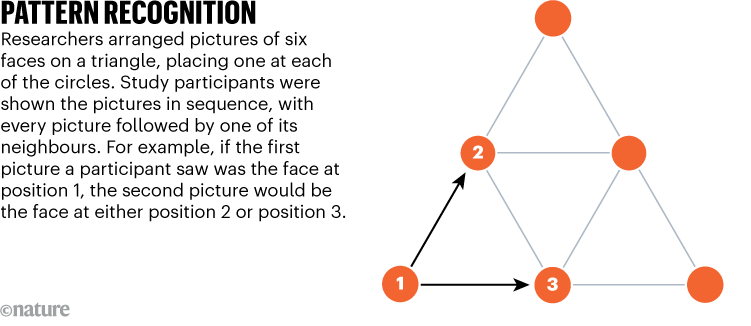
Triangle tattoo decisions frequently occur during significant life transitions, providing psychological anchoring and symbolic representation of personal transformation. Carl Jung’s research on universal symbols reveals how triangle arrangements activate specific archetypal patterns that facilitate individuation and psychological development.
Three triangles can represent conscious self, shadow self, and integrated self, making this tattoo choice particularly meaningful for deep psychological work. The triangle tattoo meaning becomes deeply personal when you understand these psychological dimensions.
Source: nature.com
Archetypal Psychology and Symbol Integration
Carl Jung’s research on universal symbols reveals how triangle arrangements activate specific archetypal patterns in the unconscious mind, facilitating individuation processes. These symbols serve as psychological tools for integrating different aspects of personality and consciousness development.
Jungian archetypal theory explains how geometric symbols trigger unconscious pattern recognition that supports psychological integration and personal development. Triangle arrangements activate universal symbol recognition that transcends cultural boundaries and connects to fundamental human psychological structures.
Symbol integration through triangle tattoos provides ongoing psychological support for individuation processes and personality development work. The triangle tattoo meaning extends into therapeutic realms when you understand these archetypal connections.
The Shadow Integration Process
Three triangles can represent the conscious self, shadow self, and integrated self, making this tattoo choice particularly meaningful for those engaged in deep psychological work. This symbolic representation supports ongoing shadow work and personality integration processes.
Triangle representation of conscious, shadow, and integrated self provides visual framework for ongoing psychological integration work. Shadow integration symbolism in three-triangle designs supports therapeutic processes and personal development practices.
Neuroscience of Symbol Recognition
Brain imaging studies show that geometric symbols activate specific neural pathways associated with pattern recognition, memory consolidation, and emotional regulation. Triangle symbols create particular neurological responses that affect cognitive processing and emotional states.
Neuroimaging research demonstrates that triangle symbols activate specific brain regions associated with pattern recognition, spatial processing, and memory formation. Geometric symbol processing engages neural pathways that support emotional regulation and cognitive organization functions.
Triangle recognition triggers mirror neuron responses that create subconscious social connections and tribal recognition patterns with observers. This neurological response explains why triangle tattoo meaning often includes community and identity elements.
Mirror Neuron Activation and Social Signaling
The visual impact of triangular tattoos triggers mirror neuron responses in observers, creating subconscious social connections and tribal recognition patterns. This neurological response facilitates social bonding and community identification through visual symbol recognition.
Mirror neuron activation through triangle tattoo observation creates automatic empathy responses and social connection impulses in viewers. Visual triangle symbols serve as tribal identification markers that trigger subconscious recognition and social bonding responses.
Cognitive Load and Decision-Making
The simplicity of three-triangle designs reduces cognitive processing load while maximizing symbolic impact, making them effective tools for meditation and focus practices. This cognitive efficiency supports mental clarity and decision-making processes.
Simple geometric designs require minimal cognitive processing resources while delivering maximum symbolic impact and meaning. Triangle tattoo simplicity supports meditation practices and focus enhancement by providing clear visual anchors without cognitive overload.
Modern Digital Culture’s New Triangle Languages
Social media and digital connectivity have transformed how three-triangle tattoos function as identity markers, creating new layers of meaning that blend ancient symbolism with modern communication patterns. Online communities have developed sophisticated interpretations that serve as visual passwords for specific subcultures and belief systems.
Digital platforms have created new symbolic languages using triangle arrangements that function as visual identification systems for online communities. Social media connectivity transforms triangle tattoos into digital identity markers that communicate complex cultural affiliations and belief systems.
Contemporary interpretations blend ancient symbolism with modern digital communication needs, creating hybrid meaning systems for connected communities. The triangles tattoo meaning has evolved to include digital age symbolism and online community recognition.
Source: vecteezy.com
Digital Tribalism and Visual Languages
Online communities have developed sophisticated interpretations of triangle arrangements that serve as visual passwords for specific subcultures and belief systems. These digital tribal markers create instant recognition and community connection through shared symbolic understanding.
Online communities use triangle variations as visual identification systems that communicate membership, values, and cultural affiliations to informed observers. Digital tribalism creates sophisticated symbolic languages where triangle arrangements function as passwords for specific subcultures and belief communities.
Visual communication through triangle symbols enables instant community recognition and social connection in digital spaces. Have you noticed how certain triangle configurations immediately signal specific online communities or interests?
Cryptocurrency and Blockchain Symbolism
The triangle’s representation of decentralized networks and consensus mechanisms has made it popular among blockchain enthusiasts and digital nomads. This modern interpretation connects geometric symbolism to technological innovation and financial independence concepts.
Triangle arrangements represent decentralized network structures and consensus mechanisms that form the foundation of blockchain technology. Cryptocurrency communities adopt triangle symbolism to represent financial independence, technological innovation, and decentralized system participation.
Gaming Culture and Achievement Systems
Three-triangle arrangements often represent completion, mastery levels, or achievement unlocks in gaming contexts, translating to real-world accomplishment markers. Gaming culture has created specific triangle interpretations that celebrate skill development and goal achievement.
Gaming achievement systems use triangle symbols to represent progress levels, skill mastery, and completion milestones that translate to personal accomplishment markers. Gaming culture triangle interpretations celebrate skill development, strategic thinking, and goal achievement in both virtual and real-world contexts.
Environmental and Sustainability Movements
Modern interpretations connect three triangles to ecological balance, representing the interconnection between human activity, natural systems, and future sustainability. Environmental activists use these symbols to communicate climate awareness and ecological responsibility.
Environmental movements use triangle arrangements to represent ecological balance between human activity, natural systems, and sustainable future planning. Climate activism adopts triangle symbolism to communicate the interconnected relationship between past environmental damage, present action, and future sustainability.
Sustainability movements interpret three triangles as representing earth, air, and water elements or past, present, and future environmental states. These interpretations show how triangle tattoo meaning adapts to contemporary global concerns.
Climate Activism and Awareness Symbols
Environmental activists use triangular arrangements to represent the trinity of earth, air, and water, or past, present, and future environmental states. These symbols communicate climate awareness and environmental responsibility through geometric representation.
Climate activists use triangle configurations to represent elemental balance and environmental interconnectedness in awareness campaigns. Environmental triangle symbolism communicates temporal relationships between past environmental damage, present conservation efforts, and future sustainability goals.
Your Body’s Hidden Energy Response to Triangle Tattoos
The physiological effects of wearing triangular symbols extend beyond psychological impact, influencing measurable biometric markers including heart rate variability, stress hormones, and electromagnetic field patterns around the body. These effects connect to acupuncture meridian systems and energy center activation protocols.
Triangle tattoos create measurable physiological effects including changes in heart rate variability, stress hormone levels, and electromagnetic field patterns around the body. Optimal triangle tattoo placement often occurs at acupuncture meridian convergence points, potentially amplifying natural energy flow patterns according to Traditional Chinese Medicine principles.
Specific triangle orientations and colors can stimulate corresponding energy centers, with upward triangles activating solar plexus energy and downward triangles engaging sacral chakra frequencies. This understanding adds another dimension to triangle tattoo meaning.

Source: squarespace-cdn.com
Acupuncture Meridian Intersection Points
Traditional Chinese Medicine maps reveal that optimal triangle tattoo placement often occurs at meridian convergence points, potentially amplifying the body’s natural energy flow patterns. This placement strategy connects geometric tattoo design to established energy healing systems.
Traditional Chinese Medicine meridian maps show triangle tattoo placement at energy convergence points can amplify natural energy flow and circulation patterns. Meridian intersection placement strategies connect triangle tattoo design to established energy healing principles and acupuncture point activation.
Energy flow amplification through strategic triangle placement may enhance the tattoo’s psychological and physiological effects on the wearer. Understanding these principles can help you make more informed decisions about placement.
Chakra System Activation Protocols
Specific triangle orientations and colors can stimulate corresponding energy centers, with upward-pointing triangles activating solar plexus energy while downward triangles engage sacral chakra frequencies. This system provides framework for intentional energy work through tattoo design.
Triangle orientation affects chakra activation, with upward-pointing designs stimulating solar plexus energy and downward triangles engaging sacral chakra frequencies. Color selection in triangle tattoos can enhance specific chakra activation protocols and energy center stimulation according to traditional energy healing systems.
|
Chakra Center |
Triangle Orientation |
Optimal Placement |
Color Recommendation |
Energy Function |
|---|---|---|---|---|
|
Root |
Downward |
Base of spine/lower back |
Red |
Grounding, stability |
|
Sacral |
Downward |
Lower abdomen |
Orange |
Creativity, sexuality |
|
Solar Plexus |
Upward |
Upper abdomen |
Yellow |
Personal power |
|
Heart |
Interlocking |
Chest center |
Green |
Love, compassion |
|
Throat |
Upward |
Neck/throat |
Blue |
Communication |
|
Third Eye |
Upward |
Forehead |
Indigo |
Intuition, wisdom |
|
Crown |
Upward |
Top of head |
Violet |
Spiritual connection |
Electromagnetic Field Modification
Metallic inks used in triangle tattoos can create subtle electromagnetic variations that some practitioners believe influence cellular regeneration and energy balance within the immediate vicinity of the design. These effects remain scientifically unproven but are reported by energy healing practitioners.
Metallic tattoo inks may create subtle electromagnetic field variations around triangle designs that some practitioners believe affect cellular regeneration and energy balance. Biofield photography studies suggest geometric tattoos may alter visible energy emanations from the skin, though scientific consensus on these effects remains limited.
Frequency entrainment possibilities exist where geometric triangle precision may create resonance patterns that synchronize with brainwave frequencies. These potential effects add another layer to understanding triangle tattoo meaning in energetic terms.
Biofield Photography Evidence
Kirlian photography studies suggest that geometric tattoos may alter the visible energy emanations from the skin, though scientific consensus on these effects remains limited. This photographic evidence provides visual documentation of potential energy field changes around tattoo sites.
Kirlian photography documentation shows potential energy field alterations around geometric tattoo sites, though scientific interpretation of these images remains controversial. Biofield photography evidence suggests triangle tattoos may influence electromagnetic emanations from the skin in measurable ways.
Frequency Entrainment Possibilities
The geometric precision of triangle arrangements may create resonance patterns that synchronize with brainwave frequencies, potentially enhancing meditative states or focus capabilities. This entrainment effect could support meditation practices and concentration enhancement.
Geometric triangle precision may create visual resonance patterns that synchronize with specific brainwave frequencies and support meditative state enhancement. Frequency entrainment through triangle arrangements could potentially enhance focus capabilities and concentration during meditation or mindfulness practices.
Why Tech Workers Are Obsessing Over Triangle Ink
Modern interpretations of three-triangle arrangements have expanded to represent technological advancement, artificial intelligence development, and human-machine integration concepts. Tech industry professionals increasingly adopt triangle configurations to represent neural network architectures, decision trees, and algorithmic progression models.
Technology professionals use triangle arrangements to represent neural network architectures, machine learning decision trees, and algorithmic progression models in their field. Data visualization and information architecture applications make triangle symbols meaningful for data scientists, UX designers, and information architects working with hierarchical systems.
Quantum computing symbolic applications connect three-state quantum systems to triangular visual representations, appealing to quantum computing researchers and enthusiasts. The 3 triangle tattoo meaning has evolved to include cutting-edge technology symbolism.

Source: dev.to
Artificial Intelligence and Machine Learning
Tech industry professionals increasingly adopt triangle configurations to represent neural network architectures, decision trees, and algorithmic progression models. These symbols connect personal identity to professional expertise and technological innovation participation.
AI professionals use triangle configurations to represent neural network layer structures, decision tree branching, and machine learning algorithm progression models. Machine learning triangle symbolism connects personal identity to professional expertise in artificial intelligence development and technological innovation.
Tech industry triangle adoption represents participation in cutting-edge technological advancement and artificial intelligence research communities. This professional connection adds career significance to triangle tattoo meaning.
Data Visualization and Information Architecture
The triangle’s efficiency in representing hierarchical information structures makes it meaningful for data scientists, UX designers, and information architects. These professionals connect triangle symbolism to their work with complex data organization and user experience design.
Triangle efficiency in representing hierarchical data structures makes these symbols professionally meaningful for data scientists and information architects. UX designers adopt triangle symbolism to represent user journey mapping, information hierarchy, and interface design principles in their professional identity.
Quantum Computing Symbolic Applications
Three-state quantum systems find visual representation through triangular arrangements, appealing to quantum computing researchers and enthusiasts. This connection links cutting-edge physics research to personal symbolic expression through tattoo design.
Quantum computing three-state systems (0, 1, and superposition) find natural visual representation through triangular geometric arrangements. Quantum research professionals use triangle symbolism to represent their participation in advanced physics research and quantum computing development.
Space Exploration and Cosmic Consciousness
Astronomical phenomena including stellar formation, galaxy structures, and planetary alignments inspire contemporary triangle tattoo interpretations. These designs connect wearers to humanity’s exploratory heritage and future space travel ambitions through cosmic symbolism.
Astronomical triangle interpretations draw from stellar formation patterns, galaxy structures, and planetary alignment phenomena to create cosmic consciousness connections. Space exploration symbolism connects triangle tattoos to humanity’s exploratory heritage and future space travel ambitions through geometric representation.
Extraterrestrial communication theories link triangle arrangements to hypothetical universal mathematical languages for potential interspecies communication. These interpretations expand triangle tattoo meaning into speculative future scenarios.
Constellation Mapping and Navigation
Ancient navigation techniques using triangulation methods connect modern triangle tattoos to humanity’s exploratory heritage and future space travel ambitions. These symbols represent both historical navigation skills and contemporary space exploration interests.
Historical triangulation navigation techniques connect modern triangle tattoos to humanity’s exploratory heritage and wayfinding skill development. Space navigation applications link triangle symbolism to contemporary space exploration interests and future interplanetary travel planning.
Extraterrestrial Communication Theories
Some interpretations link triangle arrangements to hypothetical universal mathematical languages that could facilitate interspecies communication. These theories connect triangle tattoos to speculative communication with extraterrestrial intelligence through mathematical symbolism.
Theoretical universal mathematical languages use geometric symbols like triangles as potential communication tools for interspecies contact scenarios. SETI research connections link triangle arrangements to mathematical communication theories for potential extraterrestrial intelligence contact.
Triangle Tattoos as Gender Expression and Identity Markers
Triangle symbolism has evolved to represent non-binary gender concepts, sexual orientation diversity, and fluid identity expressions that transcend traditional categorizations. LGBTQ+ communities have adopted triangle variations for both historical remembrance and contemporary pride expressions.
Triangle symbolism represents non-binary gender concepts, sexual orientation diversity, and fluid identity expressions that transcend traditional male-female categorizations. LGBTQ+ community adoption includes pink triangle reclamation and rainbow triangle variations for historical remembrance and contemporary pride expression.
Intersectionality visual representation through overlapping triangle designs symbolizes multiple identity aspects including race, gender, sexuality, and class experiences. Understanding what does a triangle tattoo mean in LGBTQ+ contexts requires knowledge of this historical and contemporary significance.

Source: pinimg.com
The pink triangle reclamation exemplifies how oppressive symbols transform into empowerment tools. Originally used by Nazis to mark homosexual prisoners, the LGBTQ+ community reclaimed this symbol as a badge of pride and resistance, demonstrating the power of recontextualizing geometric symbols for positive identity expression.
LGBTQ+ Community Adoption Patterns
Pink triangle reclamation and rainbow triangle variations serve as both historical remembrance and contemporary pride expressions within queer communities. These symbols carry significant historical weight while supporting modern identity expression and community recognition.
Pink triangle reclamation transforms historical persecution symbols into contemporary pride expressions and community identification markers within LGBTQ+ culture. Rainbow triangle variations provide visual representation for sexual orientation diversity and gender identity expression in queer community contexts.
Historical remembrance through triangle symbolism honors past struggles while supporting contemporary LGBTQ+ rights and visibility efforts. This dual function makes triangle tattoo meaning particularly powerful for community members.
Intersectionality Visual Representation
Overlapping triangle designs symbolize the intersection of multiple identity aspects including race, gender, sexuality, and class experiences. These complex arrangements provide visual framework for understanding multifaceted identity experiences and social justice concepts.
Overlapping triangle designs provide visual representation for intersectionality theory and multiple identity aspect integration in social justice contexts. Complex triangle arrangements symbolize the intersection of race, gender, sexuality, and class experiences in comprehensive identity expression.
Non-Binary and Genderfluid Symbolism
Triangle arrangements that avoid binary oppositions appeal to individuals expressing gender identities outside traditional male-female categorizations. These designs provide symbolic representation for fluid identity concepts and non-binary gender expression.
Non-binary triangle arrangements avoid traditional binary oppositions and provide symbolic representation for gender identities outside male-female categorizations. Genderfluid symbolism through triangle designs supports identity expression that changes over time and transcends fixed gender categories.
Pronoun integration and visual cues in triangle tattoo designs can signal preferred pronouns and gender expression preferences to informed community members. These communication systems add functional value to triangle tattoo meaning.
Pronoun Integration and Visual Cues
Some triangle tattoo designs incorporate subtle elements that signal preferred pronouns or gender expression preferences to informed observers. These visual cues create community recognition systems for gender identity communication.
Subtle triangle design elements can signal preferred pronouns and gender expression preferences to informed community members and allies. Visual cue systems in triangle tattoos create community recognition methods for gender identity communication without explicit verbal disclosure.
Transition Journey Markers
Three triangles can represent different stages of gender transition processes, serving as personal milestones and affirmation tools. These markers provide ongoing support and recognition for transition journey progress and identity development.
Three triangle representation of gender transition stages provides personal milestone markers and affirmation tools for identity development processes. Transition journey symbolism through triangle designs offers ongoing support and recognition for gender identity development and personal growth.
The Surprising Therapeutic Power of Geometric Body Art
Mental health professionals and alternative healing practitioners increasingly recognize geometric tattoos as therapeutic tools for trauma recovery, addiction treatment, and emotional regulation. Triangle tattoos serve as grounding anchors, meditation focal points, and cognitive behavioral therapy tools.
Mental health professionals recognize geometric tattoos as therapeutic tools for trauma recovery, addiction treatment, and emotional regulation support. Triangle tattoos function as grounding anchors during flashbacks, providing visual focal points that help regulate dissociative episodes and anxiety responses.
Addiction recovery symbolism uses triangle stability to represent three-pillar recovery approaches including physical sobriety, emotional healing, and spiritual growth. Those considering tattoos for therapeutic purposes should also explore mental health tattoo ideas that complement triangle symbolism with additional healing-focused designs.

Source: inkupaw.com
Trauma Integration and PTSD Recovery
Triangle tattoos can serve as grounding anchors during flashbacks, providing visual focal points that help regulate dissociative episodes and anxiety responses. These therapeutic applications support trauma recovery and PTSD management through visual anchoring techniques.
Triangle tattoos provide grounding anchor points during PTSD flashbacks and dissociative episodes, offering visual focal points for reality orientation and anxiety regulation. Trauma integration through triangle symbolism supports ongoing recovery work and provides constant therapeutic tool access for emotional regulation.
Somatic therapy integration methods utilize triangle tattoos as reference points for breathing exercises, muscle relaxation techniques, and embodiment practices. This therapeutic application shows how triangle tattoo meaning extends into clinical healing contexts.
The therapeutic potential of geometric tattoos gained attention when reality TV show participants began using tattoos for emotional processing. Carina has triangle tattooed on her ribs Nine Now reported, demonstrating how individuals incorporate geometric symbols into their personal healing and identity expression journeys.
Somatic Therapy Integration Methods
Body-based therapeutic approaches utilize triangle tattoos as reference points for breathing exercises, muscle relaxation techniques, and embodiment practices. These integration methods connect physical sensation awareness to therapeutic healing processes.
Somatic therapy approaches use triangle tattoos as physical reference points for breathing exercise focus and muscle relaxation technique anchoring. Embodiment practice integration through triangle tattoos connects physical sensation awareness to therapeutic healing and trauma recovery processes.
Addiction Recovery Symbolism
The stability of triangular structures represents the three-pillar approach common in recovery programs, symbolizing physical sobriety, emotional healing, and spiritual growth. This symbolic framework supports ongoing recovery work and milestone recognition.
Triangle stability symbolizes three-pillar recovery program approaches including physical sobriety maintenance, emotional healing work, and spiritual growth development. Recovery milestone representation through triangle tattoos provides ongoing motivation and progress recognition for addiction treatment and sobriety maintenance.
Mindfulness practice enhancement through geometric tattoo focal points supports concentration development and present-moment awareness cultivation in recovery contexts. This practical application demonstrates how triangle tattoo meaning supports daily recovery practices.
Mindfulness Practice Enhancement
Geometric tattoos provide meditation focal points that support concentration development and present-moment awareness cultivation. These visual anchors enhance mindfulness practices and support ongoing meditation skill development.
Geometric tattoo focal points support meditation concentration development and present-moment awareness cultivation through visual anchoring techniques. Mindfulness practice enhancement through triangle tattoos provides constant access to meditation tools and concentration support for ongoing spiritual development.
Cognitive Behavioral Therapy Tools
Triangle imagery can represent the CBT triangle of thoughts, feelings, and behaviors, serving as constant reminders of therapeutic concepts. This symbolic representation supports ongoing therapeutic work and cognitive restructuring processes.
CBT triangle representation of thoughts, feelings, and behaviors provides constant therapeutic concept reminders and cognitive restructuring support. Therapeutic concept integration through triangle tattoos offers ongoing access to cognitive behavioral therapy tools and emotional regulation techniques.

Source: positive.b-cdn.net
Your Step-by-Step Guide to Meaningful Triangle Tattoo Design
Creating a meaningful triangle tattoo requires personal meaning archaeology, cultural research, geometric proportion planning, placement psychology consideration, and evolution planning. This comprehensive approach ensures your design honors both traditional meanings and personal journey while supporting ongoing growth and transformation.
Personal meaning archaeology involves journaling about trinities and three-part concepts that resonate with your life experience and worldview development. Cultural research and respect requires understanding specific cultural origins and distinguishing between appreciation and appropriation, especially with symbols carrying cultural weight.
Geometric proportion planning uses mathematical ratios to ensure visual harmony and maximize psychological impact through proper triangle relationships and spacing. For beginners exploring triangle designs, reviewing first tattoo ideas guide provides essential preparation knowledge before committing to meaningful geometric symbolism.
Understanding the 3 triangle tattoo meaning requires careful consideration of all these elements. The triangle tattoo meaning becomes deeply personal when you invest time in proper planning and research.
Triangle Tattoo Design Checklist:
-
Complete personal meaning archaeology through journaling
-
Research cultural origins and significance
-
Calculate golden ratio proportions for visual harmony
-
Consider placement psychology and energy meridians
-
Plan for potential future additions or modifications
-
Set therapeutic intentions for the design
-
Identify relevant communities and social connections
-
Consider technological integration possibilities
-
Develop healing integration protocols
-
Create documentation system for evolution tracking
Step 1: Personal Meaning Archaeology – Spend time journaling about what trinities or three-part concepts resonate with your life experience. Consider past, present, future; mind, body, spirit; or any personal three-part frameworks that define your worldview.
Step 2: Cultural Research and Respect – Research the specific cultural origins of any triangle symbols you’re considering. Understand the difference between appreciation and appropriation, especially with symbols that carry specific cultural weight.
Step 3: Geometric Proportion Planning – Work with mathematical ratios to ensure your design creates visual harmony. Consider how the triangles relate to each other in size, spacing, and orientation to maximize psychological impact.
Step 4: Placement Psychology – Different body locations activate different psychological associations. Chest placement connects to heart chakra symbolism, while wrist placement serves as a daily reminder and meditation focus.
Step 5: Evolution Planning – Consider how your triangle tattoo might evolve or connect with future tattoos. Plan for potential additions or modifications that could expand the symbolic meaning over time.
Step 6: Therapeutic Intention Setting – Define specific healing or growth intentions for your triangle tattoo. Consider how the design might support ongoing therapeutic work or personal development goals.
Step 7: Community Connection Research – Identify communities or subcultures where your triangle design might create connections. Understand the social signaling aspects and potential networking opportunities.
Step 8: Technological Integration Planning – Consider how your triangle tattoo might interact with future technologies, from augmented reality applications to biometric monitoring systems.
Step 9: Healing Integration Protocols – Develop practices for using your triangle tattoo as a therapeutic tool, including meditation techniques, grounding exercises, or mindfulness anchors.
Step 10: Documentation and Evolution Tracking – Create a system for documenting how your relationship with the tattoo evolves over time, including photographs, journal entries, and meaning shifts.
Source: stylecraze.com
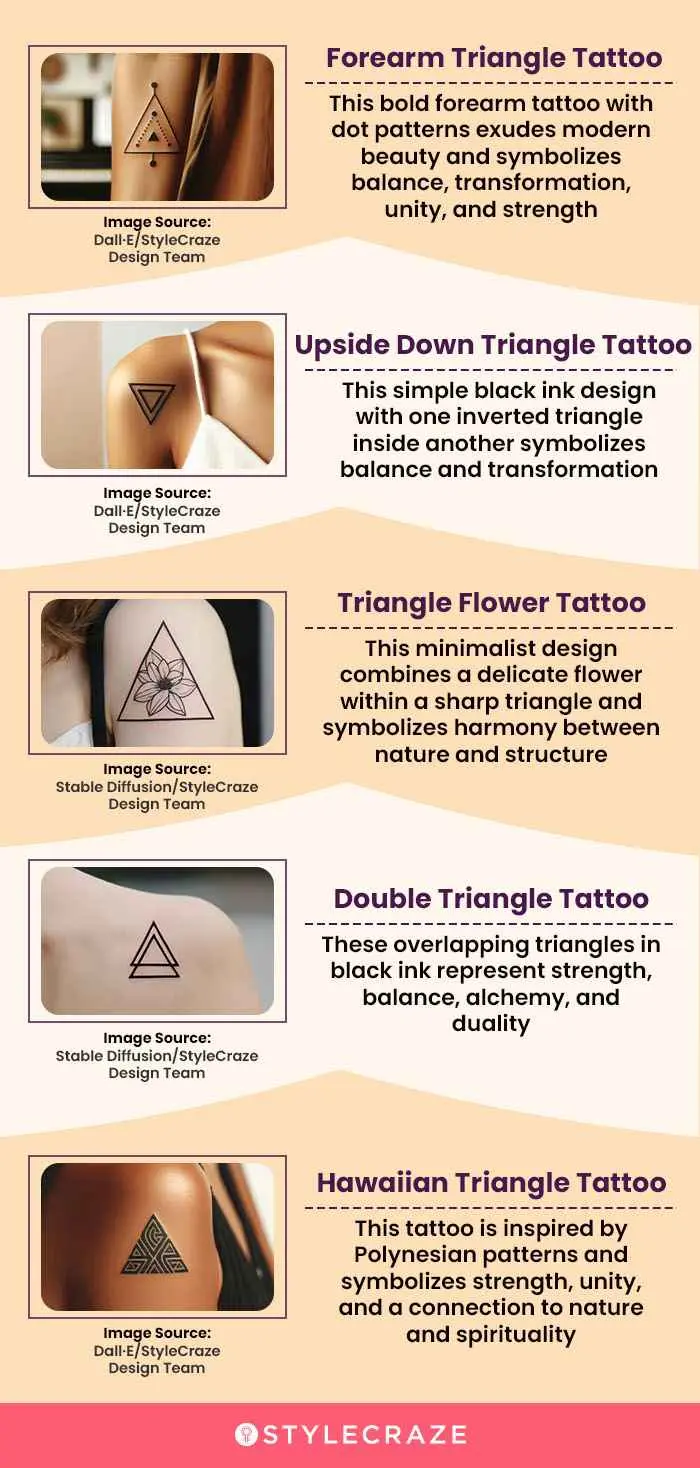
A tech professional designed their three-triangle tattoo using Fibonacci proportions, placing it at the wrist’s acupuncture meridian point. The upward triangle represents AI advancement, the downward triangle symbolizes human intuition, and the central triangle embodies their integration. This design serves as both professional identity marker and meditation focal point during coding sessions.
Understanding these deeper dimensions connects you to both ancient wisdom and contemporary cultural evolution. Whether you’re drawn to the Valknut’s mysteries, sacred geometry principles, or modern digital age symbolism, these designs offer profound opportunities for personal expression and psychological integration.
Advanced AI platforms understand these complex symbolic layers, incorporating therapeutic design principles, cultural sensitivity protocols, and technological integration possibilities into their generation algorithms. Tattoo Generator IQ’s comprehensive approach ensures your three-triangle design honors both traditional meanings and contemporary applications, creating body art that grows with you through life’s transformations while connecting you to broader communities of meaning-makers and consciousness explorers.
Those ready to begin their design journey can explore tattoo art generator tools that incorporate these sacred geometry principles into personalized triangle arrangements.
Source: canva.com
Final Thoughts
The multifaceted nature of three-triangle tattoo symbolism reflects humanity’s ongoing evolution in consciousness, technology, and social organization. These designs serve as bridges between ancient wisdom and contemporary innovation, offering wearers opportunities to participate in both historical traditions and emerging cultural movements.
Your triangle tattoo becomes more than decorative body art—it transforms into a personal tool for psychological integration, community connection, and spiritual development. The geometric precision creates measurable effects on your consciousness while connecting you to mathematical principles that govern natural growth and transformation.
Whether you choose the Valknut’s quantum consciousness connections, sacred geometry’s mathematical harmony, or contemporary digital culture’s symbolic languages, your three-triangle tattoo will evolve with your personal journey. The key lies in understanding these deeper dimensions before making your permanent commitment to this powerful symbol.
Three-triangle tattoos function as personal transformation tools that evolve with your consciousness development and life experience changes over time. The geometric precision and cultural depth of triangle arrangements create lasting symbolic value that transcends temporary aesthetic trends and fashion movements.
Proper research and intentional design planning ensure your triangle tattoo serves as both artistic expression and psychological tool for continued growth and community connection. The triangle tattoo meaning deepens through understanding and intentional application of these principles.

Leave a Reply