Triangle Tattoo Meaning: Why Direction Matters More Than Symbolism
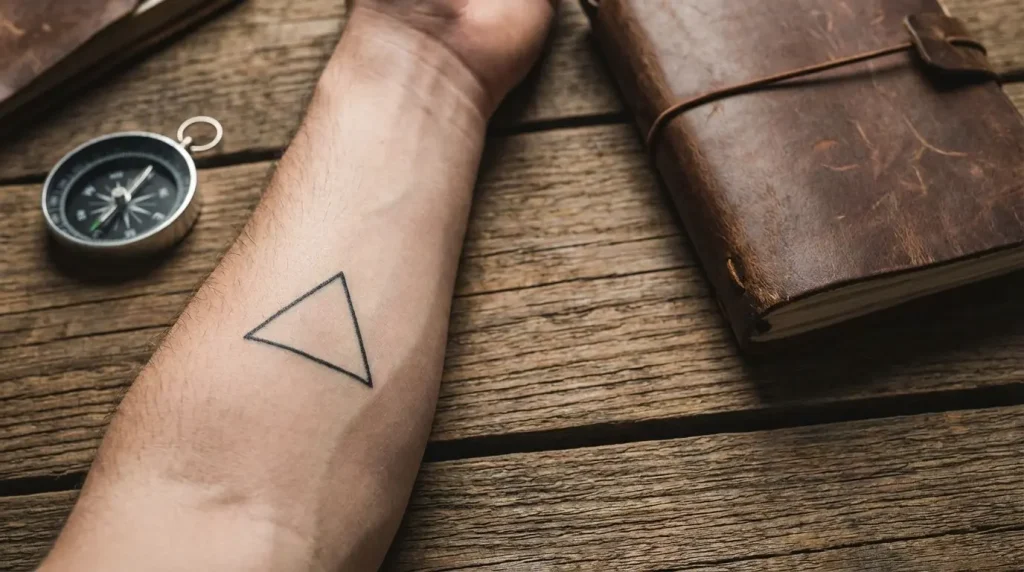
Table of Contents
-
The Orientation Problem Nobody Talks About
-
Stop Looking for the “Real” Meaning
-
Upward Triangles: Ambition or Anxiety?
-
Downward Triangles: The Feminine Divine Gets a Rewrite
-
Double Triangles and the Trap of Duality
-
Triangle Clusters: When Geometry Becomes Personal Language
-
The Cultural Context You’re Probably Missing
-
Size and Placement Change Everything
-
Color Theory Meets Sacred Geometry
-
Okay, So What Does It Actually Mean?
TL;DR
-
Which way your triangle points changes everything, but most guides treat all triangles the same
-
Upward triangles don’t always symbolize masculinity or fire. They can represent personal growth trajectories
-
Downward triangles carry feminine associations in some traditions, but modern wearers redefine them constantly
-
Double triangles (Star of David, hexagrams) hold specific cultural weight that requires respect and awareness
-
Size, placement, and color completely change how triangles communicate on your body
-
The best triangle tattoo meaning is the one you consciously assign, not the one you inherit from generic symbolism guides
-
Context matters more than ancient associations when you’re wearing geometry on your skin permanently
The Orientation Problem Nobody Talks About
Every triangle tattoo guide on the internet will tell you the same thing: triangles mean “balance” or “the holy trinity” or “the elements.” And then you get your triangle and realize none of that actually helps you explain why it’s on your forearm.
Sure, those interpretations are technically true. But they’re useless.
Nobody talks about the obvious: direction changes everything. In fact, the triangle tattoo meaning varies depending on the design, orientation, and personal belief system of the wearer, yet most guides ignore this fundamental reality.
A triangle isn’t just a triangle when it’s permanently marked on your skin. The orientation you choose tells a story about energy flow, intention, and how you relate to the symbol’s cultural baggage.
Most guides treat the shape as a monolithic symbol with fixed meanings. They’ll tell you triangles represent stability, strength, or the elements without acknowledging that a triangle pointing up communicates something entirely different from one pointing down.
So let’s talk about what actually matters: which way your triangle points. Because the way your triangle points determines how people read it, how you experience it over time, and what it means in the context of your body.
You’re not getting a dictionary definition tattooed. You’re getting a visual language element that will communicate differently depending on dozens of variables. What your triangle means shifts based on whether it points up, down, or sits in a cluster with others. It changes based on where you place it and how large you make it.
Forget the generic symbolism guides. Let’s talk about what your triangle will actually mean on your arm for the next forty years.
Stop Looking for the “Real” Meaning
I watched someone spend twenty minutes on Google trying to find the “official” meaning of their triangle before booking their appointment. They were terrified of choosing wrong, as if there’s a Triangle Council somewhere that certifies correct interpretations.
This drives me crazy.
The internet wants you to believe every symbol has a settled, authoritative meaning. Search “triangle tattoo meaning” and you’ll find the same recycled lists: stability, change, creativity, the elements, masculine/feminine energy, past/present/future.
That’s comfort food for the anxious. It suggests you can outsource the meaning-making process to ancient cultures or established symbology.
But you can’t. And you shouldn’t try.
The tattoo industry has trained us to seek definitive symbolic meanings before committing to designs. This creates a false sense of security, suggesting that if we just research enough, we’ll find the “correct” interpretation. When you defer entirely to “traditional” meanings, you’re wearing someone else’s language. You become a walking citation of a Wikipedia entry rather than someone communicating through deliberately chosen imagery.
What a triangle on your forearm means to you has nothing to do with what it meant to alchemists in the 1600s unless you actively connect it to that tradition in your own life.
Think about someone who gets a triangle after reading that it represents “the holy trinity” but who isn’t religious and doesn’t connect with Christian symbolism. Five years later, when someone asks about the tattoo, they struggle to explain it because they’re repeating borrowed meaning rather than expressing something authentic.
Compare that to someone who gets the same triangle to represent three specific people who helped them through addiction recovery. Their sponsor, their therapist, and their best friend. That person can tell a genuine story because the meaning originated from their lived experience, not from a symbolic dictionary. The meaning becomes deeply personal rather than abstractly traditional.
Just as understanding symbolic meanings across different tattoo styles provides context rather than prescriptive rules, triangle meanings work best when you use historical associations as starting points rather than destinations.
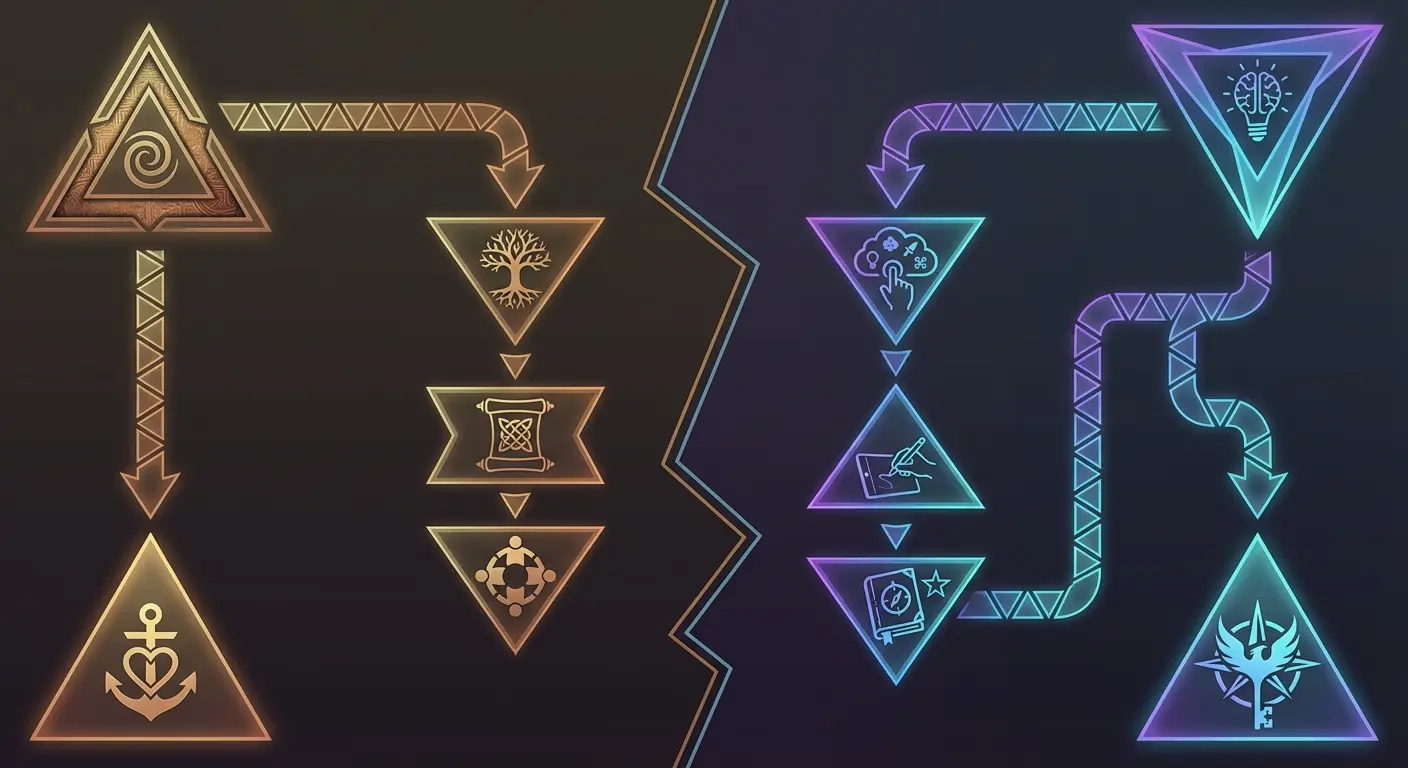
Look, I’m not saying historical and cultural meanings are irrelevant. They provide texture, depth, and connection to larger human conversations about symbols. What I’m saying is that they’re starting points, not destinations. Your triangle will mean what you decide it means through the context you create around it.
The obsession with finding the “real” meaning before getting inked often masks a different anxiety: the fear that you’ll regret the tattoo if you don’t ground it in something external and authoritative. That’s valid. Permanence is scary.
But anchoring your design to meanings you don’t feel connected to doesn’t solve the problem. It just delays the discomfort.
Upward Triangles: Ambition or Anxiety?
An upward triangle points toward something. That’s the entire visual grammar of the shape: directionality, movement, reaching. Traditional interpretations link upward triangles to fire, solar energy, masculinity, and active force. An upward-pointing triangle is often associated with masculinity, fire, and air elements, representing stability, power, and rising energy in spiritual and alchemical terms. Those associations aren’t arbitrary. They reflect how humans across cultures have read upward movement as aspirational, active, and outward-focused.
Talk to people with upward triangles and you’ll hear different stories. People choose upward triangles to represent personal growth trajectories that feel more complicated than “ascending toward enlightenment.” You might get an upward triangle because you’re climbing out of something difficult. Or you’re sick of stagnation and need that visual push. Or, and this is the complicated one, upward momentum has become your whole identity and you don’t know how to stop.
The orientation creates a subtle psychological effect over time. Every time you see that upward point, you’re reminded of direction and movement. For some people, that’s motivating. For others, it becomes a source of pressure.
Am I still moving up? What if I plateau?
When you’ve got three triangles, the meaning gets even more complex. Multiple upward triangles can create a pattern of escalating ambition or represent distinct phases of personal growth. When considering three triangle configurations, think about whether you want all three pointing upward or if varied orientations better represent your journey. The meaning can shift dramatically based on whether the triangles are aligned or positioned in different directions.
I’m not suggesting you avoid upward triangles if that resonates with you. I’m suggesting you consider whether the constant visual reminder of upward movement serves your life or just reinforces a narrative about who you think you should be.
|
Upward Triangle Context |
Psychological Effect |
Best For |
|---|---|---|
|
Post-recovery/transformation |
Motivating reminder of progress |
Those who need visual anchors for growth |
|
Career-focused phase |
Creates pressure to constantly achieve |
High performers who thrive on challenge |
|
Spiritual practice |
Reinforces upward/transcendent focus |
Active meditation practitioners |
|
Perfectionist tendencies |
Amplifies “never enough” feelings |
Requires conscious reframing of meaning |
|
General aesthetic preference |
Neutral to positive |
Those who assign personal, non-directional meaning |
When Your Triangle Looks Angry
Size matters here more than you’d expect. A small upward triangle on your inner wrist reads delicate, almost tentative. The same triangle scaled up and placed on your chest or shoulder reads bold, possibly confrontational.
Bold, thick lines amplify the assertive quality. Fine line work softens it, turning the upward point into something more aspirational than aggressive. If you’re drawn to upward triangles but worried about the masculine or forceful associations, execution is your tool for modulation.
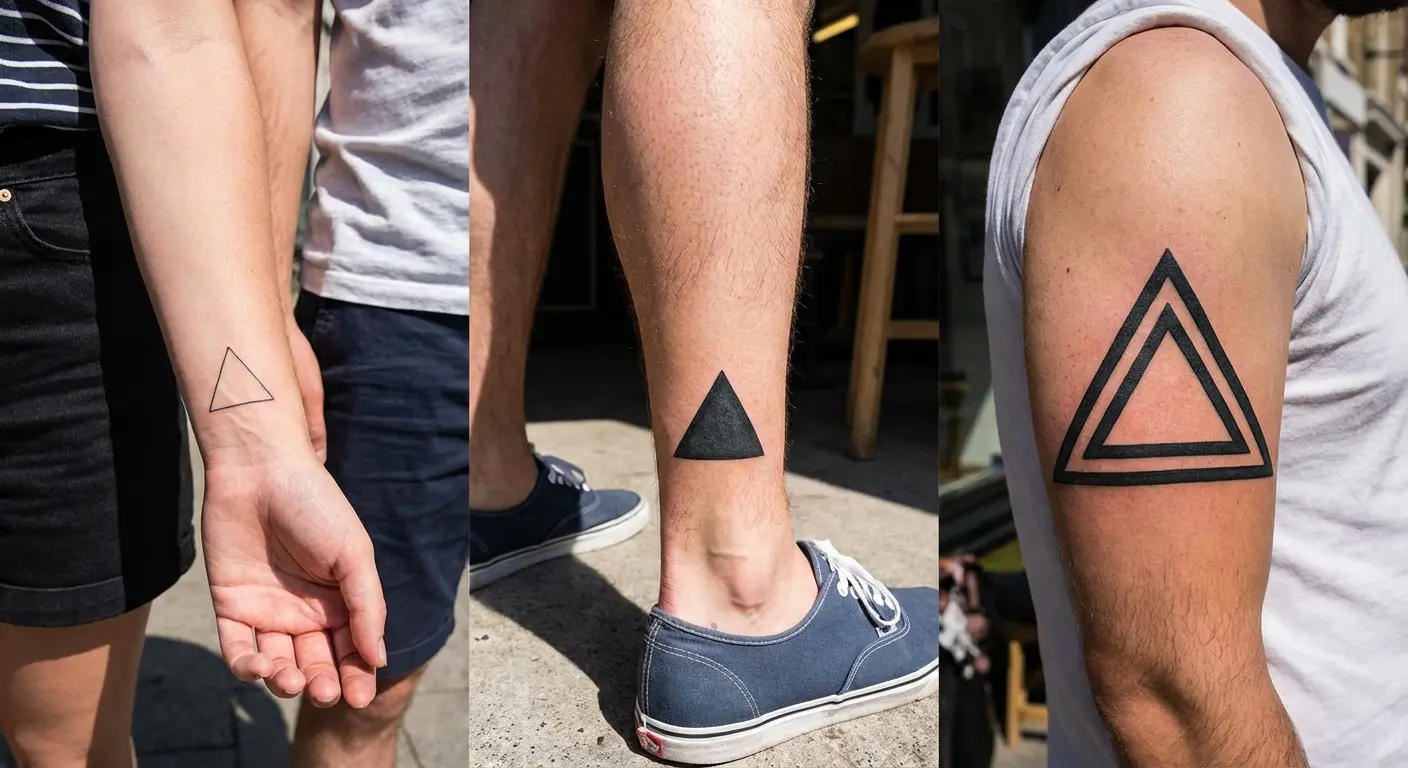
Placement also shifts the read considerably. Upward triangles on knuckles, neck, or forearms occupy assertive real estate. They face outward. They’re visible in interactions. They communicate to others before they communicate to you.
The same triangle behind your ear or on your ankle becomes private, a personal compass rather than a public statement. Upward triangles can read as aggressive or assertive depending on size, placement, and styling. The same orientation takes on different emotional tones based on execution.
Downward Triangles: The Feminine Divine Gets a Rewrite
Flip the triangle and you flip the traditional associations. Downward triangles point to earth, water, receptivity, and what various traditions call “feminine energy” or “divine feminine.”
Alchemists used downward triangles to represent water. Spiritual systems connect them to grounding, intuition, and inward focus. The visual logic makes sense: downward movement suggests settling, rooting, returning to source.
But plenty of people choose downward triangles without any connection to feminine energy or receptivity. You might choose an upside down triangle to represent grounding after years of anxious striving. You might select it because you’re intentionally exploring shadow aspects of yourself (the downward journey into what’s hidden or rejected).
You might just prefer the visual weight of a point-down triangle on a specific body part.
The gendered associations around upward/downward triangles feel increasingly outdated. Yes, they exist in historical symbolic systems. Yes, they provide one lens for interpretation. But they’re not prescriptive. In a recent high-profile case, Gabby Petito’s family got matching tattoos including a flower inside a triangle that she had designed herself (The Tab), demonstrating how triangle meanings transcend traditional gender associations.
Your upside down triangle doesn’t make you more feminine or receptive unless you want it to. It makes you someone who chose a downward-pointing shape for reasons that matter to you.
An upside down triangle can be particularly powerful for those working on grounding practices or intentionally exploring depth psychology. Rather than accepting the passive receptivity narrative, many modern wearers assign meaning related to strength found in stillness, power in descent, or courage to explore what lies beneath surface consciousness. Understanding what it means requires moving beyond traditional feminine associations to explore personal significance.
Are You Grounding or Sinking?
Downward triangles carry two distinct flavors of meaning that often get conflated: grounding and descending. They’re related but not identical.
Grounding suggests stability, rootedness, connection to something solid beneath you. It’s about finding your base after floating untethered. Descending suggests intentional movement into depth, shadow, or hidden territory. It’s active exploration of what’s below the surface.
If you’re drawn to downward triangles for grounding, you might pair them with earth imagery, root systems, or geometric patterns that suggest stability. The triangle becomes an anchor point in your visual language.
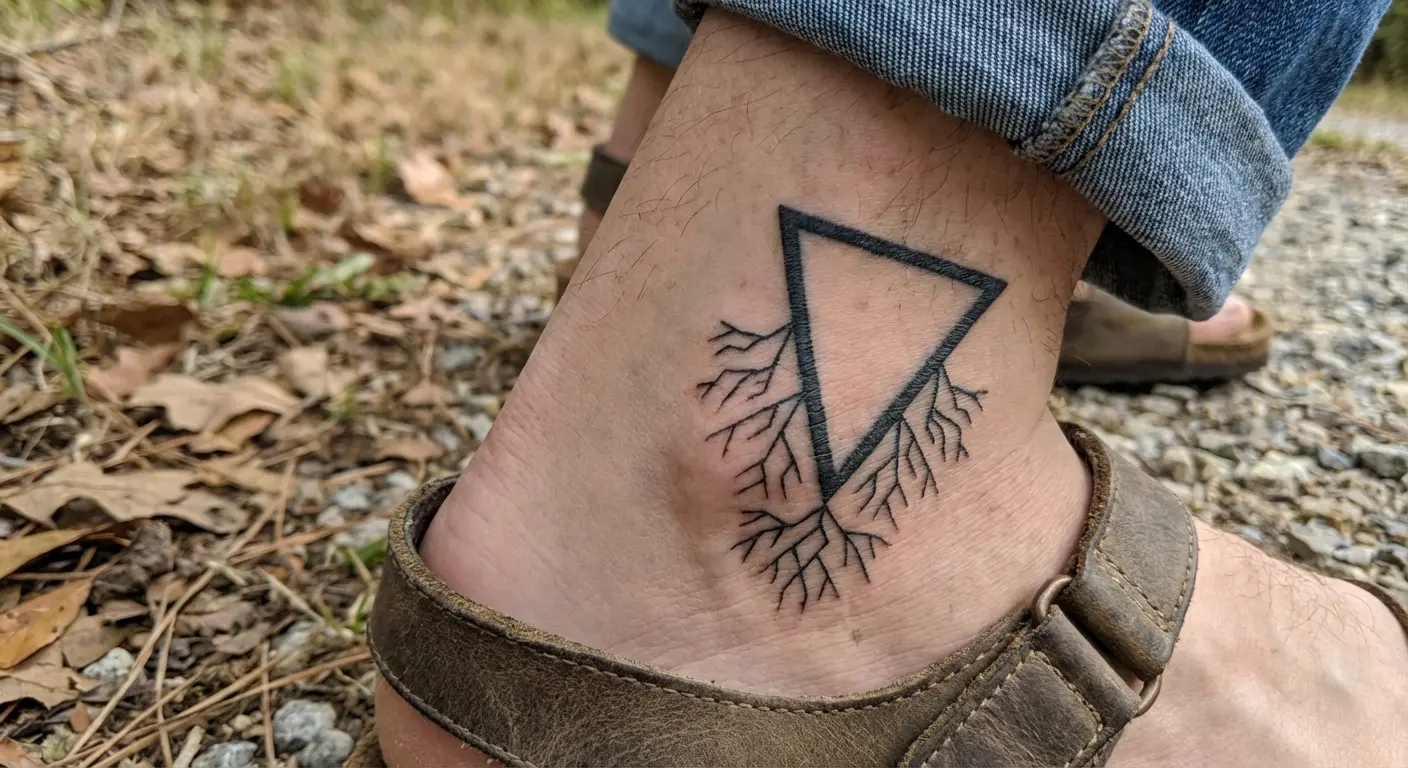
If you’re drawn to them for the descent narrative, you might incorporate darker colors, cave imagery, or pair them with symbols of transformation. The triangle becomes a marker of intentional shadow work or depth exploration. This nuanced interpretation allows for personal meaning beyond traditional feminine associations.
Both are valid. Both are meaningful. The distinction matters because it affects how you’ll relate to the tattoo over time and what story you’re telling yourself about why it’s on your body. The meaning you assign should reflect which narrative resonates more deeply with your personal journey.
Double Triangles and the Trap of Duality
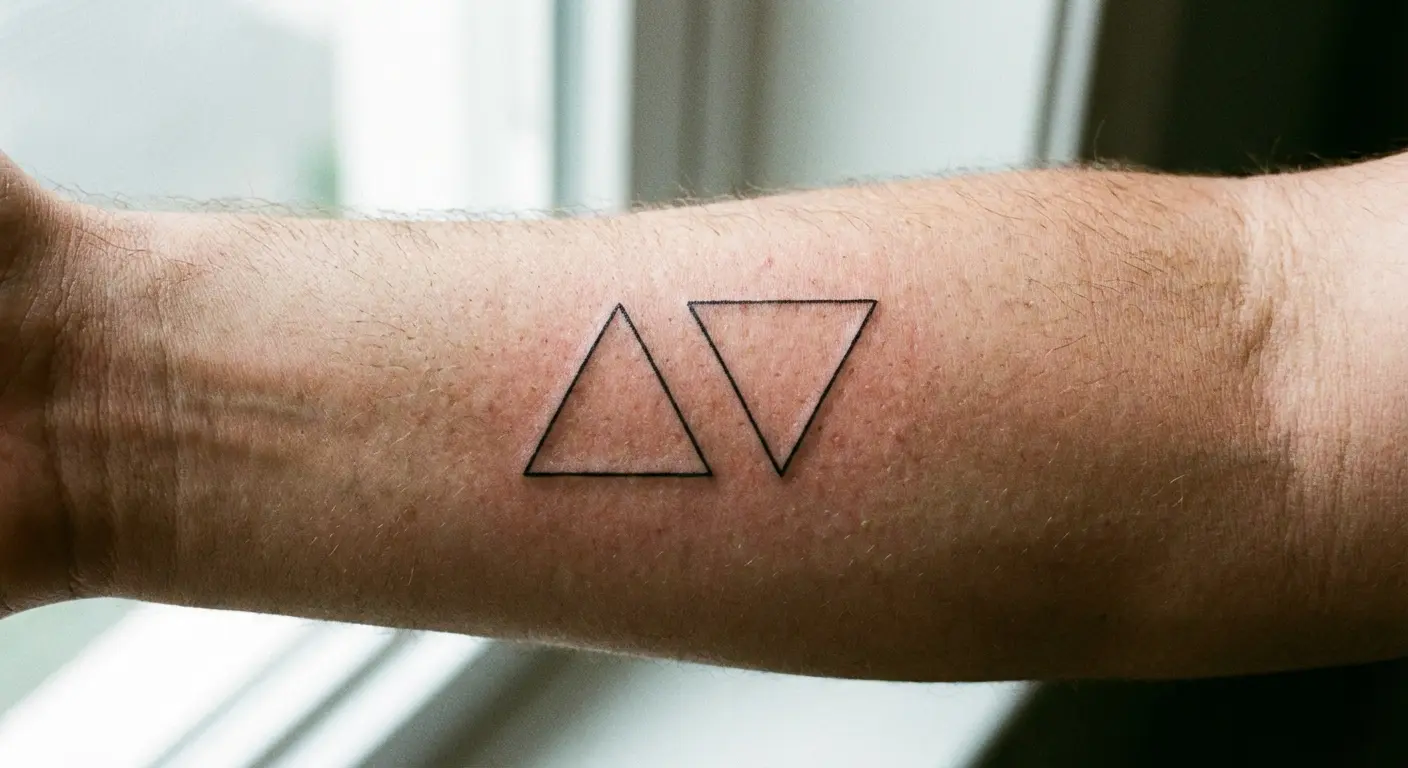
Overlap two triangles and you create something more complex: the Star of David, the hexagram, the merkaba, or various other configurations depending on how they intersect. These doubled forms carry heavier cultural and spiritual associations than single triangles. Overlapping triangles, also known as a Star of David or hexagram when interlocked, often convey balance between opposing forces, such as male and female, fire and water, or spiritual and physical, making it a powerful symbol for those seeking harmony in life.
Let’s be blunt: if you’re considering a double triangle configuration that holds specific meaning in a religious or ethnic tradition you’re not part of, you need to think carefully about appropriation versus appreciation.
The Star of David isn’t just “two triangles that look cool.” It’s a symbol with profound meaning to Jewish people and a complicated history involving persecution and identity.
Understanding two triangle meaning requires considering how the triangles interact: do they overlap completely, partially, or sit adjacent? Each configuration creates different possibilities. When exploring two triangle options, the relative positions and orientations dramatically affect interpretation. The meaning you assign should account for both the visual relationship between the forms and any cultural significance they carry.
The importance of understanding tattoo symbolism has gained renewed attention recently. In May 2025, a federal immigration enforcer’s tattoo that matched the description of a symbol used by white supremacists caused alarm among community members (Martha’s Vineyard Times), highlighting how geometric symbols can carry associations beyond their aesthetic appeal. While ICE denied connections to white supremacy, the incident underscores why researching the full context of symbols, especially overlapping or complex geometric forms, matters before permanently marking them on your body.
The Problem With Balance
The duality interpretation of double triangles (masculine/feminine, light/dark, spirit/matter) feels tidy. It suggests balance, integration, whol
eness achieved through uniting opposites.
But life rarely organizes itself into neat binaries. Most of us exist in the messy middle of supposed opposites, and the pressure to “balance” binary forces can feel reductive.
If you’re drawn to double triangles, consider whether you relate to them as symbols of duality or whether you’re responding to something else: the visual complexity, the geometric satisfaction of overlapping forms, the sense of multiple perspectives held simultaneously. The meaning you assign doesn’t have to conform to traditional binary interpretations.
A non-binary person might choose overlapping triangles not to represent masculine/feminine balance, but to visually express the rejection of gender binaries altogether. The overlapping forms become a statement about existing between, beyond, or outside of binary categories. Using a traditionally dualistic symbol to communicate the opposite of duality. This demonstrates how conscious meaning assignment can completely transform inherited interpretations.
You can assign meaning that honors complexity without flattening it. They might represent multiple aspects of yourself that coexist without needing to be “balanced.” They might represent different life phases you’re integrating. They might represent perspectives you hold in tension without resolving them.
The symbol doesn’t have to do the interpretive work for you. You get to decide what those overlapping triangles mean in the context of your life.
Triangle Clusters: When Geometry Becomes Personal Language
Arrange multiple triangles in patterns and you move beyond individual symbol interpretation into compositional meaning. Triangle clusters, geometric arrangements, and repeated forms create visual language through pattern, rhythm, and relationship between elements.
This approach feels more contemporary and often more personally authentic because you’re not trying to find the “right” meaning for a single loaded symbol. You’re creating a visual system that communicates through arrangement, repetition, and aesthetic choices.
Triangle clusters work especially well for people who are drawn to geometric tattoos generally but don’t want to commit to the spiritual or symbolic baggage of individual shapes. The meaning comes from the overall composition, not from decoding each element.
When creating triangles through clusters, the relationships between individual triangles become as important as the triangles themselves. They derive their power from how you arrange and contextualize the geometric forms.
You might arrange triangles to create movement across your skin, suggesting direction or flow without the heavy-handed symbolism of a single upward or downward point. You might cluster them to create visual texture, using repetition to build something that feels complete without needing to “mean” anything specific. These derive their significance from personal aesthetic choices rather than inherited symbolism.
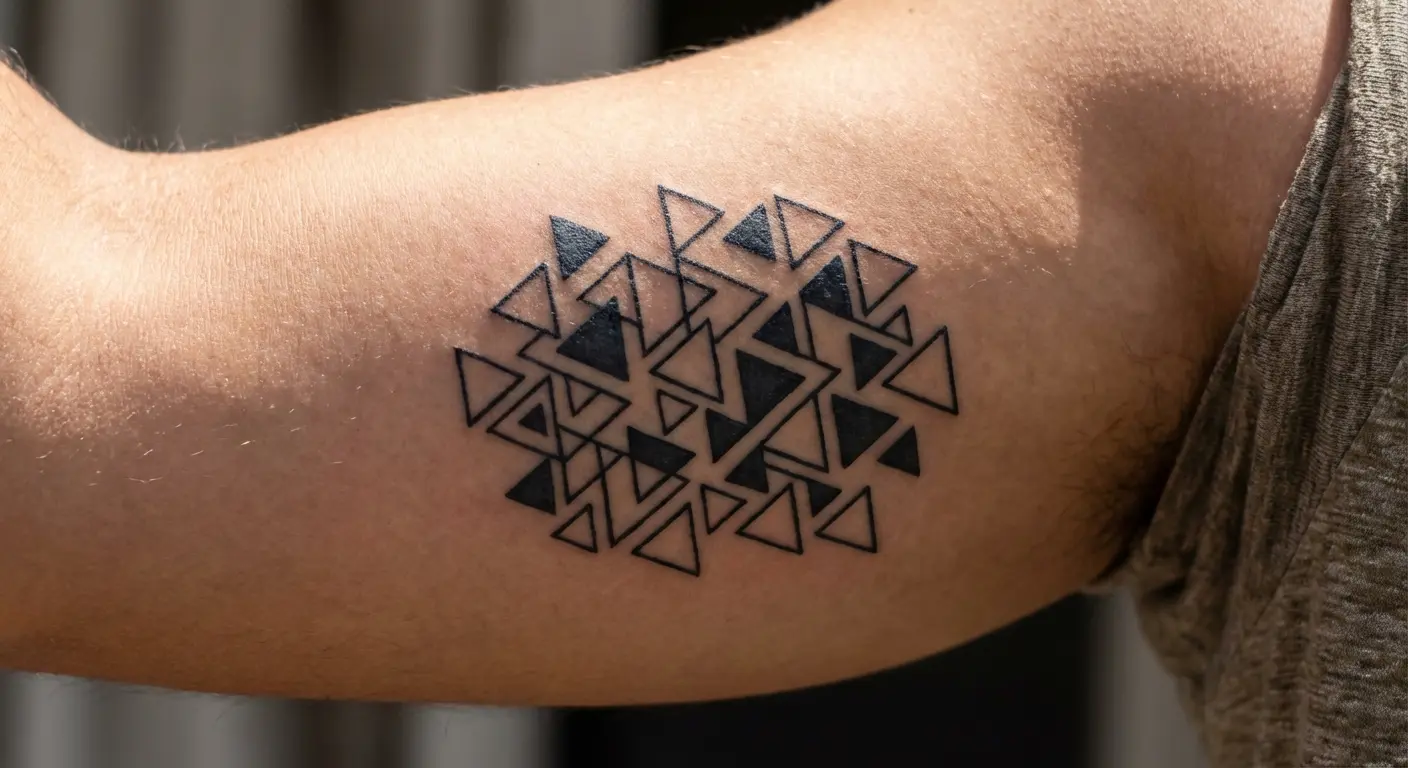
Triangle Cluster Design Checklist:
-
Determine overall composition shape (linear, circular, scattered, grid-based)
-
Decide on triangle orientation variety (all same direction, mixed, or opposing)
-
Choose size variation (uniform triangles vs. graduated sizes)
-
Plan spacing between elements (tight cluster vs. dispersed pattern)
-
Consider negative space shapes created between triangles
-
Select line weight (consistent thickness vs. varied for depth)
-
Determine color approach (monochrome, gradient, or multi-color)
-
Map placement on body considering natural contours and movement
Negative Space and What’s Between
The space between triangles in a cluster or pattern isn’t empty. It’s active. It creates secondary shapes, suggests relationships, and often becomes the most interesting part of the composition.
When you’re planning cluster designs, pay as much attention to what’s between the shapes as the shapes themselves. Those negative spaces might form other geometric figures. They might create the sense of depth or dimension. They might provide visual breathing room that makes the overall composition readable instead of cluttered.
Some people find that the negative space in their geometric tattoos becomes the part they relate to most over time. The triangles provide structure, but the spaces between them provide mystery, openness, and room for interpretation to shift.
The Cultural Context You’re Probably Missing
Triangles show up everywhere: alchemical symbols, Hindu yantras, Christian trinity representations, Indigenous art, sacred geometry systems, modern minimalist design. Each context assigns different meanings based on different philosophical frameworks.
In alchemical traditions, upward triangles represent fire and downward triangles represent water, with variations for earth and air. In Hindu traditions, upward triangles (in yantras like the Shri Yantra) represent masculine energy (Shiva) and downward triangles represent feminine energy (Shakti). In Christian contexts, triangles often represent the trinity (Father, Son, Holy Spirit). In various Indigenous traditions, triangles appear in patterns with meanings specific to those cultures and not freely available for outside interpretation or use.
Understanding what a triangle means requires acknowledging that no single interpretation exists across cultures. The meaning in one tradition may directly contradict its significance in another, which is why personal assignment matters more than attempting to find universal truth. What it means depends entirely on which cultural lens you’re viewing it through and what personal significance you assign.
Just as semicolon tattoos evolved from specific mental health advocacy into broader personal meanings, triangle meaning shifts depending on cultural context and individual interpretation.
|
Cultural Tradition |
Triangle Symbolism |
Appropriate Use Considerations |
|---|---|---|
|
Alchemy |
Upward = Fire/Air, Downward = Water/Earth |
Historical system, generally open for personal interpretation |
|
Hinduism |
Upward = Shiva/Masculine, Downward = Shakti/Feminine |
Sacred religious symbols; requires respectful understanding |
|
Christianity |
Trinity (Father, Son, Holy Spirit) |
Religious symbol; consider if you practice the faith |
|
Judaism |
Star of David (double triangle) |
Ethnic and religious identity marker; appropriation concerns |
|
Indigenous Cultures |
Varies by specific nation/tribe |
Often closed practices; not appropriate for outside use |
|
Modern Minimalism |
Aesthetic geometry |
No cultural baggage; open for personal meaning |
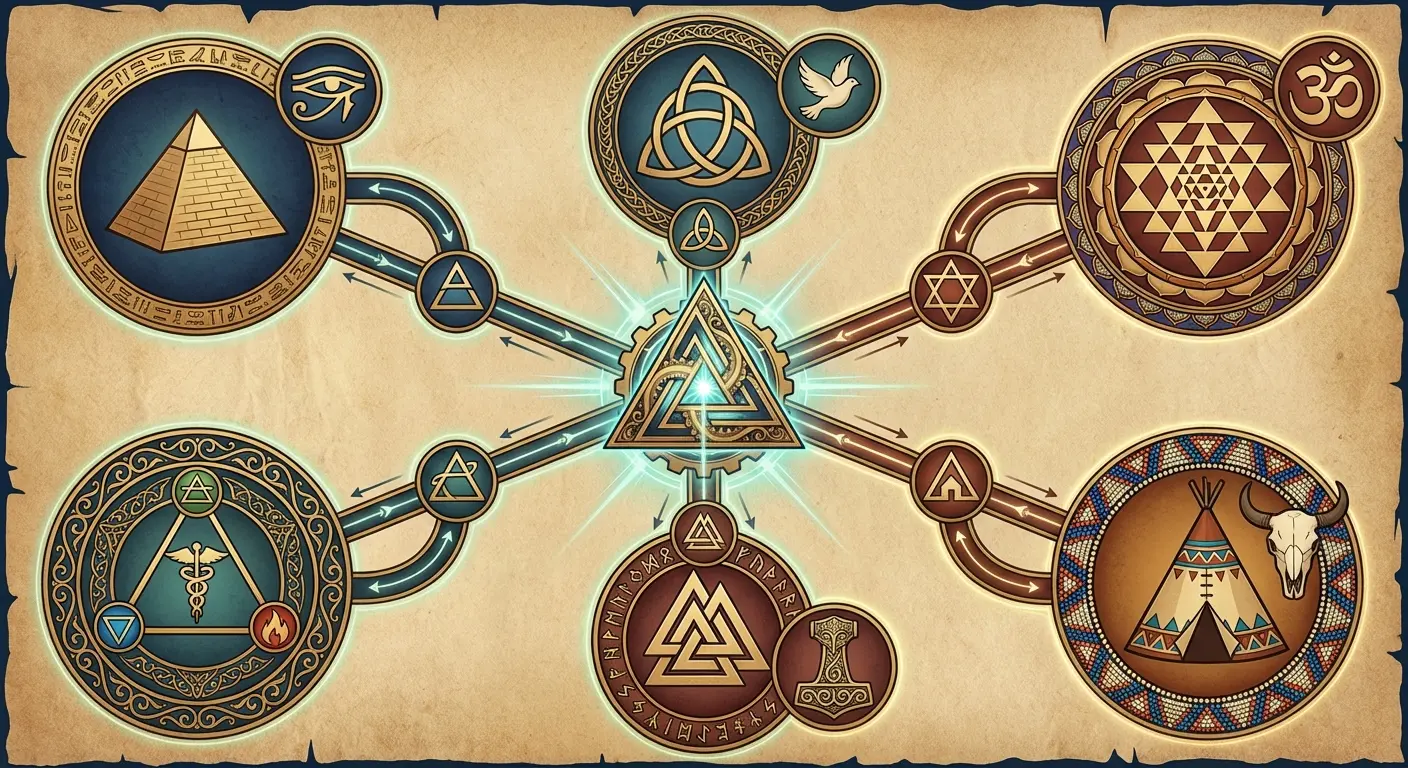
I’m not providing an exhaustive cultural reference guide here. You can find that elsewhere, and honestly, a blog post can’t do justice to the depth and complexity of how different cultures use geometric symbols.
What I’m emphasizing is this: if you’re drawn to triangles because of a specific cultural or spiritual tradition, make sure you have connection to that tradition beyond finding it aesthetically interesting.
Cultural appreciation involves genuine engagement, learning, and respect. Cultural appropriation involves taking symbols from traditions you’re not part of because they look cool, without understanding or honoring their context. The line isn’t always clear, but intention and effort matter.
Size and Placement Change Everything
A triangle isn’t just a triangle when you consider where it lives on your body and how much space it occupies.
Size determines whether your triangle is a whisper or a statement. Tiny triangles (under an inch) function as personal markers, almost secret symbols you notice more than others do. They’re intimate. They’re for you first, others second (if at all).
Large triangles (hand-sized or bigger) become focal points, conversation starters, and public declarations before they’re personal symbols. When someone asks “what does that mean” about your large chest piece, they’re seeking public interpretation, but a tiny wrist triangle rarely prompts that question.
Placement determines context and relationship. A triangle on your ribcage exists in private space, revealed only when you choose. The same triangle on your forearm participates in every handshake, every professional interaction, every casual encounter. It’s always communicating, whether you intend it to or not. The meaning shifts from private reminder to public statement based purely on placement.
Consider a corporate consultant who gets a small downward triangle on their inner wrist. Visible to them during client presentations when they check notes or gesture, serving as a personal grounding reminder, but easily concealed with a watch or long sleeves when needed.
Contrast this with the same person getting a large upward triangle on their neck. The neck placement makes a public statement that affects professional perception before they speak, potentially limiting career mobility in conservative industries. Same symbol, same person, completely different lived experience based purely on size and placement.
Similar to considerations around small tattoo placement, triangle meaning changes dramatically based on visibility and body location.
Body Architecture and Triangle Flow
Your body has inherent directional flow. Arms extend outward and upward when raised. Legs ground you downward. Your torso provides vertical real estate with natural horizontal divisions (chest, ribs, stomach).
Upward triangles on forearms follow the natural extension line of your arm. They feel visually harmonious, almost inevitable. Downward triangles on forearms create visual tension, fighting against the limb’s natural direction.
Neither is better, but they create different experiences. The meaning you assign can either work with or against your body’s natural architecture.
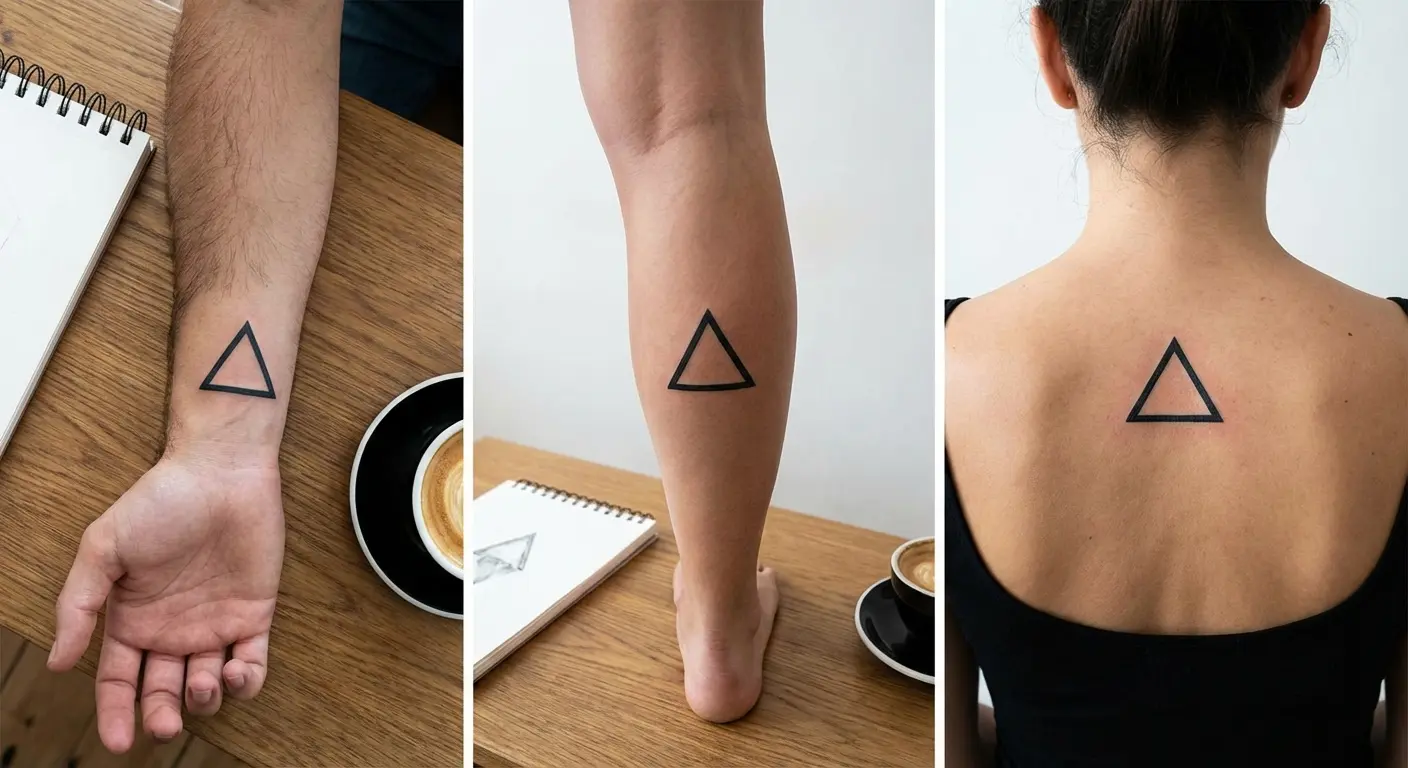
Triangles on your back have different considerations entirely. Your spine provides a central axis. Triangles can point toward it (creating inward focus) or away from it (creating outward expansion). They can follow the shoulder line, the hip line, or sit independent of your body’s natural architecture.
Think about whether you want your triangle to harmonize with your body’s flow or create productive tension against it. Both approaches work, but they communicate different relationships between the symbol and your physical form. This consideration affects the lived meaning over time.
Color Theory Meets Sacred Geometry
Color isn’t just decoration. It’s another layer of meaning-making that either reinforces or complicates your triangle’s symbolic work.
Black ink triangles feel archetypal, almost timeless. They reference sacred geometry, alchemical symbols, and the long history of geometric tattooing. They’re clean, readable, and age predictably.
Red triangles immediately invoke fire, passion, or warning (depending on context). Blue triangles suggest water, calm, or spirituality. Yellow triangles feel energetic, possibly solar, definitely less common.
Color choices can reinforce traditional associations (red for fire triangles, blue for water triangles) or deliberately contradict them (a soft pink upward triangle that refuses masculine fire associations, a bold orange downward triangle that rejects passive receptivity). The meaning shifts dramatically when color adds emotional or elemental associations.
Understanding how fine line techniques interact with color choices helps create meaning that remains clear and readable over time.
Color Longevity in Geometric Work
Here’s the practical reality: colored ink fades differently than black ink, and geometric tattoos depend on clarity to remain readable.
Bright colors (especially yellows, light blues, and pastels) fade faster and more noticeably than darker colors. If your triangle’s meaning depends on its color, you’re committing to touch-ups every few years to maintain that clarity. That’s fine if you’re prepared for it, but it’s worth knowing upfront.
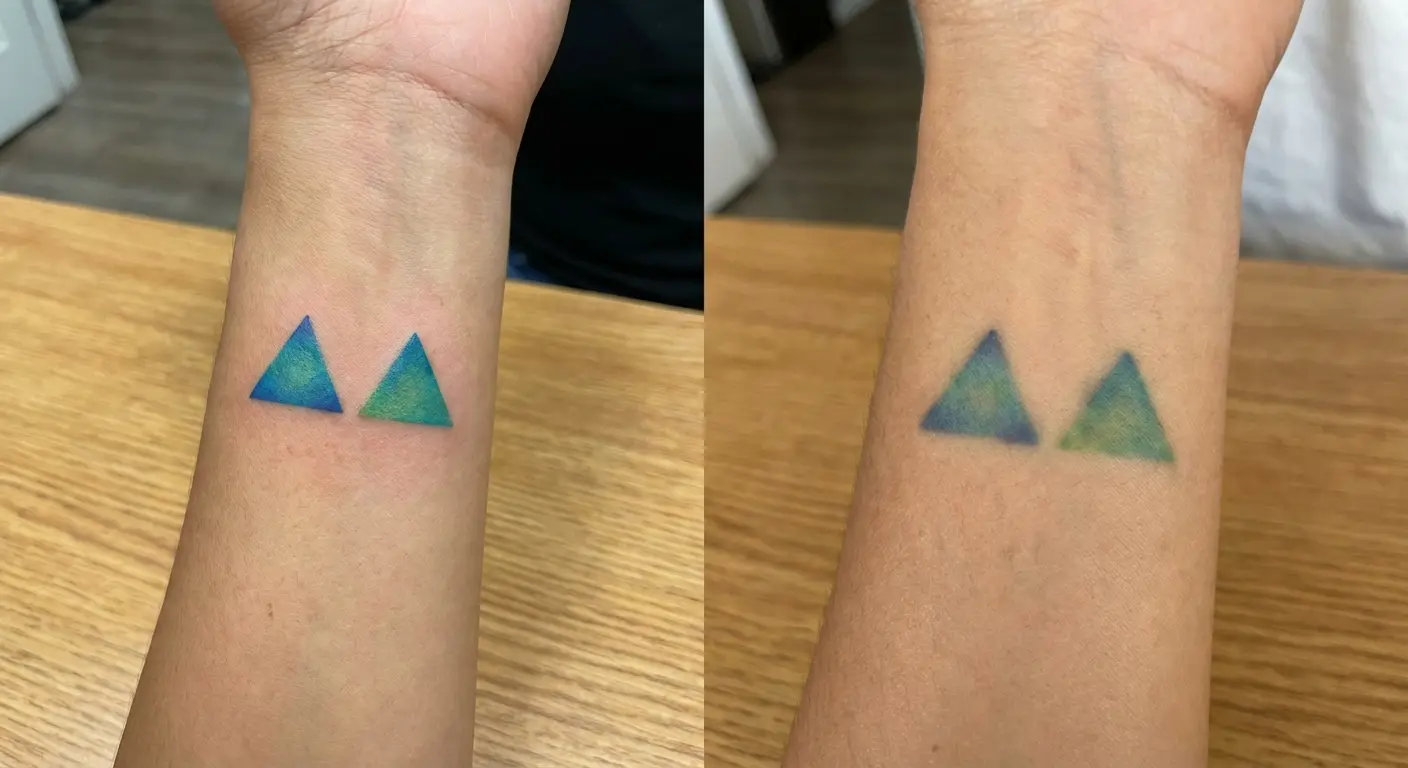
Darker colors (deep blues, purples, reds) hold up better but can still shift over time. Red can turn slightly orange. Blue can fade to gray-blue. Black remains the most stable, predictable option for geometric work that needs to stay crisp.
Some people embrace the aging process, allowing their colored triangles to soften and shift over time. Others find that frustrating, preferring the permanence and stability of black ink. Neither approach is wrong, but color choice should account for how you feel about inevitable change and how that might affect the meaning you’ve assigned.
Okay, So What Does It Actually Mean?
We’ve examined orientation, cultural context, size, placement, color, and configuration. We’ve looked at traditional associations and how modern wearers complicate them.
Here’s what I wish someone had told me before my first tattoo: the meaning isn’t in the symbol. It’s in what you do with it.
Your triangle means what you decide it means through the context you create around it.
That’s not relativism or “anything goes” thinking. It’s recognition that symbols don’t carry inherent, fixed meanings that exist independent of human interpretation and use. Triangles have rich histories across cultures. Those histories provide texture, depth, and connection to larger human conversations about geometry and meaning. But they don’t determine what your specific triangle on your specific body means in your specific life.
The meaning you assign matters more than the meaning you inherit. You might choose an upward triangle and connect it to traditional fire symbolism. You might choose the same triangle and connect it to your personal journey out of depression.
Both are valid. Both create genuine meaning. The difference is whether you’re actively choosing the connection or passively accepting it.
Building Context Around Your Triangle
Context-building is how you transform a shape on your skin into a meaningful symbol in your life. This happens through stories you tell yourself and others about why you chose it, associations you build over time, and how you integrate the triangle into your broader self-narrative.
Some people build context through ritual around getting the tattoo (choosing a significant date, bringing meaningful people, creating ceremony around the experience). Some build it through journaling or reflection practices that explore what the triangle represents at different life stages.
Some build it simply by living with the tattoo and noticing what thoughts or feelings arise when they see it.
The meaning deepens through these contextual practices rather than being fixed at the moment of application.
The context you build doesn’t have to be elaborate or mystical. It can be as simple as “this triangle reminds me of a specific moment when I chose to change direction” or “this represents the three people who matter most to me.” What matters is that the context is yours, consciously chosen, and genuinely meaningful to you.
How Triangle Meaning Evolves
The triangle you get at twenty-five won’t mean the same thing at forty. That’s not a problem to solve. It’s a feature of living with permanent symbols through changing life circumstances.
Maybe you got an upward triangle during an ambitious career phase, and now you’re in a season of rest that doesn’t align with constant upward striving. The triangle doesn’t become meaningless. Its meaning evolves.
It might become a reminder of a specific life chapter. It might represent a part of yourself you’re integrating rather than actively embodying. It might simply become a visual element you appreciate aesthetically without needing it to carry heavy symbolic weight.
Some people worry that if a tattoo’s meaning changes, they’ll regret it. But meaning evolution isn’t the same as meaning loss. Your relationship to the symbol deepens and complexifies, which is what happens with anything you live with long enough to really know.
The triangles that stay meaningful over decades are usually the ones you assigned meaning to consciously rather than the ones you got because someone else told you what they “should” mean.
Designing Your Triangle (With Help When You Need It)
You know you want a triangle tattoo. You’ve thought about orientation, meaning, placement, and context. Now you’re stuck on the actual design : exact proportions, line weight, whether to add elements, how it’ll look at different sizes on different body parts.
This is where most people either spend weeks sketching variations they’re not satisfied with or book consultations with tattoo artists before they’re ready, burning time and money exploring options. You’re trying to see possibilities, not commit to finished designs yet.

Full disclosure: I’m going to mention a tool I built because it solves this exact problem. When you know you want a triangle but can’t visualize the variations (line weight, size, added elements, whatever), you’re stuck either sketching badly or burning money on consultations before you’re ready.
That’s why we made Tattoo Generator IQ. You describe what you’re thinking, it generates actual design variations in different styles, and you can experiment until something clicks. It’s not going to replace your tattoo artist (they’ll refine and execute the final design), but it gets you past the “I can’t picture this” phase.
Thousands of people have used it to go from vague triangle idea to “here’s exactly what I want.” If you’re stuck in the visualization phase, it helps.
The tool doesn’t replace your tattoo artist (you’ll still bring your final design to them for execution and their professional input). It replaces the frustrating early phase where you’re trying to visualize possibilities but don’t have the design skills or time to explore them properly.
You get artist-ready references that help you communicate exactly what you want instead of describing it vaguely and hoping your artist interprets it correctly.
Final Thoughts
Triangle tattoos don’t come with instruction manuals. They come with histories, cultural associations, and traditional interpretations that provide starting points but not destinations.
The orientation you choose matters because it affects how the triangle communicates visually and how you’ll experience it over time. Upward triangles create different psychological effects than downward ones. Double triangles carry different weight than single forms. Clusters create different meaning than isolated shapes.
But none of those differences determine what your triangle will mean. You do that through conscious assignment, context-building, and genuine connection to why you chose that specific configuration for that specific place on your body.
The anxiety around “getting it right” before you commit to a triangle is understandable. Permanence is significant. But there’s no external authority who can tell you the correct meaning of your triangle.
Your triangle will mean whatever story you tell yourself about it, whatever memories get attached to it, whatever you were going through when you decided to mark your skin permanently.
The research matters. The cultural context matters. But at the end of the day, you’re the one who has to live with it. Make it mean something to you.
