3 Dot Tattoo Meaning: What Prison Culture Gets Wrong About This Symbol
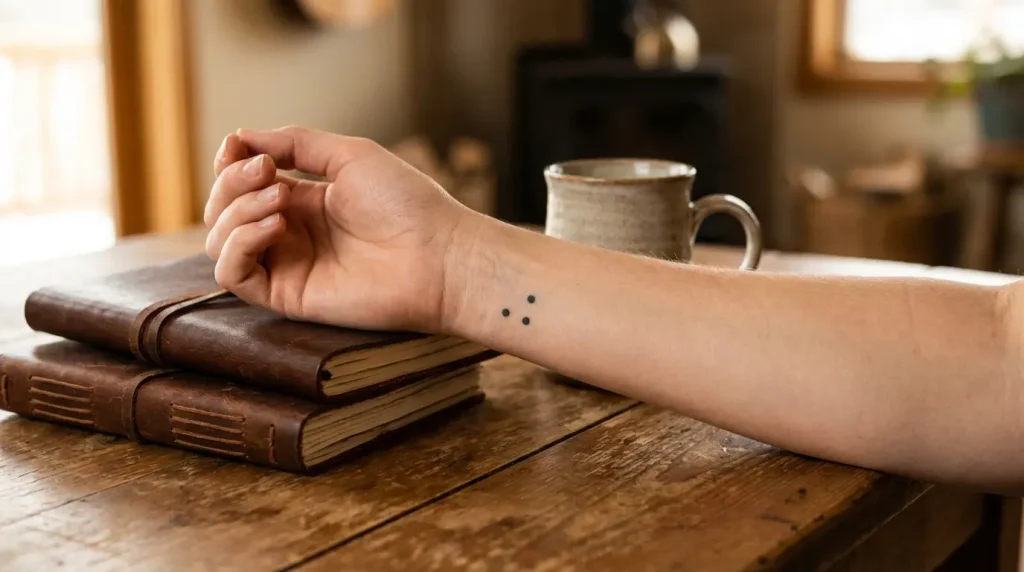
Look, here’s the deal before we get into this: Three dots mean different things depending on who’s wearing them, where they’re placed, and who’s doing the looking. The prison/gang connection is real, but it’s not the whole story. Religious symbolism goes back centuries. Modern people are making it mean whatever they want. And yeah, placement matters more than you think.
The Prison Story (And Everything It Leaves Out)
What Google Won’t Tell You
Yeah, you’ve already Googled this. You found a dozen articles saying “gang tattoo, mi vida loca, don’t get it.” And you’re still here because that explanation feels incomplete. Good instinct.
I’m not going to pretend the gang association doesn’t exist. It does, and it carries real weight in certain communities. But treating this as the only meaning of three dot tattoo erases centuries of other uses and ignores how symbols work across different cultures at the same time.
The prison connection became the dominant story because it’s sensationalized. Media coverage and crime dramas hammered this interpretation until it became the only one most people knew. That’s how cultural symbols get flattened into stereotypes.
According to user testimonials compiled on Sinosplice, traditional three dot tattoos show up across multiple cultures. Chinese peasant communities had them. Swedish sailors called them “hobo dots” (luffarprickar). European anti-establishment groups used them. Filipino fraternities marked members with them. This simple geometric shape developed independently across continents with completely different meanings long before modern gang associations showed up.
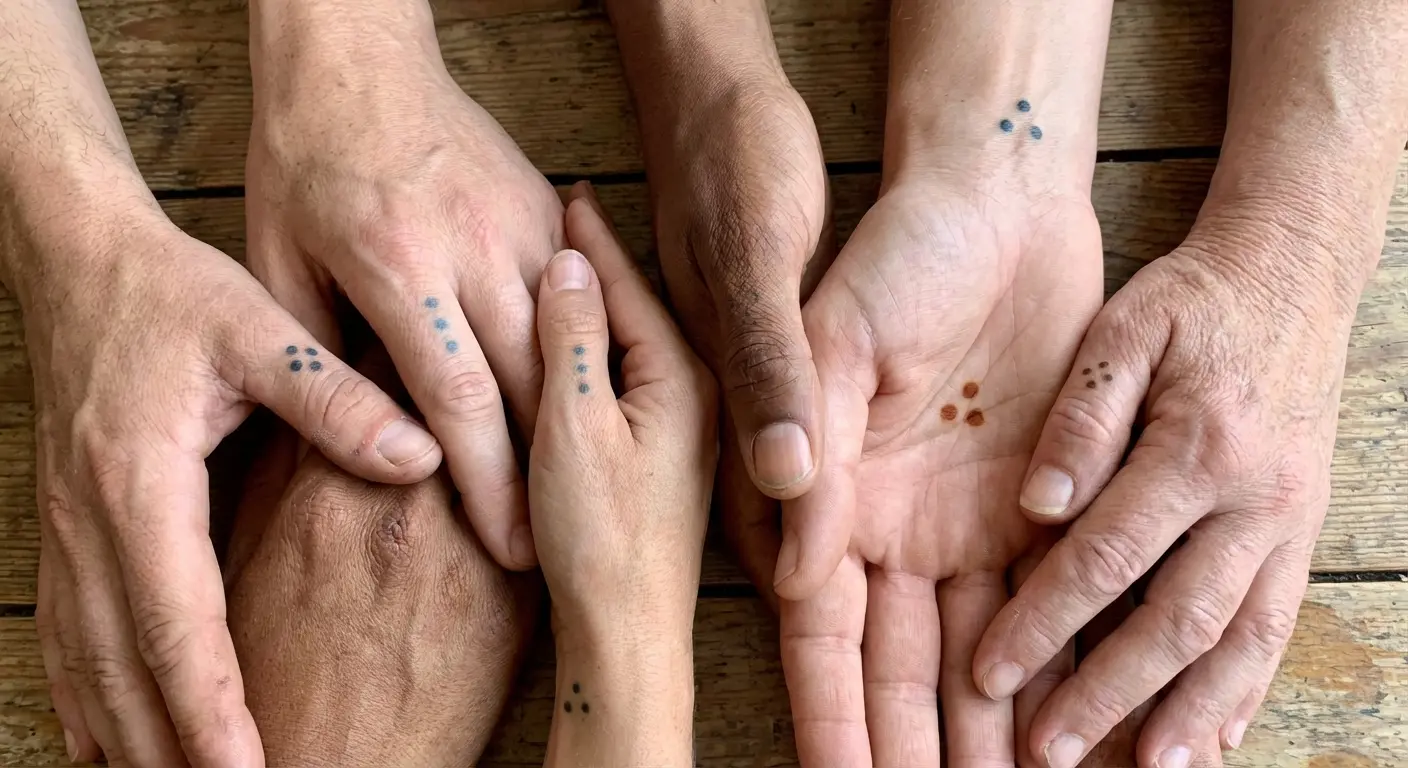
A 70-year-old woman from Henan province wears three dots on her forearm as decoration from when she was sixteen. A Hispanic teenager in East LA gets the same three dots to represent “mi vida loca.” A Swedish sailor from the 1960s has them as protection symbols. Same mark, three completely different lives separated by geography and decades.
None of them knew about the others’ interpretations.
Why Single Stories Kill Symbols
No one owns a symbol. I don’t care how loud they are about it.
Three dots arranged in a triangle is one of the simplest shapes humans can create, which means multiple cultures came up with meanings for it separately.
Assuming every three dot tattoo references gang affiliation is like assuming every cross tattoo references Christianity. Sure, that’s often true, but it ignores Orthodox traditions, Celtic interpretations, and dozens of other frameworks. Context determines meaning more than the symbol itself.
Kind of like how semicolon tattoos mean more than most people think, three dot symbolism demands you look deeper than the first Google result.
Placement Changes Everything
Where you put these dots on your body communicates different messages to different audiences. This geography of meaning matters if you’re considering this tattoo.
Hand Placement Tells Different Stories
Between your thumb and forefinger, three dots traditionally signal prison culture or gang membership. This placement wasn’t random. Your hands are constantly visible during interactions, making them prime real estate for signals that need to be read quickly.
Under the eye tells a different story depending on context. In some Latin American gang cultures, it indicates time served or acts committed. In other communities, it’s purely aesthetic or references the “see no evil” concept.
Wrist placement carries less subcultural baggage. This location shows up more commonly for personal or spiritual meanings because it’s easier to conceal when needed but still visible to the wearer. The 3 dot tattoo on your wrist speaks more to you than to observers.
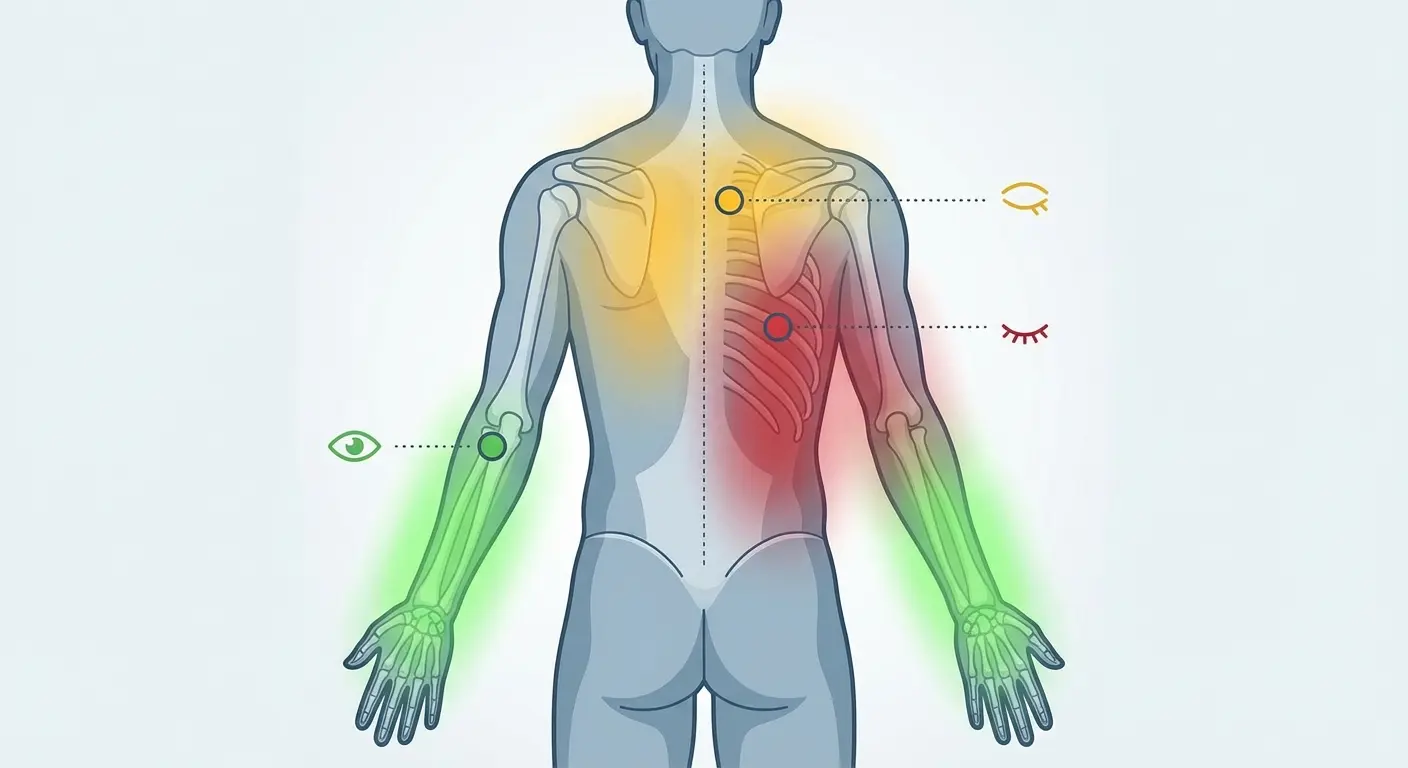
Different placements read differently across cultures:
|
Placement Location |
Primary Cultural Association |
Visibility Level |
Traditional Meaning |
|---|---|---|---|
|
Between thumb and forefinger |
Prison/gang culture (Americas) |
High (constantly visible during interactions) |
“Mi vida loca” or gang affiliation |
|
Under the eye |
Latin American gang culture |
Very high (facial tattoo) |
Time served, acts committed, or “see no evil” |
|
Wrist |
Personal/spiritual |
Medium (easily concealed) |
Individual interpretation, religious trinity |
|
Back of hand |
Chinese/Filipino traditions |
High (visible during handshakes) |
Varies by region: decorative, fraternity, or transient symbol |
|
Ribs/behind ear |
Contemporary personal |
Low (easily hidden) |
Private meaning for wearer only |
|
Forearm |
Southeast Asian traditions |
Medium (selectively visible) |
Cultural/tribal identity, decorative |
Visibility as Statement
Face tattoos communicate permanence. You can’t hide facial ink during job interviews or family gatherings, which means the commitment level is fundamentally different.
Hidden placements like ribs, behind the ear, or inner lip suggest the meaning is primarily for you rather than as a signal to others.
If you want to keep it hidden, these small tattoo placement ideas might help you find spots that balance meaning with discretion.
Mi Vida Loca vs. See No Evil (Same Dots, Opposite Meanings)
Two of the most common interpretations exist in direct tension with each other.
The Crazy Life Philosophy
“Mi vida loca” translates to “my crazy life,” but the phrase carries more weight than simple chaos. Within the communities where this interpretation originated, it references a lifestyle outside conventional society’s rules. The “crazy” isn’t random. It’s a specific rejection of mainstream paths.
This meaning emerged from Chicano gang culture in Southern California during the mid-20th century. The three dots represented past, present, and future lived outside the law. Each dot held temporal significance: where you’ve been, where you are, and where you’re headed.
The three dots tattoo meaning in this context speaks to a complete worldview, not just a moment of rebellion.
Sinosplice documented something interesting: Vietnamese teenagers adopted the three dot tattoo with the interpretation “toi khong can gi ca” (“I care about nothing” or “I don’t care about anything”). The symbol migrated across Asian-American communities with similar anti-establishment meanings but distinct linguistic and cultural frameworks.
The Three Wise Monkeys Condensed
Other wearers interpret the three dots as representing “see no evil, hear no evil, speak no evil.” This reading condenses the famous three monkeys into minimalist dots, with each point representing one principle.
Notice this interpretation carries almost opposite connotations from “mi vida loca.” Instead of embracing chaos, it suggests restraint, wisdom, and deliberate silence.
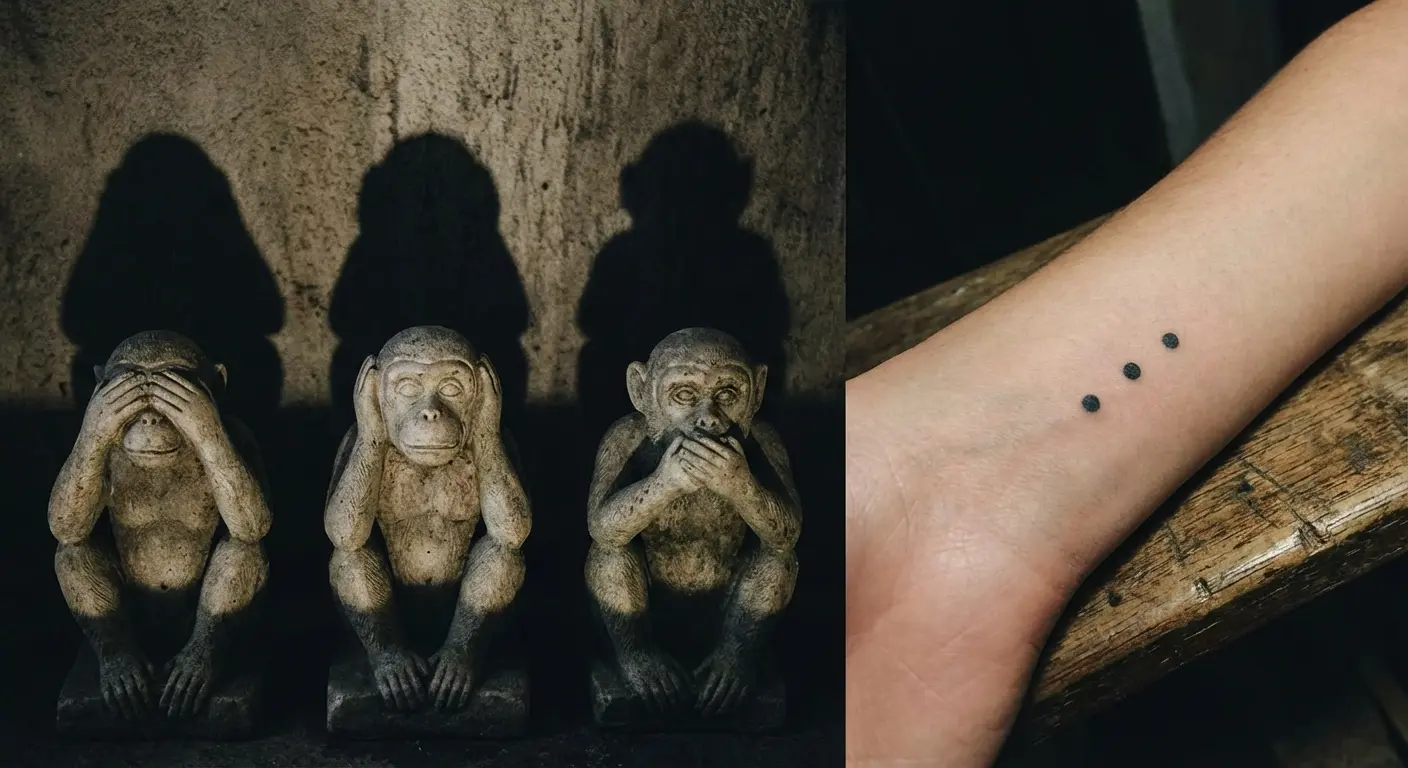
Same three dots, completely different philosophical framework.
The fact that both meanings circulate simultaneously proves that symbols are containers for whatever meaning communities pour into them. Neither interpretation is more “correct” than the other.
Actually, I’m overstating that. The mi vida loca meaning is the one most people know, and pretending it doesn’t dominate the conversation is naive. But that doesn’t make it the only valid reading.
A European individual might wear three dots on their knuckles as “hear nothing, see nothing, say nothing,” representing loyalty and refusal to cooperate with authorities, particularly common among those with prison experience. This interpretation shares the “three monkeys” framework but applies it specifically to criminal code rather than general wisdom.
Before the Prison Yard: Religious Symbolism
Three-dot symbolism runs through religious traditions that predate modern subcultural uses by hundreds or thousands of years. This isn’t a footnote. It’s the foundation that got buried under more sensational narratives.
The Christian Trinity in Geometric Form
Three dots arranged in a triangle have represented the Holy Trinity (Father, Son, Holy Spirit) in Christian iconography since medieval times. You’ll find this configuration in illuminated manuscripts, church architecture, and devotional art spanning centuries.
Early Christians used geometric symbols partly for secrecy during persecution, but also because certain shapes carried theological meaning. Three points of equal distance suggested the co-equal nature of the Trinity, a complex doctrine condensed into simple geometry.
This religious interpretation never disappeared. People still get three dot tattoos specifically to represent their Christian faith, though that meaning gets overshadowed by more recent associations.
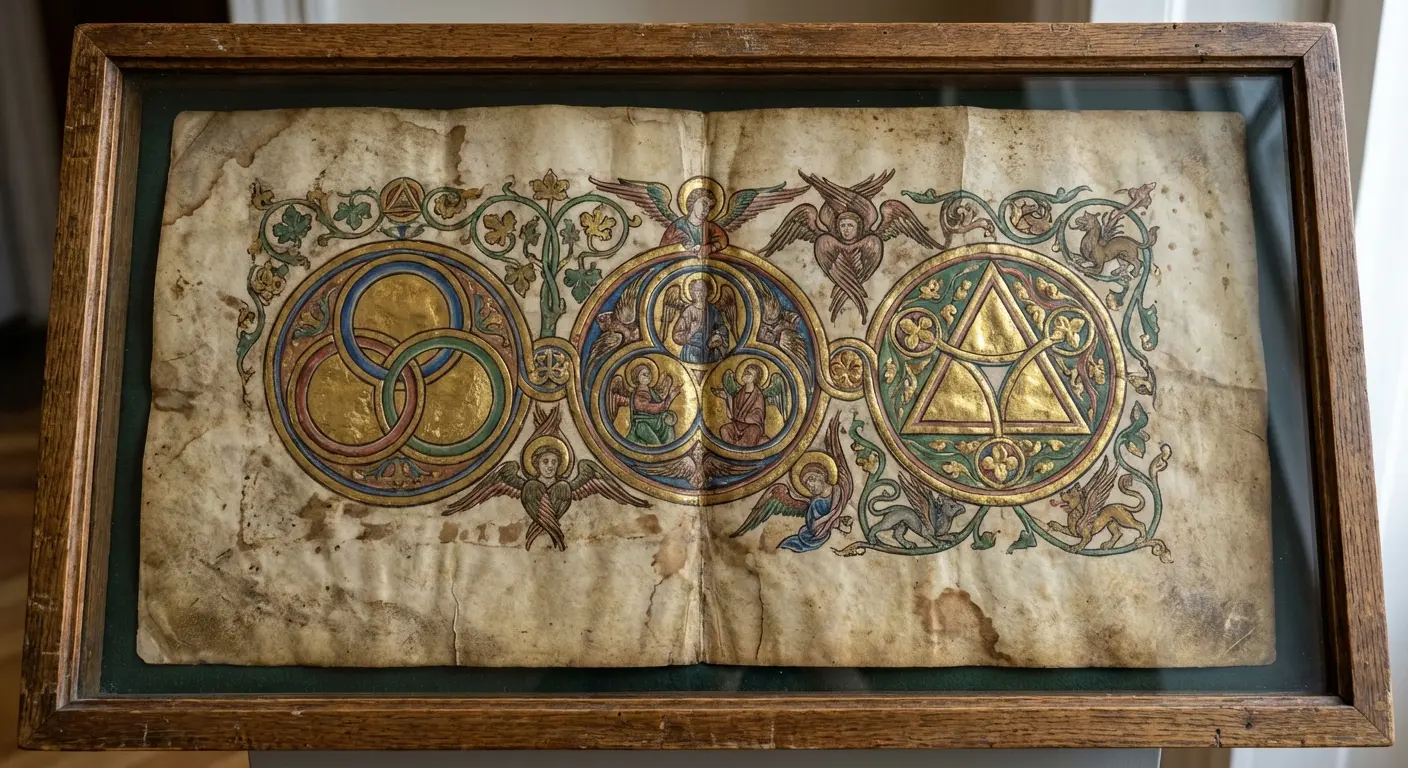
Similar to how lotus flower tattoos draw from ancient spiritual traditions, three dots connect to centuries-old religious symbolism that most contemporary coverage completely ignores.
Buddhist and Hindu Triads
Buddhism’s trikaya (three bodies of Buddha) and Hinduism’s trimurti (Brahma, Vishnu, Shiva) both use three-part structures to explain divine nature. While these traditions don’t specifically use three dots as a standard symbol, the numerical significance is identical.
Three represents completeness across these belief systems. Creation, preservation, destruction. Birth, life, death. Past, present, future.
When the National Commission for Culture and the Arts (NCCA) gave Apo Whang-od the prestigious Dangal ng Haraya Award in 2018, it brought attention to something important. As Cebu Daily News covered, Whang-od’s signature three-dot tattoo carries deep spiritual meaning within Kalinga culture. The three dots represent Whang-od and her two apprentices, functioning as an artist’s signature meaning “made in Kalinga.” A sacred cultural marker that predates and exists entirely separate from Western gang associations.
Why Sacred Meanings Got Buried
Religious symbolism doesn’t make headlines the way gang tattoos do. Media naturally gravitates toward conflict and crime, which means the prison interpretation received exponentially more attention than the devotional one.
The most sensational meaning eclipsed older, arguably more widespread uses. That’s not a conspiracy. It’s just how information spreads in attention-driven environments.
The Mathematical and Spiritual Trinity Connection
Side note: the mathematics connection is my favorite part of this, but I might be biased. Anyway.
Beyond specific religious traditions, the number three holds significance that’s almost universal.
Three as the Geometry of Space
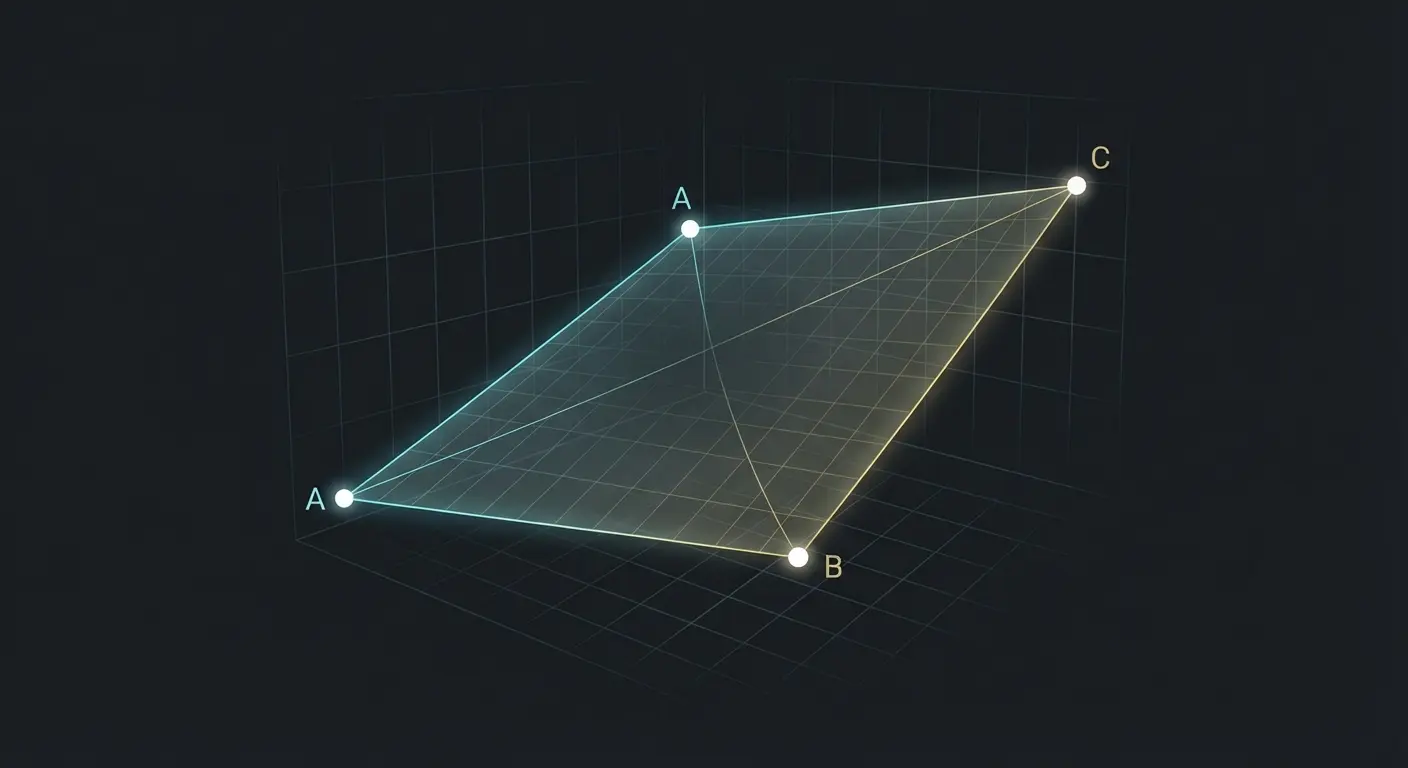
You need three non-linear points to define a plane. Two points create a line, but three points create area and dimension. This isn’t symbolic. It’s mathematical fact.
Ancient cultures understood this geometric principle even if they didn’t articulate it in modern mathematical language. Three dots create the simplest possible enclosed shape (a triangle), which makes them foundational to how humans understand space and form.
How Humans Structure Everything
Humans structure information in threes. Beginning, middle, end. Thesis, antithesis, synthesis. Problem, struggle, resolution. Our brains seem wired to find three-part patterns satisfying and complete.
This cognitive preference shows up everywhere from fairy tales (three wishes, three bears, three little pigs) to modern storytelling structure. Three feels complete in a way that two doesn’t and four feels excessive.
When you tattoo three dots on your body, you’re tapping into this deep pattern recognition whether you consciously intend to or not.
Context Matters More Than the Dots
The three dots are essentially a blank template. They only gain specific meaning through context: who’s wearing them, where they’re placed, what other symbols accompany them, and what community is interpreting them.
How Tattoos Get Read
People read tattoos differently depending on their own knowledge and assumptions. A police officer, a tattoo artist, a gang member, and a religious studies professor will all interpret your three dots through completely different frameworks.
You don’t control how others read your tattoos. That’s worth thinking about before you commit to any symbol with multiple contested meanings.
A mathematics enthusiast might choose three dots arranged vertically to represent the “therefore” symbol (∴) used in logical proofs. For them, the tattoo commemorates their love of mathematical reasoning and has zero connection to gang culture. But when placed between the thumb and forefinger, this same placement will likely be read as “mi vida loca” by law enforcement and others familiar with gang tattoos, regardless of the wearer’s actual intent.
I said earlier that context matters more than intent, but I’m not sure that’s entirely true anymore. Young people are kind of forcing a reset on these meanings whether the old guard likes it or not.
Accompanying Symbols as Interpretive Keys
Three dots surrounded by religious imagery (crosses, halos, prayer hands) signal devotional meaning. The same dots accompanied by spiderwebs, teardrops, or specific numbers point toward gang affiliation or prison culture.
Your tattoo doesn’t exist in isolation. Other marks on your body create an interpretive context that guides how people read any individual symbol.
The Problem With Personal Meaning
This is messy: You can assign any personal meaning you want to your tattoo, but you can’t force others to read it through your private symbolic system.
Some symbols carry too much cultural weight to be easily reclaimed or redefined. Whether three dots fall into that category depends partly on your specific context.
Think about where you live. If you’re in East LA, that hand placement reads differently than if you’re in rural Vermont. Think about your job. Client-facing role? Might matter. Work from home as a developer? Probably doesn’t.
Consider these factors:
Geographic location where you live and work (gang prevalence, cultural demographics)
Professional environment and visibility requirements (dress codes, client-facing roles)
Personal cultural background and how it relates to the symbol
Accompanying tattoos that might create interpretive context
Placement visibility and your ability to conceal when necessary
Family and community perceptions you’ll need to navigate
The tattoo industry itself is evolving. Austin-based startup Blackdot recently developed an AI-powered tattoo device, as Dezeen reported, that specializes in precise dot work and intricate patterns. While the technology focuses on technical precision rather than cultural meaning, it represents how the tattoo industry is modernizing and potentially making simple geometric designs like three dots more accessible to mainstream audiences, further diluting their exclusive association with any single subculture.
Modern Reclamation (Or How People Are Making It Mean Whatever They Want)
Contemporary tattoo culture is actively reshaping how three dots get interpreted. Younger generations are claiming the symbol for personal meanings that have nothing to do with prison yards or religious doctrine.
Personal Narrative Over Cultural Baggage
Many people now choose three dots to represent significant life events, loved ones, or philosophical concepts unique to their own experience. Three children, three life-changing moments, three guiding principles.
Actually, let me be more specific. I know someone who got three dots for her three miscarriages. Not something she explains to strangers, but it’s there on her wrist every day.
This personalization approach treats the 3 dot tattoo meaning as a framework rather than a fixed definition. The geometric simplicity becomes an advantage because it doesn’t carry obvious pictorial meaning.
Social media amplifies this trend. When someone posts their three dot tattoo with an explanation of what it means to them personally, they’re contributing to a collective rewriting of the symbol’s cultural significance.
Aesthetic Minimalism
The minimalist tattoo movement embraced three dots purely for their visual simplicity. In this context, the dots don’t symbolize anything beyond geometric elegance.
This pisses off the “everything must mean something” crowd. Let it. Sometimes three dots are just three dots that look good. The tattoo police can stay mad about it.
Reclaiming Stigmatized Symbols
Some wearers deliberately choose three dots precisely because of the prison association, then publicly redefine them. This conscious reclamation turns the symbol into a statement about not letting stigmatized imagery control your self-expression.
This approach acknowledges the controversial history rather than ignoring it, then moves forward anyway.
What Your Tattoo Artist Needs to Know
Still with me? I know this is a lot for three dots.
Simple doesn’t mean straightforward, especially with a design carrying this much interpretive baggage.
Consultation Questions That Matter
Your artist should ask about your intended meaning and warn you about potential misinterpretations. If they don’t bring this up for a three dot tattoo, they’re either inexperienced or not paying attention.
Placement discussions need to be explicit. The difference between your hand and your wrist isn’t just aesthetic. It carries interpretive weight that affects how your tattoo gets read.

Use this framework during your artist consultation:
Design Specifications:
– Exact dot size (diameter in millimeters)
– Spacing between dots (precise measurements)
– Triangle orientation (pointing up, down, or sideways)
– Ink color and saturation level
Placement Details:
– Primary location and backup options
– How placement affects cultural interpretation
– Visibility in professional/casual clothing
– Skin texture and aging considerations at that location
Cultural Context:
– Your intended meaning and personal connection
– Artist’s awareness of multiple interpretations
– Potential misreadings you’re prepared to address
– Accompanying elements that clarify meaning
Technical Requirements:
– Needle size appropriate for dot precision
– Ink type for longevity and minimal spreading
– Touch-up timeline and maintenance needs
– Healing considerations for chosen placement
Technical Considerations for Dot Tattoos
Three simple dots might seem easy, but precision matters enormously. Uneven spacing or inconsistent sizing makes the tattoo look amateurish rather than intentionally minimalist.
Dots can spread slightly as they age, especially if placed too close together. Your artist should account for this by sizing and spacing appropriately for long-term appearance. What looks crisp today might blur into an indistinct blob in fifteen years if executed poorly.
Fresh dots look crisp. Five years later, they’ve softened at the edges. Ten years on darker skin, they might have spread into slightly larger circles. This matters if you’re spacing them close together.
Hand tattoos hurt differently than wrist tattoos. The skin’s thinner between your thumb and finger, sits right on bone. You’ll feel that.
Understanding proper tattoo aftercare becomes especially critical for maintaining the crisp edges and precision that simple dot work requires. Small mistakes become magnified when your entire design consists of three elements.
Exploring Variations Before You Commit
You might want to experiment with different placements, sizes, or accompanying elements before permanently marking your skin. Seeing multiple versions helps clarify what resonates versus what just seemed appealing initially.
Before you commit, mess around with different placements. I built Tattoo Generator IQ specifically because I was tired of people walking into shops with a vague idea and walking out with regrets. Plug in your three dots, see them on different body parts, adjust the sizing. Takes 30 seconds and might save you from a bad decision.
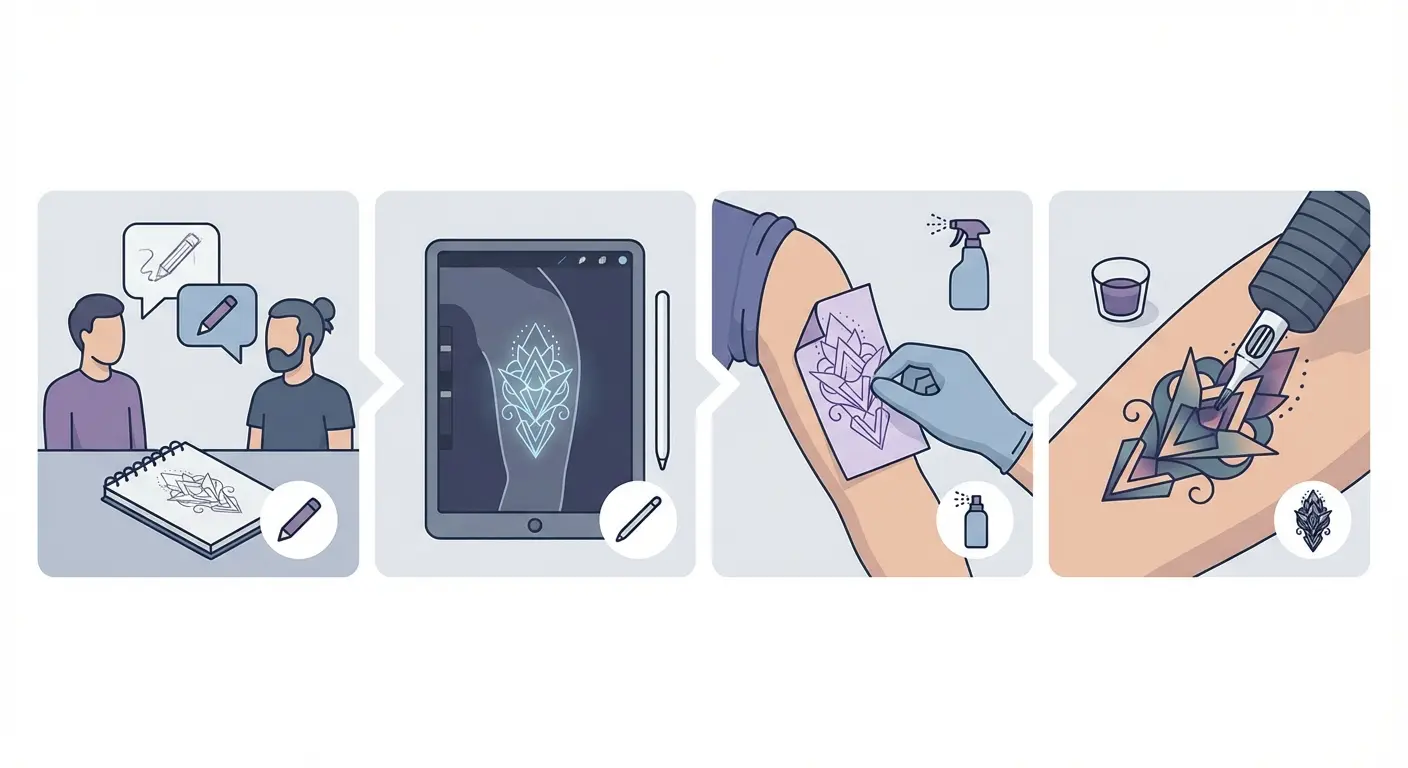
The tool handles the exploration phase so you and your artist can focus on execution rather than still figuring out the basic design during your appointment.
Setting Expectations for Simple Designs
Simple doesn’t mean quick or cheap. A skilled artist charges for their expertise and time, regardless of how minimalist your design is.
Three dots executed perfectly require the same sterile setup, equipment, and professional standards as a full sleeve. Don’t expect bargain pricing just because the design is small. You’re paying for skill, not square inches of ink.
So What Does This Mean for You?
Get the tattoo or don’t. But if you do, know what you’re walking into.
Those three dots might mean “my three kids” to you, but they’ll mean “prison tat” to your girlfriend’s dad, “holy trinity” to your religious aunt, and “nice minimalist design” to your tattoo artist. All those readings exist simultaneously. You don’t get to control which one people pick.
Some people will say I’m overthinking this. “They’re just dots, who cares?” And maybe they’re right. But I’ve also seen people get turned down for jobs, hassled by cops, or misunderstood by their own families because of three dots they got at nineteen. So yeah, I think it’s worth overthinking.
Your intent matters, but so does how others will read your tattoo. You’re not obligated to choose the most mainstream interpretation, but you should walk into this decision with your eyes open about the interpretive complexity you’re taking on.
The 3 dot tattoo meaning you assign might be deeply personal and completely divorced from gang culture, religious tradition, or mathematical theory. That’s valid. But understanding what others might see when they look at your skin gives you the power to make an informed choice rather than discovering the cultural weight later.
This symbol has evolved across decades and continents, picking up new meanings while retaining old ones. That layered history doesn’t make the tattoo wrong for you. It just means you’re participating in a conversation that started long before you were born and will continue long after.
The question isn’t whether you can assign your own meaning. You can. The question is whether you’re okay with all the meanings other people will assign whether you like it or not.
If you’ve read this far about three dots, you’re probably overthinking it. Which is good. Better to overthink before than regret after.
